
Ganges river dolphin tagged for the first time in India
Source: The Hindu
Syllabus: GS III Environment and Conservation
Ganges River Dolphin Tagged for the First Time in India
India has achieved a significant milestone in wildlife conservation with the first-ever satellite tagging of the endangered Ganges River Dolphin in Assam. This pioneering initiative was led by the Ministry of Environment, Forest and Climate Change (MoEFCC) in collaboration with the Wildlife Institute of India (WII) as part of the larger Project Dolphin.
About the Ganges River Dolphin
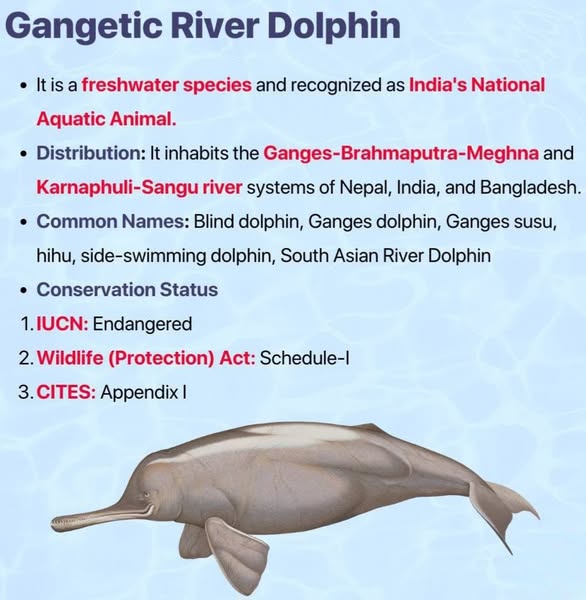
National Aquatic Animal: The Ganges River Dolphin (Platanista gangetica gangetica) was declared India’s National Aquatic Animal in 2009.
Key Features:
- Physical Characteristics: Nearly blind, the dolphin relies on echolocation to navigate and hunt in murky river waters.
- Diet: Carnivorous, primarily feeding on fish and invertebrates.
- Habitat: Found in slow-moving, deep waters of rivers with ample prey availability.
- Geographical Range: Found in the Ganga, Brahmaputra-Meghna, and Karnaphuli-Sangu river systems across India, Nepal, and Bangladesh.
Ecological Significance:
- Keystone Species: As an apex predator, the dolphin plays a critical role in maintaining the ecological balance of riverine ecosystems.
- Indicator Species: Its presence reflects the overall health of freshwater ecosystems.
Conservation Status:
- IUCN: Endangered
- CITES: Appendix I (restricting international trade)
- Indian Wildlife Protection Act, 1972: Schedule I (providing the highest level of protection)
Major Threats to the Ganges River Dolphin
- Habitat Degradation:
- Pollution from industrial, agricultural, and urban runoff.
- Dams and barrages fragment habitats, restricting dolphin movement and connectivity.
- Bycatch and Hunting:
- Accidental entanglement in fishing nets.
- Targeted hunting for oil and meat in some areas.
- Water Abstraction: Excessive water withdrawal for agriculture and industry reduces river flow and habitat availability.
- Riverbed Alteration: Sand mining and dredging disrupt the dolphins’ habitats.
Conservation Efforts in India
Project Dolphin (2020):
- Announced by the Prime Minister, it focuses on conserving both river and marine dolphins.
- Emphasizes habitat protection, pollution control, and community engagement.
Protected Areas:
- Establishment of sanctuaries such as the Vikramshila Gangetic Dolphin Sanctuary in Bihar.
Community Awareness:
- Outreach programs to educate local communities about sustainable fishing practices and dolphin conservation.
Technological Interventions:
- Use of satellite tagging to monitor migratory patterns and habitat needs.
- Deployment of lightweight, non-intrusive satellite tags compatible with the Argos system.
Legislative and Policy Measures:
- Enforcement of the Wildlife Protection Act, 1972 to curb hunting and habitat destruction.
- Regulations on sand mining and other harmful practices affecting dolphin habitats.
The tagging initiative involved attaching lightweight satellite transmitters to a Ganges River Dolphin in Assam. This technological advancement ensures minimal interference with the dolphin’s natural movement.
Objectives of Satellite Tagging:
- Study Migratory Patterns: Gather data on habitat preferences, range distribution, and seasonal movements.
- Enhanced Conservation Planning: Use findings to develop targeted action plans for habitat restoration and pollution mitigation.
- Strengthening Ecosystem Management: Support the broader goal of sustaining river ecosystems through scientific interventions.
Broader Implications for Conservation
- Global Conservation Benchmark:
- Demonstrates India’s leadership in wildlife conservation, setting an example for other nations.
- Technological Integration:
- Highlights the importance of leveraging advanced technology for ecological research and management.
- Sustainable Development Goals (SDGs):
- Contributes to SDG 14 (Life Below Water) by addressing the need for aquatic biodiversity protection.
- Community Participation:
- Engages local stakeholders in sustainable practices, fostering a sense of shared responsibility.
Conclusion
The satellite tagging of the Ganges River Dolphin underscores India’s commitment to conserving endangered species and maintaining ecological balance. This landmark initiative not only enhances scientific understanding of this keystone species but also strengthens efforts to protect freshwater ecosystems critical to biodiversity and human livelihoods.
Why imaging of underwater hot spring active with microbial life is significant for India’s Deep Ocean Mission
Source: The Indian Express
Syllabus: GS III Technology
India’s Breakthrough: Imaging Hydrothermal Vents for Deep Ocean Explorations
Indian oceanographers have achieved a historic milestone by capturing high-resolution images of an active hydrothermal vent located 4,500 meters below the Indian Ocean. This breakthrough, made under the Ministry of Earth Sciences’ (MoES) ambitious Deep Ocean Mission (DOM), has significant implications for resource exploration and scientific research.
About Deep Ocean Mission (DOM)
Objective:
DOM aims to explore and sustainably utilize the living and non-living resources of the deep ocean while advancing India’s understanding of its role in climate change.
Key Features:
- Cost and Duration: The mission is estimated at ₹4,077 crore over five years, with ₹2,823.4 crore allocated for Phase I (2021–2024).
- Alignment with Blue Economy: DOM is central to India’s Blue Economy initiative, promoting sustainable use of ocean resources for economic growth, improved livelihoods, and ecosystem health.
Six Components:
- Manned Submersible:
- Development of a submersible capable of carrying three people to depths of 6,000 meters, equipped with advanced scientific tools and sensors.
- Ocean Climate Change Advisory Services:
- Development of predictive models and observation systems to understand and forecast climate variables influenced by oceanic changes.
- Deep-Sea Biodiversity:
- Study of deep-sea flora, fauna, and microbes to sustainably harness marine bio-resources.
- Deep Ocean Survey and Exploration:
- Identification of sites for polymetallic nodules and hydrothermal sulfide mineralization in the Indian Ocean.
- Ocean Energy and Freshwater Utilization:
- Development of technologies to harness ocean energy and generate freshwater.
- Advanced Marine Station:
- Establishment of a dedicated research station for ocean biology and biotechnology.
Lead Agencies:
The mission is spearheaded by the MoES, with contributions from the Department of Biotechnology (DBT), ISRO, Ministry of New and Renewable Energy (MNRE), and other research organizations.
What Are Hydrothermal Vents?
Definition:
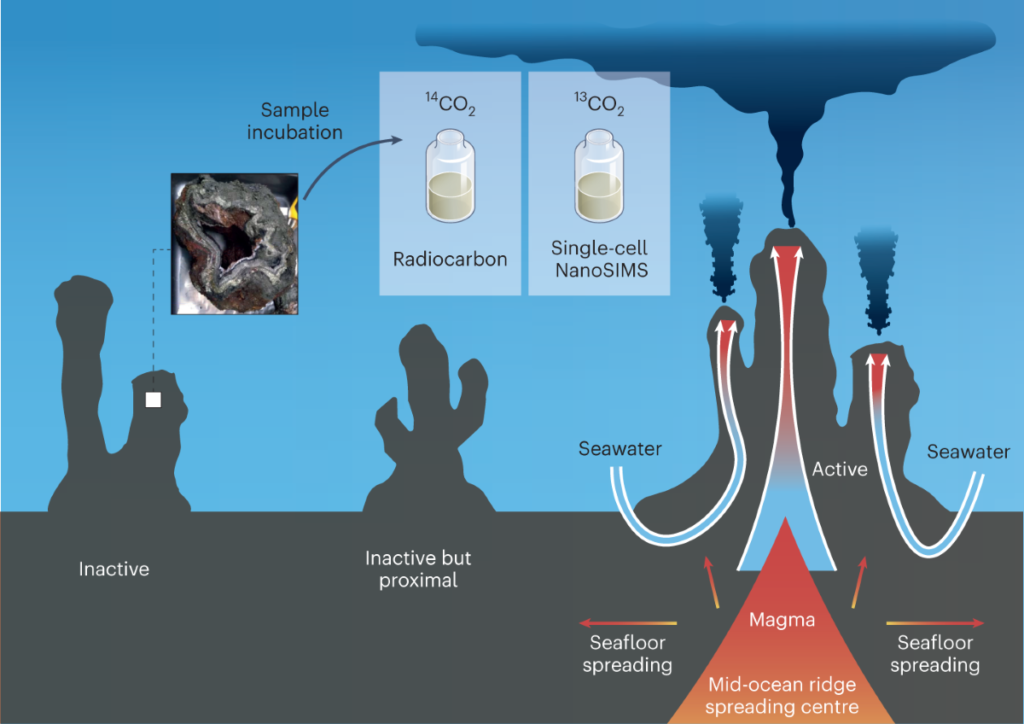
Hydrothermal vents are underwater springs located near tectonic plate boundaries. These occur when cold seawater interacts with magma, heating up to 370°C and releasing superheated water rich in minerals and gases through vent chimneys and fissures.
Unique Ecosystems:
- Chemosynthetic Organisms: Unlike surface ecosystems dependent on sunlight, these organisms derive energy from chemical reactions involving vent minerals.
- Examples include specialized bacteria, archaea, and deep-sea fauna that thrive in extreme conditions.
Discovery of Hydrothermal Vents: A Landmark Achievement
Survey History:
- The National Centre for Polar and Ocean Research (NCPOR) in Goa has been conducting geophysical surveys since 2012 across the Central and Southern Indian Ocean Ridges to locate hydrothermal vents.
Historic Image:
- In April 2024, researchers from NCPOR and the National Institute of Ocean Technology (NIOT) deployed an Autonomous Underwater Vehicle (AUV) from the research vessel Sagar Nidhi.
- The AUV successfully captured high-resolution images of an active hydrothermal vent during a 12–15-hour observation campaign along the Central Indian Ridge.
Significance of Hydrothermal Vents
Mineral-Rich Deposits:
- Hydrothermal vents are known for deposits of economically valuable minerals and metals such as copper, zinc, gold, silver, platinum, iron, cobalt, and nickel.
- These deposits can remain active for thousands of years, presenting significant opportunities for mineral exploration.
Biological Insights:
- The vents harbor unique ecosystems that provide insights into life forms adapted to extreme environments.
- Study of chemosynthetic organisms could lead to advancements in biotechnology and medicine.
Relevance to India’s Deep Ocean Mission
Boost to Samudrayaan Initiative:
- This discovery strengthens India’s Samudrayaan initiative, which focuses on deep-sea mineral exploration and manned submersible expeditions.
Scientific Advancements:
- Confirms earlier geophysical surveys, paving the way for detailed study of mineral deposits and deep-sea biodiversity.
- Enhances knowledge of vent ecosystems and their role in global biogeochemical cycles.
Economic Potential:
- Unlocks the potential for tapping into polymetallic sulfides and other rare minerals critical for high-tech industries.
India’s Strategic Leadership:
- Establishes India as a global leader in deep-sea exploration and technology development.
- Contributes to achieving Sustainable Development Goal (SDG) 14: “Life Below Water.”
Future Exploration Plans
Sampling and Analysis:
- NCPOR plans to conduct TV-guided grab sampling to analyze the economic and biological potential of the hydrothermal vents.
Technological Innovation:
- Development of advanced imaging and sampling tools for precise exploration.
Collaborative Efforts:
- Increased partnerships with global research institutions for knowledge-sharing and resource development.
Conclusion
India’s imaging of hydrothermal vents marks a transformative moment in the nation’s scientific journey. It underscores the importance of sustainable deep-sea exploration to balance resource extraction with ecological preservation. By integrating cutting-edge technology, robust policy frameworks, and international collaboration, India is poised to make significant contributions to the global understanding of ocean ecosystems and their resource potential.
Formulate policy to manage sacred groves, SC tells govt.
Source: The Hindu
Syllabus: GS III Environment
Supreme Court Urges Comprehensive Policy for Sacred Groves
In a landmark judgment, the Supreme Court, while hearing petitions related to the protection of sacred groves in Rajasthan, directed the Union Government to formulate a comprehensive policy for the management and preservation of sacred groves across India. These forest patches, traditionally protected for their religious and cultural significance, play a vital role in biodiversity conservation and ecosystem preservation.
What are Sacred Groves?
Definition:
Sacred groves are small forested areas protected by local communities due to their spiritual and cultural importance. These ecosystems are deeply interwoven with the traditions and beliefs of indigenous and local communities.
Geographical Distribution:
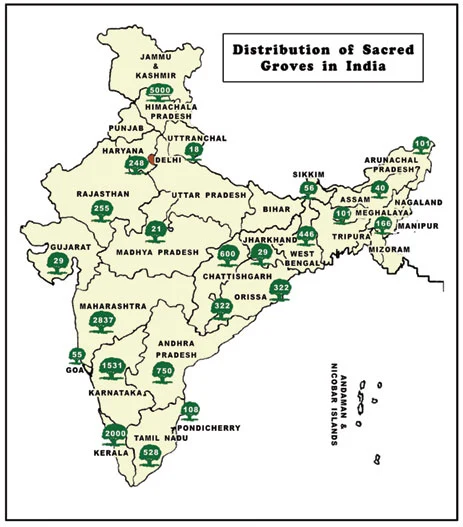
- Prominent in states such as Rajasthan, Tamil Nadu, Kerala, Karnataka, Himachal Pradesh, Maharashtra, and Meghalaya.
- Contribute significantly to local biodiversity and act as carbon sinks.
Ecological Importance:
- Serve as biodiversity hotspots, home to rare flora and fauna.
- Act as micro-watersheds, aiding water conservation.
- Prevent soil erosion and desertification.
Legal Framework Governing Sacred Groves
- Wild Life (Protection) Act, 1972:
- Empowers state governments to declare any private or community land as a community reserve to protect:
- Fauna: Wildlife unique to the area.
- Flora: Rare and medicinal plant species.
- Cultural conservation values: Traditions and practices associated with the grove.
- Empowers state governments to declare any private or community land as a community reserve to protect:
- Scheduled Tribes and Other Traditional Forest Dwellers (Recognition of Forest Rights) Act, 2006:
- Recognizes the rights of tribal and traditional communities over forest resources.
- National Forest Policy, 1988:
- Encourages community-led initiatives to conserve forest patches, including sacred groves.
Supreme Court’s Directives
Policy Framework
The SC emphasized the urgent need for a national policy and instructed the Ministry of Environment, Forest and Climate Change (MoEF&CC) to:
- Conduct Nationwide Surveys: Identify and map all sacred groves using satellite imagery and on-ground surveys.
- Mark Boundaries: Clearly delineate grove boundaries, ensuring provisions for future forest growth.
- Issue Guidelines: Implement stringent measures to prevent deforestation, encroachment, and degradation of sacred groves.
- Formal Recognition: Advocate for recognizing sacred groves as community reserves under the Wild Life (Protection) Act, 1972.
Empowering Traditional Custodians
- Recognize the role of traditional custodians and empower them under the Forest Rights Act, 2006.
- Enable these communities to regulate unsustainable practices, ensuring the long-term conservation of sacred groves.
Rajasthan’s Piplantri Model: A Success Story
The SC highlighted the transformative efforts of Piplantri village in Rajasthan, where community-driven initiatives revitalized barren land into thriving sacred groves.
Key Initiatives:
- Tree Planting for Every Girl Child: Planting 111 trees for every girl child born.
- Social and Economic Benefits:
- Reduced female foeticide.
- Increased income through sustainable livelihoods.
- Improved access to education and healthcare.
- Empowered women’s self-help groups.
Significance of the Model:
- Demonstrates how community efforts can simultaneously address gender issues, environmental conservation, and economic empowerment.
Specific Directives for Rajasthan
- Mapping and Classification:
- Conduct detailed satellite and on-ground surveys to identify sacred groves.
- Classify these groves as forests based on ecological and cultural importance, irrespective of their size.
- Legal Protection:
- Declare identified sacred groves as community reserves under the Wild Life (Protection) Act, 1972.
- Supervisory Committee Formation:
- Constitute a five-member committee, chaired by a retired Rajasthan High Court judge, to oversee the survey, identification, and protection processes.
Significance of SC’s Judgment
- Holistic Approach to Conservation:
- Recognizes the interconnectedness of ecology, culture, and community rights in protecting sacred groves.
- Aligns with Sustainable Development Goals (SDG), particularly SDG 15: Life on Land.
- National Priority:
- Marks a shift in the approach to wildlife and forest management by emphasizing the Union Government’s role in aligning state efforts with a cohesive national strategy.
- Preserving Cultural Heritage:
- Upholds the spiritual and cultural values associated with sacred groves, ensuring their conservation for future generations.
- Community Participation:
- Advocates for community-led conservation efforts, empowering local populations to safeguard these natural treasures.
Future Course
- Follow-Up Hearing:
- The SC has scheduled the case for January 10, 2025, to review progress reports on:
- Formation of the supervisory committee.
- Survey and mapping activities.
- The SC has scheduled the case for January 10, 2025, to review progress reports on:
- Integration into Policy Frameworks:
- Incorporate sacred groves into state-level biodiversity strategies and the National Biodiversity Action Plan.
- Sustainable Development Initiatives:
- Promote sustainable ecotourism and livelihood generation around sacred groves.
Conclusion
The Supreme Court’s directive underscores the ecological, cultural, and societal significance of sacred groves and advocates for their preservation as a national priority. By ensuring a harmonious balance between community rights, cultural values, and environmental conservation, this judgment reaffirms India’s commitment to sustainable development and biodiversity protection.
How to secure entrance exams, stop leaks: expert panel’s ideas
Source: The Indian Express
Syllabus: GS II Governance
Malpractice in Exams: An Emerging Challenge
Context
A seven-member expert panel, chaired by former ISRO Chairman K Radhakrishnan, submitted 101 recommendations to the Ministry of Education for ensuring transparency, efficiency, and fairness in national-level entrance examinations. This move comes in the backdrop of increasing incidents of malpractice in exams like NEET, JEE, and other competitive tests, which play a pivotal role in shaping the academic and professional futures of candidates.
Reasons for Malpractice in Exams
- High Stakes Involved
- Entrance exams like NEET and JEE are gateways to premier institutions like IITs, AIIMS, and NITs. The intense competition and life-changing stakes often push candidates and stakeholders toward unethical practices.
- Lack of Robust Systems
- Outsourced agencies and weak digital infrastructure leave exam processes vulnerable to manipulation, including question paper leaks and fraudulent activities.
- Inadequate Monitoring
- Insufficient oversight at test centres allows for malpractices like impersonation and unauthorized use of electronic devices.
- Corruption and Collusion
- Involvement of insiders and collusion with private service providers contributes to question paper leaks and irregularities in exam management.
- Technological Exploitation
- Advancements in technology have been misused for cheating through hacking, e-cheating devices, and bypassing online examination systems.
Recent Exam Scams in 2024
- NEET-UG Paper Leak
- Reports surfaced of question paper leaks, sparking criticism of the National Testing Agency (NTA) for inadequate safeguards and lapses in ensuring confidentiality.
- UGC-NET Irregularities
- Allegations of mismanagement, irregular question patterns, and suspicious allocation of testing centres undermined trust in the examination system.
- BPSC Exam Scam
- Accusations of paper leaks and manipulated candidate selection tainted the credibility of recruitment processes for state government jobs, raising concerns over systemic inefficiencies.
Government Initiatives to Counter Malpractice
- Strengthening the National Testing Agency (NTA)
- Enhancing the NTA’s capacity to independently conduct exams with improved technology and human resources.
- Biometric Verification
- Implementation of Digi-Exam systems for candidate verification using biometric data to eliminate impersonation and unauthorized access.
- Digital Infrastructure Enhancement
- Collaboration with Kendriya Vidyalayas and Navodaya Vidyalayas to establish state-of-the-art computer-based testing centres nationwide, ensuring secure and reliable digital platforms for examinations.
- Artificial Intelligence (AI) and Big Data Analytics
- Leveraging AI and Big Data to detect irregular patterns in exam results, monitor real-time activities, and flag suspicious behaviours during the evaluation process.
- Legal Frameworks and Penalties
- Stringent enforcement of state-level laws like the Prevention of Malpractices in Exams Act with severe penalties for offenders, including exam administrators, candidates, and middlemen involved in scams.
Proposed Recommendations by the Radhakrishnan Panel
- Secured Examination Process
- Use blockchain technology to encrypt and secure question papers from preparation to distribution.
- Deployment of GPS-enabled transportation systems for question paper movement.
- Independent Monitoring Mechanism
- Constituting an independent oversight body to monitor examination processes, especially during high-stakes national-level exams.
- Standardized Test Centre Operations
- Setting uniform operational guidelines for test centres, including mandatory CCTV surveillance, metal detectors, and proctored environments for conducting exams.
- Capacity Building
- Conducting regular training programs for exam personnel on cybersecurity and advanced technologies to mitigate risks.
Significance of Addressing Malpractice in Exams
- Restoration of Credibility
- Ensuring fairness and transparency will restore public confidence in India’s examination system, a critical component of its meritocracy-driven education model.
- Safeguarding Equal Opportunities
- Eliminating malpractice ensures a level playing field, enabling all candidates to compete fairly.
- Aligning with Global Standards
- Strengthened systems and robust policies will align India’s examination framework with global best practices, reinforcing its position as an educational hub.
- Preventing Brain Drain
- A credible system will discourage talented candidates from seeking opportunities abroad, thus addressing the issue of brain drain.
Conclusion
Malpractice in examinations is a multi-faceted challenge requiring technological, administrative, and legal interventions. The Radhakrishnan panel’s recommendations, combined with government initiatives, provide a pathway to achieving a transparent and efficient examination system. By addressing systemic vulnerabilities and leveraging advanced technologies, India can ensure that its examination process remains a hallmark of equity, integrity, and excellence.
