

Chhatrapati Shivaji Maharaj Jayanti
Syllabus: GS 1/History
In News
- The Prime Minister, Narendra Modi has paid homage to Chhatrapati Shivaji Maharaj on his Jayanti.
About Shivaji
- He was born in 1630 in Maharashtra.
- He was a prominent warrior king and founder of the Maratha Empire, widely admired for his progressive leadership, military acumen, and fight for Swarajya (self-rule).
- He was inspired by the teachings of Maharashtra saints like Tukaram, Dnyaneshwar, and Ramdas, who promoted social equality and spiritual awakening.
Coronation
- In 1674, Shivaji crowned himself at Raigad, marking the start of the ‘Rajyabhisheka Era’.
- Shivaji aimed to completely separate from the Mughal Empire by establishing a new coinage and regal insignia.
Administration
- He formed a council of eight ministers called the Ashtapradhna, drawing inspiration from ancient Indian political texts like Mahabharata and Sukraniti.
- Shivaji’s kingdom was divided into administrative units like Prants, Tarafs, and Maujas.
- Each Prant was governed by a Subedar and a Karkun, while a Taraf was managed by a Havaldar.
- Sanskrit titles were given to positions like Deshadhikari, Mukhya-Deshadhikari, Lekhak, and Mukhya-Lekhak
Revenue System
- He ensured financial unity by adopting Malik Ambar’s land revenue system, which classified land based on fertility and fixed government shares.
- He abolished intermediaries (landlords or mirasdars) and controlled land revenue collection directly.
- Other sources of state revenue included customs, transit duties, fines, war booty, Chauth, and Sardeshmukhi.
| – Chauth: 25 per cent of the land revenue claimed by zamindars. In the Deccan, this was collected by the Marathas. – Sardeshmukhi: 9–10 per cent of the land revenue paid to the head revenue collector in the Deccan. |
Judicial System
- The judicial system was based on ancient Indian texts like Manusmriti and Sukraniti.
- Courts like the Raj Sabha, Dharmasabha, and Brahman Sabha played crucial roles in decision-making.
- Disputes at the village level were resolved by panchayats, with higher appeals made to the mamladar or Peshwa.
Economic and Agricultural Policies
- Shivaji encouraged agriculture and the prosperity of peasants by eliminating oppressive feudal lords.
- New cultivators were given seeds and cattle and their loans recovered over time.
- He also emphasized moderate taxation on newly cultivated lands and excluded wastelands from taxation initially.
Military and Foreign Affairs
- He maintained a strong military to protect Swarajya and manage territories.
- His foreign policy involved strategic alliances, diplomacy, and maintaining an efficient intelligence network.
- He charted a course for a self-reliant naval force, earning the title of the ‘Father of the Indian Navy’.
Legacy
- Shivaji’s governance laid the foundation for the Maratha Empire, combining a spirit of nationalism with a strong, practical administrative structure.
- His legacy is seen as a transformation in the way leadership and governance were perceived in 17th-century India.

Peatlands: A Vital Yet Underprotected Carbon Reservoir
Syllabus: GS3/ Environment
Context
- A recent study has cautioned that peatlands are severely underprotected, and their ongoing destruction could jeopardise climate change goals.
What are Peatlands?
- Peatlands are unique wetland ecosystems composed of partially decayed organic matter accumulated over thousands of years.
- In cool climates, peatland vegetation is mostly made up of Sphagnum mosses, sedges and shrubs and are the primary builder of peat, whereas in warmer climates graminoids and woody vegetation provide most of the organic matter.
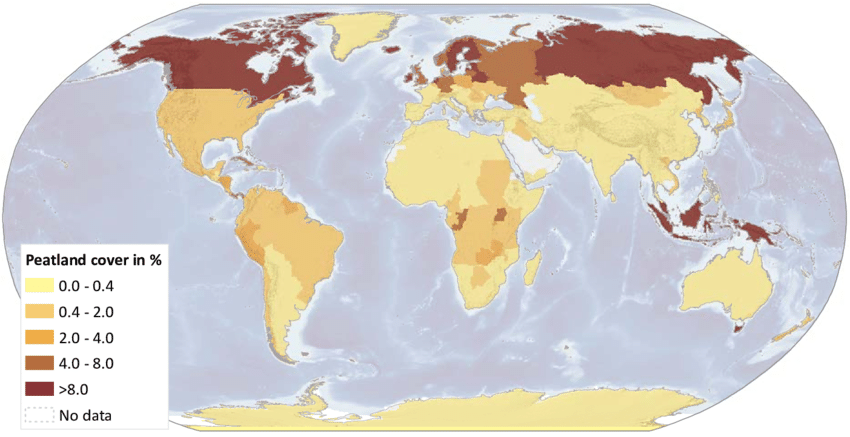
Distribution of Peatlands
- Peatlands occur in every climatic zone and continent and cover 4.23 million km2, which corresponds to 2.84% of the Earth’s terrestrial surface.
- Countries with the most peatlands include Canada, Russia, Indonesia, the United States, Brazil, the Democratic Republic of the Congo, China, Peru, Finland and the Republic of the Congo.
- The first five contain 70 percent of global peatlands.
- Peatlands on the Earth’s surface, hold 600 billion tonnes of carbon — surpassing the carbon stored in all the world’s forest biomass combined.
- However, merely 17 percent of peatlands are safeguarded worldwide.
- Specifically, only 11 percent of boreal peatlands are protected, compared to 27 percent of temperate and tropical peatlands.
Threats to Peatlands
- Agriculture and Forestry: Large-scale commercial agriculture and logging operations drain peatlands, causing carbon release into the atmosphere.
- Mining: Peat extraction for fuel and horticulture, along with infrastructure projects, leads to the destruction of peat ecosystems.
- Climate Change: Rising temperatures and changing precipitation patterns exacerbate peatland degradation, increasing the risk of wildfires and carbon release.
Conservation Efforts
- Role of Indigenous Communities: Around 27% of global peatlands lie within indigenous territories, where traditional practices have contributed to their conservation.
- The Brazzaville Declaration on Peatlands is an agreement adopted in 2018 in Brazzaville, Republic of the Congo.
- It aimed at protecting and sustainably managing peatlands in the Congo Basin, which contains the world’s largest tropical peatland complex.
- The Global Peatlands Initiative (GPI), led by United Nations Environment Programme (UNEP), aims to protect and conserve peatlands.
- Ramsar sites, comprises roughly a fifth of protected peatlands globally and nearly two-fifths of protected peatlands in the tropics.
Way Ahead
- Strengthening Legal Protections: Countries should integrate peatland conservation into domestic environmental laws and ensure the enforcement of Ramsar site protections.
- Nationally Determined Contributions (NDCs) under the Paris Agreement and action plans under the Kunming-Montreal Global Biodiversity Framework should incorporate peatland conservation.
- Indigenous Stewardship Support: Recognizing and supporting indigenous-led conservation efforts can significantly enhance peatland protection.
Concluding remarks
- Peatlands are invaluable carbon reservoirs essential for climate stability. Despite their ecological significance, they remain critically underprotected.
- Strengthening conservation efforts through legal frameworks, global commitments, and sustainable management is imperative for preserving these vital ecosystems.
Global Sea Ice Cover Has Dipped to Record Low
Syllabus: GS3/ Climate Change
Context
- According to the US National Snow and Ice Data Center (NSIDC) the combined sea ice extent in the Arctic and Antarctic has reached a record low of 15.76 million sq km in February 2025.
What is Sea ice?
- Sea ice refers to the free-floating ice in the polar regions. While it generally expands during the winter and melts in the summers, some sea ice remains year-round.
- Sea ice is different from icebergs, glaciers, ice sheets, and ice shelves, which form on land.
- Sea ice plays a crucial role in cooling the planet by trapping existing heat in the ocean, and thus precluding it from warming the air above.
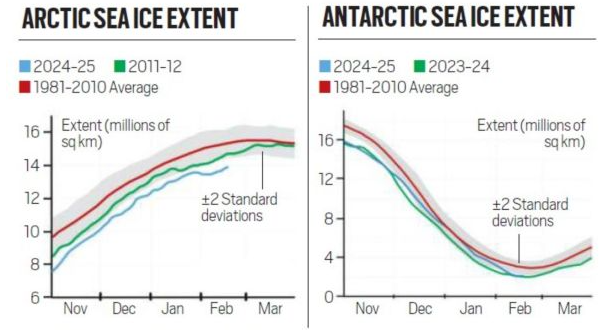
Reasons for the Decline in Global Sea Ice Cover
- Rising Global Temperatures: The Arctic and Antarctic regions are warming at an accelerated pace, with the Arctic experiencing warming four times faster than the global average.
- Ongoing ocean warming is setting the backdrop for sea ice decline, as warmer waters delay freezing and accelerate melting.
- The ice-albedo feedback effect worsens the situation—as ice melts, darker ocean water absorbs more solar radiation, leading to further warming and ice loss.
- Wind Patterns and Storms: In the Arctic, storms have broken apart ice around the Barents Sea (near Norway and Russia) and the Bering Sea (between Alaska and Russia).
- Antarctic sea ice is surrounded by the ocean instead of continents, making it more mobile and thinner.
Implications of Low Sea Ice Cover
- Climate Change: Less sea ice cover means that more ocean water is exposed to the Sun, leading to greater heat absorption and a rise in temperatures.
- Disruption of Ocean Currents: The influx of freshwater from melting ice is slowing down the circulation of water in the world’s oceans.
- Rising Sea Levels: While melting sea ice does not directly raise sea levels, its loss exposes glaciers and ice sheets to warmer waters, speeding up their melting.
- Disruption of Marine Ecosystems: The loss of sea ice affects marine food chains, particularly species such as krill, seals, and polar bears, which depend on ice for survival.
Way Ahead
- Countries must adhere to Paris Agreement targets and work towards limiting global average temperature to 1.5°C.
- Satellite observations and scientific expeditions must be expanded to better understand polar ice changes.
- International agreements on protecting marine ecosystems and polar biodiversity should be enhanced.
- Strict regulations on industrial activities, fishing, and resource exploitation in the polar regions are needed.
Concluding remarks
- The record low global sea ice cover is a stark reminder of the accelerating impacts of climate change.
- Immediate global action is essential to mitigate its cascading effects on climate, ocean currents, ecosystems, and human livelihoods.
- Without urgent intervention, the loss of sea ice could push the Earth closer to irreversible climate tipping points.
Committee to Review India’s Insurance Sector
Syllabus: GS3/ Economy
Context
- The Economic Survey 2025 projecting the Insurance sector as the fastest-growing among G20 nations. However, certain challenges necessitate a comprehensive review of the sector.
- In response, the government has set up a Committee chaired by Dinesh Khara to Review the Insurance Sector, aiming to modernize regulations, enhance consumer protection, and boost investment.
Background: The Evolution of India’s Insurance Sector
- The insurance sector in India has evolved through various policy reforms and regulatory developments.
- Key milestones:
- 1938: The Insurance Act, 1938, was passed during British India to regulate the insurance sector. It provides the legal framework for the functioning of the insurance industry through IRDAI.
- The act defines types of insurance policies in India: life, general, and health insurance.
- 1956: Life Insurance Corporation of India (LIC) was nationalized.
- 1972: General insurance was nationalized.
- 1999: The Insurance Regulatory and Development Authority of India (IRDAI) was established, opening up the sector to private players.
- 2015: FDI limit increased to 49% (later raised to 74% in 2021).
- 2025 Economic Survey: Highlights the need for further reforms due to increased digitalization, rising risks, and global market trends.
- 1938: The Insurance Act, 1938, was passed during British India to regulate the insurance sector. It provides the legal framework for the functioning of the insurance industry through IRDAI.
Why Are Insurance Reforms Needed?
- Low Insurance Penetration & Density: Insurance penetration declined from 4% in FY23 to 3.7% in FY24, below the global average.
- Life insurance penetration dropped from 3% to 2.8%, while non-life insurance remained at 1%.
- Regulatory Gaps & Need for Simplification: Fragmented regulations across life, non-life, and health insurance.
- Need for faster claim settlements, improved consumer grievance redressal, and enhanced digital security.
- Emerging Risks & Cybersecurity Challenges: Climate change, geopolitical uncertainties, and cyber threats are reshaping risk management.
- Digital fraud and misselling have emerged as major consumer concerns.
- Boosting Innovation & Investment: Technological advancements (AI, blockchain, and insurtech) require a regulatory framework that fosters innovation.
- Foreign investments in the sector need further ease of regulations.
- Expanding Rural & MSME Coverage: Government schemes like PMFBY and Ayushman Bharat have expanded coverage, but private sector participation remains limited.
- Microinsurance for MSMEs, gig workers, and rural communities needs customized policies.
Way Ahead
- Regulatory Modernization: Streamline IRDAI guidelines for uniformity across sectors.
- Improve consumer protection laws for faster claim settlements.
- Enhancing Insurance Penetration: Encourage new insurance products tailored for rural areas, MSMEs, and gig workers.
- Strengthen financial literacy programs to increase awareness.
- Strengthening Cybersecurity & Digital Oversight: Establish robust cybersecurity norms for digital insurance.
- Improve fraud detection using AI-driven solutions.
- Encouraging Insurtech & Innovation: Simplify compliance for tech-driven insurance startups.
- Promote usage-based and AI-driven insurance models.
- Attracting Investments & Improving Market Competitiveness: Further liberalization of FDI policies to attract global players.
- Ensure a level playing field between public and private insurers.
Conclusion
- The Committee to Review the Insurance Sector marks a critical step in reforming India’s insurance landscape. By focusing on regulatory simplification, financial inclusion, digital security, and innovation, India can unlock the full potential of its insurance market and ensure sustainable growth in the coming years.
Concern Over Moving African Cheetahs to India: Study
Syllabus: GS3/Environment and Conservation
Context
- A new study by the Centre for Wildlife Studies (CWS), has expressed concern over the translocation of the African cheetahs to India.
About
- The study examines the ethical, ecological and welfare challenges associated with the translocation of African cheetahs to India.
- Project Cheetah Overview: 20 African cheetahs (8 from Namibia in Sept 2022, and 12 from South Africa in Feb 2023) were introduced into Kuno National Park, Madhya Pradesh, India.
- Importation Plans: Plans to import 12 cheetahs annually until a viable population is established.
Major Highlights
- Challenges Faced by Cheetahs: The cheetahs have experienced significant stress, with over 90 immobilisations and frequent veterinary care.
- The mortality rate was 40%-50% in the first phase of the project, far below the expected survival rate of 85%.
- The project has raised concerns about the physical and mental health of the cheetahs due to their ongoing stress.
- Challenges of the Project:
- Conservation Challenges: African cheetah populations are already at risk, with only around 6,500 mature individuals left in the wild.
- Sustainability Issues: Reliance on continuous imports from Africa is seen as ecologically unsustainable and ethically problematic.
| Cheetah – Cheetah (Acinonyx jubatus), is one of the world’s most-recognizable cats, known especially for its speed. In India, the cheetah population used to be fairly widespread. – The cheetah is believed to have disappeared from the Indian landscape in 1947 when Maharaja Ramanuj Pratap Singh Deo of Koriya princely state hunted down and shot the last three recorded Asiatic cheetahs in India. 1. The cheetah was officially declared extinct by the Indian government in 1952. – Since the 1940s, the cheetah has gone extinct in 14 other countries – Jordan, Iraq, Israel, Morocco, Syria, Oman, Tunisia, Saudi Arabia, Djibouti, Ghana, Nigeria, Kazakhstan, Pakistan and Afghanistan. Reason for Extinction – Over-hunting was a major contributing factor. – The decimation of its relatively narrow prey base species and – The loss of its grassland-forest habitat. |
Difference between Asiatic Cheetah and African Cheetah
| Asiatic Cheetah (Acinonyx jubatus venaticus) | African Cheetah (Acinonyx jubatus jubatus) |
| IUCN status: critically endangered. | IUCN status: vulnerable. |
| Distribution: Less than 50 cheetahs are left in the wild. | Distribution: Around 6,500-7,000 African cheetahs are present in the wild. |
| Characteristics: Smaller and paler than the African cheetah. | Characteristics: They are bigger in size as compared to Asiatic Cheetah. |
Suggestions
- Call for Justice-Informed Approach: Researchers advocate for a more inclusive and participatory conservation model, considering diverse knowledge systems, values, and local consent.
- Focus on Sustainable Coexistence: Conservation efforts should aim at maintaining sustainable spaces for both humans and wildlife, rather than causing division and distress.
900-yr-old Kalyana Chalukya-era inscriptions unearthed
Syllabus :GS 1/History
In News
- Three Kannada inscriptions from the Kalyana Chalukya era were noticed for the first time in Kankal village of Telangana.
| Historical Context – The inscriptions belong to the reign of Emperor Someswara-III Bhulokamalladeva. – The dates of the inscriptions are: Dec 25, 1129 CE, Oct 5, 1130 CE, and Jan 8, 1132 CE. |
Details of the Inscriptions
- First inscription mentions the construction of the Bijjeswara temple, consecration of a Shivalinga, and a donation of 100 martars (a historical land measure) of land by a local chief.
- Second inscription records land and cash donations to the Bijjeswara temple by a local.
- The third inscription also documents donations to the Bijjeswara temple.
| Chalukyas – The Chalukyas of Badami began their rule in North Karnataka. – Pulakesin I (543-66 CE), the founder of the Chalukya dynasty, fortified Badami and began territorial expansion. – Pulakesin II defeated Harsha of Kanauj, securing a major victory and assuming the title “Parameshvara” (Supreme Lord). – The Chalukyan rule in Badami ended around 750 CE when Rashtrakuta feudatory Dantidurga defeated Kirtivarman II, bringing an end to the Chalukya dynasty. Chalukyas of Kalyana (Later Chalukyas): – Known as the Later Chalukyas or Kalyani Chalukyas, descended from the Badami Chalukyas. – Taila II, a key figure, rose to power under the Rashtrakutas around 957 CE. – Defeated Rajaraja Chola (992 CE), Latas, Gurjaras, Chedis, and Paramaras. |
Source :TOI
International Organization of Aids to Marine Navigation (IALA)
Syllabus: GS2/International Organisations
Context
- India is elected to the Vice Presidency of the International Organization of Aids to Marine Navigation (IALA) in Singapore.
About
- It was the first General Assembly of IALA and also marks its transition from a non-governmental organization (NGO) to an inter-governmental organization (IGO).
- This underscores India’s strong leadership and contributions to maritime affairs, reaffirming its commitment to sustainable and secure marine navigation.
International Organization of Aids to Marine Navigation (IALA)
- IALA was established in 1957 as an NGO.
- New IGO Status: Expands IALA’s role in harmonizing global maritime navigation systems, promoting safety, and addressing emerging challenges in safety and environmental protection.
- India’s Hosting Role: India will host the IALA Council meeting in December 2025 and the IALA Conference & General Assembly in September 2027 in Mumbai.
- Significance for India: India’s election highlights its commitment to maritime safety, navigational aids, and international cooperation in the maritime sector.
Source: PIB
India and Argentina Strengthen Cooperation in Lithium Exploration
Syllabus: GS2/IR, GS3/Economy
Context
- India and Argentina discussed expanding mining cooperation, focusing on lithium exploration.
About
- Argentina’s Lithium Reserves: Argentina, part of the ‘Lithium Triangle,’ is key for India’s access to minerals needed for EV batteries and renewable energy storage.
- Ongoing Efforts: Discussions included lithium exploration by Khanij Bidesh India Ltd. (KABIL) & Greenko and increasing Indian company participation in Argentina’s mining projects.
| About Lithium – Lithium is a silvery-white metal and is highly reactive. – Applications: Lithium has various industrial applications, most notably in rechargeable lithium-ion batteries. 1. These batteries are widely used in electronic devices such as smartphones, laptops, and electric vehicles. – Global Production: The majority of the world’s lithium production comes from countries like Australia, Chile, and Argentina. 1. These countries have significant lithium reserves and are major players in the global lithium market. |
Lithium Triangle
- The “Lithium Triangle” refers to a region in South America that contains some of the world’s largest lithium reserves.
- This triangular-shaped region encompasses parts of Argentina, Bolivia, and Chile; they possess 58% of the world’s known lithium reserves.
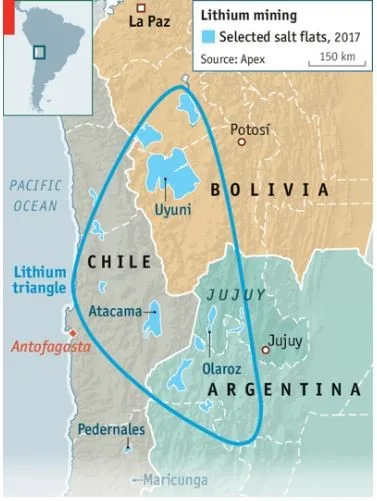
- India has been increasing its diplomatic outreach to the LTCs for accessing the mineral.
Source: PIB
Inland Waterways Terminal (IWT)
Syllabus: GS 3/Economy
In News
- Union Minister of Ports, Shipping and Waterways inaugurated an Inland Waterways Terminal (IWT) on Brahmaputra in Assam’s Jogighopa.
About
- The IWT is an important port of call for trade with Bangladesh given the MoU signed between India & Bangladesh for developing the economic corridor under Bharatmala Programme.
- A port of call is a stop made by a ship to load or unload cargo, embark or disembark passengers, or allow crew changes on an offshore vessel.
- Also, it will enhance logistics and connectivity in Eastern India, boosting trilateral trade with India, Bhutan, and Bangladesh.
| Growth of Inland Waterways Sector – The IWT sector has seen a 767% increase in operational national waterways, a 727% increase in cargo handled, and a 62% rise in multi-modal terminals. – Cargo traffic has grown from 18 million tonnes a decade ago to 133 million tonnes in FY 2023-24. |
