
Relics of Ratnagiri: Buddhist Heritage
Syllabus: GS1/Art & Culture
Context
- Archaeologists have unearthed a 1.4-meter-tall Buddha head along with 1,500-year-old tablets and stupas at Ratnagiri, Odisha, in December 2023. This significant discovery further establishes Ratnagiri as a major center of Vajrayana (Tantric Buddhism), which flourished between the 6th and 12th centuries CE.
- The recent excavation sheds light on the artistic, spiritual, and educational importance of Ratnagiri in the ancient Buddhist world.
Historical Significance of Ratnagiri
- Ratnagiri, meaning ‘Hill of Jewels’, flourished between the 6th and 12th centuries CE under the patronage of the Gupta and post-Gupta rulers.
- It was part of a broader network of Buddhist sites in Odisha, along with Lalitgiri and Udayagiri, forming the ‘Diamond Triangle’ of Buddhist heritage.
- The presence of inscriptions, images of Bodhisattvas, and stupas indicate that Ratnagiri was a major center of Vajrayana Buddhism.
- The site is believed to have played a crucial role in the propagation of Buddhism in India and beyond, particularly towards Southeast Asia.
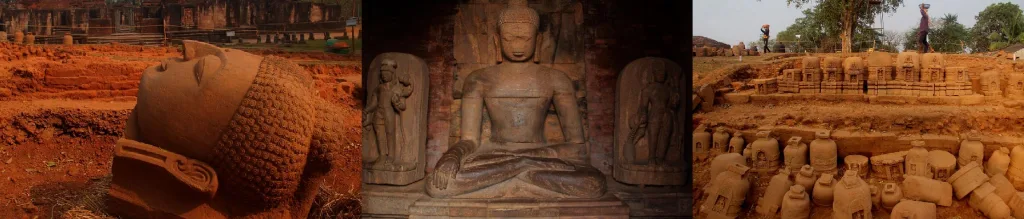
Relics and Artifacts
- Sacred Stupas and Relic Deposits: The presence of relic caskets, sometimes containing bone fragments, beads, or inscriptions, suggests strong religious reverence associated with these structures.
- Monasteries (Viharas) and Residential Complexes: Ratnagiri houses two well-preserved monasteries(Viharas), which served as centers for Buddhist learning and meditation.
- The larger monastery features a grand entrance, a spacious courtyard, and numerous cells for monks.
- The walls of these monasteries are adorned with intricate carvings, including depictions of deities such as Tara, Avalokiteshvara, and Manjushri.
- Exquisite Buddhist Sculptures:
- Seated Buddha in Bhumisparsha Mudra (Earth-touching gesture), symbolizing enlightenment.
- Dhyani Buddhas represent different aspects of Buddhist philosophy.
- Images of Bodhisattvas such as Avalokiteshvara and Maitreya.
- Female deities like Tara, signifying the influence of Tantric Buddhism.
- Inscriptions and Copper Plates: Several inscriptions in Brahmi and Sanskrit scripts have been discovered, providing valuable historical records.
- These inscriptions mention the patronage of Buddhist kings, donations made to the monasteries, and teachings followed at Ratnagiri.
- Some inscriptions hint at connections with distant Buddhist centers like Nalanda and Vikramashila.
- Terracotta Seals and Manuscripts: Excavations have also yielded terracotta seals bearing the inscriptions ‘Sri Ratnagiri Mahavihariya Arya Bhikshu Sanghasya’ indicating that Ratnagiri was an important monastic university.
- Fragments of ancient manuscripts suggest the presence of scriptural studies and Buddhist education.
Ratnagiri’s Role in Vajrayana Buddhism (A Tantric Form)
- Numerous depictions of Vajrayana deities and the presence of esoteric Buddhist symbols suggest that this site was a key center for tantric Buddhist practices.
- It is believed that Ratnagiri attracted scholars, monks, and practitioners from across India and beyond, contributing to the spread of Buddhist philosophy.
| Hinayana and Mahayana Buddhism – Buddhism was separated into the Hinayana and Mahayana sects in the Fourth Buddhist Council (72 AD) held in Kashmir, under the patronage of Kushan King Kanishka because of differences in philosophy, practice, and interpretation of Buddhist teachings. Hinayana Buddhism (Lesser Vehicle, aka Theravāda Buddhism) – It emphasizes personal enlightenment (Arhat ideal) through strict adherence to the Buddha’s teachings. – It focuses on monastic discipline and the earliest Buddhist scriptures (Pali Canon or Tripitaka). – View of Buddha: Historical teacher – It is prevalent in Sri Lanka, Myanmar, Thailand, Laos, and Cambodia, and is often considered its surviving school. Mahayana Buddhism (Greater Vehicle) – It was developed later (around the 1st century BCE) emphasizing compassion (Karuna) and the Bodhisattva ideal (seeking enlightenment for all beings i.e Universal enlightenment or Bodhisattva path). – It includes many texts beyond the Pali Canon, such as the Lotus Sutra and Prajnaparamita Sutras (Sanskrit and Chinese texts). – View of Buddha: Divine figure, multiple Buddhas – Spread across China, Korea, Japan, Tibet, and Vietnam, leading to further branches like Zen, Pure Land, and Vajrayana. |
Three-language Policy Under NEP 2020
Syllabus: GS2/Polity and Governance
Context
- The Centre has withheld funds to Tamil Nadu under the Samagra Shiksha scheme due to the state’s refusal to implement the National Education Policy (NEP) 2020) and its three-language formula.
- Tamil Nadu follows a two-language policy (Tamil and English) and has consistently opposed the introduction of Hindi, viewing it as a threat to its linguistic identity.
What is the Three Language Formula?
- NEP 1968 made Hindi compulsory across the nation, with specific language requirements for states.
- Hindi-speaking states were to teach Hindi, English, and a modern Indian language (preferably a South Indian language).
- Non-Hindi-speaking states were expected to teach local language, Hindi, and English.
- NEP 2020 retains the three-language formula, introduced in the NEP of 1968.
- States, regions, and students can choose the three languages, as long as at least two are native to India.
- In addition to the state language, children must learn one other Indian language (not necessarily Hindi).
- Emphasizes bilingual teaching, focusing on the home language/mother tongue and English.
- Sanskrit is given special emphasis as an optional choice in the three-language formula.
Significance of the Three-Language Formula
- Enhances Multilingual Proficiency: Encourages students to learn multiple languages, improving cognitive skills and communication.
- National Integration and Cultural Exchange: Helps bridge the north-south linguistic divide by promoting Hindi in non-Hindi states and regional languages in Hindi-speaking states.
- Increased Employment and Mobility Opportunities: Knowledge of multiple languages expands career prospects and makes migration for jobs and higher education easier across different states.
- Strengthens Regional Languages: Ensure that regional languages continue to be actively used and preserved.
What are the Concerns?
- Perceived Imposition of Hindi: Non-Hindi-speaking states, especially Tamil Nadu, West Bengal, and Karnataka, oppose it as an attempt to impose Hindi.
- Practical Implementation Challenges: Many schools lack qualified teachers for teaching additional languages.
- Burden on Students: Learning an additional language may increase the academic load, particularly for students who struggle with language acquisition.
- Potential Neglect of Foreign Languages: Some argue that instead of a third Indian language, students should be encouraged to learn global languages like French, German, or Mandarin to improve international opportunities.
Way Ahead
- Constructive dialogue and a practical compromise between the Centre and State is the way forward.
- Education was transferred to the concurrent list during the Emergency, making it a shared responsibility.
- Disagreements over the third language should not hinder funding for Samagra Shiksha, a key education program.
| PM SHRI scheme – Aim: The scheme aims to turn existing government schools into model schools. 1. The scheme is for existing elementary, secondary, and senior secondary schools run by the central government and state and local governments around the country. – Funding: It is a Centrally sponsored scheme for the period of five years from 2022-23 to 2026-27 for transforming nearly 14,500 schools across the country. Samagra Siksha Abhiyan (SSA) – The scheme extends from pre-school to class XII and aims to ensure inclusive and equitable quality education at all levels of school education. – The Scheme subsumes the three erstwhile Centrally Sponsored Schemes of Sarva Shiksha Abhiyan (SSA), Rashtriya Madhyamik Shiksha Abhiyan (RMSA) and Teacher Education (TE). – The major objectives of the Scheme are: 1. Support States and UTs in implementing the recommendations of the National Education Policy 2020 (NEP 2020); 2. Support States in implementation of Right of Children to Free and Compulsory Education (RTE) Act, 2009; 3. Emphasis on Foundational Literacy and Numeracy; 4. Strengthening and up-gradation of State Councils for Educational Research and Training (SCERTs)/State Institutes of Education and District Institutes for Education and Training (DIET) as nodal agency for teacher training; 5. Promoting vocational education. – Under the Scheme, financial assistance is provided to all the States and UTs for undertaking above activities. |
India-Japan Economy and Investment Forum
Syllabus: GS2/IR
Context
- India-Japan Economy and Investment Forum was held recently.
About
- Concerns Over Trade Surplus: Union Minister Piyush Goyal expressed concerns over Japan’s growing trade surplus with India.
- Stagnant Exports: India’s exports to Japan have remained stagnant for the past 15 years.
- Many Japanese investments in India source products from countries like Korea, Japan, Taiwan, and China, using India mainly as a market for their goods.
- Rising Japanese Exports: Japanese exports to India have consistently increased, worsening the trade imbalance.
- Focus on Addressing Imbalance: The Union Minister highlighted the need to address this growing disparity in trade between the two countries.
- He urged Japanese companies to produce goods and services in India that can be exported to Japan, aiming to balance the trade relationship.
Brief on India and Japan Relations
- Historical and Cultural Ties: Both countries share spiritual and cultural traditions, such as the influence of Hinduism on Japan’s Seven Lucky Gods and historical connections like the 752 AD consecration of Lord Buddha’s statue by Indian monk Bodhisena at Todaiji Temple in Japan.
- Establishment of Relations: After WWII, India opted for a separate Peace Treaty with Japan, signed in 1952, marking the start of formal diplomatic relations.
- Strategic Synergy: Both nations align on key regional initiatives, such as India’s Act-East Policy, Indo-Pacific vision (SAGAR), and Japan’s Free and Open Indo-Pacific Vision.
- Trade and Investment: Japan is a key ally in India’s economic growth, with FDI from Japan exceeding $43 billion from 2000 to 2024, making it India’s fifth-largest source of foreign investment.
- In 2023-24, the country’s export to Japan was $5.15 billion and imports were $17.7 billion. The trade gap was $12.55 billion.
- Collaboration on Global Initiatives: Japan and India cooperate in initiatives like the International Solar Alliance (ISA), Coalition for Disaster Resilient Infrastructure (CDRI), and Leadership Group for Industry Transition (LeadIT).
- Both countries work together in multilateral frameworks like the Japan-Australia-India-U.S. Quad and the India-Japan-Australia Supply Chain Resilience Initiative (SCRI).
- Integral Defense Partnership: India-Japan defense cooperation is a key pillar of bilateral ties, focused on Indo-Pacific peace, security, and stability.
- Key Agreements:
- Joint Declaration on Security Cooperation (2008).
- Memorandum of Defense Cooperation (2014).
- Agreements on Defense Equipment & Technology (2015) and Protection of Classified Military Information (2015).
- Reciprocal Provision of Supplies and Services Agreement (2020).
- Exercises and Joint Activities: Maritime Exercise Malabar.
- First Bilateral Fighter Exercise, Veer Guardian, in Japan (2023).
- First-ever Army-to-Army Exercise Dharma Guardian held in Japan ( 2023).
- Exercise Shinnyu Maitri between IAF and JASDF.
- JIMEX joint Naval Exercise between two nations.
- Key Agreements:
- Connectivity Projects in India: The first High Speed Rail (HSR) corridor is being implemented from Mumbai to Ahmedabad with technical and financial assistance from Japan.
- Presently, six Metro Rail projects (Ahmedabad, Bangalore, Chennai, Delhi, Kolkata, Mumbai) are being implemented with technical and financial support from Japan.
- Space Collaboration: ISRO and JAXA collaborate in X-ray astronomy, satellite navigation, lunar exploration, and the Asia Pacific Regional Space Agency Forum (APRSAF).
- In 2016, they signed a Memorandum of Cooperation (MoC) for peaceful space exploration and use.
Challenges
- Trade Imbalance: There is a significant trade imbalance, with Japan exporting more to India than India exports to Japan, creating a need for better reciprocal trade.
- Geopolitical Tensions: Regional security issues, such as China’s influence in the Indo-Pacific, pose challenges for India-Japan relations, requiring careful diplomatic balancing.
- Cultural and Language Barriers: Despite strong ties, differences in language, culture, and business practices pose challenges to deeper integration.
- Limited People-to-People Exchanges: The scale of people-to-people interactions is still limited, impacting deeper mutual understanding.
- Infrastructure Constraints: Despite improvements, some areas in India still lack the infrastructure necessary to support large-scale Japanese investments effectively.
- Different Economic Priorities: India’s focus on rapid economic growth may sometimes contrast with Japan’s emphasis on sustainable development and technology.
Way Ahead
- Enhance Trade and Investment: Focus on reducing the trade imbalance by increasing Indian exports to Japan and encouraging Japanese investment in India’s manufacturing and technology sectors.
- Boost People-to-People Connections: Increase cultural exchanges, tourism, and educational collaborations to deepen mutual understanding.
- Technology and Innovation Partnership: Leverage Japan’s expertise in technology and India’s growing digital sector to collaborate in AI, robotics, renewable energy, and space exploration.
- Address Environmental Concerns: Increase cooperation on environmental sustainability, climate change, and disaster resilience to support both countries’ green energy goals.
India’s dilemma Over Fighter Jets
Syllabus :GS 3/Defence
In News
- Both the F-35 and SU-57 gained attention at Aero India 2025 in Bengaluru, with the SU-57 being the showstopper for its maneuvers.
India’s evolving fighter jet landscape
- The Indian Air Force (IAF) has a sanctioned strength of 42.5 fighter squadrons but currently operates 31 squadrons, many with aging aircraft.
- India is facing a two-front challenge with China and Pakistan.
- To address this, India is exploring advanced jets like the U.S. F-35 and Russian Su-57.
| Do you know ? – Countries like China, Russia, and the U.S. have already inducted fifth-generation jets, with China developing advanced sixth-gen jets. – Pakistan is looking to acquire J-35 fifth-generation jets from China. |
Partnerships
- U.S. President Donald Trump mentioned the U.S. might provide F-35 stealth fighters to India in the future.
- The F-35 is a single-seat, single-engine strike fighter with three variant
- The F-35 costs around $100 million per aircraft, with development and maintenance costs exceeding $2 trillion through 2088.
- India and Russia initially planned to co-develop the FGFA (SU-57), but due to high costs and limited technology transfer, India pulled out.
- Swedish company Saab has shown interest in participating in the Multi-Role Fighter Aircraft (MRFA) programme, where the IAF aims to procure 114 jets to strengthen its depleting fleet.
New Approach
- India’s fleet, historically reliant on Russian military hardware, began diversifying in the early 2000s.
- India now plans to focus on its indigenous Advanced Medium Combat Aircraft (AMCA).
- By 2040, the IAF plans to have 220 LCA-Mk1s, 120 LCA-Mk2s, and the initial batch of AMCA fighters.
- India aims to acquire 500+ fighter jets, mainly focusing on LCA variants and the AMCA.
- The AMCA prototype is expected by 2026-2027, with induction by 2034.
- LCA-Mk1A deliveries were delayed, and LCA-Mk2 is expected to fly by 2026.
Need
- India’s fighter jet landscape is undergoing significant transformation as the country seeks to modernize its air force and enhance its defense capabilities.
- This evolution is driven by the need to address current challenges and prepare for future threats.
Concerns
- India still relies on U.S. and French-made engines for its fighters and helicopters, leading to dependency on foreign suppliers for critical systems.
- despite its benefits, has created dependency issues.
- Adding advanced fighters like the F-35 will come with challenges related to operational flexibility, maintenance, and impact on indigenous manufacturing efforts.
- Balancing relationships with defense suppliers like the U.S. and Russia while maintaining strategic autonomy is complex.
Conclusion and Way Forward
- India’s evolving fighter jet landscape reflects its commitment to strengthening national security and achieving self-reliance in defense.
- By addressing current challenges and strategically planning for the future, India can build a formidable air force capable of meeting emerging threats.
Glacier Ice Algae Accelerate Greenland Ice Sheet Melting
Syllabus: GS3/ Environment
Context
- A study highlights how dark-pigmented microalgae accelerate Greenland Ice Sheet melting by efficiently colonizing exposed ice without additional nutrients.
Key Findings
- Ice Algae’s Role in Melting: Dark-pigmented microalgae grow rapidly on exposed ice surfaces.
- Their pigmentation reduces ice reflectivity, increasing heat absorption and accelerating melting.
- Efficient Nutrient Uptake: Ice algae store phosphorus and sustain high carbon-to-nutrient ratios, enabling survival in nutrient-poor conditions.
- Significance: The study stresses the need to integrate biological factors into climate projections.
- Ice algae have also been found in the Alps, Himalayas, and Alaska, suggesting that similar biological processes may contribute to glacier retreat globally.
| Ice Algae – Ice algae are single-celled, elongated, brownish, and ellipse-shaped microorganisms that thrive on ice surfaces worldwide. – Similar to plants, they perform photosynthesis, releasing oxygen and producing organic molecules. |
Implications
- Accelerated Sea-Level Rise: The Greenland Ice Sheet is the largest contributor to global sea-level rise.
- Disruption of Ocean Circulation: The melting ice releases large volumes of freshwater, which disrupt thermohaline circulation such as the Atlantic Meridional Overturning Circulation, AMOC.
- Impact on Global Climate: Darkened ice absorbs more heat, contributing to regional warming and amplifying Arctic temperature rise, which is already occurring at twice the global average.
- Marine and Polar Ecosystems: The influx of freshwater into the ocean alters salinity and nutrient cycles, affecting marine food chains.
Way Forward
- Improved Climate Models: Incorporating biological factors can enhance the accuracy of sea-level rise predictions.
- Mitigation Strategies: Addressing global warming to slow ice melt and minimize feedback loops.
- Further Research: Understanding ice algae dynamics in different glacier regions to assess their overall impact.

