
Deregulation Commission & State’s Role in Governance
Syllabus: GS2/Governance
Context
- In a significant move aimed at promoting ease of doing business and reducing bureaucratic red tape, the Prime Minister of India announced the establishment of a Deregulation Commission.
Understanding Deregulation and Its Need in India
- Deregulation refers to the process of reducing or eliminating government-imposed restrictions on industries to promote free-market competition and efficiency.
- In India, bureaucratic red tape, excessive licensing requirements, and sectoral restrictions have often deterred businesses, particularly startups and MSMEs, from reaching their full potential.
Key Highlights of the Announcement
- Prime Minister Modi highlighted the government’s efforts to eliminate hundreds of archaic compliances through the Jan Vishwas 2.0 initiative, and emphasized the need for less government interference in society.
- Focus areas include banking, energy, telecom, retail, and manufacturing.
- The Deregulation Commission aims to identify and eliminate unnecessary government regulations.
- It aims to work alongside existing regulatory bodies such as RBI, SEBI, TRAI, and CERC, along with accelerating private investment, reducing red tape, and enhancing economic competitiveness.
Key Reasons for Establishing a Deregulation Commission
- Reducing Bureaucratic Red Tape: India ranks 63rd in the Ease of Doing Business Index (2020) by the World Bank.
- A Deregulation Commission would focus on reducing excessive paperwork, streamlining approval processes, and eliminating redundant laws.
- Enhancing Economic Growth: Sectors such as manufacturing, infrastructure, and digital economy require faster clearances and simplified compliance mechanisms.
- Encouraging Entrepreneurship and Innovation: Startups and MSMEs often struggle with regulatory bottlenecks, including multiple approvals, high tax burdens, and stringent labor laws.
- Revisiting Outdated Laws: Several colonial-era laws still exist in India’s legal framework. A Deregulation Commission could recommend amendments or repeals of such archaic laws to align with modern governance needs.
- Boosting FDI: India has witnessed increasing FDI inflows, but restrictive policies in sectors like retail, insurance, and e-commerce still pose challenges.
- Strengthening Federalism and State Autonomy: Regulations vary across states, leading to inconsistencies in business environments.
- A central body could work with state governments to create uniform policies, ensuring a level playing field for businesses across India.
- Increased Competition & Efficiency: Lower prices and better services for consumers.
- Private sector participation has enhanced productivity.
Evolution of Deregulation in India
- India’s economic liberalization initiated reforms to reduce state control over industries, encourage foreign direct investment (FDI), and promote private sector participation.
| Regulatory Commissions Overseeing Deregulation | |||
| Regulatory Commission | Sector | Role | Past Regulations |
| RBI | Banking & Finance | Monitors financial institutions and monetary policy. | – Reduced its stake in public sector banks; – Increased FDI limits in the insurance sector; – Deregulation of interest rates; |
| TRAI | Telecommunications | Ensures fair competition and consumer protection. | – 1994: National Telecom Policy allowed private players. – 1999: Revenue-sharing model replaced license fees. – 2016: Entry of Reliance Jio led to a price war, benefiting consumers. |
| CERC | Energy | Oversees electricity tariffs and open access. | – Increased private investment in power generation. – Open access to electricity transmission, allowing consumers to choose their suppliers. – Renewable energy promotion with solar and wind power auctions. |
| PNGRB | Oil & Gas | Ensures transparency in petroleum pricing. | – 2010: Deregulation of petrol prices. – 2014: Diesel price deregulated. – 2016: Introduction of daily fuel price revision. |
Negative Impact of Deregulation
- Market Failures: Unchecked deregulation can lead to monopolies and economic crises (e.g., the 2008 financial crisis).
- Job Losses in PSUs: Privatization led to layoffs in public sector enterprises.
- Regulatory Capture: Private entities may influence policies in their favor, harming consumer interests.
- Some industries saw the rise of dominant players (e.g., Jio in telecom).
- Rural Disparities: Wealth concentration in the hands of a few can widen social inequalities. Benefits of deregulation are unevenly distributed, with rural areas lagging.
- Environmental Concerns: Rapid industrial growth has increased pollution and resource depletion.
Way Forward
- Ensuring Consumer Protection: Regulations that protect consumer rights and fair competition must not be diluted.
- Preventing Corporate Malpractices: Oversight is necessary to prevent monopolies and unethical practices.
- Balancing Public Welfare and Business Interests: Sectors like healthcare and education require careful deregulation to avoid profiteering.
3 Years of India and UAE-CEPA
Syllabus: GS2/IR/GS3/Economy
Context
- The India-United Arab Emirates (UAE) Comprehensive Economic Partnership Agreement (CEPA) has completed three years of its signing in 2025.
About Comprehensive Economic Partnership Agreement (CEPA)
- It is India’s first deep and full-fledged Free Trade Agreement (FTA) in the last decade.
- It represents a strategic economic collaboration between two major trade partners and is expected to significantly enhance bilateral trade and investment flows.
- Signed in February 2022, CEPA covers a wide range of sectors, including:
- Trade in Goods & Services
- Pharmaceuticals
- Intellectual Property Rights (IPR)
- Investment & Digital Trade
Significance of India-UAE CEPA
- Boosting Bilateral Trade: Aims to increase trade in goods to USD 100 billion and trade in services to USD 15 billion over the next five years.
- Strengthens economic ties with one of India’s largest trade partners in the Gulf region.
- Job Creation & Economic Growth: Expected to generate over 1 million job opportunities for the Indian workforce through trade liberalization and improved market access.
- Preferential Market Access for Indian Goods: Enhances market access for India’s labour-intensive exports. Provides zero-duty market access for 90% of India’s exports to the UAE, improving India’s global competitiveness.
- Strengthening UAE-India Trade Links in the Gulf Region: Expands Indian exporters’ access to UAE’s neighbouring markets, particularly the Gulf Cooperation Council (GCC) states, Africa, and Europe.
Brief overview of the UAE and India relations
- Political : India and the United Arab Emirates (UAE) established diplomatic relations in 1972.
- Multilateral Cooperation: India and the UAE are currently part of several plurilateral platforms such as I2U2 (India-Israel-UAE-USA) and UFI (UAE-France-India) Trilateral, etc. UAE was also invited as a Guest Country to the G-20 Summit.
- Economic & Commercial: India UAE trade, valued at US$ 180 million per annum in the 1970s, is today US$ 85 billion making UAE, India’s third largest trading partner for the year 2022-23 after China and US.
- UAE is the second largest export destination of India (after the US) with an amount of nearly US$ 31.61 billion for the year 2022-23.
- Defence cooperation: It is steered through a Joint Defence Cooperation Committee (JDCC) at the Ministry level, with the signing of Agreement on Defence Cooperation in 2003, which came into effect in 2004.
- Nuclear Cooperation: India and the United Arab Emirates (UAE) signed a Memorandum of Understanding (MoU) for civil nuclear cooperation in 2024.
- In 2015, both countries had agreed to cooperate in “peaceful use of nuclear energy”, the agreement is part of the UAE’s policy of expanding investments into the nuclear energy sector.
- Space Cooperation: Indian Space Research Organisation (ISRO) and the UAE Space Agency signed an MoU regarding cooperation in the exploration and use of outer space for peaceful purposes in 2016.
- Indian Community: Indian expatriate community of approximately 3.5 million is the largest ethnic community in UAE constituting roughly about 35% of the country’s population.
- NRI Remittances: The annual remittances made by the Indian community is 18% of the total remittances to India [2020-21 data].
Challenges
- Trade Imbalances: India has a trade deficit with the UAE, primarily due to high oil imports from the UAE, which makes the economic relationship uneven despite growing non-oil trade.
- Geopolitical Tensions in the Region: Political instability in the Middle East and the Gulf region affect bilateral relations, especially with India’s strategic interests in the region.
- Labor and Migration Issues: India is one of the largest sources of migrant labor in the UAE, and issues related to the welfare and rights of Indian workers have been a point of concern.
- Foreign Policy of UAE: India’s relations with countries like Iran and Pakistan sometimes complicate its relations with the UAE, which maintains different strategic priorities in the region.
Way Ahead
- Strengthen Economic and Trade Ties: Continue to focus on diversifying trade beyond oil, aiming for the USD 100 billion target for non-oil trade by 2030.
- Joint Strategic and Security Cooperation: Enhance collaboration in counter-terrorism, regional security, and defense, focusing on the shared goal of a stable and peaceful Middle East.
- Address Labor and Migrant Issues: Work towards improving the welfare and rights of Indian migrant workers in the UAE through better labor policies and protection mechanisms.
International Mother Language Day
Syllabus: GS2/ Government Policies & Interventions
Context
- International Mother Language Day, observed on February 21, reminds us of the need to preserve linguistic diversity and protect fading languages.
Background
- The idea to celebrate International Mother Language Day was the initiative of Bangladesh to commemorate the 1952 Bengali Language Movement.
- It was approved at the 1999 UNESCO General Conference and has been observed throughout the world since 2000.
The diversity of India’s languages
- India is one of the most linguistically diverse countries in the world and considered a language hotspot.
- According to the 2018 Census, India has over 19,500 languages and dialects, with 121 languages spoken by 10,000 or more people.
Linguistic Loss and Its Impact
- The Indian Census of 1961 recorded 1,652 mother tongues, but by 1971, this number had dropped to 109, as many languages were grouped under broader linguistic categories.
- 42 Indian languages are critically endangered, a higher number than any other country in the world (UNESCO).
- 197 languages in India are currently endangered.
- Around 250 languages have gone extinct in the last 60 years.
- Languages spoken by remote and indigenous communities, particularly in the Northeast and Andaman & Nicobar Islands, are the most vulnerable.
- Example: The Great Andamanese language and Rai-Rokdung language (Sikkim) are critically endangered.
Reasons for Language Disappearance
- Modernization: Younger generations prefer dominant languages like Hindi and English for better education, job opportunities, and social integration.
- Lack of Speakers: Fewer speakers lead to difficulty in transmission across generations.
- Dominance of Major Languages: Larger languages tend to overshadow regional and indigenous languages, reducing their practical usage in daily life.
- Standardization and Script: Many endangered languages lack a written script, making their documentation and preservation difficult.
Preservation efforts
- People’s Linguistic Survey of India (PLSI) documents linguistic profiles of communities.
- Sidhela Archive of Sikkim University aims to preserve endangered languages in Northeast India.
- Scheme for Protection and Preservation of Endangered Languages (SPPEL): Under the Scheme, the Central Institute of Indian Languages (CIIL), Mysore works on protection, preservation and documentation of all the mother tongues/languages of India spoken by less than 10,000 people which are called endangered languages.
- AI4Bharat Initiative: Uses AI to develop speech recognition, machine translation, and text-to-speech models in 22 Indian languages, making them accessible to researchers, industries, and native speakers.
Conclusion
- Language preservation is not merely about safeguarding words; it is about protecting cultural heritage, indigenous knowledge, and unique identities.
- As languages disappear, so do the rich traditions and histories they carry. Therefore, preserving linguistic diversity is crucial for cultural sustainability and inclusive development.
Internet Shutdowns in India
Syllabus: GS2/Polity and Governance
Context
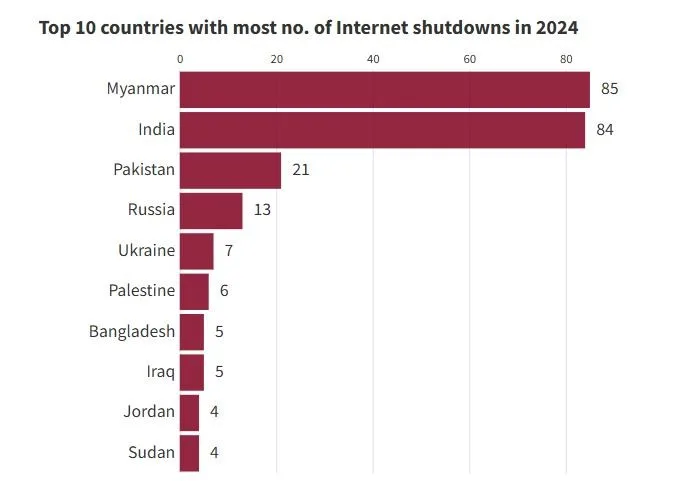
- According to a report by advocacy body ‘Access Now’, the number of Internet shutdowns are highest in 2024 globally.
About
- Global trend: 296 Internet shutdowns happened globally in 2024, and India’s cumulative 84 curbs accounted for 28% of these.
- India had the second highest number of Internet shutdowns in 2024; Myanmar had one more disruption than India.
- India’s total shutdowns in 2024 were fewer compared to the previous year.
- Shutdowns affected 16 States and Union Territories in India.
- Most Shutdowns: Manipur (21 shutdowns), Haryana (12), and Jammu & Kashmir (12).
- Reasons for shutdowns: 41 related to protests, 23 due to communal violence.
Legal Provisions Relating to Internet Shutdown
- Grounds: Indian States and Union Territories can impose an internet shutdown only in case of a “public emergency” or in the interest of “public safety”, according to the Indian Telegraph Act.
- However, the law does not define what qualifies as an emergency or safety issue.
- Till the year 2017, shutdowns were imposed largely under Section 144 of the Code of Criminal Procedure (CrPC).
- Section 144 of CrPC gave the police and the District Magistrate the powers in order to prevent unlawful gathering of people and also to direct any person to abstain from a certain activity.
- In 2017, the law was amended and the Government promulgated the Temporary Suspension of Telecom Services (Public Emergency or Public Safety) Rule 2017.
- These rules outline the procedures and conditions under which internet services can be temporarily suspended.
- They require the review of orders by an advisory board within 5 days to ensure the legitimacy of the shutdown.
| Anuradha Bhasin v. Union of India Case: – In 2020 the Supreme Court by ruling on Jammu and Kashmir Internet shutdown held that indefinite internet shutdowns by the State is not permissible under Indian Constitution. – The apex Court further stated that imposition of Section144 can not be used as a mechanism to avoid genuine protest which is permitted under the Constitution. 1. Section 144 has very specific parameters, only if those parameters are satisfied then only a Magistrate can pass the orders. Key Highlights of the orders: 1. Usage of the Internet is the Fundamental Right under Article 19 of the Indian Constitution. 2. Internet shutdowns can be of temporary period but not for indefinite period. 3. Government to publish all orders imposing restrictions under Section 144. 4. The Court had also said that any order with regard to Internet Shutdowns will come under Judicial Scrutiny. |
Arguments in Favour of Internet Shutdown by the Government
- National Security: The government suspend internet services as a temporary and targeted measure to prevent the spread of misinformation, coordinate unlawful activities, or address security threats.
- Temporary and Targeted Measures: These measures are not meant to infringe on long-term access but rather to address specific and immediate concerns.
- Preventing Unrest and Violence: Suspending online communication helps prevent the organization of protests, riots, or other forms of civil unrest.
- Counteracting Fake News and Disinformation: During times of crisis or conflict, false information circulating online can exacerbate tensions and contribute to misinformation.
Arguments Against the Internet Shutdown by the Government
- Impact on Freedom of Expression: Internet shutdowns infringe upon the freedom of expression guaranteed by the Indian Constitution.
- Global Image and Investment: Frequent internet shutdowns impact India’s global image, raising concerns among investors and international partners.
- Human Rights Concerns: Internet shutdowns raise human rights concerns, including the right to access information, freedom of speech, and the right to peaceful assembly.
- Economic Disruptions: India has a rapidly growing digital economy, and internet shutdowns can lead to significant economic losses.
- Educational Challenges: With the increasing use of online platforms for education, internet shutdowns severely affect students’ access to learning resources.
- Lack of Transparency: The government needs to provide clear justifications for such actions and communicate transparently about the duration and reasons for the shutdown.
Conclusion
- In a democracy, governments need to provide a rationale for disrupting the internet services in a periodic manner.
- Indiscriminate shutdowns have high social and economic costs and are often ineffective.
- For better internet governance the Indian civil society needs to push for a transparent and accountable system.
India’s Rising LNG Imports
Syllabus: GS 3/Economy
In News
- India’s LNG imports from the US reached a record 7.14 billion cubic meters (BCM) in the first 11 months of 2024, marking a 71% year-over-year increase.
About LNG
- Liquefied Natural Gas (LNG) is natural gas cooled to -162°C (-260°F), transforming it into a liquid state for easier storage and transport.
- Composed primarily of methane (90%), LNG is odorless, colorless, non-toxic, and non-corrosive.
India’s LNG Landscape
- As the world’s third-largest energy consumer, India is experiencing the fastest-growing energy demand globally.
- Economic growth is fueling higher energy consumption, making LNG a strategic fuel source.
- India’s LNG infrastructure includes import terminals, pipelines, and distribution networks serving power plants, industries, and city gas systems.
- However, existing infrastructure faces congestion and supply chain inefficiencies, limiting its full potential.
- US Overtakes UAE: In 2023, the US became India’s second-largest LNG supplier, overtaking the UAE, while Qatar remains the top supplier.
- 53.5% Growth in 2024: India’s LNG imports from the US increased by 53.5% in 2024 compared to the entire 2023 calendar year.
- Key Growth Drivers:
- US expansion in liquefaction capacity
- Competitive pricing
- Strategic proximity via the Cape of Good Hope
Why Does India Need LNG?
- Energy Diversification: As India shifts away from coal, LNG plays a key role in the clean energy transition.
- Energy Transition & Net-Zero Goals: India is shifting from coal-based power to LNG to reduce carbon emissions and meet its net-zero target by 2070.
- Industrial Demand: The industrial sector requires cleaner energy, and LNG is a suitable alternative due to its low emissions and efficient combustion.
- Urbanization & City Gas Networks: Growing urban areas are driving the expansion of city gas distribution (CGD) networks.
- Piped Natural Gas (PNG) is a cleaner and safer alternative to traditional cooking fuels, improving urban living standards.
Challenges in India’s LNG Sector
- Infrastructure Deficiencies: India aims to increase natural gas share to 15% of its energy mix by 2030, but LNG infrastructure remains inadequate.
- Congested LNG terminals cause delays and inefficiencies.
- Limited Pipeline Network: Underdeveloped pipelines restrict LNG distribution to remote areas.
- Storage Constraints: India’s limited LNG storage capacity makes it vulnerable to global price fluctuations and supply disruptions.
Government Initiatives to Boost LNG
- Energy Transition Policy: Shift towards cleaner fuels with a goal to increase gas share to 15% by 2030.
- National Gas Grid Expansion: Strengthening the LNG pipeline network to enhance supply efficiency.
- Expansion of City Gas Distribution (CGD): Accelerating urban access to Piped Natural Gas (PNG) and Compressed Natural Gas (CNG).
- Development of New LNG Terminals: Expanding import and storage facilities.
- Priority Gas Allocation: Allocating domestic natural gas to key sectors like CNG for transport and PNG for households.
- Liberalization of Gas Pricing:
- Marketing and pricing freedom for gas from high-pressure, deepwater, and coal seam sources, with a ceiling price mechanism.
- Sustainable Alternative Towards Affordable Transportation (SATAT) Initiative:
- Promotes Bio-CNG as a clean alternative for transportation.
Conclusion & Way Forward
- Investment Incentives: The government must introduce policy measures to encourage private and foreign investment in LNG infrastructure.
- Regulatory Simplification: Streamlining approval processes to accelerate LNG terminal and pipeline expansion.
- Small-Scale LNG Development: Supporting research and deployment of small-scale LNG plants for decentralized energy supply.
- Public-Private Partnerships (PPPs): Collaborative efforts among government, private sector, and financial institutions are essential for building a resilient LNG ecosystem.
Using Quantum Property of the Nanocrystals
Syllabus: GS3/Science and Technology
Context
- Scientists have devised a new way to check whether gravity is quantum-mechanical using nanocrystals.
About
- General relativity explains gravity, while quantum mechanics describes the electromagnetic, strong nuclear, and weak nuclear forces.
- Scientists are exploring how gravity fits into quantum mechanics, with experiments proposed to test gravity’s quantum nature.
- Quantum mechanics studies particle behavior at the quantum level, where classical physics no longer applies.
- Quantum technology utilizes quantum properties like superposition and entanglement to perform tasks previously thought impossible.
- Nanocrystals are tiny crystalline structures, typically 1 to 100 nm in size, exhibiting quantum mechanical behaviors (e.g., changes in conductivity, magnetism, light absorption).
- Use of Nanocrystals: Scientists have proposed using a quantum property of the nanocrystals called spin.
- The spin affects the nanocrystals’ motion and can be manipulated by an external magnetic field.
- The spin of each nanocrystal exists in a superposition of two states until it is measured.
- Test outcomes: Experts believe it may reveal that gravity is not a classical force, or it may suggest gravity is something entirely different from both classical and quantum forces.
Supreme Court Emphasized Segregation of Waste at Source
Syllabus: GS2/ Governance, GS3/ Environment
Context
- The Supreme Court emphasized that waste segregation at source is crucial for environmental health and must begin at the household level.
- Waste segregation refers to the systematic separation of different types of waste at the point of generation to facilitate proper disposal, recycling, and treatment.
Importance of Waste Segregation
- Reducing Landfill Burden: Proper segregation minimizes the amount of waste sent to landfills, thereby reducing land pollution and methane emissions.
- Enhancing Recycling: Effective separation allows organic waste to be composted and non-biodegradable materials to be recycled, promoting a circular economy.
- Preventing Pollution: Mixed waste leads to toxic leachate and harmful emissions, contaminating soil, water, and air. Segregation helps in safe disposal and treatment of hazardous materials.
- Waste-to-Energy Efficiency: Segregated waste ensures better efficiency of waste-to-energy plants, as contaminants in mixed waste reduce energy output and cause operational issues.
Challenges in Implementing Waste Segregation
- Lack of Public Awareness: Many households do not follow waste segregation due to limited awareness and behavioral inertia.
- Inadequate Infrastructure: Many urban and rural areas lack proper collection and processing facilities, leading to mixed waste dumping.
- Weak Enforcement of Rules: Despite the Solid Waste Management Rules, 2016, enforcement at municipal levels remains weak due to limited accountability and resources.
- Resistance from Waste Handlers: Informal waste pickers and sanitation workers lack incentives and training to handle segregated waste efficiently.
Government initiatives
- Solid Waste Management Rules, 2016: Mandates segregation of waste at source into biodegradable, non-biodegradable, and domestic hazardous waste.
- Promotes waste processing through composting, bio-methanation, and waste-to-energy technologies.
- Encourages bulk waste generators (housing societies, hotels, etc.) to process their own waste.
- Swachh Bharat Mission (SBM):SBM-Urban focuses on 100% door-to-door waste collection and encourages source segregation.
- SBM-Rural promotes biodegradable waste composting and bio-gas plants in villages.
- Waste-to-Energy Projects: The government is encouraging waste-to-energy plants to convert non-recyclable waste into electricity.
- Extended Producer Responsibility (EPR): Under EPR rules, manufacturers and producers must take responsibility for managing post-consumer waste (e.g., plastic waste, e-waste).
| Successful examples in waste Management – Indore, consistently ranked India’s cleanest city under Swachh Survekshan, has demonstrated that strict enforcement like 100% Source Segregation, Processing Infrastructure etc. can transform urban waste management. – Ambikapur, Chhattisgarh, has adopted a ‘Zero Waste’ model, where Women-led self-help groups (SHGs) manage solid waste collection and processing. – Pune’s SWaCH (Solid Waste Collection and Handling) model has successfully integrated waste pickers into formal waste collection, ensuring livelihood security. |
Way Forward
- Strict Enforcement Norms: Authorities must impose penalties for non-segregation and incentivize compliance.
- Strengthening Infrastructure: Investment in decentralized waste processing units at community levels can improve efficiency.
- Technology-Driven Solutions: Adoption of smart waste management systems, AI-based sorting, and RFID tracking can streamline waste processing.
- Integrating informal waste pickers into municipal frameworks can enhance segregation and recycling.
