
Delimitation Debate: Why Are Southern States Wary?
Syllabus: GS2/ Polity & Governance
Context
- The Union Home Minister has assured that no parliamentary constituencies in southern states will be reduced as a result of the proposed delimitation exercise in response to concerns raised by the Tamil Nadu Chief Minister.
Understanding Delimitation
- Delimitation is the process of redrawing the boundaries of parliamentary and legislative assembly constituencies to reflect changes in population. It aims to:
- Ensure fair representation based on demographic shifts.
- Adjust the number of seats allocated to different states.
- Determine reservations for Scheduled Castes (SC) and Scheduled Tribes (ST).
- This system was designed to balance population growth with political representation and uphold the democratic principle of “one citizen, one vote, one value.”
- Constitutional Provisions:
- Article 82: After every Census, Parliament enacts a Delimitation Act to redefine constituency boundaries.
- Article 170: The total number of seats in state assemblies is adjusted according to the Delimitation Act after each Census.
Who Conducts Delimitation?
- The Delimitation Commission is an independent body established through a Parliamentary Act, is responsible for overseeing the process.
- The authority, and its decisions cannot be challenged in court. The Election Commission of India (ECI) provides technical assistance for the exercise. However, the Supreme Court has ruled in 2024 that delimitation orders can be reviewed if they violate constitutional values.
- Composition: Chairperson: A retired Supreme Court judge
- Members: The Chief Election Commissioner (CEC) or a commissioner appointed by the CEC.
- State Election Commissioners of the respective states
- Members: The Chief Election Commissioner (CEC) or a commissioner appointed by the CEC.
History of Delimitation in India
- Parliamentary Authority: The power of delimitation (deciding the number and boundaries of constituencies) is vested in the Parliament.
- This power has been exercised four times through the Delimitation Commission Acts of 1952, 1962, 1972, and 2002.
- 42nd Amendment Act (1976): Freezes the allocation of Lok Sabha seats to states and the division of territorial constituencies based on the 1971 Census.
- This freeze was intended to protect states that successfully implemented population control measures from losing their representation in Parliament.
- 84th Amendment Act (2001): Allowed readjustment and rationalization of territorial constituencies based on the 1991 Census.
- However, it did not permit an increase or decrease in the number of seats allotted to each state in the Lok Sabha and State Legislative Assemblies.
- The main objective was to maintain uniformity in population representation without disturbing the total number of seats.
- 87th Amendment Act (2003): Changed the basis of delimitation from the 1991 Census to the 2001 Census.
- Like the 84th Amendment, it did not alter the number of seats allocated to each state in Parliament and State Assemblies.
- It was primarily aimed at ensuring fairer representation based on more recent population data.
Why Is Delimitation Being Revisited?
- The next delimitation exercise is expected to be based on the 2021 Census (delayed due to the pandemic). This has raised concerns among South Indian states, as their population growth has been lower compared to the North Indian states.
- If delimitation follows the historical patterns (1951, 1961, 1971 and 2002), the number of Lok Sabha seats could increase from 543 to 753 based on the population ratio of 20 lakh people per constituency.
Why Are Southern States Worried About Delimitation?
- Northern states (Uttar Pradesh, Bihar, Rajasthan, Madhya Pradesh, etc.) have experienced higher population growth, which could result in them gaining more seats at the expense of the South.
- Southern states (Tamil Nadu, Kerala, Karnataka, Andhra Pradesh, and Telangana) fear a loss of representation despite better governance and population control measures.
What’s Next?
- Potential Increase in Total Seats: Instead of reducing seats from any state, the total number of Lok Sabha seats may be increased to accommodate growing population disparities.
- 2026 Review: The next delimitation can happen only after the first Census post-2026, likely to be the 2031 Census.
- Women’s Reservation Act: The implementation of 33% women’s reservation may also impact seat adjustments.
Integrating AI in India’s Judiciary and Law Enforcement
Syllabus: GS2/Government Policies & Interventions; GS3/Science & Technology
Context
- By integrating Artificial Intelligence (AI) into judicial processes, case management, legal research, and law enforcement, India is streamlining operations, reducing delays, and making justice more accessible to all.
Current State of India’s Legal and Law Enforcement System
- India’s judiciary operates under a hierarchical structure with the Supreme Court at the apex, followed by High Courts and subordinate courts.
- Despite its well-established legal framework, the system grapples with challenges such as:
- Case Backlogs: Over 5 crore pending cases (as per National Judicial Data Grid, NJDG) burden the courts.
- Delayed Judgments: Prolonged legal proceedings due to complex documentation and procedural inefficiencies.
- Manual Case Management: Traditional paper-based documentation slows judicial functions.
- Law Enforcement Challenges: Policing inefficiencies, rising cybercrime, and limited resources hamper effective crime prevention and investigation.
Applications of AI in India’s Judiciary
- AI-Powered Legal Research & Case Management: AI-driven legal research tools like SUPACE developed by the Supreme Court of India, assist judges in analyzing vast legal data efficiently.
- Predictive Justice & Case Prioritization: Machine learning algorithms can predict case outcomes based on past rulings and legal precedents. Courts can leverage AI models to:
- Prioritize urgent cases, reducing delays.
- Estimate probable case durations.
- Identify patterns in case dismissals or approvals.
- Virtual Courts & AI-Powered Dispute Resolution: India has launched E-Courts, enabling virtual hearings and online case management.
- AI-powered Online Dispute Resolution (ODR) platforms help resolve minor disputes without judicial intervention, saving time and resources.
- AI-Assisted Translation for Legal Documents: With India’s linguistic diversity, AI-based real-time legal translation tools can bridge the language gap in courts, making legal resources accessible in regional languages.
AI in Law Enforcement and Crime Prevention
- AI-Powered Surveillance & Facial Recognition: The Crime and Criminal Tracking Network & Systems (CCTNS) integrates AI-driven facial recognition and predictive policing to:
- Identify suspects using CCTV footage.
- Track missing persons and criminals in real-time.
- Enhance public safety with AI-assisted crowd monitoring.
- Predictive Policing & Crime Analytics: AI-based predictive analytics helps law enforcement agencies anticipate and prevent crimes. AI tools analyze:
- Historical crime data to detect crime hotspots.
- Behavioral patterns of repeat offenders.
- Social media and online activities to track cybercriminals.
- AI in Forensic Investigations: AI-driven forensic tools enhance evidence analysis, including:
- Voice recognition and deepfake detection in digital investigations.
- AI-assisted DNA and fingerprint matching for faster case resolution.
- Cybercrime tracking using AI-driven data forensics.
- AI Chatbots for Public Assistance: Several states have deployed AI-powered police chatbots to assist citizens in:
- Filing FIRs online.
- Tracking case updates.
- Getting legal advice in simple language.
- Others: AI-powered technologies — including Machine Learning (ML), Natural Language Processing (NLP), Optical Character Recognition (OCR), and Predictive Analytics are now being leveraged to automate administrative tasks, improve case tracking, and enhance crime prevention.
Challenges in AI Adoption in India’s Judiciary and Law Enforcement
- Ethical and Bias Concerns: AI models may inherit biases from historical judicial data, raising fairness and impartiality concerns in legal decision-making.
- Data Privacy & Security: AI-driven systems require access to vast legal and crime databases. Ensuring data confidentiality and security is crucial.
- Infrastructure and Digital Divide: Not all courts and police stations have access to AI infrastructure, especially in rural areas.
- Legal and Regulatory Framework: India lacks AI-specific legal frameworks to regulate AI-driven judicial and law enforcement mechanisms.
Government Initiatives for AI Integration
- SUVAS & SUPACE (Supreme Court AI):
- SUVAS (Supreme Court VidhikAnuvaad Software) for translating Judicial domain English documents in vernacular languages and vice versa has been developed.
- SUPACE (Supreme Court Portal for Assistance in Court Efficiency) assists Supreme Court judges in case research and legal analysis.
- AI for Legal Translation and Language Accessibility:
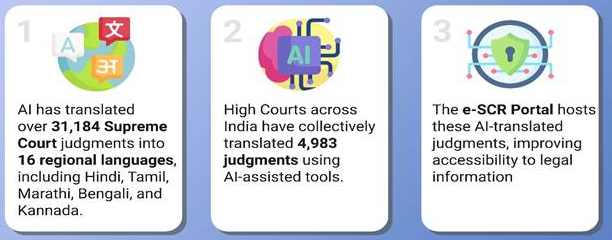
- E-Courts (Phase III) Mission Mode Project: It integrates advanced AI solutions to enhance case management and administrative efficiency across courts in India.
- The Union Government allocated ₹7210 Crore for the e-Courts Phase III project, within this, ₹53.57 Crore is specifically earmarked for the integration of AI and Blockchain technologies across High Courts in India.
- CCTNS (Crime and Criminal Tracking Network & Systems): A nationwide AI-enabled police database to track criminals and coordinate investigations across states.
- AI Task Force & NITI Aayog’s AI Strategy: The NITI Aayog AI Task Force is formulating policies for AI adoption in governance, including judicial and police reforms.
Way Forward: AI for a Smarter Justice System
- Establish AI Ethics Guidelines: Ensure fairness and transparency in AI-driven legal decisions.
- Strengthen AI Infrastructure: Invest in AI training for judges and law enforcement personnel.
- Enhance Public Awareness: Educate citizens on AI-based legal resources and rights.
- Encourage AI Research in Law: Support innovation in legal AI applications through academic and industry partnerships.
Concerns Raised By PwDs Over DPDP rules
Syllabus: GS2/ Governance
Context
- The disability rights activists have raised concerns over certain provisions in the draft Rules of the Digital Personal Data Protection Act, 2023.
Background
- The draft Digital Personal Data Protection Rules aim to safeguard citizens’ rights for the protection of their personal data.
- However, Section 9(1) has raised concerns among disability rights activists as it treats persons with disabilities (PwDs) the same as children in requiring guardian consent for data processing.
Key Provisions of the rules
- The DPDP Act defines:
- Data Fiduciaries as entities processing personal data.
- Data Principals as individuals whose data is collected.
- For PwDs, Section 2(j)(ii) includes a “lawful guardian” within the meaning of Data Principal, effectively transferring decision-making power from the PwD to their guardian in specific cases.
- Section 9(1): It mandates that for PwDs with legal guardians, consent for data processing must be obtained from the guardian.
Guardianship Laws for PwD
- The National Trust Act (NT Act), 1999: Provides full guardianship for individuals diagnosed with autism, cerebral palsy, intellectual disabilities, or severe multiple disabilities.
- The Rights of Persons with Disabilities (RPWD) Act, 2016: Advocates for “limited guardianship,” ensuring PwDs retain decision-making power with support.
- The Act aligns with the United Nations Convention on the Rights of Persons with Disabilities (UNCRPD).
Concerns with the Draft Rules
- Denial of Digital Autonomy: Section 9(1) assumes that PwDs with legal guardians do not make independent digital decisions.
- Gender and Disability Intersectionality: PwD women will face additional hurdles, such as requiring guardian consent for accessing essential services for purchasing products online.
- Data Privacy Risks: Platforms may collect disability-related data even when a guardian is not involved, raising concerns over unnecessary data collection and potential misuse.
Way Forward
- Provide Clear Guidelines: Introduce specific illustrations and procedural clarifications in the draft rules to ensure practical implementation.
- Enhance Digital Accessibility: Strengthen mandates for accessible digital infrastructure to reduce systemic barriers faced by PwDs.
- Promote Digital Literacy: Develop targeted programs to empower PwDs with the skills needed for independent online navigation.
Harnessing AI to Generate Patterns of Antibiotic Resistance
Syllabus: GS2/Health
Context
- IIIT-Delhi and Indian Council of Medical Research (ICMR) researchers developed AMRSense, an AI tool that analyzes hospital data for real-time antibiotic resistance insights.
About
- This initiative aims to enhance AMR surveillance at the global, national, and hospital levels.
- AMRSense leverages hospital-generated culture sensitivity test reports (blood, sputum, urine, pus, etc.) to construct AI-based pipelines, enhancing antimicrobial stewardship.
| What is Antimicrobial Resistance? – Antimicrobial Resistance (AMR) occurs when bacteria, viruses, fungi and parasites change over time and no longer respond to medicines making infections harder to treat and increasing the risk of disease spread, severe illness and death. – Antibiotic resistance is emerging as the threat to successful treatment of infectious diseases, organ transplantation, cancer chemotherapy and major surgeries. Causes for Antimicrobial Resistance – Overuse and Misuse of Antibiotics: The excessive and inappropriate use of antibiotics in humans and animals is a major driver of antimicrobial resistance. 1. A survey on prescribing trends for antibiotics released by the National Centre for Disease Control (NCDC) in 2023 found that 71.9% of patients coming to hospitals were prescribed antibiotics on average. – Inadequate Dosage and Duration: When antibiotics are not taken in the correct dosage and for the recommended duration, it can lead to incomplete eradication of the targeted microorganisms, allowing the surviving bacteria to develop resistance. – Self-Medication: Self-prescription without proper medical guidance contributes to the misuse of antibiotics. – Antibiotics in Food-Animals: Use of antibiotics as growth promoters in food animals and poultry is a common practice and later it evolves in the food chain. – Poor Sanitation: A significant proportion of sewage is discharged untreated into water bodies, leading to severe river contamination with antibiotic residues and antibiotic-resistant organisms. |
Role of AI in Combating AMR
- Early Outbreak Detection: AI-powered tools analyze large-scale hospital data to track emerging AMR trends, enabling proactive interventions.
- AMRSense predicts resistance patterns using routine hospital records, aiding in faster decision-making.
- Integration of Data: AI can combine hospital AMR data with antibiotic sales records, agricultural antibiotic use, and environmental factors to offer a holistic approach to AMR surveillance and control.
- Overcoming Limitations: Unlike genomic sequencing, which is expensive and time-consuming, AI models use routine hospital data to generate cost-effective, actionable insights.
Challenges
- Data Quality: The accuracy of AI models heavily depends on the quality and completeness of available data, which can be a significant challenge in healthcare settings.
- Model Accuracy & Validation: AI predictions depend on past trends; unexpected events (e.g., pandemics) can disrupt accuracy.
- Implementation: Hospitals and policymakers face challenges in adopting AI-based AMR strategies due to regulatory, ethical, and technical barriers.
Concluding remarks
- AI plays a pivotal role in AMR surveillance, prediction, and stewardship, transforming public health responses.
- With proper integration of AI-driven tools, evidence-based policies can help combat the rising threat of antimicrobial resistance effectively.
India’s ‘Look East’ Policy Has Transformed Into ‘Act East’
Syllabus: GS2/ IR
In News
- Recently, the Vice-President of India highlighted the transformation of India’s “Look East” policy into “Act East” by Prime Minister Narendra Modi.
Historical Context and Evolution
- Look East Policy (Post-Cold War Era): Introduced by Prime Minister P.V. Narasimha Rao in 1992, the Look East Policy sought to rectify India’s historical neglect of Southeast Asia, despite deep cultural and historical ties.
- Initially focused on Southeast Asia, the policy later expanded to East Asia and Oceania.
- Primary Objectives: Enhance trade and economic development.
- Strengthen strategic and cultural connections with ASEAN nations.
- Draw inspiration from the economic success stories of East Asia.
- Initial Outcomes: Reduction of trade barriers to facilitate commerce.
- Increased inbound tourism from Southeast Asia.
- Act East Policy (Post-2014): The Act East Policy was a direct evolution of the Look East Policy, emphasizing stronger action and outcomes. In 2011, U.S. Secretary of State Hillary Clinton urged India to play a more active role in the Asia-Pacific, prompting a shift in approach.
- In 2014, External Affairs Minister Sushma Swaraj formally declared India was ready to “Act East,” a commitment reinforced by Prime Minister Modi.
- Key Advancements: Greater emphasis on concrete action and outcomes.
- Integration of Northeast India as a critical hub for regional engagement.
- Recognition of the Indo-Pacific as a strategic and economic priority.
- At the 2014 East Asia Summit, PM Modi introduced the 3Cs approach:
- Commerce – Expanding trade and economic ties.
- Culture – Strengthening historical and cultural linkages.
- Connectivity – Building infrastructure and digital networks for seamless integration.
Objectives and Achievements of Act East Policy
- Strategic Expansion: Extended focus beyond ASEAN to the broader Indo-Pacific region.
- Strengthened regional groupings like BIMSTEC, Asia Cooperation Dialogue, and the Indian Ocean Rim Association (IORA).
- Enhanced defense diplomacy: Sale of BrahMos missiles to the Philippines.
- Military logistics pact with Vietnam.
- Economic and Trade Ties: Reduction in trade barriers.
- Greater economic integration with Southeast Asia via Free Trade Agreements (FTAs).
- Increased foreign investment flows from the region into India.
- India has elevated relations to strategic partnerships with Indonesia, Vietnam, Malaysia, Japan, South Korea, Australia, Singapore, and ASEAN.
- India has invited ASEAN countries to join the International Solar Alliance, emphasizing regional integration and effective project implementation.
- Cultural and Soft Power Diplomacy: Promotion of shared cultural heritage, including Ramayana and Mahabharata traditions and Buddhist linkages.
- Hosting of cultural events such as the Ramayana Festival with Southeast Asian participation.
- India aims to revive and strengthen Buddhist and Hindu cultural links to enhance people-to-people connections and regional cooperation.
- Connectivity: Improved infrastructure development in Northeast India to serve as a gateway to Southeast Asia.
- Major projects include:
- India-Myanmar-Thailand Trilateral Highway.
- Kaladan Multi-Modal Transit Transport Project.
- Rhi-Tiddim Road Project and Border Haats to strengthen connectivity.
- Major projects include:
Challenges and Areas of Improvement
- Strategic and Economic Challenges:Environmental impact of urbanization and industrialization in Northeast India.
- China’s Belt and Road Initiative (BRI) presents strong competition by offering attractive financial incentives to Southeast Asian nations.
- China’s BCIM-EC (Bangladesh, China, India, Myanmar Economic Corridor) poses competitive challenges in connectivity and infrastructure.
- Myanmar’s political transition is becoming increasingly challenging for India.
- Despite its strategic geographical proximity to ASEAN nations, the Northeast is not yet fully integrated into India’s Bharatmala and Sagarmala projects.
- Soft Power and Cultural Challenges: China’s claim over Buddhist heritage challenges India’s narrative.
- Limited linguistic engagement: Few Indian universities offer courses in Khmer, Bahasa Indonesia, Thai, or Burmese.
- Connectivity Bottlenecks:Delays in infrastructure projects like the Kaladan Multi-Modal Transit Transport Project.
- Underdeveloped transport and trade facilities in Northeast India.
Conclusion and Way Forward
- The road to greater Act East Policy will require infrastructure development, investment, and addressing security issues to ensure mutual growth and progress.
- India’s North-East must play a central role in strengthening ASEAN-India ties, benefiting from the region’s proximity to South East Asia.
- India’s connectivity efforts must address infrastructure gaps and ensure seamless integration for improved trade and interaction.
- As Southeast Asia becomes increasingly vulnerable to climate change and non-traditional security threats, India’s role in regional disaster management, climate diplomacy, and maritime domain awareness is set to grow.
- India should also work to expand its network of strategic partnerships by engaging more proactively with middle powers in the Indo-Pacific.
India’s First indigenous Semiconductor Chip to be Ready by 2025
Syllabus: GS3/ S&T
In Context
- Union Minister for Electronics and IT announced at the Global Investors Summit 2025 in Bhopal that India’s first indigenously developed semiconductor chip will be ready for production by 2025.
About
- Semiconductors: Semiconductors are materials that have conductivity between a conductor and an insulator. They are the foundation of modern electronics, used in:
- Computers and smartphones
- Automobiles and electric vehicles (EVs)
- Defense and aerospace technology
- Medical devices
- Telecommunication and AI applications
- Importance: India is one of the largest consumers of semiconductors but imports 100% of its requirements.
- The launch of an indigenous semiconductor chip in 2025 will:
- Reduce import dependence (India imports $24 billion worth of semiconductors annually).
- Strengthen national security (used in defense and critical infrastructure).
- Boost Make in India and Atmanirbhar Bharat initiatives.
- Create high-skilled jobs in semiconductor design and manufacturing.
- The launch of an indigenous semiconductor chip in 2025 will:
Initiatives to Develop the Semiconductor Industry
- India Semiconductor Mission (ISM) (2021): A ₹76,000 crore incentive scheme aimed at:
- Setting up semiconductor fabrication units (fabs) in India.
- Encouraging global semiconductor firms to invest in India.
- Developing design-linked incentive (DLI) schemes to support local start-ups.
- Production-Linked Incentive (PLI) Scheme for Electronics Manufacturing
- Semiconductor Manufacturing Ecosystem: Five semiconductor units under construction in India.
- Strategic Partnerships: Collaboration under India-U.S. Initiative on Critical and Emerging Technology (iCET).
- Talks on setting up chip manufacturing units in India.
- Role in the QUAD Group: QUAD (India, US, Japan, Australia) is focusing on semiconductor supply chain resilience.
Challenges in India’s Semiconductor Sector
- Lack of Existing Semiconductor Fabs: No existing commercial fab in India yet (first expected in 2025).
- Dependence on Global Supply Chains: Taiwan, South Korea, and the U.S. dominate semiconductor manufacturing.
- High Capital and Technological Requirements: Semiconductor manufacturing requires precision, specialized labor, and high investment.
- Geopolitical Risks: US-China trade war & Taiwan tensions impact semiconductor availability.
Future Prospects and Way Forward
- Achieving Self-Sufficiency: The government must ensure faster implementation of semiconductor plants.
- Strengthening Infrastructure: Improve power supply, water availability, and logistics for fabs.
- Enhancing Skill Development: Establish semiconductor training institutes in partnership with global leaders.
- Reducing Import Dependence: Promote local semiconductor startups under the Design-Linked Incentive (DLI) scheme.
India’s Space Economy to Increase Five-fold
Syllabus: GS3/Space
Context
- As per the union minister of state for Science & Technology India’s space economy is set to grow fivefold to $44 billion in the next decade, with private investments already crossing ₹1,000 crore.
India’s share in Space Industry
- India’s space economy stands at $8 billion contributing 2-3% of the global space economy and this is expected to rise to 8% by 2030 and further to 15% by the year 2047.
- With over 400 private space companies, India ranks fifth globally in no. of space companies.
Private players in Space Industry
- The number of space startups in India increased to nearly 200 in 2024 from just one in 2022, in just about two years.
- The funding received by these start-ups reached a total of $124.7 Mn in 2023 from $67.2 Mn in 2021.
- The Skyroot, have launched India’s first privately built rocket, Vikram-S, into space, with plans to revolutionize satellite launches.
Regulation of the Private sector in the Space industry in India
- National Space Promotion and Authorisation Centre (IN-SPACe): It is an autonomous and single window nodal agency in the Department of Space for the promotion, encouragement and regulation of space activities of both government and private entities.
- NewSpace India Ltd (NSIL): It is mandated to transfer the matured technologies developed by the ISRO to Indian industries.
- All of them are under the purview of the Ministry of Defence.
Significance of privatization of space sector
- Cost Reduction: Profit motive drives private companies to reduce costs in space missions and satellite launches.
- Competition & Innovation: Privatization introduces competition, enhancing efficiency and fostering innovation.
- Commercialization: Private players enable space applications in sectors like agriculture, disaster management, urban planning, navigation, and communication.
- Autonomy: Greater decision-making autonomy allows private companies to take on new projects more swiftly.
- Employment & Self-reliance: Privatization generates jobs, supports modern technology adoption, and helps make the space sector self-reliant.
Challenges
- High Investment Costs: Space technology requires heavy investment, potentially leading to monopolization by wealthy corporations.
- Specialized Expertise: Building and operating space tech demands specialized technical skills and resources.
- Protecting intellectual property rights (IPR): Safeguarding intellectual property rights is essential to encourage innovation and investment.
- International Competition: Indian private space companies face strong competition from established players like SpaceX and Blue Origin globally.
Steps Taken by Government
- Space Sector Reforms (2020): Government allowed private sector participation, defining roles of IN-SPACe, ISRO, and NSIL.
- Space Vision 2047: Aims for Bharatiya Antariksh Station (BAS) by 2035 and an Indian Moon landing by 2040.
- Gaganyaan follow-on missions & BAS first module by 2028.
- Next Generation Satellite Launch Vehicle (NGLV) by 2032.
- Chandrayaan-4 by 2027, to collect moon samples and demonstrate return technology.
- Venus Orbiter Mission (VOM) by 2028, to study Venus.
- Indian Space Policy, 2023: Ensures level playing field for Non-Government Entities (NGEs) in space activities.
- Venture Capital Fund: Rs. 1000 crore fund for space startups under IN-SPACe over the next 5 years.
- SpaceTech Innovation Network (SpIN): SpIN is a one-of-its-kind public-private collaboration for start-ups and SMEs in the space industry.
- Under the amended FDI policy, 100% FDI is allowed in the space sector.
Way Ahead
- Private entities are now actively involved in crucial aspects of research, manufacturing, and fabrication of rockets and satellites, fostering a vibrant ecosystem of innovation. It is expected to integrate Indian companies into global value chains.
- With this, companies will be able to set up their manufacturing facilities within the country duly encouraging ‘Make In India (MII)’ and ‘Atmanirbhar Bharat’ initiatives of the Government.
