

Cities Coalition for Circularity (C-3) Launched
Syllabus: GS2/Government Policy & Intervention; GS3/Urban Infrastructure
Context
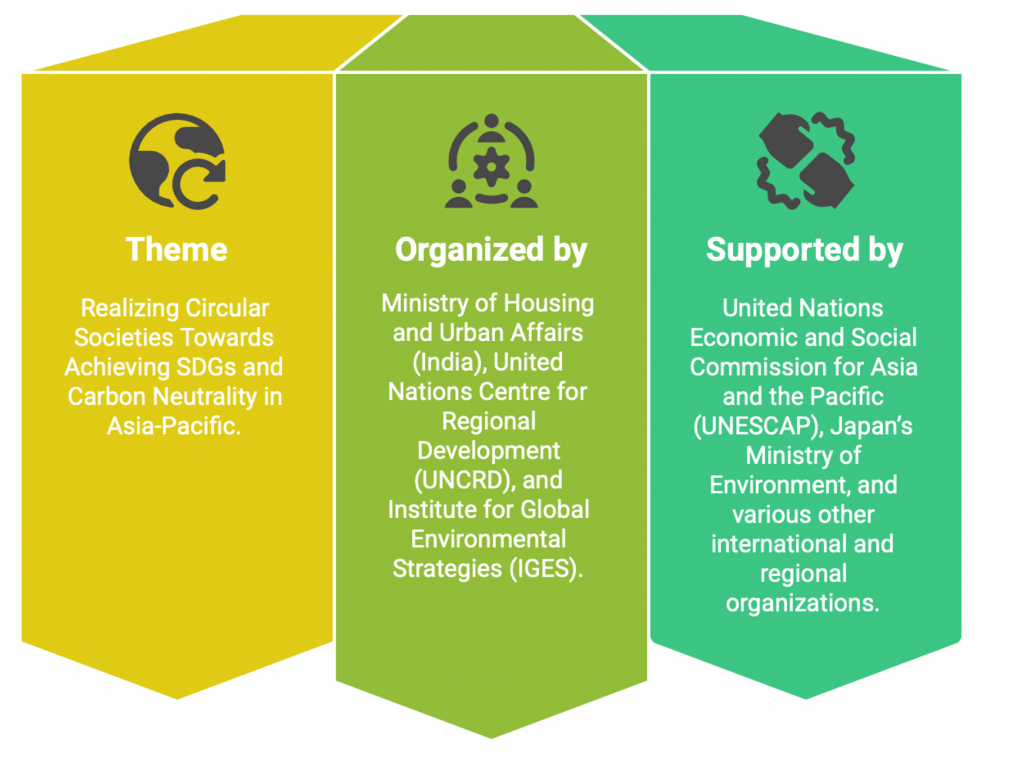
- Recently, India has launched the Cities Coalition for Circularity (C-3), a multi-nation alliance aimed at fostering city-to-city collaboration, knowledge-sharing, and private sector partnerships during the 12th Regional 3R and Circular Economy Forum in Asia and the Pacific, held in Jaipur.
| Key Highlights of the Event – The Prime Minister of India emphasized India’s commitment to the Pro-Planet People (P3) approach and the importance of the 3R (Reduce, Reuse, Recycle) for sustainable urban development. – A Memorandum of Understanding (MoU) for CITIIS 2.0 (City Investments to Innovate, Integrate, and Sustain) was signed. 1. It involves agreements worth ₹1,800 crore, benefiting 18 cities across 14 states and serving as lighthouse projects for other urban areas. |
Background
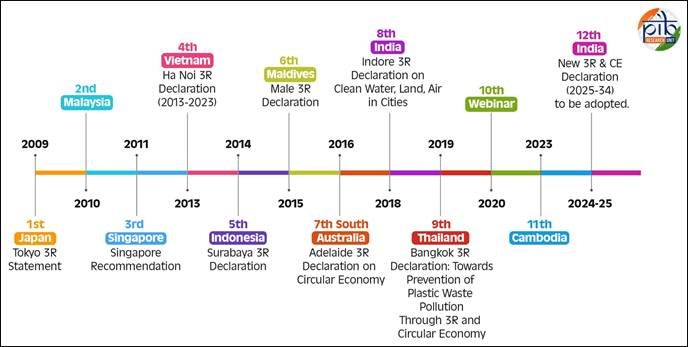
- The Regional 3R and Circular Economy Forum in Asia and the Pacific forum was launched in 2009 with the objective of regional cooperation for sustainable waste management and circular economy initiatives in the rapidly urbanizing and industrializing Asia-Pacific.
- Hanoi 3R Declaration (2013-2023) outlined 33 voluntary goals for shifting towards a more resource efficient and circular economy.
- It has been actively negotiating for a ‘Global Plastic Treaty’.
Cities Coalition for Circularity (C3)
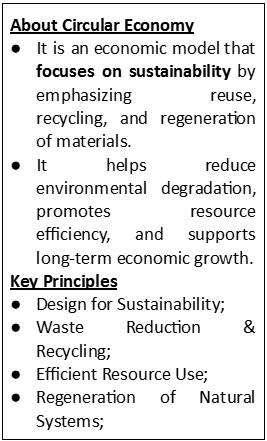
- About: It is a multi-nation alliance designed to help urban centers adopt circular economy principles by integrating sustainable practices into urban planning, waste management, and resource utilization.
- Objectives: Focuses on reducing waste generation through segregation, composting, and upcycling, enhancing resource efficiency by promoting reuse and shared materials, and encouraging sustainable infrastructure.
Importance of C3 for Urban Sustainability
- Mitigating Climate Change: By reducing waste and optimizing resource use, C3 helps cut greenhouse gas emissions.
- Economic Benefits: Transitioning to a circular economy can create new business opportunities in recycling, remanufacturing, and waste management sectors.
- Resilient Cities: A circular economy model ensures that cities become less dependent on finite resources, making them more resilient to supply chain disruptions and economic downturns.
- Job Creation: It generates employment in sectors like renewable energy, sustainable construction, and eco-friendly product manufacturing.
- Improved Quality of Life: Cleaner environments, better waste management, and greener urban spaces lead to improved public health and enhanced overall well-being for citizens.
Global and Indian Context
- Several cities across the globe, such as Amsterdam, Copenhagen, and Tokyo, have already implemented circular economy policies under the C3 framework.
- In India, circularity is gaining traction through initiatives like:
- Swachh Bharat Mission: Encouraging waste segregation and recycling.
- Smart Cities Mission: Promoting sustainable urban development.
- Extended Producer Responsibility (EPR): Holding companies accountable for the lifecycle of their products.
- GOBAR-Dhan Scheme: Currently covers 67.8% of the total number of districts in India.
Challenges in Implementing Circularity in Cities
- Lack of Awareness and Technical Expertise.
- High Initial Investment Costs.
- Resistance to Change from Businesses and Consumers.
- Insufficient Policy Support and Enforcement Mechanisms.
Way Forward
- Develop and enforce policies that mandate circular economy practices.
- Invest in research and innovation for sustainable materials and processes.
- Promote awareness campaigns to educate communities on circular living.
- Strengthen public-private partnerships to scale up circular economy projects.
Capital Account Convertibility
Syllabus: GS3/ Economy
Context
- The Chairman of the 16th Finance Commission, Arvind Panagariya, said that India should not rush into full capital account convertibility at its current per capita income level.
Capital Account Convertibility (CAC)
- Capital account convertibility refers to converting local financial assets into foreign ones freely and vice versa without restrictions.
- It allows unrestricted capital movement for foreign investments, asset purchases, and remittances.
Current Status of Capital Account Convertibility
- India follows a partial capital account convertibility regime.
- While current account transactions (such as trade in goods and services) are fully convertible, capital account transactions are regulated.
- Key aspects of India’s capital account framework include;
- Foreign Direct Investment (FDI) is largely liberalized but still subject to sectoral caps and government approvals in sensitive areas.
- Foreign Portfolio Investment (FPI) is permitted with restrictions on ownership limits in certain sectors.
- Outward investments by Indian residents are allowed but within prescribed limits under the Liberalized Remittance Scheme (LRS).
Advantages of Full CAC
- Greater Capital Inflows: Free capital movement attracts more foreign investments, boosting economic growth and infrastructure development.
- Integration with Global Markets: Increased financial integration enhances India’s competitiveness and access to international financial markets.
- Improved Credit Rating: A more open capital account can signal economic maturity and stability, enhancing investor confidence.
Challenges of Full CAC
- Macroeconomic Instability: Unrestricted capital flows can lead to excessive volatility in exchange rates and inflation, affecting economic stability.
- Risk of Capital Flight: In times of economic uncertainty, rapid outflows of capital could destabilize financial markets and drain foreign exchange reserves.
- Exposure to External Shocks: Open capital accounts make an economy vulnerable to global financial crises and sudden capital reversals.
- Banking Sector Vulnerabilities: A fully convertible capital account requires a strong financial system capable of handling external shocks without excessive government intervention.
Tarapore Committee Recommendations
- Fiscal consolidation: Maintain fiscal deficit around 3-3.5% of GDP for macroeconomic stability.
- Monetary Policy Objectives: Align inflation rates to global levels and ensure interest rates reflect inflation differentials.
- Institutional Strengthening: Enhance monetary policy framework for better decision-making.
- Banking System Reforms: Strengthen banks through restructuring, safeguards, and capacity-building for liberalized capital flows.
- Adequacy of reserves: With implementation of full CAC, adequacy of reserves would be an important parameter in gauging an economy’s ability to absorb external shocks.
Concluding remarks
- While capital account convertibility offers potential benefits, India must adopt a pragmatic approach considering its economic conditions.
- A premature shift to full convertibility could expose the economy to financial instability.
- A well-calibrated strategy focusing on financial sector reforms, exchange rate stability, and macroeconomic resilience will be essential in determining the right path toward greater capital account openness.
Poverty Estimation in India
Syllabus: GS3/Economy
Context
- According to a study by economists Surjit S Bhalla and Karan Bhasin, India has witnessed a sharp reduction in poverty and inequality over the past decade.
Major Highlights
- The study is based on government household expenditure data from 2022-23 and 2023-24.
- Poverty Reduction: India’s poverty rate at the $3.65 PPP line dropped from 52% in 2011-12 to 15.1% in 2023-24. Extreme poverty at the $1.90 PPP line is now below 1%.
- Consumption Growth: Largest improvements in consumption seen in the bottom three deciles of the population, showing record increases.
- Declining Inequality: Consumption inequality has decreased, with the Gini coefficient dropping from 37.5 in 2011-12 to 29.1 in 2023-24.
- Global Context: India’s reduction in inequality is exceptional for a large, fast-growing economy, with only Bhutan and the Dominican Republic having better records (with smaller populations).
- New Poverty Line Needed: Current poverty lines are outdated, suggesting a new benchmark based on the bottom 33rd percentile or relative poverty measures like Europe’s.
- NITI Aayog has yet to revise official poverty estimates, last set by the Tendulkar and Rangarajan committees.
Poverty Line Estimation in India
- Tendulkar committee (2009): Poverty line in the Suresh Tendulkar methodology was expenditure of ₹33 a day in urban areas and ₹27 a day in rural areas.
- The national poverty line for 2011-12 was estimated at Rs. 816 per capita per month for rural areas and Rs. 1,000 per capita per month for urban areas.
- Rangarajan committee(2014): In the Rangarajan methodology, it was ₹47 a day in urban areas and ₹30 a day in rural areas.
- The government did not take a call on the report of the Rangarajan Committee, therefore, poverty is measured using the Tendulkar poverty line.
- International Poverty Line: The World Bank defines a person as extremely poor if a person is living on less than $2.15 per day, which is adjusted for inflation as well as price differences between countries.
Concerns with India’s Calculation of Poverty Line
- Inadequate Thresholds: The updated poverty line of Rs 965 (urban) and Rs 781 (rural) per month is seen as too low to reflect basic living standards, leading to criticism for not accurately capturing poverty.
- Outdated Methodology: It focuses on calorie intake and fails to reflect modern consumption patterns and needs.
- Limited Consideration of Non-Food Needs: The poverty line doesn’t fully account for rising private expenditures in health, education, and other essential services.
- State-Level Variations: The same poverty line is applied uniformly across states despite significant regional cost-of-living differences, which distorts the accuracy of poverty assessments.
- Lack of Regular Updates: The official poverty line hasn’t been updated in alignment with newer economic realities, such as inflation or changes in consumption patterns, making it less relevant.
Way Ahead
- Periodically revise the poverty line to reflect current economic conditions, inflation, and changing consumption patterns.
- Broaden Criteria: Incorporate non-food factors like health, education, and housing into the poverty line calculation to better reflect the true cost of living.
- Regional Adjustments: Implement region-specific poverty lines to account for variations in cost of living across states and regions.
- Adopt Modern Methodologies: Move away from outdated calorie-based measures and adopt more holistic indicators, such as nutritional needs and overall well-being.
IRCTC & IRFC Granted Navratna Status
Syllabus: GS3/ Economy
Context
- The Union Government has granted Navratna status to Indian Railway Catering and Tourism Corporation (IRCTC) and Indian Railway Finance Corporation (IRFC), making them the 25th and 26th Navratna CPSEs (Central Public Sector Enterprises) in India.
About Navratna Status
- Navratna is a prestigious classification awarded to high-performing CPSEs, providing them with greater investment autonomy and operational flexibility.
- The Department of Public Enterprises (DPE) under the Ministry of Finance grants Navratna status to eligible CPSEs.
- Eligibility Criteria for Navratna Status: Be a Miniratna-I CPSE with a positive net worth.
- Achieve an “Excellent” or “Very Good” MoU rating in at least three of the last five years.
- Score 60+ points on key financial indicators such as net profit, net worth, and manpower cost.
- Have at least four independent directors on its board.
Benefits of Navratna Status to Firms
- Enhanced Financial Autonomy: They can invest up to ₹1,000 crore or 15% of their net worth without government approval.
- Operational Freedom: Increased flexibility in forming strategic alliances, joint ventures, and subsidiaries at domestic and international levels.
- Increased Market Credibility: Strengthens corporate reputation, making the company more attractive to investors, partners, and financial institutions.
- Strategic Decision-Making: More power in capital expenditure, mergers, acquisitions, and human resource management.
| Indian Railway Catering and Tourism Corporation (IRCTC) – About: 1. IRCTC is a public sector enterprise that provides ticketing, catering, and tourism services for Indian Railways. – Establishment & Ministry: 1. Established: 1999 2. Operates under: Ministry of Railways, Government of India About Indian Railway Finance Corporation (IRFC) – About: 1. IRFC is the dedicated financing arm of the Indian Railways. Its primary purpose is to raise funds from both domestic and overseas capital markets. – Administrative Control: 1. Ministry of Railways, Government of India. – Working: 1. It operates as a Systemically Important Non-Deposit taking Non Banking Financial Company (NBFC – ND-SI) and Infrastructure Finance Company (NBFC-IFC) registered with the Reserve Bank of India (RBI). 2. Its core business model involves borrowing funds and then leasing assets to Indian Railways. |
Taxing Virtual Digital Assets
Syllabus :GS3/Economy/Science & Technology
In News
- India’s Income Tax Bill, 2025 introduces a legal framework for Virtual Digital Assets (VDAs), aligning the country’s tax structure with global standards.
- Major economies like the U.K., U.S., Singapore, and Australia treat VDAs as property or securities.
Virtual Digital Assets (VDAs)
- VDAs were defined in the Finance Act, 2022 with the introduction of clause 47A to Section 2 of the Income Tax Act, 1961.
- The Supreme Court, in the Internet and Mobile Association of India v. RBI case, referred to the FATF Report’s definition of virtual currency (VC), describing it as a digital unit that acts as a medium of exchange, unit of account, and store of value, but is not government-issued legal tender.
- The Court also interpreted VDAs as property, commodity, or payment method, and concluded they can be treated as intangible property or goods.
Introduction of VDA Taxation in India
- India’s Income Tax Bill, 2025 classifies VDAs (including crypto assets, NFTs, etc.) as property and capital assets.
- This aligns India with global practices like the U.K., Australia, and New Zealand, where VDAs are treated as property for tax purposes.
- VDAs will be taxed under capital gains provisions.
- Profit from the sale of VDAs will be taxed based on short-term or long-term capital gains rules, depending on the holding period.
Features
- A flat 30% tax rate is applied on VDA income from transfers, with no deductions for transaction costs, unlike some countries like the UAE.
- A 1% TDS (Tax Deducted at Source) is imposed on VDA transfers, even for peer-to-peer (P2P) transactions.
- TDS exemption thresholds are ₹50,000 for small traders and ₹10,000 for others.
- Tax authorities can seize VDAs during investigations or tax raids, similar to assets like cash or gold.
- Entities dealing in VDAs (such as exchanges and wallet providers) are required to report transactions in a prescribed format.
- VDAs must be included in the Annual Information Statement (AIS), ensuring automatic recording in taxpayers’ financial profiles.
Importance
- The requirement for reporting VDA transactions increases transparency and helps prevent tax evasion, as authorities can track large crypto transactions through mechanisms like Tax Deducted at Source (TDS).
- The taxation of VDAs as property may alter investment behavior by introducing more financial discipline, encouraging investors to carefully consider tax implications before trading.
- It will foster foreign investment and confidence and it enhances the credibility of India’s digital asset market on the global stage.
Challenges
- Despite advancements in taxonomy and taxation, there are gaps in investor protection, market regulation, and enforcement mechanisms.
- A 30% tax rate can lead to a higher tax burden on individuals trading VDAs compared to traditional investments, especially for frequent traders.
Suggestions
- India’s move to treat VDAs as property and capital assets aligns with international standards like the U.K. and the U.S., enhancing the legal recognition and regulatory framework for digital assets.
- But a comprehensive policy framework integrating financial regulations, consumer rights, and technology is necessary for a secure digital asset ecosystem.
OTHERS:
India Secures Copper Exploration Block in Zambia
Syllabus: GS1/Geography/Critical Minerals
Context
- India has secured a 9,000-sq-km exploration block to explore copper and cobalt in Zambia.
- Zambia is the 7th largest copper producer globally.
Recent Trends in Global Copper Market
- As per a Bloomberg report, global copper ore supply is shrinking, intensifying the race for resources.
- China controls 50% of global copper smelting and refining capacity.
- Copper demand is rising, driven by EV batteries, renewable energy, and clean technologies.
- Chile, Peru, China, the Democratic Republic of the Congo (DRC), and the United States lead in global copper production.
- India, China, and the U.S. are securing copper supply chains, leading to increased geopolitical competition over the next decade.
India’s Copper Situation
- Domestic ore production in 2023-24 was 3.78 million tonnes (8% lower than 2018-19).
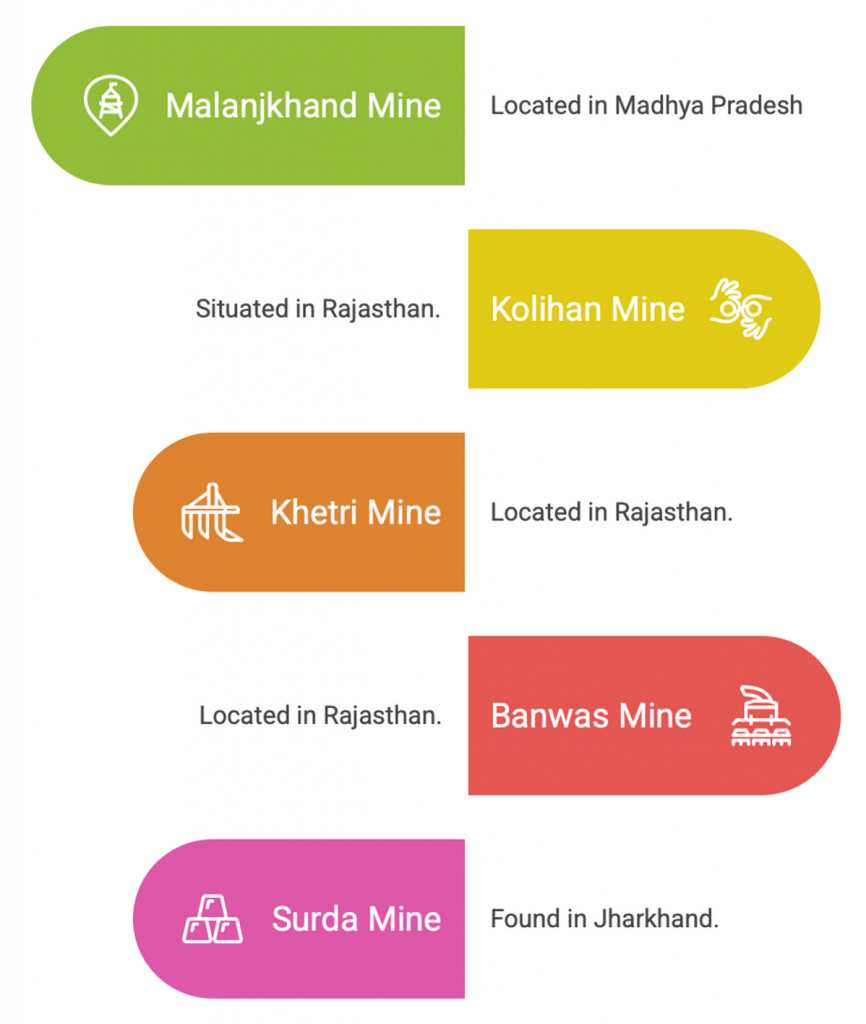
- Madhya Pradesh is the leading producer of copper in India followed by Rajasthan.
- Copper Mines in India:
- Copper Imports: India’s copper concentrate imports have doubled in value to Rs 26,000 crore in 2023-24 from 2018-19.
- Challenges with Domestic Deposits: India has large copper deposits, but they require extensive exploration before mining.
- The global average time to operationalize a copper mine is 17 years.
- Overseas Investment Strategy: India is securing copper assets in Zambia, Chile, and the DRC for short-term demand.
- However, overseas investments carry significant geopolitical risks.
Africa’s Rising Share in Critical Minerals
- The continent produces 70% of global cobalt and 16% of global copper.
- The DRC is set to become the world’s second-largest copper supplier by 2030.
- India’s Efforts in Africa: India’s Ministry of Mines is working in the DRC, Tanzania, Mozambique, and Rwanda to acquire critical mineral assets.
Source: IE
Swavalambini
Syllabus: GS2/ Governance
Context
- The Ministry of Skill Development and Entrepreneurship (MSDE), in collaboration with NITI Aayog, launched Swavalambini, a Women Entrepreneurship Programme.
About
- Swavalambini aims to establish a structured and stage-wise entrepreneurial journey for young women.
- This programme aims to nurture the entrepreneurial spirit among young women in Higher Education Institutions (HEIs) by providing them with the necessary mindset, resources, and mentorship to successfully build and scale their ventures.
Key Features of the Swavalambini Programme
- Faculty Development Programme (FDP): Swavalambini focuses on training faculty members from participating Higher Education Institutions (HEIs) with five-day training sessions.
- Mentorship: Once participants have developed their business plans, they receive mentorship from industry experts and successful entrepreneurs. Additionally, the programme facilitates:
- Access to funding opportunities through government schemes and private investors.
- Networking opportunities with established business leaders and professionals.
- Women Entrepreneurship Development Programme (EDP): Building on the foundation laid in the EAP, the Entrepreneurship Development Programme (EDP) provides a deeper understanding of:
- Business planning, Leadership and decision-making skills,
- Financial literacy and investment strategies.
- Market research and competitive analysis.
Source: PIB
Doctrine of Equality
Syllabus :GS 2/Polity
In News
- The Supreme Court of India ruled that visually challenged candidates cannot be deemed unsuitable for judicial service.
Supreme Court’s Recent Rulings
- The court emphasized the principle of inclusivity and equality, noting that ‘disability’ should be added as a ground for non-discrimination in Article 15 of the Constitution.
- The court stressed that any indirect discrimination, such as rigid cut-offs or procedural barriers, that excludes persons with disabilities (PwD) from judicial service should be removed to ensure equality.
Right to Equality in India
- Articles 14 to 18 deal with different aspects of the right to equality.
- Article 14 – It ensures that all persons are equal before the law and have equal protection of the laws within India, without discrimination on grounds such as religion, race, caste, sex, or place of birth.
- Article 15 – It prohibits discrimination by the state on grounds of religion, race, caste, sex, or place of birth.
- Allows for special provisions to be made for the welfare of women, children, socially and educationally backward classes, and SCs/STs.
- Also prohibits discrimination in public spaces like shops, restaurants, and public entertainment venues.
- Article 16 -It guarantees equality of opportunity for all citizens in public employment, prohibiting discrimination in employment based on religion, race, caste, sex, descent, place of birth, or residence.
- Article 17 – It abolishes untouchability and prohibits its practice in any form.
- Article 18 – It prohibits the state from granting titles other than military or academic distinctions.
Source:TH
US Announces Creation of Crypto Strategic Reserve
Syllabus: GS3/ Economy
In News
- The U.S. government has announced the creation of a Crypto Strategic Reserve.
What is the Crypto Strategic Reserve?
- The Crypto Strategic Reserve will serve as a national stockpile of digital assets, managed under a federal regulatory framework. The reserve will consist of five major cryptocurrencies: Bitcoin, Ethereum, Ripple, Solana & Cardano.
- This initiative aims to integrate cryptocurrencies into the U.S. financial infrastructure.
Significance of the Initiative
- The establishment of a Crypto Strategic Reserve draws parallels to the Strategic Petroleum Reserve.
- By holding digital assets, the U.S. can mitigate financial risks and expand its economic portfolio.
- Cryptocurrencies can serve as a safeguard against inflation and traditional market fluctuations.
Source: TH
Ferrihydrite
Syllabus: GS3/Space
Context
- A study by NASA and ESA suggests that Mars’ red color originates from ferrihydrite.
About
- Formation of Ferrihydrite: Ferrihydrite requires cool water to form, indicating that Mars may have had liquid water in its past.
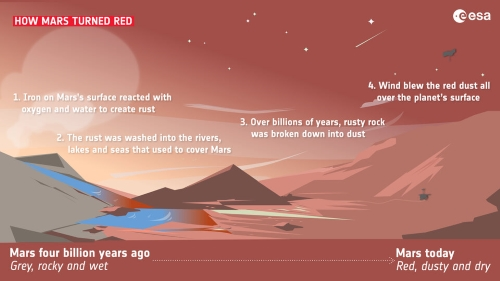
- Mars was thought to have turned red due to slow oxidation in dry conditions over billions of years.
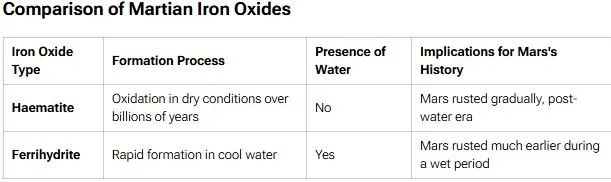
- Implication for Habitability: The presence of ferrihydrite implies that Mars could have been habitable in the past, with conditions that allowed liquid water.
Significance of the Study
- Evidence of Water: The presence of ferrihydrite indicates prolonged water activity.
- Past Habitability: Suggests an environment more suitable for sustaining life.
- Climate Insights: Helps reconstruct Mars’ transition from a wet to a dry planet.
| About Mars – Mars is the fourth planet from the sun and has a distinct rusty red appearance and two unusual moons. 1. Phobos: ~6000 km above Mars; Deimos: ~20 000 km above Mars. – It has a very thin atmosphere, but dusty. – Gravity: 3.711 m/s2 (about one third of Earth’s gravity) – Mars also has the largest volcanoes in the solar system, Olympus Mons being one of them. – Atmosphere: 95.32% carbon dioxide, 2.7% nitrogen, 1.6% argon, 0.13% oxygen |
