
International Women’s Day
Syllabus: GS1/Society
Context
- Prime Minister reiterates commitment for Women Empowerment on International Women’s Day.
About
- Every Year International Women’s Day is celebrated on the 8th March.
- Vladimir Lenin declared March 8 as International Women’s Day in 1922 to recognise the women’s role in the 1917 Russian Revolution.
- It was officially recognized by the United Nations in 1977.
- The themes for 2025 include:
- United Nations (UN) Theme: “For All Women and Girls: Rights. Equality. Empowerment,”.
- Official IWD Theme: “Accelerate Action.”
- The year 2025 commemorates 30 years since the adoption of the Beijing Declaration and Platform for Action.
- This agreement remains one of the most comprehensive frameworks for advancing women’s and girls’ rights globally.
Legal Framework for Women Empowerment in India
- The Indian Constitution guarantees gender equality through provisions in its Preamble, Fundamental Rights, and Directive Principles of State Policy.
- Article 14 ensures equality before the law, while Article 15 prohibits discrimination based on sex.
- Article 51(a)(e) encourages citizens to renounce practices derogatory to women’s dignity.
- The Directive Principles, particularly Articles 39 and 42, emphasize equal livelihood opportunities, equal pay, and maternity relief.
Challenges Faced by Women
- Gender Discrimination: Persistent cultural biases and stereotypes that limit opportunities for women in various sectors.
- Lack of Access to Education: Limited access to quality education, especially in rural areas, affecting girls’ future opportunities.
- Economic Inequality: Women often face wage gaps, limited job opportunities, and unequal financial independence.
- Safety and Security: High rates of gender-based violence, including sexual harassment, domestic violence, and trafficking.
- Health and Reproductive Rights: Limited access to healthcare, reproductive rights, and maternal health services.
- Child Marriage: Prevalence of child marriage, particularly in rural areas, which affects women’s health, education, and autonomy.
- Political Representation: Underrepresentation in political offices and decision-making roles.
- Social Norms and Expectations: Rigid societal roles that limit women’s freedom and opportunities for self-expression and growth.
- Workplace Harassment: Gender-based harassment and lack of proper support structures in workplaces.
India is a signatory to international treaties such as:
- Universal Declaration of Human Rights (1948).
- International Covenant on Civil and Political Rights (ICCPR, 1966).
- Convention on the Elimination of All Forms of Discrimination Against Women (CEDAW, 1979).
- Beijing Declaration and Platform for Action (1995).
- United Nations Convention Against Corruption (2003).
- Agenda 2030 for Sustainable Development.
Achievements in India:
- Nari Shakti Vandan Adhiniyam, 2023, seeks to reserve one-third of the total number of seats for women in Lok Sabha, State Legislative Assemblies and Delhi Assembly.
- The National Sex Ratio improved to 1020 for the first time (National Family Health Survey -5).
- Paid maternity leave increased to 26 weeks.
- 3.2 Crore Sukanya Samruddhi Yojana accounts.
- 72% women ownership under PM Awas Yojana Gramin.
- MMR to 97/lakh live births in 2018-20 from 130/lakh live births in 2014-16.
- Abolition of Triple Talaq empowering Muslim women.
- Permanent commission granted to Women Officers in 12 Arms and Services.
- Entry of women as Agniveers commenced in all the three Services.
- 43% of STEM graduates in India are women which is highest in the world.
Government Initiatives
- Mission Shakti is a women empowerment programme launched by the Ministry of Women and Child Development (MWCD) for the period 2021-2025.
- It aims to strengthen interventions for women’s welfare, safety, and empowerment, making women equal partners in nation-building.
- Initiatives like Beti Bachao, Beti Padhao, Sukanya Samriddhi Yojana, Janani Shishu Suraksha Karyakram, and PM Matru Vandana Yojana have also contributed to significant improvements in the welfare and empowerment of women and girls.
- The Mission Saksham Anganwadi and Poshan 2.0 programmes focus on improving women’s health beyond just calorie intake and improving overall health and immunity with proper micronutrients.
- The Women in Science and Engineering-KIRAN (WISE KIRAN) program has supported nearly 1,962 women scientists from 2018 to 2023.
- Nari Shakti Puraskar: Recognizes the contributions of women in various fields, celebrating achievements and inspiring others.
- Maternity Benefit (Amendment) Act, 2017: Provides for 26 weeks of paid maternity leave for women working in the private sector and government.
Iran Declined to Resume Nuclear Deal Negotiations with USA
Syllabus: GS2/IR
Context
- Iran declined to resume negotiations on its nuclear programme with the United States.
About
- Trump’s administration has levied sanctions against Iran – including on the country’s oil network – as part of his “maximum pressure” strategy.
- Trump wrote to Iran, urging negotiations on the nuclear deal or risk military action.
- Iran’s Foreign Minister stated they would only negotiate with other JCPOA members (Europe, Russia, China), not the U.S.
Joint Comprehensive Plan of Action (JCPOA) 2015
- Participants:
- Iran
- P5+1: Five permanent members of the UN Security Council (China, France, Russia, UK, U.S.) plus Germany.
- EU: Participated in negotiations.
Iran’s Commitments:
- Nuclear Restrictions: Iran agreed not to produce highly enriched uranium or plutonium for nuclear weapons and to ensure its nuclear facilities (Fordow, Natanz, Arak) focus on civilian purposes.
- Centrifuge Limits: Iran limited the number, type, and level of its centrifuges, and reduced its stockpile of enriched uranium.
- Uranium enriched to 5% is for nuclear power; 20% for research or medical use; 90% for weapons.
- Monitoring and Verification: Iran agreed to allow the International Atomic Energy Agency (IAEA) unfettered access to nuclear facilities, including undeclared sites.
- A Joint Commission monitors the deal’s implementation and resolves disputes, including granting IAEA access to suspicious sites.
What Other Signatories Agreed To:
- Sanctions Relief: The EU, UN, and U.S. agreed to lift nuclear-related sanctions on Iran, but U.S. sanctions on ballistic missiles, terrorism support, and human rights remained.
- The U.S. lifted sanctions on oil exports but kept restrictions on financial transactions.
- UN arms and missile bans on Iran were lifted after five years, provided the IAEA confirmed Iran’s nuclear activities remained civilian.
- Violation of the Deal: If any signatory suspects Iran is violating the deal, the UN Security Council can vote on whether to continue sanctions relief.
- This “snapback” mechanism remains in effect for ten years, after which the UN sanctions are set to be permanently removed.
- Trump’s Withdrawal: In 2018, President Trump withdrew the U.S. from the deal, leading Iran to resume nuclear activities.
- Iran’s Nuclear Activity: In 2023, Iran enriched uranium to near weapons-grade levels, raising international concerns.
- Key provisions of the JCPOA began to expire by late 2023.
Goals of the JCPOA:
- Delay Iran’s Nuclear Weapon Development: The goal was to delay Iran’s ability to make a nuclear weapon by at least one year, compared to a few months without the agreement.
- Prevent Regional Crisis: Fears that Iran’s nuclear program could lead to preemptive military action by Israel or a nuclear arms race within the region.
Challenges in Negotiation
- Mistrust between the U.S. and Iran: Past betrayals hinder diplomatic progress.
- Diverging Interests: U.S. wants a broader deal; Iran seeks JCPOA restoration.
- Domestic Political Constraints: Hardliners in both nations resist compromise.
Way Ahead
| Scenario | Possible Outcomes |
| – Successful Negotiations | De-escalation of tensions, economic relief for Iran, nuclear restrictions in place. |
| – No Deal / Status Quo | Continued nuclear escalation, further sanctions, regional instability. |
| – Military Action | Risk of conflict in the Middle East, disruption of oil markets, global economic impact. |
Seagrass Conservation Key to Global Biodiversity
Syllabus: GS3/ Environment, Conservation
In Context
- A recent review published in Nature Reviews Earth & Environment highlights declining status of seagrass worldwide due to human activities at a rate of 1-2% per year.
About Seagrasses
- Seagrasses are submerged, flowering plants that form dense underwater meadows. They evolved from terrestrial plants and adapted to marine environments.
- Unlike seaweed (which is algae), seagrasses have roots, stems, and leaves and can produce flowers and seeds.
Importance of Seagrass Ecosystems
- Carbon Sequestration and Climate Action: Known as the “lungs of the sea,” seagrasses can store carbon up to 35 times faster than tropical rainforests.
- Biodiversity and Marine Life Protection: Seagrass meadows provide habitat and nurseries for fish species and shelter for threatened & endangered marine species.
- Coastal Protection: Acting as natural barriers, seagrasses protect coastal communities from storms and erosion, thereby reducing disaster risks.
- Economic Values: Seagrass meadows provide immense economic benefits, valued at US $6.4 trillion annually. They support coastal economies by sustaining fisheries, tourism
Seagrass in India
- India, with a recalculated coastline of 11,098 km (2023-24), has extensive seagrass meadows, particularly in the Gulf of Mannar, Palk Bay, Andaman and Nicobar Islands, Lakshadweep Islands, and the Gulf of Kutch.
Threats to Seagrass Ecosystems
- Anthropogenic Activities like urbanization, pollution and agricultural activities.
- Weak Enforcement of Laws for protecting coastal ecosystems
- Biodiversity Loss and unregulated fishing and boating activities.
Global and Indian Restoration Efforts
- Global Success Stories:
- Seagrass Watch: A collaborative citizen science program that trains volunteers, NGOs, and research organizations to monitor, document, and conserve seagrass habitats worldwide.
- Blue Carbon Initiative: A global project focusing on carbon sequestration in coastal ecosystems, including mangroves, salt marshes, and seagrasses.
- Indian Conservation Initiatives:
- National Policy on Marine Fisheries (2017): Recognizes seagrass meadows as essential coastal marine ecosystems alongside mangroves and coral reefs.
- Climate Resilience Project: Implemented in Andhra Pradesh, Maharashtra, and Odisha. Supported by a grant from the Global Climate Fund (GCF).
- Seagrass Restoration in Gulf of Mannar and Palk Bay.
‘Democracy to Emocracy’
Syllabus: GS2/Governance, GS4/ Ethics
Context
- Recently, the Vice-President of India called for a national debate on the shift from ‘Democracy to Emocracy’, emphasizing that emotion-driven policies and debates threaten the foundational principles of democracy.
Understanding Emocracy: From Rational Debate to Emotional Influence
- Traditionally, democracy is built upon logical reasoning, debate, and informed citizenry.
- In an ideal democratic setup, policies are formulated and debated based on evidence, expert insights, and rational decision-making.
- However, in an emocracy (fusion of ‘emotion’ and ‘democracy’), decision-making is increasingly dictated by public emotions, viral narratives, and psychological persuasion tactics.
- It is visible worldwide—from the rise of leaders like Donald Trump in the U.S. to Brexit in the U.K. and the nationalist surge in several European nations.
| Democracy vs Emocracy: Key Differences | ||
| Feature | Democracy | Emocracy |
| Decision-Making | Rational, evidence-based | Emotion-driven, impulsive |
| Political Leadership | Accountable, policy-focused | Charismatic, populist |
| Public Engagement | Informed debate | Sentiment-driven reactions |
| Media Influence | Free press, investigative journalism | Sensationalism, misinformation |
| Long-term Governance | Stability, institutional continuity | Short-term, reactionary policies |
Drivers of the Shift from Democracy to Emocracy
- Digital Revolution and Social Media Influence: Social Media Platforms amplify sensationalism over substance, allowing emotionally charged narratives to go viral.
- In contrast to traditional media, where journalistic ethics ensured some degree of fact-checking, social media allows unchecked misinformation to spread rapidly.
- Role of Political Messaging and Propaganda: Political parties across the spectrum have adopted emotionally charged rhetoric to mobilize voters.
- Whether it’s invoking nationalism, religious sentiments, or historical grievances, political campaigns are now designed to elicit strong emotional responses rather than engage in logical debates.
- Identity Politics and Group-Based Mobilization: Political leaders have realized that appealing to group identities—religion, caste, region, and ethnicity—can secure mass support.
- It led to a governance model where policies are often framed to appease emotional constituencies rather than being based on broader economic and developmental priorities.
- Affirmative Action vs. Appeasement: Provisions for marginalized communities, as outlined in Articles 14, 15, and 16 of the Constitution, are justifiable and necessary for social equity.
Threats to Good Governance from Emotionally Driven Policies
- Populism and Fiscal Prudence: Populist leaders appeal to mass emotions rather than policy-based governance.
- For example: Farm Loan Waivers: Several Indian states, including Punjab and Maharashtra, have announced large-scale farm loan waivers in response to farmers’ protests. Data from RBI (2023) shows that less than 30% of small farmers actually benefit from such waivers, while they create long-term financial burdens on state budgets.
- Legal and Constitutional Conflicts: Emotionally driven policies often bypass due process, leading to poorly drafted laws with constitutional or legal loopholes.
- Example: Demonetization (2016): Announced as a move to curb black money, demonetization created short-term economic distress without effectively reducing illicit wealth.
- NSSO Data (2018): 1.5 million jobs were lost in the informal sector due to cash shortages. The Supreme Court of India (2023) upheld demonetization’s legality but acknowledged its flawed implementation.
- Example: Demonetization (2016): Announced as a move to curb black money, demonetization created short-term economic distress without effectively reducing illicit wealth.
- Economic Disruptions and Resource Misallocation: Policies based on emotions often ignore economic feasibility, leading to wasteful expenditure.
- Disrupts market confidence and investment climate.
- Example: Free Electricity and Water Schemes: Many governments announce free utilities as an emotional appeal to voters.
- CAG Report (2021): Free electricity schemes in Delhi and Punjab have led to rising power sector debts, affecting infrastructure investments.
- Social Polarization and Policy Paralysis: Policies framed under emotional pressure often lead to divisive politics. Lack of consensus among stakeholders results in implementation failures.
- Example: Citizenship Amendment Act (CAA) (2019): Passed amidst heated political debates, the CAA led to nationwide protests due to concerns over religious discrimination which further delayed the NRC process.
- Reactionary vs. Long-Term Policy Making: Crisis-driven policies often lack long-term vision. Immediate measures overshadow structural reforms.
- Example: COVID-19 Lockdown (2020): The nationwide lockdown was implemented abruptly, leaving millions of migrant workers stranded.
- CMIE Data (2021): 75 million people lost jobs due to lack of planning for economic disruptions.
- Countries like Germany and South Korea adopted phased lockdowns with social security support, minimizing economic shocks.
- Example: COVID-19 Lockdown (2020): The nationwide lockdown was implemented abruptly, leaving millions of migrant workers stranded.
Why Emotionally Driven Policies Are Still Important?
- Social Justice and Correcting Historical Wrongs: Some policies need to be emotionally driven to address past injustices and ensure equity.
- Policies aimed at marginalized groups are often motivated by ethical and emotional considerations.
- Example: Reservation for SCs, STs, and OBCs.
- Despite criticism, affirmative action policies have played a key role in social mobility.
- NITI Aayog Report (2023): The literacy rate among SCs and STs has improved significantly due to reservation policies in education.
- Quick Decision-Making During Crises: Emotional responses are often necessary in times of disaster or war to ensure rapid government intervention.
- Bureaucratic delays can worsen humanitarian crises if policies are overly rationalized without urgency.
- For example: 80 million people benefited from Pradhan Mantri Garib Kalyan Yojana (PMGKY) in the pandemic period.
- Bureaucratic delays can worsen humanitarian crises if policies are overly rationalized without urgency.
- Strengthening National Unity & Identity: Some emotionally driven policies are designed to foster national unity and reinforce common identity.
- Policies promoting patriotism, culture, and heritage may not always be economically or legally necessary but serve long-term social cohesion.
- Example: Swachh Bharat Abhiyan: While critics argued it focused more on symbolism than structural sanitation reforms, it significantly improved rural sanitation awareness.
- UNICEF Study (2021): Open defecation reduced by 60% in rural India due to behavioral changes.
Way Forward
- Strengthening Data-Driven Governance: Policies should be framed by economic, scientific, and social research rather than sentiment.
- Example: Kerala’s Nava Keralam Mission focuses on health and education reforms based on real-time data analysis.
- Regulating Social Media Narratives: While free speech must be protected, platforms must adopt stricter regulations to prevent misinformation and hate speech.
- Reviving Rational Public Debates: Institutions like universities, think tanks, and civil society groups should take the lead in restoring logic-based discussions in public forums.
- Institutional Reforms: Fiscal policies should undergo rigorous scrutiny by parliamentary committees to assess long-term impact.
- Example: The Fiscal Responsibility and Budget Management (FRBM) Act helps prevent reckless public spending.
- 2nd ARC Recommendation: Institutionalize Impact Assessment Committees before rolling out major policies to avoid reactionary decision-making.
US Withdrawn from Loss and Damage Fund
Syllabus: GS 3/Environment
In News
- The US has withdrawn from the board of the Loss and Damage Fund.
| Trump Administration’s Climate Disengagement – The decision reflects the Trump administration’s ongoing disengagement from international climate agreements, including pulling out of the Paris Agreement, halting US scientists’ participation in the IPCC, and cancelling funds for the Green Climate Fund. |
Loss and Damage Fund (LDF)
- It was established at the 2022 UNFCCC Conference (COP27) in Egypt to provide financial support to regions suffering both economic and non-economic losses caused by climate change.
- These include extreme weather events and slow-onset processes, such as rising sea levels.
- The LDF is overseen by a Governing Board that determines how the Fund’s resources are disbursed, with the World Bank serving as the interim trustee.
Objectives
- The purpose of the Fund is to assist developing countries that are particularly vulnerable to the adverse effects of climate change in responding to economic and non-economic loss and damage associated with the adverse effects of climate change, including extreme weather events and slow onset events.
Concerns
- Climate funds are often too slow to be accessible immediately after a disaster, particularly for local communities at the sub-national level.
- It is anticipated that the LDF may face similar challenges.
- Without drastic emissions reductions, more countries will suffer from climate change’s devastating effects, making additional resources for mitigation, adaptation, and loss and damage critical to achieving the Sustainable Development Goals.
- The US withdrawal undermines global climate justice and must be held accountable for its role in climate damage and reparations.
| India’s Approach – Despite suffering over $56 billion in damages from weather-related disasters between 2019 and 2023, India has focused more on mitigation efforts rather than adaptation, leading to limited participation in Loss and Damage dialogues at COP meetings. – The introduction of a climate finance taxonomy in India’s Union Budget 2024 has raised hopes for increased international climate finance. However, without clear guidelines on accessing LDF funds, vulnerable communities will remain exposed. |
Conclusion and Way Forward
- The effectiveness of the Loss and Damage Fund depends on addressing gaps left by existing climate finance institutions like the Green Climate Fund.
- However, for the fund to truly be effective, the root cause of climate change—emissions—must be tackled.
- India needs a clear legal and policy framework to streamline climate finance for adaptation and loss and damage, in line with locally led adaptation principles crucial for vulnerable communities.
MISCELLANEOUS
Golden Passport Program of Vanuatu
Syllabus: GS 1/Places
In News
- Former IPL chief Lalit Modi has surrendered his Indian passport and acquired citizenship in Vanuatu which offers a golden passport program.

Golden passport program
- Vanuatu offers a popular Citizenship by Investment (CBI) or “golden passport” program.
- It allows individuals to acquire citizenship by making significant financial contributions to a country’s economy.
- The cost of citizenship ranges from $135,500 to $155,500, with options for a family of four.
- Processing time ranges from 30 to 60 days after application submission.
Benefits of Vanuatu’s Citizenship
- It ranks 51st in the Henley Passport Index (ahead of Saudi Arabia, China, India and Indonesia).
- Vanuatu is a tax haven with no personal income tax, capital gains tax, inheritance tax, or wealth tax.
- Vanuatu relies heavily on offshore financial services for revenue generation.
- Despite being a poor country, it uses its tax haven status to attract investment.
Scandals and Criticism
- Several individuals linked to criminal activities have been granted citizenship, raising concerns about exploitation of the scheme.
- Experts warn that the program is vulnerable to exploitation and could be used as a backdoor for access to the EU and UK.
- Vanuatu’s lax taxation laws are seen as a potential avenue for money laundering.
Source: IE
6 Years of POSHAN Abhiyan
Syllabus: GS2/ Welfare Scheme
In Context
- POSHAN Abhiyaan which was launched in 2018, recently completed 7 years of its implementation.
About POSHAN Abhiyaan
- Objectives:
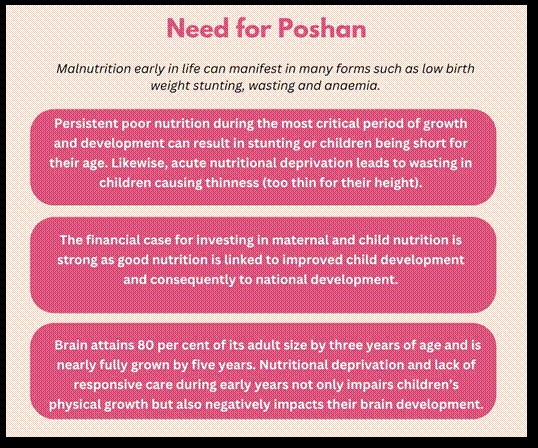
- Prevent and reduce stunting in children (0-6 years).
- Prevent and reduce under-nutrition (underweight prevalence) in children (0-6 years).
- Reduce anemia prevalence among women and adolescent girls (15-49 years).
- Reduce low birth weight (LBW) through improved maternal and child healthcare.
- Strategic Pillars of Poshan Abhiyaan:
- Access to Quality Services: Providing essential health services through schemes like Integrated Child Development Scheme (ICDS) , National Health Mission (NHM), and Pradhan Mantri Matru Vandana Yojana (PMMVY), especially during the first 1,000 days of a child’s life.
- Cross-Sectoral Convergence: Coordinating efforts across multiple ministries, including water and sanitation under the Swachh Bharat Mission and drinking water access through the National Drinking Water Mission.
- Leveraging Technology: Tools like the Poshan Tracker application enable real-time data collection and intervention.
- Jan Andolan: Community engagement is key to driving mass awareness and encouraging behavioral change around nutrition.
Mission Saksham Anganwadi and POSHAN 2.0
- Launched in 2021, it amalgamated various programmes with similar objectives such as Supplementary Nutrition Programme and POSHAN Abhiyaan under one umbrella.
- Funding pattern:
- For States & UTs with a legislature: 60:40 between Union and State/ UT Government.
- For Northeastern (NER) & Himalayan States: 90:10 between Union and State Government.
Rashtriya Karmayogi Jan Seva Programme
Syllabus: GS2/Governance
Context
- The Union Ministry of Social Justice and Empowerment, successfully inaugurated the first batch of the Rashtriya Karmayogi Jan Seva Programme.
About
- It is an interactive event aimed to inspire, enlighten, and guide Central Government employees to adopt the Karmayogi Way, emphasizing a citizen-centric approach to governance.
- The initiative is launched by the Capacity Building Commission.
- The programme focused on fostering Seva-Bhav (a sense of service) and accountability.
Capacity Building Commission
- It was established in 2021.
- It is a three-member Commission, supported by an internal Secretariat headed by a Secretary.
- Members have been appointed from diverse backgrounds such as private sector, academia, public sector, and civil society.
- The Commission’s focus is on driving stand harmonisation across the public sector learning and development landscape.
| Mission KarmaYogi – In 2020, Government of India has launched Mission Karmayogi, a National Programme for Civil Services Capacity Building (NPCSCP). – It is anchored by an apex body and headed by the Prime Minister. – The programme aims at building a future-ready civil service with the right attitude, skills and knowledge, aligned to the vision of New India. |
Organization of Islamic Cooperation (OIC)
Source: GS2/ Regional Groupings
In News
- The Organization of Islamic Cooperation (OIC) supported the Arab League’s alternative proposal opposing Trump’s plan to take control of Gaza and forcibly relocate its residents.
About Organization of Islamic Cooperation (OIC)
- It is the second largest organization after the United Nations with a membership of 57 states spread over four continents and represents the collective voice of the Muslim world.
- Founded: 25 September 1969
- Headquarters: Jeddah, Saudi Arabia
- Objectives of the OIC:
- Promote Islamic Solidarity among member states.
- Defend Muslim interests in political, social, economic, and cultural spheres.
- Protect Islamic holy sites, particularly in Palestine.
India and the OIC
- India is not a member but has been mentioned in OIC resolutions, particularly concerning Kashmir.
- In 2019, India was invited as a guest of honor to the OIC Foreign Ministers’ meeting.
- India has criticized OIC’s stance on Kashmir, considering it an interference in internal affairs.
Chief of Defence Staff Visit to Australia
Syllabus: GS2/IR
Context
- Chief of Defence Staff, General Anil Chauhan, visited Australia.
About
- Focus: The visit advanced cooperation on shared priorities and interoperability between India and Australia.
- Key areas of cooperation:
- Maritime domain awareness.
- Reciprocal information sharing.
- Deployments from each other’s territories.
| Chief of Defence Staff (CDS) – Indian Army chief General Bipin Rawat was appointed the first Chief of Defence Staff (CDS) in 2019. – It is the highest-ranking military officer in the Indian Armed Forces. 1. It is responsible for overseeing the operations and coordination of the Indian Army, Navy, and Air Force. – The CDS so heads the Department of Military Affairs and plays a key role in modernization and strategic defense planning. |
India-Australia Partnership
- Australia and India focus on long-term vision for enhancing collective strength and security.
- India is a key security partner for Australia, both aiming for a peaceful, stable, and prosperous Indo-Pacific.
- Defence & Strategic Cooperation: Major transformation in the last 8-10 years between Australia and India.
- Mutual Logistics Support Agreement: Signed in 2020 to enhance logistical cooperation.
- Navy-to-Navy Relationship: ‘Joint Guidance for India-Australia Navy to Navy Relationship’ signed in August 2021.
- Ongoing Talks: Advanced discussions on hydrography cooperation and air-to-air refueling.
