

Use of Tools by Ancient Ancestors
Syllabus: GS1/Ancient History
Context
- As per a study in Nature, ancient ancestors were using bone tools at least 1.5 million years ago, roughly a million years earlier than was previously thought.
About
- The earliest known stone tools are even older, dating to 3.3 million years ago.
- These dates are based on prehistoric tools that have survived into the present.
- The earliest evidence for the use of wood dates back to only 700,000 years ago.
- British palaeoanthropologist Kenneth Oakley identified tool-use and toolmaking as uniquely human traits in the late 1940s.
- It suggested that tool technology was a uniquely human trait.
- Experts today suggest that ape-like ancestors might have been using sticks and stones in their daily lives millions of years prior to what the oldest tools can be dated to.
- This means that tool technology predates the emergence genus Homo, and it is not a uniquely human trait.
Timeline of Study of Tool Making
- Charles Darwin (1871): Noted that chimpanzees used tools, such as cracking nuts with stones.
- Jane Goodall (1960s): Expanded on Darwin’s work by observing chimps using tools like sticks to fish for termites and leaves to drink water.
- Despite Goodall’s findings, scientists for decades continued to hold an anthropocentric view of tool technology.
- Tool use and toolmaking: Initially believed to be uniquely human, chimps and other primates also use and modify tools.
- Recent Research:
- Chimps have been observed making rudimentary wooden spears.
- Capuchin monkeys unintentionally produce stone flakes resembling those made by early human ancestors.
| Stone Age – It is a prehistoric period marked by the use of stone tools, divided into three major periods: Paleolithic, Mesolithic, and Neolithic. – Paleolithic Age: Also known as the Old Stone Age. 1. Began around 2.6 million years ago and lasted until around 10,000 BCE. 2. Humans were hunter-gatherers, using stone tools for hunting, butchering, and food processing. – Mesolithic Age: Occurred between 10,000 BCE and 5,000 BCE (varies by region). 1. Characterized by specialized tools, environmental adaptations, and the early domestication of plants and animals. – Neolithic Age: Began around 12,000 years ago and ended between 4500 BCE and 2000 BCE. 1. Marked by the adoption of agriculture, animal domestication, and settled communities. 2. Led to the development of pottery, weaving, and complex social structures. 3. Agriculture revolutionized human societies and led to the rise of civilizations. |
The Rise of Quick Commerce in India
Syllabus: GS3/ Economy
Context
- Quick commerce , altering India’s retail and last-mile delivery landscape, stands out as a prominent trend in the country’s e-commerce sector.
What is Quick Commerce?
- Quick commerce, a subclass of e-commerce, refers to the rapid delivery of goods, primarily groceries and essential items, within a very short time frame, typically in 10 to 20 minutes.
- This model relies on hyperlocal fulfillment centers, dark stores, and robust supply chain management to ensure fast and efficient delivery.
- The Indian quick commerce market is presently valued at $3.34 billion and is expected to reach $9.95 billion by 2029.
- The industry grew 76% YoY in FY 2024.

Growth drivers of quick commerce market
- Changing Consumer Behavior: Urban consumers prefer instant gratification and convenience, making quick commerce an attractive option.
- Internet Penetration: The widespread use of mobile applications and digital payment systems has accelerated Q-commerce adoption.
- Technological Advancements: AI-driven inventory management, data analytics, and last-mile delivery optimization have made quick commerce viable.
- Affordable Workforce: Availability of low-cost manpower enhances efficiency.
Benefits of Quick Commerce
- Urban Convenience: Quick commerce delivers essentials like groceries, medicines, and personal care products within 10-30 minutes.
- Employment Growth: Expands the gig economy, projected to reach 23.5 million workers by 2029-30.
- Tech & Innovation: AI-powered demand forecasting, route optimization, and micro-warehousing models. Companies like Zepto use machine learning to manage inventory efficiently.
- Tier-2 & Tier-3 Expansion: 60% of e-commerce growth is from smaller cities.
- Emergency Support: Quick commerce helps in emergency situations, providing fast access to medicines, baby products, and essential goods. For example: recently launched Ambulance by Blinkit.
Favourable Government Initiatives
- Digital India has transformed India’s digital infrastructure, increased digital literacy, and promoted e-services.
- Start-up India has created a favourable environment to encourage innovation from new-age start-ups.
- UPI and RuPay have simplified digital payments, offering seamless banking access.
- BharatNet has expanded broadband connectivity, boosting quick commerce and e-commerce in underserved areas.
- Open Network for Digital Commerce (ONDC) has increased the reach of India’s quick commerce and e-commerce ecosystem by onboarding smaller vendors onto digital platforms.
- 100% FDI is permitted through the automatic route in entities engaging in B2B models to encourage the participation of foreign players.
Concerns associated with quick commerce
- Gig Economy Issues: Delivery executives face job insecurity, long working hours, and lack of social security benefits.
- Anti-Competitive Practices: Predatory pricing and deep discounting to eliminate competitors.
- These platforms have deep pockets because of the inflow from venture capitalists and/or foreign direct investment.
- Data Exploitation: Differential pricing based on user data, location, and purchasing behavior.
- Impact on Traditional Retailers: Small retailers struggle to compete, leading to business closures and financial losses.
- Quality Assurance: The rush to deliver products quickly compromises product quality, packaging, and safety standards.
Way Forward
- Fair Employment Practices: Companies should focus on providing better wages, insurance, and incentives for delivery personnel.
- Integration of Local Kirana Stores: Strengthening partnerships with local retailers can ensure broader market participation and economic inclusivity.
- Technological Upgradation: Leveraging AI, blockchain, and IoT can enhance efficiency while maintaining quality and compliance standards.
Concluding remarks
- Quick commerce is reshaping India’s e-commerce with unmatched convenience.
- A balanced, well-regulated approach is needed to address sustainability, labor rights, and environmental concerns, ensuring long-term benefits for all stakeholders.
Farm Lending: Rise of Kisan Credit Card Bad Loans
Syllabus: GS3/Agriculture; Economy
Context
- Recent data reveals that bad loans under the Kisan Credit Card (KCC) scheme have surged by 42% over the past four years, highlighting the financial stress in the agricultural sector.
Understanding Kisan Credit Card (KCC) Scheme (1998)
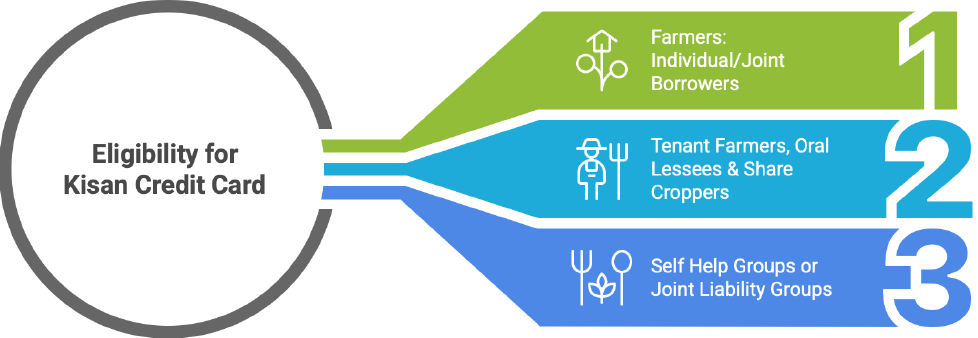
- About: It is designed to provide short-term credit to farmers for agricultural and allied activities, based on the recommendations of the R.V. Gupta Committee.
- Features:
- Issued by commercial banks, cooperative banks, and regional rural banks.
- Covers crop production needs (seeds, fertilizers, pesticides, etc.).
- Includes working capital for allied activities like dairy, poultry, and fisheries.
- Can be used for farm machinery, irrigation, and post-harvest expenses.
- A KCC loan is classified as NPA if unpaid within three years of disbursal.
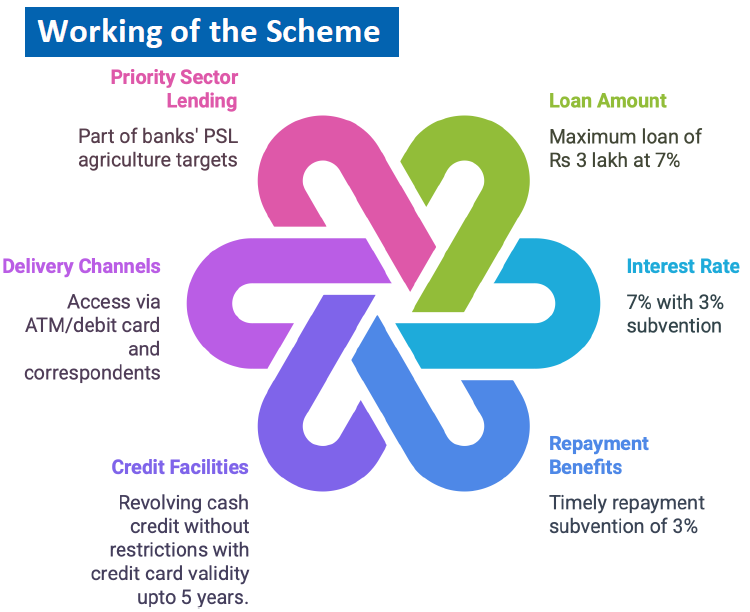
- Working of KCC Scheme:
| About Non-Performing Assets (NPAs) – These refer to loans or advances for which the principal or interest payment remains overdue for more than 90 days. Types – Substandard Assets: NPA for less than or equal to 12 months. – Doubtful Assets: NPA for more than 12 months. – Loss Assets: Unrecoverable loans, identified by the bank or RBI. RBI Guidelines For Agricultural Loans (as NPAs) – Short-term crop loans are considered NPAs if payment is overdue for two crop seasons. – Long-term agricultural loans become NPAs if overdue for one crop season. |
Current Trends in Agricultural NPAs
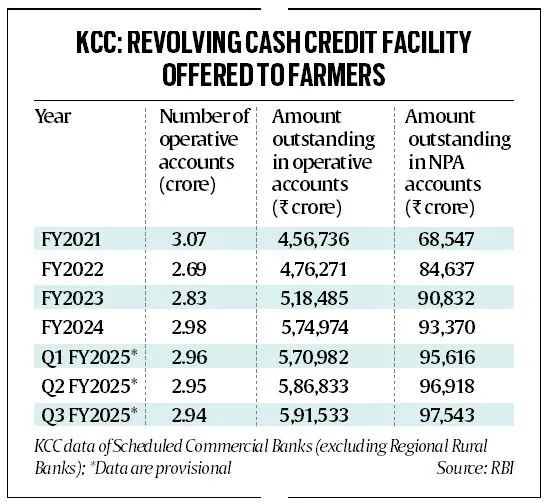
- According to data from the RBI, the outstanding NPAs in KCC accounts of scheduled commercial banks (excluding regional rural banks) increased from ₹68,547 crore at the end of March 2021 to ₹97,543 crore by December 2024.
- It underscores the growing challenges faced by farmers in repaying their loans.
Major Causes of Rising NPAs in Agriculture
- Unpredictable Weather and Climate Change: Erratic rainfall, frequent droughts, floods, and changing weather patterns directly impact crop yields, making it difficult for farmers to repay loans.
- With limited insurance coverage, crop failures lead to defaults on agricultural credit.
- Low Farm Income and Market Volatility: Despite government support, farmers often struggle with low productivity and unremunerative prices.
- Market price fluctuations, lack of assured MSP for all crops, and inadequate procurement mechanisms contribute to financial distress.
- Loan Waiver Schemes and Moral Hazard: State and central governments frequently announce loan waivers as a relief measure, encouraging willful defaults.
- Farmers often anticipate future waivers, leading to poor repayment discipline.
- Inadequate Risk Management by Banks: Banks are sanctioning loans without sound risk assessment.
- Structural Weakness in Agricultural Finance: Small and marginal farmers, who form 86% of India’s farming community, have limited access to institutional credit.
- Dependence on informal moneylenders results in debt traps and an inability to repay formal loans.
- Delay in Crop Insurance Settlements: Pradhan Mantri Fasal Bima Yojana (PMFBY) has faced delays in claim settlements, leaving farmers unable to repay loans.
Implications of Rising Agricultural NPAs
- Stress on Banking System: High NPAs reduce the ability of banks to extend fresh loans, impacting overall agricultural credit growth.
- RRBs and Cooperative Banks, which primarily cater to farmers, suffer from financial instability.
- Increased Fiscal Burden: The government often compensates banks for loan waivers, straining fiscal resources and diverting funds from productive rural investments.
- Economic and Social Distress: Indebtedness is a key reason behind farmer suicides, particularly in states like Maharashtra, Karnataka, and Punjab.
- Rising NPAs lead to rural distress, impacting employment and food security.
- Credit Crunch for Genuine Farmers: Due to higher default rates, banks tighten credit norms, making it difficult for genuine, creditworthy farmers to access loans.
Measures to Address Rising Agricultural NPAs
- Strengthening Crop Insurance and Risk Mitigation: Faster claim settlements under PMFBY and expansion of insurance coverage can reduce financial distress.
- Promoting climate-resilient farming and crop diversification can mitigate weather-related risks.
- Improving Credit Discipline: Restricting loan waivers to genuinely distressed farmers and ensuring targeted relief can prevent willful defaults.
- Encouraging timely repayment incentives, such as interest rate discounts, can improve repayment behavior.
- Enhancing Institutional Credit Access:Expanding Kisan Credit Card (KCC) coverage to all small and marginal farmers.
- Strengthening Farmer Producer Organizations (FPOs) to ensure collective bargaining for better credit access.
- Online application through banks’ websites & Common Service Centers (CSCs).
- Integration with PM-KISAN and Aadhar for easier verification.
- Strengthening Bank Supervision and Credit Monitoring: Implementing technology-driven loan tracking to identify early signs of distress.
- Increasing financial literacy programs to educate farmers on loan management and risk mitigation.
- Encouraging Diversification and Value-Addition: Promoting agribusiness, food processing, and non-farm activitie
- Strengthening supply chains and storage infrastructure to minimize post-harvest losses.
Gene-Edited Bananas
Syllabus :GS3/Science and Technology
In News
- Recently, a UK-based biotech company developed genetically-engineered bananas that have a longer shelf-life and do not brown as much.
Ripening of Bananas
- Bananas undergo a ripening process triggered by ethylene, a hormone they produce in large quantities.
- Ethylene activates genes that produce polyphenol oxidase (PPO), an enzyme that causes browning by breaking down the yellow pigment in bananas.
- Bruising increases ethylene production, speeding up ripening and browning.
Latest Developments
- Scientists genetically modified bananas by silencing the gene that produces PPO, preventing browning.
- This genetic modification does not stop ripening but keeps the fruit looking fresh longer.
- A similar technique was used in Arctic apples, which have been commercially sold since 2017.
What is Gene Editing?
- It is a method that allows scientists to modify the DNA of various organisms (plants, bacteria, animals).
- It leads to changes in physical traits (e.g., eye color) and disease risk.
- Early genome editing technologies were developed in the late 1900s.
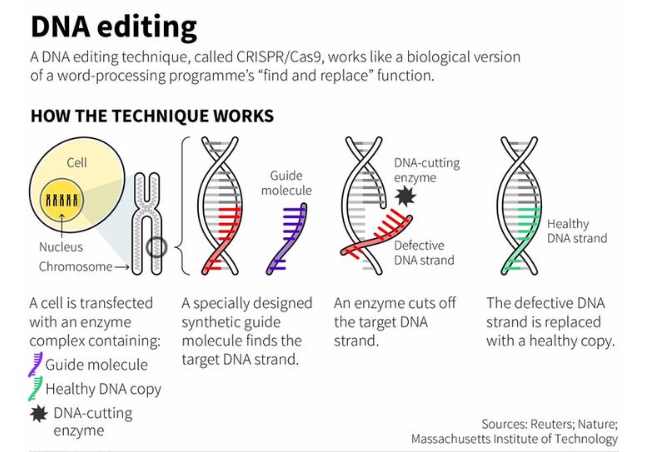
- The CRISPR tool, invented in 2009, revolutionized genome editing by making it simpler, faster, cheaper, and more accurate.
- CRISPR is now widely used by scientists for genome editing due to its efficiency and precision.
Recent Trends in Gene Editing
- CRISPR Technology Advancements: While CRISPR-Cas9 remains a cornerstone, research is expanding to explore other Cas enzymes (like Cas12 and Cas13) and alternative CRISPR systems.
- Improved Delivery Methods: Researchers are developing more efficient and targeted delivery systems, including viral vectors, lipid nanoparticles, and other innovative approaches.
- Gene Therapy for Genetic Diseases: Gene editing is showing promise for treating inherited disorders like sickle cell disease, cystic fibrosis, and Huntington’s disease.
- Crop Improvement: Gene editing is being used to develop crops with enhanced traits, such as increased yield, improved nutritional value, and resistance to pests and diseases.
Regulations in India
- Genetic Engineering Appraisal Committee (GEAC) under MoEFCC oversees gene-editing approvals.
- Food Safety and Standards Authority of India (FSSAI) regulates genetically modified (GM) food products.
Current Status In India
- India has approved GM Mustard hybrid DMH-11 for its seed production and testing but has not yet approved CRISPR-based crops.
- The Indian Council of Agricultural Research (ICAR) is exploring gene-editing research aimed at enhancing climate resilience and pest resistance in crops.
Space-Tech for Good Governance
Syllabus: GS2/E-Governance
Context
- The Minister of Science and Technology has said that India’s Space technology is playing a major role in revolutionising governance at the “Good Governance” Conclave.
What is Space Technology?
- Space technologies designate technologies used to enable activities conducted in outer space:
- such as Earth observation, satellite communication, satellite navigation or even robotic and human space exploration beyond Earth’s orbits.
- Governments use space technology, geospatial data, and field information for planning, monitoring, and evaluating developmental activities.
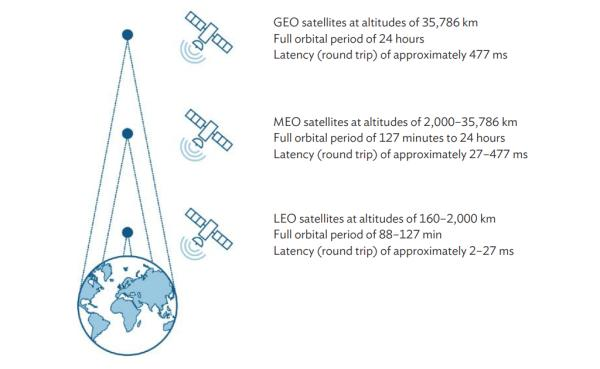
| Future Prospects and Economic Growth – Growth: India’s space economy is growing rapidly, with a tripled space budget and over 300 space startups. 1. The space sector’s value is expected to rise from $8 billion to $44 billion, marking India as a key global space player. – Vital Missions: Trials for India’s first human spaceflight, Gaganyaan Mission, will begin by the end of 2025. 1. India aims to send an astronaut to the Moon by 2040 and establish the Bharat Antariksh Station by 2035. |
Use of Space Technology in Governance
- Disaster Management and Response: National Remote Sensing Centre (NRSC) provides satellite data that helps in identifying flood-affected areas, mapping damage, and planning rehabilitation.
- The Indian National Disaster Management Authority (NDMA) uses it for disaster relief operations.
- Agriculture and Rural Development: FASAL (Forecasting Agricultural output using Space, Agrometeorology, and Land-based observations) uses satellite data to predict crop yields, helping farmers make informed decisions.
- Soil Health Management and irrigation management are optimized using remote sensing technologies.
- Efficient Land Management: Initiatives like “Swamitva Yojana” use satellite mapping for land record management.
- This initiative simplifies land verification and promotes transparency in land ownership.
- Environmental Monitoring: Bhuvan an Indian web-based application developed by ISRO provides satellite data for various environmental and land-use applications.
- Satellites like the Oceansat series provide data on sea surface temperatures, sea level rise, and coastal erosion.
- Security and Defense: Satellites help in remote sensing for border surveillance.
- Administrative Efficiency: Satellite data helps in the implementation of the Digital India initiative by enabling access to e-governance services.
Challenges
- High Costs: The development, maintenance, and launch of satellites are expensive.
- Technical and Infrastructure Gaps: Lack of adequate ground infrastructure, technical expertise, and trained personnel in remote areas.
- Data Interpretation and Accuracy: Space-based data requires accurate interpretation and analysis, and errors in data processing can lead to wrong decisions in governance.
- Privacy Concerns: Increased surveillance and monitoring through space technology raise privacy and security concerns among citizens.
- Environmental Impact: Increased space missions and satellite launches can contribute to space debris and environmental pollution.
Way Ahead
- Develop and upgrade ground infrastructure, data centers, and communication systems to support space-based services effectively.
- Encourage collaboration between the government and private sector to reduce costs, foster innovation, and improve the application of space technology.
- Increase the number and diversity of satellites for better coverage, particularly in remote and underserved regions of the country.
- Encourage research in space technology and its applications to address emerging governance challenges, including climate change and urban planning.
- Adopt sustainable practices for satellite launches and space missions to minimize environmental impacts and manage space debris effectively.
MISCELLANEOUS
Jadayaswamy Festival
Syllabus :GS 1/Culture
In News
- Jadayaswamy festival was recently celebrated in Tamil Nadu.
About
- The Badagas community (aboriginal Tribes) of the Nilgiris celebrate the Jadayaswamy festival at Jackanarai village near Kotagiri in Tamil Nadu.
- The Badagas live in villages, called “Hattis”.
- Badaga people speak the language called “Badugu”.
- The festival is dedicated to Jadayaswamy, a deity revered by the Badagas. It symbolizes faith, devotion, and the preservation of ancestral traditions.
- Eight villages organise a procession to the Jadayaswamy temple and perform a firewalk every year.
Bijayananda Patnaik
Syllabus: GS1/ Famous Personalities
In News
- The Prime Minister paid homage to Biju Patnaik on his 109th birth anniversary.
About Biju Patnaik
- He was recognized as one of the key architects of modern Odisha and played a crucial role in India’s freedom movement, aviation, and governance.
- He used his flying skills to help freedom fighters escape British forces and transport secret messages.
- He founded the Kalinga Foundation and established the Kalinga Prize to promote scientific knowledge.
- Biju Patnaik was honored with the title “Bhumi Putra” (Son of the Soil) by Indonesia—one of the highest civilian honors given to a foreigner.
- Awarded Bintang Jasa Utma, Indonesia’s highest civilian honor in 1996.
Bills of Lading Bill, 2024
Syllabus: GS2/Governance
Context
- The Union Minister of Ports, Shipping & Waterways, introduced the Bills of Lading Bill, 2025.
About
- Aim: To update and simplify the legal framework for shipping documents.
- To provide a modern, comprehensive, and user-friendly approach to maritime shipping.
- The Bill replaces the Indian Bills of Lading Act, 1856, a colonial-era law governing maritime shipping.
- The existing law is outdated, consisting of just three sections, and does not meet the evolving global trade and shipping industry needs.
- Features:
- It brings India’s maritime shipping law in line with global standards.
- It simplifies the language and reorganizes provisions for easier understanding without changing their substance.
- It gives the Central Government the authority to issue directions for the law’s effective implementation.
- A standard repeal and saving clause will be added to facilitate a smooth transition.
Vizhinjam Port
Syllabus: GS3/ Economy
In News
- Vizhinjam International Seaport has received the environmental clearance for the development of phase II and III.
About Vizhinjam Port
- Location: Thiruvananthapuram, Kerala
- Key Features: One of the deepest ports in India.
- Capable of handling Ultra Large Container Vessels (ULCVs).
- Developed under the Design, Build, Finance, Operate, and Transfer (DBFOT) model.
- Significance: Efficient cargo movement, reduces India’s dependence on foreign ports like Colombo (Sri Lanka), Singapore, and UAE for transshipment, strengthens India’s maritime security.
Cassava
Syllabus: GS3/ Agriculture
In Context
- Study has revealed that thousands of years of indigenous farming traditions have played a crucial role in maintaining the genetic diversity of cassava.
About Cassava (Also called ‘Bread of the Tropics’)
- Also known as ‘Yuca’ or ‘Manioc’, cassava is a root vegetable grown through stem cuttings.
- It is a tall semi-woody perennial shrub or tree native to South America and was introduced in Africa & Asia by Portuguese sailors.
- Nigeria is the world’s largest producer of Cassava.
- It has numerous health benefits as it is rich in energy & vitamins.
- Under India’s National Policy on Biofuels (2018), cassava is recognized as a raw material for ethanol production, enhancing its significance beyond food security.
India’s Wheat Production Estimated to Hit Record High
Syllabus: GS3/ Agriculture
Context
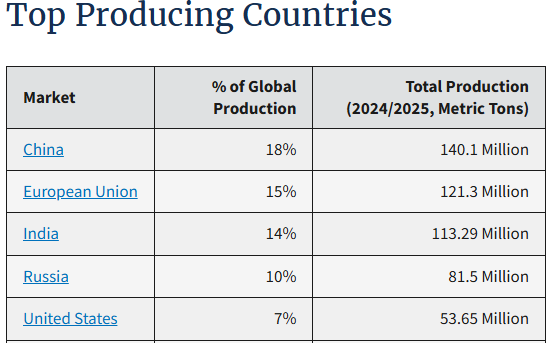
- According to the Second Advance Estimates of Agriculture production, India’s wheat production is estimated to reach a record level of 115.3 million metric tonnes during 2024-25.
Wheat Production in India
- Area: In 2023-24, the area under wheat stood at 318.33 lakh hectares, while the production is estimated at 113.92 million tonnes.
- In India wheat is the second largest crop after paddy in terms of area coverage.
- Uttar Pradesh is the top wheat-producing state in the country, followed by Madhya Pradesh, Punjab, Haryana, Rajasthan, Bihar, Gujarat and Maharashtra.
- Major Export Destinations (2023-24): Nepal, Iraq, South Korea, UAE and Mongolia.
Condition for Wheat Cultivation
- Climate: Temperature: Requires 10-15°C during sowing (germination) and 21-26°C during ripening and harvesting.
- Rainfall: Optimal rainfall is 50-100 cm. Excess rainfall can damage the crop.
- Sunlight: Requires bright sunshine during the ripening period.
- Frost & Hailstorm: Sensitive to frost at the flowering stage and susceptible to damage from hailstorms.
- Soil Type: Grows best in well-drained loamy and clayey soil.
- pH Level: Prefers slightly alkaline to neutral soil (6-8 pH).
Reasons for increased wheat production India
- Scientific Agronomic Practices: Adoption of zero tillage in wheat-growing areas, particularly in Punjab and Haryana, reducing soil degradation and enhancing yield.
- Soil Health Management: Increased awareness of balanced fertilizer application through initiatives like Soil Health Card Scheme.
- Irrigation Facilities: Greater coverage under micro-irrigation schemes such as PMKSY (Pradhan Mantri Krishi Sinchayee Yojana) has improved water availability.
- Absence of extreme weather events like unseasonal rains and heatwaves during critical growth stages.
Indian Scientists makes Ink to Thwart Counterfeiting
Syllabus: GS3/Science and Technology
Context
- Scientists from the Institute of Nano Science and Technology and the Bhabha Atomic Research Centre have made a new security ink using strontium bismuth fluoride (Sr2BiF7) nanoparticles.
About
- Counterfeiting is a crime involving the theft of someone’s trademark.
- Businesses – both small and large – use trademarks to help consumers identify their products.
- Threat of Counterfeiting: Counterfeiting harms businesses, especially in sectors like pharmaceuticals and branded consumer goods.
- Fake medicines can delay treatment or be fatal, making security printing vital in packaging.
- Security Printing Features: The printing of items with safeguards against counterfeiting is called security printing.
- Optically Variable Ink: Changes color when viewed from different angles.
- Watermarks: Embedded designs for authenticity.
- Holograms: Three-dimensional images for added security.
- Currently available fluorescent inks are visible only under either ultraviolet light or infrared light but not both, the new ink stands out because it fluoresces in both the ultraviolet and the near-infrared parts of the spectrum.
Source: TH
Chandrayaan-3 Reveals Data of Moon’s Polar Regions
Syllabus: GS3/Space
Context
- A new analysis of data from Chandra’s Surface Thermophysical Experiment (ChaSTE) aboard Chandrayaan-3 suggests that water ice might be present in locations outside of the polar regions of the moon.
About
- Findings offer insights into the Moon’s surface composition and evolution.
- Practical implications include potential for creating temperature-controlled habitats for future human missions.
- High-latitude areas with slopes >14° in the poleward direction may have conditions similar to polar regions for hosting water-ice.
- These areas may be more accessible than extreme polar regions for exploration.
ChaSTE
- It is a thermometer that performed on-site temperature measurements of the Moon’s surface and sub-surface near the polar regions for the first time.
- It revealed a significant temperature difference of nearly 60°C between the Moon’s surface and a layer just 10 cm beneath it, highlighting the extreme non-conductivity of the Moon’s surface.
