
$1bn Funds on the Creative Economy
Syllabus: GS3/ Economy
In Context
- The Govt. has decided to set up a fund of $1 billion for the country’s creative economy.
- And, the first Indian Institute of Creative Technology (IICT) is being established in Mumbai with funds of about 400 crore.
What is the Creative Economy?
- Also known as the orange economy, the creative economy refers to a knowledge-driven economic system where creativity and intellectual capital fuel economic activities. It includes:
- Creation, production, and distribution of goods and services based on creativity.
- Monetization of intellectual property in industries such as film, music, fashion, gaming, software development, and advertising.
- Key Characteristics:
- Knowledge-Based Economic Activity: Creativity is developed through education, training, or inherited traditional skills.
- Originality & Intellectual Property: Monetization of ideas through copyrights, patents, and trademarks.
- Adaptability to Technology: Continuous evolution with AI, automation, and digital platforms.
- Cultural and Economic Value Chain: Ideas are transformed into commercial products and services.
Significance of Creative Economy
- Economic Contributions:
- Global Revenue & Job Creation: Goldman Sachs predicts the global market will surge from $250 billion in 2023 to a staggering $480 billion by 2027 & and employ nearly 50 million people worldwide
- Export Potential: Indian creative sectors, including Bollywood, IT services, fashion, and handicrafts, have huge export markets.
- Spillover Effects: Boosts hospitality, tourism, and retail sectors.
- Social & Cultural Impact:
- Youth & Women Empowerment: 23% of creative economy jobs are held by youth aged 15-29, and women hold 45% of creative occupations.
- Cultural Diplomacy & Soft Power: Indian cinema, cuisine, yoga, and literature enhance global influence.
- Sustainability & Green Economy: Creativity relies on intellectual resources rather than natural exploitation.
- Role in Innovation & Technology:
- Promotes Startups & Digital Entrepreneurship: Growth of YouTubers, content creators, and AI-driven art.
- Supports Technological Advancements: AI and virtual reality (VR) redefine art, gaming, and immersive experiences.
Challenges
- Digital & Infrastructure Gaps:
- Limited Rural Digital Access: Only 41% of rural India has internet connectivity, restricting digital content creation.
- Cybersecurity Risks: Threats to digital assets, NFTs, and online platforms.
- Economic & Policy Barriers:
- Weak Intellectual Property Rights (IPR): Patent processing in India takes 58 months, compared to 20 months in China.
- Market Fragmentation: Lack of organized industry structure and distribution platforms for creative products.
- Limited Access to Finance: Few MSMEs and startups in the creative sector receive formal credit or investment.
- Societal & Career Constraints:
- Traditional Career Preferences: Creative fields are perceived as unstable compared to medicine or engineering.
- Lack of Awareness & Recognition: Limited global branding of India’s cultural and creative industries.
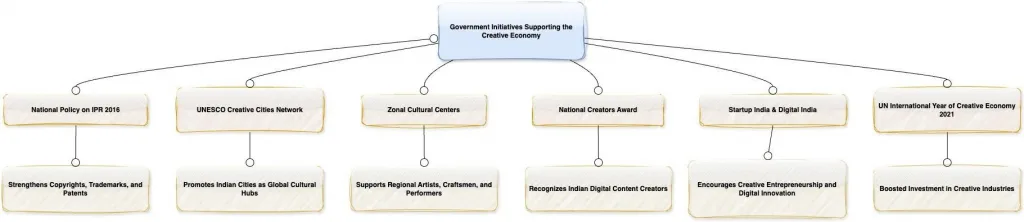
Way Forward: Strengthening India’s Creative Economy
- Expanding Indian Culture Globally: Promote Indian Films, Arts & Fashion in International Markets through trade fairs and cultural festivals.
- Boost Exports of Handicrafts, Digital Art, and Animation.
- Financial & Policy Support: Launch Credit Guarantee & Crowdfunding Portals for creative MSMEs.
- Provide Startup Incentives for Digital Content Creators & Game Developers.
- Strengthening Intellectual Property Protection: Faster Patent & Copyright Processing to protect creative works.
- Establishing Creative Hubs & Districts: Develop Creative Districts in Tier-2 & Tier-3 Cities to support local artists and startups.
- Skill Development & Digital Education: Integrate Digital Design, AI, and Digital Marketing Courses into higher education.
- AI & Emerging Technology Governance: Develop AI-based copyright policies for digital art, music, and content. Use Blockchain for Securing Digital Creations & NFTs.
Petition on CAG Appointment Process
Syllabus :GS 2/Governance
In News
- The Supreme Court is examining a plea challenging the sole prerogative of the Centre, acting through the President, to appoint the Comptroller and Auditor General of India.
Comptroller and Auditor General (CAG) of India.
- The CAG plays a critical role in overseeing financial accountability of the Union, State governments, and Panchayati Raj institutions.
- Constitutional provisions:
- Article 148: The CAG is appointed by the President and can only be removed in the same manner as a Supreme Court judge.
- The salary, allowances, and conditions of service of the CAG are determined by Parliament and cannot be changed to their disadvantage once appointed.
- The CAG is ineligible for any further office after leaving the position.
- Article 149: The CAG is responsible for auditing the accounts of both the Union and the States, as prescribed by law.
- It continues the duties previously held by the Auditor-General of India before the Constitution’s enactment.
- Article 150: The form in which accounts of the Union and States are kept is prescribed by the President, based on advice from the CAG.
- Article 151: The CAG’s audit reports on Union accounts are submitted to the President, who ensures they are laid before Parliament.
- For state accounts, the reports are submitted to the respective Governor and laid before the state legislature.
- Article 279: The CAG certifies the “net proceeds” of taxes and duties, and its certificate is final.
- Article 148: The CAG is appointed by the President and can only be removed in the same manner as a Supreme Court judge.
Recent Issues and Concerns
- There is an argument that the executive-controlled appointment process of CAG violates the Constitution.
- The executive can exert control over the CAG’s independence, thereby undermining its role as a neutral, objective watchdog.
- Recent issues with the CAG’s work were highlighted including delays in audits, a decline in Union government audits, and allegations of corruption in recruitment.
- The challenge has arisen amid recent CAG reports that exposed irregularities in public fund management, such as those related to Delhi’s excise policy and Uttarakhand’s Compensatory Afforestation Fund Management.
- These reports have also led to tensions between the CAG and the executive, particularly regarding the timing and presentation of reports.
Proposed Reforms
- Proposals to address the tensions between the CAG and the executive include establishing a separate selection committee for the CAG.
- Setting time limits for the presentation of reports, and reforming the auditing structure to include a multi-member body.
- Additionally, critics have suggested that creating separate auditing bodies for states, as seen in federal countries like Australia and the US, might help improve the system.
- There are also suggestions that the President should appoint the CAG in consultation with a non-partisan selection committee, comprising the Prime Minister, the Leader of the Opposition, and the Chief Justice of India.
Conclusion
- The CAG remains a crucial institution in India’s democratic framework, but addressing existing issues requires a balanced approach that respects its constitutional mandate while ensuring its independence and effectiveness.
Need For Electoral Reforms in India
Syllabus: GS2/Polity & Governance
Context
- In India, the need for electoral reforms has become increasingly evident to address challenges such as voter fraud, criminalization of politics, and the influence of money power.
Key Challenges in the Current Electoral System
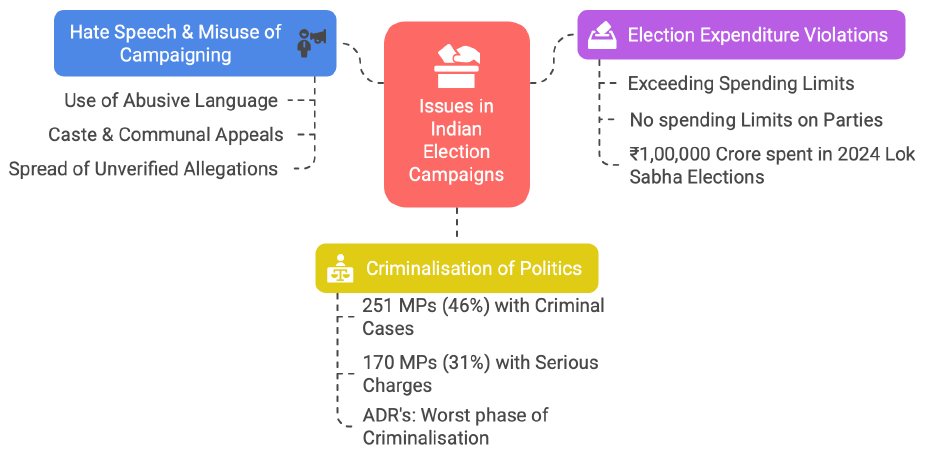
- Criminalization of Politics: A significant number of elected representatives face criminal charges, raising concerns about the integrity of the political system.
- According to reports from the Association for Democratic Reforms (ADR), a substantial percentage of MPs and MLAs have pending criminal cases against them.
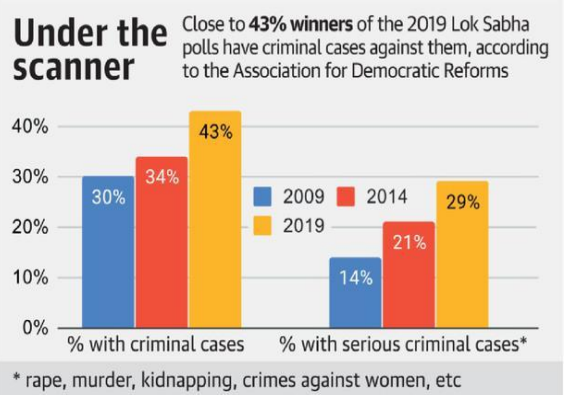
- Influence of Money Power: Excessive election spending and the lack of transparency in political funding undermine the democratic process.
- Reforms are needed to cap expenditures and promote accountability in campaign financing.
- Voter Fraud and Electoral Roll Issues: Allegations of duplicate voter IDs and manipulation of electoral rolls highlight the need for robust mechanisms to maintain the integrity of voter lists.
- Misuse of Technology: While Electronic Voting Machines (EVMs) and Voter Verifiable Paper Audit Trails (VVPATs) have enhanced efficiency, concerns about their security and transparency persist.
- Reforms can address these issues by improving verification processes.
- Inappropriate Campaign Practices: The use of divisive rhetoric, false claims, and appeals to caste or communal identities during campaigns undermines the spirit of democracy.
- Stricter regulations are required to ensure ethical campaigning.
- First-Past-The-Post System (FPTP) and Representation Issues: India follows the FPTP system, where the candidate with the most votes wins, even if they do not secure an absolute majority.
- It leads to situations where a candidate winning with just 30-40% of votes represents the entire constituency, raising concerns about true democratic representation.
- Delimitation and Representation: It raised concerns about potential shifts in political power between regions, especially among southern states.
Key Recent Electoral Reforms in India
- 52nd Amendment Act (1985): Anti-Defection Law & introduction of Tenth Schedule to the Constitution, aiming to curb political defections by disqualifying defectors from holding public office.
- 91st Constitutional Amendment Act (2003): Aimed to curb political defections by limiting the size of ministerial councils and enforcing anti-defection laws.
- 61st Constitutional Amendment Act (1988): Lowering of Voting Age from 21 to 18, expanding democratic participation.
- 73rd Constitutional Amendment Act (1992): Strengthened local governance by institutionalizing Panchayats, ensuring direct elections and reserved seats for marginalized communities and women.
- Introduction of EVMs: To improve the voting process’s efficiency and reduce electoral fraud, EVMs were introduced in Indian elections.
- Ceiling on Election Expenditure: Limits have been set on election expenditures to promote fair competition among candidates.
- Provision of NOTA (None of the Above): Introduced in 2013, the NOTA option allows voters to reject all candidates if they find none suitable.
- Systematic Voters’ Education and Electoral Participation (SVEEP): It is a flagship programme of the ECI to promote voter education and participation in elections.
- One Nation, One Election: It advocates simultaneous elections for the Lok Sabha and state assemblies to reduce costs and governance disruptions.
- Delimitation Exercise: Plans to redraw parliamentary constituencies based on new population data aim to ensure equal representation.
Proposed Electoral Reforms
- Decriminalization of Politics: The Supreme Court has repeatedly emphasized the need for decriminalizing politics.
- Disqualifying candidates with serious criminal charges and fast-tracking cases against politicians can enhance the credibility of the electoral process.
- Transparency in Political Funding: Introducing measures such as state funding of elections and mandatory disclosure of donations can reduce the influence of money power.
- Proportional Representation System: Replacing or modifying the FPTP system with a proportional representation model can ensure fairer representation of diverse political ideologies.
- It can help in reducing the monopoly of dominant parties and make elections more inclusive.
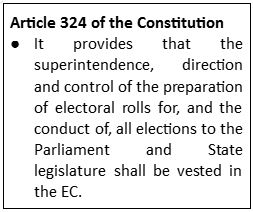
- Strengthening the Election Commission of India (ECI): EC should be given more autonomy and legal authority to act against electoral malpractices.
- The process of appointing ECs should be transparent and independent of political influence.
- Strengthening Voter Verification: Linking Aadhaar with voter IDs, while addressing privacy concerns, can help eliminate duplicate entries and ensure accurate electoral rolls.
- Mandatory Internal Democracy in Political Parties: The Representation of the People Act should be amended to ensure democratic functioning within political parties.
- Regular elections within parties and term limits for leadership positions should be mandated to promote fresh and dynamic leadership.
- Improving EVM and VVPAT Systems: Conducting random audits and increasing the sample size for VVPAT verification can enhance public confidence in the voting process.
- Regulating Campaign Practices: Enforcing stricter penalties for hate speech, misinformation, and unethical practices can promote fair and issue-based campaigning.
- One Nation, One Election: Concerns about its impact on federalism and regional representation persist.
Recommendations: Committees & Commissions
- Dinesh Goswami Committee (1990): On election expenses, voter IDs, and transparent political funding.
- Indrajit Gupta Committee (1998): Advocated for state funding of elections.
- Vohra Committee (1993): Criminalization of politics and the nexus among criminals, politicians, and bureaucrats in India.
- Agencies, including the CBI, IB, RAW, had unanimously expressed their opinion that the criminal network was virtually running a parallel government.
- 244th Report of Law Commission of India: It said that in the 10 years since 2004, 18% of the candidates contesting either national or State elections had criminal cases against them (extensive criminal backgrounds).
- Ram Nath Kovind Panel: It suggested 15 amendments including insertion of a new Article 82A and Amendment of Article 327.
- It was supported by the Election Commission in 1983 itself.
- TS Krishnamoorthy: It has suggested a ‘National Election Fund’ as an alternative for election funding.
Conclusion
- Electoral reforms are not just necessary but urgent to safeguard the democratic fabric of India.
- By addressing systemic challenges and ensuring transparency, accountability, and inclusivity, these reforms can strengthen public trust in the electoral process.
- A collaborative effort involving the Election Commission, political parties, and civil society is essential to realize the vision of a truly representative democracy.
Private Participation of India’s Space Sector
Syllabus: GS3/ Space
In News
- Information Technology (IT) major Infosys is eyeing opportunities in India’s space tech sector and has put forward its name as a contender to build and launch satellites.
About
- India’s space sector has traditionally been dominated by ISRO, but recent policy changes are opening the sector to private enterprises and startups.
- The Indian space economy is projected to grow at a 48% CAGR over the next five years, reaching $50 billion.
- The privatization of the Indian space sector aims to boost innovation, attract private investment, reduce dependence on imports, and strengthen India’s position as a global space power.
- The establishment of IN-SPACe (Indian National Space Promotion and Authorization Centre) is a landmark step, enabling private enterprises to participate in satellite launches, space-based services, and even deep-space missions.
Why is Privatization of the Indian Space Sector Necessary?
- Increasing Demand for Space-Based Services: India’s space industry is growing rapidly, with demand for satellite-based services exceeding ISRO’s capacity.
- The private sector’s involvement is essential to meet the demand for satellite communications, remote sensing, and geospatial intelligence.
- Reducing Import Dependency: India’s import costs in space technology are 12 times higher than its exports (2022-23). Major imported items include high-strength carbon fibers, space-qualified solar cells, and electronic components.
- Encouraging private manufacturing can help develop indigenous space-grade materials.
- Freeing ISRO to Focus on Core Missions: Privatization allows ISRO to shift focus towards interplanetary missions, space research, and national security projects.
- Private players can take over commercial satellite launches and operational aspects of space technology.
- Enhancing Global Competitiveness: Countries like the United States, Russia, and China have successfully leveraged private enterprises to reduce costs and enhance efficiency.
- Companies like SpaceX, Blue Origin, and Arianespace have transformed space commercialization.
- India’s private space firms must evolve to compete globally and contribute to the $450 billion global space economy.
- Utilizing India’s Human Capital: India produces over 1.5 million engineers annually.
- India’s space economy is projected to grow at 48% CAGR and reach $50 billion by 2028.
- Risk Sharing: Space exploration involves high costs and risks. Public-Private Partnerships (PPPs) can distribute costs, reducing financial pressure on the government.
Major Reforms in the Privatization of India’s Space Sector
- Indian Space Policy 2023: Allows private firms to engage in satellite launches, R&D, and exploration.
- Establishment of IN-SPACe: Acts as a single-window agency to regulate and facilitate private sector participation.
- Grants private players access to ISRO’s launch facilities, R&D centers, and satellite data.
- Creation of NewSpace India Limited (NSIL): Handles the commercial operations of ISRO, such as satellite launches and transponder leasing.
- Focuses on monetizing ISRO’s technologies through partnerships with private companies.
- FDI Policy Reforms:74% Foreign Direct Investment (FDI) allowed in satellite manufacturing and operations.
- 49% FDI allowed in launch vehicles, spaceports, and associated systems.
- Supporting Space Startups: Over 200 space startups are working in India, developing launch vehicles, satellite services, and space applications.
- Vikram-S Rocket: India’s first private rocket, launched by Skyroot Aerospace.
- Agnikul Cosmos: Developed the world’s first 3D-printed rocket engine.
- OneWeb India: First company approved by IN-SPACe for satellite broadband services.
- Encouraging Global Collaborations: Indian companies can partner with international space agencies and corporations for knowledge sharing.
- Example: ISRO’s collaboration with NASA and JAXA for joint lunar and Mars missions.
- Atal Tinkering Lab (ATL) Space Challenge: Encourages school students in space innovation.
Challenges and Concerns in Private Sector Participation
- Regulatory and Legal Gaps: No dedicated space law to govern private sector operations.
- Multiplicity of regulations (ISRO, DoS, NSIL, Antrix, IN-SPACe) causes bureaucratic hurdles.
- National Security Risks: Sensitive technology transfer risks due to increased private participation.
- Strict cybersecurity policies are needed to protect satellite data.
- Intellectual Property (IP) Issues: Lack of clear IP laws for space technologies may discourage private R&D.
- Private firms fear technology leakage or misuse of ISRO’s research.
- Funding and Investment Constraints: Space projects require high capital investments and long incubation periods.
- Private investors prefer short-term gains in sectors like 5G and fintech.
- Dependence on Government Infrastructure: Private firms rely on ISRO’s launch facilities, labs, and ground stations.
- High costs of developing private infrastructure hinder independent growth.
- Market Saturation & Competition: Too many players entering the sector could cause instability.
- Smaller startups may struggle to compete with large corporations.
- Environmental and Space Debris Issues: Increase in satellite launches could worsen space debris problems.
- Sustainable space policies are needed to manage deorbiting and recycling of satellites.
Way Ahead
- Enactment of a Space Activities Act: Define private sector roles, liability frameworks, and investment policies.
- Development of Indigenous Capabilities: Invest in domestic manufacturing of propulsion systems, AI-driven satellite tech, and 3D-printed components.
- Building Private Launch Infrastructure: Encourage private launchpads and testing centers to reduce dependency on ISRO.
ISRO Undocks SpaDeX Satellites
Syllabus: GS3/ Space
In News
- Nearly two months after ISRO successfully docked two satellites in space, it carried out an undocking procedure recently.
More About the News
- This makes India the fourth country after the US, Russia, and China to demonstrate space docking and undocking capabilities.
- To demonstrate this capability, ISRO launched the experimental Spadex mission on December 30, 2024.
What is Space Docking?
- Space docking is the process of bringing two fast-moving spacecraft into the same orbit, gradually bringing them closer, and physically joining them together.
- This is a highly complex maneuver requiring precise navigation, automated control, and real-time adjustments.
Why is this Important?
- Enabling Heavy Space Missions: Large spacecraft cannot be launched in one go due to weight limitations.
- Docking allows modular spacecraft assembly in orbit, similar to the International Space Station (ISS).
- Critical for Future Human Spaceflight: Essential for transporting astronauts & supplies to India’s planned space station by 2035.
- Key to India’s crewed lunar missions (by 2040) under Gaganyaan & future Moon missions.
- Supports Lunar Sample Return Missions: Chandrayaan-4, India’s future mission to bring back lunar soil and rock samples, will rely on docking technology.
- Advancing In-Space Servicing & Robotics: Enables repairing, upgrading, and refueling satellites in orbit without launching new ones.
About India’s Space Docking Experiment (SpaDeX)
- Objective: To demonstrate in-space docking, rendezvous, and undocking capabilities.
- Satellites Used:
- SDX01 (Chaser Satellite): Actively approached and docked with the target.
- SDX02 (Target Satellite): Served as the docking module.
- Launch Vehicle: PSLV-C60
- Orbit: 470 km circular orbit
- Developed by: UR Rao Satellite Centre (URSC), Bengaluru, with support from other ISRO centers.
Post-Docking Applications
- High-Resolution Imaging (SDX01): Capturing Earth observation images.
- Multi-Spectral Payload (SDX02):Monitoring natural resources and vegetation.
- Radiation Monitoring (SDX02): Studying space radiation to support future human space missions.
India and Australia Agree to Deepen Cooperation
Syllabus :GS 2/IR
In News
- India and Australia held their 9th Defence Policy Talks in New Delhi.
Key Outcomes of Recent meeting
- Enhanced Maritime Security & Interoperability: Both nations agreed on increased cooperation in maritime domain awareness and reciprocal information sharing and strengthening joint naval exercises such as AUSINDEX and Malabar.
- Defence Industry & Science-Technology Collaboration: Both sides discussed defence technology transfers, co-development, and co-production of military hardware and use of emerging technologies.
- Strengthening Strategic Partnership Beyond Bilateral Ties: Alignment with regional and multilateral frameworks, including:
- Quad (India, Australia, Japan, USA) – Strengthening Indo-Pacific security architecture.
- ASEAN Defence Ministers’ Meeting Plus (ADMM-Plus) – Expanding regional security dialogues.
- Indian Ocean Rim Association (IORA) – Promoting maritime security and blue economy cooperation.
Significance of India-Australia Defence Partnership
- Defence Engagement: Australia and India have strengthened their defence ties since becoming Comprehensive Strategic Partners in 2020.
- Key milestones include the Mutual Logistics Support Agreement (2021).
- Indo-Pacific Security & Maritime Strategy: The Indo-Pacific region faces growing security challenges, including China’s assertiveness in the South China Sea.
- India and Australia, both maritime powers, seek to enhance naval cooperation to ensure regional stability.
- Countering Emerging Threats: Cybersecurity, space security, and hybrid warfare tactics have become major concerns. India and Australia are collaborating on defence technology innovations to counter these challenges.
- Expanding Defence Trade & Industry Collaboration: India’s ‘Make in India’ initiative aligns with Australia’s defence industry growth strategy, allowing mutual investments in:
- Missile systems and radar technology
- Unmanned aerial and naval platforms
- Joint shipbuilding projects
- Strengthening Strategic Autonomy & Diversifying Defence Ties: Australia’s increasing defence partnerships with India reduce its reliance on traditional allies like the USA and UK.
- India benefits from deeper Indo-Pacific alliances, complementing its ties with the US, France, and Japan.
Challenges in India-Australia Defence Cooperation
- Aligning Defence Procurement & Industrial Capabilities: Australia’s defence industry has historically been more aligned with Western suppliers (USA, UK), making technology transfer with India challenging.
- Bureaucratic & Policy Barriers: Defence cooperation needs faster clearance for joint R&D projects and military logistics agreements. Differences in military doctrines and strategic priorities require stronger policy coordination.
- Navigating Regional Geopolitical Complexities: Managing relations with China – Australia’s past economic dependence on China creates challenges in fully aligning its Indo-Pacific strategy with India.
