
Contradiction Between High Per Capita Income vs Poverty Levels in Indian States: SC
Syllabus: GS2/Issues Relating Poverty & Hunger
Context
- Recently, the Supreme Court of India Bench, led by Justice Surya Kant, raised concerns over contradiction in some states’ claims of high per capita income while a significant portion of their population continues to live below the poverty line (BPL).
Supreme Court’s Observations
- The court expressed concern over the disparity between economic indicators and ground realities during a hearing on food security for migrant workers.
- It questioned how states could claim high per capita income while reporting up to 70% of their population as BPL.
- It emphasized that such contradictions undermine the credibility of development claims and highlight systemic issues in the distribution of resources.
- The court also scrutinized the efficiency of subsidized ration schemes, questioning whether they genuinely reach the intended beneficiaries or serve as political tools.
- SC reiterated that access to food is a fundamental right under Article 21 of the Constitution, and ensuring food security for the poor is a constitutional obligation.
- The Supreme Court noted that corruption and mismanagement in the Public Distribution System (PDS) exacerbate the problem.

Reason For High Per-Capita Income & High Poverty Level
- While national data sets from institutions like NITI Aayog, Reserve Bank of India (RBI), and the Ministry of Finance highlight various state-level economic indicators, some states consistently show high Per Capita Income but persistent poverty levels. These include:
- Wealth Concentration: A high per capita income often reflects urban prosperity and business hubs rather than equitable wealth distribution.
- High Cost of Living: States with high Per Capita Income, such as Goa and Kerala, also have high living costs, making it difficult for lower-income groups to afford essentials.
- Agricultural Distress: States like Punjab and Tamil Nadu have strong GDPs but suffer from agrarian crises, leaving rural populations in financial distress.
- Informal Sector Dominance: A large part of the workforce in high-PCI states works in informal sectors, earning low wages and lacking social security.
- Ineffective Welfare Implementation: Many government welfare schemes fail to reach intended beneficiaries due to:
- Corruption and Mismanagement;
- Outdated Data;
- Bureaucratic Inefficiencies;
- Political Influence;
Way Forward
- Targeted Welfare Schemes: Expanding direct cash transfers and food security initiatives for lower-income groups.
- Employment Reforms: Strengthening social security for informal workers and promoting skill-based employment opportunities.
- Decentralized Economic Growth & Empowering Local Governance: Encouraging rural entrepreneurship to balance income levels across regions.
- Decentralizing the implementation of welfare schemes can improve efficiency and accountability.
- Updating Data Systems: There is a pressing need to reform PDS using technology and ensure better beneficiary targeting.
- Strengthening Taxation Policies: Imposing wealth taxes or progressive taxation to improve wealth redistribution.
- Strengthening Transparency: There is a need for independent audits, transparent data collection, and standardized poverty metrics.
PAC Flag shortcomings of Swadesh Darshan Scheme
Syllabus: GS2/Governance, Schemes
Context
- Public Accounts Committee (PAC), led by K.C. Venugopal, criticized the Tourism Ministry for poor execution of the Swadesh Darshan scheme.
About
- The panel was reviewing a report of the Comptroller and Auditor General on the scheme.
- Despite the Ministry of Tourism’s claims of completion for most of the sanctioned projects, the panel found substantial discrepancies.
Swadesh Darshan
- The Ministry of Tourism launched its flagship scheme of ‘Swadesh Darshan’ in 2014-15.
- The Ministry has now revamped it as Swadesh Darshan 2.0 with the objective to develop sustainable and responsible destinations following a tourist & destination centric approach.
- Theme-Based Tourist Circuits: It identifies various thematic circuits based on specific themes such as:
- Spiritual circuits (e.g., Char Dham Yatra, Buddhist circuit)
- Cultural circuits (e.g., North East Circuit, Tribal Circuit)
- Heritage circuits
- Wildlife circuits
- Coastal circuits
- Funding: The Ministry of Tourism allocates funds to various states and Union Territories for the development of these circuits.
Key issues raised
- Lapses in Planning: No feasibility studies conducted before project launch.
- Financial Mismanagement: Budget overruns due to poor planning; approvals granted without Detailed Project Reports (DPRs).
- Weak Monitoring: No formal mechanism for project evaluation or approval; several projects delayed or incomplete.
- Tourism Ministry’s Claim vs. Reality: The Ministry of Tourism claimed that 75 out of 76 projects were completed, but the committee found that several projects, including the Kanwaria route in Bihar, Tribal circuit in Telangana, and Sree Narayana Guru Ashram in Kerala, remained incomplete or non-functional.
Way Ahead
- The committee has instructed the Ministry of Tourism to conduct physical inspections of all the projects and provide a comprehensive report within three weeks.
- The committee also asked for details on how the scheme impacted employment generation and how it affected tourist footfall, as these were key indicators of the scheme’s success.
| About Public Accounts Committee (PAC) – Constitutional Status: Not a constitutional body; formed under Rule 308 of the Rules of Procedure and Conduct of Business in Lok Sabha. – Composition: 22 members (15 from Lok Sabha, 7 from Rajya Sabha) 1. Elected annually by ParliamentChairperson appointed by the Speaker of Lok Sabha. 2. The Chairperson is usually from the opposition party, not the ruling party. Function: 1. Examines audit reports of the CAG of India 2. Scrutinises public expenditure to ensure it is not extravagant or irregular 3. Ensures accountability of the Executive to the Legislature 4. Works in tandem with CAG to maintain fiscal discipline and transparency |
Vice-President Criticised Freebies Culture
Syllabus :GS 2/Governance
In News
- Vice-President and Rajya Sabha Chairman Jagdeep Dhankhar criticized the culture of “freebies” in politics, calling for a parliamentary debate on the issue.
What are Freebies?
- There is no clear definition of what constitutes a freebie but they are goods, services, or financial aid distributed by political parties during elections to win votes, like free electricity, gas, cycles, loan waivers and cash transfers.
Challenges and Concerns
- Freebies put significant pressure on state budgets, leading to fiscal deficits and increasing public debt, contributing to long-term economic challenges.
- Spending on freebies reduces funding for critical sectors like infrastructure, education, and healthcare, hindering growth.
- Freebies can lead to inefficient use of resources and create dependency, without addressing the root causes of poverty.
- Competitive populism (where parties escalate freebies), reduces policy efficiency and focuses on short-term solutions instead of long-term growth.
- Focusing on freebies shifts attention away from necessary policy reforms that could improve skills, education, and job creation.
- The Constitution mandates that the State promote welfare and reduce inequalities (Article 38), but the issue arises when freebies strain state finances.
Supreme Court observations
- The Supreme Court Bench criticized the practice of offering freebies before elections, stating it discourages people from working and harms the labor force.
- Earlier The Supreme Court has also acknowledged that the distribution of freebies during elections influences voters and affects the fairness of elections.
View of experts
- Former RBI Governor Duvvuri Subbarao criticized the freebie culture in India, highlighting its negative impact on state finances.
- Prime Minister Narendra Modi criticized the culture of distributing “revris” (freebies) for votes, calling it short-term politics.
Suggestions
- There is a need for a national policy to ensure that government investments are used effectively for the greater good.
- There is a need for a national dialogue and code of conduct to address the freebie culture, with the Centre taking leadership.
- Targeted welfare programs are more effective than untargeted freebies, addressing the needs of those who truly require help.
X Corp. Challenges Content Blocking Orders of Government
Syllabus: GS2/Polity and Governance
Context
- X Corp, formerly known as Twitter Inc., is challenging the Indian government’s approach to content blocking on its platform, particularly in relation to the Sahyog portal.
About
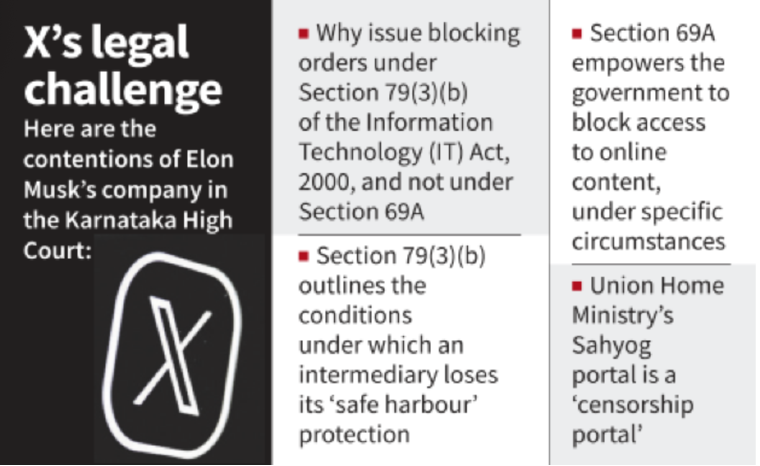
- At the heart of the issue is the invocation of Section 79(3)(b) of the Information Technology Act, 2000, which X Corp believes is being used inappropriately to issue content-blocking orders.
- The Sahyog Portal: It was launched by the Ministry of Home Affairs in 2024.
- The portal acts as a centralized system for government agencies at various levels—ranging from ministries to local police stations—to issue blocking orders more efficiently.
- X Corp has asked the Karnataka High Court to intervene and ensure that content blocking can only occur under Section 69A.
- This legal battle is part of a broader tension between social media platforms and governments worldwide over the regulation of online content and the balance between freedom of expression and national security concerns.
Legal Framework: Section 69A vs. Section 79(3)(b)
- Section 69A of the IT Act, 2000: This section empowers the government to block public access to content on the internet in certain circumstances, such as concerns over national security, sovereignty, public order, or to prevent incitement.
- It includes safeguards as laid out by the Supreme Court in the Shreya Singhal case (2015).
- A reasoned order explaining the necessity of blocking content.
- The person or entity affected should have a chance to contest the order.
- Section 79(3)(b) of the IT Act: This section deals with the liability of intermediaries (such as platforms like X Corp) for third-party content.
- It exempts platforms from liability for illegal content unless they fail to act swiftly to remove or disable access to that content when notified by the government.
- X Corp argues that this provision should not be used to directly block content, as it is not intended for that purpose.
Implications & Way Forward
- Rising State Regulation: The case underscores the growing trend of government intervention and regulation over online content in India.
- Digital Rights at Risk: Lack of transparency in content moderation and takedown processes can undermine users’ fundamental digital rights and freedoms.
- Freedom vs. Security Dilemma: Striking a balance between safeguarding national security and ensuring freedom of expression remains a persistent governance challenge.
MHA To Review AFSPA in the Northeast
Syllabus: GS3/ Internal Security
In News
- The Union Home Ministry is currently reviewing the extent of AFSPA coverage in the states of Manipur, Nagaland, Arunachal Pradesh, and Assam.
- This comes after recent ethnic tensions and law-and-order disturbances, particularly in Manipur.
About AFSPA
- Enacted by the Parliament and approved by the President in 1958.
- Grants extraordinary powers & immunity to the armed forces to bring back order in the “disturbed areas”.
- An area can be disturbed due to differences or disputes b/w members of different religious, racial, language or regional groups or castes or communities.
- Provisions:
- Section 3: Empowers the Governor of the State/Union territory to declare the whole or part of the State or Union Territory as a disturbed area.
- Section 4: Gives the powers to the Army to search premises and make arrests without warrants.
- Section 6: Stipulates that arrested persons and the seized property are handed over to police.
- Section 7: The prosecution is permitted only after the sanction of the Central Government.
Need for AFSPA
- Insurgency and Security Threats: Armed separatist movements in the Northeast and terrorism in J&K necessitate rapid and decisive action.
- Support to Civil Administration: In areas where police and civil forces are inadequate, the military assists in restoring normalcy.
- Geopolitical Factors: Bordering countries like China, Myanmar, and Pakistan pose cross-border security challenges.
- Strategic Deterrence: The presence of armed forces under AFSPA acts as a deterrent to insurgent groups.
Concerns and Criticism
- Human Rights Violations: Allegations of extrajudicial killings, torture, and sexual violence in conflict zones. Notably highlighted by the Justice Jeevan Reddy Committee (2005) and UN agencies.
- Immunity and Lack of Accountability: Requirement of Central Government sanction often results in impunity for accused personnel.
- Alienation of Local Populations: Perception of militarisation leads to mistrust between citizens and the state.
- Judicial Observations: Supreme Court in 2016 has expressed that excessive use of force under AFSPA is not justified; operations must adhere to constitutional norms.
- Democratic Deficit: Goes against the spirit of federalism, rule of law, and civil liberties.
Way Ahead
- Gradual Withdrawal Based on Ground Situation: Follow a phased removal of AFSPA in areas showing long-term peace and stability.
- Strengthening Local Institutions: Empower state police, improve intelligence gathering, and enhance development infrastructure.
- Accountability and Oversight Mechanisms: Establish independent civilian oversight bodies for redressal of complaints.
- Legal Reforms: Amend the Act to balance national security with fundamental rights.
- Introduce time-bound reviews and sunset clauses.
Global Forest Vision 2030
Syllabus: GS3/ Environment & Conservation
In Context
- According to the Forest Declaration Assessment (FDA) report released, the world lost 6.37 million hectares of forests in 2023 alone, threatening global climate and biodiversity goals.
About
- The Forest Declaration Assessment (FDA) was launched in 2015 as the New York Declaration on Forests (NYDF) Progress Assessment.
- The NYDF, is a voluntary, non-binding declaration, was adopted in 2014 at the UN Climate Summit.
- It sets 10 goals, including halting deforestation by 2030 and restoring 350 million hectares of degraded landscapes.
- India is not yet a signatory to the NYDF.
Key Findings
- Alarming Forest Loss:
- 6.37 million hectares of forest lost in 2023. Equivalent to 9 million soccer fields.
- Major drivers: Palm oil, soy, beef, timber.
- Affects regions like the Amazon, Southeast Asia, and Africa.
- Cost to Biodiversity:
- Amazon: Cattle ranching is the largest cause of deforestation, responsible for about 80 per cent of deforestation across all Amazon countries.
- Southeast Asia: Palm oil expansion threatens orangutans, Sumatran tigers.
- Palm oil alone contributes 5% to tropical deforestation.
Key Recommendations of the Report
- Align national plans with forest goals in UNFCCC COP30 (Brazil, Nov 2025).
- Strengthen deforestation-free trade agreements.
- Ban imports of products linked to forest loss.
- Scale up results-based payments and forest carbon finance.
- Secure land and resource rights of Indigenous Peoples and Local Communities (IPs & LCs).
- Ensure financial institutions account for forest-related risks.
- Repurpose harmful subsidies towards sustainable land-use practices.
- Improve forest governance in line with international environmental commitments.
- Integrate forest natural capital into debt management frameworks.
India’s Role: Challenges and Opportunities
- Challenges:
- High dependence on imported palm oil and timber.
- No specific trade restrictions on deforestation-linked products.
- Small farmers may lack tech to prove deforestation-free production.
- Opportunities:
- Introduce deforestation-free import laws.
- Support farmers through capacity building, finance, and tech.
- Lead South-South cooperation on sustainable agriculture and trade.
- Link with existing schemes like CAMPA, National Agroforestry Policy, and Bio-Energy Mission.
