
India Pitch for UNSC Reforms
Syllabus: GS2/International Organization
Context
- India stresses the need for UNSC reform to achieve lasting peace in conflict situations.
Major Highlights
- Security of Peacekeepers: Pacekeepers are facing non-state actors, armed groups, terrorists, and complex threats.
- India emphasizes the importance of safety and security for peacekeepers, calling for justice for the crimes against them.
- Modernisation: Advocates for integrating advanced surveillance, communication, and data analytics into peacekeeping operations.
- India offers training courses through its Centre for UN Peacekeeping (CUNPK), addressing modern peacekeeping demands.
- Funding: Stresses the need for adequately funded and resourced peacekeeping missions, with resources matching the mandates.
- Inclusion in Mandate Formation: Calls for the inclusion of troop-contributing countries in the mandate formulation process to adapt operations to new realities.
About the UNSC
- The United Nations Security Council (UNSC) is one of the principal organs of the United Nations, responsible for maintaining international peace and security.
- It was established in 1945 as part of the UN Charter and is composed of 15 member states, including five permanent members with veto power—China, France, Russia, the United Kingdom, and the United States—and ten non-permanent members elected for two-year terms by the General Assembly.
- It is headquartered in New York City.
Need for the Reforms in the UNSC
- Current Composition: The current composition of the Security Council has under-representation and un-representation of key regions.
- Inability to Address Conflicts: The existing composition of the Council has demonstrated significant limitations in effectively addressing major international conflicts. This has undermined its credibility and hindered its core mandate of upholding international peace and security.
- Changes in World Order: The world has undergone significant changes since 1945 and the new realities need to be reflected in the permanent membership.
- Veto Power: Currently, only the five permanent members hold veto powers and through its use have stalled action in the Council to address global challenges and conflicts such as in Ukraine and Gaza.
- The remaining 10 nations in the Council are elected to sit as non-permanent members for two-year terms and do not have veto powers.
- Legitimacy: The disproportionate power held by the five permanent members, particularly their veto power lead to a perception of unfairness and lack of legitimacy.
Why Should India Get Permanent Membership of UNSC?
- Global Population and Representation: India is one of the world’s most populous countries, accounting for approximately 18% of the global population.
- Such demographic significance warrants proportional representation in global decision-making bodies like the UNSC.
- Economic Powerhouse: India has emerged as a major global economic force, ranking among the top economies by GDP (nominal) and GDP (PPP).
- Its economic strength contributes significantly to global stability and development, which aligns with the UNSC’s mandate to maintain international peace and security.
- Commitment to Peacekeeping: India has been one of the largest contributors to UN peacekeeping missions, demonstrating its commitment to global peace and security.
- Strategic Importance: India occupies a pivotal geopolitical position in South Asia and the broader Indo-Pacific region.
- Its influence extends beyond regional boundaries, making it crucial in addressing global security challenges such as terrorism, climate change, and maritime security.
- Democratic Values: As the world’s largest democracy, India upholds principles of pluralism, tolerance, and inclusivity, which are fundamental to the UN’s ethos.
- Support from Member States: India enjoys broad support from a significant number of UN member states, including influential nations from various regions.
- This backing reflects recognition of India’s global role and its potential contributions to enhancing the UNSC’s capacity to respond to global crises.
Limitations in Introducing the Reforms in UNSC
- Veto Power of Permanent Members: Any reforms to the composition or working methods of the UNSC require the approval of the five permanent members.
- These countries have divergent interests and are reluctant to support changes that could diminish their influence within the Council.
- Regional Dynamics: Regional rivalries and geopolitical tensions complicate efforts to reform the Council.
- Complexity of the Reform Process: Amending the UN Charter to enact reforms requires a lengthy and complex process involving ratification by a significant number of member states, making it difficult to enact substantive reforms.
- Chinese Opposition: China being a permanent member blocks the growth of India becoming a Permanent Member.
Way Ahead
- It is important that both the permanent and non-permanent membership be representative of the world as it is today, not the world as it existed in the wake of the Second World War.
- Reforms in the UNSC are essential for maintaining its relevance, legitimacy, and effectiveness in addressing the complex security challenges facing the international community in the 21st century.
- However, achieving consensus on such reforms among the UN’s member states remains a challenging and ongoing process.
India-China Look Forward to Stabilize Ties
Syllabus: GS2/IR
Context
- The Indian delegation discussed cross-border cooperation with Chinese officials during the Working Mechanism for Consultation and Coordination (WMCC) on border affairs.
Key Highlights
- The meeting was part of efforts by the two sides to normalise bilateral relations.
- It also came in the wake of Prime Minister Narendra Modi’s recent remarks about India-China cooperation being essential for global stability and prosperity.
- India and China explored ways to rebuild ties, focusing on people-to-people exchanges, including resumption of direct flights and Kailash Manasarovar Yatra.
- The two sides discussed resuming dialogue in a “step-by-step” manner to stabilize relations.
India-China Relations (2025 marks the 75 Years of Ties)
- Panchsheel Agreement:
- Signed in 1954 which emphasized the principles of peaceful coexistence, mutual respect for sovereignty, and non-interference in each other’s internal affairs, forming the foundation of India-China diplomatic relations.
- Historical Tensions:
- Strained since the 1962 Sino-Indian war, deepened by recent clashes and mistrust.
- India restricted Chinese investments, banned Chinese apps (e.g., TikTok), and halted flights to China.
- Trade Relations: China overtook the U.S. in 2024 as India’s largest trading partner, with over $100 billion in imports. Despite tensions, economic ties continue to grow.
- Ongoing Mechanisms: Despite tensions, mechanisms like the Special Representatives (SR) and Working Mechanism for Consultation and Coordination (WMCC) have been in place to address the boundary issue.
- Recent Developments:
- 2024 Disengagement: India and China announced successful disengagement in eastern Ladakh.
Key areas of concern in India-China Relations
- Ongoing Border Tensions:
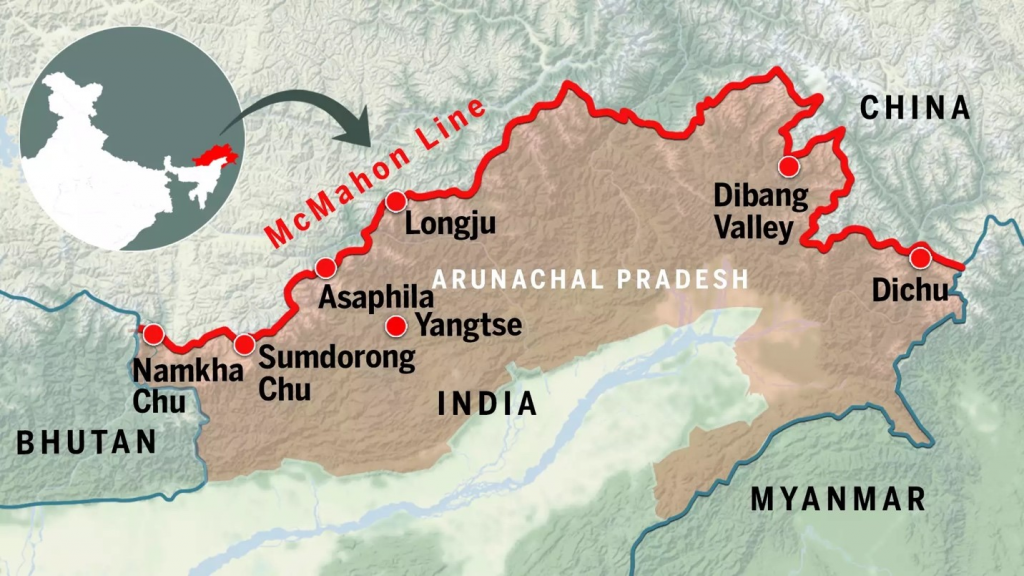
- The unresolved border dispute spans over 2,000 miles, marked by frequent clashes.
- Incidents in Doklam (2017), Galwan Valley (2020), and northeastern states (Sikkim, Arunachal Pradesh).
- Military Infrastructure: Both countries have heavily fortified the border with roads, railways, and airstrips for rapid troop mobilization.
- Belt and Road Initiative (BRI): India has expressed reservations about China’s Belt and Road Initiative, especially regarding the China-Pakistan Economic Corridor (CPEC), which passes through territory of India.
- Trade imbalance: While politically desirable, reducing trade dependence is complicated by China’s economic influence and India’s need for foreign investment.
- China’s growing presence in the Indian Ocean Region:
- Sri Lanka: China’s presence at Hambantota Port and investments in an oil refinery raise concerns in India.
- Nepal: China’s investments in infrastructure (e.g., Pokhara airport) challenge India’s strategic position.
- Bangladesh: China’s growing influence, including loan agreements, threatens India’s regional influence.
- Myanmar: China’s deepening ties with Myanmar’s junta, including the China-Myanmar Economic Corridor, strengthen its presence in India’s backyard.
India’s Efforts to Address these concerns
- India’s Defense Partnerships: Strengthened ties with France, Germany, Spain, and expanded naval alliances in Southeast Asia.
- Quadrilateral Security Dialogue (Quad): India’s shift towards the U.S. and its allies to counter China’s growing influence.
- Maritime Security: India has prioritized maritime security, expanding its naval capabilities and strengthening defense ties with the U.S. and Japan.
- Countering the Belt and Road Initiative (BRI): India joined alternative infrastructure projects such as the Global Infrastructure Facility and India-Middle East-Europe Economic Corridor to counter China’s BRI.
- Trade Relations: India seeks to reduce reliance on Chinese goods, especially in electronics and renewable energy.
Way Ahead
- Addressing the Border Issue: Resolving boundary disputes remains critical. Continued efforts through military and diplomatic negotiations—such as recent developments regarding Depsang and Demchok along the Line of Actual Control (LAC)—are essential to ensure stability and prevent future escalations.
- Diplomatic Engagements: Sustaining open and constructive dialogue is key. India should strengthen bilateral communication mechanisms and actively engage through regional and multilateral platforms such as BRICS, Shanghai Cooperation Organisation (SCO), and others to foster mutual understanding and strategic stability.
Public Accounts Committee Recommendations For GST Regime
Syllabus :GS 3/Economy
In News
- The Public Accounts Committee (PAC) has recommended a simplified Goods and Services Tax (GST) regime in its 19th report.
Goods and Services Tax (GST)
- The idea of Goods and Services Tax (GST) in India was first proposed during Atal Bihari Vajpayee’s tenure.
- In December 2014, the Constitution (122nd Amendment) Bill was introduced, passed in 2015, and ratified in 2016 as the 101st Constitutional Amendment, paving the way for GST.
- GST was officially launched on 1st July 2017 by Prime Minister Narendra Modi, marking a significant step in India’s tax reform.
- It is a destination-based consumption tax levied at all stages, from manufacture to final consumption, with credit for taxes paid at previous stages.
- The tax burden is ultimately borne by the final consumer, and the revenue is allocated to the authority governing the place of consumption (place of supply).
Objectives
- GST aims to simplify India’s indirect tax system by combining multiple Central and State taxes into one, reducing the cascading effect and creating a unified national market.
- It stimulates economic growth, broadens the tax base, increases trade volumes, and improves tax compliance.
Challenges
- The implementation of GST has faced challenges, including complex compliance requirements and high costs for small businesses.
- Frequent changes in tax rates and multiple tax slabs have caused confusion.
- Issues with refund processes create liquidity problems, and cross-border trade is complicated by varying GST rates across states.
Latest Recommendations
- The Public Accounts Committee (PAC) urged the Finance Ministry to review the current framework to eliminate unnecessary complexities and ease compliance.
- The Committee expressed concerns about issues in the biometric-based Aadhaar authentication process, potentially hindering the “One Nation One Tax” vision.
- Other Recommendations
- Streamlining the process by consolidating forms, reducing filing frequency, and introducing a tiered compliance approach for smaller businesses.
- Improving the portal’s ease of use and providing clearer guidance for taxpayers during filing.
- Addressing the issue of harsh criminal penalties for unintentional errors in compliance, particularly for honest taxpayers.
- Using data analytics and AI tools to accurately project GST revenue, addressing the decline in indirect tax share.
- Implementing a more efficient refund system with clear timelines, regular updates, and a dedicated grievance redressal mechanism.
- Simplifying GST compliance for MSMEs by automating return filing and refund processing with reduced frequency and easier online reporting.
Govt. Submits Status Report on Deepfakes
Syllabus: GS3/Science & Technology
Context
- Recently, the MeitY submitted a comprehensive status report to the Delhi High Court, addressing the growing concerns surrounding deepfake technology.
- It highlights the challenges posed by deepfakes, particularly in the context of misinformation, privacy violations, and malicious uses, while proposing actionable recommendations to mitigate these risks.
About Deepfake Technology
- The term ‘deepfake’ originates from ‘deep learning’ and ‘fake’ referring to AI-generated synthetic media that manipulates or replaces real content with fabricated, hyper-realistic counterparts.
- Deepfake models use generative adversarial networks (GANs), where two AI models — the generator and the discriminator — compete against each other to improve the authenticity of the generated content.
Working of Deepfakes
- Data Collection: The AI is trained on a large dataset of real images, videos, or audio recordings of the target person.
- Feature Learning: The deep learning model learns facial structures, expressions, and speech patterns.
- Synthesis & Manipulation: AI algorithms generate synthetic media that can swap faces, alter expressions, or mimic voices.
- Refinement via Generative Adversarial Networks (GANs): The generated content is refined to improve realism and reduce detectable inconsistencies.
Key Concerns Highlighted in the Status Report
- Lack of Uniform Definition: Stakeholders emphasized the absence of a standardized definition for ‘deepfake’, complicating efforts to regulate and detect such content effectively.
- Targeting Women During Elections: Deepfakes have been increasingly used to target women, especially during state elections, raising serious concerns about privacy and the spread of harmful content.
Other Concerns Surrounding Deepfakes
- Misinformation and Political Manipulation: In India, where social media platforms play a crucial role in political discourse, deepfake videos can be weaponized to create unrest.
- Threat to National Security: Malicious actors can use deepfakes to impersonate government officials, leading to misinformation or even cyber warfare tactics that threaten national security.
- Financial Frauds and Cybercrime: AI-generated deepfake voices have been used to mimic corporate executives, leading to financial fraud.
- In India’s digital economy, such crimes could severely impact businesses and individuals.
- Violation of Privacy and Defamation: Deepfakes are frequently used to create non-consensual explicit content, disproportionately targeting women.
- Undermining Trust in Media: When realistic fake content circulates widely, it erodes public trust in authentic journalism and evidence-based reporting, affecting democratic processes.
Government Response and Legal Framework
- Information Technology (IT) Act, 2000: It provides a broad framework for cybercrimes but lacks specific provisions addressing deepfake-related offenses.
- Section 66D: Punishes identity theft and impersonation using digital means.
- Section 67: Penalizes the publishing of obscene material, which can be used against deepfake pornography.
- Personal Data Protection Bill (PDPB) [Now Digital Personal Data Protection (DPDP) Act, 2023]: It aims to regulate the collection and use of personal data. Misuse of deepfakes involving personal identity could be challenged under this act.
- Intermediary Guidelines & Digital Media Ethics Code (2021): These rules mandate social media platforms to proactively monitor and remove harmful content, including deepfakes, failing which they may lose legal immunity under the IT Act.
- Fact-Checking and AI Detection Initiatives: Platforms like PIB Fact Check have been actively debunking deepfake videos spreading misinformation.
- Indian start-ups and researchers are developing AI tools to detect and flag deepfake content.
- Global Collaboration: India is collaborating with global tech firms and governments to combat deepfakes through policy discussions and AI research initiatives.
Challenges in Regulation
- Intermediary Liability Frameworks: The report raised concerns about over-reliance on intermediary liability frameworks, which determine the extent to which platforms can be held accountable for content.
- Detection Difficulties: Audio deepfakes, in particular, pose significant challenges for detection, underscoring the need for advanced technological solutions.
Recommendations from the Report
- Mandatory Content Disclosure: The report advocates for regulations requiring AI-generated content to be disclosed and labelled, ensuring transparency and accountability.
- Focus on Malicious Actors: Emphasis was placed on targeting the malicious uses of deepfake technology rather than benign or creative applications.
- Improved Enforcement: Instead of introducing new laws, the report recommends enhancing the capacity of investigative and enforcement agencies to tackle deepfake-related crimes effectively.
India’s Bioeconomy & Road Ahead
Syllabus: GS3/ Economy, Environment
In News
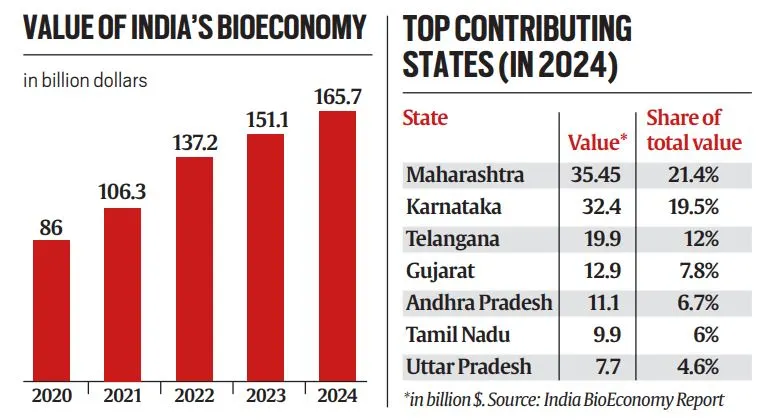
- India BioEconomy Report has pegged the value of India’s bioeconomy in 2024 at more than $165 billion, accounting for over 4.2% of the country’s GDP.
- The report highlighted ample opportunity for this sector to grow to about $300 billion by 2030, and to $1 trillion by 2047.
What is Bioeconomy?
- Bioeconomy refers to the industrial use of biological resources (plants, animals, and microorganisms), and the replication of natural biological processes in the production of goods and services.
- Bioresources like plants or microorganisms are renewable, relatively cheap, and locally available, while natural processes are more sustainable and eco-friendly.
- A prime example of this is the growing use of ethanol, which is produced through fermentation of crops like sugarcane or corn by microorganisms, as a biological alternative to fuels traditionally derived from hydrocarbons.
Why Bioeconomy Matters for India?
- Economic Growth & Jobs:
- Expected to contribute $1 trillion by 2047.
- The number of companies in the bioeconomy has increased by almost 90% in the last three years.
- Nearly half the value of the bioeconomy (roughly $78 billion) was generated in the industrial sector, for the development and use of biofuels and bioplastics.
- Food & Agriculture Security:
- GM technologies improve yields by 21%.
- Biofertilizers enhance soil health.
- Innovations like golden rice combat micronutrient deficiencies.
- Healthcare Access:
- Affordable drug and vaccine production (e.g., CERVAVAC – HPV vaccine).
- Gene therapy advancements (e.g., Hemophilia A trial).
- India supplies 25% of WHO’s total vaccine volume.
- Environmental Benefits:
- Promotes circular economy via waste-to-energy technologies.
- Reduces reliance on fossil fuels with biogas and ethanol.
- Supports biodiversity conservation and eco-restoration (e.g., TERI’s Oilzapper).
- Climate Action:
- Helps achieve India’s net-zero target by 2070.
- Reduces emissions through bio-based alternatives.
BioE3 Push For India’s Bioeconomy
- To catalyze this growth, the government launched the BioE3 policy in 2024—Biotechnology for Economy, Environment, and Employment.
- The policy promotes:
- Establishment of Bio-AI Hubs, Bio-Foundries, and Bio-Enabler Hubs
- Focus on advanced technologies, sustainable biomanufacturing, and pan-India implementation
- Assam became the first state to formally adopt the BioE3 framework, setting the stage for widespread national rollout.
Other Initiatives
- BioSaarthi Mentorship Initiative (2025): BioSaarthi is designed as a six-month cohort facilitating structured mentor-mentee engagements, offering personalized guidance to emerging entrepreneurs in the biotech sector.
- Draft National Biotechnology Development Strategy (2020–25): Targets $150 billion bioeconomy by 2025, focusing on R&D innovation, Industry competitiveness & startup growth.
- Biotechnology Industry Research Assistance Council (BIRAC): Public sector interface to Fund biotech startups.
- National Biopharma Mission: Supports clinical trials, biosimilars, biotherapeutics, and vaccine development.
- PM-JIVAN Yojana: Focus on bioethanol and compressed biogas from agri-waste.
- SATAT & GOBARdhan Schemes: Promotes bio-CNG plants and waste-to-energy models, aligned with rural bioeconomy goals.
- Global Biofuel Alliance (2023): Led by India, USA, and Brazil to strengthen biofuel supply chains and reduce fossil fuel dependence.
- IP Guidelines (2023): Encourages commercialization of public-funded research.
Challenges to Address
- Despite progress, India’s bioeconomy faces several hurdles:
- Fragmented Regulation: Overlaps between agencies delay biotech approvals.
- Limited Investment: High risk and long return on investment deter private capital.
- IP & Bio-piracy Issues: Weak enforcement hampers innovation and indigenous protection.
- Weak Industry-Academia Linkages: Limits commercial translation of research.
- Import Dependence: On high-end equipment and biotech inputs.
- Skill Shortages: Need for trained professionals in genomics, bioinformatics, etc.
- Public Perception: Skepticism around GMOs and lab-grown food remains high.
- Environmental Risks: Overexploitation of biological resources could harm biodiversity and land use.
Way Ahead
- Strengthen Policy Implementation & Coordination: Ensure effective rollout of the BIO-E3 Policy across all states.
- Establish a National Bioeconomy Mission to provide centralized coordination.
- Promote state-level policies aligned with national bioeconomy goals (as Assam has done).
- Boost Investment & Public-Private Partnerships: Create dedicated Bioeconomy Investment Funds.
- Offer tax incentives and risk-sharing models to attract private capital in high-risk biotech ventures.
- Scale PPP models in R&D, manufacturing, and skill development.
- Accelerate Regulatory Reforms:
- Streamline regulatory frameworks through a single-window system (expand BioRRAP).
- Harmonize biotech approvals across agencies (DBT, FSSAI, GEAC, etc.).
- Build capacity in biosafety and ethics review boards for faster innovation deployment.
- Foster Research, IP & Innovation Ecosystem: Fast-track IP approvals and set up specialized IP courts for biotech.
- Strengthen academia-industry linkages through co-development platforms.
- Encourage applied research in synthetic biology, gene therapy, bioinformatics, etc.
- Expand Biotech Infrastructure & Hubs:
- Set up Bio-AI Hubs, Biofoundries, and bio-incubation centers in Tier 2/3 cities.
- Invest in shared testing labs, pilot-scale facilities, and data repositories.
- Support precision farming zones and bio-industrial parks.
- Empower Startups & Entrepreneurs:
- Scale initiatives like BioSaarthi for mentorship and global exposure.
- Strengthen BIRAC schemes for funding, incubation, and early-stage scale-up.
- Encourage grassroots bio-entrepreneurship and women-led biotech ventures.
- Invest in Skilling & Education: Integrate bioeconomy curricula in universities and skill development missions.
- Establish Centers of Excellence in genomics, molecular biology, and bio-manufacturing.
- Enhance Global Collaboration: Forge R&D partnerships with biotech leaders like the EU, Japan, USA.
- Lead international forums like the Global Biofuel Alliance and One Health platforms.
