
Concerns of Rising of ‘1 Person, 1 Family’ Culture: SC
Syllabus: GS1/Society
Context
- Recently, the Supreme Court of India has expressed deep concern over the erosion of traditional family values, highlighting the emergence of a ‘1 person, 1 family’ culture, a stark contrast to India’s cultural philosophy of Vasudhaiva Kutumbakam—’the world is one family’.
What is Family?
- A family is a social group characterized by common residence, economic cooperation, and reproduction. It serves as the primary unit of socialization, deeply influencing an individual’s behavior, identity, and values.
- In Indian society, the family has traditionally held a central place—not just as a unit of kinship, but also as a moral, emotional, and economic anchor. It has shaped interpersonal dynamics, offering emotional security, generational wisdom, and social discipline.
Emergence of the ‘1 Person, 1 Family’ Culture
- India, traditionally known for its strong joint family system, is witnessing a dramatic transformation in family structures.
- In ‘1 Person, 1 Family’ culture, individuals prefer living alone or in nuclear setups, reflecting changing social dynamics, economic aspirations, and shifting personal priorities.
- It is particularly noticeable in urban areas, where young professionals, entrepreneurs, and even elderly individuals are choosing solitude or micro-family structures over large, interdependent households.
Key Reasons For the Shift
- Rapid Urbanization and Economic Independence: India’s metropolitan cities evolving into global economic hubs; professionals migrated into urban hubs often preferring to live independently.
- Data suggests that metros like Mumbai, Bengaluru, and Delhi are witnessing the highest surge in single-person living.
- Changing Aspirations and Individualism: In modern times, youth prioritize personal growth, career ambitions, and self-development; the rise of individualism has shifted priorities from family duty to personal fulfillment.
- Traditional hierarchical family structures are being challenged.
- Delayed Marriages and Changing Relationship Norms: Many urban Indians are delaying marriages, and trends like live-in relationships, single parenting, and choosing to remain unmarried are becoming more acceptable in society.
- Total fertility rate (TFR) has fallen to 2.0 (below the replacement level), reflecting changing family structures.
- Economic Pressures: Rising cost of living and the demanding pace of modern life often make joint family living impractical.
- Influence of Western Lifestyles: Social media, education, and employment abroad has influenced lifestyle choices in India.
- Decline in Moral and Ethical Values: Increasing individualism and materialism has led to reduced emphasis on virtues like empathy, respect, honesty, and sacrifice—essential for harmonious family life.
Challenges of the ‘1 Person, 1 Family’ Trend
- Mental Health Concerns: Loneliness and isolation can impact individuals, particularly older adults and professionals working remotely.
- Financial Pressure: Managing rent, utilities, and daily expenses alone can be expensive.
- Declining Family Bonds: The shift may lead to weaker intergenerational relationships and a fading sense of collective responsibility.
Conclusion
- The Supreme Court’s concerns about the ‘1 person, 1 family’ culture serve as a wake-up call for society to reflect on the values that underpin familial relationships.
- While legal frameworks can address specific disputes, fostering a culture of empathy, respect, and unity within families is essential for preserving the social fabric of the nation.
Dark Side of Digital Gambling in India
Syllabus: GS1/ Social Issue
In Context
- Online gambling is claiming young lives across India, with devastating stories like that of 21-year-old Sai Kiran, who died by suicide after being overwhelmed by debts incurred through online gambling.
Rise in Online Gambling: Alarming Trends
- India’s online skill-gaming market is estimated at $3 billion, but the illegal offshore betting market ranges between $20–30 billion annually. Some estimates even peg it at $100 billion.
- UNICEF reports that children in India spend over $1,000 daily on online gambling.
- A study in South India found that 19.5% of college students gamble, with 7.4% showing signs of addiction.
- During popular sporting events like the IPL, illegal betting surges dramatically, with multiple suicide cases linked to rising debts and gambling losses.
Major Reasons for the Rise in Online Gambling
- Smartphone Penetration & Digital Payments: Over 600 million Indians use smartphones, and with seamless UPI transactions, access to gambling platforms has become incredibly easy.
- Aggressive Digital Marketing: Betting apps spend up to 50% of their revenue on influencer promotions and digital ads. Celebrities and influencers endorse these apps, often disguised as fantasy sports or game reviews, luring unsuspecting users.
- Instant Loans with No Checks: Platforms and associated loan apps offer no-documentation, instant credit, encouraging users to borrow and bet without understanding the consequences.
- Psychological Triggers: Online gambling taps into reward-seeking behavior. It offers quick gratification, near-miss illusions, and an adrenaline rush, making it highly addictive, especially for youth raised in a fast-reward digital culture.
- Weak Enforcement & Offshore Operations: Most illegal betting platforms operate from offshore jurisdictions like Curaçao, Cyprus, China, and Dubai. They exploit tax loopholes, avoid KYC norms, and are almost impossible to track.
Implications of Online Gambling
- Mental Health Crisis: Gambling addiction leads to anxiety, depression, suicidal ideation, and substance abuse. Many victims suffer in silence, and some, like Sai Kiran in Telangana, tragically end their lives due to mounting debts.
- Financial Destruction: Users often borrow from family or loan sharks, sell valuables, or default on digital loans. Families lose life savings, and intergenerational debt becomes a real threat.
- Cybercrime & Money Laundering: Illegal platforms use UPI, crypto wallets, and mule accounts to process over ₹2,500 crore in illicit transactions monthly, according to RBI data.
- Youth Vulnerability: The illusion of “quick money” appeals strongly to young adults under pressure to earn, maintain social status, or purchase gadgets — making them ideal targets.
Current Regulations
- The Information Technology (Intermediary Guidelines and Digital Media Ethics Code) Rules, 2021 were amended in 2023 to regulate online gaming.
- 28% GST is now levied on gaming firms, but offshore platforms bypass this tax.
- The Telangana Gaming (Amendment) Act, 2017 banned online gambling in the state.
- The GST Council in 2023 mandated that offshore betting companies should be registered with Indian tax authorities — most have ignored it.
Why is Regulation Difficult?
- Offshore operations make jurisdictional control hard.
- Lack of clear legal distinction between “games of skill” (legal) and “games of chance” (illegal) creates a regulatory grey zone.
- Digital advertising is fragmented and decentralized, allowing disguised promotions to flourish.
- Influencer marketing loopholes mean even banned content is repackaged as “sports blogs” or “gaming reviews.”
Way Ahead
- Clear and Unified Legislation: There is a pressing need for a centralised legal framework that clearly distinguishes legal skill gaming from illegal gambling, with stringent penalties for violations.
- Strengthening Enforcement: Empower agencies like I4C (Indian Cyber Crime Coordination Centre) to monitor, investigate, and take swift action against rogue apps and influencers.
- International Collaboration: Coordinate with global agencies and governments to block illegal offshore operators and crack down on cross-border financial crimes.
- Tighter Digital Ad and Influencer Oversight: Mandate strict KYC for digital advertisers, enforce real-time takedowns, and penalise celebrities and influencers endorsing illegal betting platforms.
Union Cabinet Approved Electronics Component Manufacturing Scheme
Syllabus: GS3/Economy
Context
- The Union Cabinet chaired by the PM approved the Electronics Component Manufacturing Scheme with a funding of Rs.22,919 crore to make India Atmanirbhar in the electronics supply chain.
About
- Objectives:
- Develop a robust component ecosystem by attracting both global and domestic investments.
- Increase Domestic Value Addition (DVA) through capacity and capability development.
- Integrate Indian companies into Global Value Chains (GVCs).
- Expected Outcomes:
- Attract an investment of Rs.59,350 crore.
- Result in production of Rs.4,56,500 crore.
- Generate 91,600 direct jobs and numerous indirect jobs.
- Duration: Tenure of six years with a one-year gestation period.
Electronics Sector
- The electronics sector encompasses the design, manufacturing, and marketing of electronic components and systems.
- Electronics is one of the highest-traded and fastest-growing industries globally and is expected to play a pivotal role in shaping the global economy.
- Since electronics permeates all sectors of economy it has economic and strategic importance.
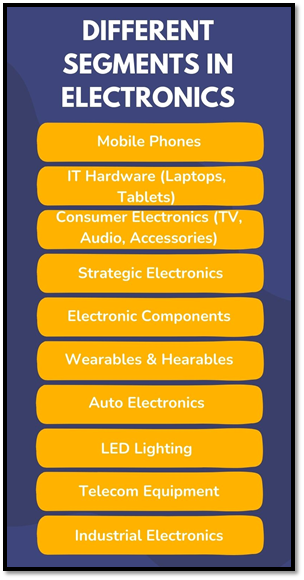
India’s Electronic Sector
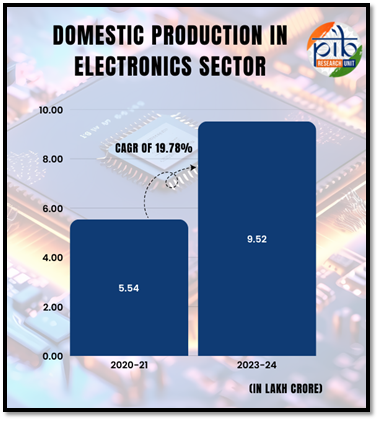
- Domestic Production: It has increased from Rs.1.90 lakh crore in FY 2014-15 to Rs.9.52 lakh crore in FY 2023-24 at a CAGR of more than 17%.
- Exports: The exports of electronic goods have also increased from Rs.0.38 lakh crore in FY 2014-15 to Rs.2.41 lakh crore in FY 2023-24 at a CAGR of more than 20%.
- India is the second largest mobile phone producer in the world.
- India’s semiconductor ecosystem has gained significant momentum, with five landmark projects receiving approval with a total combined investment nearing Rs 1.52 lakh crores.
- Future Projections: It indicates that India’s electronics production will reach USD 300 billion by 2026.
Challenges
- Dependence on Imports: High reliance on imported components, especially semiconductors, increases costs and supply chain vulnerabilities.
- Infrastructure Gaps: Inadequate infrastructure for large-scale manufacturing and logistics hampers efficiency.
- Skilled Labor Shortage: Limited availability of skilled workers for advanced manufacturing processes and R&D.
- High Capital Investment: Significant investment required for setting up world-class manufacturing facilities, making entry challenging for new players.
- Technology Gaps: Lack of cutting-edge technology and innovation in certain segments of the electronic value chain.
- Competition from Global Players: Intense competition from established global electronics manufacturers and countries with lower production costs.
Government schemes for the Electronics boom in India:
- Make in India: launched in 2014, aimed at boosting India’s manufacturing sector and economic growth.
- Transform India into a global hub for design and manufacturing.
- Phased Manufacturing Programme (PMP): Launched in 2017, aimed to promote domestic value addition in mobile phones and their parts.
- Increased investment and set up significant manufacturing capacities in India.
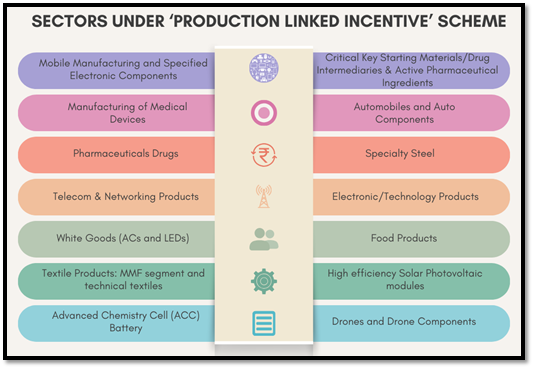
- Production Linked Incentive (PLI) Scheme: Introduced in 2020, aimed to boost domestic manufacturing in mobile phones, electronic components, and semiconductor packaging.
- Incentives: 3% to 6% on incremental sales (over base year) for eligible companies.
- Duration: 5 years.
- Semicon India Program: Launched in 2021 with a financial outlay of ₹76,000 crore, it is structured to promote the domestic semiconductor industry through incentives and strategic partnerships.
- At Global Investors Summit 2025, it was announced that India’s first indigenous semiconductor chip will be ready for production by 2025.
- The Scheme for Promotion of Manufacturing of Electronic Components and Semiconductors (SPECS): The scheme will provide financial incentive of 25% on capital expenditure for the identified list of electronic goods that comprise downstream value chain of electronic products.
- Increased Budget: Allocation for electronics manufacturing rose from ₹5,747 crore (2024-25) to ₹8,885 crore (2025-26), highlighting the government’s commitment to industrial growth.
Conclusion
- India’s rapid transformation into a global electronics manufacturing hub is a testament to the success of the Make in India initiative.
- With numerous schemes to support the manufacturing processes in India, the country has significantly boosted local manufacturing, exports, and investment.
- India aims for USD 300 billion in electronics production by 2026 that will position it as a major hub in the electronics and semiconductor industries.
New Study Differs from NCRB on the Issue of Child Labour in India
Syllabus: GS1-Society/GS2-Governance
Context
- A study on child labour by by Enfold and CivicDataLab, based on judicial data from the e-Courts platform differs from NCRB and revealed more child labour cases in six states.
Key Findings
- Discrepancy in Data: Judicial data reveals 8 times more child labour cases than reported by NCRB.
- NCRB reports 1,329 cases (2015-2022) under the Child and Adolescent Labour (Prohibition and Regulation) Act, 1986.
- e-Courts data shows 9,193 trials in the same period, a significant increase.
- 10,800 child labour cases were analyzed across six states: Maharashtra, Assam, Bihar, Jharkhand, Tamil Nadu, and Uttar Pradesh.
- Issues with NCRB Data: NCRB follows the “Principal Offence Rule”, counting only the most serious crime in cases with multiple offences.
- Minor crimes, like child labour, may not be reflected if they are part of a larger criminal case.
- Importance of Data: Data is key for understanding crime trends and addressing issues like child labour.
- Helps researchers and academics create better solutions and policies.
Issue of Child Labour in India
- Child Labour continues to be a significant issue in India, despite government efforts.
- Root causes: Poverty and illiteracy, requiring societal involvement for effective solutions.
- Statistics on Child Labour
- Census 2001: 1.26 crore working children (age 5-14) out of 25.2 crore total child population.
- Census 2011: India had approximately 10.1 million child labourers aged 5-14 years, representing 3.9% of the total child population in this age group.
- Gurupadswamy Committee: It was formed in 1979, to study child labour and propose measures.
- Found that poverty was a key barrier to eliminating child labour.
- Recommended banning child labour in hazardous sectors and regulating other areas.
- Advocated for a multiple policy approach.
Impact of Child Labour on Society
- Hindered Economic Growth: Child labour leads to a loss of productivity in the long term as children miss out on education and skill development.
- Perpetuation of Poverty: Children working instead of studying contribute to the continuation of the poverty cycle, as they are less likely to secure well-paying jobs as adults.
- Lack of Skilled Workforce: Children involved in labour miss out on education, leading to a lack of skilled workers in the future economy.
- Social Inequality: Child labour exacerbates social inequality, as marginalized and economically disadvantaged children are more likely to be exploited.
- Weakens Social Progress: Widespread child labour limits the progress of society, as it hinders efforts to improve education, health, and overall quality of life.
Challenges in Preventing Child Labour in India:
- Poverty: Families often rely on children’s income for survival, making it difficult to eliminate child labour.
- Lack of Access to Education: Poor infrastructure and limited schools, especially in rural areas, prevent children from receiving education.
- Cultural Acceptance: In some regions, child labour is normalized and seen as part of family tradition or livelihood.
- Limited Awareness: Lack of awareness among families, employers, and communities about the harmful effects of child labour.
- Economic Exploitation: Demand for cheap labour in industries like textiles, agriculture, and construction continues to exploit children.
- Migration: Migrant families in urban areas often push children into work due to instability and lack of access to education.
Constitutional Provisions:
- Fundamental Rights:
- Article 21A: The State shall provide free and compulsory education to all children of the age of 6 to 14 years.
- Article 24: Prohibits child labour below 14 years in hazardous employment.
- Directive Principles of State Policy:
- Article 39(e): Protects children from exploitation and abuse.
- Article 39(f): Ensures children’s development in conditions of dignity and freedom.
Legislative Actions
- Child Labour (Prohibition & Regulation) Act, 1986: Prohibited child labour in hazardous occupations and regulated work in other sectors.
- Amendment (2016): Prohibited child employment below 14 years in all occupations.
- Extended prohibition to adolescents (14-18 years) in hazardous jobs.
- Amendment (2016): Prohibited child employment below 14 years in all occupations.
- National Policy on Child Labour (1987): Focused on a gradual and sequential approach.
- Prioritized the rehabilitation of children and adolescents.
- National Child Labour Project (NCLP): Provides education, vocational training, and rehabilitation for children rescued from labour in high-concentration areas.
- Right to Education (RTE) Act, 2009: Ensures free and compulsory education for children aged 6-14, aiming to keep them out of the workforce.
- Mid-Day Meal Scheme: Encourages school attendance by providing free meals, reducing the incentive for children to work.
- Labour Inspections and Raids: State governments conduct regular inspections and raids to identify and prevent child labour in industries.
- Integrated Child Protection Scheme (ICPS): Provides support and rehabilitation for children at risk of exploitation and abuse, including child labour.
National Gene Bank
Syllabus: GS3/ S&T
In News
- The central government has announced the establishment of a second National Gene Bank (NGB) as a part of the Union Budget 2025-26 under the theme “Investing in Innovations”.
What is Gene Bank?
- A Gene Bank is a bio-repository that preserves genetic material of plants, animals, and microbes, particularly seeds, tissues, and DNA.
- In the case of crops, this involves the storage of germplasm (viable plant material such as seeds) under controlled conditions to ensure their long-term viability.
| Type of Bank | What it Stores | Example |
|---|---|---|
| Seed Bank | Seeds under controlled conditions | ICAR-NBPGR, New Delhi |
| Field Gene Bank | Live plants maintained in the field | For perennial crops like mango |
| Cryobank | Genetic material stored at ultra-low temperatures (e.g., -196°C in liquid nitrogen) | DNA, pollen, embryos |
| DNA Bank | Purified DNA samples | Used for genetic research |
| In Vitro Bank | Plant tissues stored in nutrient mediums | Tissue culture |
Need
- The goal of the new NGB is to conserve 10 lakh crop germplasm.
- These genetic resources are used for crop improvement and genetic resource management.
- The new Gene Bank will have state-of-the-art infrastructure and aims to expand India’s conservation capacity.
- It is important for preserving genetic diversity and promoting sustainable agricultural practices to ensure future food security.
Do you Know?
- The first National Gene Bank is located at the ICAR-National Bureau of Plant Genetic Resources (NBPGR) in New Delhi.
- The first NGB is the second-largest gene bank in the world, holding 4,71,561 accessions from 2,157 species.
