
SC Cleared 10 Bills Using Article 142
Syllabus: GS2/Governance
Context
- The Supreme Court invoked Article 142 to pass 10 Bills pending with Tamil Nadu Governor effectively granting assent to them.
About
- The Court exercised its rare powers to do “complete justice,” bypassing the Governor’s role in the lawmaking process.
- The Supreme Court ruled that Governors cannot delay or withhold assent to Bills indefinitely once they are passed or re-passed by the state Assembly.
- The ruling set a timeline for the Governor to act on Bills:
- One month for re-passed Bills.
- Three months if the Bill is withheld contrary to Cabinet advice.
- Significance: The ruling redefines the relationship between the Centre and states, curbing the power of Governors and reinforcing the authority of state legislatures.
What is Article 142?
- Article 142 of the Indian constitution is a provision that empowers the Supreme Court to pass any decree or order necessary for doing complete justice in any case or matter pending before it.
- It also makes such decree or order enforceable throughout the territory of India.
- The importance of Article 142 lies in the following aspects:
- It enables the Supreme Court to exercise executive and legislative functions in certain situations, such as issuing guidelines, directions, or orders to the government or other authorities.
- It allows the Supreme Court to intervene in matters of public interest, human rights, constitutional values, or fundamental rights, and to protect them from any violation or infringement.
- It enhances the Supreme Court’s role as the guardian of the constitution and the final arbiter of the law.
- Criticism: It may encroach upon the principle of separation of powers and the domain of the executive and the legislature, and may invite criticism of judicial overreach or activism.
How are the Bills Passed by the Governor?
- Article 200 provides that when a Bill passed by the State Legislature, is presented to the Governor, the Governor shall declare:
- that he assents to the Bill;
- or that he withholds assent there from;
- or that he reserves the Bill for the President’s consideration;
- or the Governor may return the Bill (other than a Money Bill) with a message for re-consideration by the State Legislature.
- Reconsidered Bill: If the bill is returned by the Governor for reconsideration and the Legislature passes it again without any change, the Governor is constitutionally bound to give assent.
- The Governor cannot then reserve it for the President’s consideration under Article 200.
- Reserving the Bill: If the Governor reserves a Bill for President’s consideration, the enactment of the Bill then depends on the assent or refusal of assent by the President.
- Article 201: The President shall, under Article 201—, either declare his assent or withhold his assent thereto.
- Instead of following either of these courses, the President may (if the Bill is not a Money Bill) direct the Governor to return the Bill together with a message to the State Legislature for reconsideration.
- The State Legislature shall then reconsider the Bill within 6 months of its receipt and, if it is again passed, it shall be presented again to the President for his consideration.
- In contrast with the power of the Governor regarding a reconsidered Bill, it is not obligatory for the President to give his assent to a reconsidered Bill.
Concerns of the States
- Interference in State Autonomy: States argue that the Governor’s role in reserving bills for the President undermines the autonomy of state legislatures, especially when the bills are in the State List.
- Misuse of Discretion: There are concerns that Governors reserve bills contrary to the advice of the State Council of Ministers, leading to misuse of discretionary powers.
- Subordination to Union Executive: States view the Governor’s ability to refer bills to the President as subordinating state legislative authority to the Union Executive.
- Delays in Decision-Making: Many states complain of delays in the President’s decision on reserved bills, which affects the timely enactment of laws.
- Lack of Clear Guidelines: States suggest that there should be clear guidelines for the Governor and Union Government to prevent arbitrary use of discretion.
- Impact on Federalism: Some states believe that Articles 200 and 201, which allow the Governor to reserve bills, are inconsistent with the true federal structure of India.
Conclusion
- There were demands to establish clear, uniform guidelines for the Governor’s discretion in reserving bills, ensuring transparency and consistency in decision-making.
- Introducing time-limits on the duration of passage of bills will ensure timely formation and implementation of policy and will also strengthen the federal structure of India.
Report-Death Sentences and Executions 2024
Syllabus: GS2/Polity & Governance
Context
- Amnesty International has released its report, Death Sentences and Executions 2024.
Major Findings
- Global Execution Statistics: In 2024, 1,518 people were executed across 15 countries, marking the highest number since 2015.
- It is an increase by 32% in recorded executions compared to 2023.
- Reason for Spike: Weaponization of the death penalty to silence dissent, punish minorities, and crack down on drug-related offences.
- Key Countries Leading the Surge: Iran, Saudi Arabia, and Iraq were responsible for 91% of global executions.
- Death Penalty as a Tool of Fear: The report condemned the use of the death penalty as a political tool rather than for justice.
- China topped the global list for executions, followed by Iran, Saudi Arabia, Iraq, and Yemen.
- The authorities of China continued to balance secrecy on information on the death penalty with occasional disclosures around certain types of cases.
- Drug-Related Executions: Over 40% of global executions in 2024 were for drug-related offences.
- Declining Global Use of the Death Penalty: Despite the rise in executions, the number of countries carrying out executions remained low at 15 for the second consecutive year.
- 145 countries have abolished the death penalty in law or practice.
Death Sentence in India
- In 2024, for the second consecutive year, the Supreme Court of India didn’t confirm any death sentence, revealed a report from Project 39A of the National Law University Delhi.
- Prisoners on Death Row in India
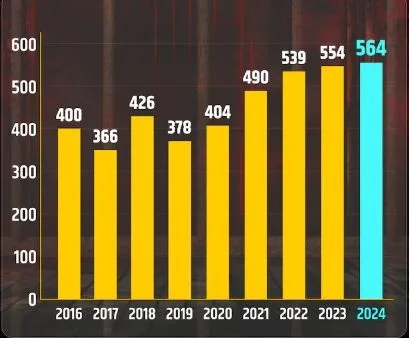
- In India, capital punishment, also known as the death penalty, is carried out by “hanging by the neck until death”.
- Several countries like Portugal, the Netherlands, France and Australia have moved towards abolishing executions, countries like the US, Iran, China and India have retained a legal framework to enable the death penalty.
- Capital punishment, which the Supreme Court has repeatedly stated should be used only in the rarest of rare cases, was last carried out in 2020 in the Nirbhaya case.
‘Rarest of rare’ Doctrine in India:
- 1972 – Jagmohan Singh vs. State of U.P.: The Supreme Court upheld the constitutionality of the death penalty.
- 1980 – Bachan Singh vs. State of Punjab: The Court introduced the ‘rarest of rare’ doctrine, stating the death penalty should be imposed only in exceptional cases.
- 1983 – Machhi Singh vs. State of Punjab: The Supreme Court clarified the ‘rarest of rare’ doctrine and identified five categories of crimes where the death penalty may be justified:
- Manner of committing the murder: Extremely brutal and dastardly murders.
- Motive of the murder: Committed for a motive showing total depravity.
- Socially abhorrent nature of the crime: When a murder targets a minority community and raises social wrath.
- Magnitude of the crime.
- Victim: When the victim is particularly vulnerable, such as a child, woman, or elderly person.
Global Framework on Death Penalities
- Article 6 of the International Covenant on Civil and Political Rights (ICCPR): Allows the death penalty in limited circumstances but stresses that nothing in this article should delay or prevent the abolition of capital punishment by any State Party.
- 1984 – UN Safeguards: The UN Economic and Social Council adopted Safeguards guaranteeing the rights of individuals facing the death penalty.
- 1989 – Second Optional Protocol to the ICCPR: The UN General Assembly adopted this protocol, urging member states to abolish the death penalty.
- States that ratified agreed not to execute anyone within their jurisdiction.
- UN General Assembly Resolutions (2007-2018): It urged countries to:
- Respect international standards protecting the rights of those facing the death penalty.
- Progressively restrict its use.
- Reduce the number of crimes punishable by death.
- For the first time, more than two thirds of all UN member states voted in favour of the tenth General Assembly resolution on a moratorium on the use of the death penalty.
Panchayat Advancement Index (PAI) Baseline Report
Syllabus: GS2/Governance; Government Policy & Intervention
Context
- Recently, the Ministry of Panchayati Raj has unveiled the first-ever Panchayat Advancement Index (PAI) Baseline Report for the fiscal year 2022–23.
About Panchayat Advancement Index (PAI)
- It is a composite Index & has been compiled based on 435 unique local Indicators (331 mandatory & 104 optional) consisting of 566 unique data points across 9 themes of Localization of Sustainable Development Goals (LSDGs).
- It reflects India’s commitment to achieving the SDG 2030 Agenda through participatory, bottom-up development.
- It is aligned with the National Indicator Framework (NIF) of the Ministry of Statistics and Programme Implementation (MoSPI).
- It is a collaborative effort of various Union Ministries, State Governments and UN Agencies.
Key Factors in Panchayat Advancement Index (PAI)
- Infrastructure: Availability of basic amenities like roads, electricity, water supply, sanitation facilities, etc.
- Health and Education: Access to healthcare services, educational institutions, literacy rates, and enrollment in schools.
- Economic Indicators: Income levels, employment opportunities, agricultural productivity, and economic activities.
- Social Indicators: Poverty rates, gender equality, social inclusion, and overall quality of life.
- Governance and Administration: Efficiency and transparency of local governance, delivery of public services and citizen participation.
- Environmental Sustainability: Measures related to ecological balance, conservation, and sustainable practices.
Key Features of the PAI
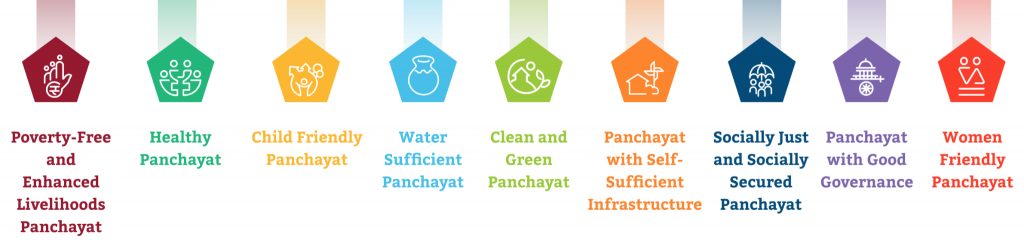
- Localized SDG Themes: The PAI evaluates Panchayats across nine themes, including poverty alleviation, health, child welfare, water sufficiency, environmental sustainability, infrastructure, social justice, good governance, and women’s empowerment.
- Performance Categories: Panchayats are categorized into five tiers based on their scores:
- Achiever (90+ points): None qualified this year.
- Front Runner (75–90 points): 699 Panchayats (0.3%).
- Performer (60–75 points): 77,298 Panchayats (35.8%).
- Aspirant (40–60 points): 1,32,392 Panchayats (61.2%).
- Beginner (below 40 points): 5,896 Panchayats (2.7%).
- Data Validation: Out of 2,55,699 Gram Panchayats, 2,16,285 submitted validated data through the dedicated PAI portal.
State-Level Insights
- Top Performers: Gujarat led with 346 Front Runner Panchayats, followed by Telangana with 270 Front Runners.
- States like Maharashtra, Madhya Pradesh, and Uttar Pradesh recorded high numbers of Performer Panchayats.
- Developmental Gaps: States such as Bihar, Chhattisgarh, and Andhra Pradesh showed a larger share of Aspirant Panchayats, highlighting areas requiring focused developmental efforts.
Purpose and Impact
- Evidence-Based Planning: The PAI fosters transparency and accountability, enabling policymakers to identify developmental gaps and prioritize resource allocation.
- Empowering Panchayats: By providing a standardized framework, the index empowers Panchayats to craft effective development plans tailored to local needs.
- Commitment to SDGs: The initiative reflects India’s dedication to achieving the 2030 SDG Agenda through participatory, bottom-up development.
Conclusion
- The rollout of the Panchayat Advancement Index Baseline Report marks a significant milestone in rural governance, bridging global SDG ambitions with local realities.
- By promoting evidence-based planning and fostering competition among Panchayats, the PAI is set to transform grassroots development and empower rural communities across India.
India’s Genome Mapping Reveals 180 Million DNA Variants
Syllabus: GS3/ Science and Technology
Context
- The GenomeIndia project has published preliminary findings based on genome sequencing of 9,772 individuals across 85 diverse Indian populations.
What is genome sequencing?
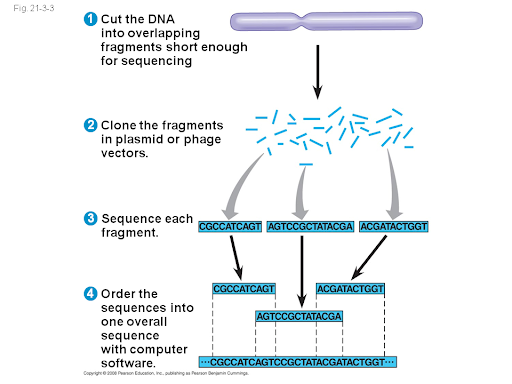
- It is the process of determining the complete DNA sequence of an organism’s genome, which includes all its genes and non-coding regions.
- It involves identifying the exact order of the four nucleotide bases (adenine, cytosine, guanine, and thymine) that make up the DNA.
Key Findings of the study
- 180 million genetic variants discovered:
- 130 million in autosomes (non-sex chromosomes).
- 50 million in sex chromosomes (X and Y).
- Population-specific uniqueness: Certain variants are found exclusively in specific communities, pointing to localized genetic adaptations.
- Disease-related variants: Some variants indicate susceptibility or resistance to infectious diseases, while others relate to environmental adaptations, e.g., high altitude, low oxygen.
Importance of the study
- It enables personalized treatment protocols based on individual genetic makeup.
- It identifies genetic markers for complex diseases like diabetes, cancer, cardiovascular disorders.
- It helps in predicting drug response, minimizing adverse effects through pharmacogenomics.
| What is GenomeIndia Project? – The objective of GenomeIndia is to build a comprehensive catalogue of genetic variations that reflect the unique diversity of the Indian population. – It is a collaborative effort of 20 institutions and funded by the Department of Biotechnology, Ministry of Science and Technology. Goals of the project: 1. Establish a Robust Biobank for Future Research: Collect and store 20,000 blood samples to enable cutting-edge biological research and advancements. 2. Enable Open Access to Genomic Data: Provide publicly accessible genomic datasets through the Indian Biological Data Centre (IBDC), fostering global research collaborations and innovation. |
National Critical Mineral Mission
Syllabus: GS3/ S&T
In Context
- The National Critical Mineral Mission (NCMM) was launched in 2025 to establish a robust framework for self-reliance in the critical mineral sector.
About
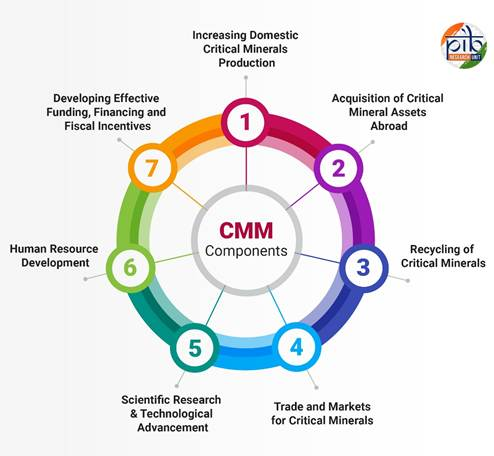
- Critical minerals are essential for clean energy technologies like solar panels, wind turbines, EVs, and energy storage systems. To secure these resources, India launched the NCMM to ensure their long-term availability and processing.
- The NCMM mission aims to establish a robust framework for self-reliance in the critical mineral sector. Under this mission, the Geological Survey of India (GSI) has been tasked with conducting 1,200 exploration projects from 2024-25 to 2030-31.
- A committee formed by the Ministry of Mines in November 2022 identified 30 critical minerals, with 24 included in Part D of Schedule I of Mines and Minerals Development and Regulation Act, 1957 (MMDR Act, 1957).
- The Union Government now has the exclusive authority to auction mining leases and composite licenses for these specific minerals.
What are Critical minerals?
- Critical minerals are essential for a country’s economic development and national security, and their lack of availability or concentration in a few geographical locations can lead to supply chain vulnerabilities.
Uses of Critical Minerals
- Energy Security & Clean Transition: Lithium, cobalt, nickel, and REEs are crucial for renewable energy systems (e.g. solar panels, wind turbines).
- Support India’s targets: 50% electric power from non-fossil sources by 2030
- Net-zero emissions by 2070
- Increases wind energy capacity from 42 GW to 140 GW by 2030
- Support India’s targets: 50% electric power from non-fossil sources by 2030
- Boost to Electric Vehicles (EVs) and Storage: Essential for manufacturing lithium-ion batteries, the backbone of EVs and energy storage systems.
- Reduce India’s dependency on imported oil.
- Aligns with the National Electric Mobility Mission Plan (NEMMP) and FAME scheme.
- Economic Development & Job Creation: Mining, processing, and R&D in critical minerals can:
- Attract domestic and foreign investment.
- Create jobs in exploration, engineering, refining, and technology sectors.
- Strengthen MSMEs and startups in the clean-tech value chain.
- National Security: Critical minerals like rare earths, titanium, and tungsten are used in:
- Defense (missile systems, stealth aircraft, radar)
- Electronics (telecom, semiconductors, satellites)
- Reduces strategic vulnerabilities by minimizing import dependence.
- Infrastructure & Digital Economy Backbone: Minerals like silicon, gallium, indium are essential for:
- Semiconductors
- 5G/6G tech
- Smart grids, smart cities, and digital India initiatives
IREL (India) Limited
- It is a key public sector enterprise under the Department of Atomic Energy, and plays a vital role in India’s critical minerals value chain.
- With a processing capacity of 6 lakh tonnes per annum, it produces essential beach sand minerals such as ilmenite, rutile, zircon, sillimanite, and garnet.
- The company operates a Rare Earth Extraction Plant in Chatrapur, Odisha, and a Rare Earth Refining Unit in Aluva, Kerala, contributing to the indigenous processing of rare earth elements (REEs).
International Engagements
- KABIL-CAMYEN Agreement (Argentina, 2024): Lithium exploration over 15,703 hectares.
- MoU with Australia’s Critical Minerals Office (2022).
- Talks with Democratic Republic of Congo (DRC) for cobalt and copper.
- Strategic tie-ups with Africa, Latin America, and ASEAN countries for secure sourcing.
Challenges
- Geopolitical Risks: Dependence on imports from China, DRC, and South America.
- Lack of Domestic Processing Capacity: India currently lacks advanced REE separation technologies.
- Low Private Investment: Mining sector faces regulatory and financial entry barriers.
- Environmental Concerns: Mining and refining can damage local ecosystems.
- Recycling Ecosystem: Still nascent and lacks scale.
Way Forward
- Strengthen domestic exploration and incentivize the private sector via PPP.
- Forge long-term strategic partnerships with mineral-rich countries.
- Boost R&D and recycling to close the mineral loop.
- Skilling and capacity-building for critical mineral-specific technologies.
The Arctic Boreal Zone (ABZ) Rejects More Carbon
Syllabus: GS3/Environment
Context
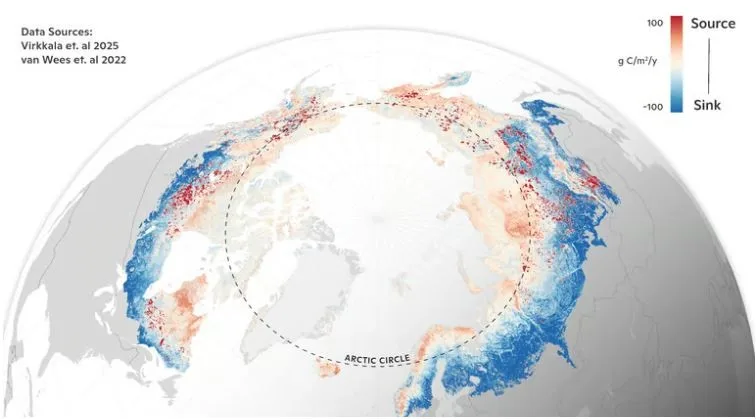
- According to a new study published in Nature, the increasing ferocity of wildfires means that more than 30% of the Arctic Boreal Zone (ABZ) has now stopped capturing carbon and is instead releasing it.
About
- The findings align with the National Oceanic and Atmospheric Administration (NOAA’s) 2024 Arctic Report Card.
- It also highlighted that the Arctic tundra, a treeless region, is becoming a net carbon source, largely due to warming temperatures and escalating wildfire activity in the Northern polar region.
The Arctic Boreal Zone (ABZ)
- ABZ is a critical region in the northern hemisphere, characterized by its unique ecosystems and significant role in regulating global carbon cycles.
- Geographical Location:
- The ABZ spans across the Arctic Circle, including parts of Alaska, northern Europe, and Siberia.
- It includes tundra, coniferous forests, wetlands, and permafrost regions.
- Carbon Sink: The ABZ has historically acted as a significant carbon sink, absorbing large amounts of carbon dioxide (CO₂) from the atmosphere through its forests, soil, and permafrost.
- The tundra and wetlands in the ABZ sequester carbon in the form of organic material frozen in permafrost, which helps mitigate global warming.
Recent Wildfires:
- Multiple U.S. states (Texas, Oklahoma, California) and Japan (Ofunato) faced severe wildfires in early 2025.
- India’s forest fire hotspots dropped, but the number of fires remains high, particularly in Uttarakhand, Odisha, and Chhattisgarh.
- Rising land temperatures and prolonged heat waves contribute to more intense fires.
Carbon Emissions:
- Wildfires in January 2025 released 800,000 tonnes of carbon, nearly four times the amount released a decade ago.
- Wildfires worldwide significantly contribute to carbon emissions, including 69 million tonnes annually in India.
Carbon Sinks and the Arctic Boreal Zone (ABZ):
- Oceans, forests, and soil are carbon sinks, but wildfires have disrupted their ability to absorb carbon.
- The ABZ, once a significant carbon sink, has started releasing carbon, especially due to thawing permafrost and increased wildfires.
- Over 30% of the ABZ now releases carbon, reversing its long-standing role as a carbon sink.
