
106th Anniversary of Jallianwala Bagh Massacre
Syllabus: GS1/ Modern Indian History
Context
- Prime Minister Modi paid homage to the martyrs of Jallianwala Bagh.
What was the Jallianwala Bagh Massacre?
- The Jallianwala Bagh massacre, also known as the Amritsar massacre, occurred on 13th April 1919 and marked one of the darkest chapters in India’s colonial history.
- To celebrate the Baisakhi festival and protest the arrest of prominent nationalist leaders Dr. Saifuddin Kitchlew and Dr. Satyapal under the Rowlatt Act, a large crowd of men, women, and children had gathered at the Jallianwala Bagh.
- Colonel Reginald Dyer ordered British Indian Army troops to open fire on a peaceful gathering of thousands, without issuing any warning or order to disperse.
- According to official British records, at least 379 people were killed and many wounded.
The Rowlatt Act
- The Rowlatt Act, officially known as the Anarchical and Revolutionary Crimes Act of 1919, was passed on March 10, 1919.
- It gave the British government extraordinary powers to detain individuals suspected of sedition without trial.
- This act was based on the recommendations of the Sedition Committee chaired by Sir Sidney Rowlatt and was modelled on the wartime Defence of India Act of 1915.
British response to Jallianwala Bagh Massacre
- Martial Law: The shooting was followed by the proclamation of martial law in Punjab.
- The Hunter Commission, also called the Disorders Inquiry Committee, was set up by the British government in October 1919 to investigate the massacre.
- The Commission criticized Colonel Reginald Dyer for his actions at Jallianwala Bagh.
- It censured Dyer but did not impose any significant penalties. It did, however, recommend his resignation from the military.
Nationalist Response
- Rabindranath Tagore, the Nobel laureate poet, renounced his knighthood in protest against the brutality of the British actions.
- Mahatma Gandhi, launched the Non-Cooperation Movement in 1920, urging Indians to boycott British goods and institutions.
- He also gave up the title of Kaiser-i-Hind, bestowed by the British for his work during the Boer War.
- This movement marked a significant phase in India’s struggle for independence.
The Jallianwala Bagh Memorial
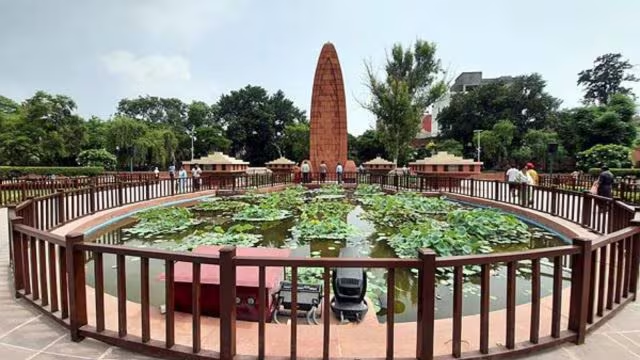
- Jallianwala Bagh is a memorial site maintained by the Jallianwala Bagh National Memorial Trust.
- The site includes several structures like a memorial flame, bullet-marked walls, and a well where many people had jumped to escape the bullets.
- The memorial also houses a museum and gallery that showcases the events of the massacre and the larger context of India’s fight for freedom.
BR Ambedkar Jayanti
Syllabus: GS1/Indian History; Society
Context
- Recently, India celebrated the legacy of Dr. Bhimrao Ramji Ambedkar on Ambedkar Jayanti, a towering figure in India’s fight against caste-based discrimination.
| About Dr. Bhimrao Ramji Ambedkar (1891–1956) – Born: April 14, 1891; Mhow, Madhya Pradesh, in Hindu Mahar Family. – He was the 14th child of Subedar Ramji Maloji Sakpal, a respected figure in the British Army and a follower of Sant Kabir. Education – B.A. in Economics and Political Science from Bombay University. – M.A. and Ph.D. in Economics (Thesis work: National dividend for India — A Historic and Analytical Study) from Columbia University, and furthered studies at the London School of Economics. 1. His thesis was published as ‘Evolution of Provincial Finance in British India’. Architect of the Indian Constitution – Chairman of the Drafting Committee of the Constituent Assembly – He emphasized the importance of equality, liberty, and fraternity. – He was India’s first Minister of Law and Justice 1. He resigned his ministership in 1951, expressing his differences on the Kashmir issue, India’s Foreign Policy and Nehru’s Policy towards the Hindu Code Bill. – He was conferred with the title of ‘Bodhisattva’ by the Buddhist monks at ‘Jagatik Buddhism Council’ in 1954 in Kathmandu, Nepal. Major Writings and Publications – Mooknayak (fortnightly newspaper, in 1920) – The Problem of the Rupee: Its Origin and Its Solution (1923) – The Bahiskrit Bharat (newspaper, 1927) – Annihilation of Caste (1936) – The Untouchables: Who Are They? – Who Were the Shudras? (1942) – Thoughts on Linguistic States (1955) Economic Contributions – Ambedkar’s recommendations to the Hilton Young Commission contributed to the establishment of the Reserve Bank of India. Legal Advocacy – In 1934, he defended the All India Textile Workers Conference, highlighting flaws in the Trade Disputes Act of 1929 – His vision established a democratic framework with checks and balances among the Executive, Legislature, and Judiciary. – He considered the ‘Right to Constitutional Remedies’, enshrined in Article 32, as the ‘heart and soul’ of the Indian Constitution. Others – Bahishkrit Hitakarini Sabha (aka Outcastes Welfare Association) in 1924 – Led the Mahad Satyagraha (1927) – Kalaram Satyagraha in Nashik (1930), a temple entry movement for the untouchables. – Formation of Independent Labour Party (1936) – Foundation of Bharatiya Bauddha Mahasabha (1955) Award – In 1990, he was posthumously awarded the Bharat Ratna (highest civilian honour of India). |
BR Ambedkar & ‘Annihilation of Caste’
- Origins of Annihilation of Caste: Originally written as a speech for a 1936 meeting of progressive Hindus under the Jat-Pat Todak Mandal, the address was never delivered due to its provocative content.
- Instead, Ambedkar published it himself, making it a foundational text for anti-caste thought in India.
Core Arguments of the ‘Annihilation of Caste’
- Caste as Social Tyranny: Ambedkar rejected the view that caste is merely a division of labor; instead, he saw it as a division of laborers — deeply hierarchical and oppressive.
- Critique of Hindu Scriptures: He directly attacked the sanctity of Hindu shastras, including Manusmriti, for legitimizing caste discrimination and inequality.
- Rejection of Gandhi’s Approach: Ambedkar openly criticized Mahatma Gandhi’s views on caste, especially his defense of varna (the four-fold division of society), and reforming Hinduism without discarding its texts.
- Religion as a Social Force: Ambedkar emphasized that for any real reform, Hinduism must undergo a radical transformation.
- He provocatively argued that Hindu society must ‘burn the scriptures that preach inequality’.
- Appeal for Rationality and Justice: Drawing from liberal and Enlightenment ideals, he urged Indians to abandon traditions that violate human dignity and embrace rationality, human rights, and constitutional morality.
Vision of an Ideal Society
- Liberty: It encompasses both freedom from social norms that limit one’s options and freedom from physical tyranny.
- Equality: Ambedkar pushed for the adoption of perfect equality as he thought that in order to maximize society potential, equal chances must be given from birth.
- Fraternity: Ambedkar promoted ‘social endosmosis’ or the free exchange of information across all groups, and saw brotherhood as the foundation of democracy.
Influence on Later Movements
- Dalit Panthers (1970s): It emphasized cultural assertion and resistance inspired by Ambedkar’s radicalism.
- Bahujan Samaj Party: It emerged with an explicitly Ambedkarite ideology aimed at political representation for Dalits and backward classes.
India-Italy Seek to Deepen Ties with Comprehensive Strategic Partnership
Syllabus: GS2/ International Relations
In News
- Deputy Prime Minister of Italy Antonio Tajani, visited India to bolster bilateral cooperation between both the nations.
More about the News
- Both the nations discussed how to boost cooperation in trade, defence, clean energy, and technology, focusing on the India-Middle East-Europe Economic Corridor (IMEEC).
- Focus should be on deepening India-Italy cooperation under the framework of Joint Strategic Action Plan (JSAP) 2025-29.
India–Italy Relations
- Historical Connect: Italy’s port cities once served as crucial nodes on the ancient spice trade route, linking the East and the Mediterranean.
- The Venetian merchant Marco Polo’s 13th-century travels to India exemplify the long-standing civilizational contact between the two regions.
- Diplomatic Ties: India and Italy established diplomatic relations in 1947, founded on historical connections and shared cultural values.
- India and Italy elevated their Relations into Strategic Partnership in 2023.
- The Joint Strategic Action Plan 2025–29 launched in 2024 between India and Italy marks a significant step towards deepening their bilateral relationship.
- Italy’s exit from China’s Belt and Road Initiative (BRI) in 2023—after being its only G7 signatory—resonates with India’s concerns over China’s growing footprint in Europe and the Indo-Pacific.
- Economic Cooperation: Bilateral trade stood at $13.220 billion in 2023–24, with Indian exports valued at $7.94 billion.
- Italy is India’s 4th largest trading partner in the EU and ranked 17th in FDI inflows into India between 2000 and 2023.
- Defence Cooperation: INS Sumedha participated in a PASSEX (Passing Exercise) with ITS Morosini off the coast of Sardinia in 2023.
- The Italian Navy participated in MILAN 2024, a multinational naval exercise hosted by India in 2024.
- Multilateral Convergence: Both nations support multilateralism, and Italy has joined key Indian-led initiatives such as the International Solar Alliance (ISA), Global Biofuel Alliance (GBA), and the India-Middle East-Europe Economic Corridor (IMEEC).
- Cultural Diplomacy: From yoga to Italian cuisine, the cultural exchanges between India and Italy create a unique bond.
- The Executive Programme on Cultural Cooperation for the term 2023-27 was signed in 2023.
- Indian Diaspora: The Indian community in Italy is estimated at 2 lakhs including Persons of Indian Origin (PIOs).
- The Migration and Mobility Partnership Agreement (MMPA) was signed in 2023 to facilitate safe and legal migration of seasonal and non-seasonal workers, researchers, professionals and academicians.
Challenges
- Structural Trade Barriers: Non-tariff barriers, regulatory delays, and logistical constraints limit potential trade growth between both the nations.
- Italian Marines Case (2012): The case caused a diplomatic strain, with concerns over national sovereignty and legal jurisdiction impacting defence ties.
- Differing Policies on Military Sales: Italy has been selling military equipment to Pakistan which has created a perception of policy divergence in defence matters between the two countries.
Way Ahead
- Joint Strategic Action Plan 2025–29: Focused execution of this roadmap can unlock potential in areas such as trade, innovation, education, defence and sustainability.
- Boost Innovation & Start-Up Linkages: Establish joint incubation centres and tech parks focusing on AI, green energy, biotech, and space.
- Streamline FDI procedures and regulatory frameworks to foster a more predictable, investor-friendly environment for Italian investments in India and Indian businesses in Italy.
- During Italy-India Business, Science and Technology Forum, Italy emphasised deepening cooperation in AI, supercomputing, defence, innovation, and space technology.
- India also underlined new areas of synergy in fashion, luxury goods, pharmaceuticals, food processing, green tech, tourism, and manufacturing.
US-Iran Nuclear Talks
Syllabus :GS 2/IR
In News
- The United States and Iran have resumed negotiations over Iran’s nuclear program following a period of heightened tensions, signaling a potential thaw in diplomatic relations.
Earlier talks
- Iran had previously refused direct talks with the U.S. following the U.S. withdrawal from the 2015 nuclear deal (JCPOA).
- Indirect talks were held under Joe Biden but were unsuccessful, and Iran accelerated its nuclear program.
Iran’s Nuclear Programme
- Iran is a signatory of the Nuclear Non-Proliferation Treaty (NPT) but it ceased cooperating with the International Atomic Energy Agency (IAEA) after the 1979 revolution.
- Allegations have existed about Iran pursuing a secret nuclear weapons program, although Iran claims its nuclear program is for peaceful purposes.
- Iran has enriched uranium to varying degrees, including 19.75% in 2010 and 60% recently, moving closer to weapons-grade uranium (90%).
| Do you know? – Uranium enrichment is crucial for nuclear fuel and weapons. Natural uranium contains only about 0.7% of U-235, which needs to be enriched for nuclear use. – Uranium can be enriched to various levels for reactors (up to 20%) or weapons (90%+ for weapons-grade). |
The 2015 Iran nuclear deal (JCPOA)
- The Joint Comprehensive Plan of Action (JCPOA) was signed between Tehran, the five permanent members of the UN Security Council, and the European Union.
- It aimed to resolve the nuclear crisis by lifting sanctions on Iran in exchange for Iran limiting its nuclear activities, including reducing its centrifuges, capping uranium enrichment to 3.67%, and limiting its low-enriched uranium (LEU) stockpile to 300 kg.
- Iran complied with the deal until the U.S. withdrew in 2018 under President Trump and reimposed sanctions.
- In response, Iran accelerated its nuclear program, enriching uranium to 60%, which is a significant step towards weapons-grade uranium.
Potential for a Nuclear Weapon and Related Concerns
- It’s estimated that Iran could develop a deployable nuclear warhead within months, if it chooses to do so, given its current enrichment capabilities.
- The increasing stockpile and reduced breakout time have raised concerns.
- Israel has expressed strong concerns over Iran’s nuclear progress, threatening military action to prevent Iran from acquiring nuclear weapons.
- Trump has also suggested military action if diplomatic talks fail, with Israel playing a key role in any military operation.
Latest Developments
- Recently, Iran has faced military, political, and economic pressures, including setbacks in its regional influence and worsening economic conditions.
- Trump offered dialogue, stating that the U.S. couldn’t allow Iran to obtain a nuclear bomb, prompting Iran to engage in diplomacy.
- Iran agreed to negotiate, partially due to its weakened position.
Way Forward
- Revival of JCPOA: Requires mutual trust-building, sanctions relief, and IAEA monitoring.
- Multilateral Guarantees: Broader international consensus is essential to prevent breakout scenarios.
- Regional Dialogue: Middle Eastern security architecture must include nuclear non-proliferation commitments.
- India’s Diplomatic Role: As a responsible regional player, India can advocate for peaceful nuclear energy and non-proliferation.
Saving Traditional Varieties of Seeds
Syllabus: GS3/ Agriculture
In Context
- The traditional seeds are rapidly disappearing after the adoption of the green revolution and modern agricultural policies.
What are Traditional Seeds?
- Traditional seeds, also known as indigenous or heirloom seeds, are naturally evolved and locally adapted over generations. These seeds are:
- Open-pollinated and can be saved by farmers,
- Rich in genetic diversity,
- Adapted to local climatic and soil conditions, and
- Culturally embedded in local food systems.
Benefits of Traditional Seeds
- Climate Resilience: Tolerant to drought, floods, and extreme temperatures.
- Require less irrigation and fewer chemical inputs.
- Biodiversity Conservation: Promote genetic diversity critical for ecological balance and future crop improvement.
- Nutritional Value: Millets and pulses contain higher fibre, protein, and micronutrients compared to polished grains.
- Economic Sustainability: Lower input costs as farmers can reuse seeds and rely less on commercial seed and agrochemical markets.
- Cultural and Heritage Value: Integral to traditional food practices, festivals, and indigenous knowledge systems.
- Example: Navara rice, a traditional medicinal rice variety from Kerala, is used in Ayurvedic treatments and temple rituals.
Reasons for the Decline of Traditional Seeds
- Policy Bias toward High-Yielding Varieties (HYVs): Green Revolution policies focused on maximizing output from a few staple crops like rice and wheat.
- Government subsidies, MSP, and procurement favoured HYVs.
- Market and Consumer Preferences: Urban markets and public food schemes prioritize polished, high-yield grains.
- Lack of awareness about traditional grains leads to poor demand.
- Inadequate Institutional Support: Weak community seed banks and poor conservation infrastructure.
- Limited investment in research and development for improving traditional varieties.
- Commercialization of Agriculture: It has led to the dominance of seed corporations and input-intensive farming models (use of Chemical fertilizers, mechanization, irrigations etc), which prioritize hybrid and genetically modified (GM) seeds.
Key Initiatives and Best Practices
- Odisha Millet Mission: Promotes production, consumption, and marketing of millets in tribal districts.
- Empowers local farmers and encourages nutritional security.
- Community Seed Banks: Grassroots initiatives in states like Andhra Pradesh, Karnataka, and Odisha support seed conservation, exchange, and revival.
- M.S. Swaminathan Research Foundation (MSSRF): Tribal Agrobiodiversity Centre in Jeypore, Odisha conserves over 1,200 rice varieties.
- FAO and Biodiversity International Programs: Global initiatives to document, conserve, and enhance genetic diversity in agriculture.
- Paramparagat Krishi Vikas Yojana (PKVY): Supports organic farming using traditional seeds and indigenous practices.
Way Ahead
- Policy Reorientation: Integrate traditional crops into MSP, PDS, and midday meal schemes.
- Include climate-resilient crops in the National Food Security Mission.
- Strengthening Seed Sovereignty: Expand well-funded community seed banks and regional conservation centres.
- Promote Participatory Plant Breeding (PPB) with farmer-scientist collaboration.
- Market and Branding Support: Launch awareness campaigns on the health and environmental benefits of traditional crops.
- Create GI tags, organic labels, and e-commerce platforms for indigenous grains.
- Education and R&D Investment: Revise agricultural curricula to emphasize traditional knowledge systems.
- Allocate research grants for improving productivity of traditional varieties.
