
India’s Tectonic Shifts: Splitting in Two
Syllabus: GS1/Geography
Context
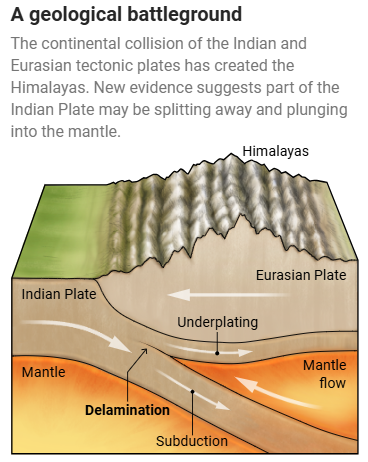
- Recent geological studies have revealed that the Indian Plate is undergoing a process of delamination, where a portion of it is splitting apart and sinking into the Earth’s mantle.
About
- India is drifting northward at an average of about 5 cm per year—one of the fastest continental motions on Earth.
- This northward movement, postulated by plate tectonics, is responsible for the uplift of the Himalayas, along with the complex geological stress within the Indian plate itself.
Science Behind the Split
- Delamination of the Indian Plate: The Indian Plate has been colliding with the Eurasian Plate for about 60 million years, leading to the formation of the Himalayan mountain range.
- Evidence from Seismic Waves and Gas Emissions: Scientists studying earthquake waves beneath Tibet noticed unusual patterns, indicating a vertical tear in the plate.
- Helium isotopes detected in Tibetan springs further support the theory of deep fractures forming in the Earth’s crust.
Potential Consequences
- Increased Earthquake Risk: The delamination process could lead to stronger and more frequent earthquakes, particularly in the Himalayan region and Tibetan Plateau.
- The Cona-Sangri Rift, a large fracture in Tibet, may be directly linked to this underground activity.
- Implications for Plate Tectonics: The above discovery challenges traditional views on continental stability, suggesting that Earth’s plates are more dynamic and unpredictable than previously thought.
- Geologists believe that similar processes may be occurring in other tectonic regions worldwide.
| Plate Tectonic Theory – It explains the movement and interaction of lithospheric plates, provides insights into the processes driving this collision and its implications. – It proposes that the earth’s lithosphere is divided into seven major and some minor plates that float on the semi-fluid asthenosphere beneath. – These plates interact at boundaries, leading to geological phenomena such as earthquakes, volcanic activity, and mountain formation. Types of Plate Boundaries – Convergent Boundaries: Plates collide, leading to subduction or mountain building. 1. Three ways of convergence: (i) between an oceanic and continental plate; (ii) between two oceanic plates; and (iii) between two continental plates. – Divergent Boundaries: Plates move apart, creating new crust. 1. Example: Mid-Atlantic Ridge: American Plate(s) is/are separated from the Eurasian and African Plates. – Transform Boundaries: Plates slide past each other, causing earthquakes. 1. Transform faults are the planes of separation generally perpendicular to the midoceanic ridges. |
World Pandemic Treaty Proposal Finalised by WHO
Syllabus: GS2/ Health
In News
- Members of the World Health Organization (WHO) have finalized a proposal for the World Pandemic Treaty.
More About the News
- The proposal was finalised by the Intergovernmental Negotiating Body (INB), established in December 2021 to draft and negotiate a convention, agreement or other international instrument, under the WHO Constitution, to strengthen pandemic prevention, preparedness and response.
- It would be presented in May at the 78th World Health Assembly for consideration.
Objective of the Treaty
- To ensure coordinated global response to pandemics while strengthening national and global:
- Prevention strategies
- Preparedness capacities
- Resilience of health systems
- Equitable access to pandemic-related resources
Need for the Treaty
- Fragmented Global Response: Countries responded in disconnected, uncoordinated ways—closing borders, hoarding supplies, and imposing export bans.
- The treaty would promote international cooperation and harmonised policy responses during public health emergencies.
- R&D and Technology Gaps: Disparity in research and production capabilities limited rapid response, especially in the Global South.
- The agreement promotes technology transfer, capacity building, and geographically diverse R&D.
- Lack of Timely Information Sharing: Delayed reporting of outbreaks and inadequate transparency in data sharing worsened the global spread of the virus.
- Disruption in Global Supply Chains: Shortages of essential medical supplies revealed the fragility of global supply chains.
- The agreement aims to establish a resilient global logistics and supply mechanism for future crises.
- Unequal Access to Health Products: During COVID-19, high-income countries secured vaccines and treatments disproportionately.
- Low- and middle-income nations faced delays in accessing diagnostics, vaccines, PPE, and treatments.
Key Provisions of the Draft Treaty
- Pathogen Access and Benefit Sharing System: It establishes a framework for sharing pathogens and ensuring equitable distribution of vaccines, diagnostics, and treatments derived from them.
- Pandemic Prevention via One Health Approach: Treaty encourages integrated surveillance of human, animal, and environmental health.
- Technology Transfer and Capacity Building: Promotes sharing of technology, knowledge, and skills to enhance R&D and production across diverse geographies.
- Health Workforce Mobilisation: Proposes a global pool of trained and multidisciplinary professionals for rapid pandemic response.
- Coordinated Financial Mechanism: Sets up a fund or mechanism to support preparedness and emergency response, especially in lower-income countries.
- Resilient Health Systems: Calls for strengthening core health infrastructure, preparedness drills, and public health communication systems.
- Global Supply Chain and Logistics Network: Establishes a coordinated mechanism for uninterrupted supply and distribution of essential health commodities.
Current Frameworks to Deal with Pandemics
- International Health Regulations (IHR) (2005): Legally binding international instrument coordinated by WHO.
- Requires countries to detect, assess, report, and respond to Public Health Emergencies of International Concern (PHEIC).
- Example: COVID-19 was declared a PHEIC under IHR in Jan 2020.
- Limitations: No enforcement power; countries can delay reporting or ignore WHO recommendations.
- Global Outbreak Alert and Response Network (GOARN): A network of over 250 institutions coordinated by WHO.
- Provides rapid deployment of experts during outbreaks.
- Example: Mobilized teams for Ebola, Zika, and COVID-19 responses.
T.N. Govt. Forms Panel to Recommend Measures on State Autonomy
Syllabus: GS2/Polity and Governance
Context
- The Tamil Nadu Chief Minister has set up a high-level committee to recommend measures on state autonomy with a view to protect state governments’ rights and improve working relations with the union government.
About the Committee
- It is a three member committee headed by former Supreme Court judge Justice Kurian Joseph.
- The committee is expected to submit its interim report by January 2026 and the final report within two years.
- The mandate of the committee includes:
- to review the Constitutional provisions, laws, rules and policies with respect to Centre-State relations;
- to recommend ways to restore subjects moved from the State List to the Concurrent List;
- to propose measures for States to overcome administrative challenges;
- to suggest reforms to ensure maximum autonomy for States without compromising the unity and integrity of the nation;
- and to consider the recommendations of the Rajamannar Committee and subsequent commissions formed by the Union government on the Centre-State relations.
Federalism and Its Key Features
- Federalism is a system of government in which the power is divided between a central authority and various constituent units of the country.
- There are two or more levels (or tiers) of government.
- Different tiers of government govern the same citizens, but each tier has its own jurisdiction in specific matters of legislation, taxation and administration.
- The jurisdictions of the respective levels or tiers of government are specified in the constitution.
- The fundamental provisions of the constitution cannot be unilaterally changed by one level of government. Such changes require the consent of both the levels of government.
- Courts have the power to interpret the constitution and the powers of different levels of government.
- Sources of revenue for each level of government are clearly specified to ensure its financial autonomy.
Key Features of Indian Federalism
- Constitutional Division of Powers: The Constitution divides subjects between the Union and the States through the Union List, State List, and Concurrent List (Seventh Schedule).
- Strong Centre: The central government has more powers, especially in times of emergency.
- The Union List contains more and significant subjects (like defense, foreign affairs).
- Single Constitution & Citizenship: India has a single constitution and single citizenship, unlike the USA.
- Independent Judiciary: The Supreme Court acts as the guardian of the Constitution and arbitrator in Centre-State disputes.
- Interstate Councils & Finance Commission: Bodies like the Inter-State Council and Finance Commission promote cooperative federalism.
Challenges to Indian Federalism
- Rising Regional Sensitivity and Sub-Nationalism: Increasing regional identity and sensitivity among states challenge national unity.
- Political ideologies focused on regional interests may benefit specific areas but weaken the overall federal spirit.
- Financial Dependency of States: States are financially dependent on the Centre due to lack of fiscal autonomy.
- This dependency results in operational constraints and deepens the federal crisis.
- Inequality and Political Bias: States often express grievances over unfulfilled regional demands.
- Disparities in representation based on population and territory lead to inequality.
- This leads to both inter-state inequality and a perception of neglect by the Centre.
- Indestructible Union, Destructible States: Unlike the U.S. model, Indian states do not have a permanent status.
- The Union can alter, merge, or bifurcate states unilaterally.
- This power of the Centre weakens the federal nature by making states structurally vulnerable.
- Religious Conflicts: Religious tensions lead to institutional conflicts and disrupt the unity.
- These challenges highlight the difficulty of maintaining harmony in a diverse nation.
- Demand for new States: The continuous increase demands for the new states create a threat in the smooth operation of federalism.
Recommendations by Committees
- Sarkaria Commission (1983): To examine and review the working of the existing arrangements between the Centre and the States.
- Key Recommendations: Strengthen the role of the Inter-State Council (Article 263) as a permanent, regular body.
- Use Article 356 (President’s Rule) sparingly and only as a last resort.
- More financial autonomy to states; a greater share in central taxes.
- Key Recommendations: Strengthen the role of the Inter-State Council (Article 263) as a permanent, regular body.
- National Commission to Review the Working of the Constitution (NCRWC) – 2000 (Headed by: Justice M.N. Venkatachaliah)
- Key Recommendations: Strengthen fiscal federalism with greater devolution of funds to states.
- Set up an Inter-State Trade Commission to regulate trade disputes.
- Improve Centre-State consultation mechanisms before passing legislation affecting states.
- Key Recommendations: Strengthen fiscal federalism with greater devolution of funds to states.
- Punchhi Commission (2007): To revisit Centre-State relations in the context of changes since the Sarkaria Commission.
- Key Recommendations: Limit misuse of Article 356; it should be used only in exceptional situations.
- The Governor’s role should be non-partisan; the removal process should be more transparent.
- Creation of a Supreme Court-authorized Inter-State Trade and Commerce Commission.
- States should have more autonomy in subjects listed under Concurrent List.
- Key Recommendations: Limit misuse of Article 356; it should be used only in exceptional situations.
- NITI Aayog Reforms (Post-Planning Commission):
- Promote Cooperative Federalism through regular consultations with states.
- More say for states in economic planning.
- Reorienting Centrally Sponsored Schemes based on state-specific needs.
NITI Aayog’s Report on Hand and Power Tools Sector
Syllabus :GS3/Economy
In News
- NITI Aayog launched a report on Hand and Power tools sectors – ‘Unlocking $25+ Billion Export Potential – India’s Hand & Power Tools Sector’.
About the report
- The report underscores the transformative potential of the hand and power tools industry for India’s economic growth, delving into the challenges, policy headwinds, and necessary interventions vital for strengthening the Indian hand and power tool ecosystem.
- It outlines a strategic path for the sector to enhance its global competitiveness and capture a significantly larger share of the international market.
Tools industry
- The tools industry is a vital component of capital goods.
- Tools are essential for tasks like drilling, cutting, sanding, and polishing
- They play a critical role in industrial operations and everyday tasks. Key industries such as construction, electronics, automotive, and aerospace rely heavily on tools for manufacturing and operations.
- The global tools market was valued at ~$100 billion in 2022, projected to grow to $190 billion by 2035.
- China dominates the global export market, commanding nearly 50% of the trade with $16 billion in hand tools and $22 billion in power tools exports.
- This dominance is attributed to its scale of operations, cost efficiencies, and well-established supply chains.
Current Position of India
- India exports $600 million in hand tools (1.8% global market share) and $425 million in power tools (0.7% global market share).
- Major exports include wrenches, pliers, screwdrivers, and drills, with key exporting states being Punjab and Maharashtra.
Export Opportunity
- India has a significant opportunity to increase its export share and establish itself as a competitive player in the global tools sector.
- India can target a 10% market share in power tools and a 25% share in hand tools by 2035.
- It would enhance India’s global competitiveness, create millions of jobs, and contribute to rural and inclusive development.
Challenges Hindering Growth
- India faces a 14-17% cost disadvantage compared to China, due to high raw material costs, lower labor productivity, and logistical challenges
- Limited access to advanced manufacturing technologies and R&D capabilities.
- Lack of sufficient industrial land for scaling up operations.
- Current financial schemes are limited and inefficient.
Strategic Roadmap and Policy Interventions
- Building World-Class Hand Tool Clusters: Establish 3-4 advanced industrial clusters across 4,000 acres, particularly in Punjab, to reduce setup time, improve infrastructure, and attract labor.
- Addressing Structural Cost Disadvantages: Implement market reforms to reduce import restrictions, lower import duties, simplify export schemes, and reform building and labor regulations to reduce costs by 10-12%.
- Bridge Cost Support: If reforms falter, an additional $700 million investment may be needed over five years, with a projected 2-3x return in tax revenues.
- Coordinated efforts across government, industry, and private stakeholders are required to achieve the export target.
Conclusion and Way Forward
- The hand and power tools sector is crucial to India’s goal of becoming a global manufacturing hub.
- The sector will help India enhance its manufacturing capabilities, boost exports, and contribute to economic growth, aligning with the “Make in India” initiative.
- Achieving the $25 billion export target by 2035 is essential for India’s industrial development and its ambition of becoming a developed nation by 2047.
Indian Agriculture to 2047 Report
Syllabus: GS3/Agriculture
Context
- According to an analysis by ICAR-National Institute of Agricultural Economics and Policy Research (ICAR-NIAP), India’s aggregate food demand is projected to exceed twice the current demand by 2047.
Major Findings
- Increase in Population: By the 100th year of its independence in 2047, India aims to attain the status of a developed nation.
- By this time, of the projected 1.6 billion population, approximately half may reside in urban areas.
- Increase in Demand: By 2047, India’s demand for nutrient-rich foods, including horticultural and animal products, is expected to increase three to four times.
- Land Shrinking: Agricultural land needed to meet this increased food demand is expected to shrink to 176 million hectares (mha) from the current 180 mha.
- The cropping intensity is likely to increase to 170% from the current 156%.
- Structural Changes in Agriculture: By 2047, Agriculture’s contribution to the national income may decrease to 8% from the current 18%.
- The average landholding size is expected to decrease significantly to 0.6 hectares from approximately one hectare now.
- Farmers would increasingly diversify their production portfolios towards less land-intensive activities such as animal husbandry and fisheries.
- Projections indicate an increase in the contribution of livestock to the gross value of agricultural output to 39% from the current 31%, and of fisheries to 10% from 7%.
- Impact of climate change on agriculture: Over the past five decades, extreme climate events such as droughts, heat waves, and floods have reduced India’s agricultural productivity growth by approximately 25%.
- India’ water use efficiency is also low at 35-40%, which is roughly one-third to one-half of the efficiency levels observed in China, Brazil, and the United States.
- Agriculture is a major consumer of water (83 per cent), and by 2047, its demand will be approximately 18 per cent higher than its current use.
| Agrifood Systems – It refers to the entire network of activities, people, and institutions involved in producing, processing, distributing, consuming, and disposing of food and agricultural products. Key Components of Agrifood Systems: 1. Production: Farming, livestock, fisheries, forestry, etc. 2. Processing: Converting raw products into consumables (e.g., milling wheat into flour, canning vegetables). 3. Distribution: Transporting and selling food—wholesalers, retailers, and markets. 4. Consumption: What people eat, their preferences, nutrition, and health outcomes. 5. Waste Management: Food loss during production or processing and food waste at the consumer level. |
Policy Recommendations
- Efficient Management of Water Resources: Rainwater harvesting and groundwater recharge are essential for sustainable water resource management.
- Water use efficiency currently stands at 35–40%; a 10% improvement could irrigate an additional 14 million hectares.
- Power Sector Reforms: Phasing out universal electricity subsidies and targeting only needy farmers can help curb the overuse of electricity and groundwater.
- Fertilizer Sector Reforms: Current subsidy system favors nitrogenous fertilizers, disrupting NPK balance.
- Linking subsidies to Soil Health Cards can optimize fertilizer use and restore soil health.
- Emerging tech like nano-fertilizers and drone-based precision fertilization can enhance efficiency and reduce environmental harm.
- Climate Change Mitigation: Single risk mitigation strategies are inadequate; integrated climate-smart practices are more effective (resilient varieties, efficient irrigation, etc.).
- Digital tools (remote sensing, drones) can improve risk assessment and enable region-specific insurance.
- Investment in Agricultural R&D: India spends only 0.43% of AgGDP on R&D (vs. global average of 0.93%); private sector share is low (7%).
- Need sustained public investment and private/philanthropic partnerships.
- Crop Planning and Diversification: Must align cropping with resource endowments and climate, but profitability is key for farmer adoption.
- High-value crops (fruits, vegetables) require strong market infrastructure, cold storage, and financial support.
- De-stress Agriculture Employment: Agriculture faces excessive labor pressure due to slow rural industrialization.
- Promote agri-startups and MSMEs to create jobs and add value to farm produce.
- Strengthening Market Infrastructure & Value Chains: Market infrastructure has not matched growing commercialization in agriculture.
- Strengthen FPOs, cooperatives, and contract farming to improve market access and reduce risks.
Conclusion
- The challenges facing the agri-food system are multifaceted and interconnected, and their management requires a comprehensive approach encompassing technological and institutional innovations, investments in infrastructure, and reforms in incentive structures.
