
World Heritage Day 2025
Syllabus: GS3/ History and Culture
Context
- World Heritage Day, also known as the International Monuments and Sites Day, is observed on 18 April every year.
- This year’s theme is “Heritage under Threat from Disasters and Conflicts: Preparedness and Learning from 60 years of ICOMOS Actions.”
Background
- In 1982, The International Council on Monuments and Sites (ICOMOS) proposed that April 18 should be observed as the World Heritage Day.
- Later, the date was approved by the United Nations Educational, Scientific, and Cultural Organization (UNESCO) at the 22nd General Conference in 1983.
World Heritage Sites
- World Heritage is the designation for places on Earth that are of outstanding universal value to humanity and as such, have been inscribed on the World Heritage List to be protected for future generations to appreciate and enjoy.
- These can be cultural, natural, or a mix of both.
- They are protected under an international agreement led by UNESCO.
- The World Heritage Convention, 1972 was adopted by UNESCO’s member countries.
- The Convention sets out the duties of States Parties in identifying potential sites and their role in protecting and preserving them.
- India became part of this Convention in 1977.

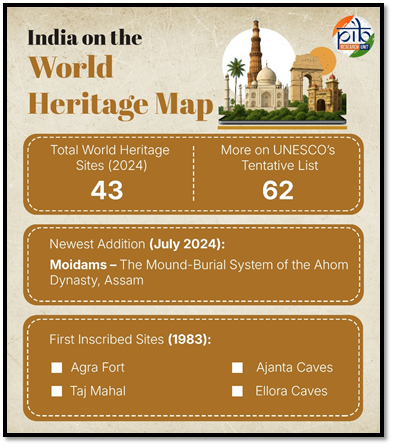
| Monuments of National Importance (MNI) of India – The MNIs are officially conserved by the Archaeological Survey of India (ASI), which functions in accordance with The Ancient Monuments and Archaeological Sites and Remains Act of 2010 (AMASR Act 2010). – There are 3697 ancient monuments and archaeological sites and remains declared as of national importance in the country. |
Government’s Initiatives to Promote India’s Cultural Heritage
- Retrieval of Antiquities: Archaeological Survey of India is committed to the protection of cultural property.
- The government has retrieved 655 antiquities from foreign countries from the year 1976 to 2024.
- Adopt a Heritage’ Scheme: The programme was launched in 2017 and revamped as “Adopt A Heritage 2.0” in 2023.
- It allows private and public groups to help develop facilities at protected monuments using their Corporate Social Responsibility (CSR) funds.
- 46th Session of the World Heritage Committee: Archaeological Survey of India, hosted the 46th Session of the World Heritage Committee in 2024.
- Must See Portal: The Archaeological Survey of India (ASI) has created a portal to showcase “Must-See Monuments and Archaeological Sites of India.”
- Digitization of Cultural Heritage in India: The National Mission on Monuments and Antiquities (NMMA), set up in 2007, works to digitize and document India’s heritage and antiquities.
Concluding remarks
- World Heritage Day reminds us that protecting our heritage is a shared responsibility.
- From ancient monuments to timeless literature, India continues to preserve its cultural and natural legacy through strong national efforts and global collaboration.
- These efforts ensure that our rich heritage inspires, educates, and unites generations to come.
Making Primary Health Care Visible, Accessible, and Affordable
Syllabus: GS2/Health
Context
- In India, the government has been working to transform primary health care through innovative policies and programs, addressing challenges such as accessibility, affordability, and visibility.
About the Primary Healthcare in India
- According to WHO, Primary Health Care (PHC) is a whole-of-society approach to effectively organize and strengthen national health systems to bring services for health and wellbeing closer to communities.
- It aims to provide accessible, affordable, and comprehensive services to all citizens.
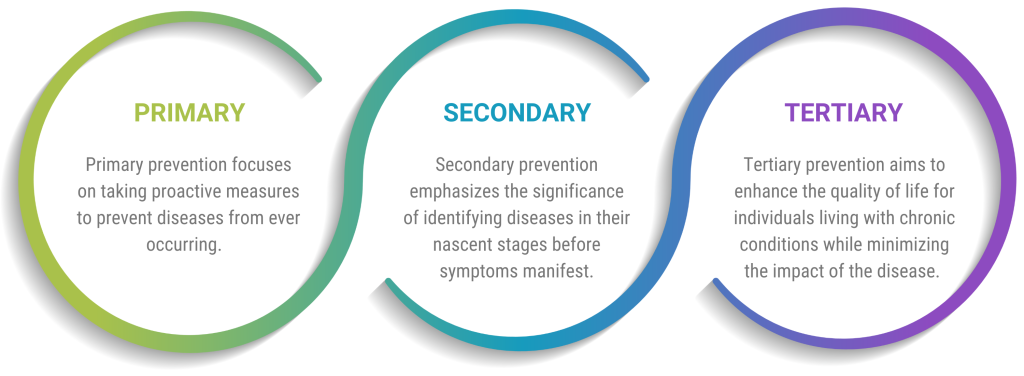
- It focuses on promotive, preventive, curative, rehabilitative, and palliative care, ensuring equitable access to essential health services.
- Alma-Ata Declaration of 1978 identified PHC as essential health care based on scientifically sound and socially acceptable methods.
Key Concerns in Primary Healthcare
- Urban vs. Rural Divide:Urban slums, while geographically closer to tertiary care centers, still face issues of affordability and overcrowding.
- Rural areas house over 65% of the population but suffer from shortage of PHCs and trained medical personnel, along with poor transport connectivity.
- Human Resource Shortages (2023–24):
- Shortfall of 77% surgeons, 69% obstetricians, 70% physicians at Community Health Centres.
- 10–25% staff nurse vacancies in many states.
- Burden of NCDs and Mental Health: PHCs are now expected to manage lifestyle diseases and mental health concerns.
- However, limited staff training and infrastructure often hinder effective response.
Key Government Initiatives
- National Health Mission: India has a vast network of Sub-Centres (SCs), Primary Health Centres (PHCs), and Community Health Centres (CHCs).
- These facilities serve as the first point of contact for individuals seeking healthcare services.
- According to the National Health Mission, there are 1.6 lakh sub-centres, 26,636 PHCs, and 6,155 CHCs across the country.
- Ayushman Bharat Program (2018): It aims to transform primary healthcare through Health and Wellness Centres (HWCs).
- HWCs provide services related to non-communicable diseases, maternal and child health, mental health, and geriatric care.
- Comprehensive Primary Health Care (CPHC): The National Health Policy 2017 emphasizes universal health coverage through CPHC.
- It integrates traditional medicine systems like Ayurveda, Yoga, Unani, Siddha, and Homeopathy (AYUSH) with modern healthcare.
- Focus on Underserved Areas: Initiatives like the Aspirational District Program (ADP) and Aspirational Block Program (ABP) aim to improve healthcare in underdeveloped regions.
- Pradhan Mantri Ayushman Bharat Health Infrastructure Mission (PM-ABHIM): It focuses on equipping India’s health system with the necessary infrastructure, with an outlay of ₹64,180 crore.
- Women Led Initiatives:
- Role of Self Help Groups (SHGs): Over 1.9 crore women are empowered through SHGs that promote awareness on PHC services.
Global Initiatives
- Universal Health Coverage (UHC): It aims to ensure that all individuals have access to quality health services without financial hardship.
- Scaling up primary healthcare interventions in low- and middle-income countries could save 60 million lives and increase average life expectancy by 3.7 years by 2030.
- Global Health Programs: Programs like the Global Fund to Fight AIDS, Tuberculosis, and Malaria focus on integrating primary healthcare with disease-specific interventions.
- The Gavi Alliance supports immunization efforts, strengthening primary healthcare systems in developing countries.
Way Forward
- Strengthening Infrastructure: Expanding the network of HWCs and ensuring their functionality in underserved areas is crucial.
- Investments in telemedicine can bridge the gap between urban and rural healthcare access.
- Enhancing Awareness: Community outreach programs and health education campaigns can improve visibility and utilization of health services.
- Ensuring Affordability: Continued efforts to reduce out-of-pocket expenses and provide financial protection through schemes like PM-JAY are essential.
Vehicle-to-Grid (V2G) Technology
Syllabus :GS 3/Science and Technology
In News
- The Kerala State Electricity Board (KSEB) and IIT Bombay have initiated a pilot project to explore the implementation of V2G technology across the State.
- Though, V2G in India is still at a nascent stage.
Vehicle-to-Grid (V2G) Technology
- Vehicle-to-Grid (V2G) technology is a transformative solution aimed at enhancing the sustainability and resilience of electric grid infrastructure.
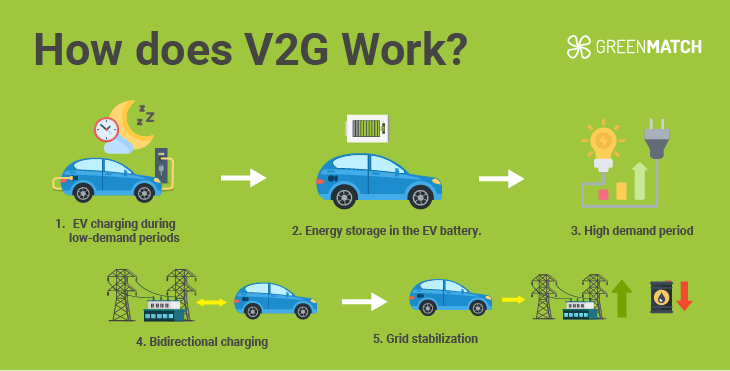
- It allows Electric Vehicles (EVs) to send power back to the electricity grid when not in use, acting as decentralized energy storage. It enables both
- G2V (Grid to Vehicle) – charging EVs from the grid.
- V2G (Vehicle to Grid) – discharging power from EVs to the grid.
- It supports renewable energy integration, demand response, and grid stability.
- Smart charging and Time of Use (ToU) tariffs are key tools to manage this.
Benefits
- It can manage peak demand and avoid grid overload.
- It can store excess solar energy during the day and use it at night.
- It improves grid stability by modulating variable renewable energy.
- Utilities can use smart charging, well-designed tariffs, and financial incentives to encourage V2G adoption and truly decarbonise transportation.
Challenges
- The implementation of Vehicle-to-Grid (V2G) services faces complex and region-specific regulatory landscapes.
- Key challenges to effective V2G integration include technical difficulties, data security, and fragmented regulations.
- A major technical issue is the unpredictable and irregular availability of EVs for grid services due to varied charging behaviors.
Global Application
- V2G is already active in Europe, the U.S., and the U.K., where EV owners are compensated for returning energy during peak demand.
- In California, it supports grid stability and emergency power during crises.
Conclusion and Way Forward
- V2G technology has the potential to provide grid services such as peak power support and spinning reserves while also acting as renewable energy storage.
- Data-driven optimization of EV charging can enhance grid reliability amid rising EV usage and distributed energy resources.
India’s Trade Deficit with China Widened
Syllabus: GS2/IR
Context
- India’s trade deficit with China widened to a record $99.2 billion in the 2024-25 fiscal year.
About
- The trade deficit is driven by a surge in imports of electronics, batteries and solar components, even as exports fell sharply.
- China remained India’s second-largest trading partner in 2024-25, with total bilateral trade amounting to $127.7 billion, behind the United States.
- Total imports from China for the financial year ending March climbed to $113.5 billion. In contrast, India’s exports fell to $14.3 billion.
Reasons for India’s Trade Deficit with China
- Intermediate goods and raw materials: India imports a significant volume of components and raw materials from China, especially in sectors like electronics, pharmaceuticals (APIs), chemicals, and textiles.
- Consumer electronics and machinery: China is a major exporter of mobile phones, electrical machinery, and telecom equipment to India.
- Narrow export basket: India’s exports to China are primarily raw materials such as iron ore, cotton, and copper, which are low in value addition.
- Barriers to market access: Indian firms face regulatory hurdles, quality norms, and lack of demand for Indian goods in China’s domestic market.
- Cost and scale advantages: China’s well-established manufacturing infrastructure allows it to produce goods more cheaply and efficiently.
- Global supply chain integration: Chinese firms are deeply embedded in global value chains, providing a wider variety of goods at competitive prices.
- India’s ‘Make in India’ initiative is still evolving, and local manufacturing isn’t yet competitive enough to substitute Chinese imports, especially in electronics and industrial machinery.
Concerns
- Future Outlook: Chinese imports could rise by as much as 20% in the current fiscal year as Chinese exporters seek to re-route goods away from the United States in the wake of new American tariffs.
- Cheap imports from China undercut Indian manufacturers, especially MSMEs (Micro, Small and Medium Enterprises), leading to reduced competitiveness, job losses, and slow industrial growth.
- Heavy import of telecom equipment, surveillance gear, and electronics from China raises cybersecurity and data security concerns.
- A large trade deficit contributes to a wider current account deficit (CAD), putting pressure on the rupee and foreign exchange reserves.
- Border tensions and strained diplomatic relations make the large trade dependence appear contradictory and risky, raising public and political pressure to reduce imports.
- Dependence on Chinese tech goods reflects India’s lag in high-tech innovation and manufacturing, which has broader implications for economic and strategic autonomy.
Government Initiatives
- The Directorate General of Trade Remedies (DGTR) actively monitors unfair trade practices by foreign companies and recommends corrective remedial actions.
- The Government is also encouraging Vocal for Local Campaign by promoting awareness among consumers and businesses to buy Indian-made products, thereby aiming to reduce demand for imported goods.
- Production Linked Incentive (PLI) Schemes for 14 key sectors are under implementation to enhance India’s manufacturing capabilities and exports.
- Assistance provided through several schemes to promote exports, namely, Trade Infrastructure for Export Scheme (TIES) and Market Access Initiatives (MAI) Scheme.
- Agricultural & Processed Food Products Export Development Authority (APEDA) has a Central Sector specific scheme for Financial Assistance to facilitate the export of agriproducts.
- The Marine Products Export Development Authority (MPEDA) provides assistance for upgrading the infrastructure facilities for value addition, establishing testing laboratories, participating in international trade fairs, and providing technical assistance for aquaculture production meant for exports etc.
- Districts as an Export Hubs initiative has been launched by identifying products with export potential in each district, addressing bottlenecks for exporting these products and supporting local exporters/manufacturers.
Conclusion
- While this dependency has facilitated cost-effective manufacturing and consumer affordability, it has also exposed India to vulnerabilities in its supply chain and trade balance.
- To ensure economic resilience and strategic autonomy, India must work toward diversifying its import sources, investing in domestic manufacturing through initiatives like ‘Make in India’ and PLI (Production-Linked Incentives), and enhancing technological capabilities.
- Reducing dependency does not imply isolation but creating a more balanced and secure economic framework.
India’s Global Pharmaceutical Footprint
Syllabus: GS3/ Economy
Context
- The Department of Pharmaceuticals, with a vision to make India the world’s largest provider of quality medicines at reasonable prices, transformed the country’s global pharmaceutical footprint.
Pharmaceutical Sector of India
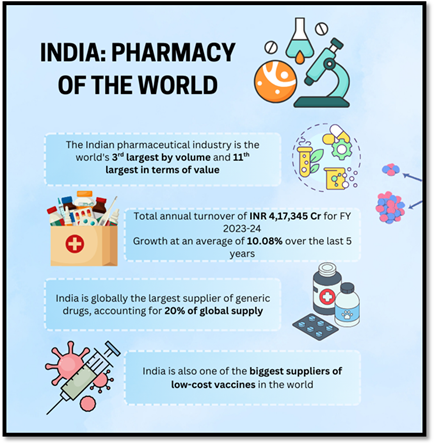
- India’s pharmaceutical market for FY 2023-24 is valued at USD 50 billion with domestic consumption valued at USD 23.5 billion and export valued at USD 26.5 billion.
- Major segments of industry include generic drugs, OTC medicines, bulk drugs, vaccines, contract research & manufacturing, biosimilars and biologics.
- The Pharma sector currently contributes to around 1.72% of the country’s GDP.
- India is the 3rd largest producer of API accounting for an 8% share of the Global API Industry.
Achievements of Pharmaceutical Sector of India
- India has been UNICEF’s largest vaccine supplier for the past six to seven years, contributing 55% to 60% of total volume procured.
- India is also contributing 99%, 52% and 45% of the WHO demand for DPT, BCG and the measles vaccines, respectively.
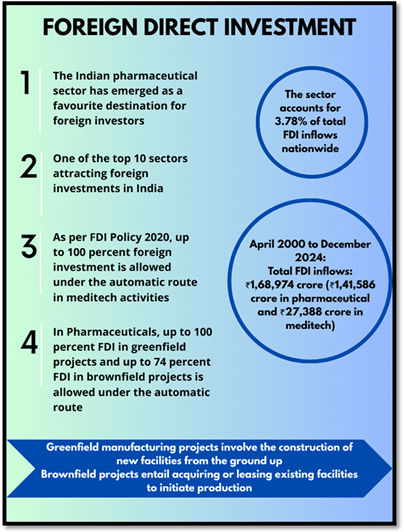
- The cumulative FDI equity inflow in the Drugs and Pharmaceuticals industry is US$ 22.52 billion during the period 2000-2024.
- The nation is the largest provider of generic medicines globally, occupying a 20% share in global supply by volume, and is the leading vaccine manufacturer globally.
- India is known as the “pharmacy of the world” due to the low cost and high quality of its medicines.
Medical Devices sector
- The medical devices sector is an essential and integral constituent of the Indian healthcare sector, particularly for prevention, diagnosis, treatment and management of all medical conditions and disabilities.
- Its constituent device categories are; Electro-medical equipment, implants, consumables and disposables, surgical instruments and in vitro diagnostic reagents.
- In the financial year of 2024-25, from April 2024 to December 2024, FDI inflows (in both pharmaceuticals and medical devices) was ₹11,888 Crore.
Government initiatives
- Production Linked Incentive Scheme, launched in 2020, is a transformative initiative aimed at boosting domestic manufacturing, attracting investments, reducing reliance on imports and increasing exports. It includes;
- PLI Scheme for Pharmaceuticals,
- PLI Scheme for promotion of domestic manufacturing of critical KSMs/DIs/APIs,
- PLI Scheme for promoting domestic manufacturing of Medical Devices.
- Promotion of Bulk Drug Parks: Approved in March 2020, the scheme (FY 2020–21 to FY 2025–26) aims to establish parks with world-class common infrastructure to reduce manufacturing costs and enhance self-reliance in bulk drugs.
- Pradhan Mantri Bhartiya Janaushadhi Pariyojana (PMBJP): Quality generic medicines are made available at affordable prices to all through dedicated outlets.
Concluding remarks
- India’s pharmaceutical and medical devices sectors stand as a testament to the country’s growing capabilities in science, innovation, and manufacturing.
- It has stressed that the country’s pharmaceutical sector will touch the 130 billion US dollar mark by 2030.
Intermediate-Mass Black Hole (IMBH)
Syllabus:GS3/Space
In News
- Indian astronomers used the Devasthal Optical Telescope (DOT) to detect and measure an elusive intermediate-mass black hole (IMBH) in the faint galaxy NGC 4395.
| NGC 4395 – It is a dwarf spiral galaxy located about 14 million light-years from Earth. – It has a low surface brightness and is notable for being one of the closest and dimmest known Seyfert galaxies. 1. Seyfert galaxies feature active galactic nuclei (AGNs) powered by supermassive black holes, which emit radiation across the electromagnetic spectrum. 2. Its central black hole is around 10,000 times the mass of the Sun. |
What Are Intermediate-Mass Black Holes (IMBHs)?
- They are missing links between stellar-mass and supermassive black holes.
- They are believed to be seeds for the growth of supermassive black holes.
- IMBHs are considered to be the “seeds” that can eventually grow into supermassive black holes, helping explain how such giants formed in the early universe.
Why Are IMBHs Hard to Detect?
- They are difficult to observe due to their faint emissions and location in small galaxies.
- This makes traditional detection techniques ineffective, requiring advanced instruments and methods.
About the Discovery
- It provides strong evidence supporting the size-luminosity relationship in low-luminosity active galaxies and offers one of the most accurate mass estimates of an IMBH.
- The black hole is accreting matter at only 6% of its theoretical maximum rate.
- The findings mark a key step in understanding black hole growth and evolution, with more advanced observations planned in the future.
| Do you know? – The 3.6m Devasthal Optical Telescope (DOT) was commissioned in 2016. – It is India’s largest optical telescope for studying celestial objects. – It is located in Nainital and operated by ARIES, it is a national facility equipped with modern instruments for imaging and spectroscopy in visible and near-infrared wavelengths. About Black Hole – A black hole is a region in space where the gravitational pull is so strong that nothing—not even light—can escape from it. This immense gravity results from matter being compressed into an extremely small area. – The concept of black holes was theorized by Albert Einstein in 1915 through his General Theory of Relativity. – The term “black hole” was later coined by John Archibald Wheeler in the 1960s. – Black holes typically form when a massive star exhausts its fuel and undergoes a supernova explosion—an immense burst of energy marking the end of a star’s life. The dense core left behind can collapse into a black hole. Types of Black Holes – Stellar Black Holes: 1. Mass: A few to tens of solar masses. 2. Origin: Formed when massive stars collapse after a supernova. Supermassive Black Holes: – Mass: Hundreds of thousands to billions of times the mass of the Sun. – Origin: Thought to be formed by the merging of smaller black holes and the accretion of mass over time. 1. Found at the centers of most galaxies, including our own Milky Way. |
