
Hindu Kush Himalaya Snow Update
Syllabus: GS3/Environment/ GS1/Geography
Context
- As per the report released by the International Centre for Integrated Mountain Development (ICIMOD) the Hindu Kush Himalaya (HKH) region has seen its third consecutive below-normal snow year in 2025.
Findings
- The report used a 23-year time series (from 2003 to 2025) of basin-scale snow persistence during the snow season between November and March.
- All three major river basins — Ganga, Indus, and Brahmaputra — are experiencing significant declines in snow persistence.
- Snow persistence across the Hindu Kush Himalayas (HKH) was at a two-decade low of 23.6%.
- Snow persistence in the Ganga basin – 24.1 per cent below normal – was the lowest in 23 years.
- The snow persistence in the Indus basin declined to 24.5 per cent below normal, from a high of 19.5 per cent above normal in 2020.
- The report recorded a bigger decline across the Mekong (51.9 per cent), Salween (48.3 per cent), and Tibetan Plateau (29.1 per cent) river basins in South East Asia.
- Continued deficit of seasonal meltwater means lesser river runoffs and early-summer water stress, especially for downstream communities.
- Recommendations:
- improved water management,
- stronger drought preparedness,
- better early warning systems,
- and greater regional cooperation.
- Long-term resilience will depend on adopting science-led, forward-looking policies, and investing in seasonal water storage, efficient use of meltwater, and integrated water management strategies.
Snow Persistence
- Snow persistence is the fraction of time snow is on the ground. When this snow melts, it provides water to people and ecosystems.
- In the river basins of the Hindu Kush Himalaya (HKH), snowmelt is the biggest source of water in the streams.
- Overall, it contributes 23% of the runoff to the region’s 12 major river basins every year.
Hindu Kush Himalaya
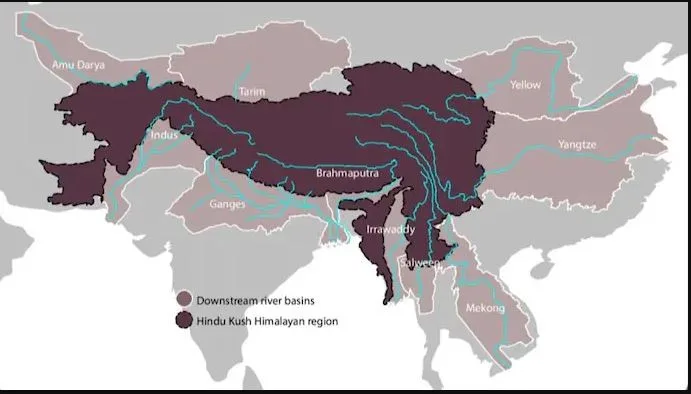
- The HKH mountains extend around 3,500 km over eight countries — Afghanistan, Bangladesh, Bhutan, China, India, Nepal, Myanmar, and Pakistan.
- These mountains are also called the “water towers of Asia” because they are the origins of 10 crucial river systems on the continent — Amu Darya, Indus, Ganga, Brahmaputra, Irrawaddy, Salween, Mekong, Yangtse, Yellow river, and Tarim.
- These river basins provide water to almost one-fourth of the world’s population and are a significant freshwater source for people in the HKH region.
| About ICIMOD – It is an intergovernmental knowledge and learning centre working on behalf of the people of the Hindu Kush Himalaya (HKH). – It was established in 1983. – It is based in Kathmandu, Nepal and work in and for eight regional member countries – Afghanistan, Bangladesh, Bhutan, China, India, Myanmar, Nepal, and Pakistan. – Activities range from hands-on research and piloting of solutions, to policy implementation with governments, to mountain advocacy on the global stage. |
Way Ahead
- In the long term reforestation with native tree species can help the ground retain more snow.
- Better weather forecasting and early warning systems can also help local communities prepare for impending water stress.
- Improving water infrastructure and developing policies for protecting areas receiving snowfall are important for long-term change.
- Communities’ involvement in local, national level decision-making and promoting regional cooperation are vital for comprehensive solutions for the sustainability of snow.
17th Civil Services Day
Syllabus: GS2/ Governance
Context
- The Prime Minister of India addressed Civil Servants on the occasion of 17th Civil Services Day in New Delhi.
Civil Service Day
- Civil Services Day is observed on 21st April every year to commemorate the day in 1947 when Sardar Vallabhbhai Patel addressed the first batch of civil servants at the Metcalfe House, New Delhi.
- He termed civil servants as the “Steel frame of India,” emphasizing their role in maintaining unity and integrity.
| History of Civil Services in India – Lord Cornwallis is considered as ‘Father of Civil Services in India’. – Lord Wellesley founded the College of Fort William in Calcutta in 1800 to educate young recruits for the Civil Services. 1. But the directors of the Company, in 1806, replaced it with their own East Indian College at Haileybury in England. – Before 1853 East India Company directors used to appoint Civil Servants. Board of Control members were allowed to make some nominations. – The Charter Act of 1853 abolished the patronage system and introduced open competitive examinations. – The first competitive exams for the Indian Civil Services (ICS) were held in London in 1855. – Satyendranath Tagore was the first Indian to clear ICS in 1864. |
Role of Civil Services in Governance
- Service delivery: They are responsible for administering welfare schemes and ensuring that public services reach the intended beneficiaries, particularly at the last mile.
- Maintaining law and order: Civil services ensure peace, justice, and security by upholding the rule of law and coordinating with law enforcement agencies.
Challenges faced by civil services
- Red-tapism: Excessive procedural formalities often delay decision-making and hinder timely service delivery.
- Mental health issues: High-pressure environments, and long working hours impact the mental well-being of civil servants.
- Resistance to innovation: A rigid administrative culture discourages experimentation and adoption of new practices.
- Outdated rules and procedures: Many service regulations are colonial-era legacies that are not compatible with modern governance needs.
Constitutional Provisions
- Article 309 empowers Parliament and State Legislatures to regulate recruitment and conditions of service.
- Article 310 of the Constitution states that civil servants of the Union and the States hold office during the pleasure of the President or the Governor, respectively.
- Article 311 provides safeguards for civil servants against arbitrary dismissal.
- Article 312 outlines the process for creating All India Services, such as the Indian Administrative Service (IAS), the Indian Police Service (IPS), and the Indian Forest Service (IFoS).
- Articles 315 to 323 of the Indian Constitution establish Public Service Commissions (PSCs) for both the Union (UPSC) and each state (SPSC).
Governance reforms to enhance efficiency of bureaucracy
- Mission Karmayogi National Program: It is a flagship programme of Government of India launched in 2020 for training of civil servants, which intends to transform the Civil Services from ‘Rule Based’ to ‘Role Based’ way of functioning and Citizen Centric. Mission Karmayogi has the following six pillars;
- Policy Framework,
- Institutional Framework,
- Competency Framework,
- Digital Learning Framework (Integrated Government Online Training Karmayogi Platform (iGOT-Karmayogi),
- Electronic Human Resource Management System (e-HRMS), and
- Monitoring and Evaluation Framework.
- Lateral Entry into Civil Services to bring domain expertise and promote competitiveness in administration.
- e-Governance Initiatives: Centralised Public Grievance Redress and Monitoring System (CPGRAMS) for grievance redressal, SPARROW for performance appraisal, and digitization of service records.
Concluding remarks
- Civil servants play a pivotal role in shaping the trajectory of India’s growth and governance, often known as the architects of Viksit Bharat.
- By embodying the Panch Pran—commitment to a developed India, shedding colonial mindsets, pride in heritage, unity, and a sense of duty—civil servants can realize the vision of a prosperous, resilient, and self-reliant India.
Censorship of Social Media
Syllabus: GS2/Polity and Governance
Context
- Under the Indian Cyber Crime Coordination Centre (I4C)-led Sahyog portal, the government has issued 130 content notices to online platforms like Google, YouTube, Amazon, Apple, and Microsoft in the last 6 months.
About
- These notices effectively act as content blocking orders and are sent under Section 79(3)(b) of the Information Technology Act, 2000.
- These fall outside Section 69(A) of the Information Technology Act, which has been commonly used to issue online censorship orders.
- As per Section 79(3)(b) of the IT Act, online intermediaries can lose their safe harbour protections if they fail to block access to content which has been flagged by an “appropriate” government agency.
- Safe harbor protections provide legal immunity to social media platforms for third-party user-generated content.
| Indian Cybercrime Coordination Centre (I4C) – It is an initiative of the Ministry of Home Affairs launched in 2020 to deal with cyber crime in the country in a coordinated and comprehensive manner. – I4C focuses on tackling all the issues related to Cybercrime for the citizens, which includes improving coordination between various Law Enforcement Agencies and the stakeholders. |
Legal Framework: Section 69A vs. Section 79(3)(b)
- Section 69A of the IT Act, 2000: This section empowers the government to block public access to content on the internet in certain circumstances, such as concerns over national security, sovereignty, public order, or to prevent incitement.
- It includes safeguards as laid out by the Supreme Court in the Shreya Singhal case (2015).
- A reasoned order explaining the necessity of blocking content.
- The person or entity affected should have a chance to contest the order.
- Section 79(3)(b) of the IT Act: This section deals with the liability of intermediaries (such as platforms like X Corp) for third-party content.
- It exempts platforms from liability for illegal content unless they fail to act swiftly to remove or disable access to that content when notified by the government.
- Intermediaries argue that this provision should not be used to directly block content, as it is not intended for that purpose.
| The Sahyog Portal – It was launched by the Ministry of Home Affairs in 2024. – The portal acts as a centralized system for government agencies at various levels—ranging from ministries to local police stations—to issue blocking orders more efficiently. |
Digital content censorship
- Digital content censorship refers to the control of online content by governments, organizations, or other entities. This includes:
- Blocking websites and apps
- Removal of social media content
- Regulation of OTT (Over-The-Top) streaming platforms
- Restrictions on digital news and journalism
Legal Framework Governing Digital Censorship in India
- Right to Freedom of Speech (Article 19(1)(a)): Subject to reasonable restrictions under Article 19(2) concerning decency, morality, and public order.
- Information Technology (IT) Act, 2000: Section 69A grants the government power to block online content for security or public order concerns.
- Intermediary Guidelines & Digital Media Ethics Code, 2021: Regulates social media, OTT platforms, and digital news media.
- Self-Regulation by OTT Platforms: Platforms like Netflix and Amazon Prime follow self-regulatory frameworks such as the Digital Publishers Content Grievances Council (DPCGC).
- The Central Board of Film Certification (“CBFC”), which was established by the Cinematographic Act, of 1952, is responsible for censoring movies in India.
Challenges in Digital Censorship in India
- Balancing Freedom of Speech & Regulation: Over-regulation can suppress creativity, while under-regulation can spread harmful content.
- Transparency & Accountability: Content moderation and censorship decisions often lack clear guidelines, raising concerns about misuse.
- Jurisdictional Issues: Many digital platforms operate from outside India, making enforcement difficult.
- Technological Advancements: The rapid evolution of digital media complicates consistent and fair regulation.
- Ethical Concerns: The subjective nature of obscenity laws can lead to arbitrary censorship.
Way Forward
- Strengthening Independent Regulatory Bodies: Ensuring that courts and neutral institutions review censorship decisions.
- Enhancing Transparency in Content Moderation: Digital platforms should publish periodic transparency reports on content takedowns.
- Encouraging Digital Literacy: Educating citizens to identify fake news rather than enforcing restrictive censorship.
- Public Consultation in Policymaking: Involving journalists, legal experts, and civil society in framing digital content regulations.
Cruise Tourism in India
Syllabus: GS3/ Economy
Context
- India is leveraging its extensive coastline and inland waterways to unlock the economic and tourism potential of cruise tourism
What is Cruise tourism?
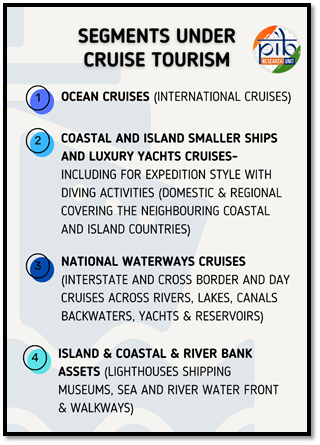
- Cruise tourism refers to travel for leisure or recreational purposes on a cruise ship where the voyage itself and the ship’s amenities are a part of the experience, along with the different destinations along the route.
- It encompasses a range of activities offered both onboard and offboard, tailored to enhance the tourist’s experience.
Potential of India in Cruise Tourism
- India has significant capabilities in cruise tourism for the coastal & river sector. This is due to the presence of:
- 12 Major and 200 Minor Ports along the coastline of India,
- Network of more than 20000 kilometres long navigable 110 waterways connecting around 400 rivers,
- There are multiple states, union territories and 1300 islands in India which are along the coastline or along the banks of states and interstate rivers or national waterways.
River Cruise Tourism
- River Cruise Tourism is a form of leisure travel that takes place on rivers and inland waterways using cruise vessels.
- Key Features of River Cruise Tourism are as;
- Short-distance travel: Cruise covers shorter stretches compared to ocean cruises.
- Access to interior regions: It connects towns, cities, and villages along rivers, often areas that are not accessible by large ships.
- Cultural immersion: Tourists experience local traditions, festivals, architecture, and cuisine.
- Examples:
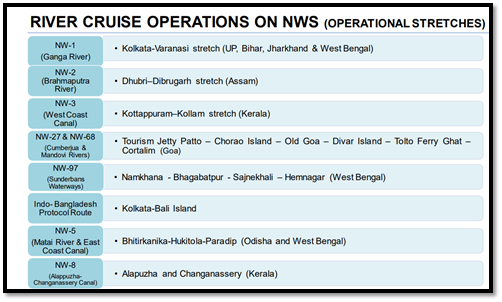
- In 2023, MV Ganga Vilas, the world’s longest river cruise, was launched to cover a 3,200-kilometer journey from Varanasi to Dibrugarh. It traversed 27 river systems across five Indian states and Bangladesh.
- Houseboats in Kerala in the backwaters of Alappuzha.
Steps taken by the Indian Government
- Cruise Bharat Mission: The ‘Cruise Bharat Mission’ was launched in 2024, from the Mumbai port.
- The programme aims to propel the country’s cruise tourism industry by doubling cruise passenger traffic within five years; i.e. by 2029.
- In FY 2023- 24, the number of cruise passengers was 4.71 lakhs.
- Maritime India Vision 2030: The Government of India’s vision is to make India a significant player in the global cruise market, both for ocean and river cruises.
- The ‘River Cruise Tourism Roadmap, 2047’ was launched at the inaugural session of IWDC (Inland Waterways Development Council (IWDC) meeting.
- This Roadmap focuses on four pillars, including Infrastructure, Integration, Accessibility, and Policy for promoting river cruise tourism.
Concluding remarks
- India’s cruise tourism is setting sail towards becoming a dynamic part of its economic and cultural narrative.
- With expansive networks of rivers and coastlines, and government-led vision plans the country is well-positioned to become a global cruise tourism hub.
India’s First Fast-Breeder Nuclear Reactor Set for Commissioning By 2026
Syllabus: GS 3/Science and Technology
In News
- India’s first prototype fast breeder reactor is being developed in Kalpakkam, Tamil Nadu.
Prototype Fast Breeder Reactor (PFBR)
- It is a machine designed to produce more nuclear fuel than it consumes, using plutonium-239 (Pu-239) and uranium-238 (U-238) for energy production.
India’s first fast-breeder nuclear reactor
- The PFBR is being developed by Bharatiya Nabhikiya Vidyut Nigam (BHAVINI).
- It will have a 500 MW capacity and is expected to be commissioned in 2025-26, nearly two years after receiving approval from the nuclear regulator.
- It marks the second stage of India’s three-stage nuclear program.
Functions
- It will recycle spent fuel from India’s Pressurized Heavy Water Reactors (PHWRs), reducing radioactive waste.
- It will also enable the transition to thorium-based reactors in the third stage of the nuclear cycle.
- It will use plutonium-based mixed oxide as fuel and liquid sodium as coolant.
Significance
- It is essential for India’s nuclear program as it will provide spent fuel for future thorium-based reactors.
- It plays a key role in reducing the inventory of radioactive waste and progressing towards a closed fuel cycle.
- It will advance India’s nuclear energy capabilities, especially in utilizing thorium for self-sufficiency in energy.
| Do you know? – India aims to produce 100 GW of electricity from nuclear power. – Current nuclear power capacity in India is 8.18 GW, with additional 7.30 GW under construction/commissioning. – The total nuclear power capacity is expected to reach 22.48 GW by 2031-32. – Nuclear Power Corporation of India Limited (NPCIL) plans to add 15.40 GW from indigenous PHWRs and 17.60 GW from Light Water Reactors with foreign cooperation. – BHAVINI aims to contribute 3.80 GW through Fast Breeder Reactors. – Remaining capacity will come from Small Modular Reactors, Bharat Small Reactors, and other advanced nuclear technologies with private sector collaboration. |
Conclusion and Way Forward
- Despite delays, the PFBR is a critical part of India’s nuclear power ambitions and is set to advance India’s nuclear energy capabilities, especially in utilizing thorium for self-sufficiency in energy
