
Terror Attack In Pehalgam
Syllabus: GS3/ Security
In News
- A terror attack happened in the Baisaran Valley (meadows) often called ‘mini Switzerland’, near the town of Pahalgam in the Anantnag district.
- The Resistance Front, an offshoot of the Lashkar-e-Taiba, has claimed responsibility for the Pahalgam terror attack.
What is TRF?
- The Resistance Front or TRF was founded in October 2019, after India bifurcated Jammu and Kashmir, and abrogated Article 370 that gave special status to the erstwhile State.
- The MHA banned the outfit under the Unlawful Activities (Prevention) Act (UAPA) in 2023.
- The front is involved in carrying out propaganda on terror activities, recruitment of terrorists, infiltration of terrorists and smuggling of weapons and narcotics from Pakistan into Jammu and Kashmir.
Militancy in Kashmir Region
- Rooted in the 1947 Partition dispute over Kashmir’s status, armed militancy erupted in the late 1980s, fueled by alleged election rigging and Pakistani support.
- The 1990s witnessed peak violence, targeting security forces and civilians, including the Kashmiri Pandit community leading to their exodus, met by intense Indian counter-insurgency.
- After India revoked Article 370 in 2019, ending Kashmir’s special status, a new phase of militancy in Jammu and Kashmir has been seen like targeted killings of minorities and non-locals, “hybrid” militants, and increased activity in Jammu’s Pir Panjal region.
Reasons For Persistence of Terrorism and Security Challenges in Jammu & Kashmir
- State-Sponsored Terrorism from Pakistan: Pakistan remains a central driver of terrorism in J&K by providing safe havens, training, funding, and logistical support to militant outfits.
- Porous Borders and Infiltration Routes: Rugged terrain, forests, and difficult weather conditions. These geographical factors make it challenging for security forces to completely seal borders.
- Security Thinning due to Strategic Diversion: After the 2020 Galwan clashes, a significant contingent of the Indian Army was repositioned to counter the Chinese threat along the eastern border. This strategic shift has inadvertently weakened the security grid in Jammu.
- Post-2019 Focus Shift: With a successful security crackdown in the Kashmir Valley post-Article 370 abrogation, terrorist outfits have shifted operations south of the Pir Panjal range—targeting Jammu’s districts like Rajouri, Poonch, Doda, and Kathua.
- Evolving Tactics of Terrorist Groups: Terrorists operating using forest cover, night vision gear, M4 rifles, and encrypted communications.
- Technological and Operational Challenges: Terrorists use apps like Telegram, TamTam, Chirpwire, Enigma—combined with VPNs, complicating surveillance.
- Communal and Demographic Sensitivities: The religious and ethnic diversity in J&K — comprising Muslims, Hindus, Sikhs, and tribal communities — is vulnerable to communal tension. Terror groups aim to exploit these divides to destabilize social cohesion and provoke unrest.
- Over Ground Workers (OGWs) Crucial Role: They enable militancy through logistics, finance, propaganda, and safe houses—often invisible yet deeply entrenched.
Way Ahead
- Rebuild and Strengthen Security Grid in Jammu Region:
- Establish integrated command centers for real-time coordination between Army, JKP, CRPF, and intelligence agencies.
- Specialized joint units (COBRA + SOG) must be deployed for ambush-prone jungle warfare operations.
- Reinforce troop deployment in terror-affected districts (Rajouri, Poonch, Doda, Kathua) with Valley-experienced personnel.
- Accelerate Technological Modernization and Surveillance:
- Fully implement Comprehensive Integrated Border Management System (CIBMS) across LoC and IB, with smart fencing, drones, seismic sensors, and AI-driven analytics.
- Invest in counter-encryption capabilities and cyber-forensics to monitor and disrupt communication on banned apps and platforms.
- Revive and Integrate HUMINT Networks:
- Rebuild human intelligence (HUMINT) networks by deconflicting inter-agency rivalries post-2019.
- Community Engagement and Youth Outreach:
- Expand Village Defence Guards (VDGs) and provide them with modern training and equipment.
- Launch targeted counter-radicalization programs in colleges and religious institutions with mentorship, skill training, and awareness drives.
- Diplomatic and International Pressure on Pakistan:
- Continue efforts to expose Pakistan’s role in cross-border terrorism at international forums (UN, FATF, etc.).
Extreme Weather Events Forecasting with AI
Syllabus: GS1/ Geography
Context
- With rising extreme weather events, Artificial Intelligence (AI) is emerging as a transformative tool to improve prediction accuracy beyond traditional models.
Traditional Model of Weather Prediction
- Traditional weather forecasting uses numerical weather prediction (NWP) models.
- The model simulates atmospheric processes using equations of fluid dynamics and thermodynamics.
- These physics-based models input observational data from satellites, radars, and weather stations and require high-performance supercomputers for computation.
Prediction of Weather with AI Models
- Unlike traditional weather models that rely on the laws of physics, AI-based models begin with data.
- These models use machine learning algorithms to identify patterns and learn relationships between input variables—such as temperature, humidity, wind speed—and resulting weather events like cyclones or heavy rainfall.
- They do this without any prior knowledge of the physical processes that govern the Earth’s atmosphere.
Advantages of AI Models in Weather Forecasting
- Ability to Use Big Data: AI models can process massive datasets from satellites, radars, weather stations, and even social media, allowing them to detect subtle signals and trends.
- Handling of Nonlinear Systems: AI models have the potential to uncover hidden patterns and nonlinear cause-effect relationships among Earth system variables that physics-based models may overlook.
- Adaptability to Local Conditions: AI allows for region-specific models that account for local geographical, topographical, and climatic factors, improving forecast relevance.
- Real-time Forecasting: AI is capable of rapid “nowcasting” — forecasting weather within the next few hours — which is crucial for disaster preparedness and urban planning.
Challenges in AI-Based Weather Forecasting
- Complexity: Weather systems require sophisticated models to capture their dynamic nature.
- Human Resource Gap: There is a lack of professionals with interdisciplinary expertise in both meteorology and AI/ML.
- This hampers the development and deployment of high-quality models.
- Inadequate Sensor Network: The diverse topography of India necessitates regionally tailored models, but this is hindered by gaps in meteorological infrastructure, leading to poor data availability.
- Climate Change: AI models trained on today’s climate data may become less effective in a warmer future, as the atmospheric system continues to evolve due to climate change.
- Data-Related Issues: AI models require large, high-quality datasets to train effectively. However, these are compromised by sensor errors, inconsistencies in format, and spatial-temporal gaps in the data, especially in remote regions.
- Black Box Nature of AI Models: AI systems, particularly deep learning models, operate as “black boxes”, meaning their decision-making processes are opaque.
- This hinders trust and interpretability, especially among non-experts and operational meteorologists.
Weather Prediction in India
- India, at present, depends on satellite data and computer models for weather prediction. The Indian Meteorological Department (IMD) uses the INSAT series of satellites and supercomputers.
- In India three satellites, INSAT-3D, INSAT-3DR and INSAT-3DS are used mainly for meteorological observations.
- Forecasters use satellite data around cloud motion, cloud top temperature, and water vapor content that help in rainfall estimation, weather forecasting, and tracking cyclones.
Initiatives taken to improve the efficiency
- Mission Mausam: It was launched to upgrade the capabilities of India’s weather department in forecasting, modelling, and dissemination. The objectives of the mission are;
- Develop Cutting Edge Weather Surveillance Technologies & Systems
- Implement Next-generation radars, and satellites with advanced instrument payloads
- Develop improved earth system models, and data-driven methods (use of AI/ML).
- The ‘National Monsoon Mission’ was set out in 2012 to move the nation over to a system that relies more on real-time, on-the-ground data gathering.
- The IMD is also increasingly using Doppler radars to improve efficiency in predictions. The number of Doppler radars has increased from 15 in 2013 to 37 in 2023.
- Doppler radars are used to predict rainfall in the immediate vicinity, making predictions more timely and accurate.
- The Ministry of Agriculture & Farmers Welfare have initiated the weather information network and data system (WINDS) under which more than 200,000 ground stations will be installed, to generate long-term, hyper-local weather data.
| Indian Meteorological Department (IMD) – IMD is an agency of the Ministry of Earth Sciences. – It is the principal agency responsible for meteorological observations, weather forecasting and seismology. – It is also one of the six Regional Specialized Meteorological Centres of the World Meteorological Organisation (WMO). |
PM State Visit to Saudi Arabia
Syllabus: GS2/IR
Context
- Prime Minister Narendra Modi paid a state visit to Saudi Arabia.
List of Outcomes
- Strategic Partnership Council: The second leaders meeting of the India-Saudi Arabia Strategic Partnership Council (SPC) was co-chaired by the leaders.
- Ministerial Committee on Defence Cooperation under the SPC: To reflect the deepening of defence partnership over the past few years, the Council decided to create a new Ministerial Committee on Defence Cooperation under the SPC.
- A new Ministerial Committee on Tourism and Cultural Cooperation: To strengthen cultural and people-to-people ties, the Council decided to create a new Ministerial Committee on Tourism and Cultural Cooperation under the SPC.
- The four committees under the India-Saudi Arabia SPC shall now be as follows:
- Political, Consular and Security Cooperation Committee.
- Defence Cooperation Committee.
- Economy, Energy, Investment and Technology Committee.
- Tourism and Cultural Cooperation Committee.
- High Level Task Force on Investment (HLTF): Building on the commitment of Saudi Arabia to invest USD 100 billion in India in multiple areas, the joint HLTF agreed to collaborate on establishing two refineries in India.
- List of MoUs/Agreements: MoU between the Saudi Space Agency and the Department of Space of India on Cooperation in the field of Space Activities for Peaceful Purposes.
- MoU between the Ministry of Health on Cooperation in the field of Health.
Brief on India and Saudi Arabia Relations
- Political Relations: The two countries established diplomatic relations in 1947.
- The royal visit of 2006 resulted in the signing of the Delhi Declaration, which was followed in 2010 by the Riyadh Declaration that elevated bilateral ties to a strategic partnership.
- The Strategic Partnership Council (SPC) Agreement was signed during the 2019 visit of the Indian PM to Riyadh, which established a high-level council to steer the Indo-Saudi relationship.
- Economic Relations: India is Saudi Arabia’s second-largest trade partner; Saudi Arabia is India’s fourth-largest trade partner.
- In FY 2023-24, bilateral trade stood at USD 42.98 billion, with Indian exports at USD 11.56 billion and imports at USD 31.42 billion.
- Energy Cooperation: Saudi Arabia remained India’s third largest Crude and Petroleum products sourcing destination for FY 2023-24.
- India imported 33.35 MMT of crude oil in FY 2023-24 from Saudi Arabia, accounting for 14.3% of India’s total crude oil imports.
- In FY 2023-24, Saudi Arabia was the 3rd largest LPG sourcing destination for India, accounting for 18.2% of the total LPG imports of India for 2023-24.
- Indian diaspora: As of 2024, there were 2.7 million Indians in Saudi Arabia. This is the second largest number of foreign workers in the country, after Bangladesh.
- Indian workers in Saudi Arabia send back significant remittances, contributing to India’s foreign exchange reserves.
- Regional Stability: Saudi Arabia plays a key role in Middle East politics. Stable and friendly ties with Saudi Arabia help India navigate the broader West Asian region diplomatically.
- Defence Cooperation: India and Saudi Arabia are focusing on strengthening defence ties to achieve self-reliance and mutual growth in defence manufacturing.
- Under Vision 2030, Saudi Arabia is aiming to transition from a defence consumer to a defence producer, with a target to localise 50% of its spending.
- Saudi Arabia signed a $250 mn contract for ammunition from Munitions India Limited, a Defence Public Sector Undertaking.
- Saudi Arabia has procured the 155mm Advanced Towed Artillery Gun System (ATAGS) from Bharat Forge.
- Joint exercises:
- Sada Tanseeq: The inaugural Army exercise held in 2024.
- Al Mohed Al Hindi: Bilateral naval exercise initiated in 2022.
Way Ahead
- The shared aspiration to reduce dependence on defence imports and boost local production presents significant opportunities for both nations.
- Joint ventures and collaboration in cutting-edge technologies such as AI and cybersecurity can enhance strategic autonomy.
- By aligning their goals under Vision 2030 and Make in India, India and Saudi Arabia can emerge as pivotal partners in shaping the global defence landscape.
India’s Aviation Industry: From Regional Runways to Global Routes
Syllabus: GS 3/Economy
In News
- India’s aviation sector is undergoing major infrastructure expansion and regional connectivity enhancement.
India’s aviation sector
- It is growing and includes scheduled air transport (domestic and international airlines), non-scheduled services (charter and air taxis), and air cargo (cargo and mail transport).
- It is witnessing rapid growth, driven by rising demand and strong government support through strategic policies.
- It has transformed into a vibrant and competitive market, making India the third-largest domestic aviation market globally, after the USA and China.
- India’s domestic air passenger traffic reached a historic milestone, surpassing 5 lakh passengers in a single day in 2024.
- Over the past decade, domestic air passenger traffic has grown 10-12% annually.
- India boasts 13–18% of women pilots, which ranks among the highest globally.
- The Directorate General of Civil Aviation (DGCA) targets 25% representation of women in all aviation roles by 2025.
Related Steps
- Parliament passed the Protection of Interest in Aircraft Objects Bill, 2025, aligning India’s aviation leasing laws with global standards to reduce leasing costs.
- The Bharatiya Vayuyan Adhiniyam 2024 modernized India’s aviation sector, replacing the colonial-era Aircraft Act from 1934.
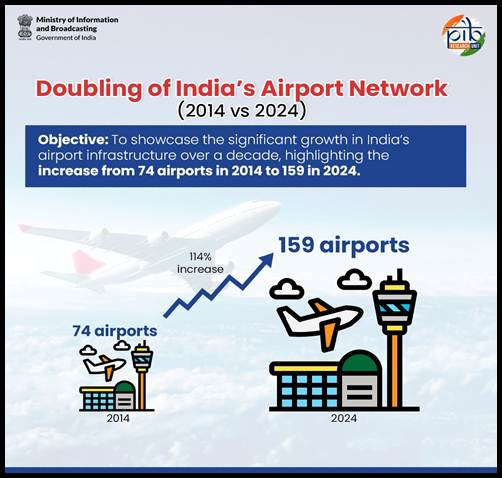
- Foundations for new terminals have been laid in cities like Varanasi, Agra, Darbhanga, and Bagdogra.
- Greenfield Airports: Since 2014, 12 out of 21 approved Greenfield Airports have become operational, including Durgapur, Shirdi, Kannur, Kushinagar, Itanagar, and others.
- Projects at Noida (Jewar) and Navi Mumbai are progressing, with completion targeted by FY 2025-26.
- The government plans to develop 50 more airports and connect 120 new destinations in the next 10 years.
- Capital Investment: Over ₹91,000 crore has been allocated under the National Infrastructure Pipeline (NIP), with ₹82,600 crore already spent by November 2024.
- RCS–UDAN: Expanding Regional Connectivity Since 2016, the UDAN scheme has operationalised 619 routes and connected 88 airports, making air travel more accessible and affordable.
- In 2024, 102 new routes were launched, including 20 in the North East.
Challenges
- India’s aviation industry is growing rapidly but experts warn of challenges, including overdependence on imports and a shortage of skilled talent.
- Despite global supply chain diversification, India’s share in aviation exports remains low.
- Current arbitration frameworks are insufficient to handle complex aviation disputes, leading to cases being resolved in global hubs like Singapore, London, and Paris.
Conclusion and Way Forward
- India’s aviation sector is undergoing a major transformation, marked by infrastructure development, improved regional connectivity, and a focus on sustainability.
- Initiatives like RCS-UDAN have expanded air travel access, boosting economic growth in underserved areas.
- With rising domestic and international passenger numbers, India is set to become a global aviation hub.
- But there’s a need to increase indigenisation and value-added production to strengthen the ecosystem.
- India must focus on neutrality, transparency, and institutional strength to align with global best practices in aviation arbitration.
- The industry stakeholders should engage and collaborate with policymakers to implement efficient and rational decisions that would boost India’s civil aviation industry.
Genetically Modified (GM) Edible Oils For Self-Sufficiency
Syllabus: GS3/Agriculture
Context
- Recently, a member of NITI Aayog has advocated for India to embrace GM edible oils to boost self-sufficiency, citing significant yield improvements seen in the US and China.
Importance of Edible Oils in the India’s Economy
- India is one of the world’s largest producers of oilseeds, making oilseeds and edible oils among the most essential agricultural commodities in the country.
- India produces a variety of edible oils such as mustard, groundnut, soyabean, sunflower, safflower, and coconut oil etc.
- It contributes about 5-6% of the world’s oilseeds production.
- The production is concentrated in states like Rajasthan, Gujarat, Madhya Pradesh, Maharashtra, and Andhra Pradesh.
- Total consumption stood at around 25.5 million tonnes, leading to a deficit that is bridged through imports. It includes:
- Palm oil: 37% (approximate)
- Soybean: 20% (approximate)
- Mustard: 14% (approximate)
- Sunflower: 13% (approximate)
| Do You Know? – India consumes about 24 kgs of edible oils (per capita annual consumption), significantly exceeding the recommended limits of 12 kg by the Indian Council of Medical Research (ICMR) and 13 kg by the WHO. 1. It marks a substantial increase from 2.9 kg in 1950-60, driven by factors such as rising incomes, urbanisation, and changing dietary habits. |
Dependence on Imports
- Currently, India imports 55-60% of its edible oil requirements from countries, including Indonesia, Malaysia, Argentina, Brazil, Russia, and Ukraine.
- In the 2023-24 oil marketing year, India’s edible oil imports reached approximately 15.96 million tonnes.
- Palm oil: Largest share, from Indonesia and Malaysia
- Soybean oil: From Argentina and Brazil
- Sunflower oil: Primarily from Ukraine and Russia
Government Initiatives
- National Mission on Edible Oils – Oil Palm (NMEO-OP): It aims to increase oil palm cultivation from 3.7 lakh hectares to 10 lakh hectares by 2025-26.
- It offers financial assistance to farmers for planting material, irrigation, and inputs.
- National Mission on Edible Oils – Oilseeds: India aims to boost the domestic oilseed production to 70 million tonnes by 2030-31 from the current 39 million tonnes.
- Price Stabilization Fund: It aimed at cushioning the impact of volatile international prices on consumers.
- It helps state agencies procure and distribute edible oils at controlled prices.
- Import Duty Adjustments: The government frequently tweaks import duties on edible oils to control retail inflation.
- Promotion of Oilseed Cultivation: Programs like NFSM-Oilseeds provide seeds, technical support, and extension services to farmers.
- Public Distribution System (PDS) Support: Edible oils are supplied at subsidized rates through PDS, especially during periods of high inflation.
Case for GM Edible Oils in India
- Boosting Productivity: India’s soybean yield has remained stagnant for decades, while countries like the United States and China have significantly increased their yields by adopting GM technology.
- It is estimated that GM crops could double or increase yields by 70-80%, making India more competitive in the global market.
- Reducing Import Dependency: India imports approximately 16 million tonnes of edible oils annually, a significant burden on its economy.
- By embracing GM edible oils, India could reduce its reliance on imports and enhance food security.
- Global Trends: Countries like the U.S. and China have successfully implemented GM technology without reported adverse effects, setting a precedent for India to follow.
