
Invisible Scars: Threat of Gully Erosion
Syllabus: GS1/ Geography, GS3/ Environment
Context
- A Scientific Reports paper highlights that gully erosion can derail progress on at least nine of the 17 Sustainable Development Goals (SDGs), especially zero hunger, clean water and sanitation, and climate action.
What is Gully Erosion?
- Gully erosion is a severe form of land degradation, marked by the carving of deep channels (gullies) into soil due to surface and subsurface runoff.
- It differs from other erosive forms due to its deeply erosive nature, high specific soil losses, and unpredictable behaviour.
- Status of Gully Erosion:
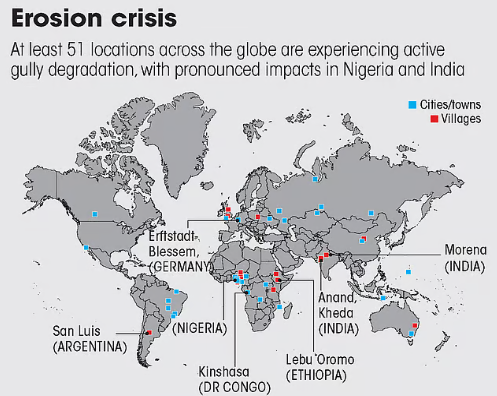
- 51 global locations have reported gully-related disasters; with Nigeria alone hosting 15.
- In India, gully landforms are observed in 19 states and Delhi. Most affected regions are Jharkhand, Chhattisgarh, Madhya Pradesh, and Rajasthan.
Causes of Gully Erosion
- Vegetation Loss: The absence of trees and grasses weakens soil structure, making it vulnerable to erosion during rain.
- Irregular weather patterns—long dry spells followed by heavy rain—reduce vegetation and increase runoff, worsening gully erosion.
- Improper disposal of solid waste in drainage channels blocks flow, creating turbulence that deepens and widens gullies during storms.
- Weak Soils: Sandy or loosely packed soils erode more easily under water pressure, especially in regions like Jharkhand and Chhattisgarh.
Impact of Gully Erosion
- Loss of Topsoil: Gully erosion removes the fertile topsoil layer, which is essential for agriculture. Once lost, it takes decades or centuries to regenerate.
- The removal of fertile land leads to declining agricultural productivity, threatening food security (SDG 2: Zero Hunger) and farmer livelihoods.
- Water Scarcity: Gully erosion disrupts the natural water-holding capacity of the land, increasing surface runoff and reducing groundwater recharge, leading to water stress and droughts. (SDG 6: Clean Water and Sanitation)
- Ecosystem Degradation: Erosion leads to habitat fragmentation and biodiversity loss, impacting local flora and fauna.
- Sediment Pollution: The displaced soil often ends up in rivers and reservoirs, leading to siltation, water pollution, and reduced storage capacity.
Way Ahead
- Reforestation: Planting native species in degraded catchments restores ecological balance and controls erosion over the long term.
- Land Use Planning: Adopting land use practices appropriate to soil and topography, such as terracing, agroforestry, and contour farming, reduces erosion risk.
- Check Dams: Small check dams made of stones, logs, or concrete across gullies reduce water speed, promote sediment deposition, and help in gully bed stabilisation.
Concluding remarks
- Gully erosion is a silent yet devastating form of land degradation that has been overlooked in mainstream environmental discourse.
- As India has pledged to restore 26 million hectares of degraded land by 2030 under the UN Convention to Combat Desertification, it is imperative that it should adopt both preventive and remedial strategies to manage gully erosion effectively.
10 Years of Three Jan Suraksha Schemes
Syllabus: GS2/ Governance
Context
- India is celebrating the 10th anniversary of the three social security (Jan Suraksha) schemes — Pradhan Mantri Jeevan Jyoti Bima Yojana (PMJJBY), Pradhan Mantri Suraksha Bima Yojana (PMSBY) and Atal Pension Yojana (APY).
- PMJJBY, PMSBY and APY were launched by PM Modi on 9th May, 2015.
Pradhan Mantri Jeevan Jyoti Bima Yojana (PMJJBY)
- Scheme: PMJJBY is a one-year life insurance scheme renewable from year to year offering coverage for death due to any reason.
- Eligibility: Persons in the age group of 18-50 years having an individual bank or a post office account are entitled to enroll under the scheme.
- People who join the scheme before completing 50 years of age can continue to have the risk of life covered up to age of 55 years upon payment of regular premium.
- Benefits: Life cover of Rs. 2 Lakh in case of death due to any reason against a premium of Rs. 436/- per annum.
Pradhan Mantri Suraksha Bima Yojana (PMSBY)
- Scheme: PMSBY is a one-year accidental insurance scheme renewable from year to year offering coverage for death or disability due to accident.
- Eligibility: Persons in the age group of 18-70 years having an individual bank or a post office account are entitled to enroll under the scheme.
- Benefits: Accidental death cum disability cover of Rs.2 lakh (Rs.1 lakh in case of partial disability) for death or disability due to an accident against a premium of Rs.20/- per annum.
Atal Pension Yojana (APY)
- Background: It is an initiative of the Government to provide financial security and cover future exigencies for the people in the unorganised sector.
- APY is administered by Pension Fund Regulatory and Development Authority (PFRDA) under the overall administrative and institutional architecture of the National Pension System (NPS).
- Eligibility: Open to all bank account holders aged 18 to 40 years.
- Applicants must not be income tax payers.
- Contribution amount varies based on the chosen pension slab and age of joining.
- Benefits: Subscribers would receive the guaranteed minimum monthly pension of Rs. 1000 or Rs. 2000 or Rs. 3000 or Rs. 4000 or Rs. 5000 after the age of 60 years, based on the contributions.
- Disbursement of the Scheme Benefits: Pension is first paid to the subscriber.
- After the subscriber’s death, the spouse receives the pension.
- Upon the demise of both subscriber and spouse, the accumulated pension corpus is given to the nominee.
- In Case of Premature Death (Before Age 60): The spouse can continue the contributions until the subscriber would have turned 60, maintaining pension eligibility.
Significance of the schemes
- Low-Cost Coverage: The schemes offer insurance and pension at extremely affordable premiums, ideal for economically vulnerable groups.
- Financial Inclusion: Enhanced the utility of Jan Dhan accounts by linking them with protective insurance.
- Women Empowerment: A significant proportion of subscribers under APY are women.
- Insurance Penetration: Broadened access to formal insurance and pension systems in rural and semi-urban India.
Conclusion
- The Jan Suraksha schemes represent a transformative step in building an inclusive social security net for India’s vast unorganised sector.
- As the nation celebrates a decade of these initiatives, there is a need to consolidate gains, plug operational gaps, and deepen coverage, ensuring that every citizen has a basic shield against life’s uncertainties.
Disqualification of MPs
Syllabus: GS2/Polity and Governance
Context
- Karnataka MLA has been disqualified from the State Legislative Assembly following his conviction by the Principal Special Judge for CBI cases in Hyderabad.
Disqualification of MPs & MLAs
- The disqualification of a Member of the Legislative Assembly (MLA) in India is primarily governed by Article 191 of the Constitution, the Representation of the People Act, 1951, and the Tenth Schedule (anti-defection law).
- The disqualification of a Member of Parliament (MP) in India is governed primarily by Article 102 of the Constitution, Representation of the People Act, 1951, along with the Tenth Schedule (anti-defection law).
- Disqualification Under Article 102
- Holds any office of profit under the Government of India or State, unless Parliament exempts the office by law.
- Declared by a competent court to be of unsound mind.
- Legally declared insolvent and not yet discharged.
- Not a citizen of India, or has voluntarily acquired citizenship of a foreign State, or shows allegiance to a foreign State.
- Disqualification by Law: The Representation of the People Act, 1951 provides that a person will be disqualified if convicted and sentenced to imprisonment for two years or more.
- Such a person is disqualified for the period of imprisonment and a further six years.
- Defection under the Tenth Schedule:
- If the MP voluntarily gives up membership of their party.
- If the MP votes/abstains contrary to party directions without permission.
- If any independently elected member joins any political party; and
- If any nominated member joins any political party after the expiry of six months.
Authority to Decide Disqualification
- MPs: President of India decides disqualification under Article 103, after consulting the Election Commission.
- For defection (Tenth Schedule), the Speaker (Lok Sabha) or Chairman (Rajya Sabha) decides.
- MLAs: The Governor decides disqualification under Article 192, after obtaining the opinion of the Election Commission of India.
- For defection cases under the Tenth Schedule, the Speaker of the Legislative Assembly makes the decision.
Challenges
- Delayed Decisions by Presiding Officers: Disqualification cases under the Tenth Schedule (anti-defection) are decided by the Speaker (MLA) or Chairman (MP).
- There are no time limits specified in the Constitution, leading to indefinite delays.
- Political Bias and Conflict of Interest: The presiding officer (Speaker/Chairman) usually belongs to a political party, leading to allegations of partiality.
- Judicial Delays: Though courts can review decisions under Articles 103 (MPs) and 192 (MLAs), the process is often slow.
- Interim reliefs and long-pending appeals delay finality, allowing disqualified members to continue holding office.
- Representation of the People Act Limitations: Certain criminal cases lead to automatic disqualification only after conviction.
- As trials are often delayed, accused persons can continue to contest and hold office for years.
- Ambiguity in Office of Profit Cases: Lack of a clear definition of what constitutes an “office of profit” has led to legal ambiguity.
- Public Perception and Accountability: Even when legally disqualified, politicians can contest elections again after short bans.
- This undermines public trust in the system and dilutes accountability.
Related Verdicts of Supreme Court
- Union of India vs Association for Democratic Reforms (2002): Voters’ right to know criminal records of candidates was established. However, the apex court did not extend this to lifetime bans.
- The CEC vs Jan Chaukidar case (2013): It upheld that persons who are under trial prisoners cease to be ‘electors’ and hence not qualified to contest elections.
- However, the Parliament amended the act in 2013 to overturn this judgment allowing under trial prisoners to contest elections.
- Lily Thomas (2013)Case: The court struck down section 8(4) of the RP Act, 1951, that allowed a sitting legislator to continue as a member even after being convicted if they filed an appeal, as unconstitutional and against political justice.
- After this judgment, a sitting legislator is disqualified immediately after the sentencing for a conviction.
- Public Interest Foundation vs Union of India (2018): Candidates facing serious criminal charges must publicly disclose their criminal records in election affidavits. The apex court left the lifetime ban decision to Parliament.
Reforms
- Strengthening the Anti-Defection Law: The Tenth Schedule, introduced in 1985, disqualifies MPs who voluntarily give up party membership or vote against party directives.
- The 52nd Constitutional Amendment (1985) aimed to curb political instability by preventing frequent party-switching.
- The 91st Constitutional Amendment (2003) removed the provision allowing one-third of legislators to split from a party, making defections more difficult.
- Addressing Loopholes in Disqualification Process: The Speaker or Chairman of the House decides on disqualification, but concerns over bias and delays have led to calls for judicial oversight.
- Expert committees have recommended that disqualification decisions be made by the President (for MPs) or Governor (for MLAs) on the advice of the Election Commission of India, ensuring greater impartiality.
- Private Member’s Bills for Reform: Some MPs have proposed Private Member’s Bills to introduce stricter timelines for disqualification decisions and reduce political interference.
- There is growing demand for automatic disqualification in cases of party defection, rather than relying on Speaker discretion.
Conclusion
- The disqualification of Members of Parliament in India is governed by a robust legal and constitutional framework aimed at upholding the integrity of the legislature.
- Landmark judicial interventions have strengthened this framework by promoting immediate accountability.
- However, persistent challenges like political bias in disqualification decisions and the criminalization of politics underline the need for further reforms.
- Strengthening these provisions is essential to maintain public trust in democratic institutions and ensure a clean and accountable political system.
Pakistan-Türkiye Nexus & India Stands
Syllabus: GS2/International Relations; GS3/Security
Context
- Türkiye’s support for Pakistan on Kashmir, along with defense collaborations, has raised concerns for India.
Türkiye’s Strategic Interests in Pakistan
- Cold War Alliances: Türkiye and Pakistan were part of the Central Treaty Organization (CENTO) and Regional Cooperation for Development (RCD), aligning their policies with Western-led security frameworks.
- Pakistan supported Türkiye’s stance in Cyprus, even offering military assistance during the 1964 and 1971 crises.
- In 1983, Pakistan declared that it would be the first country to recognize Turkish Cyprus if it declared independence, and it further strengthened the ideological bond between both countries.
- Countering Saudi-Emirati Influence: Türkiye, along with Qatar, has sought to challenge Saudi Arabia and the UAE’s dominance in the Muslim world.
- The Kuala Lumpur Summit (2019), involving Pakistan, Türkiye, Malaysia, and Indonesia, was perceived as an alternative bloc to Riyadh’s leadership.
- Türkiye’s Focus on the Indian Ocean Region (IOR): Türkiye is expanding its presence in the Indian Ocean, establishing its largest overseas base in Somalia (2017).
- In 2024, Türkiye sold Baykar TB2 drones to the Maldives, signaling growing influence in South Asia’s maritime domain.
- The Turkish Navy has frequently conducted joint exercises with the Pakistan Navy, with limited engagements with the Indian Navy.
Türkiye-Pakistan Nexus
- Türkiye’s Support for Pakistan on Kashmir: Türkiye has regularly expressed solidarity with Pakistan on Kashmir, calling for international attention to the issue.
- Pakistan has acknowledged Türkiye, China, and Azerbaijan as its key diplomatic allies during geopolitical crises.
- Türkiye’s Emergence as a Major Arms Supplier: According to SIPRI data, Turkish arms exports surged by 103% between 2015-2019 and 2020-2024.
- By 2020, Türkiye had become Pakistan’s second-largest arms supplier (after China), providing advanced military equipment.
- Pakistan’s Acquisitions from Türkiye: Under the Military Consultative Group framework (established in 1988), Pakistan has secured multiple defense agreements with Türkiye.
- The Ada-class anti-submarine corvette, and drone technology transfers highlight Türkiye’s commitment to Pakistan’s military modernization.
- Economic and Strategic Agreements: Pakistan and Türkiye have signed multiple agreements covering trade, defense, and intelligence cooperation.
- The Pakistan-Türkiye High-Level Strategic Cooperation Council (HLSCC) facilitates joint initiatives in energy, finance, and security.
Türkiye-Pakistan Nexus and Its Impact on India
- Strengthening Ties with Greece and Cyprus: India has consistently engaged and supported the Greece-backed Republic of Cyprus, countering Türkiye and Pakistan’s endorsement of the Turkish Republic of Northern Cyprus.
- Greece, in turn, has backed India’s stance on Kashmir, reinforcing diplomatic solidarity.
- Military Cooperation with Armenia: India has emerged as one of the strongest military supporters of Armenia, particularly in its territorial dispute with Türkiye-backed Azerbaijan.
- By late 2024, India surpassed Russia as Armenia’s largest arms supplier, a remarkable development in global arms trade.
- Pakistan’s Alignment with Azerbaijan: Pakistan has continued to reject the recognition of the Armenian genocide, aligning with Türkiye-supported Azerbaijan.
- In 2024, Pakistan signed a $1.6 billion defense deal to supply Azerbaijan with JF-17 Thunder Block III fighter jets, further strengthening its trilateral alliance with Türkiye and Azerbaijan.
| India-Türkiye Relations – Formal Diplomatic Ties: 1948 – Political and Diplomatic Engagements: 1. Turkish President Recep Tayyip Erdoğan visited India for the G20 Summit in New Delhi, meeting the Prime Minister of India to discuss trade, defense, and security cooperation. 2. The External Affairs Minister (EAM) of India held bilateral meetings with the Turkish Foreign Minister during the ASEAN Foreign Ministers Meeting (July 2024). 3. India and Türkiye have engaged in multilateral forums, including the UN, G20, and SCO Summits. – Economic and Trade Relations: 1. Trade Volume: India-Türkiye trade reached $10.7 billion in 2023, with India exporting automobiles, pharmaceuticals, and textiles, while Türkiye supplies machinery, chemicals, and metals. 2. Investment and Business Cooperation: Indian companies have invested in Türkiye’s infrastructure, energy, and technology sectors, while Turkish firms explore construction and manufacturing opportunities in India. – Defense and Security Cooperation: Türkiye has expressed interest in defense collaboration, including joint military exercises and technology exchange. |
Geopolitical Shifts Benefiting India
- U.S. Indo-Pacific Strategy (2022): It omitted any reference to Pakistan, and, in contrast, India was mentioned five times.
- India-Middle East-Europe Economic Corridor (IMEC) Bypasses Türkiye: It challenges Türkiye’s role as the bridge between Asia and Europe.
- Türkiye openly criticized IMEC, pushing to pursue its own Asia-Europe corridor—the Iraq Development Road.
India’s Response and Strategic Positioning
- Strengthening Regional Alliances: India has deepened ties with Saudi Arabia, UAE, and other Gulf nations, countering Türkiye’s influence.
- The India-Greece defense partnership has emerged as a counterbalance to Türkiye’s regional ambitions.
- Diplomatic Engagements: India has reiterated that Kashmir remains a bilateral issue, rejecting Türkiye’s interventionist stance.
- India continues to engage global partners to reinforce its sovereignty and territorial integrity.
- Military Preparedness: India has enhanced its air defense systems and naval capabilities, ensuring readiness against regional security threats.
- The S-400 missile system and indigenous defense projects strengthen India’s strategic deterrence.
Conclusion
- The Pakistan-Türkiye nexus presents geopolitical challenges for India, particularly in defense and diplomatic spheres.
- By reinforcing regional partnerships, military capabilities, and diplomatic outreach, India can effectively counter emerging threats while maintaining strategic stability.
