Presidential Reference to SC on Timeline to Act on State Bills
Syllabus: GS2/Polity and Governance
Context
- President Droupadi Murmu sought the Supreme Court’s advisory opinion under Article 143 on whether the President and governors need to follow timelines to decide on state bills.
Background
- Recently, the Supreme Court verdict laid down a timeline for the President and governors to decide on state bills.
- Though, the Governor is not bound by any time limit to act on a Bill.
- This creates a situation where the Governor can simply not act on a Bill indefinitely this is referred to as a “Pocket Veto”, although the term is not officially used in the Constitution.
- The Supreme Court ruled that Governors cannot delay or withhold assent to Bills indefinitely once they are passed or re-passed by the state Assembly.
- The ruling set a timeline for the Governor to act on Bills:
- One month for re-passed Bills.
- Three months if the Bill is withheld contrary to Cabinet advice.
- It raises questions about the scope of judicial authority under Article 142, and whether the courts can enforce accountability on constitutional functionaries like Governors and the President.
What is Article 142?
- Article 142 of the Indian constitution is a provision that empowers the Supreme Court to pass any decree or order necessary for doing complete justice in any case or matter pending before it.
- It also makes such decree or order enforceable throughout the territory of India.
- The importance of Article 142 lies in the following aspects:
- It enables the Supreme Court to exercise executive and legislative functions in certain situations, such as issuing guidelines, directions, or orders to the government or other authorities.
- It allows the Supreme Court to intervene in matters of public interest, human rights, constitutional values, or fundamental rights, and to protect them from any violation or infringement.
- It enhances the Supreme Court’s role as the guardian of the constitution and the final arbiter of the law.
- Criticism: It may encroach upon the principle of separation of powers and the domain of the executive and the legislature, and may invite criticism of judicial overreach or activism.
Article 143 – Power of President to consult Supreme Court
- Article 143(1): The President can refer any question of law or fact that is of public importance to the Supreme Court for its advisory opinion.
- The Court may choose to answer or decline.
- The opinion is not binding, but is highly respected.
- A similar power to make references was granted to the Federal Court of India under Section 213 of the Government of India Act, 1935.
- Article 145(3) requires any such reference to be heard by five judges, after which the SC returns the reference to the President with the majority opinion.
- Need for the Article: Under the Constitution, the President acts on the aid and advice of the Cabinet.
- The advisory jurisdiction allows her the means to seek independent advice to act on certain constitutional matters.
- It is a power that the President has invoked on at least 15 occasions since 1950.
Conclusion
- In essence, this development is not merely a legal inquiry but a crucial test of India’s federal structure, with implications for the balance of power between the Centre and the States, judicial oversight, and constitutional morality.
- The outcome could redefine how delays in Bill assent are addressed and reaffirm the judiciary’s role in safeguarding democratic processes.
Source: TH
Put Pakistan Nuclear Arsenal under Watch: India
Syllabus: GS3/Science and Technology/GS2/IR
Context
- The Union Defence Minister questioned the security of Pakistan’s nuclear arsenal and called for its supervision by the International Atomic Energy Agency (IAEA).
About
- Pakistan has tried to leverage its nuclear status against India.
- While India follows a no-first-use policy when it comes to nuclear weapons, Pakistan doesn’t have any such stated policy of restraint.
Pakistan’s Nuclear Arsenal
- Pakistan first tested nuclear weapons in 1998 in response to nuclear tests by India.
- Pakistan has vastly expanded its nuclear forces and remains outside the Nuclear Non-Proliferation Treaty (NPT) regime; the country is also a major source of proliferation concern.
- It is believed to possess an arsenal of about 170 nuclear warheads.
| Treaty on the Non-Proliferation of Nuclear Weapons (NPT) – Signed in 1968 and entered into force in 1970, the NPT aims to prevent the spread of nuclear weapons and promote disarmament. 1. It divides the world into nuclear-weapon states (NWS), recognized as possessing nuclear weapons at the time of the treaty’s signing, and non-nuclear-weapon states (NNWS), which agree not to develop or acquire nuclear weapons. 2. The treaty also requires NWS to pursue disarmament negotiations in good faith. – India, Israel, North Korea and Pakistan have not signed the NPT. |
International Atomic Energy Agency (IAEA)
- It is an international organization that promotes the peaceful use of nuclear energy while working to prevent its use for military purposes, including nuclear weapons.
- It was established in 1957.
- Headquarters: Vienna, Austria.
- Membership: 180 (as of 15 November 2024).
- Motto: “Atoms for Peace and Development”.
- Main Objective: Promote Peaceful Uses of Nuclear Energy.
- IAEA Safeguards are embedded in legally binding agreements.
- These safeguards are accepted by the states after the conclusion of such agreements with the agency.
- In 2005, the IAEA and its Director General, Mohamed ElBaradei, were awarded the Nobel Peace Prize for their work for a safer and more peaceful world.
- Role:
- Nuclear Safeguards and Verification: Monitors nuclear programs of member states to ensure they are not diverted to weapons programs, especially under the Non-Proliferation Treaty (NPT).
- Nuclear Safety and Security: Assists countries in strengthening nuclear safety standards, responding to emergencies, and preventing nuclear terrorism.
- Technical Cooperation: Provides technical assistance to developing countries to use nuclear technology for sustainable development.
- Role in Global Affairs: Works closely with the United Nations (UN) (it reports to the UN General Assembly and Security Council).
- Plays a critical role in non-proliferation diplomacy, such as inspecting Iran’s nuclear program.
India and Its Nuclear Safety Commitments
- In 2014, India ratified the Additional Protocol (AP), which granted the IAEA greater access to India’s civil nuclear programme.
- India has signed an item-specific safeguards agreement under the IAEA along with Pakistan and Israel.
- They are nuclear-power states that are not a member of the Nuclear Suppliers Group (NSG).
- India also changed its export laws to line up with the NSG, MTCR, Wassenaar Arrangement, and Australia Group — the four key nuclear control regimes.
| Key Nuclear Control Regimes – Missile Technology Control Regime (MTCR): Established in 1987, MTCR is an “informal political understanding among states that seek to limit the proliferation of missiles and missile technology”. 1. It has 35 members. India was admitted in 2016. China is not a member. – Australia Group: It is “an informal forum of countries which, through the harmonisation of export controls, seeks to ensure that exports do not contribute to the development of chemical or biological weapons.” 2. In 2018, India formally became the 43rd member of the Australia Group. – Wassenaar Arrangement (WA): The WA, formally established in 1996, aims to promote “transparency and greater responsibility in transfers of conventional arms and dual-use goods and technologies”, so there are no “destabilising accumulations”, and terrorists do not acquire them. 1. In 2017, India joined WA as the 42nd Participating State. |
India-Pakistan Nuclear Installation Agreement
- Signed in 1988 and brought into force in 1991, Non-nuclear aggression agreement (NAA) commits the two countries to abstain from attacking each other’s civilian nuclear facilities.
- It requires an annual exchange of the exact locations by latitude and longitude of power plants, enrichment labs, isotope separation units, and any site holding a significant quantity of radioactive material.
- The goal is to avoid triggering a nuclear catastrophe. However, the agreement does not mandate detailed disclosures about the nature or activities of these facilities.
- India has repeatedly proposed expanding the agreement to include a pledge not to target civilian and economic infrastructure, but Pakistan has consistently rejected such proposals.
Conclusion
- Pakistan’s lack of a declared no-first-use nuclear policy, in contrast to India’s commitment to such a doctrine, contributes to strategic instability in South Asia, raising the risk of escalation in the event of a conflict.
- Pakistan uses its nuclear capability to counter India’s conventional military edge, but its unrestrained doctrine highlights the need for confidence-building, dialogue, and regional arms control to maintain long-term peace and stability.
Account Aggregators: Blueprint for Consent Managers under India’s DPDP Act
Syllabus: GS3/ Economy
Context
- With the Digital Personal Data Protection (DPDP) Act, 2023 and Draft DPDP Rules, 2025, India aims to expand its consent-based data-sharing system by building on the Account Aggregator model.
What is an Account Aggregator (AA)?
- Definition: An Account Aggregator is a type of Non-Banking Financial Company (NBFC-AA) regulated by the Reserve Bank of India (RBI).
- It helps individuals securely and digitally access and share information from one financial institution to another in a real-time, consent-based, and secure manner.
- It acts as an intermediary between Financial Information Providers (FIPs) and Financial Information Users (FIUs).
- The AA does not store or process the data; it simply facilitates the encrypted transfer of data.
- The system is based on a ‘consent layer’, ensuring user control and privacy.
- Working: Users link their bank accounts to an AA.
- Gives consent to share data (e.g., bank statement) with a Financial Information User (FIU) like a bank or NBFC.
- The AA fetches the data from the Financial Information Provider (FIP), like a bank, and shares it securely with the FIU.
- Examples of licensed Account Aggregators (AAs):
- CAMS FinServ: A subsidiary of Computer Age Management Services (CAMS).
- PhonePe AA: A subsidiary of PhonePe, leveraging its digital reach.
Key Stakeholders of Account Aggregator
- Financial Information Providers (FIPs): Banks, mutual fund companies, insurance companies, etc.
- Financial Information Users (FIUs): Lenders, wealth managers, insurers, etc.
- Account Aggregators (AAs): Licensed entities that facilitate data flow between FIPs and FIUs.
The DPDP Act and Consent Managers (CMs)
- The Digital Personal Data Protection Act, 2023 introduces Consent Managers (CMs) as intermediaries to facilitate:
- Consent collection and withdrawal
- Consent lifecycle management
- Secure data sharing between Data Principals (individuals) and Data Fiduciaries (entities processing personal data).
Draft DPDP Rules, 2025
- The recently released Draft DPDP Rules, 2025 outline the registration process, obligations, and permitted activities of consent managers.
- Given the significant structural alignment between the Account Aggregator (AA) and Consent Manager (CM) frameworks, certain revisions have been proposed to the Draft Rules. They are as;
- Mandatory Registration with the Data Protection Board (DPB): Entities seeking to operate as consent managers under the DPDP regime must be mandatorily registered with the DPB.
- Enable Sector-Specific Consent Managers: The DPB should allow for the registration of sector-specific consent managers, provided they operate on common, interoperable APIs and technical specifications as prescribed.
- Allow Commercial Arrangements with Data Fiduciaries: Consent managers should be allowed to have business deals with data fiduciaries (like banks or companies that use personal data).
Significance of a Unified Consent Infrastructure
- Avoids duplication: Aligning AA and CM frameworks reduces regulatory overlap.
- Increases efficiency: Leveraging existing AA insights accelerates CM implementation.
- Promotes innovation: Encourages startups and established entities to develop secure data services.
- Supports Digital Public Infrastructure (DPI): Strengthens India’s ambition for a holistic, interoperable data governance regime.
Concluding remarks
- India has an unprecedented opportunity to become a global pioneer in citizen-centric data governance.
- By harmonising the Account Aggregator framework with the emerging Consent Manager regime under the DPDP Act, India can move toward a secure, scalable, and inclusive data economy.
Source: TH
Unemployment at 5.1%, Women Labour Force Rises: PLFS Data
Syllabus: GS3/Economy; Employment
Context
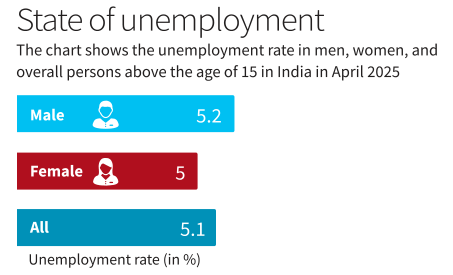
- The latest Periodic Labour Force Survey (PLFS) data, released by the Ministry of Statistics & Programme Implementation (MoSPI), shows that India’s unemployment rate stood at 5.1% in April 2025.
Periodic Labour Force Survey (PLFS)
- About: It is conducted by the MoSPI to assess employment and unemployment trends in India.
- It provides key labour market indicators, including the Labour Force Participation Rate (LFPR), Worker Population Ratio (WPR), and Unemployment Rate (UR).
- Features:
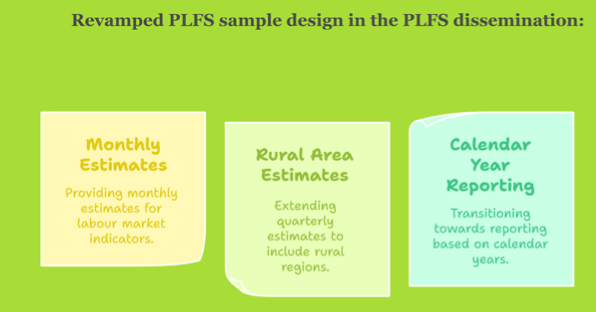
- Revamped Sampling Design (2025): The survey now includes monthly estimates for both rural and urban areas, improving data accuracy.
- Current Weekly Status (CWS) Approach: Measures employment status based on activity in the last seven days preceding the survey.
- Expanded Coverage: The sample size has increased to 22,692 First Stage Units (FSUs), covering both rural and urban sectors.
- Earlier, 12,800 FSUs surveyed in PLFS up to December, 2024.
- Annual Reports: PLFS results are now released based on the calendar year, ensuring timely updates.
Key Findings of the PLFS Report
- Unemployment Rate: It is defined as the percentage of persons unemployed among the persons in the labour force.
- Overall (persons aged 15 years and above): 5.1%
- Male: 5.2%; Female: 5.0%
- Rural: 4.5%; Urban: 6.5%
- Youth among urban females (15-29 years): 23.7%
- Labour Force Participation Rate (LFPR): It is defined as the percentage of persons in the labour force (i.e. working or seeking or available for work) in the population.
- For persons aged 15 years and above: 55.6%
- Rural: 58.0%; Urban: 50.7%
- Male: 79.0% (rural areas); 75.3% (urban areas)
- Female: 38.2% (rural areas); 25.7% (urban areas)
- Worker Population Ratio (WPR): It measures employed persons as a percentage of the total population.
- Overall: 52.8%
- Rural WPR: 55.4%; Urban WPR: 47.4%
- Female WPR: 36.8% (rural areas); 23.5% (urban areas)
Significance of the Findings
- The rise in female labour force participation, particularly in rural areas, signifies increasing economic engagement.
- However, high youth unemployment among urban females raises concerns about gender disparities, job availability, and skill gaps.
- The revamped PLFS model provides monthly employment estimates, but timely implementation of corrective measures remains a challenge.
Why is the Agriculture Sector Missing from India’s FTAs?
Syllabus: GS/ Economy, Agriculture
Context
- Despite India’s active negotiations of Free Trade Agreements with global partners, the agriculture sector, vital to its economy and employment, remains largely excluded.
Why Agriculture is Missing from India’s FTAs?
- Fear of Import Surge: Entry into FTAs like RCEP was abandoned over concerns that cheap agri imports, especially dairy from New Zealand and Australia, would hurt Indian farmers.
- Agriculture is a State subject, whereas trade is in the Union list. This leads to inconsistent policies — bans, export quotas, or quarantine rules — harming exporter confidence.
- Infrastructural Deficiencies: Absence of cold chains, agro-processing hubs, and efficient port logistics, especially in landlocked states limits agricultural trade potential.
- Indian agricultural exports suffer from quality issues like pesticide residues, aflatoxins, and weak compliance with global SPS (Sanitary and Phytosanitary) norms.
Efforts taken by other countries
- Thailand: Thailand’s agri-export success is driven by its focus on industrial crops like rubber, strong agro-processing linkages, and over 18 FTAs that enhance market access and boost value-added exports.
- Brazil: It leveraged mechanised farming, logistics corridors, and value addition in soy, coffee, and meat to reach $166 bn agri exports.
India’s Existing Strengths
- Basmati Rice: India’s agricultural strength lies in its globally recognized products such as Basmati rice, which alone contributes to around 21% of the country’s agricultural exports.
- GI-Tagged Products: Gaining visibility under schemes like One District One Product (ODOP).
- Agricultural and Processed Food Products Export Development Authority (APEDA) works towards quality promotion and certification, though more integration with smallholder farmers is needed.
How to make Indian Agriculture FTA-Ready?
- Shift from Commodities to Branding & Value Addition and develop agro-processing clusters near APMCs.
- Promote branded products and niche categories like organic, GI-tagged, or processed food.
- Institutional Reforms: Create a National Agricultural Trade Council with Centre-State-industry coordination.
- Ensure single-window clearances and digital export compliance.
- Infrastructure and Logistics: Invest in inland container depots, cold storage, and rural logistics in landlocked states.
- Agri-Investment Strategy: Move from input subsidies to Direct Benefit Transfers (DBT) to incentivise diversification and innovation.
Efforts taken by India
- The Agri Export Policy of 2018 is a comprehensive initiative by the Indian government to boost agricultural exports and integrate Indian farmers into global value chains.
- The Agricultural and Processed Food Products Export Development Authority facilitates certification, market intelligence, export promotion, and capacity-building programs for stakeholders.
- Initiatives like the Paramparagat Krishi Vikas Yojana (PKVY) and National Programme for Organic Production (NPOP) aim to tap into growing global demand for chemical-free, sustainable produce.
- Negotiation of Market Access: India continues to engage in bilateral and multilateral negotiations to reduce tariff and non-tariff barriers for its agricultural goods and secure preferential market access.
Concluding remarks
- India’s cautious approach to agriculture in FTAs safeguards farmer interests but also restricts the sector’s export potential.
- Moving forward, a balanced strategy with targeted reforms can help integrate Indian agriculture into global markets more effectively.
‘Samudrayaan’: India’s First Manned Deep Ocean Mission To Be Launched by 2026
Syllabus: GS3/ S&T
In News
- India is set to launch its first manned deep-ocean mission, ‘Samudrayaan’, by 2026, aiming to explore marine resources at a depth of 6,000 metres using the indigenously developed submersible ‘Matsya’.
About Samudrayaan Mission
- The Samudrayaan Mission is part of the manned Deep Ocean Mission.
- It would have MATSYA 6000, a indigenously designed 4th generation manned submersible vehicle capable of carrying three people to a depth of 6,000 meters.
- It is being developed by National Institute of Ocean Technology (Chennai).
- MATSYA 6000 has an operational endurance of 12 hours and an emergency endurance of 96 hours.
- India’s research vessel Sagar Nidhi will be used to deploy and recover the MATSYA 6000.
Significance of the Mission
- Scientific Research: Enables collection of deep-sea samples, critical for understanding marine biodiversity, geology, and chemistry.
- Resource Exploration: Potential for assessment of living (marine biodiversity) and non-living resources (minerals, polymetallic nodules).
- Technology Demonstration: Showcases indigenous capability in high-pressure deep-sea engineering.
- Tourism Potential: May lay foundation for future deep-sea tourism.
- Strategic Capability: Enhances India’s presence in global ocean research and resource diplomacy.
- League of Nations: With this mission, India will join a select group of nations (the US, Russia, France, Japan, and China) that have the technology and capabilities for manned deep-sea exploration.
About Deep Ocean Mission (DOM)
- The Deep Ocean Mission (DOM) was launched by the Ministry of Earth Sciences in 2021, and aims to explore and harness deep-sea resources in a sustainable and technologically advanced manner.
- With a ₹4,077 crore outlay over five years, DOM supports India’s Blue Economy and aligns with SDG-14 (Life Below Water).
- The mission is being spearheaded by the National Institute of Ocean Technology (NIOT) and comprises six components:
- Manned Submersible Development (Samudrayaan).
- Deep-sea Biodiversity Exploration
- Mining Polymetallic Nodules
- Ocean Climate Advisory Services
- Marine Station for Ocean Biology to promote research
- Advanced Ocean Observation Systems using underwater sensors and AI.
miscellaneous
Pushkar Kumbh
Syllabus: GS1/ Art & Culture
In News
- After a 12-year interval, Uttarakhand is hosting the Pushkar Kumbh Mela at Keshav Prayag in Mana village.
About Pushkar Kumbh
- Pushkar Kumbh is a sacred Vaishnavite pilgrimage held every 12 years at Keshav Prayag, the confluence of the Alaknanda and Saraswati rivers in Mana village, Uttarakhand, when Jupiter enters Gemini.
- It holds deep spiritual significance as the site where Ved Vyas composed the Mahabharata. Saints like Ramanujacharya and Madhvacharya are believed to have received divine knowledge from Goddess Saraswati here.
- Though smaller than traditional Kumbhs, it attracts devotees, especially from South India, and is seen as a bridge uniting India’s diverse spiritual traditions.
Sikkim’s 50th Statehood Day
Syllabus: GS2/Polity
Context
- Prime Minister Narendra Modi extended his wishes on the occasion of the 50th anniversary of Sikkim’s statehood.
About
- Sikkim became the 22nd state of India on May 16, 1975, under the leadership of Lhendup Dorjee Khangsarpa, the state’s first Chief Minister.
- Sikkim was earlier referred to as the Chogyal Kingdom, ruled by Chogyals.
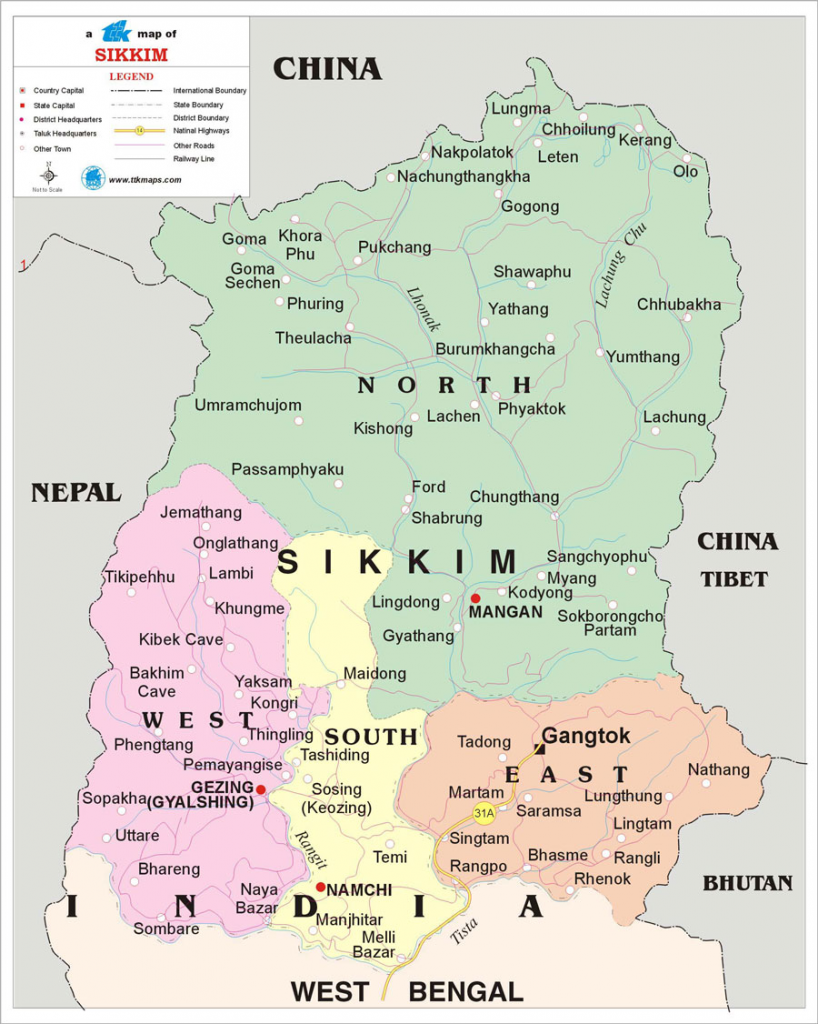
- Location: Sikkim is located in the northeastern part of the country, in the eastern Himalayas.
- It is bordered by the Tibet Autonomous Region of China to the north and northeast, by Bhutan to the southeast, by the Indian state of West Bengal to the south, and by Nepal to the west.
- Kangchenjunga, the highest peak of India is situated in Sikkim.
- The People of Sikkim consist of three ethnic groups, that is, Lepcha, Bhutia and Nepali.
- The official languages of the state are English, Nepali, Sikkimese (Bhutia) and Lepcha.
- State Animal: Red Panda
Appointment of UPSC Chairman
Syllabus: GS2/Polity and Governance
Context
- President Droupadi Murmu has appointed Dr. Ajay Kumar as the Chairman of the Union Public Service Commission under Article 316 (1) of the Constitution.
About
- The post of UPSC chairman fell vacant after the completion of Preeti Sudan’s tenure.
- The UPSC conducts civil services examinations to select officers for the Indian Administrative Service , Indian Foreign Service and the Indian Police Service , among others.
- Members: Besides the chairman, it can have a maximum of 10 members.
- A UPSC chairman is appointed for a term of six years or until attaining 65 years of age, all members have the same term.
- Reappointment: The UPSC Chairman is not eligible for reappointment after completing their term.
- Removal (317): Removal by President:
- Can only be done on the ground of misbehaviour.
- Requires a Supreme Court inquiry and report confirming the misbehaviour.
- Reference to the Supreme Court is made by the President.
- Can remove without Supreme Court inquiry if the person: Is adjudged insolvent, engages in paid employment outside office duties, is unfit due to mental or physical infirmity.
India’s Trade Deficit Widens to $8.65 Billion
Syllabus: GS3/ Economy
Context
- India’s total trade deficit, combining both merchandise and services, widened to $8.65 billion in April 2025, compared to $5.77 billion in April 2024, as per data released by the Ministry of Commerce and Industry.
About
- Export Performance: India’s total exports (merchandise + services) in FY 2024–25 touched an all-time high of $824.9 billion, registering a 6% year-on-year growth.
- Merchandise Trade (Goods):
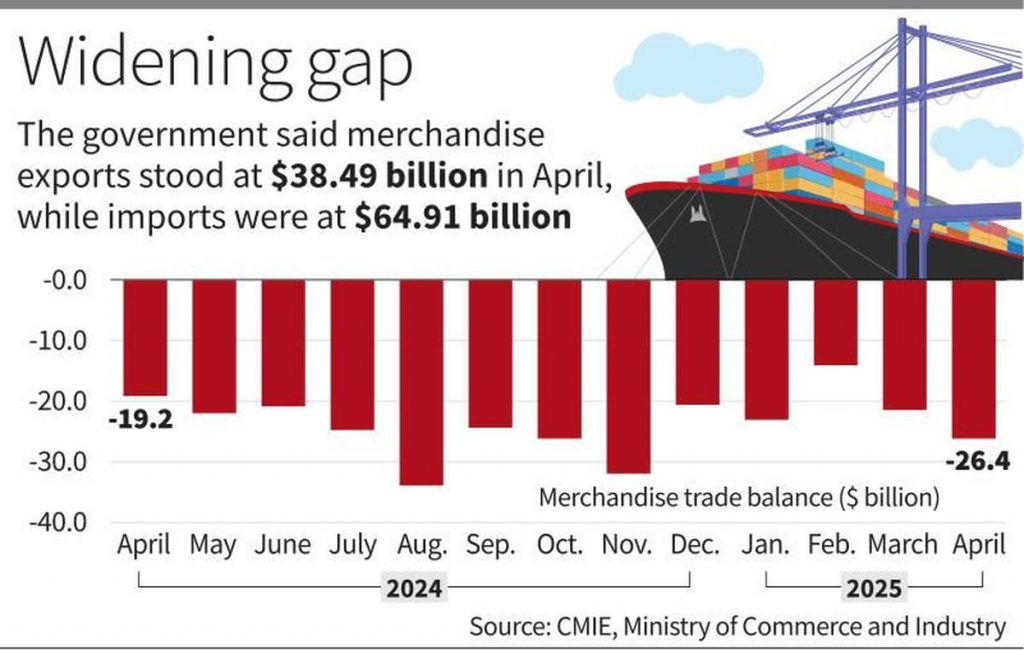
- Exports rose 9% to $38.49 billion in April 2025.
- Imports increased at a faster pace, 19.1%, reaching $64.91 billion.
- Merchandise trade deficit widened to $26.4 billion (up from $19.19 billion in April 2024).
- Services Trade:
- Services exports grew 17% to $35.31 billion.
- Services imports rose 4.6% to $17.54 billion.
- Services trade surplus thus stood at $17.77 billion, which helped moderate the overall deficit.
| What is Trade Deficit? – If a country imports more goods and services from other countries than it exports to them, it is said to have a trade deficit. – Trade Deficit weakens the domestic currency. |
Lupex Mission
Syllabus: GS3/Space
Context
- India and Japan are set to enter the design phase of the Lunar Polar Exploration (LUPEX) mission, also referred to as Chandrayaan-5.
About the Mission
- Objective: To conduct detailed exploration of the Moon’s south polar region, especially focusing on water ice deposits.
- Mission life: Approved by the Cabinet in March this year, the mission is proposed to be for 3.5 months (100 days).
- Lander and Rover: ISRO is developing the lander, while JAXA is building and programming the 350-kg rover to traverse the lunar surface and climb slopes up to 25 degrees.