
India’s Northeast – Kolkata Link via Myanmar
Syllabus: GS3/Infrastructure; Economy
Context
- India’s decision to establish a direct link between the Northeast and Kolkata via Myanmar, bypassing Bangladesh, marks a strategic shift in regional connectivity.
Key Aspects of India’s Northeast & Myanmar
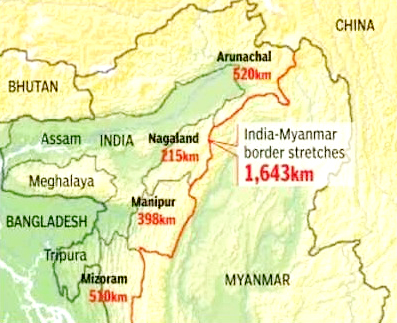
- India shares a 1,643 km land border with Myanmar, connecting Arunachal Pradesh, Nagaland, Manipur, and Mizoram.
- Myanmar serves as India’s gateway to Southeast Asia, making it vital for trade and connectivity.
Kaladan Multimodal Transit Transport Project (KMTTP)
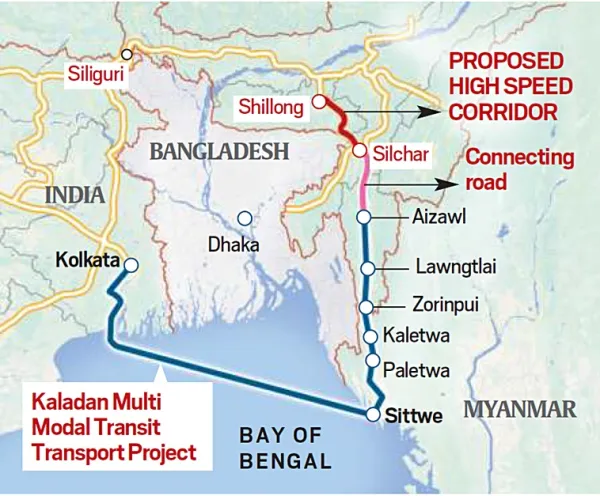
- It aims to link Kolkata to Mizoram via Sittwe Port (Myanmar) and Paletwa inland waterways.
- It enables multi-modal cargo flow (sea, river, road).
- It reduces distance and time compared to the ‘Chicken’s Neck’ corridor (Siliguri).
- It connects with India’s East-West industrial corridor plans.
- Phases:
- Kolkata to Sittwe (Sea) – 539 km (Completed)
- Sittwe to Paletwa (River) – 158 km (Completed)
- Paletwa to Zorinpui (Road) – 108 km (Partially completed, delayed due to armed conflict in Rakhine State).
- Zorinpui to Aizawl & Shillong (Road Extension): Underway through the Shillong-Silchar-Zorinpui corridor, approved by MoRTH.
Why is the Northeast-Kolkata Link via Myanmar significant?
- Shift in Connectivity Strategy: Historically, the Northeast has relied on Bangladesh for transit access to Kolkata and other parts of India.
- India has invested in major connectivity projects like the India-Myanmar-Thailand Trilateral Highway and the Kaladan Multi-Modal Transit Transport Project (expected to be completed by 2030).
- These projects aim to boost trade, tourism, and regional integration between India and ASEAN nations.
- India has invested in major connectivity projects like the India-Myanmar-Thailand Trilateral Highway and the Kaladan Multi-Modal Transit Transport Project (expected to be completed by 2030).
- Geopolitical Considerations: The decision to bypass Bangladesh comes after Bangladesh’s interim government remark related to Northeast India as ‘landlocked’ and dependent on Dhaka for ocean access.
- India’s response was to strengthen alternative routes, ensuring trade independence.
- Economic and Strategic Benefits:
- Reduced Dependency on Bangladesh: The new route eliminates transit fees and bureaucratic hurdles associated with Bangladesh.
- Boost to Northeast’s Economy: Improved connectivity will enhance trade, tourism, and industrial growth in the region.
- Strengthening India’s Act East Policy: The Myanmar route aligns with India’s broader strategy to deepen ties with Southeast Asia.
- Security Implications:
- India’s investments in Myanmar infrastructure also help counter Chinese influence.
- Presence in western Myanmar contributes to border stability, especially in conflict-prone Chin and Rakhine regions.
Challenges with Myanmar Route
- Insurgency threats (e.g., Arakan Army operations).
- Slow construction progress due to terrain and security issues.
- Chinese infrastructure competition in the same region (Kyaukpyu port, CMEC).
Curbing Bangladeshi Exports via Land Ports
- Ban on Ready-Made Garments via Land Ports: India has barred Bangladeshi ready-made garments from entering through land ports in Tripura, Assam, Meghalaya, and Mizoram.
- These goods must now be shipped via Kolkata and Mumbai sea ports, where they will undergo mandated inspections.
- Retaliation Against Bangladesh’s Restrictions: Bangladesh had earlier stopped Indian yarn exports through land ports, allowing imports only via sea routes.
- India’s response aims to counterbalance trade policies that disadvantage Indian exporters.
- Impact on Trade & Economy: Around 93% of Bangladesh’s garment exports to India previously passed through land ports.
- The new restrictions will likely increase costs for Bangladeshi exporters and shift trade dynamics in the region.
Govt School Enrolment Drops in 23 States
Syllabus: GS2/Education/Governance
Context
- Minutes of meetings held by the Ministry of Education (MoE) with 33 States and UTs show that student enrolment dipped in 23 states.
About
- The drop first came to light late last year in the UDISE+ report for 2023-24, which pointed to a sharp fall of around 1.5 crore in overall school enrolment (government and private) compared to the 2018-19 to 2021-22 average.
- PM-POSHAN minutes show the trend continuing into 2024-25, triggering fresh concern in the government.
- At least eight witnessed declines exceeding 100,000: led by Uttar Pradesh (21.83 lakh), Bihar (6.14 lakh), Rajasthan (5.63 lakh) and West Bengal (4.01 lakh).
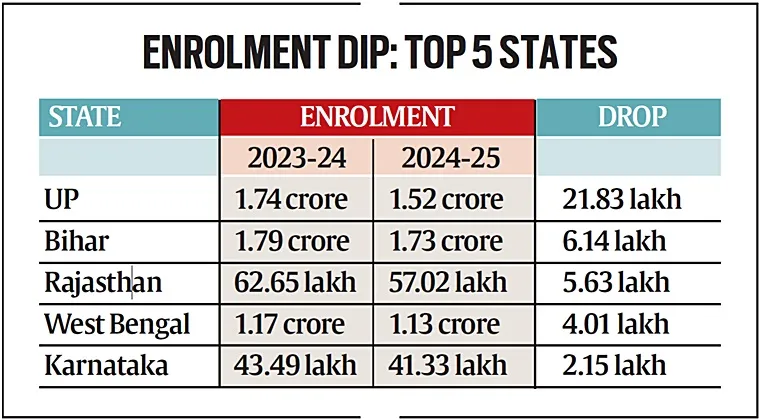
- Compared to 2023-24, Karnataka saw its enrollment fall by around 2 lakh; Assam by 1.68 lakh, Tamil Nadu by 1.65 lakh and Delhi by 1.05 lakh.
- The PM-POSHAN meetings flagged low scheme coverage: In Delhi, the number of students availing midday meals fell by 97,000 in 2024-25 versus 2023-24.
- In Uttar Pradesh, meal coverage dropped by 5.41 lakh students, by 3.27 lakh in Rajasthan and 8.04 lakh in West Bengal.
- Some States reported students bringing their own tiffin.
Possible Reasons for the Decline
- The first is a change in data-collection methodology—from school-wise reporting (just total numbers) to student-wise reporting, this ongoing “data cleansing” may have removed “ghost” entries.
- Several States have suggested enrolment may be moving from government to private schools in the post-Covid years, reversing pandemic-era trends.
Implications
- Nutritional Risk: Lower participation could impact child health and learning outcomes.
- Administrative Gaps: Transition to Aadhaar-based data is essential but may cause temporary disruption.
- Policy Reflection: Need to re-evaluate strategies to maintain enrolment and ensure scheme utilization.
MoE’s Response
- The ministry has expressed “deep concern” and asked states to investigate causes and submit reports by June 30.
- It emphasized on improving the meal coverage and quality assurance for concerns of some students reportedly bringing their own food.
| PM-POSHAN – PM-POSHAN — Pradhan Mantri Poshan Shakti Nirman, formerly known as the midday-meal scheme, is a centrally sponsored Scheme under the Ministry of Education. 1. It operates on a 60:40 funding model between the Centre and the states. – Provides hot cooked meals to 11.20 crore students in Balvatika and classes 1 to 8. – Covers 10.36 lakh govt. & govt.-aided schools. – Under the scheme, material cost is provided for procurement of ingredients such as pulses, vegetables, oil, spices and condiments, and fuel required for cooking the meals. 1. The Centre also supplies around 2.6 million metric tonnes of food grains annually through the Food Corporation of India (FCI), covering 100% of the cost. – Besides addressing child nutrition, a cooked meal in school is known to boost attendance, learning outcomes and attention spans. |
Govt. to Allow Private Operators in Nuclear Energy Sector
Syllabus: GS3/Energy
Context
- The government is likely to move two crucial amendments in the laws governing the country’s atomic energy sector in the upcoming monsoon session of Parliament.
Legal Reforms Underway
- Easing Nuclear Liability Law (Civil Liability for Nuclear Damage Act, 2010): Its objective is to limit the liability of equipment vendors in case of a nuclear accident. Key Proposed Changes:
- Monetary Cap: Liability may be capped to the original contract value.
- Time Limit: Introduce a statute of limitations for how long liability applies.
- Amendment to the Atomic Energy Act, 1962: Its objective is to allow private and foreign players to enter nuclear power generation.
- Current Restriction: Only state-owned entities like NPCIL and NTPC Ltd can operate nuclear plants.
- Proposed Change: Permit minority equity participation by foreign/private entities in upcoming projects.
Need for the Changes
- NPCIL: India’s nuclear sector is governed by the Atomic Energy Act, 1962, under which only government-owned entities such as NPCIL can generate and supply nuclear energy.
- There has been no private sector involvement in India’s nuclear power sector so far.
- Foreign companies like GE-Hitachi, Westinghouse, and Framatome have avoided India due to open-ended liability concerns.
- Amending this is crucial to attract foreign investment and technology.
- These moves aim to unlock the potential of the Indo-US Civil Nuclear Agreement, signed nearly two decades ago.
- India intends to package these reforms as part of a wider trade and investment framework with the U.S., potentially leading to a trade pact.
Recent U.S. Regulatory Breakthrough
- Recently, the U.S. Department of Energy granted Holtec International a specific authorisation (SA IN2023-001) under 10CFR810.
- Implication: Holtec can now transfer unclassified SMR technology to Indian partners like Tata Consulting Engineers and L&T.
- This clears the path for design and manufacturing of small modular reactors (SMRs) in India.
- Significance: Positions India to co-develop and manufacture nuclear components domestically.
India’s Need to Increase its Nuclear Capacity:
- Nuclear Capacity: India’s plans to increase its nuclear power capacity from the current 8,180 MW to 22,480 MW by 2031-32 and eventually 100 GW by 2047.
- Energy Demand Growth: India’s electricity demand is expected to increase 4-5 times by 2047, and nuclear power will help meet base-load demand alongside renewables.
- India’s Targets: To reduce the emission intensity of its GDP by 44% by 2030 from the 2005 level.
- To achieve 50% cumulative electric power installed capacity from non-fossil fuel-based energy resources by 2030.
- Roadmap for 100 GW: A roadmap is being developed with stakeholders, and while challenges remain, achieving the 100 GW target is seen as both ambitious and achievable
Conclusion
- These developments reflect a historic shift in India’s nuclear policy. By addressing legal and regulatory obstacles, India is poised to:
- Unlock foreign investment and advanced technology.
- Expand its clean energy portfolio through nuclear power.
- Reinforce strategic alignment with the U.S. under the civil nuclear framework.
70 Applications Received for Scheme to Produce Electronic Components
Syllabus: GS3/ Science and Technology
Context
- The Government of India has received 70 applications, 80% from small and medium enterprises (SMEs), for its Electronics Component Manufacturing Scheme.
Electronics Component Manufacturing Scheme
- It is a Rs.22,919 crore scheme, aims to develop a robust component ecosystem by;
- Attracting large investments (global/domestic) in the electronics component manufacturing ecosystem,
- Increasing Domestic Value Addition (DVA) by developing capacity and capabilities, and
- Integrating Indian companies with Global Value Chains (GVCs).
- Salient Features of the Scheme:
- The scheme provides differentiated incentives to Indian manufacturers tailored to overcome specific disabilities for various categories of components and sub-assemblies so that they can acquire technological capabilities and achieve economies of scale.
- The tenure of the scheme is six years with one year of gestation period.
- Payout of a part of the incentive is linked with employment targets achievement.
Component Classification under the Scheme
- Category A: Display modules, camera module sub-assemblies.
- Category B: Bare components like non-surface mount devices, multi-layered PCBs, lithium-ion cells, IT hardware products.
- Category C: Flexible PCBs, SMD passive components.
- Category D: Capital goods and components used in manufacturing of A, B, and C.
Progress in India’s electronics sector
- The domestic production of electronic goods has increased from Rs.1.90 lakh crore in FY 2014-15 to Rs.9.52 lakh crore in FY 2023-24 at a CAGR of more than 17%.
- The exports of electronic goods have also increased from Rs.0.38 lakh crore in FY 2014-15 to Rs.2.41 lakh crore in FY 2023-24 at a CAGR of more than 20%.
Challenges in electronics sector
- Market Competition: The global electronics market is dominated by countries like China, Taiwan, USA, South Korea, Vietnam and Malaysia.
- Technical Skills: There is a lack of adequately trained technical personnel for advanced manufacturing processes.
- Capital Intensive industry: Electronic manufacturing is a complex and technology-intensive sector with huge capital investments, high risk, long gestation and payback periods, requiring significant and sustained investments.
Government initiatives
- Make in India, Digital India, and Startup India are promoting domestic manufacturing and technological innovation.
- Production Linked Incentive Scheme (PLI): The scheme aims to attract large investments in the mobile phone manufacturing and specified electronic components, including Assembly, Testing, Marking and Packaging (ATMP) units.
- National Policy on Electronics 2019 (NPE 2019): It is a comprehensive framework to develop India as a global hub for electronics manufacturing.
- Modified Electronics Manufacturing Clusters (EMC 2.0) develops infrastructure with common amenities and industrial clusters for electronics production.
Way Ahead
- India has set a target to achieve 500 billion USD in electronics manufacturing in value terms by 2030.
- To enhance competitiveness, India needs to localize high-tech components, strengthen design capabilities through R&D investments, and forge strategic partnerships with global technology leaders.
Fatigue of Li Metal Anode in Solid-State Batteries
Syllabus: GS3/Science and Technology
Context
- A recent study identifies mechanical fatigue of the lithium metal anode, rather than current density alone, as the key cause behind dendrite-induced short circuits and failure of Solid-State Batteries (SSBs).
What are Solid-State Batteries (SSBs)?
- (SSB) is an advanced type of battery that uses a solid electrolyte instead of the liquid or gel-like electrolyte found in conventional lithium-ion batteries.
- Working Mechanism:
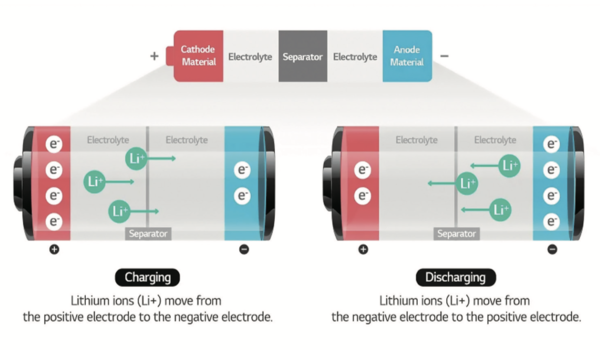
- Charging Phase: Lithium ions move from the cathode to the anode through the solid electrolyte, storing energy.
- Discharging Phase: Lithium ions travel back from the anode to the cathode, generating an electric current that powers devices or vehicles.
Difference between Conventional Li-ion Batteries and SSBs
| Feature | Traditional Li-ion Battery | Solid-State Battery |
| Electrolyte | Liquid (flammable) | Solid (non-flammable) |
| Energy Density | Moderate | Higher (up to 2x) |
| Safety | Risk of leakage and fire | Safer due to solid electrolyte |
| Charging Speed | Limited | Faster potential |
| Thermal Stability | Lower | Higher |
Challenges in Solid-State Batteries (SSBs)
- Lithium Dendrite Formation: Dendrites are hair-like metallic lithium structures that grow on the anode during repeated charge cycles.
- These structures form when lithium ions (Li⁺) unevenly deposit during charging. These dendrites can:
- Pierce the solid electrolyte,
- Reach the cathode, and
- Cause a short circuit, rendering the battery unsafe and unusable.
- Even at low current densities, dendrites can form due to cyclic mechanical fatigue of the lithium metal anode.
- The Coffin-Manson law of material fatigue, a well-known principle in materials science, was found applicable to lithium metal degradation.
Applications of Solid-State Batteries
- Electric Vehicles (EVs): Toyota and BMW are developing SSB-powered EVs with extended range and rapid charging.
- Consumer Electronics: Companies like Apple and Samsung are investing in SSBs for safer and longer-lasting smartphones and laptops.
- Grid Storage: Tesla and other energy giants are investigating SSBs for renewable energy storage solutions.
MISCELLANEOUS
New Caledonia
Syllabus: GS1/Places in News
In News
- New Caledonia is facing deepened political uncertainty ahead of the November 2025 provincial elections.
About
- It is classified as a French overseas collectivity, enjoying significant autonomy under French sovereignty.
- Colonised in 1853 by France as a penal colony, its history is marked by resistance from the Indigenous Kanak population.
- The 1998 Nouméa Accord granted autonomy and led to three referendums, all rejecting independence, though the 2021 vote was boycotted by pro-independence groups, casting doubt on its legitimacy.
- The push for independence continues due to unresolved historical grievances and contested political status.
New Caledonia
- New Caledonia is located in the Southwestern Pacific Ocean, approximately 1,500 km east of Australia.
- It lies within a geopolitically sensitive area, surrounded by Australia (west), Vanuatu (north), and Fiji (northeast) — placing it within the Indo-Pacific strategic sphere.
- The Nouméa Accord (1998) granted New Caledonia enhanced autonomy and set the path for independence referendums.
- Under the Noumea Accord signed in 1998, the French State retains sovereignty for defence, foreign affairs, law and order, monetary policy, and tertiary education and research.
PM Modi to Launch Revamped Manuscripts Mission
Syllabus: GS1/Culture
Context
- The Prime Minister will launch the revamped National Manuscripts Mission, which was announced in the Union Budget this year.
About
- National Mission for Manuscripts (NMM) is aimed to preserve, document, and disseminate India’s rich manuscript heritage.
- The Mission has been restructured with the nomenclature ‘Gyan Bharatam Mission’ as a Central Sector Scheme for the period 2024-31.
- The key objectives of the Mission include:
- Survey and Documentation: Conducting a nationwide survey and registration of manuscripts to maintain a comprehensive record.
- Conservation and Preservation: Scientific conservation and preventive preservation of manuscripts across repositories in India.
- Digitization: Large-scale digitization of manuscripts to create a National Digital Manuscripts Library for wider accessibility.
- Publication and Research: Editing, translating, and publishing rare and unpublished manuscripts to promote scholarly research.
- Capacity Building: Organizing training programs in manuscriptology, paleography, and conservation to build expertise.
- Collaboration with Institutions: Engaging with academic institutions in India and industry leaders for manuscript research and preservation efforts.
Chabahar port & INSTC
Syllabus: GS2/ International Relations
In News
- National Security Advisor Ajit Doval, in conversation with his Iranian counterpart expressed India’s interest in further expanding cooperation in the development of Chabahar port and the International North-South Transport Corridor (INSTC).
About Chabahar Port
- Meaning: Chabahar is made of Persian words Chahar meaning four; and bahar meaning spring.
- Chabahar city is also home to Iran’s only deep-seaport with direct access to the ocean.
- Location: Off the Gulf of Oman in Iran’s southeastern province of Sistan-Baluchistan & is the only Iranian port with direct access to the ocean.
- Only about 170 kilometers west of the Pakistani port of Gwadar.
- Consist of two ports: Chabahar Port consists of two separate ports called Shahid Kalantari and Shahid Beheshti.
- Significance: Chabahar is important for its fishery sector and will act as an important trade center connecting South Asia, Central Asia, and the Middle East.
- The port gives access to the energy-rich Persian Gulf nations’ southern coast & Central Asia and India can bypass Pakistan.
- Chabahar Port is also quite near the Gwadar Port of Pakistan being developed by China. Help countering CPEC; strengthening maritime power.
About International North-South Transport Corridor (INSTC)
- It is a 7,200-km-long multi-modal transportation network involving sea, rail, and road routes.
- INSTC was established in the year 2000, with the founding agreement signed in St. Petersburg by India, Iran, and Russia.
- It aims to link the Indian Ocean and Persian Gulf with the Caspian Sea via Iran, and then further onward to Northern Europe via Russia’s St. Petersburg.
- The corridor significantly shortens trade routes between India and Europe, offering a faster and cheaper alternative to the Suez Canal route.
- Currently, there are 13 member countries: India, Iran, Russia, Azerbaijan, Armenia, Kazakhstan, Kyrgyzstan, Tajikistan, Turkey, Ukraine, Belarus, Oman, and Syria. Additionally, Bulgaria has joined as an Observer State.
- India plays a pivotal role in the INSTC, with the Chabahar Port in Iran serving as a key node, facilitating access to Afghanistan and Central Asia while bypassing Pakistan.
Cyberbullying & Legal Framework in India
Syllabus: GS2/ Governance
Context
- Despite the growing prevalence of cyberbullying in India, existing laws remain inadequate in curbing the menace.
What is Cyberbullying?
- Cyberbullying involves the use of digital platforms to harass, threaten, humiliate, or target individuals. It can take many forms such as:
- Trolling: Repeated online harassment, often by anonymous users.
- Doxxing: Malicious publication of personal information (e.g., phone numbers, addresses).
- Online Stalking and Hate Speech: Persistent surveillance and abusive speech targeted at individuals or communities.
Legal Framework for Addressing Cyberbullying in India
- India lacks a dedicated law specifically aimed at tackling online hate speech and trolling.
- A limited number of provisions under the Bharatiya Nyaya Sanhita (BNS), 2003, and the Information Technology (IT) Act, 2000, cover certain aspects of cyberbullying.
- Bharatiya Nyaya Sanhita (BNS), 2023:
- Section 74: Assault or criminal force with intent to outrage modesty.
- Section 75: Sexual harassment.
- Section 196: Promoting enmity between groups.
- Section 351: Criminal intimidation.
- Section 356: Defamation.
- Information Technology (IT) Act, 2000:
- Section 66C: Identity theft.
- Section 66D: Impersonation using computer resources.
- Section 67: Publishing or transmitting obscene material.
- Section 69A: Blocking public access to online information on specified grounds.
- Section 79: Safe harbour provision for intermediaries.
