
SC Mandates 3-Year Practice for Judicial Services Examinations
Context: Syllabus: GS2/ Polity and Governance
The Supreme Court of India recently reinstated the mandatory requirement of a minimum of three years of practice as an advocate for candidates applying to entry-level judicial service examinations (Civil Judge/Junior Division). This ruling by a bench led by CJI B.R. Gavai effectively reverses the 2002 Supreme Court decision which had scrapped this requirement, aiming to attract “best talent” by allowing fresh law graduates to appear for these exams. The decision has significant implications for judicial recruitment, legal education, and the diversity of the Indian judiciary.
Background and Historical Evolution of the Rule:
- 14th Law Commission Report (1958): Proposed 3-5 years of experience for lower subordinate judges. For a proposed All India Judicial Services (AIJS), no practical experience was required, emphasizing robust training.
- All India Judges’ Association vs. Union of India (1992): Supported allowing fresh graduates in a centralized recruitment system like AIJS.
- 1993 Review: The SC reversed its stance, emphasizing the need for 3 years of experience for the lower judiciary, given the significant responsibilities involved in matters of “life, liberty, and property.”
- Justice Shetty Commission (1996): Found that the 3-year rule deterred bright talent and increased the age of recruitment.
- All India Judges’ Association vs. Union of India (2002): The Supreme Court scrapped the 3-year rule, observing that legal practice was not attracting the best minds to the judiciary and suggested that robust training could compensate for lack of experience.
- Current Ruling (2025): The Supreme Court, after reviewing affidavits from various High Courts indicating “negative outcomes” of appointing inexperienced candidates, and noting concerns about the lack of practical exposure and procedural understanding among fresh graduates, has restored the 3-year practice requirement.
Rationale Behind the Supreme Court’s Decision (Arguments in Favour):
- Bridging the Theory-Practice Gap: Most law colleges focus heavily on theoretical knowledge, leaving graduates ill-equipped for the practical realities of courtroom proceedings, evidence handling, and client interactions. Three years of practice is believed to provide essential hands-on experience.
- Improved Judgment Quality: Experience fosters better reasoning, empathy, and a nuanced understanding of litigants’ challenges. This is expected to lead to higher-quality verdicts, fewer procedural errors, and a more robust administration of justice.
- Procedural Knowledge and Courtroom Etiquette: Direct exposure to courts equips candidates with crucial procedural knowledge, how to handle evidence, and an understanding of courtroom decorum.
- Safeguard Against External Pressures: Prior experience can build resilience and ethical grounding, which is crucial for judges, especially in lower courts, where they might be more susceptible to influence and pressure.
- Professional Maturity: Dealing with real-world cases helps in developing the maturity needed to appreciate nuanced legal arguments and the human complexities inherent in judicial roles.
- Feedback from High Courts: Several High Courts submitted affidavits indicating that the direct recruitment of fresh graduates had not been a successful experience.
Arguments Against the Rule (Concerns and Criticisms):
- Impact on Attracting Talent: The best law students from premier National Law Universities (NLUs) are increasingly drawn to lucrative corporate jobs. Adding a three-year experience requirement, on top of a five-year law degree, could further deter them from considering judicial careers, pushing them beyond age limits or making the profession less attractive financially during the initial years.
- Economic Barrier and Social Implications: Junior lawyers often earn very low stipends (e.g., ₹15,000-20,000 per month). This makes it challenging for candidates from economically disadvantaged backgrounds, and especially first-generation lawyers, to sustain themselves for three years, creating an elitist barrier to entry. They may need to start earning earlier.
- Gender Implications: The rule could disproportionately affect women aspirants, who may face difficulties in meeting the requirement due to maternity breaks or prevailing social constraints and biases within the legal profession, which can limit their access to meaningful practice opportunities.
- Irregular Examination Schedules: Judicial service exams are not conducted annually in many states. This irregular scheduling, combined with the three-year practice rule, can lead to significant delays and uncertainty for aspirants.
- No Guarantee of Quality: Simply having three years of enrollment with the Bar Council does not guarantee meaningful courtroom exposure or genuine practical learning. Many junior lawyers may not get substantial opportunities to engage in litigation.
- Arbitrary Barrier: Critics argue that the rule creates an arbitrary barrier, potentially limiting the talent pool and delaying career growth unnecessarily, especially for those who are academically brilliant but lack immediate access to robust practice.
- Judicial Diversity: The rule might further reduce diversity in the judiciary by disfavoring candidates from diverse socio-economic backgrounds, thereby affecting the representative character of the judiciary.
Key Directions and Way Forward:
The Supreme Court’s ruling includes several key directives:
- Mandatory Three Years Practice: Candidates must have a minimum of three years of practice as an advocate.
- Certification: This experience must be certified by a lawyer with at least 10 years of standing at the Bar, endorsed by a judicial officer from the relevant jurisdiction (or a designated court officer in case of High Court/Supreme Court practice).
- Counting of Experience: The three-year period will be counted from the date of provisional enrollment with the Bar Council, not from the date of clearing the All India Bar Examination (AIBE).
- Law Clerk Experience: Experience as a law clerk to a judge or judicial officer will also count towards the three-year requirement.
- Prospective Application: The rule will apply prospectively to future recruitment cycles and will not affect ongoing selection processes already notified by High Courts.
- Mandatory Training: All successful candidates must undergo one year of mandatory training after clearing the selection process and before assuming judicial duties.
- Amendment of Rules: All High Courts and State Governments are directed to amend their service rules to reflect this new eligibility criterion.
Alternative Proposals & Recommendations for Reform (UPSC Mains Aspect):
To address the concerns while upholding the objective of a competent judiciary, a balanced approach is crucial:
- Extended and Structured Training: Instead of mandatory prior practice, recruit young law graduates and subject them to a rigorous and extended (e.g., two-year) training program. This program could combine:
- Academic Instruction: Advanced legal theory, ethics, and judicial conduct.
- Courtroom Exposure: Structured attachments with senior judges, observations of court proceedings, and participation in mock trials.
- Practical Skills Development: Intensive training in judgment writing, legal research, case management, and procedural aspects.
- Apprenticeships: A year-long apprenticeship under seasoned judges could provide practical experience with financial stability.
- Reform in Examination Pattern: Shift focus from rote memorization to assessing practical legal skills, analytical abilities, and judgment. This could involve:
- Scenario-Based Questions: To test practical application of law.
- Evidence Appreciation: Questions requiring analysis of evidence.
- Judgment Writing: Compulsory paper on drafting judgments.
- Case Studies: To evaluate problem-solving and critical thinking.
- Incentivizing Judicial Careers:
- Better Stipends: During the initial training/practice period, provide better stipends or financial support to make the career path more attractive, especially for those from economically weaker sections.
- Improved Career Progression: Clear and attractive career progression pathways for judicial officers to retain talent.
- Regular Examination Schedule: Ensure that judicial service examinations are conducted regularly and predictably across all states to reduce uncertainty and delay.
- Strengthening Legal Education:
- Practical Orientation in Law Schools: Integrate more practical training, moot courts, legal aid clinics, and internships into the law school curriculum itself.
- Accreditation and Quality Control: Enhance accreditation processes for law colleges and enforce minimum standards to ensure graduates are adequately prepared.
- Addressing Diversity Concerns:
- Inclusive Mentorship Programs: Establish formal mentorship programs for young lawyers, especially women and those from marginalized backgrounds, to ensure they gain meaningful practice experience.
- Gender-Sensitive Infrastructure: Ensure courts have adequate and gender-sensitive infrastructure (e.g., restrooms, crèche facilities) to support women in the profession.
- Anti-Harassment Mechanisms: Implement stringent anti-harassment mechanisms in courts to create a safer and more inclusive working environment for women advocates.
WHO Adopts Pandemic AgreemenT
Syllabus :GS 2/Health
The World Health Organization (WHO) recently adopted a landmark Pandemic Agreement, marking a significant step towards a more coordinated and equitable global response to future health crises. This agreement, the second international legal instrument under Article 19 of the WHO Constitution (the first being the WHO Framework Convention on Tobacco Control), aims to address the systemic failures and inequities exposed by the COVID-19 pandemic. For UPSC Mains, understanding this agreement requires a comprehensive analysis of its provisions, significance, challenges, and implications for India.
I. Introduction: The Imperative for a Global Pandemic Accord
The COVID-19 pandemic laid bare critical vulnerabilities in global health preparedness and coordination. It highlighted fragmented national responses, severe inequities in access to life-saving health products (vaccines, diagnostics, therapeutics), and the devastating economic and social costs of uncoordinated action. The WHO Pandemic Agreement, after three years of intensive negotiations, represents a collective commitment to build a more resilient, fair, and coordinated global health architecture, guided by principles of equity, solidarity, transparency, and scientific evidence, while respecting national sovereignty.
II. Key Provisions of the WHO Pandemic Agreement
The agreement encompasses a broad range of measures designed to enhance pandemic prevention, preparedness, and response:
- Pandemic Prevention and Surveillance:
- National Plans: Countries are obligated to develop and implement comprehensive national pandemic prevention and preparedness plans.
- Early Detection: Emphasis on strengthening early detection and control of infectious diseases, including routine immunization, laboratory safety protocols, antimicrobial resistance (AMR), and zoonotic disease prevention (One Health approach).
- Equitable Access to Health Products:
- Sustainable Local Production: Encourages nations to build local and regional capacity for manufacturing pandemic-related health products to reduce dependence on a few global suppliers.
- Technology Transfer: Promotes technology and knowledge sharing, especially with low- and middle-income countries, through voluntary licensing, financing, and regulatory incentives. It also supports the creation of regional and global technology hubs coordinated by the WHO.
- Pathogen Access and Benefit-Sharing System (PABS): A crucial element still under negotiation (to be finalized by May 2026). This system aims to establish a framework for rapid sharing of pathogen samples and genomic data by countries. In return, manufacturers receiving such data are expected to provide 20% of their real-time production of pandemic-related health products to WHO (10% as donations and 10% at affordable prices).
- Global Supply Chain and Logistics Network (GSCL): Establishment of a WHO-coordinated network to ensure equitable, timely, and need-based distribution of medical supplies during emergencies, overcoming supply chain disruptions.
- Strengthening Health Systems:
- Resilience: Directs participating countries to develop, strengthen, and maintain resilient health systems, promoting universal health coverage.
- Health Workforce: Calls for the mobilization of a global pool of trained and multidisciplinary health professionals.
- Financing Mechanism: A coordinated financial mechanism for pandemic prevention, preparedness, and response, especially for lower-income countries, is to be established.
- Combating Mis/Disinformation: Highlights the importance of addressing the spread of false information during public health emergencies.
- Respect for National Sovereignty: Explicitly states that the agreement does not grant WHO authority to direct, order, or prescribe national laws or policies, such as imposing lockdowns, vaccine mandates, or travel restrictions. Countries retain full autonomy over their public health measures.
III. Significance of the Agreement
- Enhanced Global Solidarity and Cooperation: The agreement is a testament to multilateralism and a collective recognition that health security is a shared responsibility. It aims to build trust and foster coordinated action.
- Addressing Vaccine Inequity: Directly confronts the glaring disparities in vaccine access witnessed during COVID-19 by mandating benefit-sharing and promoting local production and technology transfer.
- Improved Preparedness and Response: Establishes a legally binding framework for early detection, rapid information sharing, and equitable distribution of resources, thus strengthening global pandemic readiness.
- Protecting Developing Nations: Aims to ensure developing countries have equitable access to innovation, treatments, and the capacity to produce them, bridging the North-South divide in health.
- One Health Approach: Integrates human, animal, and environmental health, promoting a holistic view of pandemic prevention and early detection of zoonotic diseases.
- Economic Protection: By institutionalizing preparedness mechanisms, it seeks to mitigate the severe global health and economic disruptions caused by future pandemics.
IV. Challenges and Concerns
- USA’s Absence: The United States, historically a major WHO funder and key player in global health, was absent from the final adoption. Its non-participation casts a shadow on the agreement’s universal effectiveness and potential funding mechanisms.
- Enforcement Mechanisms and Funding: While legally binding, the agreement’s true impact will depend on the political will of signatory nations to comply. Concerns remain regarding the lack of strong enforcement mechanisms and the need for sustained and adequate funding pathways.
- Finalizing PABS: The Pathogen Access and Benefit-Sharing system, a critical component, is still under negotiation. Its final structure and operational modalities will be crucial for the agreement’s success.
- Technology Transfer (Voluntary vs. Mandatory): The agreement calls for technology transfer on “mutually agreed terms,” which was a contentious point. Some argue that without mandatory provisions, technology transfer may remain limited.
- National Ratification: The agreement will only enter into force once ratified by at least 60 countries, a process that could take time and face domestic political hurdles.
- Geopolitical Landscape: The current complex geopolitical environment could pose challenges to collaborative efforts and trust-building required for effective implementation.
V. Implications for India (UPSC Mains Perspective)
India, having actively participated in the negotiations and adopted the agreement, stands to play a crucial role and stands to benefit in several ways:
- Strengthening India’s Role as a Global Pharma Hub: The emphasis on sustainable local production and technology transfer provides India with an opportunity to further enhance its position as a reliable and affordable pharmaceutical and vaccine manufacturing hub for the world, particularly for the Global South.
- Enhanced Voice in Global Health Governance: The agreement strengthens India’s voice in shaping global health policies and promoting South-South cooperation, aligning with its vision of “Vasudhaiva Kutumbakam” (the world is one family).
- Improved Domestic Preparedness: The obligation to strengthen national pandemic prevention and preparedness plans will push India to invest further in its health infrastructure, surveillance systems, and public health workforce.
- Equitable Access: India, as a developing nation, stands to benefit from the provisions ensuring equitable access to essential health products during future pandemics, reducing dependence on wealthier nations.
- “One Health” Implementation: The agreement’s focus on the One Health approach aligns with India’s efforts to address zoonotic diseases and environmental health concerns, which are critical given its diverse ecosystems.
- Legal Framework Adjustments: India may need to review and potentially amend existing national laws, such as the Biological Diversity Act, 2002, to align with the access and benefit-sharing provisions, particularly once the PABS system is finalized.
- Investment in R&D: The agreement encourages publicly funded R&D to include equitable access obligations, which could benefit Indian research institutions and pharmaceutical companies.
VI. Conclusion
The WHO Pandemic Agreement is a historic milestone in international public health diplomacy, reflecting lessons learned from the devastating impact of COVID-19. While significant challenges remain, particularly regarding funding, enforceability, and the finalization of key mechanisms like PABS, its adoption signifies a collective global commitment to preventing a repeat of past inequities. For India, the agreement presents both opportunities to solidify its leadership in global health and responsibilities to strengthen its domestic health security and contribute to a more equitable world. Successful implementation, driven by sustained political will and collaborative action, will be paramount in translating this agreement into meaningful protection for all.
Disinformation Concerns in India
Syllabus: GS3/Cybersecurity
Context
- During the recent India-Pakistan crisis, misinformation was spread in social media platforms.
About
- Lokniti-CSDS on ‘Media in India: Access, Practices, Concerns and Effects’ (2022) indicated that misinformation on social media platforms significantly affects public perception, trust, and behaviour.
- It revealed widespread concern about the spread of fake news and inaccurate information online.
- The Reuters Institute’s 2024 Digital News Report reveals a significant shift in how Indians access news.
- Over 70% of respondents are preferring online media and nearly half are relying on social media platforms such as YouTube (54%) and WhatsApp (48%).
- The WEF Global Risks Report 2024 identifies India as highly vulnerable to misinformation.
- Key drivers: AI-generated content, unregulated influencer content and algorithm-driven social media platforms.
India’s Disinformation Challenge:
- Growing Internet Penetration: India is on track to surpass 900 million internet users, making it highly vulnerable to disinformation without appropriate regulations.
- Diverse Landscape, High Risk: India’s political, social, and linguistic diversity creates fertile ground for manipulated narratives, voter influence, and social unrest.
- Beyond Politics: Disinformation contributes to consumer boycotts, economic conflicts, international tensions.
- Decline of Legacy Media Trust: Public trust in traditional news sources is eroding.
- Citizens increasingly rely on social media for news.
- Unverified information spreads rapidly, often trusted because it comes from friends or family.
- Youth at Risk: India’s youth demographic is increasingly exposed to misinformation.
- Many lack digital literacy and media consumption skills.
- Gaps in Content Regulation: Despite Ministry of Consumer Affairs’ guidelines, health and fitness reels often blur the line between paid and organic content.
- Influencers frequently use shock tactics, half-truths, and emotional manipulation for virality.
Legal and Regulatory Landscape
- Constitutional Limits: Article 19(1)(a) guarantees freedom of speech.
- Article 19(2) allows restrictions for defamation, morality, and public order.
- The need to balance free speech (Article 19(1)(a)) with reasonable restrictions (Article 19(2)) is challenging.
- Existing Legal Tools: Consumer Protection Act, 2019 bans misleading ads, holds influencers accountable.
- The IT Act (Sections 66 & 67) penalizes harmful digital content.
- Intermediary Guidelines, 2021 and e-commerce rules reinforce transparency and accountability.
- Defamation laws protect individuals and brands from false or exaggerated content.
- Self-Regulation: Advertising Standards Council of India (ASCI) guidelines set advertising ethics but lack legal force; non-compliance leads to blacklisting/public reprimand.
- SEBI and RBI regulate influencers and financial content online.
Recommended Measures to Combat Disinformation in India (Global Risks Report 2025)
- Strengthening Technical Capacity & Oversight: Upskill algorithm developers to reduce bias and manipulation in AI systems.
- Establish AI supervisory boards and councils to monitor and regulate generative AI practices.
- Mandate regular risk assessments by digital platforms, especially those using AI.
- Boosting Public Awareness & Digital Literacy: Expand digital literacy campaigns to help citizens identify and resist disinformation.
- Promote critical thinking through educational reforms and public outreach.
- Regulating Big Tech Platforms: Leverage India’s status as the largest market for platforms like Facebook and WhatsApp to demand accountability.
- Protecting Press Freedom: Pass stronger laws to protect journalists and whistleblowers from intimidation and digital harassment.
- Building Global and Regional Alliances: Promote cross-border coalitions to respond to the global nature of disinformation.
- Share best practices, threat intelligence, and regulatory frameworks with allies and international bodies.
Conclusion
- Disinformation isn’t just a tech issue—it’s a threat to democracy, diversity, and truth.
- Without public awareness and strong policy measures, disinformation will deepen political and societal divisions.
- This trend underscores the pivotal role that social media platforms play, and the urgent need to promote media literacy, critical thinking, and accountability to help people identify reliable information.
GeM Celebrates 8th Incorporation Day
Syllabus: GS2/Governance
Context
- Government e Marketplace (GeM), India’s national public procurement portal, marked its 8th Incorporation Day.
Government e-Marketplace
- GeM is a one stop portal to facilitate online procurement of common use Goods & Services required by various Government Departments / Organizations / PSUs.
- It was launched in 2016, and is operated by the GeM SPV (Special Purpose Vehicle), a 100% government-owned company under the Ministry of Commerce and Industry.
- Aim: To enhance transparency, efficiency and speed in public procurement.
- The purchases through GeM by Government users have been authorized and made mandatory by the Ministry of Finance in 2017.
Core Principles of GeM
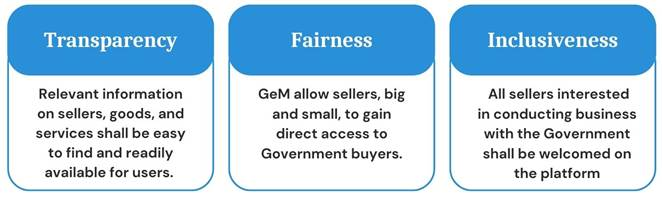
GeM: Transforming Public Procurement in India
- GeM’s user base has seen a threefold increase in recent years, with over 1.64 lakh primary buyers and 4.2 lakh active sellers now onboard.
- The platform offers more than 10,000 product categories and over 330 services.
- Over 10 lakh Micro and Small Enterprises (MSEs), 1.3 lakh artisans and weavers, 1.84 lakh women entrepreneurs, and 31,000 startups are now part of the GeM ecosystem.
- Expansion of Role: GeM’s role in advancing national priorities was underscored by key transactions, including ₹5,000 crore worth of equipment for the Akash Missile System and ₹5,085 crore in vaccine procurement.
- The platform is also enabling complex services such as drone-as-a-service for AIIMS, GIS and insurance for over 1.3 crore lives, and wet leasing of chartered flights and CT scanners.
- Nationwide Adoption: GeM has now been adopted across all 36 States and Union Territories, with Uttar Pradesh leading the way.
- Eight states—including Maharashtra, Manipur, Gujarat, Himachal Pradesh, Assam, Uttarakhand, and Chhattisgarh—have mandated GeM usage.
Significance
- Transparent and Efficient Procurement: GeM aims to reduce human intervention in government purchases, ensuring transparency, efficiency, and speed. It minimizes corruption and delays in procurement.
- Cost Savings: Competitive pricing has resulted in lower procurement costs for the government.
- Boost to MSMEs & Startups: Significant amount of the orders on GeM are from MSMEs, promoting small businesses.
- Digital Process: The entire process, from vendor registration to payment, is done online.
- Security and Audit Trails: Built-in mechanisms for data security, digital signatures, and audit trails to ensure accountability.
Challenges
- Limited Awareness and Adoption: Many government officials and potential vendors, especially in rural areas and among MSMEs, are unaware or lack training on how to use the platform effectively.
- There is a resistance to change from traditional procurement methods.
- Quality Control and Standardization: Ensuring consistent quality of products and services is difficult, especially when a large number of vendors are involved.
- Lack of standardized specifications for some products and services.
- Delays in Payments: Although the platform supports timely payments, in practice, delays by government departments in processing payments discourage sellers.
- Logistics and Delivery Challenges: Vendors often face logistical difficulties in delivering goods across vast geographies.
- Technical Issues and Platform Stability: Users sometimes face issues such as system crashes, slow interface, or bugs, especially during high-traffic periods.
- Regulatory and Policy Bottlenecks: Inconsistent application of procurement rules across departments leads to inefficiency.
Government Initiatives to Improve GeM
- SWAYATT (Startups, Women & Youth Advantage Through e-Transactions): The portal committed to enhance ease of doing business and establish direct market linkages to annual public procurement for startups, women entrepreneurs, Micro & Small Enterprises (MSEs), Self Help Groups (SHGs) and youth.
- Startup Runway 2.0: It is an opportunity for Startups to showcase their innovative products and services to Government buyers and engage in public procurement.
- GeM has created a dedicated marketplace category for all Startups to list their products and services, irrespective of their DPIIT-certification.
- Womaniya initiative: To showcase products made by women entrepreneurs and women self-help groups [WSHGs].
- GeM is collaborating with various stakeholders from the Micro, Small and Medium Enterprises [MSME] ecosystem with special focus on entrepreneurs from the Scheduled Caste/ Schedule Tribes [SC/ ST].
- The SARAS Collection: It is a pristine handcrafted collection of handicrafts, handloom textiles, office décor, furnishings, accessories, event souvenirs, personal hygiene and care products from top of the line SHGs in India.
Conclusion
- The platform’s strategic initiatives have significantly contributed to the ease of doing business and enhanced participation in government procurement.
- As GeM continues to evolve, it remains committed to its vision of creating a sustainable, open, and competitive marketplace, driving India’s progress towards inclusive and transparent public procurement practices.
The New Oil Conflict
Syllabus: GS3/ Economy
Context
- A new oil war is unfolding through production and pricing strategies rather than armed conflict, with far-reaching global economic implications.
Background
- Recently OPEC+ decided to increase crude oil output by 411,000 barrels per day (bpd) from June 2025.
- This marks the third consecutive month of production increase, reversing part of the 2.2 million bpd voluntary cuts taken in 2023.
- This move caused Brent crude prices to drop sharply, indicating a highly sensitive oil market.
Steps taken by Saudi Arabia
- Saudi Arabia significantly reduced its crude output in 2024, bringing it below 9 million bpd, its lowest since 2011, in an attempt to support falling oil prices.
- Due to non-compliance from members like Iraq, Kazakhstan, UAE, and Nigeria, it now seeks to counter overproducers by flooding the market, a strategy used in past oil wars.
Reason for policy reversal
- Post-COVID Demand Weakness: After COVID the recovery of the economy was “K-shaped” i.e. uneven and fragile and oil demand did not bounce back strongly.
- Rise of Non-OPEC+ Producers: Countries like Brazil and Guyana, along with U.S. shale oil producers, aggressively expanded production to capture market share, adding to the global supply glut.
Reasons for Decrease in Oil Prices
- Oversupplied Market: Even as demand stagnates, multiple producers are adding supply, creating downward pressure on prices.
- Peak Oil Demand Theory: The International Energy Agency (IEA) projects that global oil demand may plateau or even decline by the end of the decade, weakening long-term price prospects.
- Energy Transition: The global shift towards electric vehicles and renewable energy, especially in major markets like China and Europe, reduces reliance on fossil fuels.
Impact on India
- Short-term Gains: A $1 decrease in crude oil price translates into an annual saving of approximately $1.5 billion for India.
- Lower prices ease inflationary pressure and reduce the import bill, helping India’s current account balance.
- Long-term Risks: Prolonged low oil prices can harm the economies of Gulf countries, many of which are India’s key trade and investment partners.
- Over nine million Indian expatriates reside in the Gulf, and any economic slowdown could lead to job losses and reduce the $50 billion in annual remittances India receives.
- India’s own refined petroleum exports, among the top items in its export basket, may suffer due to falling global oil product prices.
- Investment from oil-rich sovereign wealth funds might slow down, affecting India’s infrastructure and energy projects.
| About OPEC – The Organization of the Petroleum Exporting Countries (OPEC) is an intergovernmental organisation established in 1960 at the Baghdad Conference by Saudi Arabia, Iran, Venezuela, Kuwait and Iraq. – Currently, it has 12 members, viz. Algeria, Congo, Equatorial Guinea, Gabon, Iran, Iraq, Kuwait, Libya, Nigeria, Saudi Arabia, the United Arab Emirates and Venezuela. – Objective: To coordinate policies with respect to petroleum demand and supply to ensure fair and stable prices and ensure a steady income to oil producing countries.It is headquartered in Vienna, Austria. OPEC+ – OPEC+ has 22 members, made up of 10 major oil producing countries (Russia, Kazakhstan, Azerbaijan, Brunei, Bahrain, Mexico, Oman, South Sudan, Sudan and Malaysia), along with the 12 OPEC members. – It was formed in 2016 after the adoption of the ‘Algiers Accord’ by OPEC countries in September 2016 and signing of the ‘Vienna Agreement’ in November 2016 between OPEC and other major oil exporting countries. |
MR Srinivasan: A Key Architect of India’s Nuclear Programme
Syllabus: GS3/Science & Technology
Context
- Recently, Dr. M.R. Srinivasan, renowned nuclear scientist and former Atomic Energy Commission (AEC) chairman passed away.
| About Dr. M.R. Srinivasan – Born: 5th January 1930 – Career and Contributions: 1. 1955: Joined the Department of Atomic Energy (DAE), working alongside Dr. Homi Bhabha on India’s first nuclear research reactor, Apsara. 2. 1959: Appointed as Principal Project Engineer for India’s first atomic power station. 3. 1967: Chief Project Engineer of the Madras Atomic Power Station 4. 1974: In-Charge of the Power Projects Engineering Division 5. 1984: Appointed as Chairman of the Nuclear Power Board 6. 1987: Appointed Chairman of the Atomic Energy Commission and Secretary of the Department of Atomic Energy (6.1) Founder-Chairman of the Nuclear Power Corporation of India Limited (NPCIL), under which 18 nuclear power units were developed. – Recognition and Legacy: 1. Member of the Planning Commission (1996-98); 2. Padma Shri (1984); Padma Bhushan (1990); Padma Vibhushan (2015) 3. National Security Advisory Board (2002-04, 2006-08). |
India’s Nuclear Programme
- It has been a cornerstone of its energy strategy, balancing self-reliance, technological advancement, and global cooperation, with the focus on clean energy and strategic security.
Historical Development
- The Atomic Energy Commission (AEC) was established in 1948 under Dr. Homi Bhabha. It was structured into a three-stage plan:
- Stage I: Utilization of Pressurized Heavy Water Reactors (PHWRs) using natural uranium.
- Stage II: Development of Fast Breeder Reactors (FBRs) to generate plutonium.
- Stage III: Deployment of Advanced Thorium Reactors, leveraging India’s vast thorium reserves.
- India holds 21% of the world’s thorium reserves, with indigenous projects like Bhavani aiming to harness this resource.
Current Status
- Installed Capacity: India operates 23 nuclear reactors across seven power plants, contributing to 8,180 MW (2024 data) of electricity (4,780 MW in 2014).
- It is projected to reach 22,480 MW by 2031-32.
Energy Mix and Role of Nuclear Power
- Renewable Shift: India is transitioning towards clean energy, with nuclear power playing a crucial role in reducing dependence on fossil fuels.
- Grid Distribution: The revised framework allocates 50% of nuclear-generated electricity to home states, 35% to neighboring states, and 15% to the national grid.
Recent Advancements
- Prototype Fast Breeder Reactor (PFBR): India has entered Stage II of its nuclear programme with the core-loading of the PFBR at Kalpakkam.
- Expansion Plans: 10 new reactors are approved and exploring private sector participation to accelerate growth, including Bharat Small Modular Reactors (BSMRs).
- International Collaborations: India has signed agreements with Russia, France, and the U.S. for nuclear technology exchange.
MISCELLANEOUS
Shirui Lily Festival
Syllabus: GS1/Culture
Context
- The Shirui Lily festival returns to Manipur after a two-year pause because of the long-drawn conflict in the state.
About the Festival
- Organised by Manipur Department of Tourism, first held in 2017.
- Named after the Shirui Lily (state flower of Manipur), the festival coincides with the flower’s blooming season (April to June).
- Held annually in Ukhrul district, home to the Tangkhul Naga community.
- This will promote eco-tourism, cultural heritage, and awareness about the endangered Shirui Lily.

Jarosite
Syllabus :GS 1/Geography
In News
- Jarosite has been found to potentially serve as a natural geological clock on Mars.
Jarosite
- It is a potassium-iron hydroxysulfate mineral commonly found in acidic environments, such as acid sulfate soils (ASS) and acid mine drainage environments.
- It is a yellow-brown mineral that contains potassium, iron, and sulphate.
- It plays an important role as a scavenger of trace and major elements in ASS, as well as in other natural and engineered systems.
Recent Research
- Researchers in India analyzed jarosite veins from Gujarat, whose environment resembles that of Mars.
- By studying the mineral’s luminescence — the light it emits due to stored radiation — they discovered that jarosite could survive heating from a rover’s drill without losing its ability to luminesce.
- Given Mars’ natural radiation rate, jarosite can record events from the past 25,000 years.
Importance
- As jarosite is common on Mars, durable, and easily analyzed with small heaters and LEDs, it could be used by future rovers to date dust storms, flood deposits, and volcanic ash.
K. Veeraswami vs Union of India Judgment
Syllabus: GS2/ Polity and Governance
Context
- The Vice-President of India, has stated that it is time to revisit the K Veeraswamy judgement of 1991.
Background
- The case arose when K. Veeraswami, a former Chief Justice of the Madras High Court, was charged under the Prevention of Corruption Act, 1947.
- Issue: Whether judges of the High Courts and Supreme Court can be investigated and prosecuted under anti-corruption laws, and if so, what safeguards must be observed to maintain judicial independence.
Supreme court ruling
- The Supreme Court held that judges of the higher judiciary are indeed ‘public servants’ under the Prevention of Corruption Act.
- Mandatory Prior Sanction: No FIR or investigation can be initiated against a sitting judge of the High Court or Supreme Court without the prior sanction of the CJI.
- If allegations are made against the Chief Justice of India, the mandatory consultation must be conducted with other senior judges of the Supreme Court.
India Awarded with Certificate of Elimination of Trachoma
Syllabus: GS2/Health
Context
- India has been awarded the Certificate of Elimination of Trachoma as a Public Health Problem by the World Health Organisation (WHO) at the 78th World Health Assembly in Geneva.
About
- Last year, the WHO declared that the Government of India had eliminated Trachoma as a public health problem.
- India also became the third country in the Southeast Asia region to reach this public health milestone.
- The government has taken various steps under the National Programme for Control of Blindness and Visual Impairment (NPCBVI) to eliminate Trachoma.
Trachoma
- Trachoma is a disease of the eye caused by infection with the bacterium Chlamydia trachomatis.
- It is a public health problem in 38 countries and is responsible for the blindness or visual impairment of about 1.9 million people.
- Blindness from trachoma is irreversible.
- Infection spreads through personal contact (via hands, clothes, bedding or hard surfaces) and by flies that have been in contact with discharge from the eyes or nose of an infected person.
- There isn’t a commercially available trachoma vaccine, research is ongoing to develop one.
