
Significance of Buddhist Teachings in Modern World
Syllabus: GS1/Culture
Context
- The reference to Buddhist philosophy—particularly the idea that the self is an illusion—is both potent and relevant in the modern world.
About
- The world is increasingly focused on self-promotion as a pathway to peace and progress.
- Social media, particularly selfie culture, reinforces a curated, often artificial sense of identity.
- This external validation fosters anxiety, fear of inadequacy, and a desire for more—leading to widespread emotional distress.
- The Buddha taught that the idea of a permanent “self” is a false construct and the root of suffering.
- Letting go of the self allows us to understand the interdependent causes that shape our existence.
Core Teachings of the Buddha
- The Four Noble Truths
- Dukkha: Life is suffering or unsatisfactory.
- Samudaya: Suffering is caused by craving and attachment (tanhā).
- Nirodha: The cessation of suffering is possible by letting go of craving.
- Magga: The path to the cessation of suffering is the Eightfold Path.
- The Noble Eightfold Path: Grouped into three categories: wisdom, ethical conduct, and mental discipline.
- The Three Marks of Existence
- Anicca (Impermanence): All things are in constant change.
- Dukkha (Suffering): Existence is filled with dissatisfaction.
- Anattā (Non-self): There is no permanent, unchanging self.
- The Goal: Nirvana (Nibbāna)
- A state beyond suffering and rebirth.
- Achieved through wisdom, ethical living, and mental discipline.
- Nirvana is the ultimate liberation and peace.
Buddhism’s Role in Shaping Modern India:
- Anti-caste foundation: Early Buddhism rejected the rigid Brahmanical caste system, promoting egalitarian values.
- Appeal to the marginalized: Attracted marginalized castes, women, and those outside Vedic traditions.
- Monastic communities (Sangha): Fostered social equality by allowing people of various backgrounds to live, learn, and teach together.
- Modern movements: Buddhism became a symbol of social justice, especially in Dalit movements led by B.R. Ambedkar in 20th-century India.
- Community integration: Buddhist practices like dana (generosity) and communal rituals promoted interdependence.
The Continuing Relevance of Buddhism
- Mindfulness and meditation, central to Buddhism, are widely used today to manage stress, anxiety, and depression.
- Practices like Vipassana and Zen meditation help individuals find clarity and calm in fast-paced lifestyles.
- Modern society often promotes consumerism, comparison, and self-promotion, especially through social media.
- Buddhism teaches non-attachment, humility, and selflessness, offering a path away from dissatisfaction and ego-driven living.
- The Buddhist emphasis on compassion (karuṇā) and loving-kindness (mettā) encourages empathy and ethical action.
- This is especially important in today’s world marked by inequality, conflict, and environmental crisis.
- The principle of interdependence reminds us that all life is connected.
- Buddhist teachings support non-violence (ahiṃsā) and respect for nature, promoting sustainable and mindful living.
- Buddhism has been a voice against caste discrimination and inequality (e.g., Ambedkarite Buddhism).
- It advocates a classless and casteless society, aligning with modern democratic and human rights values.
- Peaceful approach to coexistence: Its universal values—compassion, moderation, and wisdom—appeal across cultures and belief systems.
- The principle of moderation (the Middle Way) encourages balance between indulgence and austerity.
- This can be a guide for simplifying life, reducing distractions, and focusing on what truly matters.
- Buddhism is not bound by dogma or conversion, making it accessible to people from all religious, cultural, or secular backgrounds.
- Its flexible, inclusive philosophy makes it especially relevant in pluralistic societies.
Conclusion
- In an age obsessed with image and identity, the Buddha’s message—to let go of the self—is more relevant than ever.
- Buddhism offers not just spiritual insight but a framework for societal transformation.
- Rediscovering Buddhist thought could help address contemporary crises of ego, inequality, and disconnection.
Financial Fraud Risk Indicator (FRI)
Syllabus: GS2/Government Policy and Intervention; GS3/Cyber Security
Context
- Recently, the Department of Telecommunications (DoT) has launched the Financial Fraud Risk Indicator (FRI) as part of the Digital Intelligence Platform (DIP) to safeguard financial systems and telecom infrastructure.
About Financial Fraud Risk Indicator (FRI)
- FRI is a risk-based metric that classifies mobile numbers into three categories—Medium, High, or Very High risk—based on their likelihood of being involved in fraudulent activities.
- This classification is derived from multiple data sources, including the Indian Cybercrime Coordination Centre’s National Cybercrime Reporting Portal, the DoT’s Chakshu platform, and information shared by banks and financial institutions.
- When a mobile number is flagged, it undergoes a multi-dimensional analysis to assess its risk level. The FRI assessment is then shared with stakeholders in real-time.
- Major UPI platforms like PhonePe, Paytm, and Google Pay are now integrating FRI alerts.
Cyber Fraud in India
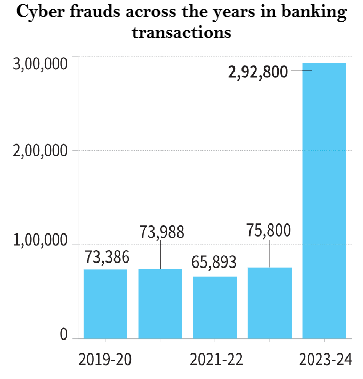
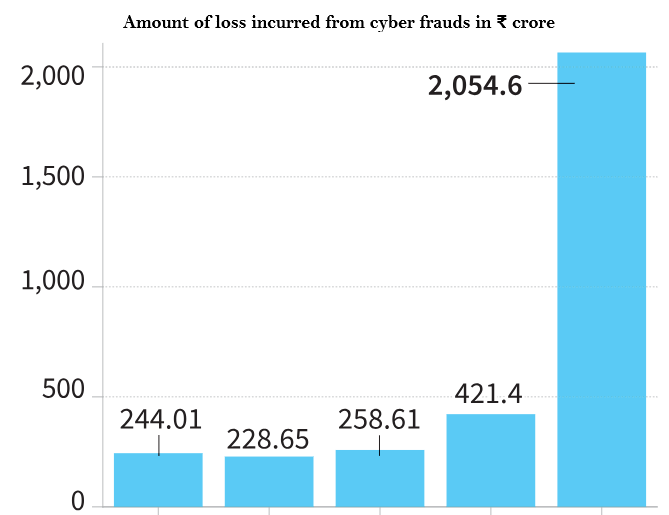
- It has become a growing concern in India, with financial scams, identity theft, and digital crimes increasing at an alarming rate.
- As digital transactions expand, so do the risks associated with cyber fraud.
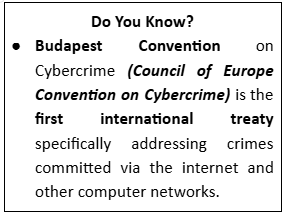
- It includes Hacking, Phishing, Identity Theft, Cyber Espionage, and Cyberbullying etc.
Data on Cyber Frauds in India
Government Initiatives Against Cyber Financial Fraud
- Key Legislative Measures: Cyber Crimes cases are handled under the provisions of the Information Technology Act, 2000, the Bhartiya Nyaya Sanhita, 2023 and Protection of Children from Sexual Offences Act, 2012 (POCSO Act).
- Chakshu Facility on the Sanchar Saathi Platform: It allows citizens to report suspicious calls and messages.
- e-Zero FIR Initiative under I4C of MHA: It allows victims to file FIRs online, eliminating jurisdictional barriers and expediting law enforcement responses.
- The Indian Cyber Crime Coordination Centre (I4C) has been established to tackle cybercrime, and the National Cyber Crime Reporting Portal allows citizens to report incidents online.
- RBI’s AI based tool ‘MuleHunter’: For identification of money mules and advised the banks and financial institutions for its uses.
- Citizen Financial Cyber Fraud Reporting and Management System: This system has helped recover over ₹1,200 crore from fraudulent transactions.
- Blocking Fraudulent SIM Cards: More than 3.2 lakh SIM cards and 49,000 IMEIs linked to cyber fraud have been blocked.
- Cyber Awareness Campaigns: The government promotes cybersecurity awareness through social media, radio campaigns, and educational programs.
Jal Jeevan Scheme: MPs Flag ‘Irregularities’
Syllabus: GS2/Governance
In News
- Several MPs have called for an investigation into alleged irregularities in the implementation of the Jal Jeevan Mission, particularly concerning inflated contracts and cost overruns.
The Jal Jeevan Mission (JJM)
- About: It is a centrally sponsored scheme that was launched by Prime Minister Narendra Modi on August 15, 2019, with the ambitious goal of providing tap water supply to every rural household.
- In the Union Budget 2025-26, Finance Minister Nirmala Sitharaman announced an increased allocation of ₹67,000 crore for the Jal Jeevan Mission, which is now extended until 2028.
- Objectives: It aims to provide Functional Household Tap Connections (FHTCs) to every rural household, with a focus on priority areas such as drought-prone regions, quality-affected zones, deserts, and Sansad Adarsh Gram Yojana (SAGY) villages.
- It also ensures tap water access in schools, Anganwadi centers, health facilities, and community buildings, while actively monitoring the functionality of these connections.
- Achievement: As of February 1, 2025, the Jal Jeevan Mission has provided tap water connections to 12.20 crore additional rural households, increasing total coverage to over 15.44 crore households—79.74% of India’s rural households.
- WHO estimates JJM will save 5.5 crore hours daily, mostly for women, and could prevent 400,000 diarrheal deaths and save 14 million Disability Adjusted Life Years (DALYs).
- Nobel laureate Prof. Michael Kremer’s research suggests that safe water coverage could reduce mortality among children under five by nearly 30%, potentially saving 136,000 lives annually.
- The Indian Institute of Management Bangalore, in partnership with the International Labour Organization (ILO), estimates that JJM will generate 59.9 lakh person-years of direct and 2.2 crore person-years of indirect employment during its capital expenditure phase.
Challenges
- The mission faces several challenges, such as a lack of dependable water sources in certain areas, groundwater contamination, uneven geographical terrain, scattered rural habitations, and delays in obtaining statutory clearances etc.
- Issues have been raised for long-standing water shortages and mismanagement.
- It faces scrutiny for possible financial mismanagement and lack of transparency.
Net FDI slumps 96% in FY25 to $353 mn
Syllabus: GS3/Economy
Context
- As per the RBI, the Net foreign direct investment (FDI) into India crashed by more than 96% to just $353 million in 2024-25 as compared to the previous year.
About
- The net FDI figure stood at $44 billion in 2020-21, it fell to $10.1 billion in 2023-24, and finally to just $353 million ($0.4 billion) in 2024-25.
- While gross FDI inflows are healthy and diversified, net FDI is falling due to:
- Higher repatriation by foreign companies (profit-taking, divestment).
- Increasing outward investment by Indian companies (global expansion).
- In 2024-25, Indian companies invested a total of $29.2 billion in other countries, 75% higher than the previous year.
- Gross Inflows: Gross FDI remained elevated in FY25, with 13.7% year-on-year (Y-o-Y) growth to clock $81 billion worth of flows.
- More than 60% of gross FDI inflows in FY25 were in manufacturing, financial services, electricity and other energy, and communication services sectors.
- Singapore, Mauritius, the UAE, the Netherlands, and the United States (US) accounted for more than 75% of the flows.
Net Foreign Direct Investment
- Net FDI is gross FDI, which is the total money coming in, minus the money being repatriated out by foreign companies doing business in India and the outward FDI by Indian companies.
- Net FDI = Gross FDI Inflows − (Repatriation by foreign firms + Outward FDI by Indian firms).
- Key Components:
- Gross FDI Inflows: Total new investments made by foreign entities into the country. It includes setting up factories, acquiring local companies, or expanding operations.
- Repatriation & Disinvestment: Profits or capital that foreign companies send back to their home countries. Includes sale of assets or shares in domestic firms.
- Outward FDI: Investments made by domestic companies in foreign countries (e.g., acquisitions, setting up subsidiaries).
Why Net FDI Matters?
- Positive Net FDI: Indicates more foreign investment is coming in than going out, often seen as a sign of economic attractiveness.
- Low or Negative Net FDI: May suggest capital is being withdrawn or domestic firms are investing more abroad than foreigners are investing locally.
- Not always negative but it may reflect economic maturity or global ambition.
International Day for Biodiversity 2025
Syllabus: GS3/ Environment
Context
- The International Day for Biological Diversity is celebrated every year on 22 May.
Background
- The IDB commemorates the adoption of the Convention on Biological Diversity (CBD) on 22 May 1992 during the Rio Earth Summit.
- The day creates awareness among the citizens and stakeholders on the importance and need for the conservation of biological diversity.
- The 2025 theme is “Harmony with Nature and Sustainable Development.”
Convention on Biological Diversity
- Origin: The Convention was opened for signature in 1992 at the United Nations Conference on Environment and Development (Rio Earth Summit).
- The Convention on Biological Diversity (CBD) entered into force on 29 December 1993.
- The first session of the COP was scheduled in 1994 in the Bahamas.
- Secretariat: Montreal, Canada.
- Ratification: The CBD has been ratified by 196 nations, making it one of the most widely adopted international treaties.
- The United States is the only UN member state that has not ratified the convention.
- It has 3 main objectives;
- The conservation of biological diversity
- The sustainable use of the components of biological diversity
- The fair and equitable sharing of the benefits arising out of the utilization of genetic resources.
- The governing body is the Conference of the Parties (COP), which meets every two years.
| Kunming-Montreal Global Biodiversity Framework – The Kunming-Montreal Global Biodiversity Framework was concluded at COP15 of the Convention on Biological Diversity (CBD), held in Montreal, Canada, in 2022. – This framework is a landmark agreement aimed at addressing the global biodiversity crisis. – It features 23 targets to be met by 2030 and four global goals for 2050 to preserve biodiversity for current and future generations. – The agreement is not binding on members. |
India’s Role and Biodiversity Profile
- India is one of the 17 mega-diverse countries in the world covering an area of 329 million hectares and is the ninth largest country.
- India is known for its rich biological diversity and accounts for more than 1,00,000 species of animals and 55,000 species of plants in ten bio-geographic regions.
India’s Conservation Efforts
- The National Biodiversity Action Plan (NBAP), launched in 2008 and updated in 2014, is India’s primary strategy to meet its obligations under the Convention on Biological Diversity (CBD).
- It’s a comprehensive plan for conserving biodiversity, promoting sustainable use of resources, and ensuring equitable access to genetic resources.
- Biological Diversity Act, 2002: It established the National Biodiversity Authority (NBA) at the central level, State Biodiversity Boards (SBBs) at the state level, and Biodiversity Management Committees (BMCs) at the local level.
- Regulates access to biological resources and associated traditional knowledge, particularly for commercial or research purposes.
- People’s Biodiversity Registers (PBRs) are community-maintained records of local biological resources, traditional ecological knowledge, and conservation practices.
- As of 2025, India has designated 89 Ramsar sites, covering over 1.35 million hectares. Additionally, 49 Biodiversity Heritage Sites (BHS) have been notified under Section 37 of the Biological Diversity Act, 2002.
Concluding remarks
- The International Day for Biological Diversity is a reminder of the intricate link between nature and human survival.
- As biodiversity continues to decline, urgent collective action is essential to foster harmony with nature and meet the sustainable development targets.
- India’s rich biodiversity and traditional wisdom place it in a unique position to lead by example in global conservation efforts.
Gallantry Awards
Syllabus :GS3/Defence
In News
- President Droupadi Murmu conferred Kirti Chakras and Shaurya Chakras to the personnel of the Armed Forces, Central Armed Police Forces and State/Union Territory Police during Phase-I of the Defence Investiture Ceremony at Rashtrapati Bhawan.
Gallantry awards
- The Ministry of Defence invites recommendations twice in a year from the Armed Forces and Union Ministry of Home Affairs for gallantry awards.
- They were given to the personnel for displaying raw courage, unparalleled bravery and total disregard to personal safety in the line of duty.
- The awardees showed exceptional courage during various operations, including counter-terrorism and counter-insurgency operations in J&K and the North-East, anti-piracy operations, and fire-fighting operations.
Param Vir Chakra
- It was instituted on January 26, 1950 and is India’s highest military decoration awarded for the highest degree of valour or self-sacrifice in the presence of the enemy, whether on land, at sea, or in the air.
- Eligible recipients include all ranks of the Army, Navy, Air Force, Reserve Forces, Nursing Services, and civilians serving under the armed forces.
- The award can be given posthumously.
- Recipients receive a monetary allowance of Rs. 3,000, with the same amount for each additional bar awarded for further acts of bravery.
Mahavir Chakra
- It was instituted on January 26, 1950 and is the second highest military decoration in India and is awarded for acts of conspicuous gallantry in the presence of the enemy, whether on land, at sea or in the air.
- Literally Maha Veer means extraordinarily brave
- Eligible recipients include all ranks of the armed forces, nursing staff, and civilians serving under military orders.
- The award can be given posthumously.
- Recipients receive a monthly monetary allowance of Rs. 2,400, with the same amount for each additional bar awarded for further acts of bravery.
Vir Chakra
- It was established on January 26, 1950 (effective from August 15, 1947), is the third-highest wartime gallantry award comes after the Param Vir Chakra and Maha Vir Chakra.
- It is given for acts of bravery in the presence of the enemy on land, sea, or air. It can be awarded posthumously.
- Eligible recipients include all ranks of the armed forces and reserve units.
- The award carries a monthly allowance of Rs. 1,700, with the same amount for each additional bar.
Ashoka Chakra
- It was instituted in 1952 and renamed in 1967 and It is awarded for valor, courageous action or self-sacrifice away from the battlefield.
- It is the peace time equivalent of the Param Vir Chakra, and is awarded for the “most conspicuous bravery or some daring or pre-eminent valour or self-sacrifice” other than in the face of the enemy.
- Eligible recipients include armed forces personnel, nursing staff, civilians, police, and paramilitary forces.
- The award can be given posthumously.
- Recipients receive a monthly allowance of Rs. 2,800, with the same amount for each additional bar awarded for further acts of bravery.
Kirti Chakra
- It was instituted in 1952 as Ashoka Chakra Class-II and renamed in 1967.
- It is awarded for valour, courageous action or selfsacrifice away from the field of battle.
- It may be awarded to civilians as well as military personnel, including posthumous awards.
- It is the peacetime equivalent of the Maha Vir Chakra. It is second in order of precedence of peacetime gallantry awards.
- Recipients receive a monthly allowance of Rs. 2,100, with the same amount for each additional bar awarded.
Shaurya Chakra
- It is a gallantry award presented for acts of valor not involving direct combat with the enemy, making it the peacetime equivalent of the Vir Chakra.
- It was initially established as the Ashoka Chakra, Class III on 4 January 1952, effective from 15 August 1947, and renamed on 27 January 1967.
- The award can be given posthumously and is open to personnel from all branches of the Armed Forces, including the Reserves, Territorial Army, and other legally constituted forces.
- Recipients receive a monthly stipend of Rs. 1500, with an additional Rs. 1500 per bar awarded.
MISCELLANEOUS
Nalanda University
Syllabus: GS1/ History and Culture
Context
- Eminent economist Sachin Chaturvedi, took charge as the Vice-Chancellor of Nalanda University in Bihar.
About
- The Parliament of India established the Nalanda University through the Nalanda University Act, 2010.
- It started functioning in 2014 from a makeshift location with 14 students, and construction work started in 2017.
- The new campus of Nalanda University is close to the site of the ancient ruins of Nalanda in Rajgir, Bihar.
Ancient Nalanda University
- The ancient Nalanda University was established in the 5th century by the Gupta ruler Kumaragupta I.
- It includes stupas, shrines, viharas (residential and educational buildings) and important art works in stucco, stone and metal.
- It was patronized by various rulers including King Harshavardhana of Kannauj (7th century CE) and the Pala rulers (8th – 12th century CE).
- It flourished for 800 years before it was burnt down by Bakhtiar Khilji in the 12th century.
- The site after its decline was first discovered by Sir Francis Buchanan and was systematically excavated and consolidated by the Archaeological Survey of India.
Significance
- Chinese scholar Xuanzang (Hsüan-tsang) visited Nalanda in 637 and 642 CE, and studied under the guidance of Shilabhadra.
- It attracted students from all over the world and stands out as the most ancient university of the Indian Subcontinent.
- In 2016 it was inscribed as a World Heritage Site by UNESCO.
Amrit Bharat Station Scheme
Syllabus: GS2/Governance
Context
- Prime Minister Narendra Modi inaugurated 103 redeveloped railway stations under the Amrit Bharat Station Scheme.
About
- The 103 stations are spread across 86 districts in 18 states and union territories and were developed at a cost of over Rs 1,100 crore.

Amrit Bharat Station Scheme
- The scheme can be traced back to 2021, when Gandhinagar became the first Railway station to undergo modernization.
- A total of 1,300 stations have been identified for redevelopment under the scheme.
- Out of these, 157 are in Uttar Pradesh, followed by 132 in Maharashtra and 101 in West Bengal.
- The goal of the scheme is to make stations cleaner, more comfortable, and easier to use.
- Local products will be sold at kiosks under the ‘One Station One Product’ scheme, and efforts will be made to make stations look greener and more attractive.
| One Station One Product – ‘One Station One Product’ concept aims to encourage indigenous and specialised products and crafts of India through providing display and sale outlets on railway stations across the country. – The products would be specific to the location, including artefacts made by indigenous tribes, handlooms by local weavers and products indigenously grown in the area. |
Cauvery Water Management Authority (CWMA)
Syllabus: GS2/Polity and Governance
Context
- The Cauvery Water Management Authority (CWMA) reviewed the storage position of all the reservoirs in the Cauvery river basin.
About
- The Cauvery Water Management Authority (CWMA) was constituted in 2018, under Section 6A of the Inter-State River Water Disputes Act, 1956, following the Supreme Court judgment on the Cauvery Water Dispute 2018.
- Purpose: The distribution of Cauvery waters among the states of Karnataka, Tamil Nadu, Kerala, and the Union Territory of Puducherry.
- Parent Ministry: Ministry of Jal Shakti.
- Functions of CWMA include:
- Ensuring implementation of the Tribunal’s and Supreme Court’s award.
- Monitoring storage, release, and inflow data of major reservoirs on the Cauvery.
- Supervising reservoir operations and regulating water releases as per schedules.
- Adjudicating or managing disputes related to water releases among the basin states.
