
Rising North East Investors Summit 2025
Syllabus: GS2/Governance/GS3/Infrastructure
Context
- The Prime Minister inaugurated the Rising North East Investors Summit 2025.
Summit Overview
- Objective: Position the North East Region (NER) as a land of opportunities for both domestic and global investors.
- Key Focus Sectors: Tourism & Hospitality, Agro-Food Processing, Textiles, Handloom & Handicrafts, Healthcare, Education & Skills, IT & ITES, Infrastructure & Logistics, Energy, Entertainment & Sports.
- Vision for North East: Emphasized the region’s crucial role in achieving a Developed India.
- Highlighted that the North East is transitioning from a frontier to a front-runner of growth.
- “EAST” Acronym: Empower, Act, Strengthen and Transform.
- Sectoral Opportunities: Urged investors to explore opportunities in Energy, Semiconductors, Eco-tourism, Bamboo and bio-economy.
- Tea, petroleum, sports, and skill development.
- Tourism Potential: The region is a complete tourism package, suitable for global conferences, destination weddings, and concerts.
- Infrastructure Development: Investment of thousands of crores in connectivity and infrastructure.
- Notable projects:
- Sela Tunnel (Arunachal Pradesh).
- Bhupen Hazarika Bridge (Assam).
- 11,000 km of new highways.
- Expansion of railways and airports.
- Waterways on Brahmaputra and Barak rivers.
- 1,600 km Northeast Gas Grid.
- Installation of hundreds of mobile towers.
North Eastern Region (NER)
- The NER comprises eight States viz. Arunachal Pradesh, Assam, Manipur, Meghalaya, Mizoram, Nagaland, Sikkim and Tripura.
- This region is culturally and ethnically diverse having more than 200 ethnic groups which have distinct languages, dialects and socio-cultural identities.
- The Region covers 7.97% of the country’s geographical area and 3.78% of its population.
- It has 5,484 km of international border viz. Bangladesh (1,880 km), Myanmar (1,643 km), China (1,346 km), Bhutan (516 km) and Nepal (99 km).
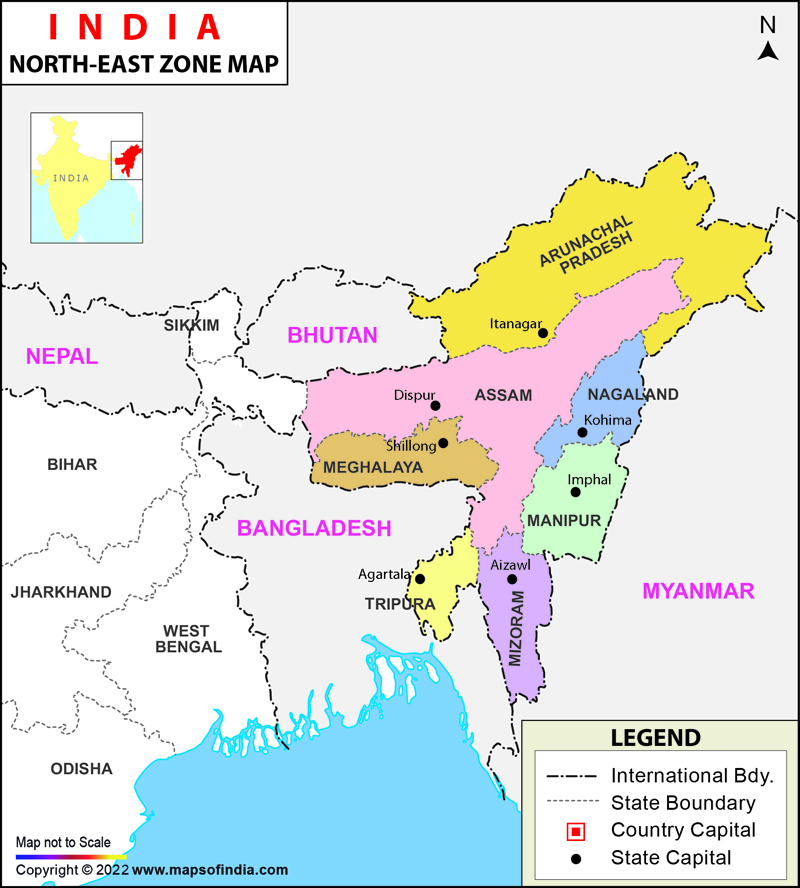
Significance of the North East Region
- Geostrategic Significance:
- International Borders: The NER shares borders with five countries—China, Bhutan, Myanmar, Bangladesh, and Nepal which make it strategically important.
- Gateway to ASEAN: It is a critical link in India’s Act East Policy, serving as a bridge to Southeast Asia.
- Current India–ASEAN trade: ~$125 billion, projected to exceed $200 billion.
- Strategic Military Importance: Due to proximity to China, the region holds significant defense value for national security.
- Economic and Trade Potential:
- Cross-Border Trade: Projects like the Kaladan Multimodal Transit and India-Myanmar-Thailand Trilateral Highway boost trade with Southeast Asia.
- Untapped markets and natural resources make it ideal for early investors in sectors like energy, agriculture, tourism, and logistics.
- Health, Wellness & Tourism: Offers clean air, organic food, serene landscapes, and rich tribal cultures.
- Ideal for wellness tourism, eco-tourism, and adventure tourism.
- Rich cultural diversity (dance, music, festivals) promotes cultural diplomacy and soft power.
Challenges Faced by the Region
- Poor connectivity: Difficult terrain and underdeveloped road, rail, and air networks.
- Limited digital infrastructure: Though improving, internet and telecom connectivity are weaker compared to other parts of India.
- Insurgency and Internal Security Issues: Presence of militant groups and separatist movements in some areas.
- Cross-border infiltration and arms smuggling due to porous borders with Myanmar and Bangladesh.
- Although security has improved, periodic unrest still affects peace and progress.
- Geographic and Environmental Constraints: Hilly and forested terrain makes development of infrastructure and industries difficult and costly.
- Ethnic Tensions and Migration Issues : Inter-community tensions and demands for autonomy or separate states lead to uncertainty in the region.
- Illegal immigration from neighboring countries has altered demographics in some areas, creating social unrest.
Way Ahead
- Historically neglected, the northeast has gained prominence in recent decades.
- Its strategic value has increased due to India’s ‘Act East’ Policy and evolving Indo-Pacific geopolitical dynamics.
- The region is now seen as a vital gateway for India’s regional connectivity initiatives.
- Ongoing connectivity efforts require capacity-building for rail and road projects and improved border infrastructure.
- The overarching goal is to maximise the multi-dimensional potential of the northeast and cement its role as a regional connectivity hub.
Revised Economic Capital Framework of the Reserve Bank of India
Syllabus: GS3/Economy
Context
- The Board of Directors of Reserve Bank of India (RBI) has approved a record transfer of over 2.68 lakh crore rupees as surplus to the Central government for the financial year 2024-25.
About
- The surplus was calculated under the revised Economic Capital Framework, which now mandates maintaining the Contingent Risk Buffer (CRB) between 5.50 per cent and 7.50 per cent of the central bank’s balance sheet.
- For 2024-25, the CRB has been increased to 7.50 per cent.
- A higher risk buffer would mean a lower amount of transferable surplus and vice versa.
- This marks the highest-ever dividend transfer by the RBI, aimed at bolstering government finances amid ongoing economic challenges.
Economic Capital Framework
- The Economic Capital Framework (ECF) guides how the RBI manages its capital reserves and determines the surplus it can transfer to the Government of India.
- It was originally formulated based on recommendations from the Bimal Jalan Committee (2019) and adopted in RBI’s 578th meeting in 2019.
- The Bimal Jalan Committee had recommended a 5-year periodic review of the ECF.
- The 2025 review is the first such exercise since the framework’s adoption.
Key Features of the Revised ECF
- Continuity in Core Principles: The broad principles and risk assessment methodologies of the existing ECF were retained.
- The ECF continues to balance financial resilience with optimal surplus transfer to the government.
- Flexibility in Risk Buffer Maintenance: The revised framework allows the RBI Central Board greater flexibility to adjust risk buffers year-on-year.
- This allows adaptation to prevailing macroeconomic risks, such as inflation, global instability, or exchange rate volatility.
- Inter-Temporal Smoothening of Surplus Transfer: The framework enables smoother and more predictable surplus transfers to the Government over time.
- This avoids abrupt increases or cuts in transfer, aiding better fiscal planning for the government.
Why ECF Matters?
- Ensures the RBI retains adequate capital to maintain its monetary and financial stability mandate.
- Supports fiscal planning by providing the Government with a predictable flow of surplus.
- Protects the RBI from potential external shocks or changes in asset risks, while contributing to public finance health.
| How RBI Earns Profit and Decides Dividend? – Though RBI’s primary role is not to earn profit, but to maintain economic stability. – Its main functions include: Ensuring price stability (controlling inflation), Managing currency issuance, Handling foreign exchange reserves, Regulating the banking system & managing government debt. – Despite these roles, profit can emerge as a byproduct of RBI’s operations. – RBI earns through: 1. Interest on government bonds it holds. 2. Lending to banks (like repo operations). 3. Foreign exchange operations (buying/selling dollars). 4. Seigniorage – Profit from printing currency (since printing cost < face value). 5. Market operations – It buys/sells assets to control liquidity and earns interest or capital gains. |
Theatre Commands: A New Era of Military Reforms in India
Syllabus: GS3/Defence & Security
Context
- Recently, the Chief of Defence Staff (CDS) emphasized the creation of Integrated Theatre Commands (ITC) marking a transformational shift in India’s military structure.
About the Integrated Theatre Commands (ITC)
- These are a modern military strategy adopted by several nations to enhance joint operations and resource optimization across their armed forces.
- The concept involves unifying the Army, Navy, and Air Force under a single command structure to improve efficiency, coordination, and rapid response to security threats.
- India’s ITC aims to strengthen India’s defense preparedness, particularly in border regions with China and Pakistan, and enhance maritime security in the Indo-Pacific.
- In 2016, Shekatkar Committee suggested 3 Theatre Commands (North, West, South). In 2024, Mumbai hosts India’s first tri-service logistics base.
Current Structure of Indian Armed Forces
- India currently operates through 17 single-service commands:
- Army: 7 (Northern, Eastern, Southern, Western, Central, South-Western, ARTRAC)
- Air Force: 7 (Western, Eastern, Southern, South-Western, Central, Maintenance, Training)
- Navy: 3 (Western, Eastern, Southern)
- Each command is headed by a 4-star officer of the respective service, leading to duplication of resources, coordination delays, and operational fragmentation.
- The ITC framework is designed to replace India’s 17 single-service commands with a smaller number of integrated commands, ensuring unified control over military operations.
Existing Existing Tri-Service Commands
- Strategic Forces Command (SFC): Overseeing India’s nuclear deterrent.
- Andaman and Nicobar Command (ANC): Oversees Bay of Bengal & Southeast Asia
Proposed Theatre Commands
- Northern Theatre (Lucknow): China border: Ladakh, Sikkim, Arunachal
- Western Theatre (Jaipur): Pakistan front: J&K, Punjab, Rajasthan
- Maritime Theatre (Thiruvananthapuram): Indian Ocean Region, Andaman Sea
Why Does India Need Theatre Commands?
- Combat Efficiency: Single commander = faster, coordinated battlefield decisions
- Resource Optimisation: No duplication of logistics, infrastructure, or personnel
- Interoperability: Seamless communication and operation across services
- Readiness for Modern Warfare: Integrates space, cyber, electronic, and special forces
- Post-Kargil Realisation: Kargil Review Committee flagged lack of coordination as a key weakness
Key Issues & Concerns
- Inter-Service Coordination Challenges: The Army and Navy need to align their operational doctrines with Indian Air Force (IAF) to ensure seamless integration.
- Structural & Command Hierarchy Issues: The proposed four-star theatre commanders may create hierarchical conflicts with existing service chiefs.
- The transition from single-service commands to joint commands requires extensive restructuring.
- Resource Allocation & Logistics: Limited air assets could be stretched thin across multiple theatre commands, reducing operational effectiveness.
- Infrastructure development for new command headquarters is still in progress.
- Geopolitical & Strategic Concerns: The China-centric Northern Theatre Command must effectively counter PLA’s Western Theatre Command, operational since 2016.
- The Western Theatre Command must address Pakistan-related security challenges, including cross-border terrorism.
- Policy & Implementation Delays: The government approval process has slowed down implementation, with final decisions still pending.
- The Standing Committee on Defence has emphasized the need for further deliberations before rollout.
Countries with Established Theatre Commands
- United States: It operates under Unified Combatant Commands, dividing global operations into geographical and functional commands.
- Examples: INDOPACOM (Indo-Pacific Command), CENTCOM (Central Command), and EUCOM (European Command).
- Each command integrates Army, Navy, Air Force, Marine Corps, and Space Force assets for strategic operations.
- Examples: INDOPACOM (Indo-Pacific Command), CENTCOM (Central Command), and EUCOM (European Command).
- China: It reorganized its military into five theatre commands in 2016, including Western (focused on India border security), Eastern (Taiwan and Pacific operations), Southern (South China Sea), Northern (Russia and Korea), and Central (domestic security).
- Russia: It integrates land, air, and naval forces under these commands for strategic defense. It operates four military districts, functioning as theatre commands, as Western, Southern, Central and Eastern Military District.
- United Kingdom & France: They have joint operational commands for overseas deployments.
- The UK’s Joint Forces Command oversees cyber, intelligence, and logistics.
- France’s Commandement des Opérations Spéciales integrates special forces across services.
Conclusion
- The creation of Integrated Theatre Commands is not just a structural change—it is a paradigm shift in India’s military doctrine.
- By fostering jointness, efficiency, and strategic clarity, this reform will modernize India’s defense forces, ensuring they remain ready, relevant, and resurgent in the face of evolving global threats.
India & Russia Eye Collaboration on Nuclear Energy and Advanced Technologies
Syllabus: GS2/ International Relations
Context
- India and Russia are enhancing strategic cooperation in nuclear energy, cyber defence, and advanced technologies amid shifting global geopolitics and domestic policy changes.
Developments in Indo-Russian Cooperation
- Nuclear Energy Expansion: India is amending its Nuclear liability laws to encourage greater foreign investment and collaboration.
- Russian state-owned nuclear firm Rosatom, builder of the Kudankulam Nuclear Power Plant (NPP), signed an MoU with Maharashtra for thorium-based Small Modular Reactors (SMRs).
| What are Small Modular Reactors (SMRs)? – Small modular reactors (SMRs) are advanced nuclear reactors with a power capacity of up to 300 MW(e) per unit, roughly one-third the generating capacity of traditional nuclear power plants. 1. Small – physically a fraction of the size of a conventional nuclear power reactor. 2. Modular – making it possible for systems and components to be factory-assembled and transported as a unit to a location for installation. 3. Reactors – harnessing nuclear fission to generate heat to produce energy. – There are four four main types of SMR i.e., light water, high temperature gas, liquid metal, and molten salt. |
- Cybersecurity and Digital Infrastructure: India and Russia are exploring co-development of cyber defence mechanisms, sector-specific firewalls, and cybersecurity products for the global market.
- Russia-based foundation Cyberus has identified India’s growth in fintech, e-governance, and smart cities as a strong case for deeper cyber cooperation.
- Science and Technology Cooperation: Innopraktika, a Moscow-based NGO, plans to set up an Indo-Russian Technology Association and Engineering Centre with bases in both countries.
- Agreements have been signed between University of Delhi and Russia’s Higher School of Economics to create a “mirror laboratory” for research in data storage, processing, and space systems.
- Other Key Areas Identified for Collaboration: Semiconductors, Artificial Intelligence, Space Technology, Critical Minerals and BrahMos-like co-development models for knowledge-based innovation and joint product development.
Strategic Significance
- Energy Security: SMRs offer a safer, more flexible, and scalable nuclear option, crucial for India’s low-carbon energy transition.
- Technological Sovereignty: Joint ventures in AI, semiconductors, and cyber defence will reduce dependency on Western technologies.
- Geopolitical Realignment: Strengthening ties with Russia offers India a hedge amid evolving tensions in Asia and disruptions in the multilateral order.
- Economic Diversification: In November 2024, a Russian Business Center was inaugurated in New Delhi to boost trade and high-tech cooperation between India and Russia.
Concluding remarks
- India-Russia collaboration is deepening beyond traditional defence ties into futuristic domains like nuclear SMRs, cyber defence, and digital innovation.
- With timely policy reforms and structured engagement, this partnership can not only enhance strategic autonomy for both nations but also contribute to shaping a multipolar technological order.
Virtual Capacity Building Session on Digital Transformation in BRICS
Syllabus :GS 2/IR
In News
- India hosted a Virtual Capacity Building Session on Digital Transformation in BRICS.
Digital Transformation in BRICS
- BRICS countries have significantly advanced their digital economies by adopting new technologies, fostering digital services, and enacting supportive policies.
- They now account for 40% of global internet users and contribute substantially to global ICT goods (30%) and digitally deliverable services (11%).
- The expansion of BRICS has increased its global share of exports and internet users.
- The group now represents 45.2% of the world’s population, 36.7% of global GDP, and 23.3% of global merchandise trade.
- As a result, digital cooperation has become a key part of the BRICS agenda.
- The group now represents 45.2% of the world’s population, 36.7% of global GDP, and 23.3% of global merchandise trade.
India’s Role
- India showcased its flagship Sanchar Saathi initiative aimed at protecting mobile users from fraud, enhancing transparency, and ensuring equitable access to mobile services.
- India and Brazil led presentations on their national approaches to cyber resilience.
- India presented AADHAAR as a foundational Digital Public Infrastructure (DPI) that has revolutionized public service delivery through identity-based digital inclusion.
- China also shared insights on its digital infrastructure journey.
- India introduced its ambitious Sangam Digital Twin initiative, aimed at using AI-native, federated platforms to enable scenario-based infrastructure planning and real-time governance solutions.
- China also shared its experiences with Digital Twin technology.
Importance
- BRICS has made the integrated implementation of the 2030 Agenda for Sustainable Development a key priority, focusing on its economic, social, and environmental dimensions.
- Digital technologies are seen as essential tools to promote inclusive growth and achieve the SDGs.
- BRICS recognises the role of the internet and ICTs in advancing e-governance, financial inclusion, service delivery, and global partnerships.
- Technologies such as AI and big data are especially valued for their development potential.
- Agritech and digital agriculture are key focus areas.
- It acknowledges digital solutions’ role in boosting agricultural productivity and farmer incomes.
Challenges
- BRICS recognises the challenges of rapid digitalisation, including the digital divide, cybersecurity threats, privacy concerns, and the misuse of technologies.
- Rotating leadership and differing priorities
- Overcoming to internal disagreements
| Know About BRICS – BRICS is an acronym for five major emerging economies — Brazil, Russia, India, China, and South Africa — that came together to promote multilateralism, & inclusive global governance. – The grouping originally began as BRIC, coined by the economist Jim O’Neill in 2001, and was formalised through the first BRIC summit in 2009 at Yekaterinburg, Russia. – Brazil, Russia, India, China (these are founding members); South Africa joined in 2010; Iran, UAE, Egypt, Ethiopia, Saudi Arabia joined in 2024. Argentina was initially expected to join in 2024 but later opted out. – BRICS represents over 41% of the world’s population, about 32% of global GDP (PPP), and nearly 18% of global trade. – A major institutional achievement of BRICS is the establishment of the New Development Bank (NDB) in 2015, headquartered in Shanghai. The NDB aims to finance infrastructure and sustainable development projects in BRICS and other developing countries. |
Needs for Stable Urban Forests in India
Syllabus: GS3/ Environment
Context
- One of Hyderabad’s last remaining urban forests, Kancha Gachibowli, faced the threat of extinction when the Telangana government decided to give away 400 acres of its land for industrial development.
Importance of Urban Forests
- Climate Change Mitigation: Urban trees absorb CO₂ and sequester carbon, reducing urban greenhouse gas emissions.
- Pollution Control: A hectare of trees can remove nearly one ton of pollutants annually, helping mitigate harmful PM 2.5 and PM 10 levels.
- Temperature Regulation: Urban forests reduce the Urban Heat Island effect, promoting cooler and livable cities.
- Stormwater Management: They help control flooding and erosion, ensuring better water infiltration and urban resilience.
- Biodiversity Conservation: Serve as urban wildlife refuges, supporting endangered birds and animal species.
- Social Well-being: Offer spaces for recreation, relaxation, and cultural activities, counterbalancing the high-speed urban lifestyle.
Judicial Interventions to protect Urban forests
- T.N. Godavarman v. Union of India Case (1996): In this case, the Supreme Court interpreted Section 2 of the Forest (Conservation) Act, 1980. The court ruled that ‘forest land’ includes;
- Areas considered as ‘forest’ in the dictionary sense.
- Any area recorded as forest in government records, irrespective of ownership.
- Samatha v. State of Andhra Pradesh (1997): The Supreme Court held that government-owned forest land in Scheduled Areas cannot be leased to non-tribals or private companies for mining.
Government Initiatives
- Nagar Van Yojana: The scheme was launched in 2020 by the Ministry of Environment, Forest and Climate Change and aims to create 1000 Urban Forests by 2027.
- According to the India State of Forest Report 2023, the scheme added 1445.81 sq. km of tree/forest cover.
- National Forest Policy (1988) and National Mission for Green India (2014) aim to expand forest cover through afforestation.
- Smart Cities Mission and AMRUT (Atal Mission for Rejuvenation and Urban Transformation) promote integrated ecological design in urban spaces.
| Miyawaki method – It is a reforestation technique developed by Japanese botanist Akira Miyawaki, designed to create dense, biodiverse forests in urban areas by planting native species densely together. – It accelerates forest growth and biodiversity compared to traditional methods, requiring minimal maintenance after the initial three years. |
Way Ahead
- Enforce Green Norms in Urban Planning: Integrate urban forestry into city master plans and zoning regulations.
- Expand Legal Protection: Strengthen forest protection laws and penal provisions for illegal deforestation.
- Citizen Participation: Encourage community-led forest protection movements and awareness campaigns.
- Data-Driven Governance: Maintain accurate digital inventories and satellite-based monitoring of urban forests.
- Public-Private Partnerships (PPPs): Involve corporations in urban afforestation as part of Corporate Social Responsibilities (CSR) activities.
Concluding remarks
- Urban forests like Aarey (Mumbai), Turahalli (Bengaluru), Ridge (Delhi), and Dol Ka Baadh (Jaipur) are crucial for ecological and public health.
- The judicial, policy, and civic actions must align to prevent the extinction of green spaces amidst expanding grey infrastructure.
- Only a collective commitment can ensure that India’s cities remain breathable, biodiverse, and livable for future generations.
Agamas
Syllabus: GS1/ Culture
Context
- The Supreme Court has allowed the Tamil Nadu government to appoint ‘archakas’ (priests) to the state’s temples not governed by Agama tradition.
Background
- Tamil Nadu has witnessed debates over caste-based priesthood, temple autonomy, and ritual conformity.
- Identifying Agamic temples ensures that appointments (archakars/maniyams) follow traditional procedures and constitutional norms.
What are Agamas?
- Agamas are a collection of scriptures that lay down rituals, temple architecture, idol worship methods, and daily worship procedures in temples.
- They are distinct from the Vedas and form the scriptural foundation of temple-based Hinduism, particularly in South India.
- Agamas are central to the Shaiva, Vaishnava, and Shakta traditions.
- Shaiva Agamas: Focused on the worship of Lord Shiva; widely followed in Tamil Shaiva temples.
- Vaishnava Agamas (Pancharatra and Vaikhanasa): These deal with the worship of Lord Vishnu and are prevalent in many major South Indian Vaishnava temples like Tirupati.
- Shakta Agamas (Tantras): Worship of Goddess Shakti.
Financial Action Task Force (FATF)
Syllabus: GS2/International Bodies
Context
- India will submit a dossier to the Financial Action Task Force (FATF) which will make a case for putting Pakistan back in the “grey list”.
About
- India will specifically point to the non-compliance of certain provisions that Pakistan had promised to adhere to when it was taken off the FATF grey list in 2022.
- Pakistan had been in the grey list for four years, between 2018 and 2022.
Financial Action Task Force (FATF)
- The FATF is the global money-laundering and terror financing watchdog.
- It is an inter-governmental organisation with 40 members, India became a member in 2010.
- The body researches how money is laundered and terrorism is funded, promotes global standards to mitigate the risks, and assesses whether countries are taking effective action.
What FATF’s grey/black lists entail?
- The FATF identifies jurisdictions with weak measures to combat money laundering and terrorist financing (AML/CFT regimes) in two public documents that are issued three times a year — in February, June and October.
- The grey list, officially “Jurisdictions under Increased Monitoring”, comprises countries that have significant deficiencies in their AML/CFT regimes but are actively working with the FATF to address these within agreed timeframes.
- Countries in the grey list are subject to increased monitoring by the FATF. Currently, there are 25 countries in this list (as of feb 2025).
- It carries adverse economic and reputational impacts, which affect the inflow of foreign investment and international aid.
- Pakistan being on the grey list from 2018 to 2022 had helped curtail illicit fund flows into India.
- The black list, officially “High-Risk Jurisdictions subject to a Call for Action”, comprises countries with “serious strategic deficiencies” in their AML/CFT regimes.
- The FATF urges all other jurisdictions to apply enhanced due diligence while dealing with such countries and also apply counter-measures to protect the international financial system from the risks emanating from the country.
- Three countries are in the black list at the moment — North Korea, Myanmar, and Iran.
