
Overfishing: A Threat to Ocean Wealth and Livelihoods
Syllabus: GS3/Agriculture; Ecology
Context
- India’s marine fisheries sector has reached its maximum potential yield, however it needs to take decisive steps to ensure sustainable fishing practices, balancing economic growth with marine conservation.
India’s Fisheries Sector
- India is the second largest fish producing country with around 8% share in global fish production.
- It has vast and diverse inland fisheries resources, including 0.28 million km of rivers and canals, 1.2 million ha of floodplain lakes, 2.45 million ha of ponds and tanks, and 3.15 million ha of reservoirs.
- India’s marine fisheries potential is estimated at 5.31 million tons, with activities spread across the country’s vast coastline and Exclusive Economic Zone (EEZ).
Concerns Related To Fisheries Sector in India
- Stabilised Yields, Unequal Gains: India’s marine fisheries sector has stabilized at around three to four million tonnes of capture per year.
- However, small-scale fishers make up 90% of the fishing population but catch only 10% of the total volume, while larger mechanized fishing operations dominate the industry.
- Ecological Consequences: Overfishing has led to juvenile fishing, where smaller mesh sizes allow sub-legal fish to enter nets, depleting spawning stock biomass and causing long-term declines in commercially important species like sardine and mackerel.
- It mirrors global collapses like Canada’s Northern Cod crash (1992) and California’s Pacific sardine collapse (1960s–1980s)
- Policy Fragmentation and Regulatory Loophole: Each Indian coastal state has its own Marine Fisheries Regulation Act (MFRA), creating a regulatory patchwork.
- Fishers exploit these gaps — landing juvenile fish in one state that would be illegal in another.
- It enables the laundering of protected species and obstructs conservation.
Government Efforts & Initiatives
- Union Budget 2025-26: It proposed the highest ever total annual budgetary support of Rs. 2,703.67 crores for the fisheries sector.
- It highlights enabling a framework for sustainable harnessing of fisheries from EEZ and High Seas with special focus on Lakshadweep and A&N Islands.
- National Fisheries Development Board (NFDB): It oversees fisheries development, ensuring sustainable practices and supporting fish farmers.
- Pradhan Mantri Matsya Sampada Yojana (PMMSY): It delves into the domain of inland fisheries and aquaculture, recognizing their pivotal role in bolstering production and ensuring robust food security.
- Blue Revolution Scheme: It focuses mainly on increasing fisheries production and productivity from aquaculture and fisheries resources, both inland and marine with its multi-dimensional activities.
- Technological Advancements:
- Satellite Technology Integration: National Rollout Plan for Vessel Communication and Support System, application of Oceansat, Potential Fishing Zones (PFZ) etc.
- GIS-Based Resource Mapping: For mapping marine fish landing centers and fishing grounds, aiding in effective resource management.
India’s Sustainable Fishing Efforts
- National Policy on Marine Fisheries (2017): It focuses a strong emphasis on sustainability as the core principle for all marine fisheries actions. It guides the conservation and management of India’s marine fishery resources.
- Regulation and Conservation Measures:
- Uniform Fishing Ban: A 61-day uniform fishing ban during the monsoon season in the EEZ to allow fish stocks to replenish.
- Prohibition of Destructive Fishing Methods: Bans on pair trawling, bull trawling, and the use of artificial LED lights in fishing.
- Promotion of Sustainable Practices: Encouraging sea ranching, the installation of artificial reefs, and mariculture activities such as seaweed cultivation.
Best Practices
- New Zealand’s Quota Management System (QMS): It aligns science with policy through:
- Total allowable catch based on stock assessments
- Transferable quotas for various fishing sectors
- Stabilised and rebuilt fish stocks over decades.
- India could pilot a QMS model for its large mechanised fleet, ensuring fishing quotas reflect ecological health — not vessel size or engine power.
- Kerala’s Minimum Legal Size (MLS) Strategy: It led to a 41% catch increase within a single season. It proves that allowing fish to reach maturity before capture ensures both better yields and higher incomes.
Way Forward
- Towards a Unified, Science-Based Framework, India needs to harmonise its fisheries management through:
- National Minimum Legal Size (MLS) for species;
- Gear restrictions to reduce juvenile catch;
- Closed seasons based on spawning cycles;
- Scientific catch limits for all fleets;
- A cohesive, science-driven framework would streamline enforcement and protect marine biodiversity.
- Multi-Level Action is Critical: There is a need that India should harmonize regulations into a national standard, integrating scientifically established catch limits, uniform minimum legal sizes, fishing gear restrictions, and closed seasons.
India’s Smart Cities Mission: Questions of Sustainability & Maintenance
Syllabus: GS2/Governance; GS3/Infrastructure
Context
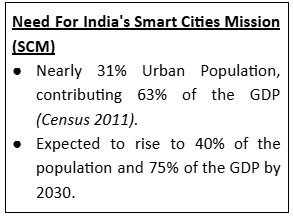
- Despite significant investments in India’s Smart Cities Mission, there are shortcomings particularly in terms of maintenance and sustainability, as recently observed severe flooding in cities like Bengaluru and Pune.
India’s Smart Cities Mission (SCM)
- It aims to address the growing urban challenges by integrating technology and sustainable development into city planning.
- It was launched in 2015 with the goal of transforming urban centers through technology-driven solutions.
- It aimed to enhance infrastructure, improve governance, and create sustainable cities.
- It included area-based development — such as retrofitting, redevelopment, and greenfield projects — and pan-city solutions that leveraged digital tools for efficient urban management.
- It aligns with 15 out of 17 SDGs, focusing on liveability, economic growth, and sustainability.
Operational Framework
- Selection Process: 100 cities were selected through a two-stage competition.
- Implementation: Special Purpose Vehicles (SPVs) handle project execution.
- Centrally Sponsored Scheme: ₹48,000 crore allocated by the central government over five years (₹100 crore per city annually).
- States or Urban Local Bodies (ULBs) need to match funding.
- Additional resources raised via municipal bonds, government programs, and public-private partnerships (PPP).
- Over the years, the mission has sanctioned over 8,000 projects across 100 cities, with an estimated investment of ₹1.67 lakh crore.
- Integrated Command and Control Centres (ICCCs) were established to enable real-time monitoring and decision-making.
Challenges and Concerns
- Maintenance & Sustainability Concerns: Despite the substantial financial commitment, cities like Bengaluru and Pune have struggled with flooding due to inadequate upkeep.
- The lack of clear guidelines for maintaining smart city assets raises concerns about the longevity of these investments.
- Governance and Implementation Issues: The governance model of smart cities bypassed local governments and relied on SPVs, which functioned like private companies.
- Delays and Incomplete Projects: Although the SCM was concluded on March 31, 2025, 7% of projects are still ongoing.
- Many cities have struggled to complete their planned infrastructure upgrades within the given timeframe, leading to uncertainty about their future.
- Financial and Strategic Concerns: SCM has disbursed funds through a grant structure that lacks a cohesive national strategy.
Need for a Long-Term Strategy
- The Smart Cities need to go beyond infrastructure upgrades and embed a culture of maintenance and performance tracking.
- Without proactive governance, cities risk repeating cycles of neglect and reconstruction.
- Expanding Digital Infrastructure: Smart cities need to continue investing in technology-driven solutions, such as real-time monitoring systems, AI-based traffic management, and IoT-enabled urban services.
- Strengthening digital infrastructure will improve efficiency and responsiveness.
- Citizen-Centric Urban Planning: Integrating elected city councils into decision-making processes can enhance transparency and accountability.
- Public participation in urban planning can make cities more responsive to residents’ needs.
Conclusion
- India’s Smart Cities Mission has made notable progress, but sustainability and maintenance remain critical concerns.
- Addressing these challenges requires clear operational strategies, accountability, and a long-term vision to ensure that smart cities remain truly ‘smart’ in the years to come.
Rising Northeast: A Vision For The Northeast India
Syllabus: GS2/Government Policy & Interventions
Context
- The Ministry of Development of North-Eastern Region (DoNER) is organizing the ‘Rising Northeast: The Investor Summit’ in New Delhi to showcase the investment and trade potential of the Northeast Region of India.
| Key Highlights of Rising Northeast Investors Summit 2025 – Inaugurated by: Prime Minister of India 1. He outlined the EAST Vision: Empower, Act, Strengthen, and Transform, as the guiding principle for development. – Summit Agenda: Includes ministerial sessions, Business-to-Government (B2G) and Business-to-Business (B2B) meetings, and an exhibition zone. – Focus Sectors: Agri, Food Processing & Allied Sectors; Textiles, Handloom & Handicrafts; Entertainment and Sports; Education & Skill Development; Healthcare; IT & ITES; Tourism & Hospitality; Infrastructure and Logistics; and Energy. – It serves as a platform for policy discussions, business collaborations, and investment partnerships to accelerate the Northeast’s growth trajectory. |
About Northeast Region of India
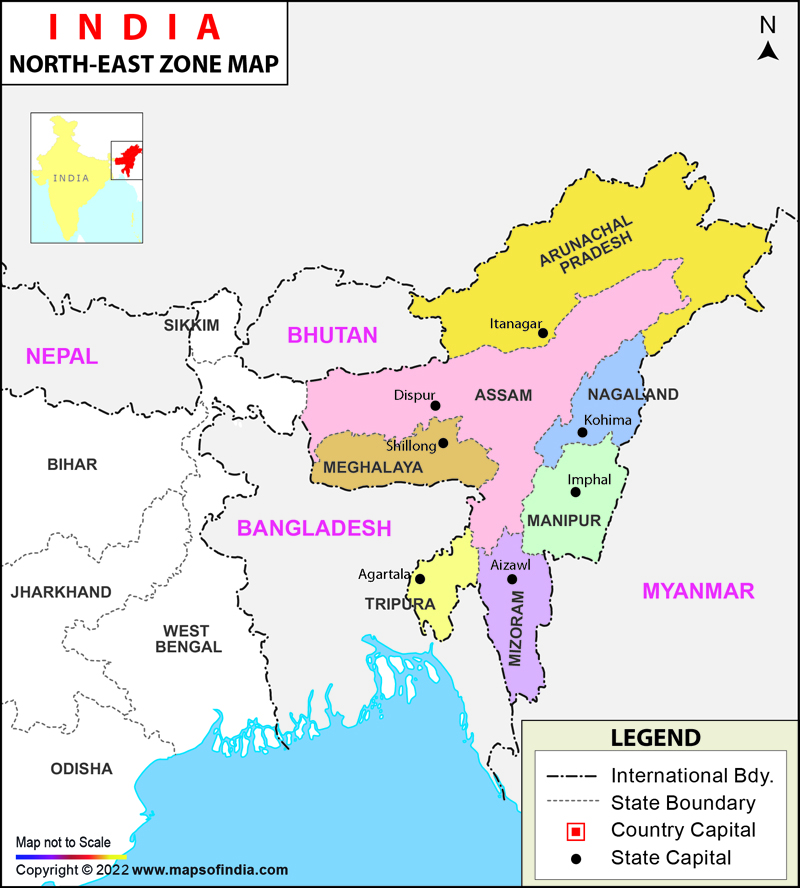
- It consists of eight states: Arunachal Pradesh, Assam, Manipur, Meghalaya, Mizoram, Nagaland, Sikkim, and Tripura.
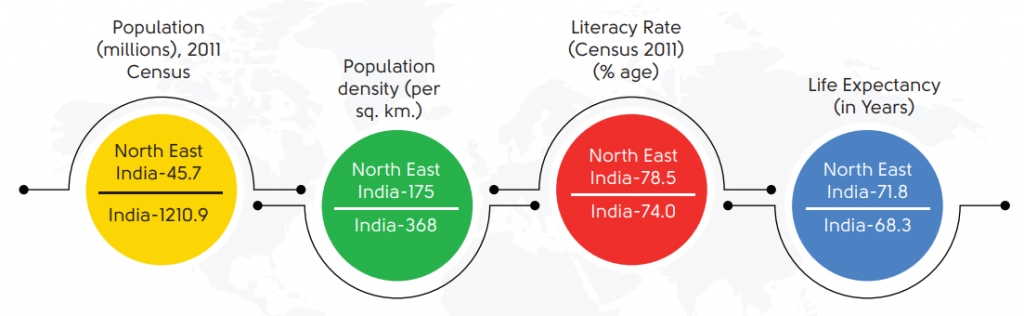
- Geographical Area: Covers 7.97% of India’s total landmass.
- Population: Around 3.78% of India’s total population.
- Hilly areas population: Over 54%
- International Borders: Shares 5,484 km of borders with Bangladesh (1,880 km), Myanmar (1,643 km), China (1,346 km), Bhutan (516 km) and Nepal (99 km).
- It is positioned as a gateway to ASEAN and East Asia, reinforcing India’s Act East Policy.
Concerns and Challenges Hindering Development of Northeast Region
- Geographical & Connectivity Issues: The region’s rugged terrain and heavy monsoons make infrastructure development difficult.
- Limited rail and road networks restrict trade and mobility.
- Political & Ethnic Conflicts: Insurgency and ethnic tensions have historically disrupted stability. Demands for autonomy and special status create governance challenges.
- Naga and Mizo separatist movements gained momentum until the 1980s.
- ULFA and NDFB emerged in Assam demanding autonomy and sovereignty.
- Infiltration from Bangladesh led to large-scale protests, culminating in the Assam Accord of 1985.
- Economic Underdevelopment: The region contributes only about 2.8% to India’s GDP, with Assam being the largest contributor.
- Limited industrialization and dependence on agriculture slow economic growth.
- Environmental Challenges: Deforestation, floods, and landslides impact agriculture and infrastructure.
- Climate change threatens biodiversity and traditional livelihoods.
- Policy & Governance Gaps: Delayed implementation of key policies like the Inner Line Permit (ILP) in Meghalaya.
- Need for better coordination between central and state governments.
Policy Transformation in Northeast India
- From Insurgency to Integration: Post-Independence, the Northeast remained marred by insurgencies.
- The government viewed the Northeast mainly through a security lens, with little focus on development. Many in the region felt alienated, both physically and emotionally.
Strategic Shift: Look East to Act East
- The Look East policy was initiated by the Narasimha Rao government to boost ties with Southeast Asia.
- Atal Bihari Vajpayee formalized this direction by establishing the DoNER Ministry in 2001.
- In 2014, the Modi government adopted the Act East policy, marking a decisive turn in India’s regional strategy.
Era of Infrastructure and Integration
- Ground-Level Transformation: The Northeast became central to India’s economic and geopolitical vision.
- Union ministers maintained a continuous presence in the region, closing the emotional gap between people and government.
- Infrastructure Push: Government initiatives like NESIDS and PM-DevINE aim to improve roads, water supply, and power infrastructure.
- North East Special Infrastructure Development Scheme (NESIDS) launched in 2018 with a $1 billion budget for roads, power, and water supply.
- 4,950 km of National Highways constructed.
- More than $5Bn invested via the Ministry of Road Transport and Highways, allocating 10% of its budget to the region.
- Key Infrastructure Projects:
- India-Myanmar-Thailand Trilateral Highway
- Kaladan Multi-Modal Transit Transport Project
- Revival of Stilwell Road
- These initiatives aim to boost land-based trade with ASEAN. Additionally, maritime connectivity will be strengthened through the upcoming Sittwe Port (Myanmar), and the Chittagong Port (Bangladesh).
Conclusion
- The ‘Rising Northeast’ summit symbolizes the transformation of a once-neglected region into a dynamic investment and strategic hub.
- With enhanced connectivity, committed infrastructure development, and sustained political engagement, the Northeast is now poised to serve as India’s gateway to Southeast Asia.
Urban Flooding
Syllabus: GS1/Urbanisation and related challenges
Context
- Bengaluru rain has led to widespread waterlogging, severe damages and traffic disruptions.
- Environmentalists and water conservationists have flagged the poor status of the city’s current drainage system, which is outdated and ill-equipped to handle the city’s current population and rainfall intensity.
What are Floods?
- Floods are the most frequent type of natural disaster and occur when an overflow of water submerges land that is usually dry.
Types of Floods
- Flash floods are caused by rapid and excessive rainfall that raises water heights quickly, and rivers, streams, channels or roads may be overtaken.
- River floods are caused when consistent rain or snow melt forces a river to exceed capacity.
- Coastal floods are caused by storm surges associated with tropical cyclones and tsunamis.
- Urban flooding occurs as a result of land development. Permeable soil layers are being replaced by impermeable paved surfaces, through which water cannot infiltrate.
- This leads to greater runoff being generated, which can make rivers out of roadways and ponds out of car parks.
Causes of Urban Flooding
- Heavy or intense rainfall in a short period.
- Blocked or undersized drainage systems.
- Encroachment of natural drains, lakes, or wetlands.
- Loss of green cover, leading to reduced water absorption.
- Rapid urbanization without proper planning or zoning regulations.
- Outdated infrastructure that can’t handle current population or rainfall levels.
Solutions to Mitigate Urban Flooding
- Upgrading and maintaining stormwater drainage infrastructure.
- Protecting and restoring wetlands, lakes, and natural waterways.
- Promoting green infrastructure: rain gardens, green roofs, permeable pavements.
- Implementing urban planning policies to prevent construction on flood-prone areas.
- Rainwater harvesting and better solid waste management.
Government Initiatives
- Swachh Bharat Mission (Urban): While primarily focused on sanitation, this mission also emphasizes solid waste management and pollution control, which contribute to preventing waterlogging and flooding.
- National smart cities mission: It promotes the measures to manage urban flooding through rainwater harvesting, green spaces and proper drainage system.
- Atal Mission for Rejuvenation and Urban Transformation (AMRUT): The Mission focuses on developing basic urban infrastructure in cities and towns, particularly in the areas of water supply, sewerage and septage management, and stormwater drainage.
- Guidelines and Regulations: The government has issued guidelines for sustainable urban development, encouraging the incorporation of features like permeable pavements, green roofs, and retention ponds to enhance water absorption.
| Global Models Related to Mitigating Urban Flooding – Singapore, a global leader in managing urban flooding despite its high rainfall and dense urban environment. – China – “Sponge Cities” Initiative 1. Challenge: Urban flooding due to rapid city expansion and impermeable surfaces. 2. Solution: Cities designed to absorb and reuse rainwater like sponges. – United States – New York City (Post-Hurricane Sandy) 1. Challenge: Severe coastal flooding from hurricanes and storm surges. 2. Solution: The “Big U” project in Manhattan. 3. Raised parks, floodwalls, berms, and green infrastructure wrapping around the city. 4. Multi-functional public spaces that act as flood barriers. – Japan – Tokyo’s Underground Floodwater System 1. Challenge: Flooding from typhoons and river overflows in a dense urban area. 2. Solution: Built the world’s largest underground flood diversion system. |
Conclusion
- Combining engineering solutions, smart urban planning, real-time technologies, and community participation is key to building flood-resilient cities and effectively mitigating the challenge of urban flooding in India.
Mizoram Declared India’s First Fully Literate State
Syllabus: GS 2/Governance
In News
- Mizoram has been declared India’s first fully literate state, marking a historic milestone in the state’s educational journey.
About Literacy
- As per the Office of the Registrar General of India, a literate person is someone aged 7 or above who can read and write with understanding in any language.
- The Department of School Education and Literacy has introduced a refined definition of literacy aligned with NEP 2020 and SDG 4.6 goals.
- Literacy is now defined as the ability to read, write, and compute with comprehension, along with critical life skills such as digital and financial literacy. This expanded definition aims to ensure full societal participation and economic progress.
- A state/UT achieving 95% literacy is considered fully literate.
Present Status
- India’s total literacy rate for individuals aged 7 and above, across both rural and urban areas, stands at 80.9% for the period 2023–24.
- India’s literacy rate has grown from 14% at independence to approximately 80.9% in 2023–24.
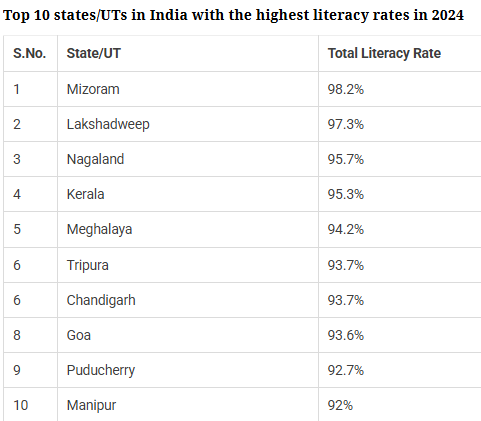
- Mizoram has achieved “full literacy” status, reaching 98.2%, surpassing the 95% threshold set by the Ministry of Education as per the 2023–24 PLFS survey.
- Earlier, Ladakh became the first administrative unit to declare full functional literacy under ULLAS (Understanding of Lifelong Learning for All in Society).
- Andhra Pradesh (72.6%) and Bihar (74.3%) have the lowest literacy rates, per the PLFS 2023–24 MoSPI survey.
| ULLAS – Nav Bharat Saaksharta Karyakram (New India Literacy Programme) – It is a centrally sponsored scheme (2022–2027) aligned with NEP 2020, aimed at educating adults aged 15+ who missed formal schooling. – It has five components- Foundational Literacy and Numeracy, Critical Life Skills, Basic Education, Vocational Skills and Continuing Education. – It aims to make Bharat – Jan Jan Saakshar and is based on the spirit of Kartavya Bodh and is being implemented on volunteerism |
Centre Urges States to Implement Labour Codes
Syllabus: GS2/ Polity and Governance; GS3/ Economy
Context
- The Union Government has urged states and Union Territories (UTs) to align their existing labour laws with the spirit and provisions of new labour codes.
Background
- Between 2019 and 2020, Parliament passed four consolidated labour codes to replace 29 outdated central labour laws:
- Code on Wages, 2019: Regulates wages, bonus payments, and equal remuneration.
- Industrial Relations Code, 2020: Deals with trade unions, employment conditions, layoffs, and dispute resolution.
- Code on Social Security, 2020: Merges laws on provident funds, pensions, insurance, maternity benefits, and gratuity.
- Occupational Safety, Health and Working Conditions Code, 2020: Consolidates regulations on safety, working hours, health, and welfare.
- The reforms were intended to streamline regulation, improve working conditions, and support industry growth.
- The new Social Security Code contains provisions for extending benefits to gig and platform workers also.
Progress at the State Level
- Labour being on the Concurrent List, states must frame their own rules under the new codes.
- Many states have proactively begun amending their respective labour laws to reflect the intent and provisions of the new codes.
Key Amendments Undertaken by States and UTs
- At least 20 states and UTs have amended laws to increase the threshold for prior government approval for retrenchment, layoff, or closure from 100 to 300 workers.
- 19 states and UTs have doubled the worker threshold for the application of the Factories Act:
- From 10 to 20 workers (where power is used in manufacturing).
- From 20 to 40 workers (where power is not used).
- Contract Labour Act Applicability: 19 states and UTs have raised the threshold for application from 20 to 50 workers.
- Night Shifts for Women: 31 states and UTs have allowed women to work night shifts (subject to specific safety conditions such as transport, lighting, and security).
- All states and UTs have notified reforms requiring prior compliance notices before prosecution, a major component of the codes meant to reduce inspector raj.
Challenges in Implementation
- Delayed Notification by the Centre: Although the codes were passed between 2019 and 2020, they are yet to be formally notified for implementation at the central level.
- The absence of a clear central timeline has created uncertainty for states, industries, and workers alike.
- Need for Synchronised and Uniform Rollout: While many states have moved ahead with individual reforms, the lack of coordination between Centre and states can lead to:
- Legal ambiguities and overlaps in enforcement,
- Compliance difficulties for firms operating across multiple states,
- Uneven labour standards, undermining the concept of a national labour market.
- Opposition from Trade Unions: Multiple national trade unions have opposed the codes, alleging that;
- They dilute job security, especially with relaxed norms for retrenchment and fixed-term employment.
- The emphasis is more on employer flexibility than on worker welfare.
- Infrastructural Gaps: Many state labour departments lack the capacity—both in manpower and digital systems—to implement new compliance and inspection frameworks.
Way Forward
- The Centre must provide clarity on notification timelines to facilitate coordinated implementation.
- Capacity-building and awareness at the state level are essential for effective enforcement.
- A balanced approach is required to ensure both worker welfare and industrial competitiveness.
- There should be inclusive consultations with trade unions, industries, and civil society groups to address concerns.
Concluding remarks
- The proactive role of states in aligning with labour reforms underscores a shared objective of improving industrial investment and employment generation.
- However, the Centre must now move decisively to ensure nationwide implementation, especially in areas like social security for gig workers, to realise the full potential of these landmark reforms.
Integrating Mission LiFE with National Action Plan on Climate Change
Syllabus: GS3/ Environment
Context
- The government is considering adding Mission LiFE (Lifestyle for Environment) to the National Action Plan on Climate Change (NAPCC).
Mission LiFE
- At the 2021 UN Climate Change Conference (UNFCCC COP26), India announced Mission LiFE, to bring individual behaviors at the forefront of the global climate action narrative.
- The mission envisions replacing the prevalent ‘use-and-dispose’ economy with a circular economy, which would be defined by mindful and deliberate utilization.
- In India, the Ministry of Environment, Forest and Climate Change, GoI (MoEF&CC) is the nodal Ministry for national level coordination and implementation of Mission Life.
Approach of Mission LiFE
- Focus on Individual Behaviors: Make life a mass movement (Jan Andolan) by focusing on behaviors and attitudes of individuals and communities.
- Co-create Globally: Crowdsource empirical and scalable ideas from the best minds of the world, through top universities, think tanks and international organizations.
- Leverage Local Cultures: Leverage climate-friendly social norms, beliefs and daily household practices of different cultures worldwide to drive the campaign.
National Action Plan on Climate Change (NAPCC)
- The NAPCC is India’s comprehensive policy framework for addressing climate change, launched in 2008. It currently comprises eight core missions:
- National Solar Mission
- National Mission for Enhanced Energy Efficiency
- National Mission on Sustainable Habitat
- National Water Mission
- National Mission for Sustaining the Himalayan Ecosystem
- National Mission for a Green India
- National Mission for Sustainable Agriculture
- National Mission on Strategic Knowledge for Climate Change
Need for Integration of the missions
- Quantifiable Action: It will help measure the role of individuals and businesses in climate mitigation and adaptation.
- Amplifying Awareness: Mass campaigns under NAPCC can broaden the outreach of Mission LiFE.
- Behavioural Transformation: It will focus on low-cost, high-impact lifestyle changes, e.g., optimal use of energy, waste reduction, and sustainable consumption.
- Bridging the Gap: Tackles the common problem of awareness not translating into action.
Challenges in Implementation
- Self-driven Model: Unlike subsidy-based schemes like rooftop solar, Mission LiFE requires voluntary and intrinsic motivation.
- Lack of Measurement Tools: Tracking impact and progress of lifestyle-based interventions remains a challenge.
- Limited Climate Literacy: A significant portion of the population still lacks basic understanding of climate change, leading to a disconnect between individual actions and their environmental impact.
Way Ahead
- Policy Synergy: Align with schemes like Ujjwala, FAME, National Electric Mobility Mission, etc., for greater synergy.
- Budgetary Allocation: Ensure adequate funding and investment to scale up behavioural campaigns.
- Awareness to Action: Launch targeted campaigns offering practical “to-do” lists for households and businesses.
Concluding remarks
- Merging Mission LiFE into the NAPCC can add a powerful, people-centric dimension to India’s climate response.
- While the transition to sustainable behaviour is a long-term process, institutional support, monitoring mechanisms, and mass outreach can catalyse significant climate-positive lifestyle changes.
