
India Becomes the World’s 4th Largest Economy
Syllabus: GS3/Indian Economy
Context
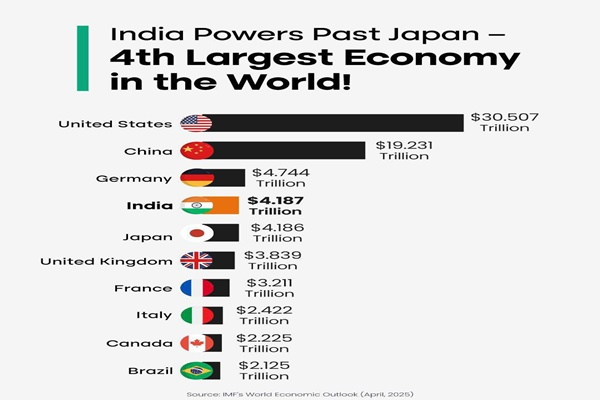
- Recently, NITI Aayog CEO B.V.R. Subrahmanyam informed that India has surpassed Japan to become the world’s fourth-largest economy (nominal GDP), and poised to displace Germany in the next 2.5 to 3 years.
India’s Economic Growth
- India’s nominal GDP has now reached $4.19 trillion, overtaking Japan’s estimated $4.18 trillion.
- The IMF’s World Economic Outlook report predicts that India aims to continue to be the fastest-growing major economy, with a projected growth rate of 6.2% in 2025 and 6.3% in 2026.
- Over the past decade, India has doubled its GDP from $2.1 trillion in 2015 to its current level.
Becoming the Third-Largest Economy
- The IMF projects that India will become the third-largest economy by 2028, with an expected GDP of $5.5 trillion by overtaking Germany.
- Germany’s projected GDP growth: 0% (2025), and 0.9% (2026) (due to ongoing global trade tensions).
Key Determinants of India’s Economic Growth
- Expanding Domestic Consumption: India’s economic growth is largely fueled by private consumption, particularly in rural areas.
- Also, the urbanization and lifestyle shifts have led to an increase in consumption-led growth. India’s urban population is expected to touch 600 million by 2030.
- The demographic dividend is a unique edge—India’s median age is just 29 years, offering a productive workforce for the coming decades.
- Infrastructure Development & Digital Transformation: India has invested heavily in modernizing infrastructure, including transportation, energy, and digital connectivity.
- For example: India’s Digital Public Infrastructure (DPI), emergence of India as a global startup hub & boost in the IT sector enhancing innovative driven growth.
- Manufacturing & Services Sector Growth: India’s manufacturing sector has seen significant growth due to initiatives like Make in India and Production-Linked Incentive (PLI) schemes.
- Additionally, the services sector, particularly IT and financial services, continues to be a major contributor to GDP.
- External and Global Realignment: Strategic initiatives like “China Plus One” and Supply Chain Resilience Initiative (SCRI) are leading to increased FDI inflows into India.
- Global firms are diversifying their manufacturing bases, turning to India as an alternative to China amid geopolitical tensions For example: Apple has investors in India for manufacturing units.
- Reform-Driven Growth: Introduction of Goods and Services Tax (GST) has created a unified domestic market, Insolvency and Bankruptcy Code (IBC) has improved the ease of doing business, Corporate tax cuts & initiatives like PM Gati Shakti, National Infrastructure Pipeline (NIP), and Atmanirbhar Bharat are boosting capital formation.
| Additional Information – Real GDP: It measures the total value of goods and services produced in an economy, adjusted for inflation. 1. It reflects the actual growth in production by using constant prices from a base year. – Nominal GDP: It measures the total value of goods and services produced at current market prices, without adjusting for inflation. 1. It means that if prices rise due to inflation, Nominal GDP may appear higher even if actual production remains unchanged. |
Challenges and Concerns
- Global Geopolitical Uncertainty: India’s economy is deeply connected to global trade, and geopolitical tensions — including conflicts, trade restrictions, and supply chain disruptions — pose risks to its growth.
- The Economic Survey 2025 highlights that ongoing conflicts and trade policy risks could create vulnerabilities for India’s economic stability.
- Inflation and Price Volatility: While inflationary pressures have eased, services inflation remains persistent.
- The rising cost of essential commodities, including fuel and food, continues to be a concern for policymakers.
- Employment and Workforce Challenges: India’s workforce faces disruptions due to automation and AI.
- The need for upskilling and reskilling is critical to ensure that workers remain competitive in a rapidly evolving job market.
- Trade Deficit and Export Challenges: India’s current account deficit has been reduced to 1% of GDP, but weak global demand has impacted exports.
- The government is focusing on diversifying trade partnerships to mitigate risks associated with declining exports.
- Infrastructure and Investment Needs: India’s Capital Expenditure (Capex) to GDP ratio has surged to 3.3%, reflecting strong investment in infrastructure.
- However, sustained investment is required to modernize transportation, energy, and digital connectivity.
Way Forward
- Diversify its trade partnerships to reduce dependency on volatile global markets.
- Strengthen domestic manufacturing through various initiatives and schemes.
- Invest in digital transformation to enhance financial inclusion and governance.
- Focus on sustainable economic policies that balance growth with environmental concerns.
Maths of How India’s Coastline Lengthened without Gaining Land
Syllabus: GS1/ Geography
In Context
- The Ministry of Home Affairs, in its 2023–24 report, updated India’s coastline length to 11,098.8 km, a significant increase from the previously recorded 7,516.6 km.
- This change stems not from any territorial acquisition or natural geological expansion, but from enhanced mapping precision, underscoring the “coastline paradox.”
Coastline Paradox
- Definition: The coastline paradox states that the length of a coastline depends on the scale at which it is measured. The more detailed the measurement (smaller ruler), the longer the coastline appears.
- Euclidean Geometry: Deals with ideal shapes and straight lines/smooth curves, where length is straightforward.
- Fractal Geometry: Coastlines exhibit fractal-like properties, meaning they display self-similar patterns at different scales. This concept was popularized by Benoît Mandelbrot.
- Hypothetical Infinity: Theoretically, measuring a coastline down to the size of a water molecule would result in its length approaching infinity.
New Measurement Methodology and Technology
- Agencies Involved: National Hydrographic Office (NHO) and the Survey of India.
- Finer Scale: Electronic navigation charts at a much finer resolution of 1:250,000.
- Technologies Used: Geographic Information Systems (GIS), Satellite Altimetry, LIDAR-GPS & Drone-based imaging.
- Measurement Reference: Highwater lines prepared by the NHO based on 2011 data on electronic navigation charts. River mouths and creeks were closed off at a fixed inland threshold.
- Inclusion of Islands: Islands exposed at low tide were also included in the review.
- Future Revisions: The coastline length will be revised every 10 years from 2024-2025, ensuring continuous accuracy.
Implications of the Revised Coastline Length
- Disaster Management and Climate Adaptation: India’s east coast is prone to cyclones (e.g., Fani, Yaas) and tsunamis.
- Accurate coastline data improves early warning systems, evacuation route planning, CRZ (Coastal Regulation Zone) zoning.
- Supports climate vulnerability assessments and resilient coastal infrastructure development.
- Economic Zoning and Blue Economy Expansion:
- Influences the computation of India’s Exclusive Economic Zone (EEZ).
- Extends reach over marine fisheries, deep-sea mining, bioprospecting, and offshore energy.
- Enhances viability of Sagarmala, coastal industrial corridors, and port-led growth models.
- Coastal Governance and Urban Planning
- Better data supports:
- Shoreline management plans
- Urban zoning laws
- Port placement and dredging
- Helps states like Tamil Nadu, Kerala, Gujarat, and Odisha optimize coastal investments.
Challenges and Way Forward
- Dynamic Nature of Coastlines: Coastlines are constantly changing due to tidal fluctuations, sedimentation, erosion, and sea-level rise. Regular revisions are crucial.
- Inter-agency Coordination: Continued collaboration between agencies like the NHO, Survey of India, and other relevant ministries (e.g., Ministry of Earth Sciences, Ministry of Environment, Forest and Climate Change) is vital.
- Technological Upgradation: Continued investment in advanced technologies for mapping and monitoring is necessary.
- Capacity Building: Training and capacity building for personnel involved in coastal management and security.
India-Maldives 2nd High Level Core Group (HLCG) Meeting
Syllabus: GS2/IR
Context
- Maldivian Foreign Minister has arrived in New Delhi to lead the Maldivian delegation at the 2nd High Level Core Group (HLCG) meeting.
About
- Both foreign ministers will review the progress of the India–Maldives comprehensive economic and maritime security partnership.
- The India-Maldives vision document on a comprehensive economic and maritime security partnership was adopted by Prime Minister Narendra Modi and Maldivian President last year.
Key Highlights of the Vision Document
- Bilateral Commitment and Financial Support: India reaffirmed its commitment under ‘Neighbourhood First’ and Vision SAGAR.
- India extended emergency financial assistance (rollover of $100 million in T-bills and currency swap worth $400 million + ₹30 billion).
- Framework for a Comprehensive Partnership: A new strategic framework is established for a Comprehensive Economic and Maritime Security Partnership, intended to be people-centric and future-oriented.
- Serve as a stabilizing force in the Indian Ocean Region.
- Development Cooperation: Enhanced infrastructure projects such as ports, airports, housing, schools, roads, hospitals.
- Trade and Economic Cooperation: Explore a Bilateral Free Trade Agreement (FTA).
- Enable local currency trade settlement to reduce dollar dependence.
- Boost investments and ease of doing business.
- Support Maldivian economic diversification (blue economy, fisheries, oceanography).
- Collaboration on Digital Public Infrastructure: UPI, Digital ID, Gati Shakti.
- Expansion of RuPay and digital payment infrastructure.
- Shared expertise in fintech and digital governance.
- Energy Cooperation: Focus on renewables (solar power), energy efficiency.
- Participation in One Sun One World One Grid initiative.
- Institutional cooperation through joint research, training, and investment.
- Health Cooperation: Access to affordable Indian healthcare and generic medicines (Jan Aushadhi Kendras).
- Recognition of Indian Pharmacopoeia in Maldives.
- Regional and Multilateral Cooperation: Work together in the Colombo Security Conclave (CSC) and other multilateral fora.
- Emphasis on maritime safety, regional peace, and mutual representation.
- Implementation Mechanism: A High-Level Core Group (HLCG) has been formed to monitor and oversee the implementation of all cooperation initiatives.
- The group will include senior representatives from both governments.
Significance
- Regional Stability: This partnership is crucial for stability in the Indian Ocean amidst growing Chinese presence in the region.
- Diplomatic Maturity: Shows both sides’ willingness to move past tensions and focus on long-term shared interests.
- People-Centric Focus: Heavy emphasis on health, education, housing, and livelihood is notable.
- Economic Sovereignty for Maldives: Local currency trade and support for diversification give Maldives more economic autonomy.
- Security Balance: India remains a key security partner, but through cooperation tailored to Maldivian preferences.
| Highlights of India – Maldives Relations – Participation in Multiple Forums: Both nations are founding members of the South Asian Association for Regional Cooperation (SAARC), the South Asian Economic Union and signatories to the South Asia Free Trade Agreement. – Economic partnership: India emerged as Maldives’ largest trade partner in 2023. 1. India is one of the biggest investors and tourism markets for the Maldives, with significant trade and infrastructure projects underway. – Defense and Security Cooperation: Since 1988, defence and security has been a major area of cooperation between India and Maldives. 1. A comprehensive Action Plan for Defence was also signed in 2016 to consolidate defence partnership. 2. Estimates suggest that almost 70% of Maldives’ defence training is done by India. – Tourism: In 2023, India is the leading source market for Maldives with a 11.8% market share. 1. In March 2022, India & Maldives agreed for an open skies arrangement which will further improve connectivity between two countries. – Connectivity: The Male to Thilafushi Link project, popularly known as the Greater Male Connectivity Project (GMCP), is a USD 530 million infrastructure project. 1. The project aims to connect Male to Villingili, Gulhifalhu and Thilafushi islands through a series of bridges, causeways and roads. 2. The project is crucial for the proposed Gulhifalhu Port, and will be a major catalyst for the Maldivian economy. |
Way Ahead
- Maldives is India’s key maritime neighbour and an important partner in India’s ‘Neighbourhood First’ policy and vision MAHASAGAR which is Mutual and Holistic Advancement for Security and Growth Across Regions.
- By acknowledging and addressing the challenges, India and the Maldives can navigate the complexities of their relationship and build a stronger, more resilient, and mutually beneficial partnership for the future.
India’s Outward remittances Decreases under Liberalised Remittance Scheme
Syllabus: GS3/ Economy
Context
- India’s outward remittances under the Liberalised Remittance Scheme (LRS) moderated by 6.85 percent year-on-year (YoY) to $29.56 billion in FY25, after reaching an all-time high of $31.73 billion in FY24.
What is Outward Remittance?
- Outward remittance refers to the transfer of money in foreign currency by a resident of India to a person or entity outside India, for purposes such as education, travel, medical treatment, investment, or gifting.
What is the Liberalised Remittance Scheme (LRS)?
- LRS was introduced in 2004 by the Reserve Bank of India (RBI).
- It allows resident individuals (including minors) to remit up to $250,000 per financial year for permissible current or capital account transactions.
- Initially launched with a $25,000 limit, later increased to current levels.
- Remittances can be made for;
- Education and studies abroad,
- Travel and tourism,
- Medical treatment abroad,
- Purchase of property,
- Investment in foreign securities or businesses.
- LRS is governed under the Foreign Exchange Management Act (FEMA), 1999.
Key Trends in FY25
- Travel Remittances emerged as the largest component, accounting for $16.96 billion, or over 57% of total outflows.
- It indicates a growing preference for international travel among Indian residents despite a marginal dip from FY24.
- Education Remittances declined 16% year-on-year, from $3.48 billion in FY24 to $2.92 billion in FY25.
- Investment Abroad: The funds remitted by Indians to invest in foreign equity and debt rose by 12.51%, reaching $1.699 billion in FY25 compared to $1.51 billion in FY24.
- It reflects growing interest in diversifying portfolios and accessing global financial markets.
Policy Changes & Tax Implications
- Union Budget 2025, raised the Tax Collected at Source (TCS) threshold on LRS transactions from ₹7 lakh to ₹10 lakh, providing relief to middle-class travellers and students.
- TCS on LRS:
- 20% TCS applies to overseas tour packages above ₹10 lakh.
- TCS is not an extra tax, as it is adjustable against final tax liability.
- Credit card spending abroad is excluded from TCS under LRS.
Why did student remittances decline?
- Global Visa Restrictions: Major destinations like US, UK, Canada saw 25–31% declines in Indian student visas.
- Economic Uncertainty: Families postponed study and travel plans due to global financial volatility.
- High Base Effect: Remittances were at peak levels in FY24, making a decline statistically likely.
Way Ahead
- India’s outward remittances under LRS reflect both the aspirations of a growing middle class and the challenges posed by global economic dynamics.
- While travel and investment continue to rise, falling student remittances highlight the importance of immigration policies abroad.
- Policy responses, such as rationalising TCS and easing compliance, aim to strike a balance between enabling individual freedom and maintaining macroeconomic prudence.
India’s Farm Trade and Impact of FTAs with US, EU and UK
Syllabus :GS 3/Economy
In News
- India is negotiating trade agreements with the United States and European Union, which are both seeking tariff reductions and greater market access for their agricultural products.
Status of India’s farm trade
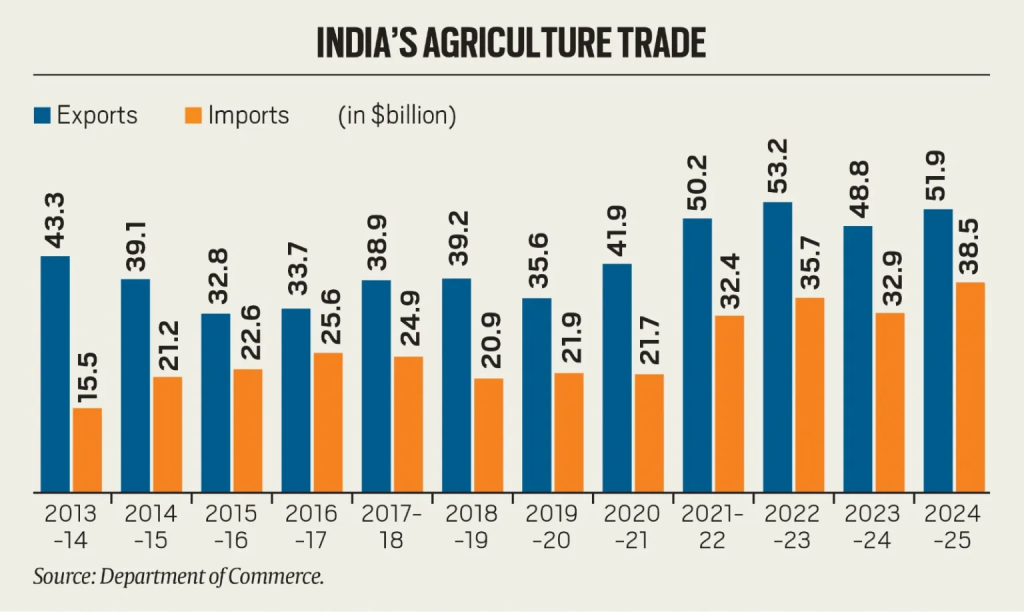
- India’s agriculture exports rose by 6.4% to $51.9 billion in 2024–25, while overall goods exports remained nearly flat.
- However, agriculture imports surged by 17.2% to $38.5 billion, widening the trade gap.
- Over the past decade, exports grew just 20%, while imports jumped 148%, causing the agri-trade surplus to shrink from $27.7 billion in 2013–14 to $13.4 billion in 2024–25.
Export Trends Productwise
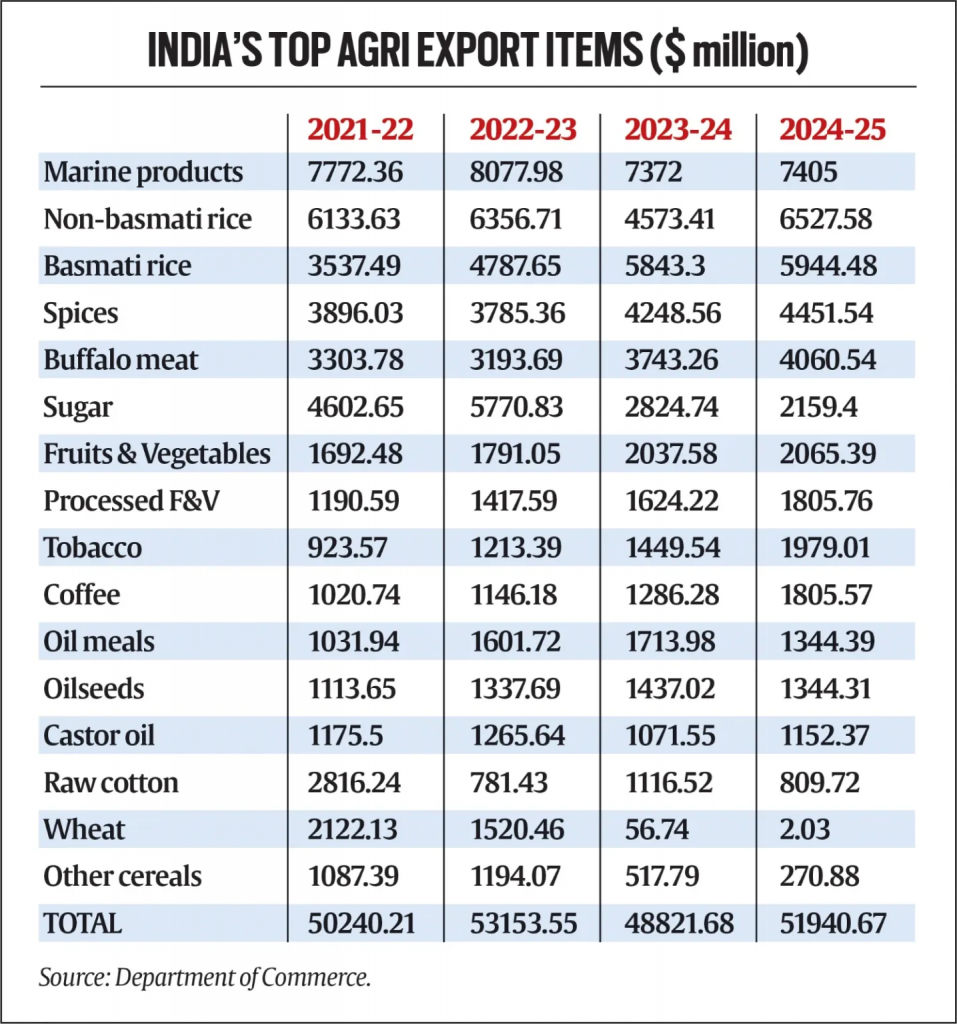
- Marine exports from India are largely to the US (roughly 35% share), China (20%) and the EU (15%).
- Shipments to the US, predominantly frozen shrimps, now attract 17.7% duty.
- Rice (basmati and non-basmati) hit a record $12.5 billion, driven by strong demand in West Asia and Africa.
- Spices, tobacco, coffee, fruits & vegetables reached new highs.
- Coffee and tobacco exports rose due to poor global harvests.
- Exports fell for wheat, sugar, and cotton due to domestic supply issues and export restrictions.
- Cotton has seen a major decline, with India turning into a net importer.
- Buffalo meat exports exceeded $4 billion but are still below past highs.
Import Trends
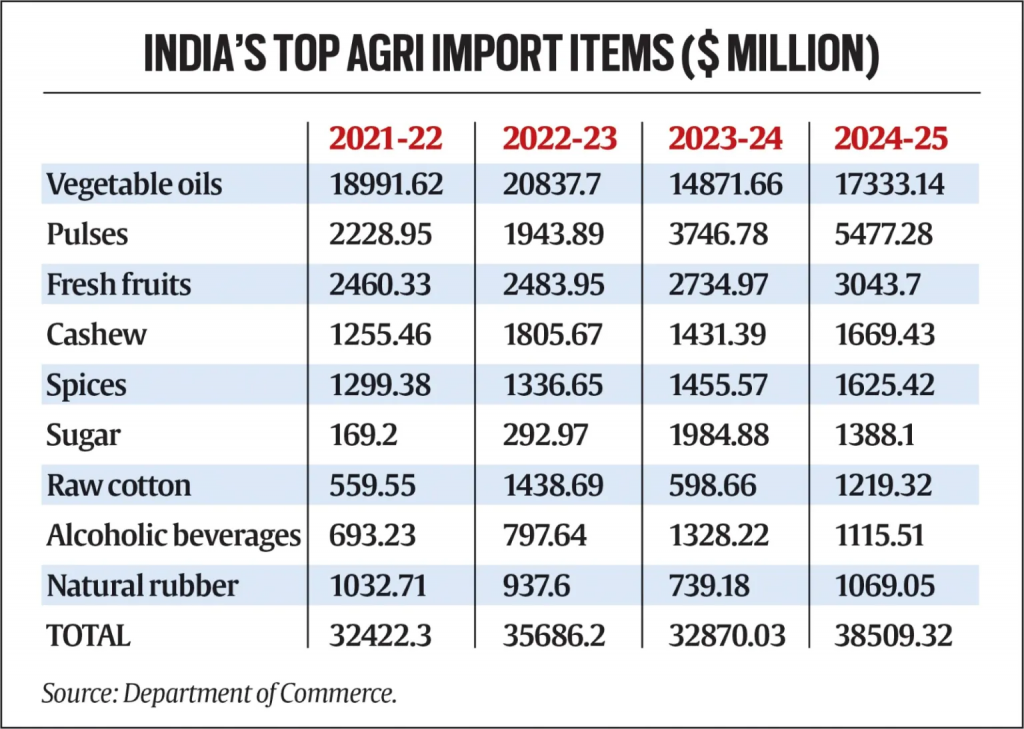
- Vegetable oils and pulses are top import items due to low yields and lack of MSP support.
- Pulses imports hit a record $5.5 billion.
- Cotton and natural rubber imports rose as domestic production fell.
- Imports of fruits, spices (pepper, cardamom), and alcoholic beverages are also significant.
Impacts of Trade Agreements
- India’s upcoming trade agreements with the US, EU, and UK are expected to see increased imports of dry fruits, wines, and spirits.
- The Trump administration may also push for lower import duties and relaxed non-tariff barriers on GM crops like maize, soyabean, and cotton.
- These developments could impact India’s agricultural trade balance, potentially further shrinking the surplus.
Tamil Nadu Adopted a Space Sector Policy
Syllabus: GS3/Space
Context
- Tamil Nadu Cabinet approved the Space Industrial Policy, thereby following Karnataka and Gujarat in formulating a State-specific document.
About
- Aim: To stimulate development and attract investments in the space sector.
- In 2023, the Union government came out with the Indian Space Policy 2023 to provide a framework to support the space ecosystem.
- The Indian National Space Promotion and Authorisation Centre (IN-SPACe) had suggested to the State government to come out with a document.
- IN-SPACe is created by the Department of Space at the Centre for promoting, authorising and overseeing the activities of Non-Government Entities (NGEs) in the sector.
Key Highlights of the TN Policy
- Aim: Aimed at attracting ₹10,000 crore investments in the next five years and generation of direct and indirect employment for nearly 10,000 persons in the given period.
- The State government would provide a payroll subsidy for companies that are involved in R&D or that would establish global capability centres in the space sector.
- The government will also notify select regions as Space Bays for offering structured packages of incentives to firms that plan to do investments below ₹300 crore.
- Space industrial park developers will be eligible for an industrial housing incentive of 10% on the cost of developing residential facilities within the industrial park over 10 years, subject to a ceiling of ₹10 crore.
- Those undertaking green and sustainable initiatives will be eligible for a 25% subsidy on the cost of capital for such initiatives, subject to a ceiling of ₹5 crore.
The Indian Space Policy – 2023
- Vision: To enhance India’s space capabilities, enable a robust commercial presence, promote international cooperation, and leverage space technology for Socio-economic development, National security, Environmental protection and Scientific advancement.
- Applicability:
- Covers all space activities originating from or involving Indian territory or jurisdiction.
- Implementation will be governed by detailed directives issued by DoS.
- Strategy: Encourage full-spectrum private sector participation in the space economy (satellites, ground systems, services, etc.).
- Allow public and private users to procure space services freely.
- Role of Non-Governmental Entities (NGEs): NGEs are permitted to:
- Design, launch, and operate satellites and launch vehicles.
- Provide communication, remote sensing, navigation services.
- Build and operate ground stations.
- Develop space transportation, space situational awareness, and recovery systems.
- Conduct asteroid/space resource mining and commercialize it.
- Collaborate internationally and engage in human spaceflight.
- Must comply with IN-SPACe regulations.
Roles and responsibilities of Various Organizations Under the Policy:
- IN-SPACe (Indian National Space Promotion and Authorization Center): It is an autonomous single-window agency responsible for:
- Authorizing all government and private space activities.
- Issuing operational guidelines.
- Promoting industry clusters, incubation centers, and accelerators.
- Ensuring fair access to public infrastructure.
- Enabling NGE participation in space exploration.
- Handling safety, liability, and dispute resolution.
- Facilitating technology transfer from ISRO to private players.
- Approving remote sensing data dissemination and launch manifests.
- Indian Space Research Organisation (ISRO) refocused on:
- R&D in new space technologies, human spaceflight, and scientific exploration.
- Transitioning operational space systems to industry.
- Providing open access to remote sensing data.
- Supporting academia and industry collaboration.
- Enabling long-term human presence in space.
- NewSpace India Limited (NSIL): Acts as the commercial arm of the Department of Space:
- Commercializes space technologies developed by ISRO.
- Manufactures and procures space assets.
- Serves both government and private sector clients on commercial terms.
- Department of Space (DoS): Acts as the policy coordinator:
- Ensures smooth role distribution among stakeholders.
- Oversees implementation of the policy.
- Coordinates international cooperation and compliance.
- Ensures safe operations and resolves disputes.
- Maintains global standards and interoperability in navigation systems.
Significance
- It redefined ISRO’s role to focus on innovation and R&D.
- Empowering private industry with end-to-end operational rights.
- Establishing a transparent and structured regulatory regime.
- Aligning with international best practices and sustainability.
Oil Spill off Kerala Coast
Syllabus: GS3/Environment
Context
- A Liberian-flagged cargo ship, MSC ELSA 3, sank 14 nautical miles off the Kerala coast in the Arabian Sea, resulting in a significant oil leak, raising environmental concerns.
- The Indian Coast Guard ship Saksham and a Dornier aircraft have been deployed for oil spill response.
What is an Oil Spill?
- An oil spill is the release of a liquid petroleum hydrocarbon from tankers, offshore platforms, drilling rigs or wells into the environment, especially marine areas.
- Spilled substances: It may be refined petroleum products, such as gasoline and diesel fuel, as well as their by-products — heavier fuels used by large ships such as bunker fuel or oily refuse of any kind.
Past incidences
- International Incidence:
- Venezuela: In 2020 oil leakage from the El Palito refinery in Venezuela.
- Japanese ship MV Wakashio carrying fuel oil split into two parts near Blue Bay Marine Park in south-east Mauritius.
- Russia: Arctic (Norilsk diesel fuel spill) Oil Spill.
- Deepwater Horizon oil spill: Gulf of Mexico, 2010
- Indian incidents:
- Chennai 2017: Two ships collided off Kamarajar Port Limited’s (KPL) harbor and resulted in a major oil spill disaster.
- Sundarban 2014: Oil spill in Sela River, Bangladesh created an environmental concern for India too.
- ONGC Uran Plant leaked oil in the Arabian Sea in 2013.
- Mumbai coast: In 2010 two ships collided causing the 800 tonnes of the oil spill.
Damage caused by oil spill
- Environmental Impact: Oil spills harm various species of fish, birds, mammals, and other marine life. The oil can coat and damage the fur or feathers of animals, making it difficult for them to swim or fly.
- Habitat Destruction: Oil can contaminate coastal habitats, including beaches, marshes, and mangroves, leading to long-term damage.
- Fisheries and Aquaculture: Contaminated waters reduce fish populations and damage to fishing gear, affecting the livelihoods of communities dependent on these activities.
- Tourism: Coastal areas affected by oil spills experience a decline in tourism due to the negative perception of polluted beaches and waters, resulting in economic losses.
- Exposure to Toxic Substances: The chemicals present in oil, such as polycyclic aromatic hydrocarbons (PAHs), pose health risks to humans. Inhalation of fumes, ingestion of contaminated seafood, or direct skin contact with oil can lead to respiratory problems, skin irritation, and long-term health effects.
Global Efforts In Tackling
- International Convention for the Prevention of Pollution from Ships (MARPOL): It was rolled out by the International Maritime Organisation (IMO) in 1973 and recognised the need for international coherent efforts for curbing oil spill.
- India is a signatory to the MARPOL Convention.
- International Convention on Oil Pollution Preparedness, Response and Cooperation 1990: It is the international instrument that provides a framework designed to facilitate international cooperation and mutual assistance in preparing for and responding to major oil pollution incidents.
Indian Efforts for dealing with Oil Spill
- National Oil Spill Disaster Contingency Plan (NOS-DCP): The Indian Coast Guard (ICG) is responsible for maintaining and implementing the Plan. It was promulgated in 1996 and revised in 2015. Its Objectives are:
- Effective reporting of spillage,
- Prompt response to prevent, control and combat oil pollution,
- Adequate protection to Public Health and Welfare along with Marine Environment,
- Use of Science and Technology for preventing and managing oil spills and pollution and residuals.
- Merchant shipping Act, 1958: The Act, describes the power to give a notice to the owner, when the central government is satisfied the ship is not as per the prescribed rules.
- After notice, if the person fails to comply, the government can convict the person of an offense.
Control measures for Oil Spills
- Bioremediation: It refers to the use of specific microorganisms to remove any toxic or harmful substances
- TERI has developed Oil Zapper Bacteria which can degrade the oil quickly.
- Oil Booms: They are temporary floating barriers used to contain marine spills, protect the environment, and assist in recovery.
- Using Dispersants: Dispersal agents are chemicals that are sprayed upon the spill with the help of aircraft and boats, which aid the natural breakdown of oil components.
- In Situ Burning for controlled burning of concentrated oil patches to reduce volume.
- Skimming: It is the physical removal of oil from the surface using specialized equipment before it reaches coastlines.
| Indian Coast Guard (ICG) – ICG is a maritime law enforcement and search and rescue agency of India with jurisdiction over its territorial waters including its contiguous zone and exclusive economic zone. – Established in 1977 by the Coast Guard Act, 1978 of the Parliament of India. – Parent Agency: Ministry of Defence – Headquarters: New Delhi |
MISCELLANEOUS
Bharat Forecasting System Launched
Syllabus :GS 1/Geography
In News
- The Ministry of Earth Sciences has launched the Bharat Forecasting System (BFS).
Bharat Forecasting System
- Developed by the Indian Institute of Tropical Meteorology (IITM), Pune, to deliver highly localized weather forecasts with a 6 km resolution—the most advanced globally.
- It allows for more precise prediction of small-scale weather events.
- It is powered by the supercomputer Arka (11.77 petaflops, 33 petabytes).
- The previous supercomputer ‘Pratyush’ used to take up to 10 hours to run the forecasting model.
- It covers the tropical region (30°S to 30°N), including all of India, and surpasses global models from the U.S., UK, and Europe, which operate at 9–14 km resolution.
Importance
- It significantly improves processing speed over the previous system, reducing model run time from 10 hours to 4.
- It uses data from 40 Doppler Weather Radars, with plans to expand to 100, enabling both detailed local forecasts and nowcasts (2-hour forecasts).
- It marks a major advancement in India’s meteorological self-reliance, with benefits for disaster management, agriculture, water resources, and public safety down to the panchayat level.
- Supports India’s commitment to the Sendai Framework for Disaster Risk Reduction.
Source :TH
Iran Slams Trump’s Plan to Rename Persian Gulf
Syllabus: GS2/IR/GS1/Places in News
Context
- US President Donald Trump’s now-aborted move to rename the Persian Gulf as the ‘Arabian Gulf’ or ‘Gulf of Arabia’ stirred sharp condemnation from Iranian officials.
About
- Iran saw it as a politically charged attack on its national identity and historical legacy.
- The suggestion reportedly emerged ahead of Trump’s visit to Saudi Arabia, Qatar and the United Arab Emirates.
Persian Gulf
- The Persian Gulf is a strategically important and economically vital body of water in Western Asia.
- A gulf is a large part of the ocean or sea that is partially enclosed by land, typically with a narrow opening to the sea.
- It opens into the Gulf of Oman and the Arabian Sea via the Strait of Hormuz.
- The countries that surround the Persian Gulf are Iran, Iraq, Kuwait, Saudi Arabia, Bahrain, Qatar, and UAE.
- All these nations, except Iran, use the names ‘Arabian Gulf’ or just ‘Gulf’ to refer to the body of water, and have debated for long that it must be renamed.
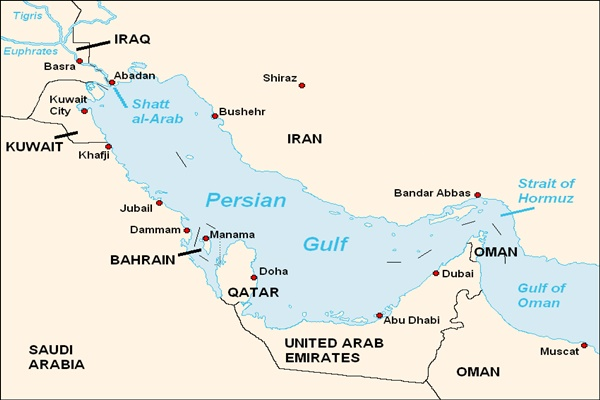
- Background: The Persian Gulf gets its name from Persia, which was the former name for Iran.
- Persia was officially renamed Iran in 1935 after Reza Shah Pahlavi, then Shah of Iran, felt that ‘Persia’ was an exonym – a historical name given by outsiders.
- He decided that the country deserves to be known by its endonym – a name given by its natives.
Moringa
Syllabus: GS2/ Health
In News
- PKM1, a variety of Moringa oleifera, has created a global impact, especially in countries such as Senegal, Rwanda and Madagascar in the African continent.
About Moringa (Moringa oleifera)
- Origin and Distribution:
- Native to India, especially the foothills of the Himalayas.
- Now widely cultivated in South Asia, Africa, and tropical regions of Central and South America.
- Agricultural Requirements:
- Prefers deep sandy loam soil with pH between 6.5–8.0.
- Thrives in semi-arid and tropical climates. Optimal temperature: 25–30°C.
- Drought-resistant and fast-growing — can be harvested multiple times a year.
- Medicinal & Health Uses:
- Used in Ayurveda to treat over 300 conditions.
- Known for anti-inflammatory, antimicrobial, and anti-diabetic properties.
- Seeds are used to purify water due to their coagulating ability.
Source: TH
NAMASTE Yojana
Syllabus :GS 2/Welfare Schemes
In News
- Recently, a special event was held in Madhya Pradesh to highlight the National Action Plan for Mechanized Sanitation Ecosystem (NAMASTE) scheme.
NAMASTE Yojana
- The Ministry of Social Justice and Empowerment in convergence with the Ministry of Housing and Urban Affairs have launched the National Action for Mechanised Sanitation Ecosystem (NAMASTE) scheme in July 2023 to ensure safety and dignity of sanitation workers.
- The focus is on prevention of hazardous cleaning and promotion of safe cleaning practices through trained and certified sanitation workers.
- It aims to ensure safety and dignity of sanitation workers in urban India and enhance their occupational safety through capacity building and improved access to PPE Kits, safety devices and machines.
Source :TH
One Big Beautiful Bill Act
Syllabus: GS2/ International issues
Context
- The United States House of Representatives has passed the One Big Beautiful Bill Act (OBBBA) of 2025, aimed at reshaping the nation’s economic and immigration framework.
Key Provisions of OBBBA
- Permanent Tax Cuts: The bill makes permanent the tax cuts introduced under the 2017 Tax Cuts and Jobs Act (TCJA), which had increased standard deductions and lowered tax brackets.
- Excise Tax on Remittances: A 3.5% excise tax on remittances sent by non-citizens, aiming to disincentivize undocumented immigration and generate federal revenue.
- Raising the Debt Ceiling: It authorizes an increase in the US debt ceiling.
- The debt ceiling is a legislative cap on the amount of national debt the US Treasury can incur.
- Fiscal Prudence: There are measures to cut government spending by targeting “waste, fraud, and abuse” in federal programs.
Implications
- For the US Economy:
- Offers tax relief to middle-income households.
- Aims to boost consumer spending and stimulate growth.
- Raises concerns over long-term fiscal sustainability, especially with simultaneous tax cuts and defence spending increases.
- The remittance tax could impact countries like Mexico, India, Philippines, etc., where remittances form a crucial part of household incomes and foreign exchange reserves.
Source: IE
Tianwen-2 Mission
Syllabus :GS 3/Space
In News
- China is set to launch its first asteroid sampling mission called Tianwen-2.
About Tianwen-2 Mission
- The mission will investigate 469219 Kamo‘oalewa, a near-Earth asteroid that orbits the Sun close to Earth.
- It aims to collect samples from Kamo‘oalewa using a “touch-and-go” technique or possibly an “anchor and attach” method.
- It aims to advance scientific understanding of asteroids and demonstrate China’s growing capabilities in deep-space exploration.
- If successful, China will join the ranks of the U.S. and Japan as one of the few countries to have collected and returned asteroid samples.
Kamo‘oalewa
- It is a small quasi-satellite asteroid of Earth and it was discovered in 2016 by the Pan-STARRS 1 telescope in Hawaii.
- It orbits the Sun but appears to follow Earth due to its unique, elliptical path.
- It has been in its current orbit for about 100 years and is expected to remain for another 300 years.
Source :IE
