
Bonded Labourer in India
Syllabus: GS1/ Social Issue
In Context
- The recent death of nine-year-old Venkatesh, taken as ‘collateral’ for his mother’s unpaid debt vividly illustrates the harsh realities and enduring challenges of bonded labor in India, despite its legal prohibition.
What is Bonded Labour?
- Bonded labour, also known as debt bondage, refers to a situation where a person is forced to work under coercion due to debt, advance payments, or inherited social obligations, often without defined limits or fair wages. It’s not just an economic issue, it’s a structural denial of human dignity.
Current Landscape and Statistics
- Prevalence: As of 2021, an estimated 11 million people in India were living in modern slavery, the highest number globally.
- Rescue and Rehabilitation Efforts: Between April 2024 and January 2025, approximately 250 bonded labourers were rescued in India. However, in the fiscal year 2023-24, only 468 bonded labourers were rehabilitated against an annual target of 1.3 million, highlighting significant gaps in implementation.
- Dominant Social Groups Affected: Studies consistently show that over 80% of bonded laborers are from historically marginalized Scheduled Caste (SC), Scheduled Tribe (ST), and Other Backward Class (OBC) communities, underscoring the deep-rooted social discrimination.
Constitutional and Legal Framework
- Article 23 of the Constitution prohibits beggar and forced labour.
- Article 21 guarantees the right to life with dignity, which bonded labour fundamentally violates.
- The Bonded Labour System (Abolition) Act, 1976 criminalised all forms of bonded labour, extinguished debt obligations, and empowered District Vigilance Committees (DVCs) for enforcement.
- Rehabilitation Scheme (2016): Envisioned the ambitious goal of rescuing 1.84 crore (18.4 million) bonded laborers by 2030.
Persistence of Bonded Labour in India
- Poverty and Indebtedness: Extreme poverty often forces families to take small advances for survival, trapping them in long-term cycles of debt bondage.
- Caste-Based Discrimination: Marginalized communities, particularly Scheduled Castes and Scheduled Tribes, are disproportionately affected due to systemic social inequalities.
- Lack of Enforcement and Data: Weak implementation of the 1976 Act and inadequate monitoring severely hinder effective rescue and rehabilitation efforts. The vast disparity between estimated cases and actual rescues is a stark indicator of this failure.
- Unregulated Informal Sector: The informal economy, employing 90% of India’s workforce, operates with minimal legal or social protections, creating fertile ground for exploitative practices like bonded labor.
- Policy Gaps: A concerning issue is the denial of the existence of bonded labor by some state governments, which delays rehabilitation and legal action. For instance, Maharashtra reportedly omitted bonded labor from its 40-point program post-Emergency.
Challenges in Eradication
- Underreporting: Many cases go unreported due to fear, lack of awareness, or social stigma.
- Inadequate Rehabilitation: Even when victims are rescued, they often do not receive the full benefits entitled to them, hindering their reintegration into society.
- Intergenerational Bondage: Debts and obligations are sometimes passed down, trapping families in cycles of servitude.
Way Ahead
- Strengthen Legal Enforcement:
- Establish Special Task Forces at the district level to monitor, identify, and raid bonded labour operations.
- Ensure strict implementation of the Bonded Labour System (Abolition) Act, 1976, with mandatory FIRs, time-bound trials, and real penalties.
- Recognise bonded labour as organised crime, and treat employers as traffickers where applicable.
- Standard Operating Procedures (SOPs) and State Action Plans:
- Mandate every state to adopt a comprehensive SOP for identification, rescue, rehabilitation, and post-rescue support.
- Ensure regular surveys (as directed by Supreme Court) to map prevalence of bonded labour, especially in high-risk sectors.
- Robust Rehabilitation Framework:
- Strengthen the Central Sector Scheme for Rehabilitation of Bonded Labourers by:
- Disbursing immediate financial relief within 30 days of rescue.
- Linking beneficiaries with livelihood schemes (MGNREGA, PMKVY) and land/housing entitlements (PMAY-G).
- Ensure issuance of Release Certificates even posthumously to enable families to access compensation and justice.
- Empower Vulnerable Communities:
- Develop targeted, holistic social protection schemes for vulnerable SC/ST groups, including guaranteed employment, skill training, access to land rights, housing, and formal credit, to break cycles of indebtedness and provide sustainable livelihoods.
- Improve Institutional Coordination:
- Designate a nodal department in each state for bonded labour with clear roles for Revenue, Labour, Police, and Tribal Welfare Departments.
- Make District Vigilance Committees (DVCs) active and independent with civil society participation and digital tracking of complaints.
- Technology and Monitoring Tools:
- Build a centralised digital database of rescued labourers linked with Aadhaar and used for tracking welfare delivery.
- Launch a 24×7 toll-free distress helpline and mobile app for anonymous reporting of bonded labour.
Push for Russia-India-China Revival
Syllabus: GS2/ IR
In News
- Russia is actively pushing for the revival of the Russia-India-China (RIC) trilateral format, a strategic dialogue that has been largely dormant for nearly five years.
What is the RIC format?
- Initiated in the late 1990s by former Russian Prime Minister Yevgeny Primakov, the RIC format was conceived as a strategic counterweight to Western dominance.
- It facilitated over 20 ministerial-level meetings, promoting cooperation in foreign policy, economics, and security.
- The format lost momentum following the 2020 Galwan Valley incident, which significantly strained India-China relations.
Reasons for Russia’s Push to Revive RIC
- Easing India-China Tensions: Russian Foreign Minister Sergey Lavrov has explicitly stated that the time is ripe for RIC’s revival due to signs of de-escalation in India-China border tensions.
- Countering Western Influence: Russia views the increasing influence of Western alliances like NATO and the Quad (US, Japan, Australia, India) as a threat to regional stability.
- Strengthening Eurasian Security Architecture: Russia aims to promote a “single and equitable system of security and cooperation in Eurasia” through the revived RIC. This aligns with Moscow’s broader objective of establishing a multipolar world order and reducing reliance on Western-centric institutions.
Importance of Russia-India-China (RIC) Trilateral Format
- Geographic and Economic Scale:
- The RIC countries collectively occupy over 19% of the global landmass & contribute to over 33% of global GDP.
- All three nations are members of crucial international groupings such as BRICS, G20, and the Shanghai Cooperation Organization (SCO).
- Promotion of Multilateralism and a Multipolar World Order:
- RIC offers a significant non-Western voice on global issues.
- Russia and China are permanent members of the UN Security Council, giving the RIC considerable diplomatic and strategic leverage on the international stage.
- Eurasian Integration and Connectivity:
- The RIC format can complement and potentially accelerate major regional integration projects like International North-South Transport Corridor (INSTC) & Eurasian Economic Union (EAEU), led by Russia.
- It will enhance regional stability across Eurasia.
Challenges to the RIC Revival
- Lingering India-China Border Disputes: Despite recent diplomatic engagements, unresolved border issues between India and China remain a significant hurdle. A persistent trust deficit could impede the effectiveness of the RIC.
- India’s Strategic Alignments: India’s active participation in the Quad and its deepening ties with Western nations demonstrate its strategic balancing act. Navigating close alignment with both RIC and Western alliances could pose diplomatic complexities for India.
- Russia-China Dynamics: Russia’s growing closeness with China, especially in the wake of the Ukraine conflict, might raise concerns in India about the impartiality of the RIC platform and its potential to become unduly influenced by Beijing.
India and New Zealand: Strengthening Defence and Security Ties
Syllabus: GS2/International Relations
Context
- Recently, New Zealand’s Deputy Prime Minister and Minister of Foreign Affairs visited India and emphasized India’s role as a ‘geopolitical giant’ and an ‘indispensable security actor’.
About India-New Zealand Relations
- India and New Zealand established their diplomatic relations in 1952. Both countries are members of the Commonwealth, sharing democratic values and governance principles.
- They collaborate on regional and global security issues, particularly in the Indo-Pacific. They emphasize freedom of navigation, maritime security, and counterterrorism efforts.
- New Zealand identified India as a priority country in its ‘Opening Doors to India’ policy notified in October 2011, which was reiterated in 2015.
Strategic and Defence Cooperation
- In March 2025, both nations signed a Defence MoU to enhance military cooperation, including staff college exchanges and naval port calls.
- New Zealand’s participation in ‘Combined Task Force 150’ highlights its commitment to maritime security in the Indian Ocean.
- Combined Task Force 150 is based in Bahrain and focuses on maritime security in the Middle East and piracy in the Indian Ocean and Gulf of Aden.
- INSV Tarini, an Indian Naval Sailing Vessel (INSV), a circumnavigation mission under ‘Navika Sagar Parikrama-II’ made a port call at Port Lyttelton recently.
- Earlier, two Indian Naval Ships, INS Sahyadri and INS Kolkata, made port calls in New Zealand in 2023, with one ship visiting Wellington and the other Auckland.
Economic and Trade Relations
- Bilateral Trade (2023-24): $1.75 Billion
- NZ exported US$ 0.84 Billion & imported US$ 0.91 Billion of total goods and services.
- India primarily imports wool, iron & steel, fruits & nuts, and aluminum, while exporting pharmaceuticals, mechanical machinery, and textiles to New Zealand.
- Comprehensive Free Trade Agreement (CFTA): It was announced by both nations, aiming to enhance market access and strengthen supply chain integration in March 2025.
- It is expected to grow with New Zealand’s participation in India’s Indo-Pacific Oceans Initiative (IPOI).
Education and Cultural Exchange
- New Zealand hosts approximately 300,000 persons of Indian origin, contributing to its diverse cultural landscape.
- Additionally, around 8,000 Indian students pursue higher education in fields such as information technology, hospitality, science, engineering, and architecture.
- Tourism and sports, particularly cricket, hockey, and mountaineering, have played a significant role in fostering goodwill between the two nations.
Key Concerns in Bilateral Relations
- Trade Barriers: India’s exit from the Regional Comprehensive Economic Partnership (RCEP) due to concerns over agricultural imports has impacted trade negotiations.
- Geopolitical Challenges: New Zealand’s strong trade ties with China ($24 billion) raise strategic concerns for India.
- Political Sensitivities: India has expressed concerns over anti-India activities in New Zealand, including protests by certain groups.
- While New Zealand upholds free expression, such issues require careful diplomatic handling.
Conclusion
- New Zealand’s renewed focus on India reflects a broader shift in its foreign policy, emphasizing realism, diplomacy, and the significance of small states in global affairs.
- As both nations continue to collaborate on defence, security, and trade, their partnership is set to play a vital role in shaping the Indo-Pacific’s future.
Government Achieves Fiscal Deficit Target of 4.8% for FY25
Syllabus: GS3/ Economy
Context
- The Government of India has successfully met its fiscal deficit target of 4.8% of GDP for the financial year 2024-25, as per provisional data released by the Controller General of Accounts (CGA).
Key Highlights of the FY25 Fiscal Performance
- In 2024–25, the Government of India recorded a fiscal deficit of ₹15.77 lakh crore, which amounted to 4.8% of the GDP, in line with its revised estimates.
- The central government’s total revenue stood at ₹30.78 lakh crore.
- Net tax revenue amounted to ₹24.99 lakh crore, which was 97.7% of the government’s target.
- The government earned ₹10,131 crore from disinvestment of public sector undertakings in 2024–25.
- This contributed to the miscellaneous capital receipts but remained far below the target.
- Total government expenditure stood at ₹46.55 lakh crore, which was 97.8% of the revised estimate.
- Capital expenditure, which refers to spending on long-term assets like infrastructure, reached ₹10.52 lakh crore.
- Revenue expenditure stood at ₹36.03 lakh crore.
What is the fiscal deficit?
- Fiscal Deficit is defined as excess of total budget expenditure (revenue and capital) over total budget receipts (revenue and capital) excluding borrowings during a fiscal year.
- Fiscal Deficit = Total Expenditure – (Revenue Receipts + Non-Debt Creating Capital Receipts).
Implications of fiscal deficit
- Inflationary Pressure: Persistently high fiscal deficits lead to inflation as governments resort to central bank-issued money to finance the deficit.
- Crowding Out effect: When the government borrows a large portion of available funds from financial markets to finance its deficit, it crowds out private investment with reduced access to credit for businesses and individuals.
- Reduced Fiscal Space: A high fiscal deficit limits the government’s ability to respond to economic shocks or crises.
- Difficulty in borrowing: As a government’s finances worsen, demand for the government’s bonds begins to drop, forcing the government to offer to pay a higher interest rate to lenders.
Benefits of lower fiscal deficit
- Improved Credit Ratings: Consistent deficit reduction enhances international credit ratings, lowering borrowing costs in global markets.
- Reduced Debt Servicing: Less spending on interest payments frees funds for development projects like infrastructure, education, and healthcare.
- Improved Balance of Payments: Lower reliance on foreign borrowing stabilizes the exchange rate and current account.
- Enhanced Investor Confidence: Signals fiscal discipline, attracting greater foreign and domestic investments.
| NK Singh committee recommendation – Debt to GDP ratio: The Committee suggested using debt as the primary target for fiscal policy. A debt to GDP ratio of 60% should be targeted with a 40% limit for the center and 20% limit for the states by FY23. – The fiscal deficit to GDP ratio of 2.5% by FY23. – Fiscal Council: The Committee proposed to create an autonomous Fiscal Council with a Chairperson and two members appointed by the center. The role of the Council would include: 1. Preparing multi-year fiscal forecasts, 2. Recommending changes to the fiscal strategy, 3. Improving quality of fiscal data, 4. Advising the government if conditions exist to deviate from the fiscal target. – Deviations: The Committee suggested that grounds in which the government can deviate from the targets should be clearly specified, and the government should not be allowed to notify other circumstances. |
India will have 1 Billion Internet Users by this Fiscal Year
Syllabus: GS2/ E-governance
Context
- The Minister of Communications announced at the India Mobile Congress (IMC) 2025 that India’s Internet user base is set to touch 1 billion by the end of FY26.
- The theme of the IMC 2025 is “Innovate to Transform”.
Growth of India’s Telecom and Internet Sector
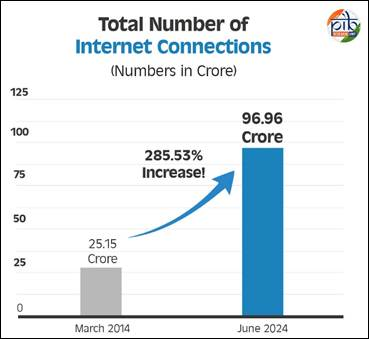
- Internet Penetration Surge: Internet users in India have risen from 250 million (2014) to 974 million, a nearly fourfold increase in a decade.
- Broadband Subscribers: Subscribers with speeds >2 Mbps rose from 66 million in 2014 to 940 million.
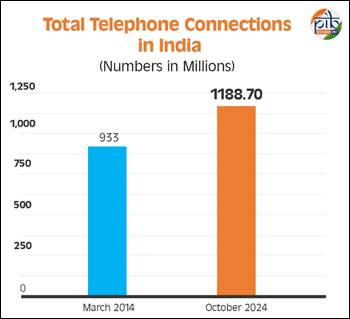
- Mobile Market: The telecom subscriber base increased from 1 billion to 1.2 billion.
- Affordability: Call rates reduced from ₹0.50/minute to ₹0.003/minute.
- Data prices in India have dropped dramatically—from ₹287 per GB to just ₹9 per GB—making it one of the cheapest globally at just 11 cents per GB, compared to the global average of $2.49.
Key Policy Initiatives of GOI
- Prime Minister’s WiFi Access Network Interface (PM-WANI) was launched by the Department of Telecommunication in 2020.
- The scheme aims to enhance the proliferation of public WiFi hotspots to create robust digital communications infrastructure in the country, especially in rural areas.
- BharatNet Project:
- Phase I: Connected 2.14 lakh Gram Panchayats with 7 lakh km of optical fibre.
- Phase II: Target to connect remaining 2.64 lakh Gram Panchayats, totaling connectivity for 3.8 lakh villages.
- Investment: ₹1.39 lakh crore ($16.9 billion) – world’s largest public-sector connectivity program.
- Technology Upgrades in BharatNet II: Use of MPLS routers (better redundancy) instead of GPON.
- Shift from linear to ring topology for uninterrupted service.
- Mandating 10-year maintenance by implementation agencies.
- Setting up a central Network Operating Centre.
- Telecom Manufacturing and Export: From 80% mobile imports to exporting ₹1.75 lakh crore worth of phones.
- The transformation has been driven by the Production-Linked Incentive (PLI) Scheme, which has attracted over ₹4,000 crore in investments, facilitated exports worth ₹16,000 crore, and created around 25,000 jobs.
- Bharat 6G Alliance: It is a collaboration between India’s domestic industry, academia, research institutions, and standards organisations.
- The alliance aims to build a national action plan for 6G, ensuring that India remains at the forefront of technological innovation in the coming decades.
Significance
- Digital Governance Backbone: Enables delivery of digital services like e-governance, telemedicine, and online education to rural areas.
- Inclusive Growth: Empowers the digitally underserved, especially rural and remote regions.
- Global Leadership: India’s telecom affordability and scale, position it as a model for developing nations.
- Economic Multiplier: Internet and telecom expansion enhances productivity, innovation, and investment.
Challenges
- Last-Mile Connectivity: Difficult terrain, low affordability, and lack of digital skills still limit access in remote areas.
- Data Privacy and Cybersecurity: India needs stronger laws and greater public awareness to protect user data.
- Quality of Service: Internet speed and reliability remain uneven despite wide network coverage.
- Skilling: Increased digital access must be supported by basic digital literacy and training programs.
Concluding remarks
- India’s near-billion Internet users mark a paradigm shift in digital empowerment.
- With supportive policies like BharatNet and PLI, the country is not just connecting its people, but also aspiring to lead the global digital future.
South Asia’s ‘largest’ Battery Energy Storage System (BESS) Inaugurated
Syllabus :GS3/Economy/Environment
In News
- The Delhi Power Minister inaugurated a 20-MW Battery Energy Storage System (BESS) at Kilokari, South Delhi .
Battery Energy Storage Systems (BESS)
- Battery Energy Storage Systems (BESS) are large-scale batteries used to store energy from renewable sources like solar and wind for later use.
- They vary in size, design, and technology, and play a crucial role in making green energy more reliable and flexible.
- They can also feed excess power back to the main grid.
- There are three main types: Pre-packaged battery modules (just batteries), pre-packaged systems (batteries plus components like chargers or inverters), and custom-made battery banks (individual batteries assembled with additional components).
BESS in Delhi
- It is the largest utility-scale system in South Asia and India’s first commercially approved energy storage system.
- The 40 MWh system enhances grid stability, reduces peak load stress, integrates renewable energy, and optimizes power purchase costs.
- It uses Lithium Iron Phosphate (LFP) technology, known for safety and thermal stability, and operates efficiently under Delhi’s varied weather conditions.
Need for Battery Energy Storage Systems (BESS) in India
- Integrating Renewable Energy into the Grid: India has ambitious goals of 500 GW of non-fossil capacity by 2030 and net zero by 2070. BESS stores surplus energy during peak generation (e.g., daytime solar) and releases it during demand spikes (e.g., night or cloudy days).
- Reducing Grid Congestion and Curtailment: BESS can decongest the grid, prevent curtailment, and increase utilization of RE infrastructure.
- Supporting Round-the-Clock (RTC) Renewable Power: India is pushing for RTC green power tenders, where RE + storage competes with coal in reliability.
- Enabling Electric Mobility and Charging Infrastructure: BESS can power fast-charging stations, reduce grid stress from EV loads, and enable vehicle-to-grid (V2G) integration.
- Economic Opportunity and Innovation: India has launched a Production-Linked Incentive (PLI) scheme for Advanced Chemistry Cell (ACC) batteries worth ₹18,100 crore that can help in domestic manufacturing & create green jobs.
MISCELLANEOUS
Zoonotic Outbreaks
Syllabus: GS2/ Health
In News
- As per the Integrated Disease Surveillance Program (IDSP), zoonotic outbreaks significantly increased over the years, particularly post-pandemic.
Key Findings of the Study
- Prevalence of Zoonotic Outbreaks: Over 8% (583 out of 6,948) of the reported outbreaks were zoonotic (spread from animals to humans).
- Peak Seasonality: Zoonotic outbreaks consistently peaked during the months of June, July, and August.
- Leading Zoonotic Diseases: Japanese encephalitis accounted for the largest share (29.5%) then Leptospirosis (18.7%) & scrub typhus (13.9%).
- Geographical Distribution: The Northeast part of India contributed the highest proportion (35.8%) of zoonotic disease outbreaks followed by the southern region (31.7%) & western region (15.4%).
Why is Zoonotic Surveillance Significant?
- Due to climate change, deforestation, and expanding urbanisation, human-wildlife contact is increasing which can elevate the chances of pathogen spillover from animals to humans & threatens to strain India’s already burdened public health infrastructure.
Initiatives Taken to Combat Zoonotic Diseases
- Integrated Disease Surveillance Programme (IDSP) was launched in 2004 to track epidemic-prone diseases.
- The National One Health Mission envisioned under the Department of Biotechnology aims to integrate animal health, human health, and environment monitoring.
- National Centre for Disease Control (NCDC) (Zoonosis Division) conducts outbreak investigations and develops standard treatment protocols for zoonotic diseases like JE, leptospirosis, brucellosis, and rabies.
Source: TH
1st Round of India-Chile CEPA Negotiation Concludes
Syllabus: GS2/ IR
In News
- India and Chile have completed the first round of negotiations for a proposed comprehensive free trade agreement.
About
- The next round of negotiations is expected in July-August, 2025. India and Chile aim to conclude their trade negotiations for a Comprehensive Economic Partnership Agreement (CEPA) by 2026.
- India and Chile already have a Partial Scope Agreement (PSA) since 2007, which was expanded in 2017.
- Despite this, trade volumes remained modest, with bilateral trade standing at around $3 billion in 2023–24, dominated by copper imports from Chile and automobiles and pharmaceuticals from India.
Key Points
- The Terms of Reference (ToR) for negotiating the India-Chile CEPA were signed on May 8, 2025.
- The first round of CEPA negotiations covered 17 thematic tracks, including trade in goods, services, movement of natural persons, rules of origin, sanitary and phytosanitary measures, technical barriers to trade, customs procedures, investment promotion, MSMEs, and critical minerals.
- The CEPA aims to unlock the full potential of the trade and commercial relationship between India and Chile, boosting employment, bilateral trade, and economic growth.
| About Chile – Location: 1. The western part of South America. 2. The capital and largest city is Santiago, and its national language is Spanish. 3. It occupies a long, narrow strip of land between the Andes to the east and the Pacific Ocean to the west. 4. Chile is the southernmost country in the world, the closest to Antarctica. Borders: 1. It shares land borders with Peru to the north, Bolivia to the northeast, Argentina to the east, and the Drake Passage in the far south. Climate and Topography: 1. Chile is home to a significant portion of the Andes, the world’s longest continental mountain range. 2. Located in northern Chile, the Atacama Desert is renowned as the driest non-polar desert in the world. 3. Loa River is the longest river of Chile. 4. Chile is located along a highly seismic and volcanic zone, part of the Pacific Ring of Fire, due to the subduction of the Nazca and Antarctic plates in the South American plate. – Resources: 1. Chile is the world’s largest producer of copper. 2. As a member of the “Lithium Triangle” (along with Argentina and Bolivia), Chile holds over 75% of global lithium reserves, primarily found under salt flats. – Membership: 1. UN, OECD, Pacific Alliance, CELAC |
Source: PIB
Goa Achieves Full Functional Literacy under ULLAS
Syllabus: GS2/ Education
Context
- Goa has officially achieved the status of a fully literate state under the ULLAS – Nav Bharat Saaksharta Karyakram (New India Literacy Programme).
- It has become the second state in India after Mizoram, to surpass the 95% literacy threshold, as defined by national standards.
ULLAS – Nav Bharat Saaksharta Karyakram (New India Literacy Programme)
- It is a centrally sponsored scheme implemented from 2022-2027.
- The scheme, aligned with NEP 2020, targets adults (aged 15 years and above) who can’t go to school.
- It has five components: Foundational Literacy and Numeracy, Critical Life Skills, Basic Education, Vocational Skills and Continuing Education.
- The vision of the ULLAS Scheme is to make India Jan Jan Saakshar and is based on the spirit of Kartavya Bodh and is being implemented on volunteerism.
| About Literacy – As per the Office of the Registrar General of India, a literate person is someone aged 7 or above who can read and write with understanding in any language. – The Department of School Education and Literacy has introduced a refined definition of literacy aligned with NEP 2020 and SDG 4.6 goals. 1. Literacy is now defined as the ability to read, write, and compute with comprehension, along with critical life skills such as digital and financial literacy. This expanded definition aims to ensure full societal participation and economic progress. 2. A state/UT achieving 95% literacy is considered fully literate. |
Source: PIB
City Gas Distribution (CGD) Project
Syllabus: GS3/Economy
In News
- Prime Minister Narendra Modi laid the foundation stone for a ₹1,010 crore City Gas Distribution (CGD) project in Alipurduar and Cooch Behar districts of West Bengal, aiming to expand clean energy infrastructure.
More About the News
- The PM outlined India’s progress in expanding its gas network, noting that city gas services have grown from 66 districts in 2014 to over 550 today.
- He credited schemes like Pradhan Mantri Ujjwala Yojana for improving the lives of poor women by providing LPG access and reducing indoor pollution.
- He also stressed the importance of the Urja Ganga project in bringing gas pipelines to eastern India, boosting energy access and job creation.
City Gas Distribution (CGD) project
- The City Gas Distribution (CGD) project, worth over Rs 1010 crore, aims to provide Piped Natural Gas (PNG) to more than 2.5 Lakh households, over 100 commercial establishments and industries .
- It will also provide Compressed Natural Gas (CNG) to vehicular traffic by establishing around 19 CNG stations in line with the Minimum Work Program (MWP) targets stipulated by the Government.
- It falls under the Minimum Work Programme (MWP) targets set by the government to expand India’s gas-based economy.
- It will provide convenient, reliable, environment-friendly and cost-effective fuel supply and create employment opportunities in the region.
Source :PIB
Indian Space Situational Assessment Report (ISSAR) for 2024
Syllabus: GS3/ Science and Technology
Context
- The Indian Space Research Organisation (ISRO) released the Indian Space Situational Assessment Report (ISSAR) for 2024 compiled by ISRO System for Safe and Sustainable Space Operations Management (IS4OM).
Global Scenario
- Record Number of Launches: 2024 recorded 261 launch attempts globally — the highest since the space age began — with 254 successful launches that placed 2,963 objects in orbit, including 2,578 operational satellites.
- Lunar Ambitions Resurface: Five lunar missions were launched in 2024, indicating renewed global interest in lunar exploration.
- Space Debris from Break-ups: Three major on-orbit break-up events occurred in 2024.
- A major incident involving China’s Long March rocket (CZ-6A) contributed ~650 catalogued debris.
- Net addition of 702 fragmented objects, significantly higher than the 69 in 2023.
- Record Re-entries and Impact of Solar Activity: 2,095 catalogued objects re-entered Earth’s atmosphere.
Indian Scenario
- Total Launched: 136 Indian spacecraft in Earth orbit till 2024, including those from private and academic institutions.
- Operational Satellites: 22 in Low Earth Orbit (LEO) and 31 in Geostationary Orbit (GEO).
- Active deep space missions: Chandrayaan-2 Orbiter (CH2O)
- Aditya-L1 at Sun-Earth Lagrange point.
- Chandrayaan-3 Propulsion Module, relocated to a high Earth orbit.
- Historical Debris: The PSLV-C3 upper stage, which broke up in 2001, created 371 debris, with 41 pieces still in orbit.
- Satellite Re-entries: 31 Indian satellites have decayed so far and 9 re-entered in 2024.
