
Bhagwan Birsa Munda
Syllabus: GS1/ History
In News
- PM pays tribute to Bhagwan Birsa Munda on the occasion of his Martyr’s Day.
About Bhagwan Birsa Munda
- Early Life:
- Born on 15th November 1875 in Ulihatu of the erstwhile Bengal Presidency.
- An Indian freedom fighter, religious leader and folk hero from the Munda Tribe.
- Learned teachings from a Vaishnav monk.
- Founder of New Religion “Birsait”:
- He believed in One God.
- Munda and Oraon community people joined the sect & challenged British conversion activities of tribals.
- He preached strong Anti-British sentiment through religion.
- Also, referred to as ‘Dharti Abba or Father of Earth’ by his followers.
- Outcomes of the Munda Rebellion:
- In 1895, Birsa Munda was arrested for rioting and imprisoned for 2 years.
- In 1900, Birsa Munda was arrested again and died of cholera in captivity, at the age of just 25.
Munda Rebellion
- A tribal movement led by Munda against the British Raj.
- Also referred to as ‘Ulgulan’ or the ‘Great Tumult,’ to establish Munda raj.
- The rebellion aimed at challenging the colonial land revenue system, Zamindari system, and forced labor imposed on the tribals.
- The movement’s primary grievances were the introduction of the Zamindari system, which displaced tribals from their land, and the exploitation by outsiders or Dikus who took control of tribal lands and resources.
- Birsa Munda and his followers used guerrilla warfare tactics to target symbols of British power, such as police stations, government buildings, and landlords’ establishments.
- Outcomes of the Rebellion:
- The British government introduced the Chotanagpur Tenancy Act in 1908, to prohibit the transfer of tribal land to non-tribals (Dikus).
- Lenient attitude of Britishers towards tribals & maintaining their faith & beliefs.
| Key Initiatives For Tribals – Janjatiya Gaurav Divas: Celebrated on 15th November on the birth anniversary of Bhagwan Birsa Munda. This day serves to recognize and honor the contributions of tribal communities in India, particularly their role in the country’s freedom struggle. – Pradhan Mantri Janjati Adivasi Nyaya Maha Abhiyan (PM-JANMAN): This initiative, launched to support Particularly Vulnerable Tribal Groups (PVTGs), aims to provide basic infrastructure in tribal areas, including pucca houses, clean drinking water, and improved roads. |
Conclusion
- Bhagwan Birsa Munda remains a guiding figure for the tribal communities, especially in Jharkhand, and continues to inspire the fight for tribal rights and social justice in India.
NHAI Releases First-Ever Asset Monetisation Strategy Document
Syllabus: GS2/ Governance
Context
- National Highways Authority of India (NHAI) released its first ever ‘Asset Monetization Strategy for the Road Sector’.
About
- NHAI monetizes assets through three modes: Toll-Operate-Transfer (ToT), Infrastructure Investment Trusts (InvITs), and securitisation models.
- These instruments have helped NHAI raise over ₹1.4 lakh crore across more than 6,100 km of National Highways under National Monetisation Pipeline.
What is Asset Monetization?
- Asset monetization, also commonly referred to as asset or capital recycling, is a widely used business practice globally.
- It entails a limited period license / lease of a public sector asset to a private sector entity for an upfront or periodic consideration through a well-defined concession/ contractual framework.
- Hence, it is a virtuous cycle where existing assets are converted into sources of funds, which are then invested in creating new assets.
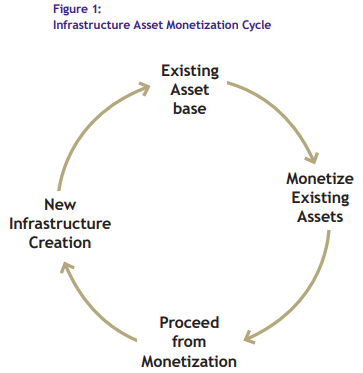
Pillars of Asset Monetization Strategy
- Value Maximation: The objective of this pillar is to codify and structure processes to systematically identify and offer attractive assets for monetization, so as to increase acceptance of bids that maximize value for the government.
- Transparency: The objective of this pillar is to codify processes that aid transparency both within the organization and in communications with investors.
- Market Development: The objective of this pillar is two-fold;
- Broaden the investor base to attract more private participation.
- Enhance stakeholder engagement to increase traction of NHAI’s asset monetization program.
| Key Monetisation Models Used by NHAI Infrastructure Investment Trusts (InvITs) – It is a pooled investment mechanism introduced in 2014 and regulated by Securities and Exchange Board of India (SEBI). – How it works: 1. NHAI transfers toll-operating road assets into a trust structure. 2. Investors buy units of the InvIT and earn returns from toll revenues. 3. Includes an Investment Manager (financial returns) and Project Manager (Operations and Management oversight). Toll-Operate-Transfer (ToT) Model – It is a public-private partnership model introduced in 2016. – How it works: 1. Private players pay a lump sum upfront for toll collection rights of completed highways. 2. They also bear the cost of operation and maintenance. Securitization of Toll Revenues – It is project-based financing by using future revenue streams as collateral. – How it works: 1. NHAI creates a Special Purpose Vehicle (SPV) to raise funds by securitizing future toll receipts. 2. E.g., Delhi-Mumbai Expressway SPV raised ₹40,000 crore using this mechanism. |
Way Ahead
- Scaling Up: More highway projects can be included under the monetisation strategy to unlock additional capital.
- Private Sector Confidence: Ensuring transparent policies and regulatory stability is crucial to boost private participation.
- Capacity Building: Strengthening institutional capacity to structure and manage monetisation deals effectively.
| National Highways Authority of India (NHAI) – The National Highways Authority of India (NHAI) is an autonomous agency of the Government of India, set up in 1995, under the Ministry of Road Transport and Highways (MoRTH). – NHAI was created through the promulgation of the National Highways Authority of India Act, 1988. – Objective: It is primarily responsible for the development, maintenance, and management of National Highways across the country. – Headquarters: New Delhi |
First State/UTs Engagement Workshop Under the National One Health Mission
Syllabus: GS2/ Health, Governance
Context
- The first State and Union Territory Engagement Workshop under National One Health Mission (NOHM) was conducted, charting a collaborative path forward for strengthening India’s integrated One Health approach.
About
- The workshop was chaired by the Principal Scientific Adviser (PSA) bringing together a diverse array of stakeholders.
- Key Highlights:
- The workshop underscored syndromic surveillance and mock drills like Vishanu Yuddh Abhyaas for preparedness.
- Gujarat and Kerala, nominated to the mission’s governance committee, presented their progress in building One Health infrastructure.
- The launch of a Youth Engagement Program to harness the energy and innovation of the country’s youth through hackathons and digital campaigns.
- One Health Dashboard: A central dashboard was launched to monitor and map state and central initiatives.
What is the One Health Approach?
- One Health is an integrated, unifying approach that aims to sustainably balance and optimize the health of people, animals and ecosystems.
- It recognizes that the health of humans, domestic and wild animals, plants, and the wider environment (including ecosystems) are closely linked and interdependent.
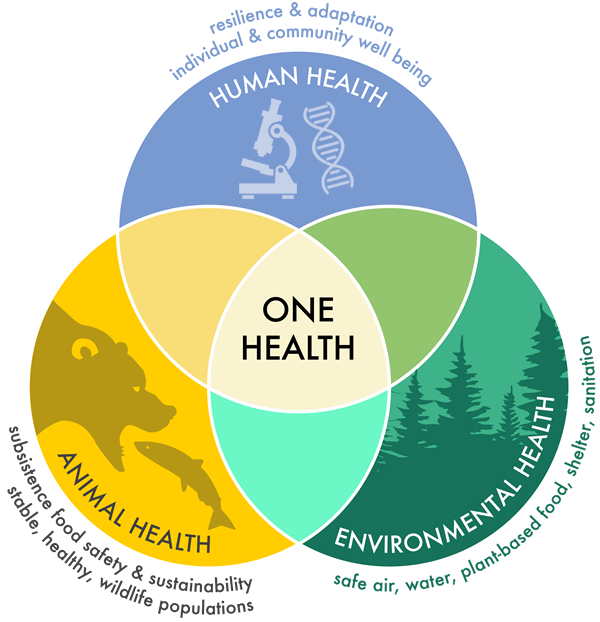
National One Health Mission
- The National One Health Mission (NOHM) exemplifies the Government of India’s commitment to leveraging cutting-edge science in real-world settings to anticipate and mitigate public health risks.
- The key pillars of the NOHM are:
- Technology enabled integrated surveillance across sectors.
- National network of Biosafety Level 3 (BSL-3) laboratories (for testing high-risk or unknown pathogens).
- Collaborative and integrated R&D for medical countermeasures including vaccines, diagnostics, and therapeutics for human-animal-wildlife-livestock health.
- Data integration across sectors.
- Training and capacity building in all spheres related to One Health.
Challenges in Operationalizing One Health
- Intersectoral Coordination: Fragmented institutional silos between human, animal, and environmental health bodies.
- Lack of Trained Workforce: Shortage of epidemiologists, zoonotic disease experts, and data scientists at the district level.
- Infrastructural Disparities: States vary in surveillance capabilities and digital health integration.
- Data Privacy & Sharing: Ensuring secure and effective real-time data flow between sectors remains a concern.
Way Ahead
- Decentralised Planning: States should localize the One Health model based on regional risks (e.g., zoonotic hotspots).
- Institutional Mechanisms: Permanent state-level One Health Cells and convergence with existing bodies like State Disaster Management Authorities (SDMAs).
- Public Awareness: Leverage campaigns and youth engagement to increase awareness of One Health.
- The states/UT’s should consider creating their own One Health dashboards and websites and link it with the central dashboard/website.
Hate Speech
Syllabus: GS2/Governance
In News
- Rajya Sabha may form a panel to probe hate speech charges against HC judge.
| Do you know? – Articles 124 and 217 of the Constitution provide that a judge of the Supreme Court/High Court shall be removed by the President, on the grounds of ‘proved misbehaviour’ or ‘incapacity’ after a motion is passed in each House of Parliament by a majority of the total membership of that House and by a majority of not less than two thirds of the members of that House present and voting (special majority) in the same session. – The Judges (Inquiry) Act, 1968 outlines the removal process for judges. 1. A motion must be signed by at least 50 Rajya Sabha members or 100 Lok Sabha members. 2. The Chairman or Speaker can admit or reject the motion after review and consultation. |
What is ‘hate speech’?
- Hate speech lacks a specific legal definition but generally refers to speech, writings, or actions that incite violence or spread hatred and disharmony between communities.
- According to the Law Commission of India, hate speech targets groups based on race, ethnicity, gender, religion, etc., intending to cause fear, alarm, or incite violence.
- It is viewed as a restriction on free speech to protect individuals or groups from hate, violence, or humiliation.
- The Law Commission has proposed adding two new IPC sections—153C and 505A—to specifically criminalize hate speech.
How is it treated in Indian law?
- In Indian law, hate speech is primarily addressed under Sections 153A (now Section 196 of the Bharatiya Nyaya Sanhita) and 505 of the IPC (now Section 353 of the Bharatiya Nyaya Sanhita).
- Section 153A criminalizes promoting enmity between groups based on religion, race, language, etc., punishable by up to three years in prison, or five years if done in places of worship.
- Section 505 penalizes statements that incite public mischief, fear, or hatred between communities, with jail terms up to three years, or five years if occurring in religious settings.
Issues and Concerns
- Enforcement of hate speech laws in India is inconsistent and often influenced by bias.
- The rise of social media has further complicated regulation by providing new platforms for spreading hate.
Suggestions and Way Forward
- India must carefully balance free speech with controlling hate speech to preserve peace, equality, and the rule of law.
- This requires stronger laws, fair enforcement, and greater public awareness.
Monaco Marine Conference
Syllabus: GS2/Global Grouping; GS3/Environment
Context
- Recently, India and Norway reaffirmed their commitment to strengthening cooperation in marine planning, Arctic research, and the Blue Economy at the Monaco Marine Conference (MCC).
Key Points
- Marine Spatial Planning (MSP): India aims to scale Marine Spatial Planning (MSP) across its coastline reinforcing its leadership in sustainable ocean management.
- MSP is a science-based framework for optimizing ocean resources, protecting biodiversity, and ensuring coastal livelihoods, under the Indo-Norwegian Integrated Ocean and Research Initiative.
- It has already yielded visible outcomes, particularly through pilot projects in Puducherry and Lakshadweep.
- India-Norway Marine Pact: Both nations emphasized the importance of joint research in polar sciences and ocean sustainability.
- Strengthening bilateral cooperation in marine planning, Arctic research, and ocean sustainability.
- Norway, with 70% of its exports originating from its maritime industry, is a recognized expert in the Ocean Economy.
- SAHAV Portal: It is a GIS-based decision support system, recognized as a Digital Public Good.
- It was introduced to mark World Ocean Day (i.e. 8th June).
India-Norway Relations
- About: India and Norway have maintained a cordial and friendly relationship since 1947, built on shared values like democracy, human rights, and the rule of law.
- Political and Diplomatic Engagement:
- 2014: It strengthened cooperation in Earth Sciences, Culture, Defence, and Scientific Research.
- 2019: It led to the signing of the India-Norway Ocean Dialogue, reinforcing maritime collaboration.
- India-Nordic Summit (2022): It focused on blue economy, renewable energy, green hydrogen, and sustainable shipping.
- Trade and Investment:
- In March 2025, Norway’s exports to India increased by 48% year-on-year. Key Norwegian exports include non-ferrous metals (like raw nickel), chemical materials, and metalliferous ores.
- The recent signing of the India-EFTA Trade and Economic Partnership Agreement (TEPA) in March 2024 is a significant milestone, expected to boost trade and investment between India and Norway.
- Scientific and Environmental Cooperation:
- India and Norway collaborate on polar research, marine spatial planning, and climate action.
- India has undertaken three Arctic Missions to Norway (in 2007, 2008, and 2009). India’s Polar Research Station, “Himadri,” is located at Ny Alesund, Spitsbergen Island, Norway.
- Export Control Regimes: Norway has supported India’s membership in key export control regimes, including the Missile Technology Control Regime (MTCR), the Wassenaar Arrangement (WA), and the Australia Group (AG).
| What is the Blue Economy? – Blue Economy refers to the sustainable use of ocean resources for economic growth, improved livelihoods, and environmental health. 1. India’s vision aligns with global efforts to balance economic development with marine ecosystem protection. – The Blue Economy is also reflected in Sustainable Development Goal (SDG 14), which advocates for the conservation and sustainable use of oceans, seas, and marine resources for sustainable development. – For India, with its extensive coastline of 11,098km spanning nine states and two union territories, and an Exclusive Economic Zone (EEZ) of 2.02 million sq.km, the Blue Economy holds significant potential. Key Policy Frameworks and Initiatives – National Blue Economy Policy Framework: It was outlined by the Economic Advisory Council to the Prime Minister, focusing on marine fisheries, coastal tourism, and ocean-based industries. – Pradhan Mantri Matsya Sampada Yojana (PMMSY): It aimed at boosting fisheries and aquaculture, contributing to India’s Blue Economy. |
Govt Notifies SEZ reforms to Boost Semiconductor, Electronics Component Manufacturing
Syllabus: GS3/ Economy
In News
- The Union government notified key amendments to the Special Economic Zones (SEZ) Rules, 2006, to ease the establishment of semiconductor and electronics component manufacturing units.
Major Reforms in SEZ Regulations
- Reduction in Minimum Land Requirement: Rule 5 has been amended to reduce the minimum land requirement for semiconductor and electronics component manufacturing SEZs from 50 hectares to 10 hectares.
- Impact: This change lowers the entry barrier for firms looking to set up operations in this crucial sector, making it easier for smaller players to enter the market.
- Relaxation on Land Encumbrance Requirements: Rule 7 now allows the Board of Approval to relax the condition of requiring SEZ land to be encumbrance-free.
- Impact: This flexibility will help overcome land acquisition challenges for companies.
- Inclusion of Free Goods in Net Foreign Exchange (NFE) Calculations: Amended Rule 53 to allow free-of-cost goods to be included in the Net Foreign Exchange (NFE) calculations for SEZ units.
- NFE is the net amount of foreign exchange that a company earns through its exports (such as the sale of goods or services to foreign markets) after deducting its imports (such as the purchase of goods or services from foreign countries).
About Special Economic Zones (SEZs)
- Definition: They are designated areas within a country that operate under different economic regulations compared to the rest of the nation.
- Purpose: The primary goal of establishing SEZs is to promote rapid economic growth by attracting domestic and foreign investment, boosting exports, and generating employment opportunities.
- Legalisation: India was one of the first countries in Asia to adopt the EPZ model in 1965 with the Kandla EPZ. The Special Economic Zones Act was passed in India in 2005 to provide a legal framework.
- Baba Kalyani Committee (2018): Formed to review the SEZ policy and make recommendations for its revitalization, including making it WTO-compatible, maximizing land utilization, and integrating it with other government schemes.
- Proposed DESH Bill (Development of Enterprise and Service Hubs): Aims to replace the existing SEZ Act.
| Key Initiatives for Semiconductor and Electronics Manufacturing – India Semiconductor Mission (ISM): Launched in December 2021, ISM is the nodal agency for the efficient and seamless implementation of semiconductor and display schemes. – Design Linked Incentive (DLI) Scheme: Offers financial incentives and design infrastructure support across various stages of development and deployment of semiconductor designs. – PLI for Large Scale Electronics Manufacturing: Notified in April 2020, it offers an incentive of 4% to 6% on incremental sales (over base year) of goods manufactured in India. – Semi-Conductor Laboratory (SCL), Mohali: To enhance its efficiency and cycle time, contributing to indigenous R&D and specialized fabrication. |
