
District & State Level Cells: Forest Rights Act, 2006
Syllabus: GS2/Government Policy & Intervention; GS3/Environment
Context
- Recently, the Union Ministry of Tribal Affairs has sanctioned the establishment of 324 district-level FRA cells and 17 state-level FRA cells under the Dharti Aba Janjatiya Gram Utkarsh Abhiyaan to ‘facilitate’ implementation of Forest Rights Act, 2006.
What Are FRA Cells?
- FRA Cells are State and District-level administrative units created under the Dharti Aba Janjatiya Gram Utkarsh Abhiyaan (DAJGUA) to accelerate the implementation of the Forest Rights Act, 2006 (FRA).
- These cells are not created under the FRA 2006 legislation, but under an administrative scheme by the Ministry of Tribal Affairs.
- The newly established FRA cells aim to facilitate the implementation of the FRA, particularly in districts and states where a large number of claims remain pending.
- These cells also aim to assist claimants and Gram Sabhas in preparing paperwork for FRA claims, managing data efficiently, and streamline administrative processes.
- These also aim to accelerate the disposal of pending claims, especially those delayed even after District Level Committee (DLC) approval.
- These cells will not interfere with decisions made by the Gram Sabha, Sub-Divisional Level Committees (SDLCs), District Level Committees (DLCs), or State government departments.
Current Status
- About 14.45% of the 51.11 lakh FRA claims across 21 states and union territories remain pending.
- Least FRA Pendency: Chhattisgarh, Madhya Pradesh, Maharashtra, and Jharkhand
- However, in Assam (over 60%), and in Telangana (around 50.27%) claims are pending.
- The highest number of district FRA cells sanctioned so far has been in Madhya Pradesh, followed by Chhattisgarh, Telangana, Maharashtra, Assam, and Jharkhand.
About the Forest Rights Act (FRA), 2006
It is officially known as the Scheduled Tribes and Other Traditional Forest Dwellers (Recognition of Forest Rights) Act, 2006.
- It was enacted to recognize the rights of Scheduled Tribes and Other Traditional Forest Dwellers (OTFDs) over forest land.
- It ensures that Scheduled Tribes (STs) and other traditional forest dwellers can legally access and manage forest resources while contributing to biodiversity conservation.
- It impacts an estimated 150 million forest-dwelling people, 40 million hectares of land, and 1,70,000 villages.
Concerns Over New FRA Cells
- Parallel Governance: Creation of FRA cells outside the statutory FRA framework may lead to a dual structure, diluting accountability.
- Lack of Legal Backing: The FRA cells have no statutory authority, unlike SDLCs and DLCs.
- Potential Duplication: May lead to bureaucratic overlap, blurring of accountability
Israel-Iran Conflict
Syllabus: GS2/IR
Context
- After the IAEA resolution accused Iran of nuclear non-compliance (first such resolution in two decades), Israel launched Operation Rising Lion, a coordinated military strike targeting Iran’s nuclear and missile infrastructure.
About
- Israeli officials have described this operation as an “existential battle” to eliminate Iran’s ability to pose a long-term threat to Israel.
- The two states have been at conflict since the founding of the Islamic Republic in 1979, but Israel’s attacks are a definite major escalation of the conflict.
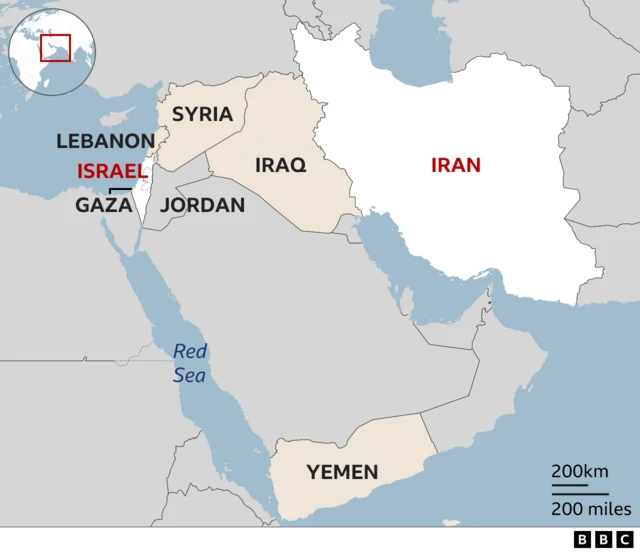
Iran’s Proxy Warfare Strategy
- Over the years, Iran has developed a network of armed non-state groups across the region to exert influence and challenge Israel without engaging directly.
- These include: Hamas in Palestine, Hezbollah in Lebanon, Houthis in Yemen and Popular Mobilisation Forces (PMF) in Iraq.
- This proxy model has allowed Iran to:
- minimize its own risks and costs;
- retain a layer of deniability while supporting actions against Israel;
- tie down Israeli military capabilities across multiple fronts.
- Strategic Impact of Iran’s Proxy Network: Through this strategy, Iran has managed to extend its influence well beyond its borders, impacting areas as far as the Mediterranean Sea, the Red Sea and the northern Arabian Sea.
- This indirect warfare has helped Iran strengthen its geopolitical position without triggering large-scale retaliation—until now.
Israel’s Ongoing Dilemma with Proxies
- Despite repeated military strikes against Iran-backed groups, Israel has been unable to completely eliminate or neutralize them.
- For instance, Hamas continues to operate in Gaza despite significant Israeli military action.
- Hezbollah still poses a threat from Lebanon.
- The Houthis have withstood Israeli-aligned efforts despite attacks on infrastructure like the Sanaa airport.
- Many of these groups, except Hamas, are heavily dependent on Iranian support, especially in terms of weapons and training.
Shift in Israeli Military Strategy
- Israel appears to have concluded that targeting these proxies individually is not enough to ensure long-term security.
- The new approach targets the root of the problem — Iran itself, which supports and sustains the “Axis of Resistance.”
- Previous direct confrontations between the two countries in 2024 did not change the strategic balance. However, they revealed that many regional countries tacitly support Israel’s stance against Iran.
Implications of the Iran-Israel Conflict
India will have to balance relations between Israel, Iran, and Arab countries, maintaining neutrality while protecting its strategic interests.
Escalation of Proxy Conflicts: Iran’s regional proxies — Hamas, Hezbollah, Houthis, and PMF — may retaliate, opening multiple fronts and turning the war into a wider Middle Eastern conflict.
Destabilization of Fragile States: Countries like Lebanon, Iraq, Syria, and Yemen could witness a surge in violence, leading to internal political chaos and humanitarian crises.
Maritime Insecurity: Key shipping routes like the Strait of Hormuz, Bab el-Mandeb, and Eastern Mediterranean may face threats, disrupting global trade and energy supply.
Oil Price Surge: A direct war involving Iran — a major oil producer — risks disrupting global oil exports, potentially triggering a spike in oil prices and inflation worldwide.
Derailment of Iran Nuclear Deal Talks: Ongoing efforts to revive the Joint Comprehensive Plan of Action (JCPOA) are likely to collapse, ending hopes for a peaceful nuclear settlement.
Strengthening Iran’s Resolve: Israeli strikes on nuclear facilities may encourage Iran to accelerate its nuclear weapons program under the pretext of national defense.
Arms Race in the Region: Gulf countries like Saudi Arabia may push for nuclear capabilities, intensifying the regional arms race.
Reconfiguration of Regional Alliances: Arab states fearful of Iranian aggression may deepen cooperation with Israel.
Regional powers like Turkey may recalibrate their roles to balance influence, while Russia may attempt to exploit the crisis for strategic gains.
India’s Strategic and Economic Concerns: Over 60% of India’s crude oil comes from the Middle East; instability can disrupt supplies and widen the current account deficit.
Millions of Indian citizens work in the Gulf; escalation may require emergency evacuations and increase remittance risk.
India and France Agree to Intensify Cooperation
Syllabus: GS2/IR
Context
- External Affairs Minister S Jaishankar held wide-ranging discussions with French counterpart and the two sides agreed to intensify bilateral cooperation in areas like defence, security, space and civilian-nuclear collaboration.
Major Highlights of the India-France Relations
- India–France Strategic Partnership: It was launched on 26 January 1998 and is India’s first-ever Strategic Partnership.
- Core vision: Enhance strategic autonomy and deepen bilateral cooperation.
- Key Strategic Pillars: Defence and security, Civil nuclear cooperation and Space collaboration.
- Expanding areas: Indo-Pacific cooperation, maritime security, digitalisation, cyber security, climate change, sustainable development, advanced technologies, and, counter-terrorism.
- Defence Cooperation: It is reviewed via the Annual Defence Dialogue (Minister-level) and High Committee on Defence Cooperation (HCDC) (Secretary-level).
- Rafale Fighter Jets: India procured 36 Rafales from Dassault Aviation.
- Scorpene Submarines (Project P-75): Collaboration with France’s Naval Group, 6 submarines built in India; latest is INS Vaghsheer.
- Combat Aircraft Engine Development: HAL and France’s Safran Helicopter Engines signed an agreement under the IMRH programme to co-develop engines.
- Recently both nations formally concluded an Inter-Governmental Agreement (IGA) to procure 26 Rafale-M fighter jets for the Indian Navy.
- Future plans: Co-development of next-gen fighter jet engines
- Joint Exercises: Shakti, Varuna, FRINJEX-23.
- Economic Cooperation: Within the European Union, France remains India’s fifth-largest trading partner, following the Netherlands, Belgium, Italy, and Germany.
- The bilateral trade between India and France has more than doubled in the last decade to USD 15.11 Billion in 2023-24.
- Both countries are also moving to jointly develop technologies and integrate existing technologies.
- The process of enabling Unified Payment Interface (UPI) has been successful in France.
- French technologies especially in renewables, sustainable manufacturing and urban infrastructure development are being integrated in India.
- Space Cooperation: There is a over 60 years of collaboration between ISRO and CNES (French space agency)
- France is a key supplier of components, launch services (Arianespace).
- Joint missions: TRISHNA (satellite mission), MDA systems, ground station support.
- Energy Cooperation:
- International Solar Alliance (ISA): Co-founded by India and France in 2015 to promote solar energy worldwide.
- Nuclear Energy Cooperation: The first meeting of special task force on nuclear energy in the framework of the Indo-French Strategic Dialogue, was convened in 2025.
- Both sides have agreed to work on establishing a partnership on low and medium power modular reactors or Small Modular Reactors (SMR) and Advanced Modular Reactors (AMR).
- Community: There are an estimated 1,19,000 Indian community in mainland France, largely originating from erstwhile French colonies.
Areas of Concern
- Trade Imbalance: Bilateral trade remains below potential, especially compared to India’s trade with other EU nations.
- Technology Transfer & Defence Restrictions: While France has supported India’s defence goals, there are concerns over the depth of technology transfer in big-ticket items.
- Nuclear Liability Concerns: Despite a civil nuclear agreement in 2008 and plans for reactors at Jaitapur, progress has been slow.
- The Civil Liability for Nuclear Damage Act (2010) poses hurdles for French firms as it imposes liability on suppliers in the event of a nuclear accident.
- Geopolitical Differences: France’s strong economic ties with China may sometimes dilute full alignment with India on Indo-Pacific issues.
- Differences in approach to Middle East geopolitics (e.g., stance on Iran, Israel–Palestine) occasionally diverge.
Future Outlook
- Horizon 2047 Roadmap envisions: To mark the 25th anniversary of the Indo-French partnership, both countries agreed to adopt a roadmap to set the course for the bilateral relationship up to 2047.
- Joint development and production of advanced defence technologies.
- Export of jointly developed products to third countries for global good.
- Deeper maritime and space security cooperation.
- Growing convergence in the Indo-Pacific through strategic dialogue and joint military presence.
Conclusion
- India–France defence cooperation is a cornerstone of their wider Strategic Partnership.
- With shared interests in sovereignty, multilateralism, and regional stability, both countries are set to elevate ties further under the Horizon 2047 vision — making defence ties more collaborative, innovative, and export-oriented.
Make Digital Literacy Part of Curriculum to Curb Online Child Sexual Abuse
Syllabus :GS1/Social Issues
In News
- A pilot study in Karnataka on online sexual exploitation and abuse of children recommends making digital literacy and online safety mandatory in schools from the primary level.
About the study
- It was conducted by ChildFund India and the Karnataka State Commission for Protection of Child Rights (KSCPCR).
- It surveyed 903 children aged 8 to 18, found that online risks have increased significantly, particularly during the COVID-19 pandemic.
- It highlights the crucial role of parents, teachers, policymakers, and communities in protecting children online.
Online child sexual abuse and exploitation
- Online child sexual abuse and exploitation involve using technology to sexually harm children, often through force, coercion, or manipulation.
- Child sexual abuse refers to abusive contact or interactions where a child is used for sexual purposes against their will, while child sexual exploitation includes such abuse combined with an exchange of favors like food or shelter.
Causes
- Many children annually fall victim to online sexual abuse and exploitation, worsened by the misuse of existing and emerging technologies like AI, deepfakes, and voice cloning.
- These technologies facilitate harassment, non-consensual sharing of images, child sexual abuse materials, extortion, and livestreaming of abuse.
- Vulnerable and marginalized children are disproportionately affected.
- Despite laws, cultural stigma and fear of backlash prevent many victims from seeking justice.
Impacts
- Sexual abuse of children is a gross violation of their rights and a global public health problem.
- It adversely affects the health of children and adolescents.
Laws cross the globe
- International and regional conventions, like the 1989 Convention on the Rights of the Child and the 2007 Lanzarote Convention, set out children’s rights and require states to protect children from sexual exploitation and abuse.
- These agreements focus on preventing abuse, protecting victims, prosecuting offenders, and fostering cooperation for effective investigation and prevention of such crimes.
Status In India
- Presently, Section 67B of the IT Act 2000 punishes those who publish or transmit material in electronic form depicting children in sexually explicit acts.
- Sections 13, 14, and 15 of the Protection of Children from Sexual Offences Act, 2012 (POCSO) prohibit using children for pornographic purposes, storing child pornography in any form, and using a child for sexual gratification.
- Additionally, Section 294 of the Bharatiya Nyaya Sanhita penalises the sale, distribution, or public exhibition of obscene materials, while Section 295 makes it illegal to sell, distribute, or exhibit such obscene objects to children.
Suggestions
- The existing legislative and policy framework in India needs to adapt to futuristic challenges, by making suitable changes
- It requires a holistic approach to include digital literacy, awareness of online rights, strong support systems, and ethical digital behavior.
- Education on consent, privacy, and responsible technology use, as well as updated laws to address AI-generated abuses, are critical.
- There is a need to enhance parental supervision, teacher training, and foster open communication between children and parents.
Agri Stack Under Digital Agriculture Mission (DAM)
Syllabus: GS3/ Agriculture
In News
- The Ministry of Agriculture & Farmers’ Welfare hosted the National Conference on Agri Stack under the Digital Agriculture Mission (DAM).
What is Agri Stack?
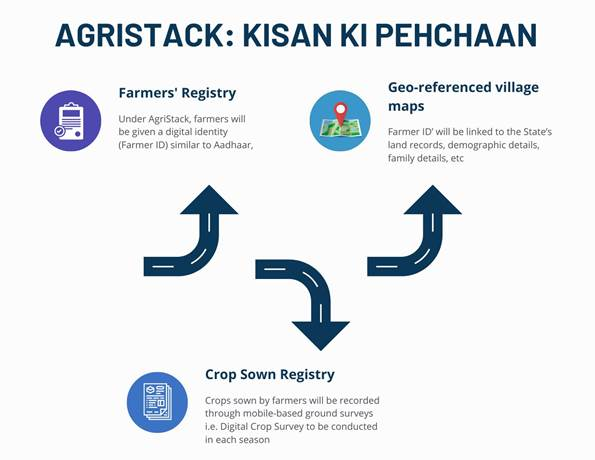
- Agri Stack is a digital ecosystem of technology platforms that integrates farmer identity, land records, crop data, and scheme benefits.
- Its core idea is to personalized agricultural service delivery using data-driven tools.
- For example: Linking Agri Stack with PM-KISAN, PMFBY, KCC, and MSP procurement to ensure targeted benefits.
Key Highlights of the Conference
- Emphasized the importance of digital land records and Aadhaar seeding for accurate farmer identification.
- The Ministry provided an overview of Agri Stack, including the integration of Farmer ID with flagship schemes like PM-KISAN, PMFBY, and KCC.
- CKO introduced the Digitally Verifiable Credential (DVC), also referred to as the Kisan Pehchan Patra, which allows farmers to generate authenticated credentials for specific land parcels and crops. These DVCs are integrated with DigiLocker and dynamically revoked upon land mutation.
- The Special Central Assistance (SCA) Guidelines were launched, allocating ₹6,000 crore to support states: ₹4,000 crore for Farmer Registry (including legal heir systems) and ₹2,000 crore for Digital Crop Survey, on a first-come-first-served basis.
- The Ministry showcased an AI-powered chatbot, trained on Agri Stack data and built using Google Gemini, capable of answering queries in multiple languages.
About Digital Agriculture Mission (DAM)
- The Digital Agriculture Mission is designed as an umbrella scheme to support various digital agriculture initiatives.
- These include creating Digital Public Infrastructure (DPI), implementing the Digital General Crop Estimation Survey (DGCES), and supporting IT initiatives by the Central Government, State Governments, and Academic and Research Institutions.
- It is built on two foundational pillars:
- Agri Stack
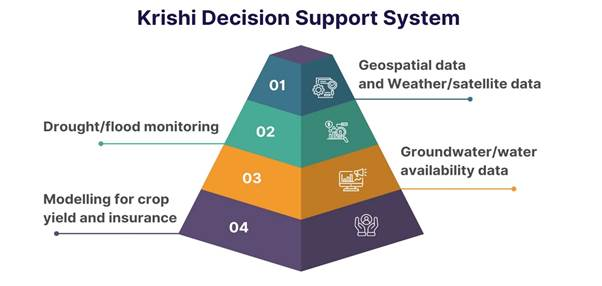
- Krishi Decision Support System.
- AgriStack is designed as a farmer-centric Digital Public Infrastructure (DPI) to streamline services and scheme delivery to farmers. It comprises three key components:
The Krishi Decision Support System (DSS) will integrate remote sensing data on crops, soil, weather, and water resources into a comprehensive geospatial system.
Benefits of the Digital Agriculture Mission (DAM)
- Digital authentication for accessing services and benefits, reducing paperwork and the need for physical visits.
- Enhanced efficiency and transparency in government schemes, crop insurance, and loan systems through accurate data on crop area and yield.
- Crop map generation and monitoring for better disaster response and insurance claims.
- Development of digital infrastructure to optimize value chains and provide tailored advisory services for crop planning, health, pest management, and irrigation.
miscellaneous:
Servants of India Society
Syllabus :GS1/History
In News
- Tensions have resurfaced between Pune’s Gokhale Institute of Politics and Economics (GIPE) and the Servants of India Society (SIS) over control of a joint bank account and allegations of financial misconduct.
The Servants of India Society
- The ‘Servants of India Society’ was founded by Gopal Krishna Gokhale at Fergusson hill in June 1905 in Pune district of Maharashtra along with three associates named Natesh Appaji Dravid, Gopal Krishna Deodhar and Anant Vinayak Patwardhan.
- It aimed to create a group of selfless, dedicated workers committed to national service.
- Members took vows of renunciation and focused on education, social welfare, and uplifting the underprivileged, including rural and tribal communities.
- It aimed to promote the welfare of the Indian people by engaging in various social and educational activities
- It played a key role in uniting diverse groups and contributing to social integration during the Indian Independence movement.
| Gopal Krishna Gokhale – He was born on May 9, 1866, in Maharashtra and was a prominent Indian liberal political leader and social reformer during the Independence Movement. – He was influenced by Western political thought and the social work of Justice M.G. Ranade. – He was leader of the Indian National Congress and he advocated for Indian self-rule and social reform. – He was a prominent moderate thinker who advocated a liberal political approach and gradual social progress. 1. He supported British rule in India, believing it had initiated the country’s modernisation. 2. He argued that continued British presence would help India progress in industry, education, commerce, and politics, eventually leading to self-governance. – He mentored Mahatma Gandhi and played a key role in the Morley-Minto Reforms. 1. Known for his scholarly speeches and economic insights, he passed away on February 19, 1915. |
Gyan Post Service
Syllabus: GS2/ E governance
In News
- The Department of Posts under the Ministry of Communications, has introduced ‘Gyan Post’, a dedicated postal service for affordable delivery of educational, cultural, social and religious books.
About
- ‘Gyan Post’ is operational through all post offices with a minimum rate of 20 rupees for packets up to 300 gms and a maximum rate of 100 rupees for packets up to 5 kilograms, excluding taxes.
- It aims to bridge the educational divide by making printed educational material more accessible and affordable across India, including remote and rural areas.
- Delivery is surface-based (via road or rail) to minimize costs. Parcels must be clearly marked with the label “Gyan Post.”
- Printed education material only, no handwritten letters, personal messages, or periodically issued journals would be sent.
India Abstains From Gaza Ceasefire Resolution in UNGA
Syllabus :GS2/IR
In News
- The UN General Assembly overwhelmingly adopted a resolution demanding an immediate, unconditional, and lasting ceasefire in Gaza,
Gaza ceasefire resolution in UNGA
- It was introduced by Spain and passed overwhelmingly with 149 votes in favor, urging protection of civilians and humanitarian aid access in Gaza.
- The Gaza conflict has resulted in over 55,000 deaths, with the UN and humanitarian agencies warning of famine and a worsening humanitarian crisis.
Key elements of the resolution
- It calls for an immediate, unconditional, and permanent ceasefire by all parties, along with the release of hostages held by Hamas and other groups.
- It urges full implementation of UN Security Council Resolution 2735, including troop withdrawal, prisoner exchanges, and the return of displaced persons.
- It reaffirms the obligation to uphold international humanitarian and human rights laws, condemns the use of starvation and aid denial as war tactics, and demands unrestricted humanitarian access across Gaza.
- It also calls for the humane treatment and release of arbitrarily detained individuals, the return of remains, and highlights the request for an advisory opinion from the International Court of Justice on Israel’s legal obligations.
- The resolution demands the lifting of the blockade on Gaza, insists on accountability from Israel, and emphasizes the protection and respect for UN personnel, humanitarian workers, and medical staff.
India’s Position
- India abstained from a recent UN General Assembly resolution calling for a ceasefire in Gaza, marking the fourth such abstention in three years.
- This reflects a shift in India’s stance, as it had supported a similar resolution in December 2024.
- India recognised Palestine in 1988, and is among 147 of 193 UNGA countries that have already recognised the Palestinian state.
- India is committed to supporting a Two-State solution where the Palestinian people can live freely in an independent country within secure borders, with due regard to the security needs of Israel
Virtual Digital Assets (VDAs)
Syllabus: GS3/ Economy
In News
- The Income Tax Department is investigating tax evasion and laundering of unaccounted income by high-risk persons through investments in virtual digital assets (VDAs).
- As per the Finance Act 2022, VDAs are the digital assets that utilize blockchain or cryptographic technology for transactions like cryptocurrencies, NFTs, and similar assets.
Taxation Provisions for VDAs
- Flat 30% tax on crypto gains under Section 115BBH.
- No deductions allowed (except cost of acquisition).
- Since July 1, 2022, 1% TDS on every crypto transaction (Section 194S).
- The Central Board of Direct Taxes (CBDT) is actively using a “NUDGE” (Non-intrusive Usage of Data to Guide and Enable) approach which aims to promote voluntary compliance using a “trust first” philosophy.
AviList
Syllabus: GS3/ Environment
In News
- The launch of AviList, the world’s first unified global checklist of bird species, is a major step towards standardizing bird taxonomy.
About AviList
- It is the first-ever unified global checklist of bird species, launched after four years of intense collaboration by the Working Group on Avian Checklists, under the International Ornithologists’ Union.
- It replaces all major existing lists (like the IOC and Clements) to bring consistency and clarity to avian taxonomy.
- It uses a combination of morphological traits, genetic data, vocalization patterns, ecology, reproductive isolation, and biogeography.
- It is downloadable in .csv and .xlsx formats — open to scientists, students, and citizens.
Why Does It Matter for Conservation?
- Enables precise tracking of endangered species and population trends.
- Improves coordination in international environmental agreements.
- Helps in targeted resource allocation for species protection.
Israel-Iran tension Impacts India’s Tea Exports
Syllabus: GS3/Economy
Context
- Renewed Israel-Iran tension is threatening potential disruptions in the tea exports of India.
About Tea
- According to the Tea Board, the Tea exports from India increased by 9.92 per cent at 254.67 million kg, from January to December 2024, against 231.69 million kg in the previous calendar year.
- India has become the second largest tea exporter in the world.
- Types of tea exported: Primarily black tea (96%), with small quantities of regular, green, herbal, masala, and lemon tea.
- Key driver: Significant rise in shipments to West Asia, especially Iraq, now accounting for 20% of India’s tea exports.
- India’s Export destinations: Over 25 countries, including UAE, Iraq, Iran, Russia, US, and UK.
- Prominent tea regions: Assam (Assam Valley, Cachar) and West Bengal (Dooars, Terai, Darjeeling).
- Global reputation: Indian teas, especially Assam, Darjeeling, and Nilgiri, are renowned for their quality.
- China is the largest tea producing country in the world followed by India.
Geographical Factors for Tea Cultivation
- Temperature: 20–30°C (ideal), no frost.
- Rainfall: 150–300 cm annually; well-distributed throughout the year.
- Soil: Deep, well-drained, acidic soils rich in humus; loamy soils are preferred.
- Topography: Grown on hill slopes to avoid waterlogging; elevation between 600–2,000 meters is ideal.
- Shade: Tea requires shade trees to protect from intense sunlight.
| Tea Board of India – It was set up as a statutory body in 1954 under the Tea Act, 1953. – It was established for the purposes of regulating the Indian tea industry and protecting the interests of tea producers in India. 1. All teas produced in the tea growing areas of India are administered by the Tea Board. – The Board consists of 32 Members, including Chairman and Deputy Chairman appointed by the Government of India representing different sections of the Tea industry. – The Board’s Head Office is situated in Kolkata. |
