
India’s Civil Liability for Nuclear Damage Act (CLNDA)
Syllabus: GS2/Governance
Context
- India is considering easing nuclear liability laws, specifically to reduce accident-related fines on equipment suppliers, in order to attract U.S. and other foreign firms for civil nuclear projects.
What is Civil Nuclear Liability?
- Civil nuclear liability laws ensure compensation to victims in case of nuclear accidents and define who is liable for such compensation.
- Liability is generally assigned to the operator of the nuclear installation, often a public entity, to streamline legal processes and ensure availability of compensation.
India’s Nuclear Infrastructure
- India operates 22 nuclear reactors, all run by Nuclear Power Corporation of India Limited (NPCIL), with plans for more.
- Despite signing civil nuclear agreements with the U.S., France, and Japan, only Russia is currently executing projects (Kudankulam), largely due to concerns around India’s liability regime.
- Jaitapur Nuclear Plant (with France) has been pending since 2009, the liability concerns remain unresolved.
- Kovvada Project (Andhra Pradesh): Yet to proceed.
- Only Russia (Kudankulam) is implementing nuclear projects due to pre-CLNDA agreements.
International Legal Framework
- After the 1986 Chernobyl disaster, the global nuclear liability regime evolved.
- The international legal framework on civil nuclear liability is based on the central principle of exclusive liability of the operator of a nuclear installation and no other person.
- The Convention on Supplementary Compensation (CSC) was adopted in 1997.
- It sets minimum compensation levels and allows supplementary public funds from member states if needed.
- Even though India was a signatory to the CSC, Parliament ratified the convention only in 2016.
- To keep in line with the international convention, India enacted the Civil Liability for Nuclear Damage Act (CLNDA) in 2010, to put in place a speedy compensation.
- Reasons for not making Supplier Liable: In the initial phase of nuclear energy development, foreign governments and the nuclear industry agreed that:
- Excessive liability claims on suppliers would make their participation financially unviable.
- Such risks could hinder the expansion of nuclear energy.
- Hence, liability was channeled exclusively to plant operators, with only a few exceptions.
- The CSC permits operator’s rightof recourse against suppliers only under two conditions:
- If it is expressly agreed in the contract.
- If the nuclear incident results from an intentional act or omission by the supplier.
Key Provisions of CLNDA, 2010
- India went beyond CSC conditions by introducing supplier liability in the Civil Liability for Nuclear Damage Act (CLNDA).
- Reason for Deviation:
- Inspired by past tragedies like the Bhopal Gas Disaster (1984), where defective equipment played a role.
- Legislators aimed to ensure accountability beyond just the operator.
- Operator Liability: Imposes strict and no-fault liability on the operator.
- As per the Act, operator means the Central Government or any authority or corporation who has been granted a licence pursuant to the Atomic Energy Act, 1962 for the operation of that installation.
- Operator must pay ₹1,500 crore in damages, insured or secured via financial means.
- If claims exceed this, the government will cover up to 300 million Special Drawing Rights (SDRs) (₹2,100–₹2,300 crore).
- Supplier Liability (Section 17): It is unique to India and introduces liability for suppliers under:
- 17(a): If contractually agreed.
- 17(b): If an incident results from defective equipment or services (even if not intentional).
- 17(c): If caused intentionally by the supplier.
- This goes beyond CSC, which allows recourse only if contractually agreed or intentional wrongdoing is proven.
- Legal Ambiguity (Section 46): It states that other legal proceedings (civil/criminal) are not barred by the Act, which opens door to civil suits outside CLNDA.
- Raises fear among suppliers of being sued under tort law, potentially leading to unlimited liability, despite the capped liability for operators.
- Tort law is considered to be a form of restorative justice since it seeks to remedy losses or injury by providing monetary compensation.
Government’s Position
- The central government has maintained that the Indian law is in consonance with the CSC till now.
- About Section 17(b), it said that the provision “permits” but “does not require” an operator to include in the contract or exercise the right to recourse.
- Section 46: The provision has no mention of ‘supplier’, and so is ‘operator specific’.
- This section applies exclusively to the operator and does not extend to the supplier is confirmed by the Parliamentary debates at the time of the adoption of this Act.
Conclusion
- India’s unique inclusion of supplier liability under CLNDA diverges from global norms.
- It has become a major barrier to operationalising civil nuclear deals.
- While the government maintains that the law permits flexibility, the legal text allows supplier liability even in absence of explicit contractual provisions.
- Unless clarified or amended, foreign participation in India’s nuclear sector may remain minimal, affecting energy security and bilateral nuclear cooperation.
Cooking Oils Can Help Recover Silver from E-Waste
Syllabus: GS3/ Environment, Science and Technology
Context
- Researchers in Finland have developed a green chemical process that uses natural fatty acids found in cooking oils to recover silver from electronic waste (e-waste).
- This innovation emerges amid a global surge in silver demand and escalating e-waste challenges, especially in countries like India.
About E-Waste
- E-waste refers to the discarded electronic and electrical devices that have reached the end of their lifespan or become obsolete due to rapid technological changes, including computers, phones, TVs, and other equipment.
- India ranks as the third-largest producer of electronic waste globally, following China and the United States.
- According to the World Silver Survey 2024, industrial applications account for over 50% of total silver demand.
- Yet, only around 15% of silver is currently recycled, causing significant loss of a non-renewable, high-demand resource.
Challenges in E-Waste Management
- Lack of Consumer Incentives: Consumers lack economic or logistical incentives to dispose of e-waste responsibly.
- Sparse Collection Infrastructure: There is a dearth of authorised collection centres, especially in Tier-II and Tier-III cities.
- Informal scrap dealers remain the primary point of contact for most consumers.
- Unsafe Recycling Practices: Over 90–95% of e-waste is handled by the informal sector, which uses crude methods such as acid leaching, open burning, and manual dismantling without protective gear.
- Grey Channel Imports: Used electronic goods often enter India under the guise of “donations” or “refurbished items,” which eventually become waste.
Silver Recovery Using Cooking Oils
- The traditional Silver extraction process generates toxic waste leading to high environmental and health risks.
- The new method used organic unsaturated fatty acids like linolenic and oleic acids, commonly found in sunflower, groundnut, olive, and other vegetable oils.
- These are combined with 30% hydrogen peroxide to form a green solvent, which can dissolve silver under mild conditions.
- Ethyl acetate, a safer alternative to harsh chemicals, is used in a second step to separate and recover the silver.
Other initiatives for E-Waste Management in India
- Extended Producer Responsibility (EPR): Producers, importers, and brand owners are made responsible for managing their product’s end-of-life waste.
- An online EPR E-Waste portal has been developed by Central Pollution Control Board (CPCB) where entities such as producers, manufacturers, recyclers, and refurbishers of the e-waste are required to be registered.
- The Ministry of Environment, Forest and Climate Change has comprehensively revised the E-Waste (Management) Rules, 2016 and notified the E-Waste (Management) Rules, 2022.
- India’s first e-waste clinic was inaugurated in Bhopal, Madhya Pradesh.
- It’s a facility for segregating, processing, and disposing of e-waste from both households and commercial units.
| Basel Convention – The Basel Convention is a global treaty aimed at controlling the transboundary movement of hazardous wastes and their disposal, ensuring that such wastes are managed in an environmentally sound manner. – It was adopted in 1989 and entered into force in 1992. – India is a party to the Basel Convention. |
Concluding remarks
- India’s e-waste challenge reflects a broader conflict between technological advancement and environmental sustainability.
- As the country climbs the digital ladder, it must not let toxic waste undermine its economic and ecological foundation.
- The goal should not merely be to manage e-waste, but to extract value, protect health, and foster green economic growth—all of which are essential to India’s journey toward Viksit Bharat.
Preservation of Traditional Seed Varieties in india
Syllabus: GS3/ Agriculture and Biodiversity
Context
- The Centre for Science and Environment (CSE) recently examined community seed banks (CSBs) across India and raised concerns over declining intergenerational transfer of traditional seed conservation knowledge.
Importance of Traditional Seed Conservation
- Genetic Diversity: These seeds have a broad genetic base, making crops naturally resilient to pests and diseases.
- Unlike monocultures that suffer rapid disease spread, traditional polycultures buffer such risks.
- Climate Resilience: With erratic weather becoming the norm—ranging from cloudbursts to droughts—traditional seeds provide insurance. In mixed cropping systems, even if some varieties fail, others survive and yield well.
- Sustainability: Open-pollinated and reusable, these seeds thrive under organic farming methods, unlike commercial hybrid seeds that demand chemical inputs and must be bought each season.
| Community Seed Banks (CSBs) – CSBs allow farmers to borrow traditional seeds and return double the quantity post-harvest. This ensures seed security, especially in ecologically fragile or tribal areas. – Yet, India lacks a concrete policy framework to govern CSBs. The Seed Bill 2019 remains pending, and no formal structure yet exists to integrate farmer-led seed systems into the national agricultural strategy. |
Challenges in Seed Conservation
- Declining Youth Engagement: Young farmers increasingly prefer hybrid or genetically modified (GM) seeds, lured by perceptions of higher yield.
- Lack of Support for CSBs: Most community seed banks (CSBs) operate with minimal funding, largely run by NGOs or self-help groups.
- Government schemes often exclude them, offering no formal recognition or incentives.
- Erosion of Cultural Practices: Familial transmission of agricultural knowledge has weakened over generations.
- Traditional seed-saving customs, like Rotiyaana in Uttarakhand, are vanishing.
- Policy Gaps and Exploitation of Farmers’ Rights: Despite laws like the Protection of Plant Varieties and Farmers’ Rights Act (PPVFRA), documentation of “common knowledge” seed varieties remains poor.
- This vacuum allows individuals to register age-old community varieties as private property, risking biopiracy.
Preservation Practices on the Ground
- Odisha’s Niyamgiri Foothills: Farmers sow diverse millets, vegetables, and herbs like tulsi and marigold, ensuring ecological balance.
- Barah Anaj System, Uttarakhand: Revived by the Beej Bachao Andolan, it promotes the cultivation of 12 traditional crops together.
- Teeratha Village, Karnataka: Youth are involved in Participatory Variety Selection (PVS) through the Sahaja Samrudha CSB network, testing and selecting the most suitable millet varieties in “diversity blocks”.
- Chizami, Nagaland: A women-led CSB not only conserves seeds but also imparts hands-on training to youth and school students on traditional farming and storage.
- In many regions women play a central role in storing seeds in mud pots or bamboo baskets with neem leaves, ensuring viability without chemicals.
- The Bharat Beej Swaraj Manch (BBSM), established in 2014, has revitalised seed-saving through community-led festivals in Mumbai, Pune, Kolkata, and Hyderabad—highlighting seed sovereignty as a people’s movement.
Way Ahead
- Policy Integration and Legal Protection: Fast-track documentation of common knowledge varieties to prevent unjust privatisation.
- Incentivising Young Seed Savers: Offer awards, training, and financial support to youth engaged in seed conservation.
- Integrate seed-saving in school curricula and rural skill programmes.
- Promoting Decentralised Diversity: Encourage in-situ seed preservation in forests and farms.
- Cluster-level CSBs (one per 100–200 villages) can ensure localised seed sovereignty.
- Cultural Revitalisation: Leverage festivals, folklore, and family traditions to connect youth with their agrarian heritage.
Concluding remarks
- Traditional seed conservation is not just about biodiversity, it is about ecological security, food sovereignty, and cultural continuity.
- With the right mix of policy, public support, and intergenerational collaboration, India’s seed saviours can help us build a more resilient agricultural future.
SIPRI Annual Report 2025
Syllabus: GS3/Defence
Context
- The Stockholm International Peace Research Institute (SIPRI) launched its annual assessment of the state of armaments, disarmament and international security for 2025.
Major Findings
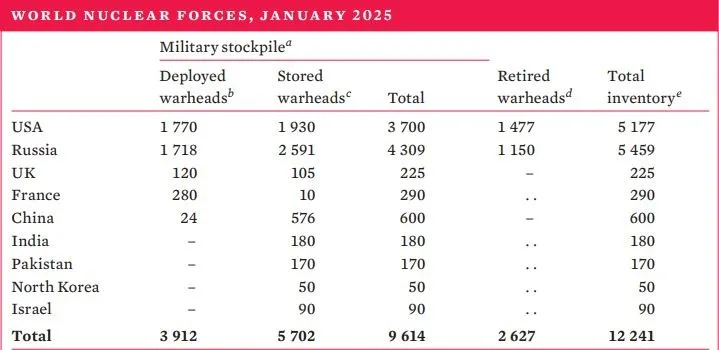
- Global Nuclear Trends (2025): Total nuclear warheads: 12,241.
- Military stockpiles (operational/potential): 9,614.
- Deployed: 3,912.
- High alert (ballistic missiles): ~2,100, mostly U.S. and Russia.
- India has 180 nuclear stored warheads as of January 2025, while Pakistan has an estimated 170.
- China has 600 nuclear warheads as of January 2025, of which 24 are deployed warheads or those placed on missiles or located on bases with operational forces.
- Expansion and Modernisation: Nearly all of the nine nuclear-armed states—the United States, Russia, the United Kingdom, France, China, India, Pakistan, North Korea and Israel—continued intensive nuclear modernization programmes in 2024.
- India slightly expanded its nuclear arsenal in 2024 and continued development of new nuclear delivery systems with enhanced capabilities.
- Pakistan continued development of new delivery systems, accumulated more fissile material, indicating intent to expand its arsenal.
- China accelerated expansion of its nuclear arsenal, It added ~100 warheads annually since 2023.
- Military Expenditure: Global spending reached $2.7 trillion in 2024, a 9.4% increase.
- Top spenders: USA ($997 billion), China ($314 billion).
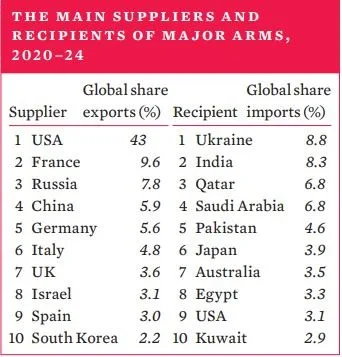
- Top importers: Ukraine, India, Qatar, Saudi Arabia, Pakistan.
- Top exporters: USA (43%), France (9.6%), Russia (7.8%).
Concerns & Outlook
- Arms control weakening: No major nuclear powers fully committed to disarmament.
- The era of reductions in global arsenals may be ending.
- China is increasing its nuclear force steadily and may reach 1,000 warheads within 7–8 years.
- All nine nuclear-armed states invested heavily in modernisation in 2024, including: upgraded systems, new technologies (e.g., MIRVs, canisterisation, AI-based command and control).
- New Nuclear States: Revitalized national debates in East Asia, Europe and the Middle East about nuclear status and strategy suggest there is some potential for more states to develop their own nuclear weapons.
- Russia and the USA together possess around 90% of all nuclear weapons.
- Both states are implementing extensive modernization programmes that could increase the size and diversity of their arsenals in the future.
- If no new agreement is reached to cap their stockpiles, the number of warheads they deploy on strategic missiles seems likely to increase after the bilateral 2010 Treaty on Measures for the Further Reduction and Limitation of Strategic Offensive Arms (New START) expires in February 2026.
| About SIPRI – SIPRI is an independent international institute dedicated to research into conflict, armaments, arms control and disarmament. It is based in stockholm. – It was established in 1966, SIPRI provides data, analysis and recommendations, based on open sources, to policymakers, researchers, media and the interested public. – Funding: It was established on the basis of a decision by the Swedish Parliament and receives a substantial part of its funding in the form of an annual grant from the Swedish Government. 1. The Institute also seeks financial support from other organizations in order to carry out its research. |
Tech Platforms for Better Disaster Management
Syllabus: GS3/Disaster Management
In News
- Union Home Minister Amit Shah launched three major technology platforms to improve the speed and precision of disaster management.
About Platforms
- The Integrated Control Room for Emergency Response (ICR-ER), National Database for Emergency Management Lite 2.0 (NDEM Lite 2.0), and the Flood Hazard Zonation Atlas of Assam.
- These tools aim to improve real-time disaster response, coordination, and flood preparedness using satellite data and digital mapping.
India’s Disaster Vulnerability
- India has been vulnerable to natural disasters on account of its unique geo-climatic conditions.
- Floods, droughts, cyclones, earthquakes and landslides have been a recurrent phenomena.
- Around 58.6% of the country is prone to earthquakes, over 12% is at risk of floods and river erosion, and 68% of cultivable land is susceptible to drought.
India’s Disaster Management Approach
- The Disaster Management Act, 2005 provides for the legal and institutional framework for the effective management of disasters.
- The National Disaster Management Authority (NDMA) has prepared the National Disaster Management Plan (NDMP) in 2016 and revised it in 2019.
- NDMP incorporates national commitments in the domain of Disaster Risk Reduction (DRR) associated with the three major post-2015 Global Frameworks namely, Sendai Framework for Disaster Risk Reduction (SFDRR), Sustainable Development Goals (SDGs) and Paris Agreement on Climate Change, and Prime Minister’s 10-point Agenda.
- Government of India has also approved Rs. 1000 Crore National Landslide Risk Mitigation Programme which includes implementation of landslide risk mitigation activities / projects in 15 States including the State of Kerala.
- Aapda Mitra Scheme has been implemented and 1,00,000 community volunteers have been trained in disaster rescue in 350 multi-hazards disaster prone districts, covering all States/UTs.
Progress
- India has shown dramatic improvement in outcomes, e.g., zero casualties during Cyclone Biparjoy, compared to 10,000 deaths in the 1999 Odisha super cyclone.
- Budget allocations significantly increased: SDRF from ₹38,000 cr to ₹1.44 lakh cr; NDRF from ₹28,000 cr to ₹84,000 cr; overall from ₹66,000 cr to ₹2 lakh cr.
- A ₹68,000 crore National Disaster Risk Management Fund has been created.
- Launch of Yuva Aapda Mitra scheme with ₹470 crore to train 1 lakh volunteers (20% women).
- India’s early warning systems, forecasting, and public awareness have improved markedly.
- Environmental conservation was cited as key to long-term disaster mitigation, with India leading initiatives like Mission LiFE, International Solar Alliance, and the Coalition for Disaster Resilient Infrastructure (CDRI).
Issues and Concerns
- Despite improvements in response capacity, there is a critical gap in long-term resilience.
- Disasters in Uttarakhand (2021) and Himachal Pradesh (2024) highlight the need for recovery efforts that empower communities and build resilient infrastructure.
- Over-reliance on central agencies can weaken local capacities.
- Environmental sustainability is often overlooked during relief operations, leading to long-term issues like pollution and resource contamination.
Suggestions and Way Forward
- India’s disaster management framework has certainly come a long way, evolving into a comprehensive system that spans prevention, mitigation, preparedness, response, recovery and reconstruction phases.
- With India’s long coastline vulnerable to cyclones and tsunamis, integrating ecosystem-based disaster risk reduction (DRR) into policy is essential.
- Nature-based solutions, such as mangrove plantations and wetland restoration, offer both protective and ecological benefits.
- Coordinating disaster response with environmental and health crises can improve efficiency.
- Empowering local leaders with training and resources can enhance self-reliance and reduce dependency.
- Eco-friendly shelters and better waste management should be priorities.
Arabian Peninsula
Syllabus :GS1/Places, Geography
In News
- New research supports the ‘Green Arabia’ hypothesis, showing that the Arabian Peninsula experienced several humid phases over the last 8 million years.
- These wet periods, confirmed by mineral cave formations (speleothems), turned the desert into a lush landscape, allowing animals and early humans to migrate between Africa and Eurasia.
Arabia Peninsula
- It is a piece of land in southwestern Asia. It is the original homeland of the Arab people. It is also the birthplace of the religion of Islam.
- It also includes Saudi Arabia, Kuwait, Oman, Qatar, the United Arab Emirates, Yemen, Bahrain, and parts of Jordan and Iraq.
- It is bordered by the Red Sea, Gulf of Aden, Arabian Sea, Gulf of Oman, and Persian Gulf.
- The Arabian Desert covers almost all of the peninsula.
- The recent findings challenge the belief that Arabia was always barren and suggest it played a key role in human evolution and migration.
- This research also offers insights into how climate change has shaped, and could again shape, human history.
Cyprus Question
Syllabus: GS2/IR
Context
- Prime Minister Narendra Modi held talks with the Cyprus President while renewing India’s support for the unity of Cyprus and “peaceful resolution” of the “Cyprus question”.
What is the Cyprus Question?
- Background: Cyprus was a British colony until it gained independence in 1960.
- Its constitution was designed to balance power between Greek Cypriots (majority) and Turkish Cypriots (minority).
- Tensions emerged between the two communities over governance.
- Greek Cypriots favored Enosis (union with Greece), while Turkish Cypriots sought Taksim (partition).
- Coup: A Greek-backed coup attempted to annex Cyprus to Greece.
- In response, Turkey invaded Cyprus, citing its rights as a guarantor power under the 1960 Treaty of Guarantee.
- Turkey occupied about 37% of the northern part of the island.
- Since 1974 Cyprus has been divided between Turkiye-backed Northern Cyprus and the internationally recognised Republic of Cyprus, and the dispute has been known as the Cyprus question.
- Since 1974, Cyprus remains de facto divided:
- Republic of Cyprus in the south (internationally recognized, EU member since 2004).
- Turkish Republic of Northern Cyprus (TRNC) in the north which is only recognized by Turkey.
India joins Elite group of Rinderpest Virus ‘Cattle Plague’ Containment
Syllabus: GS2/Health
Context
- India has joined the elite global group for Rinderpest Virus ‘Cattle Plague’ Containment, as ICAR-National Institute of High Security Animal Diseases (NIHSAD), Bhopal has been designated as Category A Rinderpest Holding Facility.
About
- It has been recognised by the World Organisation for Animal Health – WOAH and the Food and Agriculture Organization– FAO of the United Nations.
- India formally submitted its application for Rinderpest Holding Facility status in 2019.
- A joint inspection of ICAR-NIHSAD was conducted in 2025 by international experts appointed by FAO and WOAH.
- Following a comprehensive evaluation, the institute has now been officially approved as a Category A RHF for a one-year term.
- This recognition places India among a distinguished group of only six facilities worldwide entrusted with the critical responsibility of securely holding rinderpest virus material.
- The other five facilities are located in the UK, USA, France, Japan, and Ethiopia.
Rinderpest
- Rinderpest, once known as cattle plague, was one of the most destructive livestock diseases in history before its global eradication in 2011.
- However, Rinderpest Virus-Containing Material (RVCM) still remains in a few laboratories, posing potential risks if released.
- To preserve global freedom from the disease, FAO and WOAH have implemented strict measures to limit the storage of RVCM to a small number of high-security laboratories worldwide.
FATF Condemns Pahalgam Terror Attack
Syllabus: GS2/ International Organisations, GS3/ Internal Security
Context
- The Financial Action Task Force (FATF) has condemned the Pahalgam terror attack, saying the attack could not have occurred without financial backing.
- This is the first time that “state-sponsored terrorism” is being acknowledged by FATF as a funding source.
Financial Action Task Force (FATF)
- FATF is an intergovernmental organization which leads global action to tackle money laundering, terrorist and proliferation financing.
- History: FATF was established in 1989 by the G7 to examine and develop measures to combat money laundering.
- In 2001, the FATF expanded its mandate to also combat terrorist financing.
- Members: FATF currently has 39 members, including two regional organizations (European Commission and Gulf Co-operation Council).
- India became a member in 2010.
- FATF suspended membership of the Russian Federation on 24 February 2023. ( Earlier there were 40 members).
- Secretariat: It is located at the OECD Headquarters in Paris.
- Mandate: FATF has the authority to issue warnings and sanctions against countries that fail to comply with its standards, such as suspension of membership and blacklisting.
FATF ‘Grey list’ and ‘Blacklist’
- Black List: Countries known as Non-Cooperative Countries or Territories (NCCTs) are put on the Blacklist. These countries support terror funding and money laundering activities.
- Three countries are in the black list at the moment: North Korea, Myanmar, and Iran.
- Grey List: Countries that are considered a safe haven for supporting terror funding and money laundering are put in the FATF Grey list.
- Countries in the grey list are subject to increased monitoring by the FATF. Currently, there are 25 countries in this list (as of Feb 2025).
- It carries adverse economic and reputational impacts, which affect the inflow of foreign investment and international aid.
- Pakistan had been in the grey list for four years, between 2018 and 2022.
India sends Final Batch of Machinery to Suriname
Syllabus: GS2/ International relations
Context
- India has dispatched the second and final batch of machinery for Passion Fruit Processing to Suriname under the SEEDS (Supply of Equipment for Efficient Development of SMES) initiative.
About the Initiative
- The initiative is part of a $1 million SME grant from India to Suriname.
- It aims to support the establishment of a passion fruit packaging and processing unit in Suriname.
- The project is supported by NABARD Consultancy Services (NABCONS).
Passion Fruit (Passiflora edulis)
- It is a tropical fruit native to South America, particularly southern Brazil, Paraguay, and northern Argentina.
- It was introduced to Europe in 1553 by Spanish and Portuguese colonists.
- Nutritional Value: Rich in Vitamin A, Vitamin C, dietary fiber, and antioxidants.
| Suriname – Suriname is a small country on the northern coast of South America. – It is bordered by: Atlantic Ocean to the north, French Guiana to the east, Brazil to the south and Guyana to the west. – Capital: Paramaribo – Official Language: Dutch – It is known for its vast tropical rainforests, which cover over 90% of the country. |
India’s Total Trade Deficit narrows to $6.6 Billion
Syllabus :GS3/Economy
In News
- India’s trade deficit narrowed to $6.6 billion in May 2025, a 30% decline compared to 2024, driven by lower oil prices and stronger service exports.
Key Points
- Total exports rose 2.8% to $71.1 billion, with services exports up 9.4% to $32.4 billion. However, merchandise exports fell 2.2% to $38.7 billion, mainly due to falling global oil prices.
- Non-petroleum exports grew 5.1%. Merchandise imports declined 1.7%, though non-petroleum imports rose 10%.
- Overall, total imports dropped by 1% in May 2025.
Trade deficit
- It occurs when a country’s imports exceed its exports, resulting in a negative trade balance.
- It includes both goods and services and serves as a key macroeconomic indicator.
- Persistent trade deficits can lead to currency depreciation, job losses, and increased foreign borrowing.
Causes
- Trade deficits are caused by imbalances between savings and investment, high demand for imports, currency fluctuations, and global economic growth.
- Strong consumer spending and a strong domestic currency also contribute by boosting imports and reducing exports.
Impacts
- Trade deficits have both positive and negative effects.
- They can improve living standards by offering cheaper, diverse goods, but long-term deficits may increase national debt, weaken domestic industries, cause job losses, and reduce currency value.
- Persistent deficits can harm economic stability and influence government trade and diplomatic policies.
Measures
- To reduce trade deficits, countries can increase domestic savings, boost export competitiveness, adjust monetary policies, and support local manufacturing.
- Strategic use of trade barriers and investment in innovation also help reduce reliance on imports.
