
Magna Carta
Syllabus: GS1/World History
Context
- The Magna Carta (Latin for “Great Charter”) was signed on June 15, 1215, at Runnymede Meadows near London.
Historical Context and Origin (1215)
- Sealed on 15 June 1215 by King John of England, following pressure from English barons who sought to limit the king’s arbitrary power.
- Barons, part of the feudal system, were key stakeholders as landholders providing knights and military service to the king.
- The immediate cause of baronial rebellion was John’s defeat at the Battle of Bouvines (1214) by King Philip II of France.
- Long-term causes included military failures (loss of Normandy and Anjou in 1204) and heavy taxation imposed to finance campaigns.
- Purpose: It was the first document to put into writing the principle that the king and his government was not above the law.
- It sought to prevent the king from exploiting his power, and placed limits of royal authority by establishing law as a power in itself.
Charter Contents and Principles:
- The Magna Carta consisted of 63 clauses, over 3,500 words.
- Addressed both local governance and broader legal principles.
- Key clauses:
- Clause 39: Protects against arbitrary imprisonment — “No free man shall be seized or imprisoned… except by the lawful judgment of his equals or by the law of the land.”
- Clause 40: Guarantees access to justice — “To no one will we sell, to no one deny or delay right or justice.”
- Immediate Aftermath and Reissues:
- King John quickly sought annulment from Pope Innocent III; conflict resumed with the barons.
- John died in 1216; his nine-year-old son Henry III was crowned. His regents reconfirmed the Magna Carta to secure baronial support.
- The Charter was reissued multiple times in the 13th century, with revisions.
Legacy:
- Inspired legal traditions:
- In the UK: Basis for habeas corpus and rights against arbitrary detention.
- In the US: Influenced American Revolution and constitutional development — especially the Bill of Rights.
- Symbolic value: Seen as a foundational text for modern democracy, even if not originally intended as such.
- Foundation of Rule of Law: Established the principle that no one, not even the king, is above the law.
- Introduced the idea that the monarch’s power could be legally restricted, a foundational shift in political authority.
- Legal and Constitutional Legacy: Clause 39 and 40 remain part of UK law, ensuring protection from arbitrary detention.
- Right to a fair trial.
- Access to justice without delay or sale.
- Laid the groundwork for the writ of habeas corpus.
- Served as a precursor to constitutional governance and judicial independence.
- Symbol of Civil Liberties and Human Rights: While initially benefiting only the feudal elite (barons), over time it came to represent individual freedoms, protection from state oppression and the idea of accountable governance.
- Global Symbol of Justice: Used historically by reformers and revolutionaries to challenge autocracy.
- Quoted by American revolutionaries, constitutionalists, and in human rights advocacy worldwide.
Atlantic Meridional Overturning Circulation (AMOC)
Syllabus: GS1/ Geography
Context
- Recently, a climate study found that if the Atlantic Meridional Overturning Circulation (AMOC) collapses, Europe could face a dramatic and prolonged winter freeze, even in a world warmed by greenhouse gas emissions.
About Atlantic Meridional Overturning Circulation (AMOC)
- It is one of the most powerful and complex systems driving Earth’s climate.
- It is often likened to a giant conveyor belt that transports warm surface waters from the tropics northward and returns cold, dense water southward at depth.
- It regulates temperatures across the Atlantic basin and plays a vital role in global climate stability, sea-level patterns, and marine ecosystems.
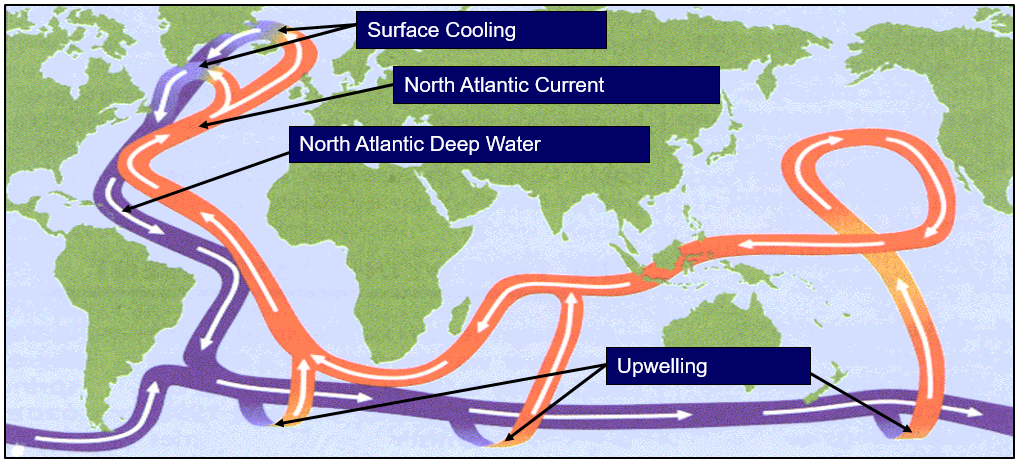
Working of AMOC
- The AMOC is a key component of the global thermohaline circulation.
- Warm, salty water flows northward via currents like the Gulf Stream. As it reaches higher latitudes, it cools and becomes denser, sinking into the deep ocean and flowing back south.
- It helps distribute heat and nutrients across the globe, influencing weather patterns from the Amazon to the Arctic.
Slowing of AMOC and the Tipping Point
- Recent studies suggest that the AMOC has weakened significantly since the mid-20th century, and is expected to slow by 18–43% by 2100.
- It is primarily driven by climate change, particularly the influx of freshwater from melting Greenland ice, which disrupts the salinity and density gradients that power the current.
- AMOC may be approaching a tipping point, beyond which its collapse could trigger abrupt and irreversible climate shifts.
- AMOC has two potential tipping points — one linked to salt transport feedback and another to deep ocean convection.
| Climate Tipping Points – These are critical thresholds in Earth’s systems—once crossed, they can trigger self-reinforcing feedback loops that lead to abrupt, irreversible, and potentially catastrophic changes. – They occur when a small change in temperature or pressure pushes a system — like an ice sheet, rainforest, or ocean current — into a radically different state. Key Tipping Elements at Risk – Recent assessments have identified at least 16 major Earth system components that are vulnerable to tipping, including: 1. Greenland and West Antarctic Ice Sheets; 2. Atlantic Meridional Overturning Circulation (AMOC); 3. Amazon Rainforest Dieback; 4. Arctic Permafrost Thaw;Coral Reef Collapse; |
Potential Consequences
- Europe may face colder winters despite global warming, as warm currents fail to reach its shores.
- West Africa could see disrupted monsoon patterns, affecting agriculture and water security.
- Eastern North America might experience accelerated sea-level rise.
- The Amazon and South Asia could suffer from altered rainfall patterns, increasing drought risk.

Increase in Oil Prices Amidst Iran-Israel Tensions
Syllabus: GS2/ International Relations, GS3/ Economy
Context
- Recent tensions between Iran and Israel have led to a spike in global oil prices.
About
- In mid-June 2025, the renewed military flare-up between Iran and Israel sent shockwaves through energy markets.
- The Brent crude futures surged by nearly 9% on June 13 to $75.65 per barrel, peaking at $78.50, a near five-month high.
Reasons for Increase in oil prices
- Vulnerability of the Strait of Hormuz: The Strait of Hormuz connects the Persian Gulf to the Arabian Sea and is the world’s most crucial oil transit chokepoint.
- In 2024, it facilitated the transport of around 20 million barrels per day, about 20% of global petroleum liquids consumption.
- Countries such as Saudi Arabia, UAE, Kuwait, Iraq, and Iran rely on this route for exports.
- Closure or disruption, even temporary, raises shipping delays, and energy costs.
- Potential Supply Chain Disruptions: Conflict in the Middle East could also hinder access to the Suez Canal and the Red Sea, affecting alternative maritime routes and leading to logistical and financial challenges for global oil trade.
- Risk Premium: The possibility of a large-scale conflict or blockades results in speculative buying and a risk premium on oil, pushing prices up even before any physical supply disruption occurs.
Implications for India
- Rising Import Costs: India imports over 80% of its crude oil. As the global price increases, it will raise India’s overall import bill.
- Inflationary Pressures: A rise in crude oil prices can spill over into transport, logistics, and manufacturing, causing a rise in retail inflation.
- Economic Growth and Investment: A sustained surge in prices may dent corporate profitability and delay private sector investments, especially in energy-intensive sectors.
Way Ahead
- Accelerate Renewable Energy Transition: Reducing long-term dependence on fossil fuels.
- Strengthen Strategic Petroleum Reserves to cushion short-term shocks.
- Diversify Energy Sources: Including gas imports, biofuels, and electric mobility.
- Diplomatic Engagements: To support de-escalation and secure oil supply routes.
Concluding Remarks
- The ongoing Iran-Israel tensions have revived global concerns about energy security and price stability.
- For India, the conflict is a reminder of the country’s high vulnerability to external shocks due to its dependence on oil imports.
- While current reserves and diversification strategies offer some resilience, a prolonged conflict could have significant economic and fiscal consequences.
| Strategic Petroleum Reserves – The government of India, through a Special Purpose Vehicle called Indian Strategic Petroleum Reserve Limited (ISPRL), has established Strategic Petroleum Reserves (SPR) facilities with a total capacity of 5.33 Million Metric Tonnes (MMT) of crude oil at 3 locations. – The locations are as; 1. Vishakhapatnam (1.33 MMT), 2. Mangaluru (1.5 MMT) and 3. Padur (2.5 MMT) capacity. – Government of India in 2021, had also approved the establishment of two additional commercial-cum-strategic petroleum reserve facilities with total storage capacity of 6.5 MMT at; 1. Chandikhol (4 MMT) in Odisha and 2. Padur (2.5 MMT) in Karnataka. |
World Refugee Day 2025
Syllabus: GS2/Human Rights
Context
- 20th June is observed as World Refugee Day.
About
- This international day is designated by the United Nations to honour refugees around the globe.
- It was first observed globally on 20 June 2001, to mark the 50th anniversary of the 1951 Convention on the Status of Refugees.
- Formerly known as Africa Refugee Day, it was changed when the United Nations General Assembly declared it an international day in 2000.
- According to the UN, every minute, 20 people leave everything to flee conflict, persecution, or terror, and World Refugee Day serves as an opportunity to build empathy and understanding for their predicament.
- The theme for this year is “Solidarity with Refugees”, which urges people to move beyond words and take meaningful steps to support those forced to flee.
Key Terms in Forced Displacement and Migration
- Refugee: According to the 1951 UN Convention, refugees are individuals living outside their countries of origin who are in need of international protection because of feared persecution, or a serious threat to their life, physical integrity or freedom in their country of origin.
- Refugees have legal permission to remain in the host country and may have access to health care, education and welfare benefits.
- Asylum seeker: A person who is seeking international protection. Prior to being granted legal status in the destination country, refugees are termed asylum seekers.
- Not all asylum seekers will be granted refugee status.
- Internally displaced person: Someone who has been forced to flee from their home to avoid conflict, violence and disasters and has moved within an internationally recognized state border.
- Returnees: Returnees are former refugees who return to their own countries or regions of origin after time in exile.
- Returnees need continuous support and reintegration assistance to ensure that they can rebuild their lives at home.
Latest UNHCR data on Displacement
- Overall Numbers: By the end of 2024, 123.2 million people were forcibly displaced worldwide.
- Causes: Persecution, conflict, violence, human rights violations, and serious public order disruptions.
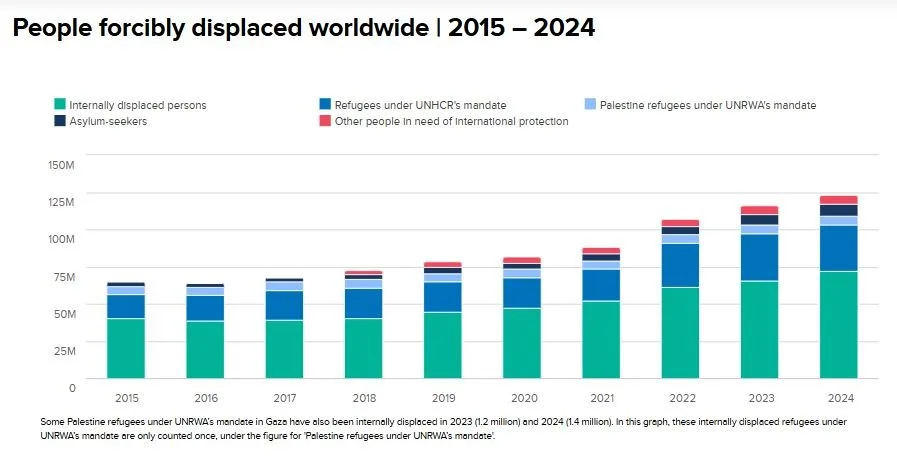
- By April 2025: Estimated decrease to 122.1 million, a 1% drop.
- This marks the first decline in over a decade.
- Refugee Returns: In the past year, 1.6 million refugees returned to their countries of origin.
- 92% of these returns were concentrated in just four countries: Afghanistan, Syria, South Sudan and Ukraine.
- Outlook for 2025: The direction of displacement trends in the rest of 2025 will hinge on several key factors:
- Peace or ceasefire prospects, particularly in: Democratic Republic of the Congo (DRC), Sudan, Ukraine and Stability in South Sudan, avoiding further deterioration.
- Improvement of return conditions in Afghanistan and Syria.
- Impact of funding cuts on humanitarian operations and capacity to create safe and dignified return environments.
1951 Refugee Convention and its 1967 Protocol
- The 1951 Convention contains a number of rights and also highlights the obligations of refugees towards their host country.
- The cornerstone of the 1951 Convention is the principle of non-refoulement.
- According to it, a refugee should not be returned to a country where he or she faces serious threats to his or her life or freedom.
- This protection may not be claimed by refugees who are reasonably regarded as a danger to the security of the country, or having been convicted of a particularly serious crime.
- The rights contained in the 1951 Convention include:
- The right not to be expelled, except under certain, strictly defined conditions;
- The right not to be punished for illegal entry into the territory of a contracting State;
- The right to work;
- The right to housing;
- The right to education;
- The right to public relief and assistance;
- The right to freedom of religion;
- The right to access the courts;
- The right to freedom of movement within the territory;
- The right to be issued identity and travel documents.
- A refugee becomes entitled to other rights the longer they remain in the host country, which is based on the recognition that the longer they remain as refugees, the more rights they need.
| India’s Policy on Refugees – India has welcomed refugees in the past, with nearly 300,000 people categorised as refugees. 1. This includes the Tibetans, Chakmas from Bangladesh, and refugees from Afghanistan, Sri Lanka, etc. – But India is not a signatory to the 1951 UN Refugee Convention or the 1967 Protocol relating to the Status of Refugee. Nor does India have a refugee policy or a refugee law. – All foreign undocumented nationals are governed as per the provisions of The Foreigners Act, 1946, The Registration of Foreigners Act, 1939, The Passport (Entry into India) Act, 1920 and The Citizenship Act, 1955. – As per the MHA foreign nationals who enter into the country without valid travel documents are treated as illegal immigrants. |
Rethinking Alcohol Control in India
Syllabus: GS2/Health
In News
- India has recorded one of the highest rates of heavy episodic alcohol drinking, with lakhs needing clinical and social support.
Present status
- Alcohol and alcoholic beverages contain ethanol, which is a psychoactive and toxic substance with dependence-producing properties.
- Alcohol has been widely used in many cultures for centuries, but it is associated with significant health risks and harms.
- The safe level of alcohol consumption is zero, yet 23% of Indian men and 1% of women consume alcohol (NFHS-5).
Reasons for Consumption
- Alcohol use is influenced by a complex mix of biopsychosocial, commercial, and policy factors.
- Biologically, some people are genetically prone to addiction, while psychologically and socially, stress relief, peer pressure, and media portrayals normalize drinking.
- Commercially, the industry targets new and younger consumers with diverse products, surrogate advertising, promotions, and strategic placements, often amplified by social media.
- Easy access is ensured through widespread liquor store locations and attractive packaging, while pricing makes alcohol affordable for both rural lower-income groups and urban middle classes.
- Policy-wise, the alcohol industry heavily influences regulation, resisting stricter laws by highlighting its revenue contributions, and circumvents advertising bans through covert marketing tactics.
Impacts of Alcohol Consumption
- Health Impact: Alcohol use significantly increases risks of injuries, mental illness, non-communicable diseases like cancer, and is linked to aggression, crime, suicides, and risky behavior.
- Economic Impact: While states earn heavily through excise duty (~₹2.5 lakh crore annually), the social cost of alcohol outweighs this gain, according to NITI Aayog estimates.
- Workplace absenteeism, job loss, and decreased efficiency are major outcomes.
- Social Impact: NCRB reports reveal a high correlation between alcohol use and cases of domestic abuse, marital rape, and child neglect.
- Easy availability, peer pressure, and glorification on social media have led to a rise in underage drinking, particularly in metros.
Regulation Status
- Alcohol regulation in India falls under State jurisdiction, granting each State authority over legislation, excise taxes, supply chain, licensing and manufacturing, sale and consumption restrictions, prohibition, and pricing.
- Some States like Bihar, Gujarat, Mizoram, and Nagaland enforce prohibition, while others like Andhra Pradesh and Kerala promote alcohol sales with policies such as affordable pricing and marketing traditional beverages.
Various Policies
- Alcohol was initially excluded from India’s 2012 National Policy on Narcotic Drugs and Psychotropic Substances but was later included in the 2021-22 National Action Plan for Drug Demand Reduction under Nasha Mukta Bharat Abhiyan.
- The National Mental Health Policy (NMHP) 2014 recognised the role of alcohol in mental illness and suicide prevention and suggested the need for a specific action plan.
- The National Health Policy (NHP) 2017 mentioned curbing alcohol use through higher taxation.
- The National Suicide Prevention Strategy (NSPS) 2022 identified alcohol as a major risk factor for suicides, advocating for a national alcohol control policy and measures to limit alcohol accessibility.
- The National Action Plan and Monitoring Framework for Prevention and Control of Noncommunicable Diseases (NMAP) 2017-2022 also echoed the call for a national alcohol policy.
Issues and Concerns
- The national policies address specific issues like drunk driving or supply-chain regulation but India currently lacks a comprehensive, unified national alcohol regulation policy.
- The efforts to reduce alcohol demand and supply are fragmented across various Central ministries and States.
- The GST Act excludes liquor from sales tax, leaving alcohol taxation largely to States, often under vague excise policies.
Suggestions and Way Forward
- Regulating alcohol in India is urgent but complex due to its ties with State revenues, social norms, and politics.
- A comprehensive, evidence-based, and equitable systems approach is needed.
- Key measures include
- Pricing alcohol to deter misuse without encouraging illicit liquor, earmarking health taxes for public health
- Restricting alcohol availability in daily environments,
- Regulating digital and influencer-driven advertising, enforcing plain packaging and warning labels,
- Increasing public awareness of alcohol’s health risks, and using AI to control online alcohol content and misinformation.
- A unified National Alcohol Control Policy is essential to prioritize public health over profits and ensure long-term well-being.
