
Child Labour Rescues in 2024–25: C-LAB
Syllabus: GS2/ Vulnerable Sections, Government Policies & Interventions
Context
- Recently, the Centre for Legal Action and Behaviour Change (C-LAB), in partnership with the Just Rights for Children (JRC) network, released a report related to child labour rescues in 2024–25.
Key Findings of Report
- Over 53,000 children were rescued across 24 states and union territories (Between April 2024 and March 2025).
- Telangana topped the list with 11,063 rescues, followed by Bihar (3,974), Rajasthan (3,847), Uttar Pradesh (3,804), and Delhi (2,588)
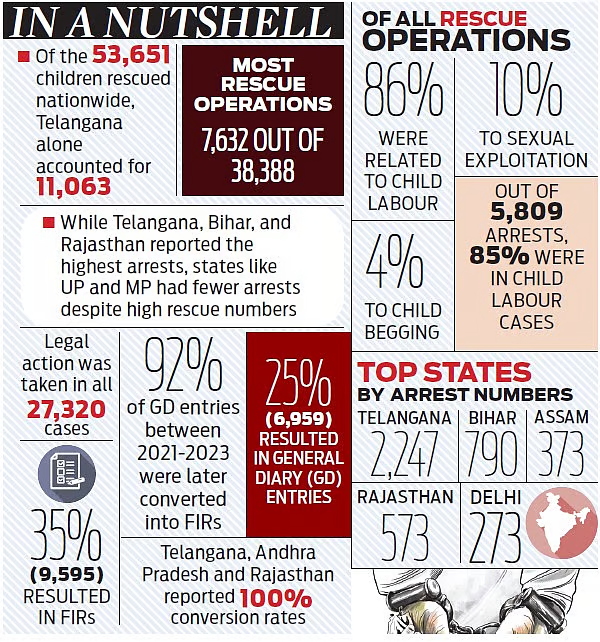
- Alarming Trends: The report reveals that nearly 90% of rescued children aged 10 to 14 were found working in sectors classified as the worst forms of child labour — including spas, massage parlours, and orchestras.
- Legal Action and Enforcement: A total of 38,388 FIRs were registered and 5,809 arrests made, with 85% of arrests directly related to child labour.
- Telangana, Bihar, and Rajasthan led in enforcement.
- States like Uttar Pradesh and Madhya Pradesh showed high rescue numbers but fewer arrests.
- Policy Recommendations: The report calls for the launch of a National Mission to End Child Labour, the formation of district-level Child Labour Task Forces, and better coordination between NGOs and law enforcement to ensure prosecution and rehabilitation.
| Definition of Child – United Nations Convention on the Rights of the Child (UNHRC): A child as an individual who has not attained the age of 18 years.India has been a signatory to the UNHRC since 1992. – International Labour Organization (ILO): Child is any person under 18. 1. Child Labour (as per the ILO) refers to work that deprives children of their childhood, their potential and their dignity, and that is harmful to their physical and/or mental development. Constitutional Provisions Related To Child 1. Article 15(3) (Protective Discrimination): It empowers the State to make special provisions for children, recognizing their need for additional safeguards and support. 2. Article 21A (Right to Education): It guarantees free and compulsory education for all children aged 6 to 14 years. 1. This provision, added by the 86th Constitutional Amendment (2002), is central to preventing child labour by ensuring access to schooling.Article 24 (Prohibition of Child Labour): It explicitly prohibits the employment of children below the age of 14 in factories, mines, or any other hazardous employment. This is a direct constitutional safeguard against exploitative labour.Article 39(e) and 39(f):Children are not forced by economic necessity to enter vocations unsuited to their age or strength.Childhood and youth are protected against exploitation and moral and material abandonment.Article 45 (Early Childhood Care and Education): It directs the State to provide early childhood care and education for all children below the age of six, laying the foundation for long-term development and protection.Legal ProtectionMinimum Wages Act, 1948 (amended in 1986): A ‘child’ is a person who has not completed his fourteenth year of age.Child Labour (Prohibition and Regulation) Amendment Act, 2016: It prohibits “the engagement of children in all occupations and of adolescents in hazardous occupations and processes” wherein adolescents refers to those under 18 years; children to those under 14. The Act also imposes a fine on anyone who employs or permits adolescents to work.Do You Know?Gurupadswamy Committee (1979) observed poverty is main factor for the child labour. It recommended that a multiple policy approach was required in dealing with the problems of working children.The Child Labour (Prohibition & Regulation) Act was enacted in 1986 based on the recommendations of Gurupadaswamy Committee. |
Reasons Behind Child Labour in India
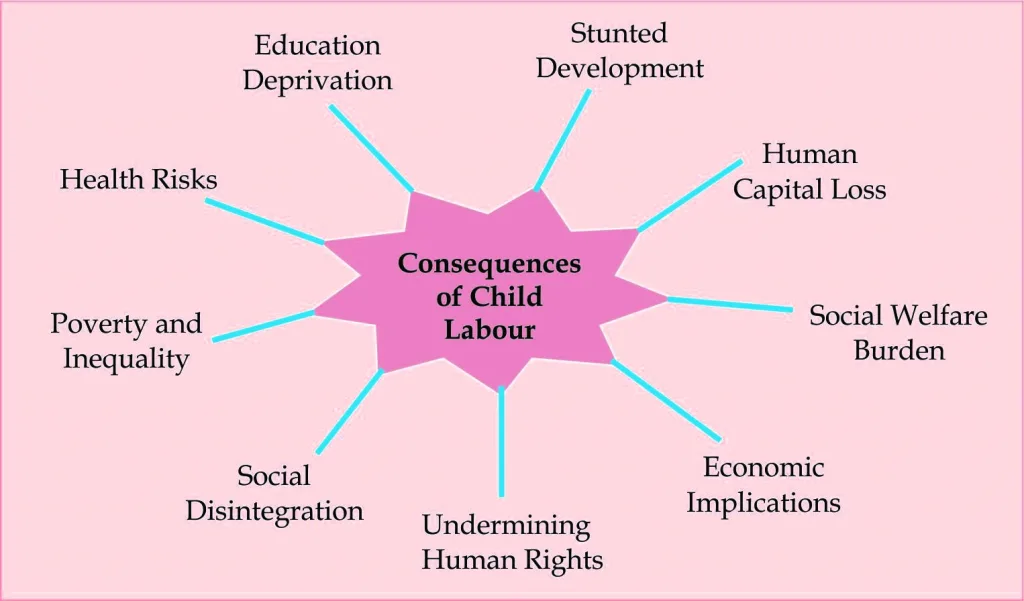
- Poverty and Economic Compulsion: According to the Ministry of Labour & Employment, poverty remains the primary driver of child labour.
- Families struggling to meet basic needs often rely on children to supplement household income, especially in rural and informal sectors.
- Lack of Access to Quality Education: Many children drop out of school due to poor infrastructure, teacher shortages, or financial constraints.
- Once out of school, they are more likely to enter the workforce.
- Illiteracy and Low Awareness: Parents with limited education may not fully understand the long-term value of schooling or the legal protections against child labour.
- It perpetuates a cycle of exploitation.
- Demand for Cheap Labour: Industries such as beedi-making, carpet weaving, and fireworks often prefer child workers for their nimble fingers and lower wages.
- Cultural and Social Norms: In some communities, child labour is normalized or even seen as a rite of passage.
- Girls, in particular, may be pulled into domestic work or caregiving roles at a young age.
- Migration and Trafficking: Children from marginalized communities are often trafficked or migrate with families to urban areas, where they end up in exploitative jobs without legal safeguards.
Model State Action Plans
- The Ministry of Labour & Employment has circulated model plans to guide states in enforcement, rescue, and rehabilitation efforts.
- Support for Action Against Child Labour (SAFAL): It aimed at strengthening enforcement and community-based monitoring.
- National Policy on Child Labour (1987):
- Focus on rehabilitating children in hazardous occupations.
- Convergence of welfare schemes to support families of child labourers.
- Launch of project-based interventions in high-incidence areas.
- National Child Labour Project (NCLP): Implemented in districts with high child labour prevalence. It provides:
- Special training centres for rescued children
- Bridge education, vocational training, mid-day meals, and stipends
- Support for mainstreaming into formal schools
- Now integrated into the Samagra Shiksha Abhiyan.
Success Stories
- Velpur Mandal in Telangana as a model for eradicating child labour through community engagement, school retention, and strict enforcement — a testament to what’s possible with sustained local action.
Challenges Before IAEA After Attacks on Iran’s Nuclear Sites
Syllabus: GS2/IR
In News
- Iran is considering a bill to suspend cooperation with the International Atomic Energy Agency (IAEA), citing the agency’s alleged failure to remain impartial and fulfill its obligations.
Background
- The announcement came as the IAEA convened an emergency Board of Governors meeting in Vienna following the U.S. attacks on Iran’s nuclear facilities at Fordow, Natanz, and Isfahan, and Israel’s earlier strike on the Arak Heavy Water Reactor.
- Iran is a signatory to the Nuclear Non-Proliferation Treaty (NPT) as a non-nuclear weapon state.
- In that capacity, it had to mandatorily enter into a comprehensive safeguards agreement with the IAEA, which allows the organisation to install its own equipment to monitor activities, including radiation levels.
- Iran accuses the IAEA of becoming a political tool and insists it will not resume cooperation without “objective guarantees.”
International Atomic Energy Agency(IAEA)
- It is the world’s central intergovernmental forum for scientific and technical cooperation in the nuclear field.
- It was established in 1957, inspired by the U.S. President Eisenhower’s 1953 “Atoms for Peace” speech to the UN, aiming to address global concerns and hopes surrounding nuclear technology.
- It works for the safe, secure and peaceful uses of nuclear science and technology, contributing to international peace and security and the United Nations’ Sustainable Development Goals.
Emerging Challenges
- The recent attacks by the United States and Israel on Iran’s operational nuclear facilities at Natanz, Isfahan, and Fordow mark an unprecedented escalation, raising serious global concerns.
- The situation threatens to undermine the Nuclear Non-Proliferation Treaty (NPT) and the IAEA’s role, with growing tensions, damaged diplomatic channels, and increased risk of nuclear escalation.
- IAEA currently lacks access to the attacked sites.
- The disruption of IAEA oversight could make it difficult to verify the location and status of Iran’s enriched uranium stockpile, which includes 400 kg enriched to 60%, close to weapons-grade level.
- The situation poses significant risks for nuclear safety and non-proliferation efforts worldwide.
India’s Perspective
- India expressed deep concern over the escalating situation in West Asia, particularly the U.S. and Israeli attacks on Iran’s nuclear facilities.
- Emphasizing the importance of nuclear safety due to potential risks to public health and the environment, India urged the IAEA to provide updates on damage and radiation levels.
- The Indian envoy called for maximum restraint from all parties and affirmed India’s readiness to offer support.
Way Forward
- In the present scenario, the IAEA must navigate a complex mix of technical, political, and security challenges to preserve its mandate and prevent a wider nuclear crisis.
10th WHO Report on the Global Tobacco Epidemic
Syllabus: GS2/ Health
In News
- WHO has released the 10th edition of its Global Tobacco Epidemic Report, assessing progress in tobacco control since the launch of the MPOWER strategy in 2008.
- The report notes significant global progress, with over 6.1 billion people now protected by at least one of the six MPOWER measures.
Key Findings of the Report
- Widespread Impact: Since 2007, 155 countries have implemented at least one of the MPOWER policy prescriptions, collectively benefiting over 6.1 billion people.
- Most Progress: Among all MPOWER measures, large graphic health warnings on cigarette packages have seen the most widespread and consistent implementation.
- India’s Leadership in Digital Content Regulation: India has notably become the first country globally to apply tobacco control regulations specifically to digital streaming content.
- India’s Strong Stance on TAPS: India has implemented stringent measures to curb tobacco advertising, promotion, and sponsorship (TAPS) across all forms of media. This aligns with the “E” (Enforce bans) in MPOWER and is a critical step in reducing tobacco appeal.
- Tobacco Tax: A critical finding is that tobacco tax remains the least-adopted MPOWER measure globally. This is a significant concern as increasing tobacco taxes is widely recognized as one of the most effective ways to reduce consumption, especially among youth and lower-income groups.
Tobacco Consumption
- Tobacco use claims over seven million lives a year, predominantly in low- and middle-income countries.
- India is the world’s second-largest tobacco producer after China.
- India is the 4th largest producer of Flue Cured Virginia (FCV) tobacco in the world after China, Brazil and Zimbabwe.
- Tobacco use is a major risk factor for non-communicable diseases (NCDs) in India, such as cancer, heart disease, and respiratory illnesses, accounting for over 1.35 million deaths each year.
- Significant progress has been made to reduce tobacco use in countries with the highest burden of tobacco consumption over the last two decades.
- Key strategies include the Framework Convention on Tobacco Control (FCTC) and the six proven World Health Organization (WHO) MPOWER tobacco control measures to reduce tobacco use:
- Monitoring tobacco use and prevention policies;
- Protecting people from tobacco smoke with smoke-free air legislation;
- Offering help to quit tobacco use;
- Warning about the dangers of tobacco with pack labels and mass media;
- Enforcing bans on tobacco advertising, promotion and sponsorship;
- Raising taxes on tobacco.
- Key strategies include the Framework Convention on Tobacco Control (FCTC) and the six proven World Health Organization (WHO) MPOWER tobacco control measures to reduce tobacco use:
First-Ever Household Income Survey in 2026
Syllabus: GS2/ Governance, GS3/ Economy
Context
- The Ministry of Statistics and Programme Implementation (MoSPI) will conduct the first-ever Household Income Survey in 2026.
About
- This will be India’s first comprehensive, nationwide survey focused entirely on household income, including both rural and urban segments.
- Lead Agency: Conducted by the National Sample Survey Office (NSSO) under the Ministry of Statistics & Programme Implementation (MoSPI).
- Technical Expert Group (TEG): It was constituted by MoSPI under the Chairmanship of Dr. Surjit S. Bhalla.
- Mandate of TEG:
- Finalize definitions, concepts, survey tools, and sampling methods,
- Adopt best practices from countries like the US, Australia, Canada, and South Africa to address prior underreporting,
- Guide estimation methods, data quality protocols, result finalization, and publication timelines,
- Incorporate digital tools to capture technology-driven impacts on wages and income.
Significance of the Household Income Survey
- First Accurate Mapping of Income Distribution: Despite decades of data on consumption, poverty, and employment, India lacks official statistics on household income levels and distribution.
- The survey fills a critical gap, enabling policymakers to understand income inequality, inter-regional disparities, and the actual spread of economic growth.
- Targeting of Welfare Schemes: The government can more effectively design and implement subsidies, social protection, and direct benefit transfers, moving toward evidence-based and inclusive policymaking.
- Analysis of Technology Impact: The survey will assess how digital platforms, gig work, automation, and informal employment influence household earnings, an area underexplored by existing datasets.
- Benchmark for Fiscal and Tax Policy: It can provide a realistic baseline for taxation policies, income slabs, and fiscal redistribution strategies by capturing actual income flows across sectors and classes.
- International Comparability: Countries like the USA, Australia, and South Africa regularly conduct income surveys.
Challenges in Conducting the Survey
- Disclosure Hesitation: Households often understate or conceal income, especially from informal or cash-based sources, fearing taxation or legal scrutiny.
- Complex and Diverse Income Sources: Indian households earn from multiple, fragmented streams—agriculture, daily wages, remittances, informal trades, and pensions.
- Capturing and verifying these streams, especially in rural settings, is technically demanding.
- Mismatch Between Income, Consumption, and Savings: Previous surveys found reported income lower than total consumption and savings, suggesting gaps in recall accuracy or deliberate misreporting.
- Seasonality and Volatility of Earnings: In sectors like agriculture and construction, incomes fluctuate widely across months or seasons. A single-point survey may fail to capture these variations unless longitudinal or repeated visits are used.
- Training of Field Enumerators: Gathering reliable income data requires well-trained surveyors who can navigate complex interviews and probe sensitively without causing discomfort or suspicion.
Way Ahead
- Institutionalising the Survey: Rather than a one-off exercise, the Household Income Survey should be institutionalised at regular intervals, allowing tracking of trends over time and enabling better long-term planning.
- Detailed training of field investigators is essential, not only in technical methods but also in building trust with respondents, navigating sensitive income questions, and understanding local income patterns.
India-ASEAN Trade Deal Review
Syllabus: GS2/IR
Context
- Over the last one year, India has held nine meetings with the Association of Southeast Asian Nations (ASEAN) to review the trade agreement signed with the grouping, but no progress has been made on any item.
About
- The original agreement was signed in 2009.
- India opened 71% of its tariff lines to the ASEAN countries whereas countries like Indonesia opened 41%, Vietnam 66.5%, and Thailand 67%.
- In the last 15 years, India’s exports to ASEAN have doubled, but the imports have tripled.
- These factors necessitated a review of the deal.
- The review by a joint committee began in 2024.

Brief on India-ASEAN Relations
- Foundation: Cooperation began in the 1990s.
- Driven by shared economic and strategic interests.
- Also a response to China’s growing influence in the region.
- Policy Framework: “Look East Policy” initiated in the 1990s, it was transformed into the “Act East Policy” in 2014, marking a more action-oriented approach to deepen ties with ASEAN.
- Milestones in the Partnership:
- 1992: India became a Sectoral Dialogue Partner.
- 1996: Elevated to Full Dialogue Partner.
- 2012: Upgraded to a Strategic Partnership.
- 2022: Elevated to a Comprehensive Strategic Partnership.
- Trade and investment: India and ASEAN have signed a Free Trade Agreement (FTA), significantly boosting trade and investment.
- ASEAN is India’s 4th largest trading partner, with total trade reaching US$110.4 billion in 2021-22.
- Regional connectivity: India is working to improve connectivity with ASEAN through projects like the India-Myanmar-Thailand (IMT) trilateral highway and the Kaladan Multimodal Transit Transport project.
- Defense and security: Defense ties between India and ASEAN have deepened through joint military exercises such as the ASEAN-India Maritime Exercise and participation in the ASEAN Defense Ministers’ Meeting Plus (ADMM+).
- India also places ASEAN at the heart of its Indo-Pacific vision for regional security and growth (SAGAR – Security and Growth for All in the Region).
- Socio-cultural cooperation: To strengthen people-to-people connections, India and ASEAN have promoted various cultural exchanges, such as the ASEAN Students Exchange Programme, training courses for ASEAN diplomats, and the ASEAN-India Network of Think Tanks.
India-ASEAN FTA
- The Framework Agreement on Comprehensive Economic Cooperation between ASEAN and India was signed in 2003, establishing the legal foundation for subsequent agreements.
- These agreements include the trade in goods agreement, trade in services agreement, and investment agreement, which together form the ASEAN-India Free Trade Area (AIFTA).
- The ASEAN-India Trade in Goods Agreement was signed and came into effect in 2010.
- Under this agreement, ASEAN member states and India committed to gradually open their markets by reducing and eliminating tariffs on 76.4% of goods.
- The ASEAN-India Trade in Services Agreement, signed in 2014, includes provisions on transparency, domestic regulations, market access, national treatment, recognition, and dispute settlement.
- The ASEAN-India Investment Agreement, also signed in 2014, ensures protection of investments, including fair and equitable treatment for investors, non-discriminatory practices in cases of expropriation or nationalization, and guarantees of fair compensation.
Challenges With AIFTA
- Widening Trade Deficit: India’s trade deficit with ASEAN has consistently widened since the FTA.
- Indian imports from ASEAN grew faster than exports, leading to asymmetrical gains.
- India’s trade deficit with ASEAN has risen to $44 billion in FY23, compared to $8 billion in FY13.
- Limited Market Access for Indian Services: Despite India’s strength in services, ASEAN countries offered limited liberalisation in sectors like IT, professional services, and healthcare.
- Non-Tariff Barriers (NTBs): ASEAN members often impose complex standards, licensing requirements, and other regulatory barriers.
- These nullify tariff concessions and restrict Indian exports, especially in agriculture and pharmaceuticals.
- Rules of Origin Issues: Lax rules of origin enable third countries (like China) to route goods via ASEAN to India, exploiting tariff benefits.
- This undermines domestic manufacturing under Make in India.
- Limited Gains for Indian Agriculture: Indian agricultural products face high sanitary and phytosanitary standards and quota restrictions.
- Meanwhile, ASEAN countries export cheap palm oil, rubber, and spices, hurting Indian farmers.
- Negotiation Imbalance: India often faces difficulty in securing reciprocal concessions.
- ASEAN acts as a bloc, whereas India negotiates alone, leading to less negotiating leverage.
Way Forward
- India and ASEAN agreed in 2022 to review the FTA to address asymmetries.
- Stronger safeguard measures and stricter rules of origin are needed.
- With India’s rising diplomatic influence and its leadership in the Global South, a deeper partnership with ASEAN offers mutual benefits and fosters regional stability.
- Since 2024, India has significantly increased its engagement with Southeast Asia.
Yeast Shows Physics can Give Rise to Multicellular Life Sans Mutations
Syllabus: GS3/Science and Technology
Context
- A new study on Snowflake yeast by National Centre for Biological Sciences (NCBS) scientists offers an ‘unconventional view’ of how major changes first arise in the course of evolution.
What is Yeast?
- Yeast is a unicellular fungus.
- Commonly used in:
- Baking (makes bread rise).
- Alcohol production (fermentation).
- Scientific research (model organism).
- Reproduction by budding:
- A small bud forms on the parent cell.
- The nucleus divides, one part goes into the bud.
- The bud grows and detaches, becoming a new yeast cell.
What is Snowflake Yeast?
- Regular yeast grows as single cells; new cells (buds) separate after formation.
- Snowflake yeast has a genetic mutation that prevents buds from separating.
- As a result, yeast cells stick together, forming a cluster like a snowflake.
- These clusters grow rapidly and become visible to the naked eye within 12 hours.
- Significance in Science: Snowflake yeast is used to study how unicellular life evolved into multicellular organisms.
- Normally, multicellular life needs special transport systems (like blood vessels) to move nutrients.
- But snowflake yeast lacks such biological systems, yet still grows exponentially.
The Scientific Puzzle
- According to current understanding, growth should stop once inner cells can’t get nutrients.
- However, snowflake yeast in the lab continued to grow beyond expected limits.
- Scientists wanted to understand how nutrients were still reaching all cells.
New Discovery – Physical Process Behind Growth
- The study found that a simple physical process helps the yeast grow: fluid flow.
- Growth was seen only in liquid (solution), not in jelly-like mediums.
- There are two types of movement in fluids:
- Diffusion: nutrients spread from high to low concentration.
- Advection: whole fluid moves, carrying nutrients with it.
- Diffusion alone couldn’t explain large growth (only up to 50 micrometers).
- Scientists observed advection — fluid moved into the cluster from sides and exited from the top.
- Snowflake yeast consumes sugar (glucose) and produces alcohol and carbon dioxide.
- This makes surrounding fluid less dense.
- Less dense fluids rise, creating natural upward flow (like hot air rising).
- This flow brings fresh nutrients into the cluster, keeping all cells alive.
Evolutionary Significance
- Traditionally, multicellularity is thought to arise from gradual genetic mutations.
- This study shows that physics and chemistry alone could allow early multicellularity — before genetic changes.
- Later, genetic evolution could make multicellularity a permanent feature in life.
