
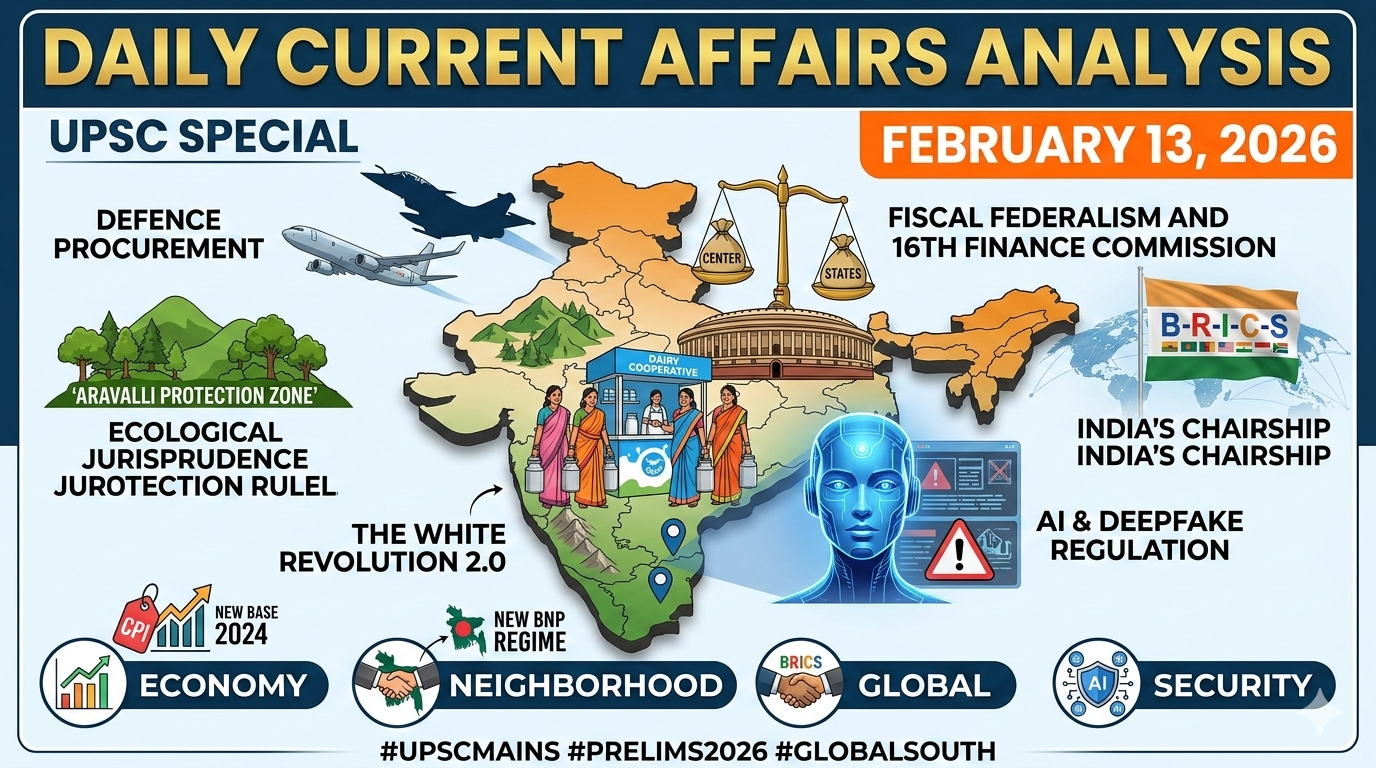
Topic 1: White Revolution 2.0 & Women’s Empowerment in Dairy
Syllabus
- GS-III: Economics of Animal-Rearing; Food Processing and Related Industries in India.
- GS-II: Welfare Schemes for Vulnerable Sections; Role of Women and Women’s Organizations.
Context
On February 13, 2026, the Ministry of Cooperation operationalized ‘White Revolution 2.0’, targeting the establishment of 1.20 lakh new Dairy Cooperative Societies (DCS) with a primary focus on women-led cooperatives to double rural incomes by 2030.
Main Body: Multi-Dimensional Analysis
- Economic Dimension:
- Income Diversification: Shifts rural dependency from rain-fed agriculture to stable, daily cash-flow activities.
- Value Addition: Moving beyond liquid milk to processed products (cheese, probiotics), which offer higher margins in the export market.
- Formalization: Integrates the unorganized “doodhwala” economy into a structured cooperative framework, enabling better credit access.
- Social & Gender Dimension:
- Financial Autonomy: Direct Benefit Transfer (DBT) to women’s accounts reduces intra-household poverty and increases their decision-making power.
- Leadership Development: The mandate for women-only M-PACS (Multipurpose Primary Agricultural Credit Societies) creates a pipeline for grassroots political leadership.
- Institutional Dimension:
- M-PACS Integration: Unlike 1.0, the 2.0 version links dairy with credit and storage, making the local cooperative a “one-stop-shop” for the farmer.
- Cooperative Federalism: Requires seamless synergy between Union’s capital and State’s implementation machinery.
- Technological Dimension:
- Smart Dairy: Use of IoT for milk quality testing at the source, ensuring transparency and preventing adulteration.
- Genomic Selection: Utilizing high-yield indigenous breeds (Gir, Sahiwal) through sex-sorted semen technology to increase productivity per animal.
- Ecological Dimension:
- Methane Management: Introduction of “Green Fodder” and seaweed-based feed to reduce the carbon footprint of India’s massive cattle population.
Positives, Negatives, and Government Schemes
| Feature | Analysis |
| Positives | Enhanced rural liquidity; Nutritional security (protein access); Resilience against climate-induced crop failure. |
| Negatives | Rising fodder costs; High initial capital for cooling infrastructure; Challenges in maintaining the cold chain in heat-prone regions. |
| Schemes | National Programme for Dairy Development (NPDD); Dairy Processing and Infrastructure Development Fund (DIDF). |
Examples
- Amul Model: The gold standard for three-tier cooperative structures.
- Shreeja Mahila Milk Producer Company: A successful all-women dairy model in Andhra Pradesh.
Way Forward
- Fodder Security: Establish “Fodder Banks” at the district level to insulate farmers from seasonal price spikes.
- Digital Traceability: Implement blockchain to track milk from “farm to fork” to meet international phytosanitary standards for export.
- Breed Improvement: Focus on indigenous cattle which are more resilient to the rising temperatures of 2026.
- Credit Ease: Simplify the collateral requirements for women-led cooperatives under the M-PACS umbrella.
Conclusion
White Revolution 2.0 is not merely a production target but a socio-economic tool. By placing women at the center of the dairy value chain, India can achieve “Sahakar-se-Samriddhi” (Prosperity through Cooperation) while ensuring nutritional security for its billion-plus population.
Mains Practice Question: “White Revolution 2.0 marks a shift from ‘volume-led growth’ to ‘value-and-gender-led growth.’ Critically analyze its potential in transforming the rural landscape of India.”
Topic 2: The 16th Finance Commission and the “Cess & Surcharge” Debate
Syllabus
- GS-II: Functions and Responsibilities of the Union and the States; Issues and Challenges Pertaining to the Federal Structure.
- GS-III: Indian Economy and issues relating to Planning, Mobilization of Resources, and Growth.
Context
With the 16th Finance Commission (FC) finalizing its interim report in February 2026, a major friction point has emerged between the Center and States regarding the exclusion of Cess and Surcharge from the divisible pool.
Main Body: Multi-Dimensional Analysis
- Constitutional Dimension:
- Article 270: Allows the Center to levy cesses for specific purposes, which are not shared with states, creating a “parallel budget” outside the FC’s purview.
- Erosion of Devolution: While the 15th FC recommended 41% devolution, the effective devolution is closer to 30-32% because the pool of sharable taxes is shrinking relative to the total tax collected.
- Fiscal Dimension:
- Vertical Imbalance: The Center has the power to raise revenue (Cess), but States have the bulk of the expenditure responsibilities (Health, Education, Agriculture).
- Debt Sustainability: States argue that limited tax revenue forces them into market borrowings, inviting “FRBM Act” restrictions from the Center.
- Political Dimension:
- Regional Inequality: Southern states argue that their demographic success (lower fertility) is being “punished” by the use of the 2011 census, while Northern states require more funds for developmental parity.
- Centrally Sponsored Schemes (CSS): The Center often uses Cess to fund CSS, which States claim infringes on their legislative domain.
- Economic Growth Dimension:
- Infrastructure Crowding-out: If States lack funds, Capex at the state level (which has a higher multiplier effect) suffers, slowing down national GDP.
Positives, Negatives, and Government Schemes
| Feature | Analysis |
| Positives | Cess allows for “ring-fenced” funding for critical sectors like Education (Cess) and Road infrastructure. |
| Negatives | Undermines “Cooperative Federalism”; Creates fiscal unpredictability for State Budgets; Lack of transparency in Cess utilization. |
| Schemes | GST Compensation Cess (Historical context); Health and Education Cess; Road and Infrastructure Cess. |
Examples
- Agriculture Infrastructure and Development Cess (AIDC): A significant portion of fuel taxes now goes here, bypasses the divisible pool.
- Southern State Protests: Recent “Chalo Delhi” movements by various state governments highlighting fiscal injustice.
Way Forward
- Capping Cess: The 16th FC should recommend a constitutional cap on the total percentage of Cess and Surcharge (e.g., not more than 10% of Gross Tax Revenue).
- Inclusion in Pool: Gradually phase out cesses and merge them into the GST or Basic Excise Duty to make them sharable.
- Performance Incentives: Use a “balanced scorecard” for devolution that rewards both demographic performance and fiscal efficiency.
- Inter-State Council: Revive the ISC as a platform for pre-budget consultations between the Union Finance Minister and State counterparts.
Conclusion
Fiscal federalism is the bedrock of Indian democracy. For the 16th Finance Commission to be successful, it must address the “Cess-pool” of contention to ensure that States remain partners, not subordinates, in India’s journey toward a $10 trillion economy.
Mains Practice Question: “The rising share of Cess and Surcharge in the Union’s Gross Tax Revenue has become a structural challenge to India’s fiscal federalism. Discuss in the light of the 16th Finance Commission’s mandate.”
Topic 3: IT Amendment Rules 2026: The AI & Deepfake Regulation
Syllabus
- GS-III: Basics of Cyber Security; Awareness in the fields of IT, Space, Computers, Robotics, and AI.
- GS-II: Government Policies and Interventions for Development in various sectors.
Context
On February 13, 2026, the Ministry of Electronics and IT (MeitY) notified the IT (Intermediary Guidelines and Digital Media Ethics Code) Amendment Rules, 2026, introducing stringent mandates for AI-generated content and platform accountability.
Main Body: Multi-Dimensional Analysis
- Security Dimension:
- Weaponization of Misinformation: Deepfakes pose a “clear and present danger” to social harmony and electoral integrity.
- Cyber-Sovereignty: Regulating foreign-owned platforms ensures that Indian “Digital Borders” are protected from algorithmic manipulation.
- Legal & Ethical Dimension:
- Safe Harbour Doctrine: The new rules narrow the “Safe Harbour” protection (Section 79 of IT Act); platforms are now liable if they fail to remove AI-generated misinformation within 2 hours of notification.
- Privacy vs. Traceability: Mandating the “first originator” of a message (to track deepfakes) clashes with end-to-end encryption.
- Economic Dimension:
- Compliance Costs: Smaller startups might find the 24/7 “Grievance Redressal” and “Automated Filtering” requirements financially prohibitive.
- AI Innovation: Over-regulation could stifle India’s budding AI ecosystem compared to the more “Laissez-faire” approach of the US.
- Rights-Based Dimension:
- Freedom of Speech: Critics argue that the “2-hour takedown” window is too short for due diligence, leading to “over-censorship” by platforms to avoid legal risk.
Positives, Negatives, and Government Schemes
| Feature | Analysis |
| Positives | Protects individual dignity (against non-consensual AI imagery); Increases platform transparency; Curbs election interference. |
| Negatives | Potential for “State-led” censorship; Technical difficulty in 100% accurate AI detection; Privacy concerns regarding traceability. |
| Schemes | Digital India Act (Proposed); National AI Portal; I4C (Indian Cyber Crime Coordination Centre). |
Examples
- 2024 Election Deepfakes: The precursor that led to these 2026 rules (e.g., viral fake videos of celebrities and politicians).
- EU AI Act: The global benchmark that India is attempting to adapt to its local socio-political context.
Way Forward
- Co-Regulation: Shift from “Command and Control” to a model where industry bodies set technical standards for AI watermarking.
- Digital Literacy: Instead of just banning content, the government must invest in “Critical Digital Thinking” campaigns for citizens.
- Global Treaty: AI knows no borders; India should lead a “G20 AI Protocol” for cross-border data sharing and criminal investigation.
- Ombudsman System: Create an independent Digital Redressal Authority to ensure that takedown orders are not politically motivated.
Conclusion
The 2026 IT Rules represent a necessary evolution of law in the age of generative AI. While the focus on safety and trust is paramount, the government must ensure that the “Digital India” of tomorrow remains an open, yet secure, marketplace of ideas.
Mains Practice Question: “Regulation of Artificial Intelligence requires a delicate balance between encouraging innovation and protecting citizen rights. Evaluate the effectiveness of the IT Amendment Rules 2026 in achieving this balance.”
Topic 4: CPI Base Year Revision (2024) & Macroeconomic Stability
Syllabus
- GS-III: Indian Economy and issues relating to Planning, Mobilization of Resources, Growth, Development, and Employment; Inflation (Indices).
Context
On February 13, 2026, the Ministry of Statistics and Programme Implementation (MoSPI) released the first retail inflation data based on the newly revised CPI series (Base Year 2024), replacing the decade-old 2012 base to better reflect modern consumption baskets.
Main Body: Multi-Dimensional Analysis
- Structural Consumption Shift:
- Engel’s Law in Action: As Indian incomes rose over the last decade, the percentage of expenditure on food (especially cereals) declined, while spending on “discretionary items” like health, education, and transport increased.
- The “Service” Economy: The 2024 base assigns higher weightage to services (streaming subscriptions, gym memberships, digital health), aligning the index with the lifestyle of the “New Middle Class.”
- Impact on Monetary Policy:
- RBI’s Precision: The old 2012 base often over-estimated inflation due to high food weightage (nearly 46%). The new series provides the MPC (Monetary Policy Committee) with a more accurate “true inflation” signal, potentially preventing unnecessary interest rate hikes.
- Real Interest Rates: A more accurate CPI ensures that depositors receive positive real interest rates, encouraging domestic savings.
- Digital Economy Integration:
- E-commerce Pricing: For the first time, the data collection mechanism incorporates prices from major e-marketplaces, acknowledging that a significant portion of urban India no longer shops at traditional brick-and-mortar stores.
- Rural-Urban Convergence:
- The revision narrows the gap between rural and urban consumption baskets, reflecting the deep penetration of FMCG products and digital services into rural hinterlands through the “JAM” trinity.
- Fiscal Dimension:
- Dearness Allowance (DA): Since DA for government employees is linked to CPI, the revision has a direct impact on the Union and State budgets’ revenue expenditure.
- Data Credibility:
- By updating the base, India aligns with IMF and World Bank standards for “Data Dissemination Standards,” enhancing global investor confidence in Indian macroeconomic indicators.
Positives, Negatives, and Government Schemes
| Feature | Analysis |
| Positives | Accurate reflection of “Cost of Living”; Better policy targeting; Reduced volatility in the Headline Inflation print. |
| Negatives | Technical challenges in back-casting data for historical comparison; Initial confusion among market participants; Data collection gaps in remote areas. |
| Schemes | National Strategy for Statistics (NSS); Digital India (e-price collection); RBI’s Inflation Targeting Framework. |
Examples
- The Protein Shift: The index now reflects higher weights for eggs, meat, and processed foods over traditional grains.
- Health Inflation: Increased weightage for diagnostic services and insurance premiums, reflecting post-pandemic health awareness.
Way Forward
- Dynamic Weighting: Explore “Chain-Base” indexing used in advanced economies to allow for annual updates to the basket.
- Big Data Analytics: Use web-scraping and AI to collect real-time price data from online retailers to supplement physical surveys.
- Strengthening NSO: Ensure the National Statistical Office (NSO) remains autonomous and adequately staffed to prevent data lags.
- Public Awareness: Educate the public on why the “inflation feel” might differ from the “official number” due to the updated weights.
Conclusion
The 2024 CPI revision is a long-overdue calibration of India’s economic compass. By reflecting the aspirations and spending habits of a digital-first India, it provides the government and the RBI with the clarity needed to navigate the complexities of a $7 trillion-plus economy.
Mains Practice Question: “The transition to the 2024 CPI base year is not just a statistical update but a recognition of India’s changing socio-economic fabric. Discuss its implications for India’s monetary policy framework.”
Topic 5: Major Defence Procurement: Rafale and P-8I
Syllabus
- GS-III: Security Challenges and their Management; Indigenization of Technology and Developing New Technology; Defence Procurement.
Context
The Defence Acquisition Council (DAC) on February 13, 2026, accorded ‘Acceptance of Necessity’ (AoN) for the procurement of 114 Rafale Multi-Role Fighters (under the MRFA program) and 6 P-8I Poseidon maritime patrol aircraft to bolster India’s air and naval superiority.
Main Body: Multi-Dimensional Analysis
- Strategic Deterrence:
- Two-Front Threat: The Rafale fleet is critical for maintaining a “qualitative edge” over regional adversaries, particularly in high-altitude Himalayan theaters where its “Omnirole” capabilities (Electronic Warfare, Air-to-Air, and Ground Attack) are unmatched.
- Maritime Domain Awareness (MDA): The P-8Is act as “Force Multipliers” in the Indian Ocean Region (IOR), tracking submarine movements and ensuring the security of Sea Lines of Communication (SLOCs).
- The “Make in India” vs. Operational Urgency Balance:
- MRFA Program: Unlike the previous government-to-government deal, this 114-jet procurement emphasizes “Buy Global – Manufacture in India,” aiming to create a domestic ecosystem for aerospace manufacturing.
- Technology Transfer (ToT): India is negotiating for 100% transfer of engine technology (Safran M88), which is the “holy grail” of indigenization.
- Inter-Operability:
- Standardizing the fleet with French and American platforms enhances India’s ability to participate in multilateral exercises (like Malabar or Desert Knight) and ensures seamless logistics during joint operations.
- Economic Dimension:
- Offsets: The deal mandates 50% offsets, forcing foreign OEMs (Original Equipment Manufacturers) to invest billions back into the Indian MSME defense sector.
- Life-Cycle Costs: The high upfront cost is analyzed against the 40-year life-cycle, where Rafale’s high “availability rate” makes it more cost-effective than cheaper, high-maintenance alternatives.
- Geopolitical Alignment:
- The split procurement (French jets, US surveillance planes) demonstrates India’s “Strategic Autonomy,” refusing to be tied to a single supplier while strengthening ties with key Western security partners.
Positives, Negatives, and Government Schemes
| Feature | Analysis |
| Positives | Massive boost to combat squadron strength; Advanced Anti-Submarine Warfare (ASW) capabilities; Domestic manufacturing jobs. |
| Negatives | Massive fiscal outgo (Budgetary pressure); Dependency on foreign spare parts; Long delivery timelines (gestation period). |
| Schemes | Defence Acquisition Procedure (DAP) 2020; Atmanirbhar Bharat in Defence; Strategic Partnership Model. |
Examples
- AESA Radar: The active electronically scanned array radar on Rafale allows for tracking multiple targets simultaneously.
- Meteor Missile: The “no-escape zone” air-to-air missile that provides India with a distinct tactical advantage.
Way Forward
- Accelerated Timelines: Use “Fast-Track” procurement routes to prevent the squadron strength from dipping below the critical 30-mark.
- Indigenous Engine Development: Use the Rafale deal to finalize the “Kaveri” engine or a joint-venture engine to ensure future fighter jets (AMCA) are truly indigenous.
- Private Sector Integration: Encourage giants like Tata and L&T to lead the “Manufacture in India” phase of the MRFA deal.
- Maintenance Hub: Develop India as a regional MRO (Maintenance, Repair, and Overhaul) hub for Rafale and P-8I for other friendly nations.
Conclusion
While indigenous platforms like Tejas are the future, the Rafale and P-8I acquisitions are the “strategic bridge” required to secure India’s present. These procurements solidify India’s role as the “Net Security Provider” in the Indo-Pacific.
Mains Practice Question: “Critically examine the challenges in balancing the immediate operational requirements of the Indian Armed Forces with the long-term goal of ‘Atmanirbharta’ in defense production.”
Topic 6: The Aravalli Ruling & Ecological Jurisprudence
Syllabus
- GS-III: Conservation, Environmental Pollution, and Degradation; Environmental Impact Assessment.
- GS-II: Judiciary (Judicial Activism vs. Restraint).
Context
In a landmark ruling on February 13, 2026, the Supreme Court stayed the Haryana government’s mega-tourism project in the Aravallis, citing the “Precautionary Principle” and the forest’s role as a vital carbon sink for Northern India.
Main Body: Multi-Dimensional Analysis
- The “Desert Barrier” Argument:
- The Aravallis act as a natural wall preventing the expansion of the Thar Desert toward the fertile plains of Punjab, Haryana, and Delhi. Any dilution of forest cover accelerates desertification.
- Groundwater Recharge:
- The fractured rocks of the Aravallis serve as critical primary aquifers. In a water-stressed NCR (National Capital Region), protecting these hills is essential for the survival of the regional water table.
- Judicial Doctrines:
- Public Trust Doctrine: The Court reiterated that the state is not the “owner” but the “trustee” of natural resources, and it cannot divert forest land for commercial use without overwhelming public necessity.
- Non-Regression Principle: This emerging legal concept suggests that environmental protections once granted should not be backtracked or diluted by subsequent governments.
- Conflict between Development and Conservation:
- The Haryana government argued for “Sustainable Tourism” and employment. The Court countered that “ecological security” is the foundation upon which economic development must be built.
- Land Use and Legal Loopholes:
- The ruling addresses the long-standing misuse of the Punjab Land Preservation Act (PLPA), which the state government attempted to amend to de-notify protected forest areas.
- Biodiversity and Wildlife:
- The Aravallis are a critical wildlife corridor for leopards and other species moving between Sariska and the Yamuna banks. Fragmentation of this corridor leads to increased human-wildlife conflict.
Positives, Negatives, and Government Schemes
| Feature | Analysis |
| Positives | Preservation of the “Green Lung” of NCR; Protection of regional water security; Strengthening of environmental law. |
| Negatives | Loss of potential tourism revenue; Stalled infrastructure projects; Legal uncertainty for existing real estate near the hills. |
| Schemes | Green India Mission; National Mission for a Green Haryana; CAMPA (Compensatory Afforestation Fund). |
Examples
- Mangar Bani: The last remaining “Sacred Grove” in the Aravallis which has been at the center of conservation battles.
- The Great Green Wall of India: The ambitious project to create a 1,400km long and 5km wide green belt from Gujarat to Haryana.
Way Forward
- Zonal Master Plans: Finalize the “Eco-Sensitive Zone” (ESZ) notifications for the entire Aravalli range with strict “No-Go” areas.
- Satellite Monitoring: Use ISRO’s Bhuvan portal to monitor illegal mining and construction in real-time.
- Community Participation: Incentivize local villagers to act as “Forest Guards” through eco-friendly livelihood schemes that don’t require large-scale construction.
- Unified Aravalli Authority: Create a multi-state statutory body (Rajasthan, Haryana, Delhi, Gujarat) to manage the range as a single ecological unit.
Conclusion
The Supreme Court’s intervention is a timely reminder that ecological boundaries are non-negotiable. For a sustainable India in 2026, the Aravallis must be viewed not as “waste land” for development, but as “critical infrastructure” for survival.
Mains Practice Question: “Discuss the significance of the Aravalli range in the ecological security of Northern India. Evaluate the role of the judiciary in protecting this fragile ecosystem against commercial interests.”
Topic 7: BRICS Summit 2026: India’s Chairship and the “Expanded” Agenda
Syllabus
- GS-II: Bilateral, Regional, and Global Groupings and Agreements involving India; Effect of Policies of Developed and Developing Countries on India’s interests.
Context
On February 13, 2026, the Ministry of External Affairs (MEA) concluded the first BRICS Sherpas and Sous-Sherpas meeting in New Delhi. This marked the official start of India’s 2026 Chairship, focusing on the theme “Building for Resilience, Innovation, Cooperation, and Sustainability.”
Main Body: Multi-Dimensional Analysis
- The “BRICS-10” Geopolitical Reality:
- Expanded Membership: This is the first full chairship cycle including the five new members (Egypt, Ethiopia, Iran, Saudi Arabia, and UAE). India’s challenge is to harmonize the interests of a diverse “BRICS-10” while ensuring the grouping doesn’t become an anti-Western bloc.
- Strategic Bridge-Builder: India is positioning itself as a bridge between the G7 and the expanded BRICS, advocating for “Reformed Multilateralism” that benefits the Global South without triggering a new Cold War.
- Economic & Financial Dimension:
- De-dollarization & Local Currencies: A key focus is the BRICS Pay system and the use of local currencies for cross-border trade to reduce vulnerability to Western sanctions and dollar fluctuations.
- New Development Bank (NDB): India aims to push for the NDB to become the primary lender for “Green Infrastructure” in Africa and Southeast Asia, challenging the dominance of the IMF and World Bank.
- Science, Technology, and Innovation:
- Digital Public Infrastructure (DPI): India is leading the push to export the “India Stack” (UPI, Aadhaar, ONDC) as a BRICS-wide template for digital financial inclusion.
- Space Cooperation: Utilizing the BRICS Remote Sensing Satellite Constellation for climate monitoring and disaster management across the 10 member nations.
- Security & Counter-Terrorism:
- Unified Action Plan: India has introduced a revamped BRICS Counter-Terrorism Action Plan, specifically targeting the misuse of “Emerging Technologies” (drones, encrypted messaging) by non-state actors.
- Cyber-Security: Establishing a BRICS framework for data sovereignty and combatting cross-border cyber-crimes.
- The “People-Centric” Dimension:
- Expanding the BRICS Academic Forum, Civil Forum, and introducing the BRICS Youth Games to foster deep-rooted cultural ties beyond high-level diplomacy.
Positives, Negatives, and Government Schemes
| Feature | Analysis |
| Positives | Enhanced voice for the Global South; Alternative to Western financial hegemonies; Access to energy-rich Iran/Saudi Arabia. |
| Negatives | Potential for China to dominate the expanded bloc; Internal friction between members (e.g., Iran-Saudi, Egypt-Ethiopia); Risk of being perceived as anti-West. |
| Schemes | Vaccine Maitri (as a template for health cooperation); Digital India (DPI export focus). |
Examples
- BRICS Pay: A decentralized multicurrency messaging system tested in late 2025.
- Contingent Reserve Arrangement (CRA): A framework to provide protection against global liquidity pressures.
Way Forward
- Institutional Reform: India must lead the charge for a permanent secretariat for BRICS to ensure continuity between chairships.
- Conflict Resolution: Establish an internal mediation mechanism to prevent bilateral disputes (like Ethiopia-Egypt water issues) from paralyzing the grouping.
- Trade Facilitation: Finalize a BRICS-wide “Customs Mutual Assistance Agreement” to reduce non-tariff barriers.
- Sustainability Focus: Launch a “BRICS Solar Alliance” to complement the International Solar Alliance, leveraging the grouping’s vast geographic diversity.
Conclusion
As the 2026 Chair, India has a unique opportunity to redefine BRICS from a “talk shop” into a powerhouse of the Global South. By focusing on Resilience and Innovation, New Delhi can ensure that the expanded BRICS remains a “Non-Western” rather than an “Anti-Western” force for global stability.
Mains Practice Question: “The expansion of BRICS has transitioned the grouping from a socio-economic alliance to a significant geopolitical force. Evaluate India’s role as the 2026 Chair in navigating the internal contradictions of this expanded bloc.”
Topic 8: Bangladesh Political Shift: Recalibrating “Neighborhood First”
Syllabus
- GS-II: India and its Neighborhood- Relations; Bilateral Agreements involving India and/or affecting India’s interests.
Context
Following the landslide victory of the Bangladesh Nationalist Party (BNP) and its allies on February 13, 2026, India is recalibrating its foreign policy to engage with the new leadership under Tarique Rahman, marking a decisive end to the 15-year “Golden Era” of relations under the Awami League.
Main Body: Multi-Dimensional Analysis
- The “Political Transition” Challenge:
- Regime Change: For a decade, India’s “Neighborhood First” policy was synonymous with the Hasina administration. The return of the BNP requires India to build new institutional trust with a party that has historically been more aligned with Pakistan and China.
- Inclusivity: India’s prompt congratulatory message to Tarique Rahman signals a pragmatic shift—prioritizing national interest over past political preferences.
- Security & Border Management:
- Insurgency Concerns: Historically, BNP administrations were accused of sheltering anti-India insurgent groups (like ULFA). India’s primary goal is to ensure that the “Zero Tolerance” policy toward terror remains a red line for the new government.
- Minority Protection: The rise of hardline elements within the winning coalition has raised concerns about the safety of the Hindu minority in Bangladesh, a sensitive issue with domestic political repercussions in India.
- Economic & Connectivity Continuity:
- Transit & Transshipment: Projects like the Agartala-Akhaura rail link and the use of Mongla and Chittagong ports are vital for India’s Northeast. New Delhi must ensure these are viewed as “mutually beneficial” rather than “Indian footprints.”
- CEPA Negotiations: The Comprehensive Economic Partnership Agreement (CEPA), which was in the works, may face delays as the new government reviews all major bilateral deals.
- The “China Factor”:
- Bangladesh is a key part of the Belt and Road Initiative (BRI). The new government is likely to seek increased Chinese investment in infrastructure, requiring India to offer more competitive and transparent “development partnership” alternatives.
- Water Diplomacy:
- The Teesta Water Sharing Treaty remains the ultimate litmus test. The BNP is likely to push hard for this, and India’s inability to deliver (due to state-level objections) could become a flashpoint.
Positives, Negatives, and Government Schemes
| Feature | Analysis |
| Positives | Opportunity for a “reset” with a more diverse political spectrum in Bangladesh; Potential to resolve long-pending issues through fresh dialogue. |
| Negatives | Risk of resurgence of anti-India sentiment; Strategic space for China/Pakistan to expand influence; Uncertainty over existing security cooperation. |
| Schemes | Indian Technical and Economic Cooperation (ITEC); High Impact Community Development Projects (HICDPs). |
Examples
- Maitri Super Thermal Power Plant: A symbol of energy cooperation that both sides seek to maintain.
- Border Haats: Grassroots economic initiatives that help reduce smuggling and build people-to-people goodwill.
Way Forward
- Broad-Based Engagement: Move beyond “Person-to-Person” diplomacy to “Institution-to-Institution” ties involving all political stakeholders in Dhaka.
- Development over Politics: Focus on “quick-win” infrastructure projects (hospitals, schools) to counter anti-India narratives at the grassroots level.
- Security Assurances: Establish a high-level “Security Dialogue” early in the new government’s tenure to define mutual red lines on cross-border insurgency.
- Water Management: Propose a “Basin-wide Management” approach for the Teesta to bypass traditional political stalemates.
Conclusion
The 2026 election in Bangladesh is a “stress test” for India’s Neighborhood First policy. While the political guard has changed, the geographic and economic realities remain the same. Pragmatism, patience, and a focus on shared prosperity will be essential for New Delhi to maintain its status as Bangladesh’s most vital partner.
Mains Practice Question: “Regime change in a neighboring country often presents a dual challenge of ‘strategic anxiety’ and ‘diplomatic opportunity.’ Discuss this statement in the context of recent political developments in Bangladesh.”
