
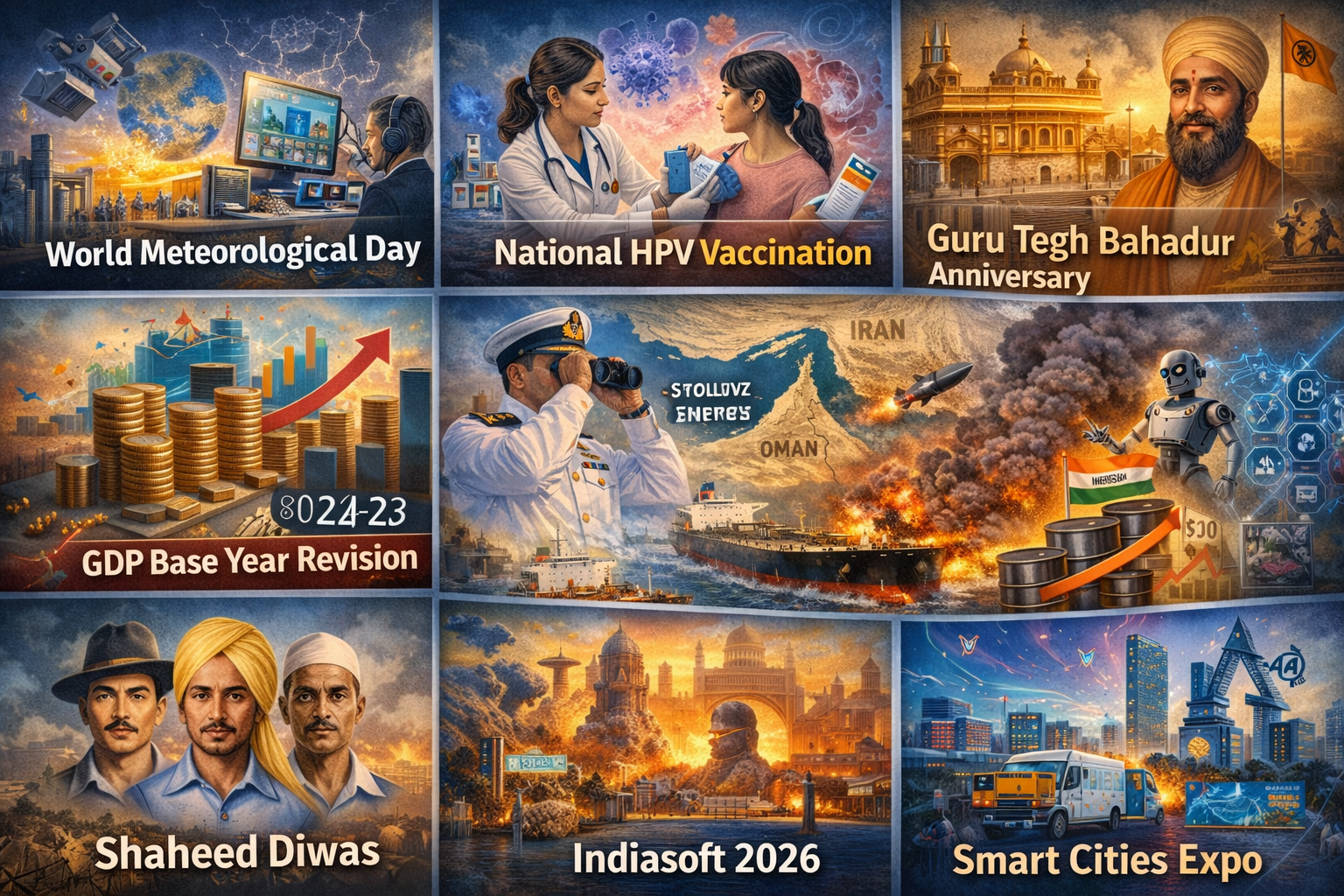
Topic 1: The “Hormuz Halt” – Global Energy Security and India’s Response
Syllabus
- GS Paper II: Bilateral, regional and global groupings and agreements involving India and/or affecting India’s interests.
- GS Paper III: Energy Security, Infrastructure, and Indian Economy.
Context
Following military strikes in West Asia and a leadership transition in Iran, vessel traffic through the Strait of Hormuz—the world’s most important oil chokepoint—has dropped by nearly 75% as of March 23, 2026. India, which imports nearly 50% of its crude through this route, has activated contingency plans.
Multi-Dimensional Analysis
- Geopolitics of Chokepoints: The Strait of Hormuz connects the Persian Gulf with the Gulf of Oman. Its “informal blockade” by non-state actors and heightened insurance premiums (War Risk Surcharge) have effectively created a “Hormuz Halt.”
- India’s Strategic Vulnerability: India is the world’s third-largest oil consumer with 88% import dependency. A disruption here risks a “Balance of Payments” crisis and inflationary pressure on the Rupee.
- Shift to the Arctic & Russia: India is pivotally shifting to the Northern Sea Route (Arctic) and increased Russian imports to bypass the Middle Eastern volatility.
- Economic Impact: Brent crude is hovering near $80-$100/barrel. Every $10 rise in oil prices typically increases India’s Current Account Deficit (CAD) by about 0.5% of GDP.
- Maritime Security: The Indian Navy’s “Operation Sankalp” has been expanded to provide “safe passage” and “escort” to Indian-flagged tankers in the Gulf of Oman.
- Diplomatic Balancing: India must balance its “strategic autonomy” by engaging with both the “West Asian Quadrant” (I2U2) and traditional partners like Iran to ensure the “freedom of navigation.”
Comparison & Schemes
| Positives | Negatives | Govt. Initiatives |
| Faster transition to Electric Vehicles (EVs) | Sudden spike in WPI/CPI inflation | ISPRL: Strategic Petroleum Reserves (5.33 MMT). |
| Resilience in “Strategic Autonomy” | Widening Current Account Deficit (CAD) | PM-KUSUM: Reducing diesel dependence in agriculture. |
| Deepening ties with Russia/Central Asia | Supply chain delays for LNG and Fertilizers | Operation Sankalp: Maritime security by Indian Navy. |
Examples
- Habshan-Fujairah Pipeline: India is exploring the use of this UAE-based pipeline to bypass the Strait.
- Northern Sea Route (NSR): Recent Indian shipments of crude from Murmansk (Russia) arriving at Jamnagar.
Way Forward
- Expand SPR: Increase Strategic Petroleum Reserves to 90 days of cover (current is ~74 days).
- Diversify Energy Mix: Accelerate Green Hydrogen and Ethanol blending (E20) to reduce crude reliance.
- Infrastructure Diplomacy: Finalize the IMEC (India-Middle East-Europe Economic Corridor) as a long-term alternative.
- Domestic Exploration: Incentivize the HELP (Hydrocarbon Exploration and Licensing Policy) to increase domestic output.
Conclusion
The “Hormuz Halt” is a wake-up call for India to transition from “Energy Security” to “Energy Sovereignty.” While short-term diversification helps, long-term stability lies in reducing the hydrocarbon footprint.
Practice Mains Question: “The volatility of maritime chekepoints in West Asia necessitates a radical shift in India’s energy diplomacy. Discuss in the context of the recent disruptions in the Strait of Hormuz.”
Topic 2: Revision of GDP Base Year (2022-23) – A New Economic Mirror
Syllabus
- GS Paper III: Indian Economy and issues relating to planning, mobilization of resources, growth, development, and employment.
Context
The National Statistical Office (NSO) has officially released the first full set of data under the new GDP base year 2022-23 (revised from 2011-12). The data shows a robust 7.6% growth for FY26.
Multi-Dimensional Analysis
- Capturing the ‘Digital’ Economy: The 2011-12 base year failed to account for the post-2016 digital revolution. The new series integrates GST data and e-commerce transactions, providing a more accurate size of the service sector.
- Informal Sector Inclusion: By using the Annual Survey of Unincorporated Sector Enterprises (ASUSE) and PLFS, the new series better captures the “missing middle” of India’s informal economy.
- Methodological Shift (Double Deflation): For the first time, India is consistently using “Double Deflation” (adjusting both inputs and outputs for inflation) in manufacturing, preventing the “overstatement” of growth when commodity prices fall.
- Policy Calibration: With a more accurate GDP denominator, the Fiscal Deficit-to-GDP ratio and Debt-to-GDP ratio are being recalibrated, potentially improving India’s sovereign credit ratings.
- Sectoral Realignment: The “Trade, Hotels, and Transport” sector has seen a weightage increase, reflecting the changing consumption patterns of the Indian middle class.
- Global Benchmarking: This shift aligns India’s National Accounts with the UN System of National Accounts (SNA) 2008/2025 standards.
Comparison & Schemes
| Positives | Negatives | Govt. Initiatives |
| Better data-driven policymaking | Lack of “Back-Series” data (pre-2022) | MCA-21: Digitized corporate filings used for data. |
| Improved investor confidence | Potential “Optical” jump in GDP size | GSTN: Using GST data for real-time economic tracking. |
| Accurate tracking of Manufacturing | Confusion in historical comparisons | National Strategy on Statistics: Strengthening MoSPI. |
Examples
- E-Vahan Integration: Using vehicle registration data to estimate “Private Final Consumption Expenditure” on transport.
- PFMS Data: Using the Public Finance Management System for real-time tracking of government spending.
Way Forward
- Timely Back-Series: MoSPI must release the back-series data by Dec 2026 to allow for longitudinal analysis.
- State-Level Integration: Encourage states to revise their GSDP (Gross State Domestic Product) base years simultaneously.
- Data Privacy: Ensure that the integration of GST and MCA-21 data adheres to strict data protection norms.
- Frequency: Shift to a 5-year base revision cycle (instead of 10+ years) to keep pace with rapid structural changes.
Conclusion
A base year revision is not just a mathematical exercise; it is an “identity update” for the economy. It ensures that the “New India” of startups and digital rails is visible in the national ledger.
Practice Mains Question: “Assess how the revision of the GDP base year to 2022-23 addresses the structural changes in the Indian economy over the last decade.”
Topic 3: National HPV Vaccination Rollout – The “Swastha Nari” Milestone
Syllabus
- GS Paper II: Issues relating to development and management of Social Sector/Services relating to Health, Education, Human Resources.
Context
On March 23, 2026, the Ministry of Health reported the completion of the first month of the National HPV (Human Papillomavirus) Vaccination Campaign, targeting 1.15 crore girls aged 14 to eliminate cervical cancer.
Multi-Dimensional Analysis
- Public Health Crisis: Cervical cancer is the second most common cancer among Indian women. India accounts for roughly 25% of global deaths from this disease.
- Preventive Healthcare Shift: This marks a transition from “curative” (treating cancer) to “preventive” (vaccinating against the virus). One dose of the quadrivalent vaccine (Gardasil-4) is now proven to be highly effective.
- Gender Equity in Health: The campaign, under the “Swastha Nari, Sashakt Bharat” vision, addresses the disproportionate health burden on women in rural areas who lack access to regular screening (Pap smears).
- Indigenization (CERVAVAC): While currently using a mix, the integration of India’s indigenous vaccine (CERVAVAC by Serum Institute) has significantly brought down the cost per dose.
- The “Single-Dose” Breakthrough: Following WHO recommendations, India’s adoption of the single-dose schedule has improved “compliance” and reduced logistical hurdles in school-based camps.
- Social Challenges: Overcoming “vaccine hesitancy” and misconceptions regarding reproductive health remains a hurdle in conservative pockets.
Comparison & Schemes
| Positives | Negatives | Govt. Initiatives |
| Potential to save 80,000 lives annually | Cold-chain logistics in remote areas | Mission Indradhanush: Including HPV in Umap. |
| Reduction in long-term DALYs | Cultural taboos & vaccine hesitancy | Ayushman Arogya Mandirs: Primary delivery points. |
| Cost-effective (Prevention > Cure) | High initial procurement costs | U-WIN Portal: Digital tracking of every dose. |
Examples
- Sikkim Model: The first Indian state to achieve 95% HPV coverage, now being used as a blueprint for the national rollout.
- U-WIN Platform: The digital backbone (like Co-WIN) used to track girl-child vaccination status.
Way Forward
- School-Based Delivery: Integrate vaccination with the “School Health & Wellness Program” for 100% coverage.
- Awareness Campaigns: Engage “Asha” and “Anganwadi” workers to dispel myths at the grassroots level.
- Screening Synergy: Combine vaccination with “thermal screening” for older women (30-45 age group).
- Indigenous Manufacturing: Scale up CERVAVAC production to ensure global export to other Global South nations.
Conclusion
The HPV vaccination drive is a landmark in India’s “Universal Immunization Programme.” By protecting young girls today, India is securing the health of its future workforce and families.
Practice Mains Question: “Cervical cancer is a disease of inequity. Examine how the National HPV Vaccination Campaign can bridge the gap in women’s healthcare in India.”
Topic 4: 11th Smart Cities India Expo – Reimagining Urban Governance
Syllabus
- GS Paper II: Statutory, regulatory and various quasi-judicial bodies; Government policies and interventions.
- GS Paper III: Infrastructure: Energy, Ports, Roads, Airports, Railways etc.; Science and Technology- developments and their applications.
Context
The 11th Smart Cities India Expo (co-located with the 33rd Convergence India) commenced on March 23, 2026, at Bharat Mandapam, New Delhi. This edition serves as a “Stock-Taking” exercise for the Smart Cities Mission (SCM) as it nears its final evaluation phase.
Multi-Dimensional Analysis
- Technological Integration (AI & IoT): The 2026 expo shifts focus from basic infrastructure to AI-driven urban management. Key showcases include “Digital Twins” of cities like Varanasi and Surat, allowing planners to simulate disaster responses and traffic flows in real-time.
- Sustainability & ESG: For the first time, a dedicated “Greentech and ESG” pavilion highlights how cities are tracking their carbon footprints. This aligns with India’s COP26/COP27 commitments to achieve Net Zero by 2070.
- Data Governance & Privacy: With the deployment of Integrated Command and Control Centres (ICCCs) in 100 cities, the analysis focuses on the “DataSmart Cities Strategy.” The expo deliberates on balancing surveillance for safety with the “Right to Privacy.”
- Economic Hubs: The expo emphasizes “Cities as Engines of Growth.” By integrating PM Gati Shakti with urban planning, the government aims to reduce logistics costs within urban clusters.
- Inclusive Urbanism: Discussions include “Gender-Responsive Urban Planning,” ensuring that smart streetlighting and public transport systems are designed with the safety of women and marginalized groups at the core.
- Financing Smart Cities: A critical dimension is the shift toward Municipal Bonds and Public-Private Partnerships (PPP) as central funding dries up, pushing cities toward financial self-reliance.
Comparison & Schemes
| Positives | Negatives | Govt. Initiatives |
| Improved service delivery through ICCCs. | High maintenance cost of tech infrastructure. | Smart Cities Mission (SCM): 100 cities. |
| Data-driven traffic & waste management. | Widening “Digital Divide” in urban slums. | AMRUT 2.0: Water security in cities. |
| Boost to local “Climate-Tech” startups. | Vulnerability to Cyber-attacks on city grids. | National Urban Digital Mission: Unified data. |
Examples
- Indore’s Waste Model: Displayed as a global standard for 100% waste segregation and “Waste-to-Energy” conversion.
- Surat’s ICCC: Used during the 2025 floods to coordinate rescue ops, now a blueprint for “Resilient Cities.”
Way Forward
- Cyber-Security Audit: Mandatory annual third-party audits for all City Data Centres to prevent ransomware attacks.
- Citizen-Centric Design: Shift from “Top-Down” tech implementation to “Bottom-Up” community-led urban solutions.
- Climate Resilience: Integration of “Sponge City” concepts to tackle the increasing frequency of urban flooding.
- Financial Autonomy: Empowering Urban Local Bodies (ULBs) to enhance their “Internal Revenue Generation” through property tax reforms.
Conclusion
The 11th Smart Cities Expo marks the transition from “Greenfield” projects to “Operational Excellence.” The success of Indian urbanization now depends on how seamlessly technology serves the last-mile citizen rather than just the city’s dashboard.
Practice Mains Question: “Smart Cities in India are evolving from mere technology hubs to resilient ecosystems. Analyze the role of AI and ESG frameworks in shaping the future of Indian urban governance.”
Topic 5: INDIASOFT 2026 – Scaling “Sovereign AI” and IT Exports
Syllabus
- GS Paper III: Science and Technology; Effects of liberalization on the economy; Indigenization of technology.
Context
The 26th edition of INDIASOFT, India’s premier international IT exhibition, opened on March 23, 2026. Organized by the ESC (Electronics and Computer Software Export Promotion Council), it hosts over 1,500 exhibitors and buyers from 80+ countries.
Multi-Dimensional Analysis
- Sovereign AI & Bhashini: A major highlight is the export-readiness of Bhashini (National Language Translation Mission). India is positioning its AI-based language models as a “Digital Public Good” for other multilingual nations in the Global South.
- Deep-Tech Pivot: Moving beyond traditional SaaS (Software as a Service), INDIASOFT 2026 focuses on “Deep-Tech” including Quantum Computing interfaces and Semiconductor Design software, reducing reliance on Western proprietary tools.
- Global South Collaboration: The event features a “Market Access Initiative” for Africa and Latin America, promoting “India Stack” (Aadhaar, UPI, DigiLocker) as a plug-and-play governance model for developing economies.
- Cybersecurity Sovereignty: With the rise in global cyber-warfare, Indian firms are showcasing indigenous “Zero-Trust Architectures” and encrypted communication tools for global government clients.
- Start-up Ecosystem: The “Startup Zone” highlights 200+ companies focusing on Space-Tech and Health-Tech, indicating a maturation of the Indian startup ecosystem from “fintech-only” to hardware-software integration.
- Economic Impact: IT and Business services remain India’s largest export earner. INDIASOFT aims to bridge the $300 billion export target for electronics and IT services by 2030.
Comparison & Schemes
| Positives | Negatives | Govt. Initiatives |
| Leadership in “Digital Public Infrastructure.” | Global talent crunch in specialized AI roles. | Digital India Bhashini: AI translation. |
| Diversification of IT export markets. | High competition from Vietnam and Mexico. | MEITY’s CHIPS to Startup: Semi-con. |
| Promotion of “Make in India” in software. | Regulatory hurdles in cross-border data flow. | MAI Scheme: Export promotion support. |
Examples
- UPI Global: Recent MoUs signed during the expo to implement UPI-like systems in five African nations.
- Hanooman AI: The Indian LLM (Large Language Model) being showcased for localized industrial applications.
Way Forward
- R&D Incentive: Increasing the “Tax Credit” for startups investing in foundational AI research.
- Skill Harmonization: Aligning Indian IT certifications with global standards to facilitate the “Global Mobility of Talent.”
- Green IT: Incentivizing data centers to transition to 100% renewable energy to meet global supply chain ESG norms.
- SME Digitization: Creating a “Cloud-Credit” system for Indian MSMEs to adopt high-end software showcased at INDIASOFT.
Conclusion
INDIASOFT 2026 signifies that India is no longer just the “Back office” of the world but the “Front office” of innovation. The focus on Sovereign AI and DPI will be the cornerstone of India’s soft power in the digital decade.
Practice Mains Question: “Critically examine the significance of ‘Sovereign AI’ and ‘Digital Public Infrastructure’ in establishing India as a global leader in the 4th Industrial Revolution.”
Topic 6: 350th Martyrdom Anniversary of Guru Tegh Bahadur – “Hind di Chadar”
Syllabus
- GS Paper I: Indian culture will cover the salient aspects of Art Forms, literature and Architecture from ancient to modern times.
- GS Paper II: Government policies and interventions for development in various sectors.
Context
On March 23, 2026, the Government of India and the Maharashtra Government concluded the “Hind-di-Chadar” samagam, marking the 350th martyrdom anniversary of the ninth Sikh Guru, Guru Tegh Bahadur.
Multi-Dimensional Analysis
- Historical Legacy: Guru Tegh Bahadur’s martyrdom in 1675 at Chandni Chowk was a pivotal moment in Indian history. He is revered as ‘Hind di Chadar’ (Shield of India) for protecting the religious freedom of Kashmiri Brahmins and the broader Indian society against forced conversions.
- Socio-Cultural Unity: The 2026 celebrations emphasize the “Nanak-namleva” (followers of Nanak’s philosophy) across diverse communities like the Sindhis, Banjaras, and Labanas, reinforcing the “Ek Bharat Shreshtha Bharat” spirit.
- Philosophical Relevance: His teachings on “Fearlessness” (Nirbhay) and “Non-enmity” (Nirvair) are highlighted as essential for modern-day social harmony and tackling global radicalization.
- Integration with Freedom Struggle: The government links the Guru’s sacrifice to the later resistance movements in India, portraying it as the foundational “Spiritual Resistance” that eventually led to the organized freedom struggle.
- Diplomatic Dimension: The Kartarpur Sahib Corridor and global samagams help India engage with the global Sikh diaspora, countering extremist narratives and promoting “Heritage Tourism.”
- Education and Youth: The 2026 samagam focused on digitizing the Guru’s Gurbani and historical records to make them accessible to the Gen-Z through VR (Virtual Reality) exhibitions at sites like Anandpur Sahib and Rakab Ganj.
Comparison & Schemes
| Positives | Negatives | Govt. Initiatives |
| Strengthening of national social fabric. | Risk of political appropriation of history. | Azadi Ka Amrit Mahotsav: Heritage phase. |
| Promotion of “Religious Tourism” circuits. | Maintenance of historical sites in urban hubs. | PRASHAD Scheme: Heritage city dev. |
| Revitalization of regional folk arts (Banjara). | Language barriers in spreading teachings. | Veer Bal Diwas: Commemorating Sahibzadas. |
Examples
- Navi Mumbai Samagam: A 2-day event that saw nearly 2 million devotees, integrating digital exhibitions with traditional Langar.
- Commemorative Stamps/Coins: Released by the PM to mark the 350th year milestone.
Way Forward
- Curriculum Integration: Include detailed chapters on the Guru’s sacrifice in NCERT books to highlight the “Civilizational Continuity” of India.
- Digital Archive: Complete the “Sikh Heritage Digital Repository” to preserve rare manuscripts and weaponry.
- Inter-Faith Dialogues: Use the 350th anniversary to launch global “Freedom of Conscience” forums led by India.
- Heritage Corridors: Connect sites associated with the Guru’s travels (from Dhaka to Assam to Punjab) into a structured “Tegh Bahadur Circuit.”
Conclusion
The martyrdom of Guru Tegh Bahadur is a timeless reminder that the “Shield of India” is forged not just by iron, but by the courage to stand for others’ rights. Celebrating his 350th year reinforces the pluralistic and resilient ethos of the Indian state.
Practice Mains Question: “Guru Tegh Bahadur’s martyrdom was a sacrifice for the ‘Freedom of Conscience’. Discuss his historical significance and his relevance in fostering social cohesion in contemporary India.”
Topic 7: 95th Shaheed Diwas – Revolutionary Legacy in “Amrit Kaal”
Syllabus
- GS Paper I: Modern Indian history from about the middle of the eighteenth century until the present-significant events, personalities, issues; The Freedom Struggle — its various stages and important contributors.
Context
On March 23, 2026, India observes the 95th death anniversary of Bhagat Singh, Sukhdev Thapar, and Shivaram Rajguru. Executed in 1931 for the Lahore Conspiracy Case, their martyrdom is being commemorated with a focus on “Youth, Courage, and National Unity” as part of the vision for 2047.
Multi-Dimensional Analysis
- Historical Turning Point: The execution of the trio sparked a massive radicalization of the Indian youth in the 1930s. It shifted the focus from purely constitutional agitation to a “Revolutionary Socialist” vision for an independent India.
- The HSRA Ideology: Unlike earlier revolutionaries, the Hindustan Socialist Republican Association (HSRA), led by Bhagat Singh, was deeply rooted in Marxist and Socialist principles. They didn’t just want the British to leave; they wanted to end the “exploitation of man by man.”
- Intellectual Revolution: Bhagat Singh’s writings, such as “Why I am an Atheist,” highlight his transition from a gunman to an intellectual who believed that “the sword of revolution is sharpened on the whetting-stone of ideas.”
- The “Lahore Conspiracy” Context: The 1928 killing of J.P. Saunders (to avenge Lala Lajpat Rai) and the 1929 Central Legislative Assembly bombing were tactical moves to “make the deaf hear” rather than to cause mass casualties.
- Legal Resistance: During their trial, the revolutionaries used the courtroom as a platform to propagate their message, refusing to seek mercy and choosing death to immortalize the slogan “Inquilab Zindabad.”
- Contemporary Relevance: In 2026, the government utilizes this day to promote “Civic Duties” and “National Integrity.” The legacy of Bhagat Singh is increasingly invoked to inspire “Atmanirbhar Bharat” (Self-reliant India) through indigenous innovation and social justice.
Comparison & Schemes
Examples
- 2-Minute Silence (11 AM): Observed nationwide on March 23 to honor the exact time of the revolutionary spirit.
- National Museum of Revolutionaries: Digital archives and VR exhibits inaugurated at Hussainiwala (Punjab) and Lahore Jail memorials.
Way Forward
- Academic Research: Fund fellowships for studying the HSRA’s impact on the Indian Labour and Peasant movements.
- Cultural Integration: Use “Cinema and Literature” to move beyond the action-oriented image of Bhagat Singh to his intellectual contributions.
- Inclusion of Regional Heroes: Ensure that Shaheed Diwas also honors regional revolutionary cells like those in Bengal (Jugantar) and the South.
- Global Outreach: Promote the history of the Ghadar Party and its link to the HSRA to the global Indian diaspora.
Conclusion
Shaheed Diwas is not just a day of mourning but a day of “re-dedication.” The vision of a socialist, egalitarian, and self-reliant India championed by the trio remains the unfinished agenda of the Indian republic.
Practice Mains Question: “Bhagat Singh’s contribution to the Indian freedom struggle was as much intellectual as it was revolutionary. Discuss the evolution of his ideology from 1924 to 1931.”
Topic 8: World Meteorological Day 2026 – “Observing Today, Protecting Tomorrow”
Syllabus
- GS Paper III: Conservation, environmental pollution and degradation, environmental impact assessment; Science and Technology.
Context
Celebrated on March 23 to mark the WMO’s 1950 establishment, the 2026 theme is “Observing Today, Protecting Tomorrow.” In India, the IMD has released a significant report on the “Early Heatwave Onset” and the success of the “Early Warnings for All” initiative.
Multi-Dimensional Analysis
- Technological Leap (AI in Met): 2026 marks a shift where the IMD has fully integrated Artificial Intelligence and Machine Learning into its Numerical Weather Prediction (NWP) models, significantly reducing the “error margin” for localized thunderstorm alerts.
- The Climate Emergency: Global temperatures in early 2026 show that the world is consistently touching the 1.5°C threshold. The WMO highlights that weather-related disasters now occur daily, costing the global economy $200 million per day.
- India’s Early Warning Success: India has achieved a 90% accuracy rate in cyclone forecasting. The focus is now shifting to “Heatwave Management” and “Urban Flooding” alerts through the Common Alerting Protocol (CAP).
- Ocean-Atmosphere Coupling: Research presented on this day emphasizes the “warming of the Arabian Sea,” which is leading to more intense cyclones on India’s west coast, a region historically less prone to them.
- Agriculture & Food Security: With erratic monsoons, the IMD’s “Gramin Krishi Mausam Seva” (GKMS) is now providing block-level weather advisories to 60 million farmers via the MEGHDOOT App.
- Global Responsibility: As a leader in the Global South, India is providing weather data and training to BIMSTEC and African nations under the “Weather Readiness” program.
Comparison & Schemes
Examples
- Bhashini Integration: Weather alerts are now delivered in 22 Indian languages via voice-AI.
- Sponge Cities: Use of meteorological data to design “rain-gardens” in Chennai and Bengaluru to mitigate urban floods.
Way Forward
- Hyper-local Observation: Install “Automatic Weather Stations” (AWS) in every Panchayat for micro-climate tracking.
- Climate Literacy: Integrate “Meteorology and Climate Change” into school curriculums from the primary level.
- Investment in Satellites: Launch of the INSAT-4 series specifically for high-resolution greenhouse gas monitoring.
- Public-Private Data Sharing: Encourage startups to use IMD’s “Open Data” to create niche solutions for the insurance and construction sectors.
Conclusion
World Meteorological Day 2026 underscores that while we cannot prevent natural hazards, we can prevent them from becoming disasters. “Observing Today” is no longer a choice; it is the only way to “Protect Tomorrow.”
Practice Mains Question: “How has the integration of AI and hyper-local data transformed India’s disaster preparedness in the face of an intensifying climate crisis?”
