
Today’s snapshot
- Cyclone Akvan: landfall on the Andhra–Odisha coast (GS 1 and 3)
- NIA Anti-Terror Conference: “Cross-Border Terrorism” (GS 3)
- COP31 Antalya, Climate Risk Index 2027, wind energy (GS 3)
- Public Sector Banks’ record H1 profit, and the High-Level Committee on Banking (GS 3)
- Export Promotion Mission changes and the FTA export surge (GS 3)
- One Health: World AMR Awareness Week and the H5N1 poultry vaccine (GS 2 and 3)
- India–Japan 2+2 Dialogue, Tokyo (GS 2)
TOPIC 1: Cyclone Akvan Nears the Andhra Pradesh–Odisha Coast.
Topic 1: Cyclone Akvan Approaches the Andhra Pradesh–Odisha Coast: A Test of India’s Cyclone Preparedness
Subject: Geography and Disaster Management
Paper: GS Paper 1: Important geophysical phenomena such as cyclones | GS Paper 3: Disaster management
UPSC Relevance: High – tropical cyclones, early warning systems, Disaster Management Act 2005, climate change and coastal vulnerability
Why in News
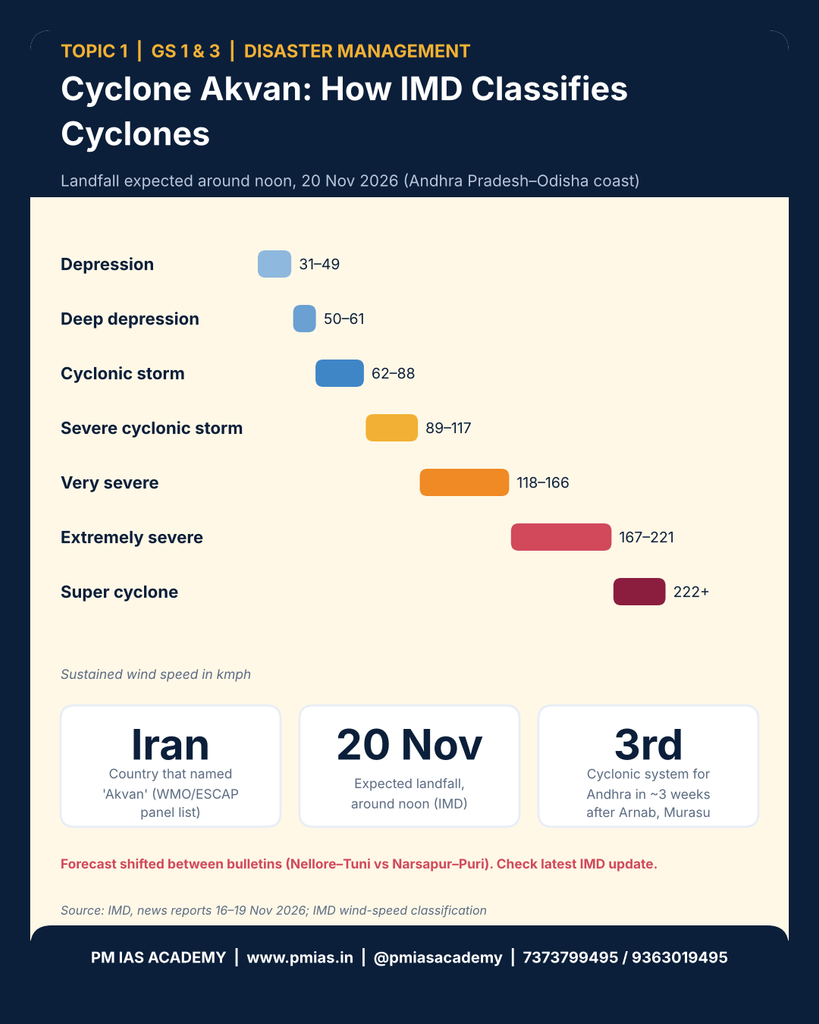
Cyclone Akvan formed over the Bay of Bengal and was forecast to make landfall on the Andhra Pradesh–Odisha coast on 20 November 2026. IMD issued an Orange Message (cyclone alert) for Andhra Pradesh and adjoining south Odisha. It forecast extremely heavy rainfall, above 21 cm, over north coastal Andhra Pradesh on 19–20 November. Earlier forecasts gave landfall winds of 120–130 kmph, gusting to 145 kmph.
Odisha began evacuating people from vulnerable areas on 17 November. Fishermen were warned to stay away from the Bay of Bengal. Tamil Nadu, Puducherry and Karaikal were warned of heavy rain, and rain was also expected in interior Telangana and Odisha. Two earlier cyclonic systems have already caused losses of over ₹7,000 crore in Andhra Pradesh.
Background: How a Cyclone Becomes a Disaster
A tropical cyclone is a low-pressure system with a calm “eye”, a ring of the strongest winds around it (the eyewall) and spiral rain bands. In the Northern Hemisphere it rotates anticlockwise. It needs sea surface temperature above about 26.5°C, high humidity, low vertical wind shear and enough distance from the equator for the Coriolis force to act. It weakens after landfall because it loses the moisture supply and faces friction over land.
The Bay of Bengal is more cyclone-prone than the Arabian Sea. Its water is warmer, and its shallow, funnel-shaped northern coast piles up water into a storm surge. The post-monsoon months (October–December) are a peak season.
Cyclones cause damage in three ways:
- Wind: damages houses, trees, power and telecom lines.
- Rain: causes inland flooding and landslides.
- Storm surge: a rise in sea level above the normal tide, driven by wind and low pressure. It is the biggest cause of deaths, and it is worse if landfall coincides with high tide.
India’s early warning system
IMD’s cyclone warnings are staged, and the alerts in this news belong to that sequence:
| Stage | Lead time before landfall | Colour message |
|---|---|---|
| Pre-cyclone watch | About 72 hours | Yellow |
| Cyclone alert | About 48 hours | Orange |
| Cyclone warning | About 24 hours | Red |
| Post-landfall outlook | About 12 hours | – |
Legal and institutional framework:
- Disaster Management Act, 2005: created the National Disaster Management Authority (NDMA), State Disaster Management Authorities (SDMAs) and the National Disaster Response Force (NDRF).
- Funding: the NDRF force is funded from the Centre. Relief is funded through the State Disaster Response Fund (SDRF) and the National Disaster Response Fund (NDRF).
- Global framework: India is a signatory to the Sendai Framework for Disaster Risk Reduction (2015–2030).
Key Dimensions
- Forecasting: Track forecasting has improved, but predicting the exact landfall point and rapid intensification is still hard. Earlier reports of a “very severe” storm and a later “severe” storm show why forecast bulletins change, and why people must follow the latest IMD update.
- Multi-hazard impact: Akvan is expected to bring wind, extremely heavy rain, storm surge and coastal flooding together. Landslides are a risk in the hilly Eastern Ghats of south Odisha. Ganjam district has already identified landslide-prone and low-lying areas.
- Agriculture and fisheries: Standing kharif paddy awaiting harvest, horticulture crops and coastal aquaculture are exposed. Andhra Pradesh is a leading aquaculture state, so shrimp and fish farms face heavy risk from flooding.
- Centre–State coordination: Andhra Pradesh, Odisha, Tamil Nadu and Telangana are affected at the same time. NDRF teams, State Disaster Response Forces (SDRF), the Navy and Coast Guard need to be pre-positioned across States.
- Climate link: The Bay of Bengal is warming. Back-to-back cyclonic systems in a few weeks show the importance of adaptation, not just post-disaster relief.
- Human security: Evacuation, shelters, food, drinking water, medical supplies and protection of livestock decide whether lives and livelihoods are saved.
Significance
- It tests India’s shift from relief-centric disaster management to preparedness, as envisaged in the Disaster Management Act and the Sendai Framework.
- It shows how coordinated early warning and evacuation can protect lives, as Odisha’s earlier record demonstrates.
- It highlights the need to link disaster management with climate adaptation and coastal planning.
- It demonstrates cooperative federalism in action, as the Centre’s agencies (IMD, NDRF, Navy) work with State governments.
Challenges
- Forecast uncertainty: Errors of even a few tens of kilometres in the landfall point change which districts must be evacuated.
- Repeated shocks: With losses of over ₹7,000 crore from two earlier cyclones, a third system strains State finances, SDRF funds and the capacity of the affected population to recover.
- Livelihood loss: Fishers, small farmers and aquaculture workers lose income, and insurance coverage among them is low.
- Vulnerable infrastructure: Kutcha houses, overhead power and telecom lines, weak embankments and drainage in coastal towns fail first.
- Evacuation hurdles: People are often reluctant to leave homes and livestock, especially when earlier warnings did not cause major damage (warning fatigue).
- Weakened natural buffers: Mangrove loss, coastal erosion and encroachment on the coastline reduce natural protection against surge.
Way Forward
- Move from “what the weather will be” to impact-based forecasting, which tells authorities what damage to expect in each district and for which sectors.
- Strengthen last-mile alerts through the Common Alerting Protocol (the NDMA’s SACHET system), SMS broadcasts, local-language messages and community volunteers.
- Build and maintain multi-purpose cyclone shelters and cyclone-resilient housing, extending the National Cyclone Risk Mitigation Project (NCRMP) to all vulnerable coastal districts.
- Restore mangroves and coastal shelterbelts through schemes such as MISHTI (Mangrove Initiative for Shoreline Habitats and Tangible Incomes) and enforce Coastal Regulation Zone rules.
- Expand crop and livelihood insurance (PMFBY, fisheries insurance), with faster claim settlement and relief for fishers.
- Keep district cyclone management plans updated, with regular mock drills, and replicate Odisha’s community-based approach in other States.
Case Study: The Odisha Model
- Trigger: The 1999 Super Cyclone killed about 10,000 people and led to the creation of the Odisha State Disaster Management Authority, India’s first State-level disaster authority.
- Measures: Cyclone shelters, trained volunteers, village-level evacuation plans, and strict coordination between IMD, the State and the district administration.
- Result: In Phailin (2013) and Fani (2019), more than 10 lakh people were moved to safety in advance. Deaths were far lower than in 1999, though property and livelihood damage remained high.
- Lesson for aspirants: Odisha has been strong on saving lives, but protecting livelihoods and infrastructure is still a challenge.
Prelims Value Addition
IMD alert stages: Pre-cyclone watch (yellow), cyclone alert (orange), cyclone warning (red), post-landfall outlook.
Storm surge: Rise in sea level due to a cyclone’s wind and low pressure; the main cause of cyclone deaths.
Disaster Management Act, 2005: Created NDMA (headed by the Prime Minister), SDMAs and the NDRF.
NCRMP: Centre-State project for cyclone shelters, embankments, early warning and capacity building in coastal States.
Sendai Framework (2015–2030): UN framework on disaster risk reduction; India is a signatory.
Eye of a cyclone: Calm centre; the strongest winds are in the eyewall around it.
Mains Value Addition
Keywords: Impact-based forecasting, storm surge, last-mile connectivity, zero-casualty approach, community-based disaster management, coastal resilience, climate adaptation.
Data and examples to use: 1999 Odisha Super Cyclone (about 10,000 deaths); Phailin 2013 and Fani 2019 (mass evacuations); losses of over ₹7,000 crore from the two earlier systems this season.
Practice question: India has become effective at saving lives during cyclones, but still struggles to protect livelihoods and infrastructure. Discuss, with reference to recent cyclones on the east coast. (250 words)
Answer framework:
- Introduction: Describe the progress in early warning and evacuation, with the Odisha example.
- Body : IMD forecasting, colour-coded alerts, shelters, NDRF.
- Body : Housing, power and telecom, aquaculture and farm losses, repeated shocks, insurance.
- Way forward: Impact-based forecasting, resilient infrastructure, mangroves, insurance.
- Conclusion: Move from survival to resilience.
TOPIC 2: NIA Anti-Terror Conference 2026: “Cross-Border Terrorism”
Subject: Internal Security
Paper: GS 3 (security challenges and their management; linkages with organised crime)
Exam focus: Mains (high), Prelims (medium)
Why in News
- Union Home Minister Amit Shah inaugurated the two-day Anti-Terror Conference (19–20 Nov), organised by the National Investigation Agency (NIA) in New Delhi.
- Theme: Cross-Border Terrorism, with a “Whole of Government” approach.
- Agenda:
- obtaining evidence from foreign jurisdictions;
- digital forensics and data analysis;
- trial management;
- countering radicalisation, espionage and hybrid threats.

Background
- The annual conference is held with State ATS and counter-terror units. At the 5th conference (December 2025), States were directed to adopt a uniform Anti-Terror Squad (ATS) structure prepared by the NIA. A “Track-2” format on digital data and big-data analytics was introduced, and an Organised Crime Network Database and a Weapon Database were launched (MHA/PIB).
- Static: NIA Act, 2008 (created after 26/11). The 2019 amendment widened its scope to human trafficking, cyber-terrorism and arms offences, and allowed it to probe scheduled offences committed outside India. UAPA (amended 2019) allows individuals to be designated terrorists.
Key Dimensions
- Legal: Cross-border cases depend on Mutual Legal Assistance Treaties (MLATs), letters rogatory and extradition. Delays hurt trials.
- Technological: Encrypted apps, crypto and drones make attribution hard. Hence the focus on digital forensics.
- Federal: Police and public order are State subjects. A uniform ATS model standardises procedure but raises autonomy concerns.
- Hybrid threats: Terror financing, narco-terror links, misinformation and radicalisation overlap.
Issues
- Weak evidence-sharing from other jurisdictions.
- Slow trials and variable conviction rates across States.
- Capacity gaps in State police: forensics, cyber units, trained prosecutors.
- Misuse concerns over stringent laws (bail under UAPA), which affect civil liberties.
Way Forward
- Faster MLAT/extradition mechanisms (a dedicated extradition portal was reportedly launched earlier).
- Common SOPs and shared databases: NATGRID, NIA, CCTNS.
- Special courts and fast-track prosecution.
- Safeguards to balance national security and rights (Article 21).
- Regional and global cooperation (Financial Action Task Force, UN 1267 listings).
Prelims points: NIA Act 2008, HQ New Delhi, under MHA; UAPA 1967; NATGRID; MLAT.
Mains Toolkit
- Keywords: Whole-of-Government, hybrid threats, uniform ATS, evidence from foreign jurisdictions, cooperative federalism.
- Question: “Terrorism today is borderless and technology-driven, but India’s response remains territorially fragmented.” Examine. (250 words)
- Ethics link: Security versus liberty; proportionality.
TOPIC 3: COP31 (Antalya), Climate Risk Index 2027 and India’s Wind Energy
Subject: Environment / Climate Change
Paper: GS 3 (conservation, climate change, renewable energy) | GS 2 (international agreements)
Exam focus: Prelims + Mains (very high)
Why in News
- COP31 (UNFCCC), Antalya, Türkiye: On 18 Nov, Environment Minister Bhupender Yadav delivered India’s National Statement.
- It stressed equity, climate justice and CBDR-RC.
- It said developing countries cannot be asked to choose between climate action and development, and that equitable access to the remaining carbon budget is non-negotiable.
- It sought an open, transparent and equitable Second Global Stocktake (GST-2), and accountability on climate finance and technology transfer.
- At a ministerial dialogue he promoted the Coalition for Disaster Resilient Infrastructure (CDRI), launched by India in 2019.
- Climate Risk Index 2027 (Germanwatch, 17 Nov): India ranked 10th (1996–2025), with over 78,000 deaths, more than 1.2 billion people affected and losses above US$170 billion. For 2025 alone it ranks 12th. Heatwaves are a major cause of deaths.
- Wind energy (PIB): installed capacity 59.20 GW (30 Sep 2026), about 19.8% of India’s 299.25 GW renewable capacity. A record 6.05 GW was added in 2025-26, surpassing 5.4 GW in 2016-17. India ranks 4th in the world. Targets: 100 GW by 2030 and 156 GW by 2036. Gross potential is about 1,163.9 GW at 150 m, mostly in Rajasthan, Gujarat, Maharashtra and Karnataka.

Basics (static)
- CBDR-RC: a principle of the UNFCCC (1992) and Paris Agreement (2015) that all countries are responsible, but developed countries have greater responsibility because of historical emissions.
- Global Stocktake (Article 14, Paris Agreement): a review every five years. The first concluded at COP28 (Dubai, 2023).
- NCQG (COP29, Baku, 2024): developed countries to mobilise at least $300 billion a year by 2035. India called this inadequate.
- India’s targets: net zero by 2070; 2030 NDC includes a 45% cut in emissions intensity (from 2005) and 50% non-fossil power capacity.
Analysis
- Equity argument: Per-capita emissions of India are well below the global average. The carbon budget is finite, so “who gets how much” is a justice issue.
- Gap between rhetoric and finance: Promised climate finance remains far below needs, which affects adaptation.
- Domestic action: Wind and solar growth supports the 2030 target, but integration needs grid upgrades, storage and land and community consent.
- Vulnerability: The Climate Risk Index shows India pays a high human cost, so adaptation (heat action plans, early warning, resilient infrastructure) is as vital as mitigation.
- Trade-climate link: Measures such as the EU’s CBAM raise carbon costs for exporters. India and other developing countries oppose them.
Way Forward
- Push for a clear adaptation-finance goal and technology transfer without conditionality.
- Expand storage and transmission (“Green Energy Corridors”) to support wind and solar.
- Strengthen local adaptation: heat action plans, flood and cyclone readiness.
- Use CDRI to share resilient-infrastructure standards with the Global South.
Prelims points: CBDR-RC; GST under Article 14; CDRI (launched 2019); India’s net-zero year (2070); wind capacity numbers; Germanwatch CRI.
Mains Toolkit
- Keywords: climate justice, carbon budget, adaptation finance, loss and damage, just transition.
- Question: “Climate justice, not just climate ambition, should be the core of global negotiations.” Discuss with reference to India’s position at COP31. (250 words)
TOPIC 4: Public Sector Banks Post Record H1 Profit; High-Level Committee on Banking for Viksit Bharat
Subject: Economy / Banking
Paper: GS 3 (banking, inclusive growth, mobilisation of resources)
Exam focus: Prelims + Mains (high)
Why in News (Finance Ministry, 18 Nov)
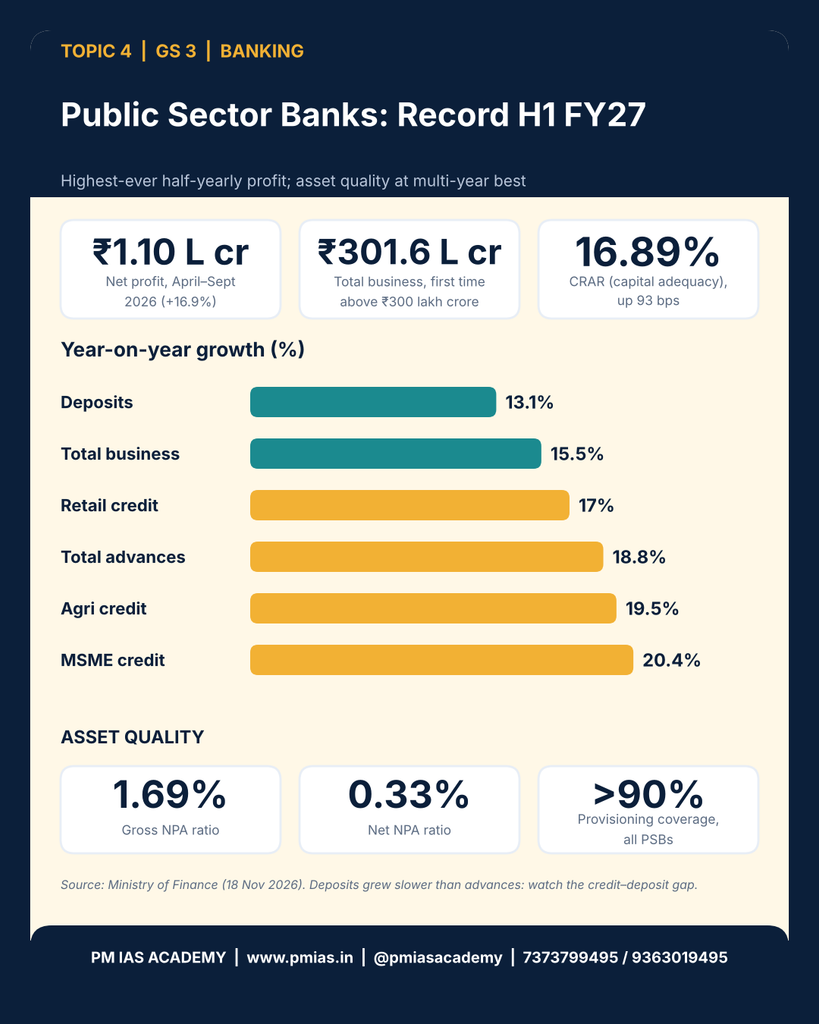
- Net profit: about ₹1.10 lakh crore in H1 FY27, up 16.9%. Operating profit ₹1.81 lakh crore.
- Business: ₹301.6 lakh crore (+15.5%), crossing ₹300 lakh crore for the first time. Deposits up 13.1% to about ₹275 lakh crore. Advances up 18.8%.
- Asset quality: Gross NPA 1.69%, Net NPA 0.33%, CRAR 16.89% (up 93 bps). All PSBs have a provisioning coverage ratio above 90%.
- Credit growth: retail 17%, agriculture 19.5%, MSME 20.4%.
- The High-Level Committee on Banking for Viksit Bharat has begun stakeholder consultations (banks, NBFCs, DFIs, regulators, fintechs) with questionnaires on reform.
- RBI (18 Nov): an overnight VRRR auction drew only ₹9,388 crore against ₹50,000 crore notified, at a cut-off of 5.49%. Treasury-bill cut-offs: 91-day 5.8602%, 182-day 6.5300%, 364-day 6.6300%.
Basics
- GNPA vs NNPA: Gross NPA is total bad loans; Net NPA is after provisions.
- CRAR: capital buffer against risk-weighted assets. RBI’s minimum is 9% (higher with buffers).
- VRRR: RBI absorbs surplus liquidity at variable rates. Low take-up suggests limited surplus liquidity (an inference, not an RBI statement).
- Static: PSB gross NPAs peaked at about 14.6% (March 2018). Fixes included the 4Rs strategy (recognition, resolution, recapitalisation, reforms), IBC 2016 and bank mergers (27 PSBs reduced to 12).
Analysis
- Positive: Strong capital and low NPAs give lending room for infrastructure and MSMEs, supporting investment-led growth.
- Watch points:
- Advances (18.8%) growing faster than deposits (13.1%) can strain liquidity and raise funding costs.
- A fast-growing unsecured retail book needs monitoring.
- Profitability is helped by recoveries and provisioning releases, which may not repeat.
- Governance and appointments, ownership questions and tech and cyber risk remain.
- Link to Viksit Bharat: Financing a $30 trillion-plus economy needs deeper bond markets, long-term infrastructure finance and wider inclusion, which is the committee’s brief.
Way Forward
- Mobilise stable deposits (innovative deposit products).
- Strengthen risk management and stress testing for retail and MSME books.
- Deepen corporate bond markets so banks are not the sole long-term financiers.
- Improve PSB governance (professional boards, accountability).
- Strengthen digital and cyber resilience.
Prelims points: GNPA, NNPA, CRAR, PCR; VRRR; Basel III; 4Rs; IBC 2016.
Mains Toolkit
- Keywords: clean balance sheet, credit-deposit gap, asset quality, financial inclusion, bond market depth.
- Question: “Record profits of public sector banks do not by themselves ensure financial stability.” Discuss. (250 words)
TOPIC 5: Export Promotion Mission (EPM) Widened; India’s FTA Export Gains
Subject: Economy / External Sector
Paper: GS 3 (industrial policy, MSMEs, trade) | GS 2 (bilateral groupings)
Exam focus: Prelims + Mains (high)
Why in News
- EPM changes (Commerce Dept, 17 Nov), under the Niryat Disha sub-scheme:
- Market Access Support: airfare reimbursement turnover ceiling raised from ₹75 lakh to ₹50 crore, with up to 95% reimbursement for micro and small exporters.
- TRACE: eligible certificates expanded from 462 to 600 (to meet overseas quality norms).
- LIFT freight support: now covers low export-intensity districts in 34 States/UTs (from 13), adds waterways, and extends air-freight support to J&K and Ladakh.
- EPM background: approved by the Cabinet on 12 Nov 2025, outlay ₹25,060 crore (FY26–FY31).
- Exports, April–September FY27 (PIB):
- ASEAN: +58% to US$28.06 bn (Singapore US$11.07 bn; Malaysia +83% to US$5.58 bn).
- SAFTA partners: +22% to US$15.29 bn (Sri Lanka +73%; Bangladesh US$5.66 bn).
- EU: +5% to US$38.79 bn. Japan: +40% to US$4.10 bn.
- Related: The India–UK CETA has been in force since July 2026. India–Canada CEPA is “on the cusp” and a defence pact may follow during the PM’s December visit (The Hindu, 19 Nov). India–Italy target of €20 billion trade by 2029.

Basics
- India’s FTA push includes UAE CEPA (2022), Australia ECTA (2022) and the EFTA TEPA (signed 2024).
- Types of trade support: interest equalisation, freight and certification support (non-tariff barriers), market access and branding.
- Non-tariff barriers: standards, testing and certification are common hurdles for MSMEs. Hence TRACE.
Analysis
- Positive: Diversification beyond the US and EU reduces concentration risk. FTA partners are showing real growth. Wider support lowers costs for MSMEs, which struggle with freight and compliance.
- Caution:
- Export growth alone does not show the trade balance. Imports from FTA partners matter (for example, India’s deficit with ASEAN).
- Rules of origin can allow routing through partner countries.
- Higher global freight and geopolitical shocks (Red Sea, West Asia) raise logistics costs.
- Reimbursement-based schemes can delay cash flow for small exporters.
Way Forward
- Faster and simpler claim processing (digital, time-bound).
- Use FTAs better: awareness and certificate-of-origin ease for MSMEs.
- Invest in logistics (ports, waterways, cold chain) to cut cost.
- Add value and move up from raw goods to manufacturing and services exports.
- Review AITIGA (ASEAN goods agreement) to correct imbalances.
Prelims points: EPM outlay and period; Niryat Disha; TRACE; LIFT; CETA vs CEPA vs FTA; SAFTA.
Mains Toolkit
- Keywords: export diversification, non-tariff barriers, FTA utilisation, rules of origin, MSME exporters.
- Question: “Signing FTAs is easy; making them work for exporters is hard.” Examine India’s experience. (250 words)
TOPIC 6: One Health: World AMR Awareness Week 2026 and India’s First Indigenous H5N1 Poultry Vaccine
Subject: Health / Science & Technology
Paper: GS 2 (health) | GS 3 (science & technology, animal husbandry)
Exam focus: Prelims + Mains (high)
Why in News
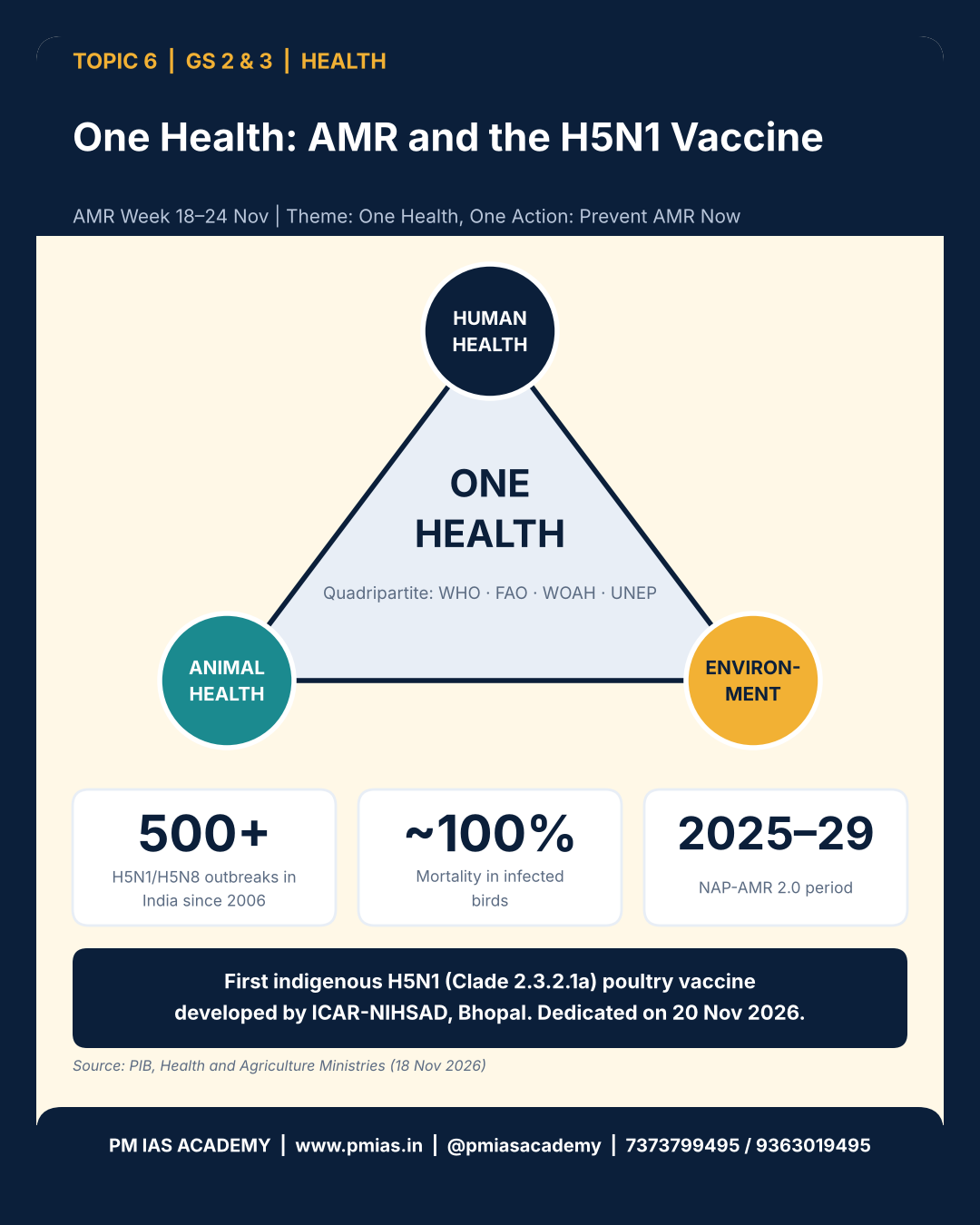
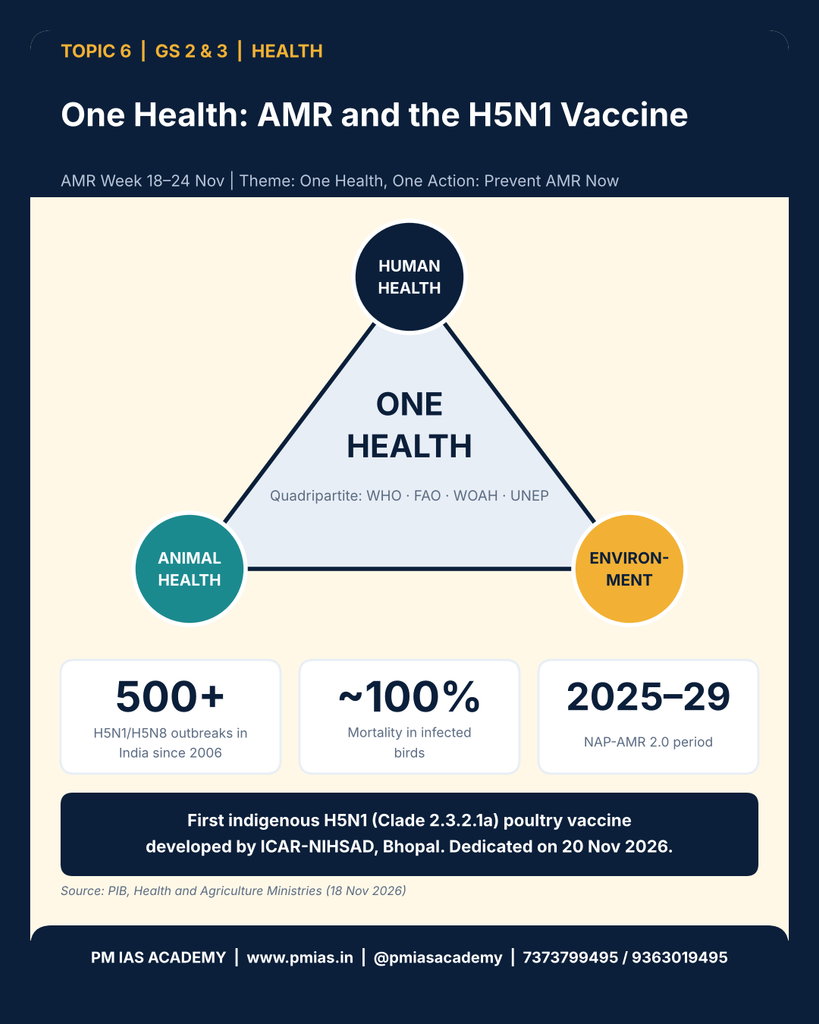
- AMR Week (18–24 Nov): The Health Ministry inaugurated India’s observance at Kartavya Bhawan on 18 Nov. Theme: “One Health, One Action: Prevent AMR Now”. Health Secretary Punya Salila Srivastava called AMR a most serious public health challenge and urged action across human, animal, plant, food and environmental sectors. NAP-AMR 2.0 (2025–29) focuses on surveillance, infection prevention, responsible use and research.
- H5N1 vaccine (20 Nov): Agriculture Minister Shivraj Singh Chouhan will dedicate India’s first indigenous inactivated H5N1 (Clade 2.3.2.1a) vaccine for chickens at ICAR-NIHSAD, Bhopal.
- Since the first detection in India in 2006, over 500 outbreaks of H5N1 and H5N8 have been reported.
- Outbreaks can cause nearly 100% mortality in birds and lead to mass culling and trade restrictions.
- Clade 2.3.2.1a caused most outbreaks in chickens, and no specific commercial vaccine against it was available.
- ICMR (PIB): crossed 100 technology-transfer deals. It is setting up a syndromic surveillance network across 70 virus and infectious-disease labs for early outbreak warning.
Basics
- AMR: pathogens stop responding to drugs. Drivers: over-the-counter antibiotic sales, antibiotic use in animals and farming, poor hygiene and sanitation, and weak diagnostics.
- Scale (static): A 2022 Lancet study estimated about 1.27 million deaths directly attributable to bacterial AMR in 2019 (around 4.95 million associated). The UN General Assembly (2024) set a target of cutting AMR-associated deaths by 10% by 2030.
- One Health: an integrated approach linking human, animal and environmental health. The Quadripartite (WHO, FAO, WOAH, UNEP) promotes it.
- India’s earlier steps: Chennai Declaration (2012), NAP-AMR 1.0 (2017–21), Kerala’s state action plan (2018), and the prescription-only rule for key antibiotics (Schedule H1).
- Zoonosis: diseases spreading between animals and humans, such as avian influenza.
Analysis
- Why the vaccine matters: Culling protects against spread but devastates small poultry farmers. A domestic vaccine can lower losses and reduce reliance on imports.
- Concerns:
- Vaccinated flocks can hide infection without strong surveillance (ability to tell vaccinated from infected birds).
- Some trading partners require disease-free status, so vaccination can affect poultry exports.
- Cold chain and farmer compliance are needed.
- Link between the two stories: Heavy antibiotic use in poultry feeds AMR, so animal-health tools (vaccines, biosecurity) reduce the need for antibiotics.
Way Forward
- Enforce prescription-only sales and curb over-the-counter antibiotic use.
- Expand lab surveillance of resistance in humans, animals and the environment.
- Antibiotic stewardship in hospitals; phase out non-therapeutic antibiotic use in animals.
- Pair vaccination with surveillance and WOAH-aligned trade protocols.
- Fast, fair compensation for farmers during culling.
- Invest in new antibiotics and rapid diagnostics (including through ICMR).
Prelims points: AMR; One Health; Quadripartite; NAP-AMR 2.0 (2025–29); H5N1 clade; ICAR-NIHSAD (Bhopal); zoonosis; WOAH.
Mains Toolkit
- Keywords: One Health, stewardship, zoonosis, surveillance, biosecurity.
- Question: “AMR cannot be solved by the health sector alone.” Discuss India’s One Health approach. (250 words)
TOPIC 7: India–Japan 2+2 Dialogue and Indo-Pacific Maritime Cooperation
Subject: International Relations / Defence
Paper: GS 2 (bilateral relations, groupings) | GS 3 (defence)
Exam focus: Prelims + Mains (high)
Why in News
- Defence Minister Rajnath Singh visited Japan’s Yokosuka naval base on 18 Nov with Japan’s Defence Minister Shinjiro Koizumi, touring the Mogami-class frigate JS Natori.
- The 4th India–Japan Foreign and Defence Ministers’ (2+2) Dialogue was scheduled for 19 November in Tokyo, co-chaired by Rajnath Singh and External Affairs Minister S. Jaishankar. He was also to hold bilateral talks with the Japanese Defence Minister (their third meeting this year). The outcome of the dialogue was not confirmed at the time of compiling; check the MEA joint statement.
- Rajnath Singh said domestic defence production has crossed a record ₹1.80 lakh crore and defence exports have reached ₹38,000 crore.

Basics (static)
- 2+2 dialogue: a format of foreign and defence ministers. India–Japan began it in 2019.
- Relationship: Special Strategic and Global Partnership (2014); Acquisition and Cross-Servicing Agreement (2020); Quad membership; Malabar and JIMEX naval exercises.
- Economic: Japan is a major source of infrastructure finance (for example, the Mumbai–Ahmedabad high-speed rail project).
- Indo-Pacific vision: a free, open and rules-based order; freedom of navigation; supply-chain resilience.
Analysis
- Strategic convergence: Both face an assertive China (East and South China Seas; the LAC). Both want diversified supply chains and trusted technology partners.
- Defence industrial cooperation: Japan’s relaxed arms-export rules open room for co-development. India seeks technology transfer and Make-in-India partnerships.
- Maritime domain awareness: Joint exercises, ship visits and information sharing build interoperability.
- Limits: Japan’s pacifist constitution (Article 9) constrains some cooperation. Projects have seen delays. Economic ties (trade, investment) lag the strategic ties.
Way Forward
- Concrete co-development and co-production projects.
- Broaden cooperation on critical minerals, semiconductors and AI (economic security).
- Regular logistics-support arrangements and exercises.
- Coordinate within the Quad and with ASEAN so cooperation supports regional centrality.
Prelims points: 2+2 format; Malabar; JIMEX; Quad members (India, Japan, USA, Australia); ACSA.
Mains Toolkit
- Keywords: Indo-Pacific, rules-based order, interoperability, economic security, strategic autonomy.
- Question: “India–Japan ties are strategic in intent but need greater economic depth.” Analyse. (250 words)
QUICK BITS (revise for Prelims)
Defence
- Barak upgrade: MoD signed a ₹1,976.40 crore contract with Israel Aerospace Industries (18 Nov) to upgrade and manage obsolescence of the Barak Point Defence Missile System on Navy ships. It was signed under the Other Capital Procurement Procedure in the presence of Defence Secretary Rajesh Kumar Singh.
- Navy LRMR: 50 years of long-range maritime reconnaissance. INAS 312 “Albatross” was commissioned on 18 Nov 1976 at INS Hansa, Goa, with Super Constellations. The Il-38 (1977), Tu-142M (1988) and P-8I (2013, INS Rajali, Arakkonam) followed.
- DRI busted an illegal alprazolam lab in Ghazipur, Delhi (148 kg of intermediate seized). Alprazolam is covered by the NDPS Act, 1985.
Governance and society
- Departmental Summit on Social Justice and Empowerment (18–19 Nov): the third in the series. Four themes: Nasha Mukt Bharat, One Nation One Scholarship portal, early intervention and reducing disability burden, Sugamya Bharat.
- VB-G RAM G Act, 2025: Ministry of Rural Development issued Ombudsperson and Appellate Authority guidelines. A district-level ombudsperson will handle grievances on job cards, wages and delay compensation. There is a digital complaint platform.
- EPFO: higher-pension liability may cost about ₹1.109 lakh crore. Of 15.24 lakh applications, demand letters went to 4,45,471 applicants and payment orders to 1,51,874 pensioners (The Hindu, 19 Nov).
- Allahabad HC (Lucknow bench): coconut is an oilseed, not a fruit, under the APMC framework (copra is used for oil).
- PM SVANidhi: Awards on 20 Nov (52 awards). Since 1 June 2020, about 81 lakh vendors have taken over 1.21 crore loans worth about ₹20,000 crore. Extended to March 2030.
Economy and industry
- Gwalior Telecom Manufacturing Zone: Phase-I ₹493 crore (100% Central funding); about 170 acres from MP; SPV 51% MP and 49% DoT.
- ADB ASEAN Resilient Rivers Initiative: target US$8 billion by 2030; part of ADB’s US$30 billion ASEAN commitment.
- SGB 2020-21 Series II: premature redemption price ₹13,345 per unit (simple average of IBJA 999-gold prices of 16–18 Nov).
- FICCI AGM: PM inaugurated it (theme “Bharat 2047”); FICCI completes 100 years in April 2027.
Science, environment and reports
- 12th India International Science Festival: Pune, 19–22 Dec 2026.
- Community seed banks: at least 1,000 in India; 652 mapped (DIVERSIFARM-India: Fridtjof Nansen Institute, Norway, and MSSRF).
- Parvat Manthan Conclave (NIUA, Dehradun): climate-resilient Himalayan cities, 11 States.
- AI Kavach (IIT Kanpur + Bharat1.ai): AI cybersecurity lab.
- TIME100 Next India 2026: first international edition; 100 people, five categories, not a ranked list.
Days
- World Toilet Day (19 Nov): theme “Safe toilets. Equal futures.”; supports SDG 6; UN-recognised in 2013.
- World Children’s Day (20 Nov) (static): marks the UN adoption of the Declaration (1959) and Convention (1989) on the Rights of the Child.
- 19 Nov: Indira Gandhi and Rani Lakshmibai birth anniversaries.
PRACTICE MCQs
Q1. In IMD’s classification, a “very severe cyclonic storm” refers to sustained winds of:
(a) 62–88 kmph (b) 89–117 kmph (c) 118–166 kmph (d) 167–221 kmph
Answer: (c)
Q2. Cyclone Akvan’s name was contributed by which country?
(a) Bangladesh (b) Iran (c) Thailand (d) India
Answer: (b)
Q3. Which of the following is/are correct about the Global Stocktake (GST)?
- It is provided for under Article 14 of the Paris Agreement.
- It takes place every five years.
Select the correct answer:
(a) 1 only (b) 2 only (c) Both 1 and 2 (d) Neither
Answer: (c)
Q4. The Coalition for Disaster Resilient Infrastructure (CDRI) was launched by India in:
(a) 2015 (b) 2019 (c) 2021 (d) 2023
Answer: (b)
Q5. The gross NPA ratio of Public Sector Banks as on 30 Sep 2026 was:
(a) 0.33% (b) 1.69% (c) 3.12% (d) 16.89%
Answer: (b). 0.33% is the net NPA and 16.89% is CRAR.
Q6. India’s first indigenous H5N1 (Clade 2.3.2.1a) vaccine for chickens was developed by:
(a) IVRI, Izatnagar (b) ICAR-NIHSAD, Bhopal (c) NIV, Pune (d) CCMB, Hyderabad
Answer: (b)
MAINS PRACTICE SET (250 words each)
- Odisha’s cyclone management is a model, yet livelihood losses continue. Discuss. (GS 3)
- Evaluate the challenges in combating cross-border terrorism and the role of a uniform ATS structure. (GS 3)
- Climate justice should anchor India’s stand at COP31. Critically examine. (GS 3 / GS 2)
- Record PSB profits do not guarantee financial stability. Discuss. (GS 3)
- How can the benefits of India’s FTAs reach MSME exporters? (GS 3)
- Antimicrobial resistance needs a One Health response. Discuss with reference to India. (GS 2 / GS 3)
- Analyse the strategic and economic dimensions of India–Japan ties. (GS 2)
