
Topic 1: Supreme Court Dismisses Tamil Nadu’s Plea for 11.7 TMC Cauvery Shortfall
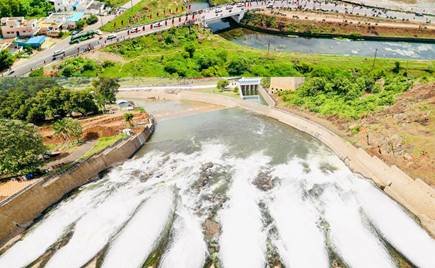
File image: water being released from the Mettur dam; assured Cauvery flows lie at the heart of the dispute (image: DD News).
Subject: Polity – Inter-State Water Disputes
Syllabus
TNPSC Group I/II: Indian polity – inter-state relations; Inter-State River Water Disputes Act, 1956; the Cauvery dispute and Tamil Nadu’s irrigation interests
Context
The Supreme Court on 20 November 2026 dismissed Tamil Nadu’s applications seeking a direction to Karnataka to make good a claimed shortfall of 11.719 thousand million cubic feet (TMC) of Cauvery water on a pro-rata basis during the current irrigation year 2026-27, with a Bench headed by Justice Vikram Nath delivering the judgment after reserving it in mid-October.
Main Body: Multi-Dimensional Analysis
1. The claim: Tamil Nadu originally quantified its shortfall at 16.01 TMC and later modified it to 11.719 TMC, seeking release at the rate of 1.3 TMC per day over ten days, measured at Billigundulu, the gauging station on the Karnataka-Tamil Nadu border.
2. The proceedings: The Bench reserved its judgment on 12 October after hearing both States; Karnataka argued that Tamil Nadu had in fact received excess water allocation for the year and that the Cauvery Water Management Authority had not ordered the releases sought.
3. Tamil Nadu’s case: The State pointed to a combined reservoir storage of approximately 49 TMC in Karnataka, which it maintained was adequate to meet water-sharing obligations to the lower riparian State despite the distress conditions claimed upstream.
4. Expert body primacy: Karnataka’s counsel described the dismissal as a check on States frequently rushing to court to challenge decisions of the Cauvery Water Management Authority, the expert body constituted under Section 6A of the Inter-State River Water Disputes Act, 1956, on water distribution during a distress year.
5. Allocation backdrop: Two distinct quantities must not be conflated: the Supreme Court’s 2018 judgment apportioned the basin’s assessed 740 TMC of water (at 50 per cent dependability), awarding Tamil Nadu 404.25 TMC, Karnataka 284.75 TMC, Kerala 30 TMC and Puducherry 7 TMC, with further provision for environmental needs and inevitable escapes to the sea; separately, Karnataka’s affidavit in the present case referred to 483 TMC available up to Billigundulu in the current year’s context, framing Tamil Nadu’s larger share as resting on historic irrigation claims while pleading its own drought-prone areas.
6. The regulatory chain: The Cauvery Water Regulation Committee first examines flows and issues directions, and the Authority reviews them; in September 2026 the Authority upheld the Committee’s direction to Karnataka to ensure flows of 6,000 cusecs a day for 15 days to Tamil Nadu.
7. Constitutional setting: Water is a State subject under Entry 17 of the State List, but Parliament can legislate on inter-state rivers under Entry 56 of the Union List, and Article 262 empowers Parliament to provide for adjudication of inter-state river water disputes.
8. Institutional history: The Cauvery Water Disputes Tribunal gave its final award in 2007; the Supreme Court modified allocations in its 2018 judgment, and the Centre then constituted the Cauvery Water Management Authority and the Regulation Committee in 2018 to implement the award.
9. Delta stakes: The Cauvery delta districts of Thanjavur, Tiruvarur and Nagapattinam depend on assured Mettur releases for the samba paddy crop, making the timing of flows as consequential as their volume.
10. The 2007 award in perspective: The Cauvery Water Disputes Tribunal, constituted in 1990, gave its final award in February 2007, allocating shares among Tamil Nadu, Karnataka, Kerala and Puducherry; the Supreme Court’s 2018 judgment revised the shares of the two principal States and clarified groundwater and environmental considerations.
11. Why timing matters: Delta farmers plan the samba nursery around the customary opening of the Mettur dam in June; delayed or deficient flows compress the cropping calendar, which is why in-season directions of the Regulation Committee carry such weight.
12. Constitutional morality of sharing: Inter-state river disputes test cooperative federalism: the awards endure only when both States treat the institutional process as binding even in years when its directions hurt.
Positives, Negatives, & Government Schemes
| Category | Dimension / initiative | Explanation |
| Positive | Deference to expert bodies | The dismissal signals that allocation disputes in distress years should first run through the Authority and the Regulation Committee, reducing ad-hoc litigation. |
| Positive | Procedural clarity | A reserved judgment delivered within weeks gives both States certainty before key irrigation decisions for the season. |
| Negative | Delta vulnerability | Distress-year shortfalls fall hardest on delta farmers whose samba crop calendar has little flexibility, and litigation cannot create water that deficits have removed. |
| Government scheme | Cauvery Water Management Authority | Statutory authority constituted in 2018 under Section 6A of the Inter-State River Water Disputes Act, 1956 to implement the Cauvery award as modified by the Supreme Court. |
Examples
1. Billigundulu, where the inter-state flows are measured, functions as the factual fulcrum of every Cauvery dispute because both States accept its readings.
2. The 2018 Supreme Court judgment revised the Tribunal’s allocations and directed the creation of an implementing authority, showing how adjudication and institutional design interact.
3. The September 2026 direction of 6,000 cusecs a day for 15 days illustrates how the Regulation Committee handles in-season operational disputes before they reach court.
4. Past distress years, notably 2002-03 and 2012, saw similar applications to the court when monsoon failure made pro-rata sharing contentious.
5. The Mekedatu project controversy shows the dispute’s continuing front line: new storage capacity upstream is viewed downstream as a threat to assured flows.
6. Kerala and Puducherry are also party to the Cauvery allocation, a reminder that the basin’s politics run beyond the two principal disputants.
Way Forward
1. Strengthen real-time, jointly verified telemetry at Billigundulu and upstream reservoirs so that shortfall claims rest on shared data rather than rival arithmetic.
2. Refine the distress-sharing formula through the Authority with clear triggers, so litigation is not the default response each deficit year.
3. Accelerate micro-irrigation, crop diversification and system-rice-intensification practices in the delta to reduce the volume at stake in lean years.
4. Both States should table Authority meeting records and flow data in the public domain promptly to build trust in the institutional process.
5. Build a basin-level decision-support system under the Authority that integrates rainfall, storage and crop data, so distress declarations are timely and uncontested.
6. Encourage joint study teams of farmers and engineers from both States so that sharing arrangements carry social legitimacy on both banks, not merely legal force.
Conclusion
The dismissal reaffirms that the Cauvery framework now runs through its expert institutions, with the courts as a forum of last resort rather than first response. For Tamil Nadu, the long-term answer lies in combining institutional vigilance with delta-level water efficiency, so that each distress year does not reopen a century-old dispute.
Practice Mains Question
Trace the evolution of the Cauvery water dispute and assess the working of the institutional mechanism created in 2018, in the light of the Supreme Court’s latest dismissal of Tamil Nadu’s plea.
Topic 2: Northeast Monsoon Set to Revive as Tamil Nadu Faces 14 Per Cent Rainfall Deficit

IMD’s All India Weather Summary and Forecast Bulletin of 20 November 2026, Table-1 seven-day rainfall forecast: Tamil Nadu and Puducherry move from isolated to fairly widespread rain during 23-26 November (image: India Meteorological Department).
Subject: Geography – Monsoon and Climate of Tamil Nadu
Syllabus
TNPSC Group I/II/IV: Geography of India and Tamil Nadu – monsoon systems; northeast monsoon; disaster preparedness and weather forecasting institutions
Context
The Regional Meteorological Centre, Chennai, has forecast a revival of northeast monsoon rainfall over Tamil Nadu from 22 November after a brief break following Cyclone Akvan’s passage, with wet weather expected to last until the first week of December and the State carrying a seasonal rainfall deficit of about 14 per cent since 1 October.
Main Body: Multi-Dimensional Analysis
1. The break: After Cyclone Akvan crossed the Odisha coast on the morning of 20 November, dry and cold northwesterly winds and the absence of cloud cover produced a pause in monsoon activity over Tamil Nadu, with day temperatures rising by two or three degrees Celsius in pockets and night temperatures dipping.
2. The deficit: The State has received nearly 26 cm of rainfall since 1 October, about 14 per cent below its seasonal share, and Tiruvarur, Thanjavur, Madurai, Salem and Chengalpattu are among the districts in the deficit category.
3. The revival mechanism: A trough in the easterly wave is expected to revive rainfall from Sunday and intensify it from Monday as it moves across the State, with coastal districts benefiting first and interior Tamil Nadu receiving moderate rainfall till 26 November.
4. District-wise warnings: Heavy rain is likely at isolated places in ten districts on Monday, including Cuddalore, Thanjavur, Tiruvarur, Nagapattinam, Pudukkottai, Sivaganga, Ramanathapuram, Thoothukudi, Tirunelveli and Kanniyakumari, expanding to seventeen districts on Tuesday, including Chennai, Tiruvallur, Chengalpattu, Kanchipuram, Ranipet, Tiruvannamalai and Villupuram.
5. Hazards flagged: Thunderstorms with lightning and gusty winds of 40 to 50 kmph are forecast at isolated places, and the RMC has issued a yellow alert for coastal districts from Tiruvallur to Kanniyakumari for 24 November, while ground frost is likely at isolated places in the Nilgiris and Kodaikanal till Sunday.
6. Chennai’s gap: Chennai and its neighbourhoods have missed much of the season’s rain so far, a deficit that matters acutely because the metropolis depends on the northeast monsoon for recharging its reservoirs and groundwater before the long dry season.
7. Extended outlook: RMC officials expect wet weather to persist till the first week of December, with a low-pressure area likely to form then, and say sustained rainfall could narrow the seasonal deficit.
8. Climatology: The northeast or retreating monsoon, from October to December, is Tamil Nadu’s principal rainy season, contributing close to half of the State’s annual rainfall, unlike most of India where the southwest monsoon dominates.
9. Forecasting institutions: The RMC Chennai, one of the six regional centres of the India Meteorological Department, issues district-level warnings under IMD’s colour-coded alert system, in which a yellow alert signals heavy rainfall requiring watchfulness.
10. Two monsoons, one State: While the southwest monsoon brings most of India its rain between June and September, Tamil Nadu lies in the rain shadow of the Western Ghats for those winds and receives its largest share from the returning northeast winds that pick up moisture over the Bay of Bengal.
11. Reservoir arithmetic: Chennai’s drinking water reservoirs and the Mettur dam both benefit from a strong northeast monsoon season; a weak close to the season tightens next summer’s water supply planning across the delta and the metropolis.
12. Forecast value chain: A forecast protects only when it moves through a chain: the IMD bulletin, the State emergency operations centre, district collectors, local bodies and finally the citizen, and each link must hold for the warning to work.
Positives, Negatives, & Government Schemes
| Category | Dimension / initiative | Explanation |
| Positive | Early warning granularity | District-level forecasts with wind and lightning specifics allow collectors and disaster managers to pre-position men and material where the hazard is highest. |
| Positive | Deficit may narrow|The projected sustained spell into December can still pull the season closer to normal, protecting samba sowing and reservoir storage. | |
| Negative | Urban flood risk | Intense short spells over Chennai and the coastal belt historically overwhelm drains, so a deficit season can still produce damaging floods. |
| Government scheme | IMD colour-coded alerts | The India Meteorological Department’s green-yellow-orange-red alert scale communicates escalating weather risk for administrative action. |
Examples
1. The 2015 Chennai floods showed how extreme northeast monsoon spells can paralyse the city even when seasonal totals are near normal.
2. Ground frost in the Nilgiris affects tea plantations and vegetable farms, a recurring cold-weather hazard of the high ranges during clear monsoon-break nights.
3. The Cauvery delta districts in the deficit list are the same districts whose paddy calendar depends on late-season rain to supplement canal water.
4. Easterly wave troughs are the workhorse rain producers of the Tamil Nadu coast between cyclones, and tracking them is central to RMC forecasting.
5. Past Decembers have produced low-pressure systems in the Bay of Bengal that delivered a large share of the season’s rain in a single week.
6. RMC Chennai’s area cyclone warning centre also serves as the regional hub for Bay of Bengal marine forecasts, which fishermen of the Tamil Nadu coast rely on daily.
7. The State’s school-closure and fishing-ban advisories during heavy rain warnings are standard disaster protocols activated on IMD alerts.
Way Forward
1. Use the warning window to clear storm-water drains and prune vulnerable trees in Chennai and coastal towns before the intensified spell.
2. Keep disaster-response teams and control rooms active through the first week of December, the full length of the forecast wet spell.
3. Publish district-wise rainfall against normal each week so that deficit persistence triggers timely water-supply and crop advisories.
4. Harvest the coming rain through tanks and recharge structures, since the northeast monsoon is the State’s last major recharge opportunity before summer.
5. Integrate ward-level rain gauge data in Chennai into public dashboards so micro-flood pockets are identified in real time during intense spells.
6. Run pre-monsoon drills for urban local bodies each October so that the first heavy spell of November does not become the season’s first flood.
Conclusion
Tamil Nadu’s rainfall ledger for the year is written between October and December, and the coming fortnight will decide whether 2026 closes as a deficit season. The forecasts give the administration time to convert warning into preparedness, which is the difference between a reviving monsoon and a flooding one.
Practice Mains Question
Describe the characteristics of the northeast monsoon in Tamil Nadu and examine the role of forecasting institutions in mitigating the risks associated with it.
Topic 3: NIA Anti-Terror Conference Focuses on Drones, Terror Financing and Agency Coordination
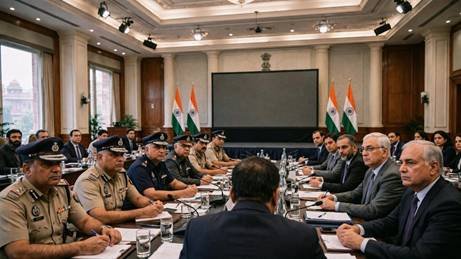
A working session during the NIA anti-terror conference in New Delhi (image: DD News).
Subject: Internal Security – Institutions and Emerging Threats
Syllabus
TNPSC Group I/II: Internal security of India – terrorism, security agencies and their mandate; science and technology in security
Context
The sixth Anti-Terror Conference of the National Investigation Agency concluded in New Delhi on 19 November 2026 with a focus on cross-border terrorism, drone-based smuggling, terror financing and closer coordination between Central and State agencies, bringing together 40 Directors General and heads of State police and Central agencies along with 230 participants from anti-terror units.
Main Body: Multi-Dimensional Analysis
1. The conference: The two-day conference was held at DRDO Bhawan on the theme of cross-border terrorism, and deliberated on dismantling terror ecosystems, strengthening prosecution of terror cases and enhancing coordination between Central and State agencies.
2. Drone threat: Drone smuggling of arms, narcotics, cash and explosives emerged as a key concern, with cheap and easily available drones increasingly used in cross-border operations, a challenge felt acutely along the western border.
3. Financing track: Discussions covered financial channels including hawala and trade-based money laundering, and the use of cryptocurrencies, with an emphasis on initiating financial investigation alongside the principal terror offence.
4. Technology and AI: A dedicated session examined the use of technology, particularly artificial intelligence, in countering cross-border terror offences, alongside online radicalisation, encrypted platforms and challenges related to SIM cards.
5. PRAHAAR framework: The Home Secretary called for translating the national counter-terrorism framework PRAHAAR into coordinated action at the State, district and police-station levels, and urged States to strengthen Anti-Terror Squads in line with the Model ATS Structure.
6. Early radicalisation: The conference stressed early identification of radicalisation, effective use of intelligence platforms and closer coordination between investigating and prosecuting agencies, covering online propaganda and lone-actor threats.
7. Fugitive returns: Agencies were urged to pursue fugitives abroad through updated dossiers, INTERPOL mechanisms and the Extradition Portal; coordinated efforts have brought back 303 fugitives from 36 countries.
8. Performance data: During 2026 the NIA registered 82 cases; of 29 cases in which judgments were pronounced, 27 ended in conviction, a rate of 93 per cent, with 123 accused convicted, and the agency trained 5,800 police personnel through 53 programmes.
9. Capacity building: The NIA has established Technical Support Units in each of its 21 State units to upgrade the use of technology and digital evidence, reflecting the shift of terror investigation toward cyber and financial trails.
10. Legal mandate: The NIA investigates scheduled offences under the Unlawful Activities (Prevention) Act and other statutes; the 2019 amendment to the NIA Act extended its jurisdiction to offences committed outside India against Indian citizens or interests, and widened the schedule to include cyber-terrorism and human trafficking among listed crimes.
11. From detection to deterrence: Officials stressed that conviction, asset seizure and financial disruption complete the deterrence cycle; an arrested network that retains its funding simply regenerates.
12. Federal design: Policing is a State subject, so counter-terror capacity is necessarily cooperative: the NIA takes over select cases, while State Anti-Terror Squads retain the first mile of intelligence and response.
13. Conspiracy versus ecosystem: Investigators increasingly speak of terror ecosystems rather than single conspiracies: recruiters, financiers, couriers and propagandists form separable layers, and dismantling the ecosystem requires cases against each layer, not only the trigger-pullers.
14. Evidence standards: Terror prosecutions fail most often on evidence handling, from seizure memos to chain of custody for digital devices, which is why the conference paired technology sessions with forensic training.
15. SIM and identity abuse: The misuse of SIM cards procured on forged or borrowed identities remains a workhorse of terror logistics, and tighter point-of-sale verification is a recurring administrative recommendation.
Positives, Negatives, & Government Schemes
| Category | Dimension / initiative | Explanation |
| Positive | Whole-of-government approach | The conference format aligns Centre, States and specialised units on a shared threat picture, which is essential when networks span borders and jurisdictions. |
| Positive | Prosecution focus | A 93 per cent conviction rate shows that investigation quality, not only detection, is being measured and improved. |
| Negative | Asymmetric threats | Low-cost drones and encrypted platforms keep the cost of attack far below the cost of defence, a structural imbalance that conferences alone cannot close. |
| Government scheme | NIA Act, 2008 | The National Investigation Agency was constituted under the NIA Act, 2008 after the Mumbai attacks, to investigate and prosecute offences affecting national security across States. |
Examples
1. Drone drops of arms and narcotics across the Punjab frontier have been intercepted repeatedly by border forces, illustrating the smuggling vector the conference flagged.
2. The NIA’s nationwide raids against organised crime-terror networks in recent years show how gangster syndicates and terror financing intersect.
3. State Anti-Terror Squads, including Tamil Nadu’s, handle first response and local intelligence, making their alignment with the Model ATS Structure operationally significant.
4. The Extradition Portal streamlines requests to foreign governments, converting diplomatic effort into a trackable administrative process.
5. Technical Support Units mirror the global shift in which digital evidence, from chat records to wallet trails, decides terror prosecutions.
6. Tamil Nadu’s own security apparatus has dealt with radicalisation and fundamentalist module cases over the years, making State ATS capability a live issue rather than an abstraction.
7. INTERPOL notices, including Red Notices, locate fugitives abroad but do not themselves compel arrest; extradition still turns on treaty and diplomacy.
8. De-radicalisation programmes run by some States pair counselling with family engagement, reflecting the conference’s stress on early identification over late prosecution.
Way Forward
1. Standardise drone-detection and counter-drone equipment for border forces and major cities, with clear rules of engagement.
2. Mandate parallel financial investigation in every terror case so funding networks are dismantled with the operational cells.
3. Expand forensic and cyber training for State ATS personnel through the NIA’s training programmes.
4. Keep radicalisation-countering community programmes distinct from policing so early identification does not become stigmatisation.
5. Create a common digital case-file standard so State ATS units and the NIA can share evidence without format friction during case transfers.
6. Publish an annual public report on conference follow-up actions so the whole-of-government resolve survives the gap between annual meetings.
Conclusion
The sixth conference confirms that India’s counter-terror doctrine now treats finance, drones and online radicalisation as one battlespace. Its outcomes will be judged by how quickly the PRAHAAR framework reaches the police-station level, where coordination either happens or fails.
Practice Mains Question
Examine the evolving nature of cross-border terrorism in India and the role of the National Investigation Agency in building a coordinated response.
Topic 4: UNFPA State of World Population Report 2026 Links Family Aspirations to Economic Insecurity

Launch banner of the State of World Population Report 2026 (image: UNFPA India).
Subject: Society – Population and Demography
Syllabus
TNPSC Group I/II: Social issues in India and Tamil Nadu – population dynamics; United Nations agencies and their reports
Context
The United Nations Population Fund released its State of World Population Report 2026, titled Succeeding Generations: Empowering Young People to Chart the Future, on 19 November 2026, finding from its global Demographic Futures Survey of more than 108,000 internet-connected adults across 73 countries, including 1,722 respondents in India, that financial insecurity is the leading barrier to the family lives young people say they want.
Main Body: Multi-Dimensional Analysis
1. The headline finding: In the global survey findings reported from the report, 57 per cent of respondents identified financial insecurity as an obstacle to finding a partner and 72 per cent cited it as a barrier to having children, showing that economics, not unwillingness, is suppressing family formation.
2. The survey base: The report draws on UNFPA’s Demographic Futures Survey of more than 108,000 internet-connected adults in 73 countries, among them 1,722 in India, one of the largest attempts to measure the gap between desired and actual family outcomes.
3. Reproductive agency: The report’s organising idea is reproductive agency: the real freedom to decide whether, when and how many children to have, which economic precarity erodes even where legal rights exist.
4. Youth employment: Insecure and informal work emerged as a core driver, since irregular earnings make housing, marriage and childcare commitments feel unaffordable even to those who want them.
5. India findings: UNFPA’s India release records that 83 per cent of Indian respondents feel positive about the future, women aged 18 to 39 describe an ideal family size of 2.1 children, and nearly 85 per cent of childless respondents aged 35 to 39 would ideally like to become parents, confirming that aspiration persists where conditions allow.
6. the limited representation of young people in political decision-making, arguing that institutions designed by older cohorts undervalue the constraints under which the young actually live.
7. Beyond fertility targets: UNFPA’s position is that policy should remove barriers to informed choice rather than chase a particular fertility rate, a framing relevant to countries now anxious about both ageing and youth unemployment.
8. India’s position: India’s total fertility rate is below replacement at around 2.0, yet large youth cohorts still enter the labour market each year, making job quality the hinge between the demographic dividend and demographic distress.
9. Tamil Nadu’s stake: Tamil Nadu reached below-replacement fertility decades ago and now faces ageing sooner than most States, so the report’s warning about economic insecurity delaying families compounds an already advanced transition.
10. Institutional note: UNFPA, headquartered in New York, is the UN’s sexual and reproductive health agency, founded in 1969, and its annual State of World Population report is a standard reference for demography questions.
11. India’s numbers: The National Family Health Survey placed India’s total fertility rate at about 2.0 in the 2019-21 round, below the replacement level of 2.1, while the Sample Registration System tracks the continuing decline in birth rates across States.
12. The ageing horizon: UN projections show India’s elderly share rising steadily through mid-century; States that completed their fertility transition early, Tamil Nadu foremost among them, will support growing elderly populations on the earnings of smaller working cohorts.
13. From targets to rights: India’s own policy history moved from the coercive sterilisation drives of the 1970s to the target-free National Population Policy of 2000, and the UNFPA framing of reproductive agency extends that rights-based trajectory.
14. What the survey measures: The report distinguishes desired fertility from achieved fertility; the persistent gap between the two across 73 countries is its central evidence that constraint, not preference, drives low birth rates.
15. Care economy link: Where childcare is costly and falls on mothers, each additional child carries an earnings penalty for women, so gender-equal care policy is itself family policy.
16. Demographic dividend window: India’s working-age share peaks around the coming decade; whether it yields a dividend or a burden depends on the employment quality that the report identifies as the missing piece.
17. Policy stakes for Tamil Nadu: The State’s pioneering family welfare success means it now confronts the report’s questions in their most advanced Indian form: sustaining living standards and care systems as the worker-to-elder ratio tightens over the coming decades.
Positives, Negatives, & Government Schemes
| Category | Dimension / initiative | Explanation |
| Positive | Evidence at scale | A 100,000-respondent survey across 73 countries gives policymakers comparable data on why family formation is delayed. |
| Positive | Choice-centred framing | The focus on agency keeps population policy within rights-based boundaries, away from coercive targets of either direction. |
| Negative | Structural drivers | Wage stagnation, housing costs and informal employment are slow-moving problems that reports can name but not solve. |
| Government scheme | State of World Population report | UNFPA’s flagship annual publication tracking global population trends, reproductive health and rights. |
Examples
1. An educated young couple postponing children because both work on short-term contracts is the lived reality behind the 72 per cent figure.
2. Tamil Nadu’s own surveys show rising age at marriage, consistent with the economic-insecurity mechanism the report describes.
3. Countries that expanded childcare and housing support saw smaller gaps between desired and actual fertility, the policy lesson the report draws.
4. India’s below-replacement fertility coexisting with youth unemployment illustrates the report’s point that quantity and quality of demographic change are separate issues.
5. The NFHS remains India’s principal source for fertility data, complementing global surveys like the one behind this report.
6. Kerala and Tamil Nadu both record fertility well below replacement, and their policymakers now weigh eldercare, migration and labour participation rather than family planning targets.
7. Several East Asian economies that once worried about overpopulation now subsidise childbirth heavily, illustrating how quickly demographic anxiety can reverse.
8. The report’s title, Succeeding Generations, signals its argument that each generation’s ability to flourish conditions the next generation’s very existence.
Way Forward
1. Prioritise quality employment, with social security for informal and gig workers, as the first population policy.
2. Expand affordable childcare and housing support so that having children is economically feasible for young families.
3. Give young people structured voice in policy bodies whose decisions shape their family and working lives.
4. Keep reproductive health services and rights intact regardless of which fertility direction a State worries about.
5. State population strategies in low-fertility regions should plan for ageing: pensions, geriatric care and productive longevity, not only family welfare.
6. Track desired-versus-actual family size in Indian surveys so policy debates rest on Indian evidence of the same kind UNFPA gathered globally.
Conclusion
The 2026 report reframes the population debate: the question is no longer whether people want families but whether economies let them have the families they want. For India and Tamil Nadu, the message is that employment quality is demographic policy.
Practice Mains Question
Discuss the findings of the UNFPA State of World Population Report 2026 and their implications for population policy in India and Tamil Nadu.
Topic 5: Measuring Unpaid Care Work Could Reshape Understanding of Women’s Employment
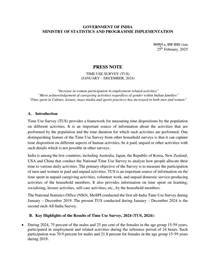
First page of the MoSPI press note on the Time Use Survey 2024, the source of the figures discussed (image: MoSPI press release).
Subject: Economy – Labour, Gender and Measurement
Syllabus
TNPSC Group I/II: Indian economy – labour force and employment; gender and development; official statistics
Context
An analysis published on 19 November 2026 has argued that India’s employment surveys must better capture unpaid domestic and care responsibilities to explain women’s work choices, drawing on Time Use Survey 2024 figures, reported from the survey, that put average daily time on unpaid domestic services at 289 minutes for participating women against 88 minutes for participating men.
Main Body: Multi-Dimensional Analysis
1. The data gap: Labour-force surveys and time-use surveys measure different things with different definitions, so their findings cannot simply be merged; the Periodic Labour Force Survey tracks employment while the Time Use Survey tracks how people spend their day.
2. The core number: Among participants in unpaid domestic services, figures reported from the Time Use Survey 2024 put the daily average at 289 minutes for women against 88 minutes for men, a more than threefold gap; MoSPI’s own press note records the participation divide behind it, with 83.1 per cent of women against 26.4 per cent of men engaged in domestic services on normal days.
3. The MoSPI initiative: The Ministry of Statistics and Programme Implementation has moved to add questions on unpaid work to the Periodic Labour Force Survey, an attempt to bridge the two statistical worlds within one instrument.
4. Why it matters for employment: Women who report being out of the labour force are often working long hours unpaid at home; counting only paid work misreads their withdrawal from employment as leisure or choice rather than constraint.
5. Flexible work trade-off: Care responsibilities push many women toward flexible or home-based work, which improves access to employment but frequently carries lower earnings and weaker security, a trade-off invisible without time-use context.
6. The surveys involved: India’s National Statistics Office conducted national Time Use Surveys in 2019 and 2024, the latter covering persons aged six years and above, while the PLFS has measured employment and unemployment since 2017-18; the survey press note records paid-work participation of 74.5 per cent for men against 24.9 per cent for women aged 15 to 59.
7. Care economy framing: Economists now describe unpaid domestic and care work as the invisible foundation of the paid economy, subsidising every employer by reproducing the labour force without wages.
8. Policy channels: Measuring the burden properly opens policy responses: childcare and eldercare services, safe transport, flexible-work standards and social protection that recognises care contributions.
9. Tamil Nadu context: Tamil Nadu has among the higher female labour-force participation rates in India, driven by manufacturing and services, yet its women carry the same unpaid care load, making measurement reform directly relevant to State policy.
10. What national accounts miss: The System of National Accounts excludes unpaid household services for own consumption from GDP, so the economy’s largest single sector of hours worked leaves no trace in the headline numbers policymakers watch.
11. Global practice: Several countries now compile satellite accounts for household production, assigning a monetary value to unpaid care so that its scale can enter fiscal and social policy debates.
12. The participation puzzle: India’s female labour-force participation has been among the lowest in the G20, and time-use evidence identifies unpaid care as the principal constraint pulling women out of measured work.
13. Survey design choices: Time-use data can be collected by full diaries or by stylised questions attached to labour surveys; the diary is richer but costlier, and the MoSPI proposal attempts to capture the essentials through the cheaper route.
14. Employment quality: For women who do enter paid work, the survey literature shows concentration in low-paid, informal and home-based work, so participation gains without quality gains reproduce the same inequality inside the workforce.
15. From measurement to budget: Gender budgeting statements in the Union and State budgets already tag schemes benefiting women; credible time-use data would let those tags be tested against actual hours freed.
Positives, Negatives, & Government Schemes
| Category | Dimension / initiative | Explanation |
| Positive | Better statistics, better policy | Adding unpaid-work questions to the PLFS would let analysts connect care hours to employment choices within a single dataset. |
| Positive | Visibility for care work | Official recognition that 289 minutes a day is work, though unpaid, is the first step toward valuing and redistributing it. |
| Negative | Methodological risk | Merging questions across survey traditions without care can corrupt both; definitions must be harmonised deliberately. |
| Government scheme | Time Use Survey | The National Statistics Office’s survey of how Indians allocate time across paid work, unpaid domestic services, care and leisure; rounds in 2019 and 2024. |
Examples
1. A woman who declines a factory shift because eldercare falls to her appears in statistics as not in the labour force, not as a carer rationing her time.
2. The Self-Employed Women’s Association has long argued that home-based workers are invisible in labour data, the same gap this debate addresses.
3. Countries that count unpaid care in satellite accounts estimate its value at a substantial share of GDP, giving governments a measure to act on.
4. Tamil Nadu’s working-women hostels and creche schemes are direct responses to the care-employment conflict the data describes.
5. The 289-88 minute gap persists across income groups, showing that the care burden is a gender norm problem, not only a poverty problem.
6. MGNREGA worksites were required to provide creche facilities precisely because childcare determines whether rural women can take up offered employment.
7. The 2019 Time Use Survey was the first national round and created the baseline against which the 2024 round’s figures, including the 289-88 minute gap, are read.
8. Public creche and anganwadi networks form the existing base on which any serious childcare expansion in India must build.
Way Forward
1. Complete the integration of unpaid-work questions into the PLFS with pre-tested definitions aligned to time-use categories.
2. Invest in childcare, eldercare and transport infrastructure that converts constrained time into employable time.
3. Use gender-disaggregated time-use data to evaluate every employment and social protection scheme.
4. Promote redistribution of care within households through paternity leave norms and workplace flexibility for all genders.
5. Include unpaid care valuation in State planning documents so budget allocations for childcare and eldercare can be argued on measured economic terms.
6. State statistical units should publish district-level time-use summaries so local governments can target childcare investment where the constraint binds hardest.
Conclusion
What statistics do not count, policy does not fix. India’s move to measure unpaid care within its flagship labour survey can finally make the largest unrecorded workforce in the country, its women carers, visible to the economy they sustain.
Practice Mains Question
Examine the significance of measuring unpaid care work for understanding women’s employment in India, with reference to recent official data initiatives.
Topic 6: Supreme Court’s Yamuna Restoration Push Emphasises Basin-Wide Responsibility
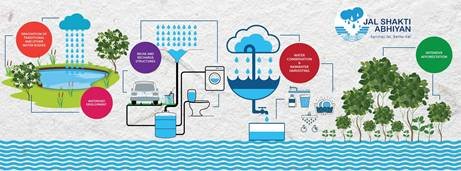
The Namami Gange mission banner; the basin-wide approach now frames the Yamuna cleanup as well (image: National Mission for Clean Ganga).
Subject: Environment – River Pollution and Governance
Syllabus
TNPSC Group I/II: Environment and ecology – river pollution; judicial intervention in environmental governance; pollution control institutions
Context
The Supreme Court has pressed for basin-wide accountability in the restoration of the Yamuna, directing the Central Pollution Control Board to frame a penalty formula based on entry and exit water quality for each State and Union Territory, warning that States and districts where the river’s water quality deteriorates will be held accountable, and observing that 520 drains discharge wastewater into the river despite huge sums spent on cleaning it.
Main Body: Multi-Dimensional Analysis
1. The ruling’s thrust: The Court’s approach makes every riparian State and Union Territory accountable through a monetary penalty regime keyed to measured water quality at entry and exit points, rather than treating the Yamuna as Delhi’s problem alone, recognising that a river’s health is set by everything its catchment does upstream.
2. Pollution liability: The Court observed that despite huge sums spent on cleaning, pollution has only increased; the proposed penalty formula converts the polluter-pays principle into an inter-governmental liability, with the Central Pollution Control Board’s monitoring as the technical backbone of enforcement.
3. Sewage treatment gap: The central failure identified is that sewage generation in the basin far outruns treatment capacity, and much of the treated output fails quality norms, so drains carry effectively untreated waste into the river.
4. Floodplain encroachment: Construction and farming on the floodplain have narrowed the river’s room to spread and recharge, converting a living floodplain into occupied land and worsening both floods and pollution concentration.
5. Ecological flows: Without a minimum environmental flow, the river lacks the water to dilute even treated waste; restoration that ignores flows treats the Yamuna as a drain to be cleaned rather than a river to be revived.
6. Rehabilitation linkage: The editorial argument stresses that ecological restoration must be tied to housing and rehabilitation of people living on the floodplain, not executed as an eviction-driven beautification exercise.
7. River profile: The Yamuna rises in the Yamunotri region of Uttarakhand, travels through Haryana, Delhi and Uttar Pradesh, and joins the Ganga at Prayagraj; its Delhi stretch is among the most polluted urban river segments in the world.
8. Institutional landscape: River cleaning has passed through the Yamuna Action Plans since the 1990s, National Green Tribunal oversight, and now Supreme Court monitoring, each layer reflecting the failure of the previous one to deliver results.
9. Lesson for Tamil Nadu: Tamil Nadu’s own urban rivers, the Cooum and the Adyar in Chennai and the Vaigai in Madurai, face the same triad of sewage shortfall, encroachment and flow loss, making the Yamuna jurisprudence a template for the State.
10. The legal frame: The Water (Prevention and Control of Pollution) Act, 1974 created the Central and State Pollution Control Boards and made discharge of polluting matter into streams an offence; the gap has never been the statute but its enforcement capacity.
11. Action plan history: The Yamuna Action Plan began in 1993 with Japanese assistance and ran through multiple phases, spending heavily on treatment works that were repeatedly outgrown by the city’s sewage generation.
12. The NGT chapter: The National Green Tribunal’s 2015 directions on the Yamuna floodplain, including the much-litigated restrictions around the Art of Living event site, showed both the reach and the limits of tribunal-led restoration.
13. The polluter pays principle: Indian environmental jurisprudence adopted polluter pays and the precautionary principle through Supreme Court rulings in the 1990s, and the Yamuna directions apply that doctrine to municipal polluters who have long escaped it.
14. Drains as rivers: The Najafgarh drain contributes the largest pollution load entering the Delhi stretch; restoring such drains is inseparable from restoring the river they feed.
15. Ammonia and drinking water: Beyond visible pollution, ammonia spikes in the Yamuna repeatedly force shutdowns of Delhi’s water treatment plants, linking river health directly to urban drinking water security.
Positives, Negatives, & Government Schemes
| Category | Dimension / initiative | Explanation |
| Positive | Basin-wide accountability | Fixing responsibility on all riparian States matches the hydrology: pollution loads accumulate downstream, so upstream action decides downstream outcomes. |
| Positive | Rehabilitation-linked restoration | Linking clearance of the floodplain with housing for its residents keeps restoration within constitutional and humanitarian bounds. |
| Negative | Implementation fatigue | Decades of plans and committees have produced little measurable improvement in water quality, the sobering baseline against which new directions must be judged. |
| Government scheme | Central Pollution Control Board | Statutory body under the Water (Prevention and Control of Pollution) Act, 1974 that monitors water quality and guides State pollution control boards. |
Examples
1. The foam that periodically covers the Yamuna at Kalindi Kunj is untreated detergent-rich waste, the visible symptom of the treatment gap.
2. Delhi’s common effluent and sewage plants run below capacity while new colonies discharge without connections, a planning failure repeated across the basin.
3. Chennai’s Cooum restoration attempts show the same pattern of sewage interception lagging urban growth.
4. The environmental flow concept was recognised in the Ganga context through notified minimum flows, a precedent relevant to the Yamuna.
5. Floodplain farming bans have repeatedly collided with livelihood claims, which is why rehabilitation is central to durable enforcement.
6. The Musi in Hyderabad and the Mithi in Mumbai show the same pathology: urban rivers reduced to drains once sewage interception falls behind growth.
7. Constructed wetlands and decentralised treatment at the drain mouth have shown promise as lower-cost complements to large centralised plants.
8. Citizen groups monitoring dissolved oxygen and coliform levels have kept public pressure on agencies between court hearings.
Way Forward
1. Publish audited, real-time sewage treatment and river quality data for every basin town so liability is measurable.
2. Ring-fence funds for treatment capacity that matches actual sewage generation, not design populations of a past decade.
3. Demarcate and protect the floodplain through notified regulation, paired with genuine rehabilitation packages.
4. Notify and enforce environmental flows so the river retains dilution capacity through the dry months.
5. Mandate that every new sewage connection corresponds to treatment capacity, so networks do not grow faster than plants.
6. Empower local urban bodies with ring-fenced funds and technical support for decentralised sewage treatment rather than waiting on mega-projects alone.
Conclusion
The Court has correctly located the Yamuna’s crisis in governance rather than geography: every failing is a failing of institutions that already exist. Basin-wide accountability, real treatment capacity and protected flows are the test, and the rest of urban India, Tamil Nadu included, is watching its own rivers in this verdict.
Practice Mains Question
Discuss the principal causes of river pollution in India’s urban stretches and evaluate the role of judicial intervention in river restoration, with reference to the Yamuna.
Topic 7: Fifth US Navy Ship Arrives at Kattupalli Shipyard for Repairs Under India-US Agreement
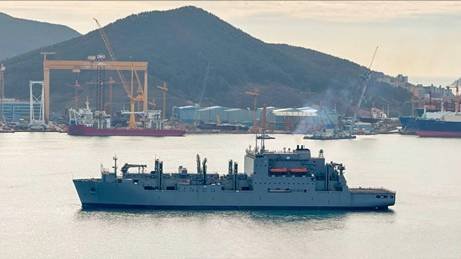
USNS Wally Schirra at the Kattupalli shipyard near Chennai, the fifth US Navy ship to be repaired there (image: DD News).
Subject: Defence and Economy – Maritime Industry and Strategic Partnerships
Syllabus
TNPSC Group I/II: India’s defence cooperation; Tamil Nadu’s ports and maritime industries; Make in India and industrial growth
Context
The United States Navy’s supply vessel USNS Wally Schirra arrived at the L&T shipyard at Kattupalli near Chennai on 20 November 2026 for repairs under the India-United States Master Ship Repair Agreement, the fifth US naval ship to be repaired at the Tamil Nadu facility and the first to arrive under a revised standard operating procedure for crew movement.
Main Body: Multi-Dimensional Analysis
1. The vessel: USNS Wally Schirra is a supply ship of the US Navy’s Military Sealift Command, which provides ocean transport, logistics and specialised maritime support to American military and government agencies worldwide.
2. The facility: Kattupalli, near Chennai, is Larsen and Toubro’s major private shipyard, and its selection for repeated US Navy work marks Tamil Nadu’s emergence as a credible node in international naval logistics.
3. The fifth repair: This is the fifth occasion a US naval vessel has come to Kattupalli for repairs, a run of repeat business that signals growing American confidence in India’s ship-repair infrastructure and technical capacity.
4. How it began: Ship-repair cooperation began in August 2022 when USNS Charles Drew became the first US Navy ship repaired at an Indian shipyard; USNS Matthew Perry followed in March 2023 and USNS Salvor in July 2023.
5. The agreement: In April 2023 the Kattupalli shipyard signed the Master Ship Repair Agreement with the US Navy, institutionalising the cooperation and qualifying the yard to undertake voyage repairs of American naval ships during their deployments.
6. Resumption signal: After USNS Charles Drew returned for a second repair in December 2024, the arrival of USNS Wally Schirra marks the resumption of US repair activity at Kattupalli and is expected to strengthen maritime industrial cooperation.
7. The revised procedure: The ship is the first to arrive under a revised standard operating procedure that streamlines the entry and exit of crew members, finalised through coordination among the Ministry of External Affairs, the Ministry of Home Affairs, the Bureau of Immigration, the Defence Ministry and the Department of Defence Production.
8. Hub potential: India’s strategic location near major international sea lanes, its expanding shipyard infrastructure, skilled workforce and rising technical capacity position it to emerge as a leading repair and maintenance hub for the Indo-Pacific and beyond.
9. Tamil Nadu’s stake: For Tamil Nadu, high-value defence-adjacent industrial work at Kattupalli supports the State’s maritime manufacturing ecosystem, skilled employment and its pitch as a destination for advanced engineering investment.
10. Voyage repairs explained: Voyage repairs are maintenance jobs performed while a ship remains in deployment, between major dockyard refits; winning them requires fast turnaround, reliable quality and hassle-free clearances, which is why the revised procedure matters commercially.
11. The strategic layer: Repair agreements of this kind deepen interoperability quietly: navies that trust each other’s yards share logistics, and shared logistics underpins wider maritime cooperation in the Indo-Pacific.
12. Employment and skills: Ship repair is skill-intensive work, employing welders, fitters, marine engineers and quality inspectors; sustained foreign orders justify long-term training pipelines that also serve Indian shipbuilding.
13. Chennai’s maritime cluster: The Kattupalli-Ennore-Chennai port belt already handles cargo, automobiles and energy; naval repair adds a high-technology layer to a cluster that anchors the State’s eastern seaboard economy.
Positives, Negatives, & Government Schemes
| Category | Dimension / initiative | Explanation |
| Positive | Industrial credibility | Repeat US Navy contracts place an Indian private shipyard inside the world’s most demanding logistics system, a reference no advertisement can buy. |
| Positive | Administrative reform | The revised crew-movement procedure shows whole-of-government coordination removing friction from a strategic industry. |
| Negative | Concentration risk | Naval repair work is geopolitically sensitive; dependence on one partner’s fleet cycles makes demand volatile. |
| Government scheme | Master Ship Repair Agreement | The 2023 agreement between the US Navy and the Kattupalli shipyard that qualifies the facility to undertake voyage repairs of American naval vessels. |
Examples
1. USNS Charles Drew’s first repair in August 2022 was described at the time as a landmark in India-US defence industrial cooperation.
2. The Military Sealift Command operates the US Navy’s logistics fleet, so its ships are precisely the ones that need reliable mid-deployment repair facilities.
3. India’s shipbuilding and repair ambitions also run through Cochin Shipyard and Mazagon Dock, but Kattupalli shows the private sector’s growing role.
4. The Indo-Pacific’s busy sea lanes off Chennai make the yard geographically attractive for ships deployed from the Western Pacific to the Gulf.
5. Defence corridors in Tamil Nadu already anchor aerospace and components manufacturing; naval repair adds a maritime dimension to the same ecosystem.
6. The L&T Kattupalli yard also builds for the Indian Navy and Coast Guard, so foreign repair work rides on capacity created for domestic defence needs.
7. The Bureau of Immigration’s role in the revised procedure shows that even niche industrial policy runs through ordinary regulatory machinery, from visas to port passes.
8. The 2022 repair of USNS Charles Drew was the first time an American naval vessel was serviced in India, and it was followed within three years by a standing agreement, showing how pilots mature into institutions.
Way Forward
1. Extend the revised crew-movement procedure into a single-window clearance for all foreign naval and merchant repair visits.
2. Market Indian yards collectively at international maritime exhibitions so Kattupalli’s reference converts into wider order books.
3. Invest in dry-dock capacity and skilled trades training to keep turnaround times competitive with East Asian yards.
4. Document quality and timelines from these repairs to build the case for India as a trusted maintenance hub.
5. Extend similar repair agreements to other friendly navies operating in the Indian Ocean so that utilisation of the yard does not depend on a single partner.
6. Publish periodic data on foreign vessels repaired, turnaround days and revenue so the hub claim is tested against numbers each year.
7. Develop a maritime skills centre near the Kattupalli-Ennore cluster so workforce supply grows with the yard’s ambitions.
Conclusion
A supply ship docking for repairs is a small event with a large meaning: strategic trust expressed through industrial work. For Tamil Nadu, Kattupalli’s growing order book is proof that the State’s maritime industry can compete for the world’s most demanding customers.
Practice Mains Question
Examine the significance of the India-US Master Ship Repair Agreement for India’s defence industrial base and for Tamil Nadu’s maritime economy.
Topic 8: Supreme Court Grants Interim Custody of Four-Year-Old to German Mother on Welfare Principle

The Supreme Court of India banner from the Court’s official website (image: sci.gov.in).
Subject: Polity – Judiciary and Child Rights
Syllabus
TNPSC Group I/II: Indian polity – judiciary and fundamental rights; international conventions on children; social justice issues
Context
The Supreme Court on 19 November 2026, in Helena Anna Maria Lersch v State of Goa (2026 INSC 1248), granted interim custody of a four-year-old boy to his German mother and permitted her to take him to Singapore, applying the best-interests-of-the-child principle after examining the care arrangements of both parents and a psychological assessment by NIMHANS, while final guardianship proceedings continue before a Delhi court.
Main Body: Multi-Dimensional Analysis
1. The order: The Court granted interim custody to the mother with permission to take the child to Singapore, making clear that the arrangement is temporary and subject to the pending guardianship proceedings before the Patiala House Court in Delhi.
2. The dispute: The parents, who were never married, contested custody; the Court considered their proposed care arrangements, the family’s interactions with the child and a professional psychological assessment.
3. The assessment: A psychological evaluation by NIMHANS, the National Institute of Mental Health and Neuro Sciences at Bengaluru, informed the Court’s understanding of the child’s developmental and emotional needs.
4. Prima facie claim: The Court observed that for a child born to unmarried parents the mother has a better prima facie claim to custody, while resting its order on an individualised welfare assessment rather than any mechanical rule, and noting that both parents were capable of caring for the child.
5. Best interests principle: Article 3 of the UN Convention on the Rights of the Child requires that the best interests of the child be a primary consideration in all actions concerning children, the standard Indian courts apply in custody matters.
6. Convention framework: The Convention on the Rights of the Child was adopted in 1989 and ratified by India in 1992; it obliges signatories to centre the child’s welfare in law and administration.
7. Parens patriae: Indian courts act as parens patriae, the State’s power to protect those unable to protect themselves, which is the doctrinal basis for welfare-driven custody adjudication beyond the parents’ competing rights.
8. Cross-border complexity: International relocation adds enforcement questions: continued contact with the other parent, jurisdiction over future disputes and the risk of forum shopping between countries.
9. Social significance: The order models a mature custody jurisprudence for an era of transnational families, in which professional assessment and individualised welfare analysis replace inherited assumptions about who should raise a child.
10. The statutory base: The Guardians and Wards Act, 1890 governs custody adjudication for most communities, and courts have consistently read its welfare mandate as overriding the personal-law preferences of either parent.
11. Settled doctrine: The Supreme Court’s ruling in Gaurav Nagpal v Sumedha Nagpal established that the child’s welfare is the paramount consideration in custody matters, displacing the legal rights of the parents to a secondary position.
12. Tender years, not a rule: The traditional preference for mothers of very young children is a presumption that yields to evidence; this case shows courts examining actual caregiving rather than applying the presumption mechanically.
13. Visitation as a right of the child: Modern custody thinking treats contact with the non-custodial parent as the child’s right rather than the parent’s, so relocation orders must build in workable arrangements for continued contact.
14. Technology in contact: Courts now routinely order scheduled video contact where physical access is impractical, a practice accelerated by the pandemic years and relevant when a child moves abroad.
15. The child’s voice: Courts increasingly interview older children directly in chambers; at four, the child’s own preference carries little formal weight, which is why professional assessment substitutes for it.
16. Gender-neutral reading: The order reinforces that custody law speaks in the language of welfare, not gender roles: a mother’s career and a father’s availability are weighed as caregiving facts, not as stereotypes.
17. Why interim orders matter: Children experience interim periods as their whole present; a stable interim arrangement reduces the psychological cost of litigation that may run for years before final guardianship is decided.
Positives, Negatives, & Government Schemes
| Category | Dimension / initiative | Explanation |
| Positive | Child-centred method | Basing custody on professional psychological assessment and observed care arrangements puts the child’s needs, not adult claims, at the centre. |
| Positive | Interim restraint | Keeping the arrangement interim preserves the trial court’s role and the father’s rights while giving the child stability now. |
| Negative | Enforcement difficulty | Once a child leaves the jurisdiction, Indian orders on visitation and custody depend on foreign cooperation, a real practical risk. |
| Government scheme | UN Convention on the Rights of the Child, 1989 | The international treaty, ratified by India in 1992, whose Article 3 makes the child’s best interests a primary consideration in all actions concerning children. |
Examples
1. Indian courts have repeatedly held that the father’s status as natural guardian does not override welfare analysis, a line this order continues.
2. NIMHANS assessments are routinely used in custody and juvenile matters, showing how mental-health expertise has entered family adjudication.
3. The Hague Convention on international child abduction addresses wrongful cross-border removal; India is not a party, which complicates transnational custody enforcement.
4. Guardianship statutes including the Guardians and Wards Act, 1890 supply the procedural framework within which welfare is assessed.
5. Shared-parenting arrangements ordered by some High Courts show the spectrum of solutions between sole custody and equal time.
6. Family courts under the Family Courts Act, 1984 were designed for exactly such disputes, with counselling built into the process, though caseloads often crowd out the counselling function.
7. The Law Commission’s 2015 report on shared parentage recommended joint custody frameworks, and though not enacted wholesale, its reasoning increasingly surfaces in judicial orders.
8. The Commissions for Protection of Child Rights Act, 2005 created national and State commissions that can intervene in child welfare matters, part of the wider protective architecture.
Way Forward
1. Ensure custody proceedings are timely and child-sensitive, since delay itself harms the child.
2. Institutionalise qualified psychological assessment in contested custody cases across family courts.
3. Protect meaningful contact with both parents wherever consistent with the child’s welfare.
4. Develop bilateral arrangements for custody enforcement with countries hosting large Indian diasporas.
5. Family courts should maintain panels of child psychologists so assessments like the NIMHANS evaluation in this case become routine, not exceptional.
6. Frame standard relocation protocols for family courts so that interim permissions like this one carry consistent safeguards for continued contact.
Conclusion
The order is a careful exercise of judicial discretion: no parent was presumed unfit, the child’s welfare was professionally assessed, and nothing was foreclosed. It is a small case that illustrates a large principle, that in matters of children, courts decide futures, not contests.
Practice Mains Question
Explain the best-interests-of-the-child principle and examine how Indian courts apply it in custody disputes involving transnational families.
