
Today’s snapshot
1. India Tells UN Security Council the Costs of Conflict Are Not Shared Equally (GS 2)
2. CAQM Tells Supreme Court Over 25 Lakh End-of-Life Vehicles Ply in Delhi-NCR (GS 3)
3. Karnataka Moves Supreme Court to Restrain Tamil Nadu’s Cauvery-South Vellar-Vaigai-Gundar Link Project (GS 2)
4. Infant Denied Birth Certificate in West Bengal After Father’s Deletion in SIR (GS 2)
5. US Jury Convicts Huawei of Trade-Secret Conspiracy and Bank Fraud (GS 3)
6. No Defence Data Breach, Says Government; Security Establishments Told to Audit Messaging Groups (GS 3)
7. Supreme Court Collegium Proposes Chief Justice Transfers Across Three High Courts (GS 2)
8. India-Bangladesh Institutions Under Strain as Hasina Announces Return Plan (GS 2)
Topic 1: India Tells UN Security Council the Costs of Conflict Are Not Shared Equally
Subject: International Relations – Multilateralism and Food Security
Paper: GS Paper 2: India and its neighbourhood; important international institutions, agencies and fora; effect of policies of developed and developing countries on India’s interests
UPSC Relevance: The statement shows how India frames its Ukraine-war diplomacy at the UN: peace as a development necessity for the Global South, freedom of navigation and protection of food and energy supply chains as practical interests, and historical memory deployed as diplomatic argument.
Why in News
India’s Permanent Representative to the UN, Ambassador Harish Parvathaneni, told a high-level Security Council briefing on 23 November 2026 that developing countries bear the brunt of the food, fuel, fertiliser and energy shortages caused by today’s global conflicts, and invoked the 1943 Bengal famine as a reminder of the human cost of distant wars.
The briefing, on ‘Protecting critical energy infrastructure and Black Sea lifelines of global food supply’, comes as the Ukraine conflict runs into its fifth year and attacks on commercial shipping and energy infrastructure have intensified, according to UN officials who briefed the same session.
Background: War, Shipping and Food Supply Chains
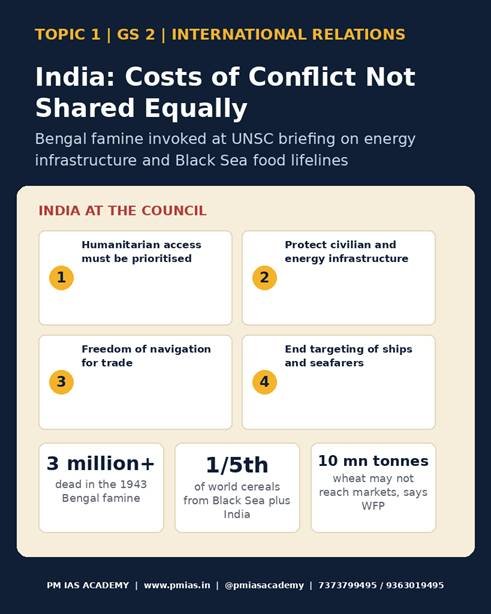
Russia and Ukraine together account for almost a quarter of global exports of wheat, maize and barley, and Ambassador Parvathaneni told the Council that the Black Sea region and India together account for nearly a fifth of global cereal production, so disruption to Black Sea shipping reverberates through food prices worldwide.
India has consistently refused to take sides in the Ukraine war at the UN, abstaining on most resolutions while pressing for dialogue; the Prime Minister’s formulation that ‘this is not an era of war’ has become the anchor of that position, and India has paired it with humanitarian assistance such as wheat to Afghanistan, rice to Sudan and aid to Palestine.
The 1943 Bengal famine, which killed over three million people during the Second World War, is increasingly cited in Indian diplomacy as evidence that populations far from a battlefield can become its collateral damage when wartime priorities override civilian food needs.
Key Dimensions
1. The core argument: India told the Council that the costs of conflict are not shared equally: Global South countries are the most adversely affected by the food, fuel and fertiliser crisis generated by wars they did not start, a framing that converts India’s neutrality into an affirmative case for peace.
2. The Bengal famine invocation: By recalling that the 1943 famine killed over three million people, India drew a parallel between wartime diversion of resources then and disruptions to grain, energy and fertiliser flows now, presenting food insecurity as a foreseeable consequence of conflict rather than an accident.
3. Critical energy infrastructure: The briefing focused on attacks on energy infrastructure, which UN Under-Secretary-General Rosemary DiCarlo said were more extensive than in the corresponding period last year, disrupting heating, electricity and water supplies as winter approaches.
4. Black Sea lifelines: WFP Executive Director Luke Lindberg warned that Black Sea food shipments had fallen sharply even though grain remains available, estimating that around 10 million tonnes of Russian and Ukrainian wheat, enough to feed 44 million people, may not reach global markets this year.
5. Three red lines: The WFP urged member states to rally around three red lines: no more famines, no more weaponisation of food, and no more attacks on humanitarians, a checklist India broadly endorsed through its own calls for humanitarian access.
6. Safety of seafarers: India flagged that merchant vessels and crews are increasingly coming under attack, citing incidents in which Indian seafarers lost their lives, and called for an end to the targeting of commercial shipping and for safe navigation through international waterways.
7. Group of Friends initiative: India recalled that it and Liberia launched the Group of Friends on Safety and Security of Shipping and Seafarers during the UN high-level week in September, giving India a convening role on the maritime dimension of the crisis.
8. Food diplomacy: India cited its own humanitarian supplies, wheat to Afghanistan, rice to Sudan and aid to Palestine, as evidence of its commitment to keeping global food supply chains functioning for the vulnerable.
9. Multilateral positioning: The statement avoided blaming either party to the conflict, instead asking the Council to prioritise humanitarian access, protection of civilian infrastructure and freedom of navigation so that humanitarian supplies and legitimate trade remain unaffected.
10. Development dimension: UNDP Administrator Alexander De Croo told the session his agency was working with Ukrainian authorities to restore power and essential services before winter, linking immediate relief to longer-term recovery, a sequencing India supports.
11. Normative stake: India argued that dialogue and diplomacy, safe commercial shipping and uninterrupted grain and energy flows are practical necessities, not abstractions, aligning its strategic autonomy with a rules-based maritime order.
12. Historical memory as leverage: Using the famine memory lets India speak for post-colonial states that view both bloc politics and sanctions regimes sceptically, strengthening its claim to leadership of the Global South without confronting any Council member directly.
Significance
1. Global South voice: The intervention consolidates India’s claim to articulate Global South concerns inside the Council even as a non-permanent outsider to the P5, turning food and energy security into its signature multilateral theme.
2. Maritime interest: With much of India’s energy and fertiliser imports moving by sea, freedom of navigation and seafarer safety are direct national interests, and the statement ties them to a universal norm.
3. Strategic autonomy: The speech restates refusal to join either bloc while staying fully engaged in Council deliberations, the balancing pattern that defines India’s Ukraine policy.
4. Exam hook: The item links international relations with modern Indian history (the 1943 famine), food security economics and UN reform debates in a single current-affairs package.
Challenges
1. Limited leverage: India’s calls for humanitarian access and safe shipping carry moral weight but little enforcement capacity, since the Council remains deadlocked by the veto of a permanent member that is a party to the conflict.
2. Attribution risks: Speaking of conflict costs without naming the parties preserves diplomacy but can dilute accountability, a criticism levelled at India’s formula by partners who want clearer positions.
3. Domestic exposure: India itself depends on imported energy, fertiliser and edible oils, so prolonged disruption transmits inflation at home, testing the gap between diplomatic advocacy and domestic preparedness.
4. Normative competition: Other middle powers, including Brazil, South Africa and Turkey, offer rival peace formulas, so India’s Global South leadership is contested rather than automatic.
Way Forward
1. Institutionalise the shipping initiative: Convert the Group of Friends on Safety and Security of Shipping and Seafarers into a standing mechanism with reporting on attacks and insurance costs, so the September launch produces continuous pressure rather than a one-off statement.
2. Scale food diplomacy: Tie wheat, rice and fertiliser assistance to a published Global South food security plan, so India’s contributions are visible as policy rather than ad hoc relief.
3. Pair advocacy with capacity: Expand strategic reserves and diversified import sources for fertilisers and energy so that India’s call for uninterrupted flows is matched by domestic resilience.
4. Use every multilateral forum: Carry the same food-and-fuel framing into the G20, UNGA and BRICS processes, keeping the issue on the agenda until the war ends and reconstruction begins.
Prelims Value Addition
- The briefing theme was protecting critical energy infrastructure and Black Sea lifelines of global food supply; India and Liberia launched the Group of Friends on Safety and Security of Shipping and Seafarers in September.
- Russia and Ukraine supply almost a quarter of global wheat, maize and barley exports; the 1943 Bengal famine killed over three million people.
- WFP’s three red lines: no more famines, no more weaponisation of food, no more attacks on humanitarians; about 10 million tonnes of wheat may not reach markets this year, enough to feed 44 million people.
- India’s recent humanitarian food diplomacy includes wheat to Afghanistan, rice to Sudan and assistance to Palestine.
Mains Value Addition
- GS 2: ‘India has consistently emphasised that the costs of conflict are not shared equally.’ Examine how India has used the Ukraine war to articulate Global South concerns at the United Nations.
- GS 2/3: Discuss the significance of freedom of navigation and seafarer safety for India’s food and energy security, with reference to recent disruptions to Black Sea shipping.
Topic 2: CAQM Tells Supreme Court Over 25 Lakh End-of-Life Vehicles Ply in Delhi-NCR
Subject: Environment – Urban Air Pollution and Transport Governance
Paper: GS Paper 3: environmental pollution and degradation; infrastructure; government policies and interventions
UPSC Relevance: The status report exposes the execution gap in India’s flagship air-quality framework: ambitious e-mobility policy on paper, scarce charging infrastructure and weak scrappage enforcement on the ground, a classic GS 3 case of policy-implementation divergence.
Why in News
The Commission for Air Quality Management (CAQM) has confirmed in its latest status report to the Supreme Court that vehicular pollution is one of the most significant contributing sectors to the generally poor air quality in Delhi-NCR, while documenting how far the transition to cleaner transport lags behind policy.
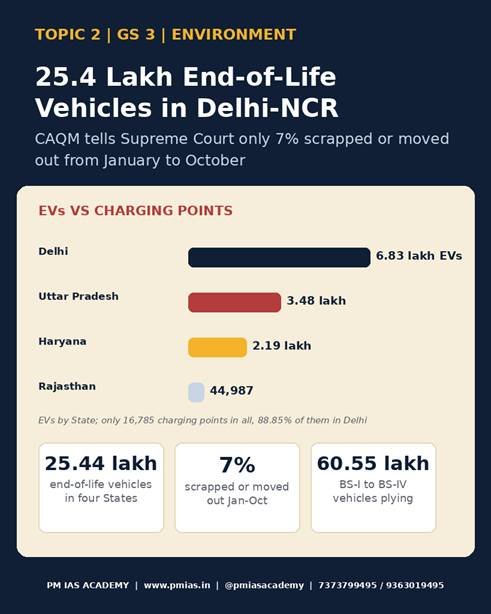
Of 25,43,679 end-of-life vehicles reported active across Delhi, Haryana, Uttar Pradesh and Rajasthan, only about 1.86 lakh, a little over 7 per cent, were scrapped or moved out of the region between January and October 2026, the Commission told the court.
Background: The Delhi-NCR Air Quality Regime
The CAQM is a statutory commission created in 2021 to coordinate air-quality management across Delhi and the adjoining NCR States, replacing the older EPCA; it issues directions under the Graded Response Action Plan and reports to the Supreme Court in the ongoing air-pollution litigation.
An end-of-life vehicle is one that can no longer be legally registered or operated on public roads due to age limits, failed fitness tests, cancelled registration, severe damage or voluntary surrender; Delhi bars petrol vehicles older than 15 years and diesel vehicles older than 10 years, though the Supreme Court has restrained coercive action against owners of such overage vehicles.
The Delhi government notified the Delhi Electric Vehicle Policy 2026 on 30 June 2026, effective 1 July, mandating that new registrations be only electric L5 three-wheelers from January 2027 and electric two-wheelers from 1 April 2028, with phased electrification targets for commercial fleets, logistics aggregators and private schools.
Key Dimensions
1. Scale of the fleet: The report counts 1,71,76,234 vehicles plying in Delhi-NCR, of which 60.55 lakh adhere to BS-I to BS-IV era emission standards and therefore carry a much higher polluting potential than BS-VI vehicles.
2. End-of-life backlog: Against 25,43,679 end-of-life vehicles active in the four States, barely 1.86 lakh were scrapped or issued no-objection certificates for removal between January and October 2026, which the Commission described as far from satisfactory enforcement.
3. Charging deficit: For a total of 12.94 lakh electric vehicles in Delhi and the three NCR States, only 16,785 charging points or stations exist, leaving registered EVs operating on a fraction of the required grid support.
4. Regional divide: Delhi holds 6,83,251 EVs and 14,913 operational charging points as on 31 October 2026, which is 88.85 per cent of all charging infrastructure among the four States, while Uttar Pradesh has 565 points for 3,47,587 EVs, Haryana 1,285 for 2,18,530 EVs and Rajasthan just 22 for 44,987 EVs.
5. Cross-border traffic: The data matters because the Supreme Court has recently observed that a large part of the capital’s pollution is caused by vehicles crossing into Delhi from Uttar Pradesh, Haryana and Rajasthan, where EV support is weakest.
6. Policy stack: The Union Finance Ministry asked central ministries to switch to EVs as early as December 2018; CAQM issued a May 2025 advisory for governments and public undertakings in NCR to procure or hire cleaner vehicles; and the Delhi EV Policy 2026 added registration mandates, yet infrastructure has not followed.
7. Two-wheeler dominance: Two-wheelers account for 65.2 per cent of the total vehicle population in Delhi-NCR and four-wheeler light motor vehicles another 28.9 per cent, so electrification of two-wheelers, targeted from April 2028, is where the largest emission gains lie.
8. Battery challenge: The Commission acknowledged that e-mobility requires robust supporting infrastructure, including charging stations, battery swapping points and mechanisms for disposal of large volumes of spent batteries expected in coming years.
9. Judicial guardrails: The Supreme Court has barred coercive action against owners of overage petrol and diesel vehicles, so the scrappage push must proceed through incentives and facilitation rather than seizure, complicating enforcement design.
10. Representation in court: The CAQM was represented by Additional Solicitor General Aishwarya Bhati, indicating the matter is being handled at the highest level of the government’s law officers in the suo motu air-pollution case.
11. Policy-advised States: The report says NCR States other than Delhi have been advised to revise their EV policies to accelerate transition, underscoring that the NCR airshed cannot be cleaned by Delhi acting alone.
12. Health framing: By certifying vehicular pollution as one of the most significant contributing sectors, the Commission keeps transport at the centre of the judicially monitored clean-air agenda alongside dust, industry and stubble burning.
Significance
1. Implementation audit: The report converts the air-pollution debate from intentions to audited numbers, giving the court a baseline against which future compliance can be measured State by State.
2. Federal coordination: Because the airshed spans four States, the data on charging asymmetry makes the case for joint NCR-level infrastructure planning rather than four separate EV policies.
3. Industrial signal: The admitted infrastructure gap tells manufacturers and charge-point operators where unmet demand lies, while flagging battery disposal as the next regulatory frontier.
4. Public health: Cleaner vehicle transition is among the few pollution levers that cut exposure year-round, unlike episodic measures such as GRAP curbs.
Challenges
1. Infrastructure lag: Charging point installation outside Delhi is orders of magnitude behind vehicle registration, and land, power connections and utilisation economics all slow rollout.
2. Scappage economics: Owners of old vehicles often hold them as assets of last resort; without attractive scrappage incentives and accessible scrapping facilities, mandates alone fail.
3. Judicial limits: The bar on coercive enforcement against overage vehicles removes the strongest compliance tool, leaving persuasion and incentive design.
4. Battery waste: A rapid EV shift multiplies spent-battery volumes, and recycling capacity and rules are still maturing, risking one pollution stream replacing another.
Way Forward
1. NCR charging compact: Set joint charging-infrastructure targets for the four NCR States with common standards and shared funding, so inter-State commuters find seamless charging and the 88.85 per cent Delhi concentration is corrected.
2. Facilitated scrappage: Expand authorised scrapping capacity, publish a simple incentive grid linked to vehicle age and fuel, and report monthly scrappage numbers to the court as the CAQM already reports vehicle counts.
3. Enforce fleet mandates: Apply the Delhi EV Policy 2026 milestones on schedule to commercial fleets and aggregators first, since high-utilisation vehicles deliver the largest per-vehicle emission cuts.
4. Plan for batteries now: Notify end-of-life battery collection and recycling obligations alongside the EV push, so spent-battery disposal capacity grows in step with the EV fleet.
Prelims Value Addition
- CAQM is a statutory body (2021) for air-quality management in Delhi-NCR; it succeeds the EPCA and operates the Graded Response Action Plan (GRAP).
- Delhi EV Policy 2026: notified 30 June 2026, effective 1 July 2026; electric-only new registration for L5 three-wheelers from January 2027 and two-wheelers from April 2028.
- BS-VI norms apply to new vehicles since April 2020; India skipped BS-V; older BS-I to BS-IV vehicles have much higher polluting potential.
- Delhi bars petrol vehicles over 15 years and diesel over 10 years; the Supreme Court has restrained coercive action against such owners; two-wheelers are 65.2 per cent of the NCR fleet.
Mains Value Addition
- GS 3: The CAQM status report shows a wide gap between e-mobility policy and charging infrastructure in Delhi-NCR. Discuss the reasons and suggest a regionally coordinated corrective strategy.
- GS 3: ‘Judicially monitored air-quality governance can expose policy failure but cannot by itself deliver clean air.’ Examine with reference to the Supreme Court’s vehicle-pollution proceedings.
Topic 3: Karnataka Moves Supreme Court to Restrain Tamil Nadu’s Cauvery-South Vellar-Vaigai-Gundar Link Project
Subject: Polity and Federalism – Inter-State River Water Disputes
Paper: GS Paper 2: federal structure; inter-State relations; functions and responsibilities of the Union and the States; Supreme Court’s original jurisdiction
UPSC Relevance: The application raises classic federalism questions: a lower-riparian State’s unilateral use of surplus flows, the Union government’s gatekeeping role in inter-State projects, and the Supreme Court’s Article 131 original jurisdiction as the arbiter of water federalism.
Why in News
Karnataka has filed an application in the Supreme Court seeking a temporary injunction against Tamil Nadu and the Union government over the Cauvery (Kattalai)-South Vellar-Vaigai-Gundar Link Project, asking that Tamil Nadu be restrained from executing ongoing and further works.
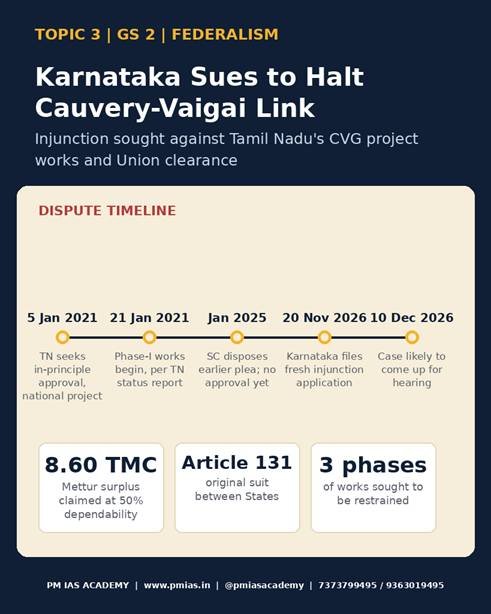
The application, filed on 20 November in Karnataka’s original suit, says Karnataka learnt from a Madras High Court order that Tamil Nadu’s own status report records Phase-I works as going on since 21 January 2021, facts Karnataka alleges were not placed before the Supreme Court.
Background: The CVG Link and the Long Cauvery Dispute
The Cauvery dispute between Karnataka and Tamil Nadu is among India’s oldest inter-State water conflicts, governed since the Cauvery Water Disputes Tribunal’s 2007 final award, modified by the Supreme Court in 2018, and implemented through the Cauvery Water Management Authority and the Cauvery Water Regulation Committee.
The CVG Link is Tamil Nadu’s proposal to divert surplus Cauvery water from the Kattalai barrage near Mettur through the South Vellar to the Vaigai and Gundar basins in the water-scarce south; Tamil Nadu sought the Union government’s in-principle approval and declaration of the project as a national project on 5 January 2021.
Under the Inter-State River Water Disputes framework and the Union’s environmental clearance regime, an inter-State project of this kind requires central clearances; a similar Karnataka application was disposed of in January last year after the Centre stated it had granted no in-principle approval, making interim relief unnecessary at that stage.
Key Dimensions
1. The core grievance: Karnataka argues that Tamil Nadu cannot undertake any work on the CVG Link without clearance from the Union government, and that any works already executed are illegal, since the project’s water is worked out from surpluses at Mettur Dam placed at about 8.60 TMC at 50 per cent dependability.
2. The equities argument: Karnataka contends that unilateral utilisation of surplus waters flowing down from Karnataka may later be relied upon by Tamil Nadu to claim prescriptive equities, prejudicing Karnataka’s own rights in the surplus waters of the Cauvery.
3. Reliefs sought: Karnataka wants the court to restrain Tamil Nadu from executing the first phase and from taking up any further Phase-I, II or III works, to stop diversion of flood waters from Mettur to the Sarabanga sub-basin, the New Kattalai Barrage at Mayanur, and other barrages and check dams across the Cauvery and Kollidam.
4. Direction against the Centre: The application also asks the court to direct the Union government not to process Tamil Nadu’s January 2021 request for in-principle approval and to refrain from declaring the CVG Link a national project while the suit is pending.
5. Demolition demand: Going beyond a freeze, Karnataka has pressed for a direction that Tamil Nadu demolish the Phase-I works already completed, a remedy courts grant sparingly but which frames the seriousness of the allegation.
6. The discovery route: The trigger was an order of the Madras High Court that extracted a Tamil Nadu status report; Karnataka says several Phase-I structures are already complete and land has been acquired for further works, changing the facts since the earlier disposal.
7. Article 131 forum: The suit sits in the Supreme Court’s original jurisdiction over disputes between States, the constitutional route for water conflicts once tribunal adjudication has run its course or new projects escape the tribunal’s mandate.
8. Counsel and timeline: The application was settled by senior advocate Mohan V. Katarki and Karnataka Advocate General Shashi Kiran Shetty and filed through advocate-on-record Nishanth Patil; the case is likely to come up for hearing on 10 December.
9. Surplus water doctrine: The dispute tests who owns surplus flows in a fully adjudicated basin: the State where they originate, the lower riparian that can impound them, or the tribunal-allocated shares that arguably exhaust the river’s waters.
10. National project politics: Declaration as a national project would bring central funding and momentum; Karnataka’s bid to block that declaration shows how the label itself has become a litigation target in inter-State water politics.
11. Parallel basin stress: The demand to halt diversions to the Sarabanga sub-basin and the Kollidam check dams shows the fight is not only about one canal but about the entire pattern of Tamil Nadu’s use of flood flows.
12. Earlier restraint: The January last year disposal shows the court’s reluctance to enjoin a project the Centre had not approved; Tamil Nadu’s alleged construction meanwhile may now persuade the court that the factual basis of that restraint has eroded.
Significance
1. Federal precedent: The case will shape whether States can build first and seek approval later on inter-State rivers, a question with implications far beyond the Cauvery for every shared basin.
2. Water governance: It highlights the gap between tribunal-era allocation of dependable flows and the growing contest over surplus and flood waters in a climate-stressed monsoon regime.
3. Southern drought politics: With the northeast monsoon underperforming and delta farmers anxious, the litigation lands amid acute scarcity politics in both States, raising the stakes of judicial timing.
4. Institutional design: The role of the CWMA, the Centre’s clearance power and the court’s original jurisdiction interact here, offering a live study of India’s multi-layered water dispute machinery.
Challenges
1. Fact-finding burden: The court must first establish what was actually built, when, and with what approvals, against competing status reports from the two States.
2. Equity versus law: Tamil Nadu’s equity in water already applied to crops clashes with Karnataka’s legal objection, and any interim order will impose real costs on one side’s farmers.
3. Enforcement: Even a restraining order requires the Centre’s cooperation to halt works and funding, and the Union government has historically moved cautiously between the two States.
4. Escalation risk: Water litigation in the Cauvery basin has repeatedly spilled into street politics, so the December hearing will be watched for its potential to inflame both States.
Way Forward
1. Freeze pending scrutiny: An interim standstill on new works, without prejudicing completed structures, would preserve the status quo while the court examines approvals, balancing equity against legality.
2. Independent verification: The court could direct the CWMA or an expert committee to verify on the ground what Phase-I works exist and what water they actually divert, replacing rival claims with inspected fact.
3. Surplus water protocol: The basin States and the Centre should negotiate a protocol for surplus and flood flows, since the tribunal award’s dependable-flow framework no longer covers the contested category.
4. Time-bound clearance process: The Union government should decide the in-principle approval request on stated criteria within a fixed period, so neither State uses administrative silence as a weapon.
Prelims Value Addition
- Article 131 gives the Supreme Court original jurisdiction in disputes between States; the Cauvery Water Disputes Tribunal gave its final award in 2007, modified by the Supreme Court in 2018.
- The Cauvery Water Management Authority implements the award; the CVG Link seeks to carry surplus Mettur water to the Vaigai and Gundar basins.
- Karnataka’s application names the Sarabanga sub-basin diversion, the New Kattalai Barrage at Mayanur, and check dams across the Cauvery and Kollidam; hearing is listed for 10 December.
- Tamil Nadu sought in-principle approval and national project status for the CVG Link on 5 January 2021; the disputed Mettur surplus is placed at about 8.60 TMC at 50 per cent dependability.
Mains Value Addition
- GS 2: ‘Surplus water is the new frontier of inter-State river disputes in India.’ Discuss with reference to the Cauvery-Vaigai-Gundar Link controversy.
- GS 2: Examine the role of the Supreme Court’s original jurisdiction and Union clearance powers in managing federal water conflicts, in the light of the CVG Link litigation.
Topic 4: Infant Denied Birth Certificate in West Bengal After Father’s Deletion in SIR
Subject: Polity – Electoral Rolls, Citizenship and Civil Registration
Paper: GS Paper 2: constitutional bodies (Election Commission); representation of the People Acts; governance and social justice; fundamental rights
UPSC Relevance: The case sits at the junction of election law and civil registration: it tests whether deletion from an electoral roll during the Special Intensive Revision can lawfully ripple into a citizen’s access to a statutory birth certificate, ration entitlements and other public services.
Why in News
A two-and-a-half-month-old infant in Cooch Behar’s Khatamari village has been denied a birth certificate after her father’s name was found deleted from the electoral rolls during the special intensive revision exercise, with local authorities reportedly insisting on residential verification that was then refused.
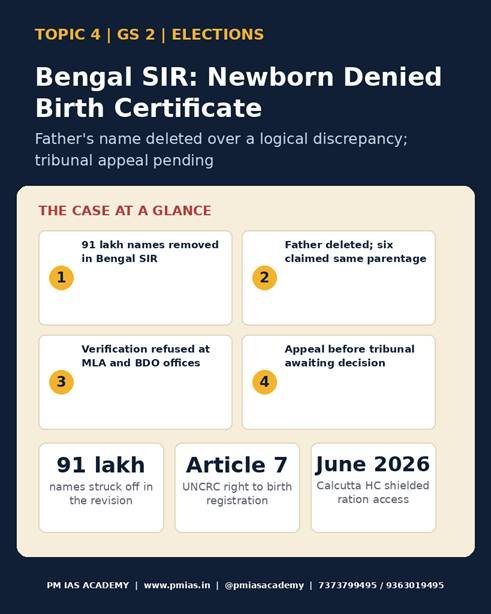
The Election Commission of India had cited a ‘logical discrepancy’, that six other persons also claimed the father of the family as their own, while calling family members for a hearing; the father has appealed to a tribunal, and the matter is awaiting decision.
Background: The Special Intensive Revision
The special intensive revision is an Election Commission exercise to clean electoral rolls by verifying every elector afresh, conducted in West Bengal ahead of the Assembly elections; the revision in the State saw the removal of 91 lakh names from the electoral rolls.
Deletion from the roll follows a statutory process of notice, hearing and appeal; appeals lie before tribunals constituted for the purpose, and the Supreme Court has separately directed that the appeals of excluded voters be heard on priority with additional judicial tribunals.
Birth registration is governed by the Registration of Births and Deaths Act, 1969, a statutory obligation of the civil registration system that is independent of electoral status; child-rights bodies argue the right to a legal identity at birth is also protected under Article 7 of the UN Convention on the Rights of the Child.
Key Dimensions
1. The immediate facts: Amina Khatun delivered a baby girl on 9 September at Dinhata Sub-Divisional Hospital; when the parents sought the birth certificate, they were asked to arrange residential verification from the Panchayat Pradhan or the MLA, and both the MLA’s office and the Block Development Officer of Sahebganj reportedly refused, citing the father’s SIR deletion.
2. The deletion rationale: The ECI told the family there was a ‘logical discrepancy’ because six other persons also claimed the same man as their father; his parents, wife and elder sister remain on the roll, while he and three of his sisters were deleted, illustrating how algorithmic matching can split a single household.
3. The allegation of mischaracterisation: The father, Abdul Habib, says an official told him he was a Bangladeshi national who must first register through the National Register of Citizens, a claim he disputes with documents and a house built by his grandfather, showing how SIR suspicion can slide into citizenship questioning.
4. Spillover into welfare: The report records several instances in Bengal in recent months where residents were denied basic facilities or scheme access after SIR deletion; in June, Umme Salma of Cooch Behar had to approach the Calcutta High Court after a ration dealer threatened to discontinue her entitlement, and the court barred coercive steps without its permission.
5. Civil-society response: The Association for Protection of Civil Rights has demanded the immediate issue of the birth certificate, arguing that birth registration is a statutory obligation and that a child’s legal identity cannot be linked to the electoral status of her parents.
6. Scale of the revision: With 91 lakh names removed in the State, even a small error rate translates into very large absolute numbers of affected residents, which is why the Supreme Court has already had to expand tribunal capacity for SIR appeals.
7. Appeal architecture: The father’s pending tribunal appeal shows the designed remedy at work, but the infant’s case exposes a gap: civil registration authorities are treating an unresolved electoral status as a ground to withhold an unrelated statutory service.
8. Administrative incentives: Local officials asked to guard against wrongful inclusion may prefer refusal over risk, shifting the cost of verification onto residents least equipped to litigate it.
9. Child rights dimension: Denying a birth certificate harms a person who was not even born when the revision occurred, converting an electoral adjudication into a penalty on a newborn’s identity.
10. Legal separation of regimes: Electoral rolls determine franchise, not citizenship or civil status; conflating the SIR outcome with birth registration collapses distinct statutory regimes that Parliament kept separate.
11. Pattern recognition: Earlier episodes around the NRC in Assam showed the same mechanics, documentary suspicion, family splits and tribunals, suggesting the SIR moment raises systemic rather than local questions.
12. Judicial oversight: The Calcutta High Court’s June intervention on rations and the Supreme Court’s tribunal-strengthening directions indicate the courts are actively fencing the revision’s collateral consequences.
Significance
1. Rule-of-law marker: The case is an early test of whether India’s largest roll-cleaning exercise can be conducted without collateral denial of unrelated statutory rights.
2. Federal machinery: It brings the ECI, State registration authorities and judicial tribunals into one frame, showing how constitutional bodies and local administration interact in practice.
3. Child rights: The UNCRC Article 7 framing gives the episode an international-law hook relevant to answers on India’s treaty commitments.
4. Exam traction: Candidates must hold the distinction between electoral status, citizenship and civil registration, all three of which this single news item ties together.
Challenges
1. Verification integrity: Roll cleaning must catch genuinely wrongful entries without generating false deletions at scale, and logical-discrepancy flags based on name matching are prone to error in communities with common naming patterns.
2. Remedy delay: Tribunal queues mean an erroneous deletion can persist for months, during which the resident bears the burden across services.
3. Administrative overreach: Local functionaries treating electoral status as a proxy for legality of residence lack legal warrant but face no quick sanction.
4. Polarisation: SIR disputes are unfolding in a charged political environment in Bengal, so administrative error quickly acquires partisan amplification, complicating neutral correction.
Way Forward
1. Firewall statutory services: Direct that birth and death registration, rations and scheme entitlements cannot be denied solely on the basis of a pending or contested SIR deletion, pending appeal outcomes.
2. Fast-track linked appeals: Prioritise tribunal hearings where a deletion has triggered denial of an unrelated statutory service, as the Supreme Court has already directed for excluded voters generally.
3. Audit deletion logic: Publish and audit the criteria behind logical-discrepancy flags, with household-level reconciliation before deletion rather than after.
4. Document accountability: Record in writing every refusal that cites SIR status, so appellate authorities and courts can review both the deletion and the collateral denial.
Prelims Value Addition
- The Registration of Births and Deaths Act, 1969 makes birth registration a statutory obligation independent of electoral status; UNCRC Article 7 recognises a child’s right to birth registration and legal identity.
- West Bengal’s SIR removed 91 lakh names; appeals lie to judicial tribunals, and the Supreme Court has directed priority hearing for excluded voters with additional tribunals.
- The ECI’s deletion ground in this case was a ‘logical discrepancy’ arising from overlapping claims of parentage; the appeal before the tribunal is pending.
- In June, the Calcutta High Court restrained discontinuation of a Cooch Behar resident’s ration entitlement over an SIR deletion without its permission.
Mains Value Addition
- GS 2: ‘Electoral roll revision must not become a parallel citizenship screening.’ Discuss in the light of the reported denial of statutory services after SIR deletions in West Bengal.
- GS 2: Distinguish between electoral status, citizenship and civil registration, and examine the institutional safeguards needed to keep them separate during intensive roll revision.
Topic 5: US Jury Convicts Huawei of Trade-Secret Conspiracy and Bank Fraud
Subject: Economy and Technology – Global Technology Competition and Sanctions
Paper: GS Paper 3: science and technology; indigenisation; effects of liberalisation; GS Paper 2: effect of policies of developed countries on India’s interests
UPSC Relevance: The verdict is a marker of the deepening US-China technology conflict: criminal enforcement now complements export controls and sanctions, and the outcome shapes the global telecom equipment and semiconductor landscape on which India’s own digital build-out depends.
Why in News
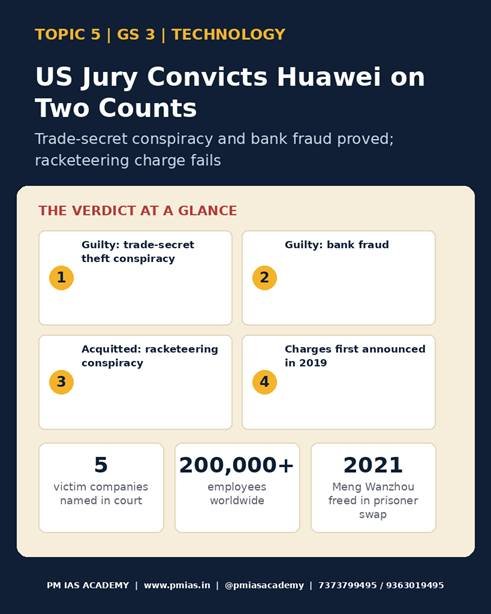
A US jury convicted Huawei Technologies on 24 November 2026 of conspiracy to steal trade secrets and bank fraud, while acquitting the Chinese company of the most serious charge it faced, a criminal racketeering conspiracy to steal intellectual property from American companies.
The verdict followed a lengthy trial in New York in which prosecutors argued that Huawei repeatedly stole technological secrets from competitors and partners, and it coincided with a summit meeting between the US, Chinese and Russian presidents in Shenzhen.
Background: The Seven-Year Prosecution
The United States announced criminal charges against Huawei in early 2019 and later expanded them, accusing the company of a long pattern of technology theft, sanctions violations involving Iran and North Korea, and false statements to US officials and banks.
Huawei has been barred from selling equipment to US carriers for years over security concerns and has been blacklisted by allies including Canada and Britain, yet it retains a robust global business in smartphones and telecom equipment and has expanded into chipmaking as artificial intelligence drives demand for processors.
The case originally also charged chief financial officer Meng Wanzhou, the founder’s daughter, who was arrested in Canada in 2018 and returned to China in 2021 in a prisoner swap that freed two Canadians, with the US dropping its case against her as part of the deal.
Key Dimensions
1. The conviction: The jury found Huawei guilty of conspiracy to steal trade secrets and of bank fraud, validating the prosecution’s core narrative that technology theft and financial deception were corporate practice rather than isolated misconduct.
2. The acquittal: Jurors cleared Huawei of the racketeering conspiracy charge, the gravest count, indicating the panel drew a line between proven discrete conspiracies and the government’s wider theory of a decades-long criminal enterprise.
3. The evidence cited: Prosecutors pointed to episodes including internet routers sold with a competitor’s copied source code, a Huawei worker photographing circuits inside a rival’s device at a Chicago trade show, and a robotic arm removed from a competitor’s lab for measurement.
4. The victim list: Court records named Cisco Systems, Motorola Solutions, T-Mobile, Quintel USA and Fujitsu among the victim companies, situating the case in the mainstream of the global telecom equipment industry.
5. The defence case: Huawei’s lawyers argued that investigators stitched isolated wrongdoing by a few of the company’s more than 200,000 employees into a false conspiracy narrative, noting it paid billions in licensing fees, 75 per cent of which went to US firms, and recalled routers when copying was discovered two decades ago.
6. Sanctions dimension: The indictment also covered business in countries under US sanctions, including Iran and North Korea, and alleged false statements to government officials and banks, which is where the bank-fraud count anchored.
7. Prosecutorial framing: The prosecutor told the jury the tone was set at the top by leaders who lied to Congress and banks and tried to interfere with the investigation, a framing the jury partly accepted through the conspiracy verdict.
8. Corporate trajectory: Despite blacklisting, Huawei has become an important Chinese alternative to US chip suppliers as AI demand surges, so the verdict lands on a company that is strategically more important to Beijing than when charged.
9. Diplomatic timing: The trial’s conclusion overlapped with a summit of the US, Chinese and Russian leaders in Shenzhen, China’s technology hub, embedding a courtroom outcome inside summit-level geopolitics.
10. China’s response: Chinese officials have long described the prosecution as economic bullying and the misuse of national security as a pretext to suppress Chinese companies, a position the conviction will reinforce rather than resolve.
11. Sentencing uncertainty: What the verdict means for Huawei’s global operations remains unclear: the company is already excluded from US carriers and several allied markets, so incremental commercial damage may be limited while symbolic damage is large.
12. Precedent value: The case shows the US using ordinary criminal law, trade-secret and bank-fraud statutes, against a foreign technology champion, a template with implications for other jurisdictions and companies.
Significance
1. Technology decoupling: The verdict strengthens the legal architecture of US-China tech separation, affecting supply chains for telecom gear and semiconductors that Indian operators and policymakers must navigate.
2. 5G and India: India has kept Huawei out of its 5G build-out; the conviction will be cited in future debates over vendor diversification and trusted-supplier regimes.
3. Rule-of-law signalling: For US partners, the mixed verdict, conviction on some counts, acquittal on the gravest, demonstrates jury independence in a politically charged case.
4. IPR governance: The case is a live example for answers on trade-secret protection, TRIPS-plus enforcement and the criminalisation of intellectual-property disputes.
Challenges
1. Enforcement asymmetry: Criminal convictions of corporations rarely produce transformative penalties; fines can be absorbed while the strategic contest continues.
2. Retaliation risk: Beijing may respond through its own regulatory or legal instruments against US firms in China, adding friction for companies operating across both markets.
3. Narrative contest: The acquittal on racketeering gives Huawei and Beijing a usable talking point that the gravest charge failed, complicating US messaging.
4. Third-country squeeze: Countries that still buy Huawei equipment face renewed pressure to choose suppliers on geopolitical rather than commercial grounds, narrowing their policy space.
Way Forward
1. Watch the remedy phase: The sentencing and any operational restrictions that follow will matter more than the verdict itself; analysts and policymakers should track what is actually imposed.
2. Strengthen India’s own base: India should press on with domestic telecom and semiconductor capability so that supplier geopolitics constrains its choices less over time.
3. Multilateral IP norms: Use WIPO and trade forums to push clearer rules on trade-secret theft by state-backed champions, so enforcement is not left to one jurisdiction’s courts.
4. Calibrated vendor policy: Keep vendor decisions on security criteria publicly reasoned and evidence-based, so India’s choices are defensible as policy rather than alignment.
Prelims Value Addition
- Charges against Huawei were announced in early 2019; the 2026 verdict convicted it of trade-secret conspiracy and bank fraud but acquitted it of racketeering conspiracy.
- Named victims include Cisco, Motorola Solutions, T-Mobile, Quintel USA and Fujitsu; Huawei employs more than 200,000 people.
- Meng Wanzhou, Huawei’s CFO, was arrested in Canada in 2018 and returned to China in 2021 in a prisoner swap; US charges against her were dropped.
- Huawei is barred from US carrier networks and blacklisted by Canada and Britain; it has expanded into chipmaking as AI demand grows.
Mains Value Addition
- GS 3: ‘The criminal prosecution of technology companies has become an instrument of great-power competition.’ Discuss with reference to the US case against Huawei.
- GS 3/2: What does the Huawei verdict imply for India’s telecom security policy and its pursuit of semiconductor self-reliance?
Topic 6: No Defence Data Breach, Says Government; Security Establishments Told to Audit Messaging Groups
Subject: Internal Security and Cyber Security
Paper: GS Paper 3: internal security; cyber security; role of media and social networking sites in internal security challenges
UPSC Relevance: The episode is a textbook GS 3 case study of social-engineering threats to the armed forces: hostile intelligence operatives exploiting commercial messaging platforms, countered through advisories, audits and indigenous secure alternatives rather than a single technical fix.
Why in News
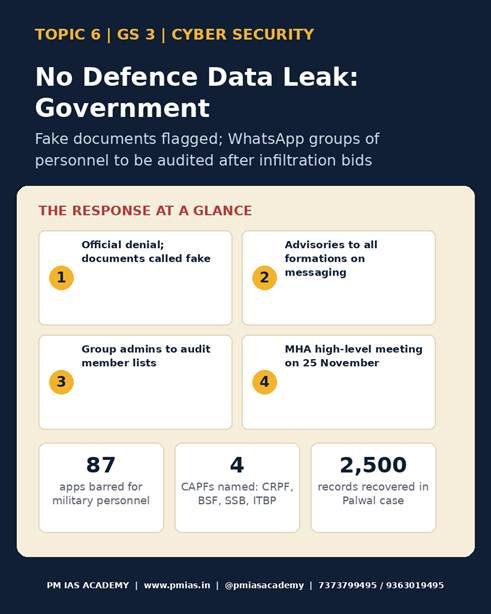
A senior Defence Ministry official said on 24 November 2026 that there had been no leak of sensitive information pertaining to the Defence Forces, describing documents circulating on social media as fake and intended to create confusion, even as security establishments reiterated advisories against sharing sensitive data on messaging applications.
A high-level meeting has been convened at the Ministry of Home Affairs on 25 November to discuss data breaches and cyber safety, amid reports that Pakistan-based intelligence operatives infiltrated unofficial WhatsApp groups used by Indian defence, paramilitary and civil defence personnel.
Background: Social Engineering Against the Uniformed Services
Intelligence operatives have historically targeted military communities through deception, from honey traps to fake job offers; the migration of informal coordination to commercial messaging apps has moved this contest onto platforms the services do not control.
An advisory issued last week to defence and security establishments, including the Central Armed Police Forces, flagged attempts by Pakistan-based operatives to gain unauthorised access to WhatsApp groups using spoofed or compromised mobile numbers, then operate as ‘silent members’ monitoring conversations.
The armed forces maintain an indigenous messaging application for secure communication, and the Ministry of Defence recently directed military personnel to refrain from using 87 mobile applications over data-security concerns, a list-based hygiene measure comparable to app bans in other strategic sectors.
Key Dimensions
1. The official denial: The Defence Ministry’s categorical statement that no data leak occurred, and that circulating documents are fabrications designed to create chaos, is itself a standard information-operation counter: deny the breach, discredit the artefact, reassure the force.
2. The infiltration method: Operatives allegedly entered unofficial WhatsApp groups through spoofed or compromised numbers and stayed on as silent members, a low-cost, low-noise collection technique that exploits the gap between official systems and informal group chats.
3. The advisory regime: The advisory covers formations across the CRPF, BSF, SSB and ITBP among others, directing group administrators to audit membership lists and remove unknown or unverified members, a governance fix rather than a technology fix.
4. The indigenous alternative: Officials reiterated that the Defence Forces have an indigenous messaging application for secure communication and that sensitive information must never move through unofficial platforms, underlining a policy of sovereign tooling for sovereign secrets.
5. The MHA meeting: The 25 November high-level meeting at the Home Ministry on data breaches and cyber safety signals that the issue is being treated as a cross-ministry internal-security matter rather than a service-specific problem.
6. The 87-app directive: The recent MoD advisory against 87 mobile applications reflects a risk model in which apps themselves are collection vectors, through permissions, metadata and third-party SDKs, not merely channels.
7. The dark web incident: Delhi Police detained a 14-year-old from Palwal, Haryana, over alleged attempts to sell Agniveer-related data on the dark web, with records of around 2,500 individuals purportedly sourced from an MHA test portal recovered for verification, showing the threat spans espionage and ordinary cybercrime.
8. Insider and error risk: Most leaks in such ecosystems come from human error, forwarding, screenshots, reused passwords, rather than sophisticated intrusion, which is why advisories stress behaviour over firewalls.
9. Verification burden: Separating genuine breaches from planted fakes requires forensic authentication of leaked documents, and premature official confirmation or denial both carry costs.
10. Platform dependence: The episode exposes the structural problem that critical communities coordinate on foreign-owned platforms whose encryption and metadata practices the state cannot audit end to end.
11. Awareness campaigns: Security personnel have been asked to run cyber-awareness campaigns, acknowledging that the sustainable counter to social engineering is a trained user base, not only blocked apps.
12. Civil defence angle: The inclusion of civil defence personnel in the reporting widens the perimeter: support echelons with weaker security culture can become the soft entry point into harder targets.
Significance
1. Force protection: Personnel data, locations, unit movements, family details, is operationally sensitive even when not classified, so hygiene failures translate into real vulnerability.
2. Policy coherence: The combination of advisories, app restrictions, indigenous tooling and ministerial attention shows a maturing, layered response to platform-borne espionage.
3. Exam relevance: The item integrates cyber security, internal security and the information-warfare dimension of statecraft, and names concrete institutions and measures candidates can cite.
4. Private-sector lesson: The same social-engineering pattern targets corporate and civil services, so the countermeasures generalise across the exam’s internal-security syllabus.
Challenges
1. Shadow communications: Informal groups persist because they are convenient; banning them without providing equally usable secure alternatives drives usage underground rather than eliminating it.
2. Attribution difficulty: Spoofed numbers and proxy operators make it hard to attribute infiltration conclusively, limiting diplomatic or legal escalation options.
3. Scale of the perimeter: Millions of uniformed and retired personnel and their families form an attack surface no advisory can fully cover.
4. False-leak fatigue: Repeated circulation of fabricated leaks can desensitise the public and the force, or conversely trigger overreaction, both of which serve the adversary.
Way Forward
1. Adopt secure-by-default tooling: Make the indigenous secure messaging platform the path of least resistance for official coordination, with usability investment so personnel prefer it over commercial apps.
2. Institutionalise group audits: Convert the one-time membership audit directive into a recurring compliance check with named administrators accountable for each official or semi-official group.
3. Test-portal hygiene: Audit government test and staging portals, the apparent source of the Agniveer dataset, for exposure, since ancillary systems often leak more than hardened core systems.
4. Continuous education: Embed cyber hygiene in basic training curricula across forces and CAPFs, refreshed against current lures, so behaviour change outlasts any single advisory.
Prelims Value Addition
- The advisory covers CAPFs including CRPF, BSF, SSB and ITBP; operatives allegedly joined groups as ‘silent members’ using spoofed or compromised numbers.
- The MoD has barred military personnel from 87 mobile applications over data-security concerns; the forces operate an indigenous secure messaging application.
- A 14-year-old was detained in Palwal for allegedly selling Agniveer-related data on the dark web; about 2,500 records from an MHA test portal were recovered for verification.
- The government states no defence data breach occurred and circulating documents are fake; an MHA high-level meeting on data breaches and cyber safety was set for 25 November.
Mains Value Addition
- GS 3: ‘The smartphone is now the most contested piece of military equipment in peacetime.’ Discuss with reference to social-engineering threats against Indian security personnel.
- GS 3: Evaluate India’s layered response to platform-borne espionage, advisories, application restrictions and indigenous secure tools, and identify its residual gaps.
Topic 7: Supreme Court Collegium Proposes Chief Justice Transfers Across Three High Courts
Subject: Polity – Judiciary and Appointments to Constitutional Courts
Paper: GS Paper 2: structure, organisation and functioning of the judiciary; appointment to various constitutional posts; separation of powers
UPSC Relevance: The resolutions are a live illustration of the Collegium system in motion: how High Court Chief Justices are proposed, the role of the Memorandum of Procedure, and the recurring tension between judicial primacy, executive clearance and State-level administrative continuity.
Why in News
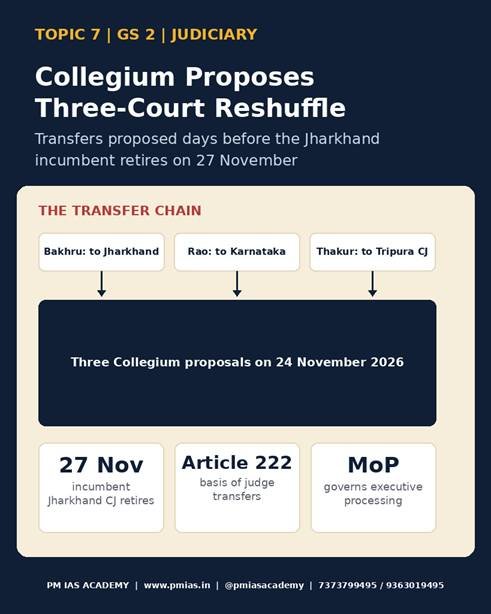
The Supreme Court Collegium headed by Chief Justice of India Surya Kant on 24 November 2026 proposed the transfer of Karnataka High Court Chief Justice Vibhu Bakhru to head the Jharkhand High Court, barely three days before the incumbent Jharkhand Chief Justice M.S. Sonak superannuates on 27 November.
In companion resolutions the same day, the Collegium recommended Tripura High Court Chief Justice M.S. Ramachandra Rao for transfer as Chief Justice of the Karnataka High Court, and Himachal Pradesh High Court judge Justice Vivek Singh Thakur as the next Chief Justice of the Tripura High Court.
Background: The Collegium and the Memorandum of Procedure
Appointments and transfers of High Court judges are made by the President under Articles 217 and 222, on recommendations generated by the Collegium, the CJI and the senior-most Supreme Court judges, and processed by the Union government under the Memorandum of Procedure.
The Collegium system emerged from the Second and Third Judges cases and survived the striking down of the NJAC in 2015; its workings, including the practice of transferring Chief Justices across High Courts, remain a standing GS 2 topic on judicial accountability and independence.
The immediate backdrop was a letter from Jharkhand Chief Minister Hemant Soren to the CJI expressing concern that no successor had been decided for Justice Sonak, and objecting to any extended interim arrangement at the head of the State’s High Court.
Key Dimensions
1. The principal transfer: Justice Vibhu Bakhru, Chief Justice of the Karnataka High Court, is proposed to take over as Chief Justice of the Jharkhand High Court upon the incumbent’s retirement, with the Union government now to clear the resolution and notify the appointment by 27 November.
2. The chain reaction: The proposal triggers a cascade: Justice M.S. Ramachandra Rao moves from the Tripura High Court to Karnataka in Justice Bakhru’s place, and Justice Vivek Singh Thakur of the Himachal Pradesh High Court is recommended to head Tripura, showing how one vacancy reshuffles three courts.
3. The Chief Minister’s intervention: Hemant Soren’s letter argued that a successor should ideally be recommended in advance and cleared as per the Memorandum of Procedure, and that frequent transitions with extended interim arrangements disrupt administrative continuity and institutional planning.
4. The timing problem: That the recommendation came three days before the retirement illustrates a chronic feature of the system: vacancies are known months ahead, yet decisions frequently arrive at the edge, forcing acting arrangements or rushed clearances.
5. Transfer policy rationale: Moving Chief Justices across High Courts is defended as insulating them from local pulls and promoting a national judicial outlook, a convention with constitutional sanction in Article 222 and judicial endorsement in the Judges cases.
6. The consent question: A judge’s consent is not legally required for transfer, but the practice has historically attracted criticism when perceived as punitive; routine elevation-track transfers like these are the system’s normal mode.
7. Executive role: The Union government’s clearance is a real step: it can seek reconsideration, and if the Collegium reiterates, it must appoint, a choreography designed in the NJAC judgment and codified in the MoP.
8. Acting Chief Justices: Where notifications lag, the senior-most judge acts as Chief Justice; the Jharkhand episode shows executive-judiciary coordination determining whether a court gets a regular head on day one.
9. Small High Courts: That Tripura figures in the chain highlights the staffing model of the newest High Courts, which draw Chief Justices from larger courts and serve as proving grounds in the transfer matrix.
10. Transparency arc: Collegium resolutions are now published with reasoning, a reform won through sustained criticism of opacity, so today’s proposals are examinable public documents rather than rumours.
11. State-judiciary relations: A Chief Minister writing to the CJI about succession planning, and the Collegium moving within days, shows informal federal dialogue shaping judicial administration without formal veto.
12. Pipeline management: With judicial vacancies persistently high, each delayed succession compounds arrears; timely Chief Justice appointments matter because they anchor the High Court’s own appointment recommendations.
Significance
1. Institutional literacy: The episode lets candidates describe the appointment process with current names, dates and constitutional provisions, exactly the applied knowledge GS 2 rewards.
2. Continuity stakes: A High Court without a regular Chief Justice slows case management, appointments and administration, so succession timing is an access-to-justice issue, not a ceremonial one.
3. Federal dimension: The Chief Minister’s letter and the rapid response show cooperative negotiation between State governments and the judiciary within constitutional bounds.
4. Reform context: The resolutions feed the continuing debate on the MoP’s finalisation and the balance of primacy between the judiciary and the executive.
Challenges
1. Last-minute culture: Deciding days before retirement risks acting arrangements and erodes the planning that the Memorandum of Procedure was meant to institutionalise.
2. Vacancy accumulation: Transfers do not add judges; High Courts continue to run below sanctioned strength while the Collegium and government negotiate lists.
3. Perception management: Even routine transfers attract speculation about motives in the absence of published criteria for who moves where and why.
4. Executive delay: The clearance stage has historically been a bottleneck, with governments sitting on names, a friction this episode compresses into three days.
Way Forward
1. Advance succession calendar: Publish and follow a rolling twelve-month vacancy and retirement calendar so Chief Justice successions are proposed months ahead, not days.
2. Time-bound clearances: Fix outer time limits in the MoP for government processing of Collegium recommendations, with deemed steps on lapse, to remove the clearance bottleneck.
3. Reasoned transfer norms: State the general criteria guiding Chief Justice transfers, seniority, court size, diversity, so routine moves are legible as policy rather than intrigue.
4. Strengthen State consultation: Formalise the channel through which State governments flag succession concerns, converting ad hoc letters into structured early input without diluting judicial primacy.
Prelims Value Addition
- The Collegium for High Court appointments comprises the CJI and the two senior-most Supreme Court judges; transfers rest on Article 222, appointments on Article 217.
- Justice Vibhu Bakhru is proposed as Jharkhand HC Chief Justice; Justice M.S. Sonak superannuates on 27 November; the government must notify by then.
- Justice M.S. Ramachandra Rao moves from Tripura HC to Karnataka HC; Justice Vivek Singh Thakur is recommended as Tripura HC Chief Justice.
- The NJAC was struck down in 2015 (Fourth Judges case); the Memorandum of Procedure governs the executive’s processing of Collegium recommendations.
Mains Value Addition
- GS 2: ‘Timely succession at the head of a High Court is an administrative necessity, not a courtesy.’ Discuss in the context of the recent Collegium resolutions on Chief Justice transfers.
- GS 2: Examine how the Collegium system and the Memorandum of Procedure distribute power over judicial appointments, and evaluate proposals to make the process more time-bound.
Topic 8: India-Bangladesh Institutions Under Strain as Hasina Announces Return Plan
Subject: International Relations – India-Bangladesh Relations
Paper: GS Paper 2: India and its neighbourhood; bilateral, regional and global groupings; effect of policies of other countries on India’s interests
UPSC Relevance: The announced return of Bangladesh’s ousted Prime Minister from exile in India is, at its core, a stress test of the institutional machinery that governs the relationship: the 2013 extradition treaty and the note-verbale channel it spawned, the in-absentia International Crimes Tribunal verdict that file must now accommodate, and the Petrapole-Benapole integrated check post and border-management architecture that any physical return would engage.
Why in News
Sources in the Awami League say Sheikh Hasina, in exile in India since 5 August 2024, wants to return to Dhaka on 16 December, the day Bangladesh marks Victory Day, and has asked the Bangladesh government to send a Biman Bangladesh aircraft to Delhi for the journey, while a four-member party team has visited Petrapole in West Bengal to assess the Benapole-Petrapole land crossing as a fallback entry route.
Dhaka has responded institutionally: Information Adviser Zahed ur Rahman says the matter is for discussion between the two governments, not with Ms. Hasina, and patrolling along the border has been intensified on the Bangladesh side.
Background: The Treaty, the Tribunal and the Border
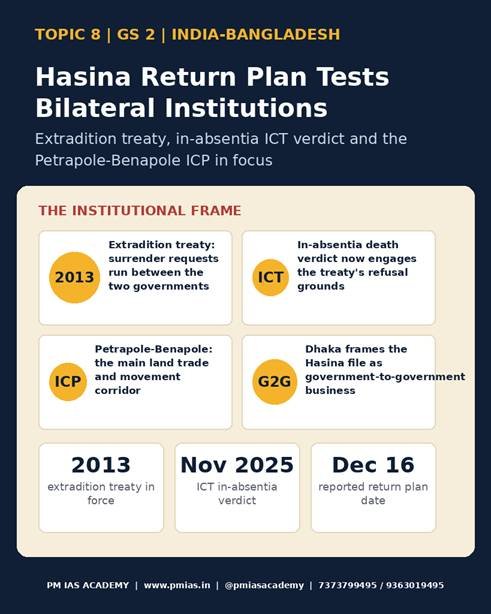
India and Bangladesh signed an extradition treaty in 2013, amended in 2016 to simplify the process, under which either State may request the surrender of convicted or accused persons; Dhaka formally invoked it in December 2024 through a note verbale seeking Ms. Hasina’s return, a request New Delhi acknowledged without committing to a course of action.
The International Crimes Tribunal, a domestic tribunal descended from the 1970s war-crimes framework, sentenced Ms. Hasina to death in absentia in November 2025 for crimes against humanity arising from the 2024 uprising; she has rejected the verdict, and its in-absentia character is central to how extradition law treats it.
Bangladesh is now governed under Prime Minister Tarique Rahman, with the Awami League banned since May 2025; Petrapole-Benapole, the busiest land crossing on the 4,096-km boundary, operates as an integrated check post managed through BSF and Border Guard Bangladesh protocols.
Key Dimensions
1. The extradition treaty: The treaty requires requests through the diplomatic channel (Article 10), and after the 2016 amendment an arrest warrant from a competent court suffices to set the process in motion. But surrender is not automatic: Article 6 permits refusal for offences of a political character, while expressly excluding serious violent crimes such as murder from that category, and Article 8 bars extradition where the accusation has not been made in good faith in the interests of justice, so the final decision rests with the requested State.
2. The note-verbale track: Dhaka’s December 2024 note verbale made extradition a standing diplomatic file; every development since, including the return plan, now lands on an open institutional channel rather than creating one.
3. The ICT in-absentia verdict: The November 2025 verdict was delivered in absentia, and the treaty sets no automatic-surrender rule for convicted persons. Its offence test (Article 2) turns on conduct punishable by at least one year’s imprisonment in both States, and its Article 8 threshold for convicted persons is written in terms of imprisonment or detention of four months or more; the text does not expressly state how a capital sentence maps onto these provisions. Legal commentary in The Hindu and the Indian Express notes that the requested State retains discretion to weigh fair-trial and due-process concerns, so the verdict converts a political question into a pending legal file without dictating its outcome.
4. Government-to-government framing: By insisting the return is a matter between Dhaka and Delhi, the Bangladesh government is deliberately routing the episode through State institutions, denying the banned Awami League a direct negotiating role.
5. Petrapole-Benapole ICP: An integrated check post built for trade and legitimate passenger movement is not designed for a politically charged entry of this kind; any use of the land route would test ICP operating procedures, crowd management and the joint protocols of the two border forces.
6. Border management machinery: Intensified patrolling on the Bangladesh side requires matching vigilance from the BSF: uncontrolled crossings, crowd surges or infiltration under political cover are precisely the contingencies the bilateral border architecture exists to prevent.
7. India’s exposure: India hosts Ms. Hasina and therefore carries custodial, legal and diplomatic risk: any forced return attempt, violence at the border, or breakdown in Dhaka-Delhi communication would land on India’s doorstep, literally at Petrapole.
8. The aircraft request: Asking Dhaka for a Biman aircraft converts a unilateral announcement into a demand on a State institution, the national carrier, and thereby forces the government to answer yes or no on the record.
9. Symbolism of the date: 16 December, Victory Day, binds the attempt to the 1971 narrative central to the Awami League’s identity, raising the domestic-political stakes for the incumbent government.
10. Indian establishment view: A highly placed source told The Hindu there is considerable concern in India about Bangladesh’s deteriorating law and order, and recalled that Prime Minister Tarique Rahman was invited twice and that India did its best to engage him, framing the estrangement as a missed opportunity.
11. Domestic politics in both States: The plan energises the Awami League’s remaining organisation while giving the incumbent government a unifying adversary, and in India it touches West Bengal’s politics given the shared border and cultural ties.
12. Uncertainty of execution: Every element, the aircraft, the route, the date, remains declaratory until Dhaka responds, so the episode is best analysed as coercive signalling with multiple possible resolutions.
Significance
1. Treaty-law salience: The episode places the rarely exercised 2013 extradition treaty, its request procedure, refusal grounds and State discretion, at the centre of the relationship, making treaty mechanics examinable current affairs.
2. Institutional stress test: It simultaneously engages the extradition file, a domestic war-crimes tribunal’s international reach, an integrated check post and two border forces, a full-spectrum test of bilateral machinery.
3. Neighbourhood-first test: India must protect a guest, manage a neighbour and safeguard a border at once; its handling will be read across the region as a statement about its commitments and leverage.
4. Security stakes: Any instability spillover affects India’s longest international border, its northeastern connectivity and its Bay of Bengal posture.
Challenges
1. No clean options: Facilitating the return angers Dhaka’s government; blocking it betrays a long-standing guest and her party; each course imposes diplomatic cost.
2. Legal ambiguity: The in-absentia sentence and the party ban create a contested legal field in which any Indian action can be portrayed as interference.
3. Violence risk: A contested return could trigger clashes involving party cadres, security forces or crowds at the border, with escalation potential.
4. Narrative warfare: Competing accounts of the uprising and the verdict are already in play, and the return saga will amplify them across both countries’ media.
Way Forward
1. Keep the channel central: India should insist that modalities of any return be settled government-to-government, as Dhaka itself has framed it, avoiding unilateral steps by either the Awami League or agencies.
2. Use the treaty’s own procedures: Responses to extradition requests should move through the treaty’s request-and-decision machinery, with refusal grounds assessed on legal merit, insulating the decision from pressure in either country.
3. Border contingency planning: Quiet BSF-BGB coordination, flag meetings and rehearsed ICP protocols can prevent a symbolic event from becoming a stampede, clash or infiltration opportunity.
4. Steady engagement: Continue engaging the elected leadership in Dhaka on the full bilateral agenda, trade, water, connectivity, so the Hasina question does not monopolise the relationship.
Prelims Value Addition
- Sheikh Hasina has been in India since 5 August 2024; the Awami League was banned in May 2025; the International Crimes Tribunal sentenced her to death in absentia in November 2025.
- India and Bangladesh signed an extradition treaty in 2013; Dhaka invoked it in a December 2024 note verbale seeking her return.
- The announced return date is 16 December, Bangladesh’s Victory Day; a Biman aircraft has been requested and the Petrapole-Benapole crossing assessed as an alternative.
- Petrapole-Benapole is the busiest land crossing on the 4,096-km India-Bangladesh border and operates as an integrated check post; the BSF and Border Guard Bangladesh manage the boundary.
Mains Value Addition
- GS 2: ‘The Hasina return plan is less a political event than a test of bilateral institutions.’ Examine with reference to the 2013 extradition treaty, the International Crimes Tribunal verdict and border management.
- GS 2: Examine how India should balance its commitments to political exiles with the imperative of a stable relationship with the incumbent government in Dhaka.
Quick Bits: Revise for Prelims
International
- The Court of Arbitration for Sport restored Senegal as Africa Cup of Nations champion, overturning an earlier ruling that had handed the trophy to Morocco more than ten months after the final.
Polity and governance
- The Supreme Court is slated to hear on 25 November the bail pleas of Sharjeel Imam and Umar Khalid in the UAPA case linked to the alleged larger conspiracy behind the February 2020 northeast Delhi riots.
- The Supreme Court Collegium proposed transfers of Chief Justices across the Jharkhand, Karnataka and Tripura High Courts in resolutions dated 24 November.
Environment and economy
- The CAQM told the Supreme Court that two-wheelers account for 65.2 per cent of Delhi-NCR’s vehicle population and four-wheeler light motor vehicles another 28.9 per cent.
- The Delhi Electric Vehicle Policy 2026, effective 1 July, mandates electric-only new registrations for L5 three-wheelers from January 2027 and two-wheelers from April 2028.
Security and technology
- A US jury convicted Huawei of conspiracy to steal trade secrets and bank fraud while acquitting it of racketeering conspiracy.
- The US CIA and the Office of the Director of National Intelligence discovered a cybersecurity breach exposing some unclassified information, the New York Times reported.
- The Ministry of Defence has asked military personnel to avoid 87 mobile applications over data-security concerns; the forces run an indigenous secure messaging platform.
Practice MCQs
Q1. With reference to the CAQM status report to the Supreme Court, consider the following: 1. About 25.44 lakh end-of-life vehicles are active across Delhi, Haryana, Uttar Pradesh and Rajasthan. 2. More than half of these vehicles were scrapped between January and October 2026. 3. Delhi holds nearly 89 per cent of the EV charging points among the four States. Which is/are correct?
(a) 1 and 2 only
(b) 1 and 3 only
(c) 2 and 3 only
(d) 1, 2 and 3
Answer: (b). Only a little over 7 per cent were scrapped or moved out; statements 1 and 3 match the report.
Q2. India’s statement at the UN Security Council briefing invoked which historical event to underline the unequal costs of conflict?
(a) The Partition of 1947
(b) The Bengal famine of 1943
(c) The 1971 refugee crisis
(d) The Bhopal disaster of 1984
Answer: (b). India recalled the 1943 Bengal famine, which killed over three million people, as a warning against wartime disruption of food supplies.
Q3. In the Cauvery (Kattalai)-South Vellar-Vaigai-Gundar Link litigation, Karnataka has sought: 1. A restraint on Tamil Nadu’s Phase-I, II and III works. 2. A direction that the Union government not process Tamil Nadu’s in-principle approval request. 3. Demolition of completed Phase-I works. Select the correct answer:
(a) 1 and 2 only
(b) 2 and 3 only
(c) 1 and 3 only
(d) 1, 2 and 3
Answer: (d). All three reliefs appear in Karnataka’s application, filed in its original suit under Article 131.
Q4. With reference to the Special Intensive Revision in West Bengal, consider the following: 1. About 91 lakh names were removed from the State’s electoral rolls. 2. Birth registration is governed by the Registration of Births and Deaths Act, 1969. 3. Electoral-roll status is a statutory precondition for issuing a birth certificate. Which is/are correct?
(a) 1 and 2 only
(b) 2 and 3 only
(c) 1 only
(d) 1, 2 and 3
Answer: (a). Statement 3 is wrong: birth registration is an independent statutory obligation and does not depend on electoral status.
Q5. The US jury in the Huawei case:
(a) Convicted the company of racketeering conspiracy
(b) Acquitted the company of all charges
(c) Convicted it of trade-secret conspiracy and bank fraud, acquitting it of racketeering
(d) Convicted it of sanctions violations only
Answer: (c). The mixed verdict found conspiracy to steal trade secrets and bank fraud proved, but not the racketeering conspiracy.
Q6. Under the Collegium resolutions of 24 November 2026, the proposed Chief Justice of the Jharkhand High Court is:
(a) Justice M.S. Sonak
(b) Justice Vibhu Bakhru
(c) Justice M.S. Ramachandra Rao
(d) Justice Vivek Singh Thakur
Answer: (b). Karnataka High Court Chief Justice Vibhu Bakhru is proposed for transfer to Jharkhand; the others figure elsewhere in the chain.
Mains Practice Set
Q1. India’s invocation of the Bengal famine at the UN Security Council recasts food security as a peace-and-security concern. Examine the strengths and limits of this diplomatic strategy. (250 words)
Q2. The CVG Link litigation shows that surplus waters, not allocated shares, now drive inter-State river conflicts. Discuss with suggestions for a basin-level surplus water protocol. (250 words)
Q3. The denial of a birth certificate to an infant after an SIR deletion reveals the risks of letting electoral adjudication spill into civil registration. Suggest institutional firewalls. (250 words)
