
Today’s snapshot
1. NIPU-2026: Six New Brownfield Urea Plants of 12.7 LMT Each Announced (GS 3)
2. MoSPI Releases Sub-Committee Report on Regional Accounts for the 2022-23 Series (GS 3)
3. IASST Develops Bivalent Antivenom for Northeast India’s Pit Vipers (GS 3)
4. 16th Finance Commission RLB Grants: First Regional Workshop on Implementation in Goa (GS 2)
5. Cabinet Approves India-Singapore MoU on Aviation MRO Skills and Industry Development (GS 2 & 3)
6. BHASHINI and SAMAVESH MoU: Multilingual Access to Social Justice Schemes (GS 2 & 3)
7. Exercise Suryakiran XX: India-Nepal Joint Military Exercise 2026 (GS 2)
8. Udyam Registration Crosses 10 Crore: India’s MSME Formalisation Milestone (GS 3)
Topic 1: NIPU-2026: Six New Brownfield Urea Plants of 12.7 LMT Each Announced
Subject: Indian Economy – Fertiliser Sector, Industrial Policy and Food Security
Paper: GS Paper 3: Indian economy and issues relating to planning, mobilisation of resources, growth, development and employment; fertiliser subsidy and food security; public and private sector roles
UPSC Relevance: Urea sits at the junction of farm economics, industrial policy, energy intensity and the fertiliser subsidy bill, and NIPU-2026 is the largest single capacity announcement since the revival of sick units under NIP-2012, a recurring GS 3 theme.
Why in News
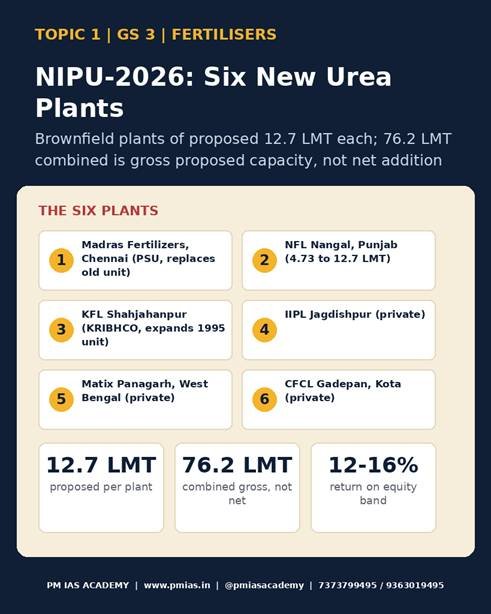
The Ministry of Chemicals and Fertilizers, in a PIB release dated 25 November 2026, set out the New Investment Policy for Urea (NIPU-2026), under which six new brownfield urea plants, each with a proposed annual installed production capacity of 12.7 lakh metric tonnes (LMT), are to be established. Six times 12.7 is a combined 76.2 LMT of proposed installed capacity, a derived figure. That is not net additional national capacity: Chennai replaces an existing unit and Nangal raises an existing 4.73 LMT unit to 12.7, so the net gain is lower.
The six plants are Madras Fertilizers Limited, Chennai (a PSU unit replacing a more than 60-year-old plant), NFL Nangal in Punjab (raising capacity from 4.73 to 12.7 LMT), KFL Shahjahanpur (KRIBHCO’s unit), and three private-sector units, IIPL Jagdishpur, Matix Panagarh in West Bengal and CFCL Gadepan in Kota.
The estimated investment is about Rs 54,000 crore at roughly Rs 9,000 crore per plant, with the policy offering a return on equity band of 12 to 16 per cent and a forex-variation mitigation that converts into support after four years, as per the release.
Background: From NIP-2012 to NIPU-2026
The New Investment Policy of 2012, notified on 2 January 2013, revived investment in domestic urea capacity and led to the commissioning of new units and the revival of closed public-sector plants such as Ramagundam, Gorakhpur, Sindri, Barauni and Talcher through joint ventures.
India’s urea demand is around 400 LMT a year; domestic production was 314.07 LMT in 2023-24 and 293.30 LMT in 2025-26, with reassessed available capacity (RAC) of 269.42 LMTPA for 2026-27, so imports bridge a persistent gap, making indigenous capacity a strategic and forex issue.
Urea pricing is administered: the MRP is statutorily controlled while producers are compensated through subsidy, so capacity policy, energy efficiency and import parity together determine the fertiliser subsidy bill, one of the largest subsidy heads of the Union budget.
Key Dimensions
1. Six plants, one design size: All six units are of 12.7 LMT, a standardised large-train size that captures economies of scale in modern gas-based ammonia-urea technology, and the mix, three public or cooperative and three private, keeps the investment base diversified.
2. Brownfield logic: The plants come up at existing sites such as Nangal, Shahjahanpur, Jagdishpur, Panagarh, Gadepan and Chennai, using established feedstock links, land and logistics, which shortens gestation compared with greenfield locations.
3. Energy efficiency: The release notes the Nangal unit’s design energy consumption of 6.498 Gcal per MT against an industry average of about 5.95 and a notified norm of 5; candidates should note that energy norms drive subsidy cost per tonne, since natural gas is the dominant input.
4. Investment and returns: At about Rs 9,000 crore a plant, the programme implies near Rs 54,000 crore of fresh investment; the 12 to 16 per cent return-on-equity band is the administered-price system’s way of guaranteeing investors a fair return while protecting farmers from market pricing.
5. Import substitution: With demand near 400 LMT and domestic output around 293 to 314 LMT in recent years, the proposed 76.2 LMT of installed capacity, gross rather than net, could substantially compress the import gap and the exposure to volatile global urea and gas prices if commissioned and run at rated capacity; candidates should keep the net gain lower than the headline arithmetic suggests.
6. PSU renewal: The MFL Chennai unit replaces a plant over 60 years old, showing how the policy doubles as public-sector modernisation rather than only capacity addition.
7. Forex mitigation: The policy’s mechanism that converts foreign-exchange variation into support after four years addresses the rupee-risk that historically deterred investment in gas-linked capacity.
8. Regional spread: The units span Tamil Nadu, Punjab, Uttar Pradesh, West Bengal and Rajasthan, distributing production closer to the major consuming belts and easing the freight load of moving urea from ports and a few producing clusters.
9. Subsidy arithmetic: More domestic capacity at efficient energy norms reduces the import-parity payouts embedded in subsidy; exam answers should connect capacity policy to the fertiliser subsidy trajectory rather than treating them as separate topics.
10. Exam lens: Hold the frame: NIPU-2026, six brownfield plants each of proposed 12.7 LMT installed capacity, gross combined 76.2 LMT (derived, not stated), about Rs 54,000 crore investment, RoE band 12 to 16 per cent, NIP-2012 notified 2 January 2013 as the predecessor policy.
Significance
1. Food security: Domestic urea capacity underwrites the assured availability that Indian cereal production depends on, reducing vulnerability to global supply shocks.
2. Fiscal significance: Fertiliser subsidy is among the Union’s largest subsidy commitments; efficient domestic capacity is the structural lever on its size.
3. Industrial policy: The policy shows administered-sector investment design: guaranteed return bands, energy norms and forex mitigation substituting for market signals.
4. Exam hook: The item links agriculture inputs, energy intensity, subsidy economics and PSU modernisation, and demands exact figures: six plants, 12.7 LMT proposed capacity each, about Rs 54,000 crore.
Challenges
1. Gas feedstock dependence: Gas-based urea ties cost to domestic gas allocation and imported LNG prices, so capacity alone does not insulate the subsidy bill from energy markets.
2. Timely commissioning: Brownfield expansions still face environment clearances, equipment lead times and gas connectivity, and the capacity translates into import savings only on commissioning.
3. Demand-side reform untouched: Capacity policy does not address imbalanced nitrogen use; without soil-health-driven balanced fertilisation, more urea can deepen the nutrient imbalance Neem Coating and Soil Health Cards were meant to check.
4. Administered-price distortions: Statutorily low MRP keeps urea far cheaper than phosphatic and potassic fertilisers, encouraging overuse; NIPU-2026 leaves that pricing structure in place.
Way Forward
1. Sequence commissioning: Track each plant’s milestones publicly, from financial closure to gas connectivity and trial production, so the 76.2 LMT of gross proposed capacity becomes a schedule, not a headline.
2. Tighten energy norms: Keep the notified Gcal per MT norms under periodic revision downward, since each efficiency gain directly lowers subsidy per tonne.
3. Pair capacity with nutrient balance: Use Soil Health Card data and neem-coated urea logistics to push balanced NPK use as new nitrogen capacity comes online.
4. Review the RoE band after four years: The policy’s own forex-conversion milestone is a natural review point for the return framework, protecting both investors and the exchequer.
Prelims Value Addition
- NIPU-2026: six new brownfield urea plants of proposed 12.7 LMT installed capacity each (76.2 LMT combined gross, derived; net addition lower because Chennai replaces an old unit and Nangal expands from 4.73 LMT), announced in the Ministry of Chemicals and Fertilizers release of 25 November 2026.
- The six units: MFL Chennai (replacing a 60-plus-year-old PSU unit), NFL Nangal (4.73 to 12.7 LMT), KFL Shahjahanpur (KRIBHCO), IIPL Jagdishpur, Matix Panagarh (West Bengal), CFCL Gadepan (Kota).
- Investment about Rs 54,000 crore (about Rs 9,000 crore per plant); return-on-equity band 12 to 16 per cent; forex mitigation converts after four years.
- Urea arithmetic: demand about 400 LMT; production 314.07 LMT (2023-24) and 293.30 LMT (2025-26); RAC 269.42 LMTPA for 2026-27; Nangal design energy 6.498 Gcal/MT versus industry 5.95 and norm 5; NIP-2012 notified on 2 January 2013.
Mains Value Addition
- GS 3: ‘Self-sufficiency in urea is as much a fiscal question as an agricultural one.’ Discuss in the light of NIPU-2026, with reference to capacity, energy efficiency and the fertiliser subsidy.
- GS 3: Examine the design of investment policy for administered-price sectors, using the return-on-equity band and energy norms of the new urea investment policy as illustrations.
Topic 2: MoSPI Releases Sub-Committee Report on Regional Accounts for the 2022-23 Series
Subject: Indian Economy – National Accounts, Statistics and Federal Data
Paper: GS Paper 3: Indian economy, national income accounting and data for development; GS Paper 2: federalism and institutional mechanisms for intergovernmental data systems
UPSC Relevance: The base-year revision to 2022-23 will re-benchmark GDP, and the Sub-Committee’s report decides how state and district output will be measured under it, which shapes everything from Finance Commission devolution debates to district-level planning.
Why in News
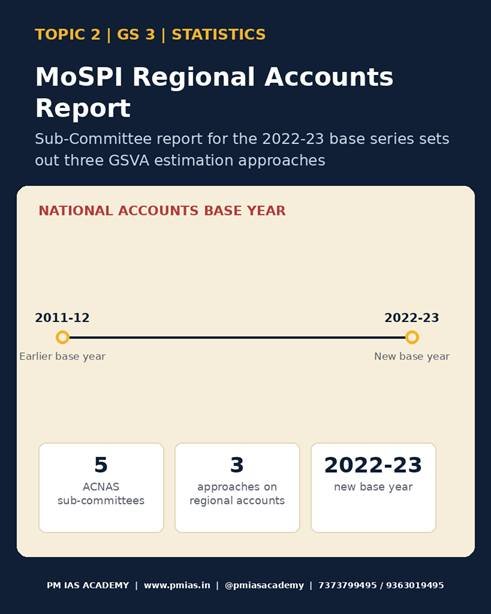
The Ministry of Statistics and Programme Implementation has undertaken revision of the base year of National Accounts Statistics from 2011-12 to 2022-23, and on 25 November 2026 released the report of the Sub-Committee on Regional Accounts for the 2022-23 series, as per the PIB release (PRID 2341138).
The Advisory Committee on National Accounts Statistics (ACNAS), under the chairmanship of Prof. B. N. Goldar, had decided FY 2022-23 as the new base year, and five Sub-Committees were constituted under ACNAS: on new data sources, rates and ratios; methodological improvements; constant price estimates; regional accounts; and the SNA 2025 update.
The Sub-Committee on Regional Accounts, chaired by Prof. Ravindra H. Dholakia, retired professor of IIM Ahmedabad, reviewed concepts, definitions, classifications, data sources and estimation methodologies for compiling State Domestic Product (SDP) and District Domestic Product (DDP).
Background: Base Years and Regional Accounts
A base-year revision updates the prices and the structural weights with which national income is measured, so that indices of real output reflect the current structure of the economy rather than that of a decade earlier; the shift from 2011-12 to 2022-23 follows the standard decadal-plus cycle.
State Domestic Product and District Domestic Product are the regional layers of national accounts: GSDP by state feeds fiscal federalism debates, per-capita comparisons and Finance Commission formulas, while DDP is the emerging layer for district-level planning and aspirational-district monitoring.
The System of National Accounts is the global standard India implements; the 2025 update of the SNA is among the subjects a dedicated ACNAS Sub-Committee is examining for adoption in the revised series.
Key Dimensions
1. All three approaches: The report presents recommendations for improving State Domestic Product methodology under all three approaches, production, income and expenditure, plus the methodology for District Domestic Product, giving the regional accounts a unified treatment.
2. From allocation to direct estimation: The major methodological improvements include a shift from allocation-based methods to direct estimation for some sectors and sub-sectors, which reduces the practice of distributing national estimates to states by fixed keys.
3. Fewer fixed ratios and proxies: The report recommends reducing reliance on fixed ratios and proxies, a long-standing criticism of GSDP estimates where national relationships were applied to states regardless of local structure.
4. State-wise information: Improved use of state-wise information on economic activity and greater methodological consistency across states are named improvements, addressing comparability, the property that lets one state’s GSDP be honestly compared with another’s.
5. Consultative process: The deliberations involved experts from academia, the Reserve Bank of India, central ministries and departments, State and UT Directorates of Economics and Statistics, NITI Aayog and NSO officers, an intergovernmental process befitting a federal data system.
6. Guidelines already public: Uniform Guidelines for compilation of Gross State Value Added under the production approach, and the DDP guidelines, were uploaded on MoSPI’s website on 18 September 2026 and 3 June 2026 respectively after stakeholder suggestions; draft GSVA expenditure-approach guidelines were posted on 9 October 2026 for comments by 28 October 2026, with final guidelines to follow.
7. Reference document role: The report is expected to serve as an important reference for State and UT Directorates of Economics and Statistics in strengthening their systems for compiling state and district estimates under the 2022-23 series.
8. Report availability: The report is published on MoSPI’s website (Report Sub-Committee on Regional Accounts PDF), making the methodology public and citable, a transparency point candidates should note.
9. DDP significance: District Domestic Product methodology is the newest layer: credible DDP enables outcome-based monitoring of district programmes and sharper targeting, though data sparsity at district level makes it methodologically hardest.
10. Exam lens: Carry the structure: base year 2011-12 to 2022-23, ACNAS chaired by B. N. Goldar, five sub-committees, regional accounts chaired by Ravindra H. Dholakia, three estimation approaches, guideline dates.
Significance
1. Federal data quality: Devolution formulas, per-capita rankings and special-category debates all consume GSDP; better regional accounts make every one of those downstream uses more defensible.
2. District planning: A workable DDP methodology equips the aspirational districts programme and state planning with outcome data below the state level.
3. Statistical credibility: After years of methodological controversy around GDP series, publishing sub-committee reports and guidelines for comment strengthens the system’s transparency.
4. Exam hook: The item links base-year revision, national accounts methods, federal institutions and evidence-based policy, a clean GS 3 statistics question.
Challenges
1. State capacity gaps: Direct estimation demands more and better state-level data collection; Directorates of Economics and Statistics vary widely in staffing and survey capability.
2. District data sparsity: DDP estimation is data-hungry; without regular district-level surveys, estimates risk remaining extrapolations with new labels.
3. Consistency versus local reality: Uniform guidelines improve comparability but can flatten genuine structural differences between state economies, a trade-off the methodology must manage.
4. Political sensitivity: GSDP figures feed competitive federalism narratives; methodological changes can shift state rankings, inviting pressure on statistical autonomy.
Way Forward
1. Fund state statistical systems: Tie the 2022-23 rollout to capacity support for State and UT Directorates of Economics and Statistics so direct estimation has real data behind it.
2. Publish the series with back-series: When the new base goes live, release consistent back-series so long-run comparisons remain possible without break-in-series distortions.
3. Institutionalise comment windows: Keep the draft-guidelines-plus-comments practice as a standing feature of statistical methodology changes, as done for the GSVA and DDP guidelines.
4. Sequence DDP carefully: Roll out district estimates first for data-rich districts with published quality grades, expanding as collection systems mature.
Prelims Value Addition
- Base year revision: National Accounts Statistics from 2011-12 to 2022-23; ACNAS chaired by Prof. B. N. Goldar decided FY 2022-23 as the new base.
- Five ACNAS Sub-Committees: new data sources, rates and ratios; methodological improvements; constant price estimates; regional accounts; SNA 2025 update.
- Sub-Committee on Regional Accounts: chaired by Prof. Ravindra H. Dholakia (retd., IIM Ahmedabad); covers SDP and DDP under production, income and expenditure approaches; report released 25 November 2026 (PRID 2341138).
- Method shifts: allocation-based to direct estimation for some sectors; fewer fixed ratios and proxies; better state-wise information; cross-state consistency; GSVA production-approach guidelines uploaded 18 September 2026, DDP guidelines 3 June 2026, draft GSVA expenditure guidelines 9 October 2026 (comments by 28 October 2026).
Mains Value Addition
- GS 3: ‘The quality of fiscal federalism rests on the quality of regional accounts.’ Discuss with reference to the base-year revision to 2022-23 and the Sub-Committee on Regional Accounts.
- GS 3: Examine the methodological challenges of estimating District Domestic Product in India and the significance of direct estimation over allocation-based methods.
Topic 3: IASST Develops Bivalent Antivenom for Northeast India’s Pit Vipers
Subject: Science and Technology – Biotechnology, Health and Regional Science Institutions
Paper: GS Paper 3: science and technology, developments and their applications in everyday life; GS Paper 2: health, regional development of the Northeast
UPSC Relevance: Snakebite is a neglected public-health burden in India, and region-specific antivenom for the Northeast’s pit vipers addresses a real gap in a country whose standard antivenom was designed around the big four species, a clean GS 3 science application.
Why in News
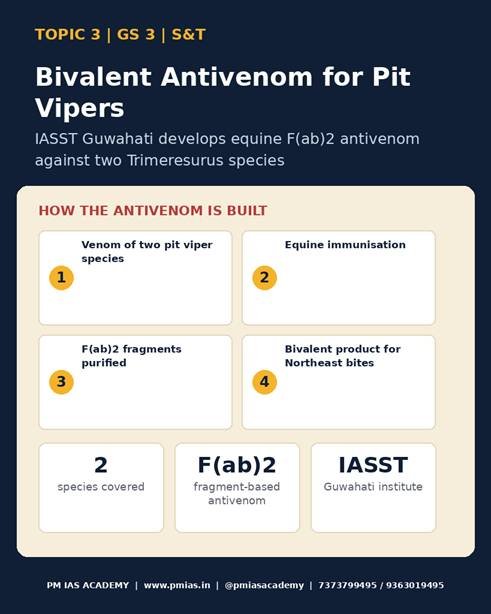
The Institute of Advanced Study in Science and Technology (IASST), Guwahati, an autonomous institute of the Department of Science and Technology, has developed a bivalent equine F(ab)2 antivenom effective against two pit vipers of the Northeast, Trimeresurus popeiorum (Pope’s pit viper) and Trimeresurus erythrurus (red-tailed pit viper), as per the PIB release of 25 November 2026 (PRID 2341204).
The work is associated with Prof. Ashis K. Mukherjee of IASST and has been published in the International Journal of Biological Macromolecules (DOI 10.1016/j.ijbiomac.2026.154578), giving the development a peer-reviewed anchor.
The standard polyvalent antivenom used across India is raised against the big four snakes, the spectacled cobra, common krait, Russell’s viper and saw-scaled viper, and does not reliably neutralise the venoms of many regionally important species such as Northeast pit vipers.
Background: Snakebite and Antivenom in India
India records the world’s largest snakebite burden, with tens of thousands of deaths and far more cases of permanent disability annually, concentrated among rural agricultural workers; the WHO lists snakebite envenoming as a neglected tropical disease.
Antivenom is produced by immunising horses with venom and purifying the antibodies; F(ab)2 fragments are the therapeutically active antibody portions, retained after removing the Fc portion that drives many adverse reactions, so F(ab)2 antivenoms are generally better tolerated than whole-IgG products.
Venom composition varies by species and geography, so a polyvalent product matched to one region’s snakes can fail against another’s; this geographic venom variation is the scientific case for region-specific antivenoms like the IASST bivalent one.
Key Dimensions
1. Bivalent design: The antivenom is bivalent, raised to cover the two Trimeresurus species named in the study, a targeted product rather than a broad polyvalent, reflecting the actual species responsible for pit viper bites in the Northeast.
2. Equine F(ab)2 platform: The product uses the standard horse-immunisation platform with F(ab)2 purification, the established manufacturing route for Indian antivenoms, which matters for scalability through existing producers.
3. Regional gap addressed: The Northeast’s snake fauna differs sharply from the mainland pattern around which the national polyvalent antivenom was standardised; the IASST work is a direct response to that mismatch.
4. Peer-reviewed evidence: Publication in the International Journal of Biological Macromolecules places the claim in the refereed literature; exam answers should treat efficacy as demonstrated at the study’s level of evidence, not as a deployed clinical product yet.
5. Institutional significance: IASST Guwahati is a DST autonomous institute in the Northeast; the work shows regional science institutions solving regional problems, a decentralisation-of-science point worth making in answers.
6. Preclinical to clinic distance: Between a characterised antivenom and bedside availability lie clinical trials, manufacturing scale-up and regulatory approval by the Central Drugs Standard Control Organisation; candidates must state this pipeline honestly.
7. Snakebite as development issue: Victims are disproportionately poor farmers and plantation workers; treatment cost, distance to care and reliance on traditional healers compound the biomedical gap, so antivenom availability is also an equity question.
8. National policy context: India has moved toward a national action plan on snakebite, and region-specific products fit its prevention-and-treatment architecture; candidates may link the development to that policy direction as background.
9. Exam lens: Hold the specifics: IASST Guwahati (DST), bivalent equine F(ab)2 antivenom, Trimeresurus popeiorum and Trimeresurus erythrurus, Prof. Ashis K. Mukherjee, big-four limitation of standard antivenom, WHO neglected tropical disease status.
10. Exam lens on naming: Remember the pairing: Trimeresurus popeiorum and Trimeresurus erythrurus are the two pit viper species, and ‘bivalent’ means the product targets exactly two venoms, unlike the polyvalent antivenom that covers the big four.
Significance
1. Public health: Effective regional antivenom can cut deaths and amputations in a high-burden region where the standard product underperforms.
2. Science for the Northeast: The development is a marker of the Northeast’s own research capacity being applied to its own health burdens.
3. One Health resonance: Snakebite sits at the human-animal-environment interface, and region-specific antivenom fits the One Health framing increasingly used in policy.
4. Exam hook: The item connects biotechnology platforms, neglected tropical disease policy, regional development and health equity in one compact story.
Challenges
1. Clinical validation: Preclinical neutralisation must be followed by human safety and efficacy trials before the antivenom can enter clinical use, a multi-year pathway with real attrition risk.
2. Manufacturing economics: Bivalent region-specific products have smaller markets than national polyvalents, which can deter commercial producers without public support.
3. Distribution and cold chain: Even approved antivenoms fail where supply, cold chain and trained administration are absent in remote districts.
4. Species coverage: Two Trimeresurus species are only part of the Northeast’s venomous fauna; a full regional panel would need coverage of further species.
Way Forward
1. Fund the clinical pathway: Support the antivenom through GLP toxicology and phased clinical trials with public funding, since the market alone will underserve a poor, regional patient base.
2. Map the region’s snakebite epidemiology: Pair the product with hospital- and community-level bite data so manufacturing volumes and distribution match real incidence.
3. Strengthen peripheral care: Train and equip primary health centres in high-burden districts to administer antivenom safely, since early treatment determines outcomes.
4. Extend the platform: Use the same bivalent approach to build coverage for other medically important Northeast species in a staged regional antivenom programme.
Prelims Value Addition
- IASST Guwahati (autonomous institute, Department of Science and Technology) developed a bivalent equine F(ab)2 antivenom against Trimeresurus popeiorum (Pope’s pit viper) and Trimeresurus erythrurus (red-tailed pit viper); PIB release 25 November 2026 (PRID 2341204).
- Associated scientist: Prof. Ashis K. Mukherjee; published in the International Journal of Biological Macromolecules (DOI 10.1016/j.ijbiomac.2026.154578).
- Standard Indian antivenom is polyvalent against the big four: spectacled cobra, common krait, Russell’s viper, saw-scaled viper; WHO lists snakebite envenoming as a neglected tropical disease.
- F(ab)2 antivenoms retain the active antibody fragment while removing the Fc portion, generally reducing adverse reactions versus whole-IgG products.
Mains Value Addition
- GS 3: ‘Geographic variation in venom demands geography-specific antivenom.’ Discuss the scientific and policy case for region-specific antivenoms in India, with reference to the IASST bivalent antivenom.
- GS 2/3: Snakebite is called a disease of poverty. Examine the biomedical, delivery and equity challenges in India’s snakebite response, and the role of regional research institutions in closing them.
Topic 4: 16th Finance Commission RLB Grants: First Regional Workshop on Implementation in Goa
Subject: Indian Polity – Fiscal Federalism, Finance Commission and Panchayati Raj
Paper: GS Paper 2: constitutional bodies, devolution of powers and finances to local levels, federal structure; GS Paper 3: public finance, mobilisation of resources
UPSC Relevance: The Sixteenth Finance Commission’s Rs 4,35,236 crore rural local body grants for 2026-27 to 2030-31 are the fiscal spine of panchayat governance for this half-decade, and the regional workshops are how recommendations turn into compliant state action, a core GS 2 theme.
Why in News
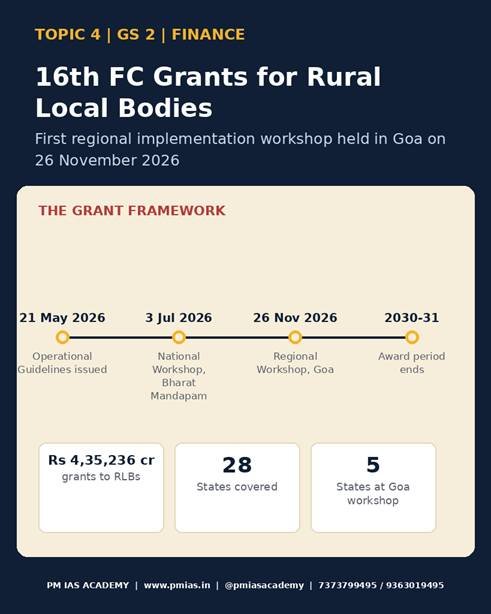
The Ministry of Panchayati Raj organised the first Regional Workshop on implementation of the Sixteenth Finance Commission recommendations for Rural Local Body grants in Goa on 26 November 2026, with senior officers from Goa, Gujarat, Madhya Pradesh, Maharashtra and Rajasthan, as per the PIB release (PRID 2341296).
The Sixteenth Finance Commission has recommended grants of Rs 4,35,236 crore to Panchayati Raj Institutions and Rural Local Bodies across all 28 States for the award period 2026-27 to 2030-31, and the Department of Expenditure, Ministry of Finance, issued the Operational Guidelines for implementation on 21 May 2026.
The Commission also recommended that the Ministry of Panchayati Raj extend guidance and handholding support to States and organise Regional Workshops to familiarise them with the recommendations; the Goa workshop is the first in that series.
Background: Finance Commissions and Local Bodies
The Finance Commission is a constitutional body under Article 280, constituted every five years to recommend the distribution of tax revenues between the Union and the States and the principles governing grants-in-aid; the Sixteenth Finance Commission’s award period runs 2026-27 to 2030-31.
The 73rd Constitutional Amendment inserted Part IX and the Eleventh Schedule for Panchayats, and Article 243-I requires State Finance Commissions; since the Tenth Finance Commission, central Finance Commissions have also recommended grants specifically for local bodies, a flow that has grown into one of the largest predictable revenue sources for panchayats.
Article 243G empowers state legislatures to devolve functions to panchayats, so the effectiveness of RLB grants depends on the function-funds-functionaries alignment, the classic 3F test applied to panchayat finances.
Key Dimensions
1. The quantum: Rs 4,35,236 crore over five years across 28 states is the headline: an unconditional-plus-conditional architecture governed by Operational Guidelines, replacing the award of the Fifteenth Finance Commission for the 2021-26 period.
2. Operational Guidelines: The Department of Expenditure’s guidelines of 21 May 2026 are the rulebook: they set the conditions, accounting and certification requirements that convert the recommendation into actual releases to states and onward to panchayats.
3. Workshop mechanism: The Goa workshop, first in a series, builds a shared understanding of the recommendations, the guidelines and compliance conditions among Western Region states, moving from policy direction to delivery practice.
4. National-to-regional cascade: The regional workshops build on the National Workshop of State Panchayati Raj Ministers held on 3 July 2026 at Bharat Mandapam, New Delhi; the design is policy direction at the national level, operational translation at the regional level.
5. Own Source Revenue focus: The workshop also deliberates on augmentation of panchayats’ Own Sources of Revenue, reflecting the ministry’s stated emphasis on fiscal self-reliance of panchayats alongside central grants.
6. Handholding as recommendation: Unusually, the Commission itself recommended that MoPR handhold states and run such workshops, an institutional learning from earlier award periods where guidelines were misread or releases delayed.
7. Timeliness as the test: The workshop’s stated aim is that grants reach panchayats on time and translate into visible improvements in rural lives; candidates should note that delay and diversion, not allocation, have been the weak links in local-body finance.
8. Fiscal federalism significance: RLB grants are the third tier’s main central channel; their size and conditionality shape what panchayats can actually do for drinking water, sanitation, roads and waste management, core GS 2 ground.
9. Exam lens: Carry the chain: Article 280 Commission, XVI FC award 2026-27 to 2030-31, Rs 4,35,236 crore to RLBs in 28 states, Operational Guidelines 21 May 2026 by the Department of Expenditure, first regional workshop Goa 26 November 2026 for the Western Region.
Significance
1. Third-tier fiscal strength: Predictable untied-and-tied grants are the closest panchayats come to a revenue entitlement, making implementation quality a direct determinant of rural service delivery.
2. Cooperative federalism practice: The workshop series is a working example of the Union coaching states on a shared fiscal framework rather than merely notifying it.
3. Accountability hook: Published guidelines and workshop-driven compliance create an audit trail that examiners can connect to citizen-centric administration questions.
4. Exam hook: The item fuses constitutional bodies, the 73rd Amendment, public finance and implementation machinery, and rewards exact figures and dates.
Challenges
1. Compliance capacity: Smaller states and panchayats often lack the accounting and certification capacity that conditional grants demand, delaying releases.
2. OSR weakness: Panchayat own revenues remain thin in most states; without property tax and fee reforms, dependence on grants persists regardless of workshop intentions.
3. State-level bottlenecks: Grants pass through state budgets, where delays in transfer to panchayats, sometimes beyond mandated timelines, have been a recurring CAG observation.
4. Function-funds mismatch: Where states have not devolved functions and functionaries, even timely grants underperform, the standing 3F critique.
Way Forward
1. Publish state-wise release calendars: A public schedule of instalment conditions and expected release dates would let panchayats and citizens track timeliness directly.
2. Invest in panchayat accounting: Scale digital accounting and trained staff so compliance conditions are met without consultants or delay.
3. Push OSR reform with models: Disseminate working models of panchayat property tax and user charges from better-performing states through the same workshop channel.
4. Report outcomes, not only releases: Pair financial releases with visible-output reporting, water supply, sanitation assets, roads, so the grant debate shifts from crores to services.
Prelims Value Addition
- XVI Finance Commission award period 2026-27 to 2030-31; RLB/PRI grants recommended: Rs 4,35,236 crore across all 28 states; Operational Guidelines issued by the Department of Expenditure on 21 May 2026.
- First Regional Workshop on implementation held in Goa on 26 November 2026; participating Western Region states: Goa, Gujarat, Madhya Pradesh, Maharashtra, Rajasthan; led by MoPR Joint Secretary Mukta Shekhar.
- The Commission recommended MoPR handholding and regional workshops; the series builds on the National Workshop of State Panchayati Raj Ministers, 3 July 2026, Bharat Mandapam.
- Constitutional anchors: Article 280 (Finance Commission), Article 243G (panchayat functions), Article 243-I (State Finance Commissions), 73rd Amendment and Eleventh Schedule.
Mains Value Addition
- GS 2: ‘The weakness of Indian local finance lies in implementation, not allocation.’ Discuss with reference to the Sixteenth Finance Commission’s rural local body grants and their Operational Guidelines.
- GS 2: Examine the role of Finance Commission grants in strengthening the third tier, and evaluate the workshop-and-handholding approach to implementing the Sixteenth Finance Commission’s recommendations.
Topic 5: Cabinet Approves India-Singapore MoU on Aviation MRO Skills and Industry Development
Subject: International Relations and Economy – Aviation, Skilling and Industrial Cooperation
Paper: GS Paper 2: India and its neighbourhood and partners, bilateral agreements; GS Paper 3: Indian economy, infrastructure, aviation sector, skill development
UPSC Relevance: India’s airlines are adding aircraft faster than domestic maintenance capacity, so MRO work, and the foreign exchange and downtime it carries, flows abroad; the Singapore MoU targets exactly that leakage through skilling and facility development, a GS 3 economy item with a GS 2 bilateral frame.
Why in News
The Union Cabinet, chaired by the Prime Minister, on 25 November 2026 approved the signing of a Memorandum of Understanding between the Government of India and the Republic of Singapore on Cooperation in Skills and Industry Development within the Aviation Maintenance, Repair and Overhaul (MRO) sector, as per the PIB release (PRID 2341444).
Union Civil Aviation Minister Ram Mohan Naidu framed the objective as positioning India as the regional aviation workshop, wanting every aircraft component, landing gear, radomes, engines, cockpit displays, seats, wings and the smallest parts, repaired in India.
The Minister noted that Singapore has a well-established aviation MRO ecosystem while India is among the world’s fastest-growing aviation markets, and that India’s expanding fleet, geographic position and ease-of-doing-business efforts offer significant MRO opportunities.
Background: India’s MRO Gap
MRO is the maintenance, repair and overhaul work that keeps aircraft airworthy, from routine checks to engine overhauls; for a fleet the size Indian carriers have ordered, MRO is a large, recurring, high-skill service market.
Indian airlines have historically sent heavy maintenance abroad, to Singapore, the Gulf and Europe, paying in foreign exchange and losing aircraft to long ferry-and-service downtime; building domestic MRO has been a stated aviation policy goal for years, with steps such as tax and royalty rationalisation at MRO sites.
Singapore is a global MRO hub anchored by its aerospace industry cluster, so the partnership pairs the region’s deepest MRO capability with its fastest-growing aviation market.
Key Dimensions
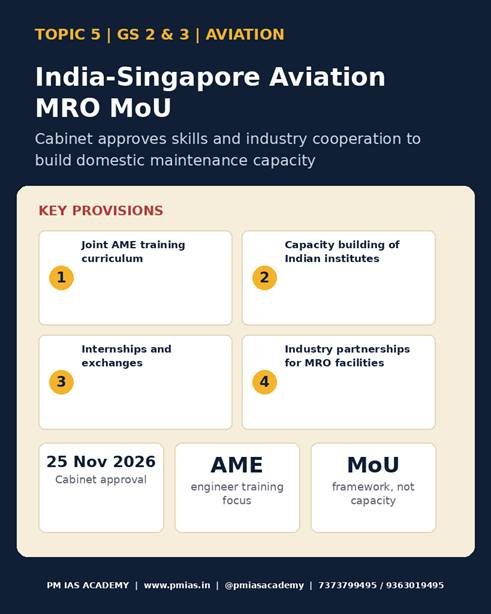
1. Skills first: The MoU’s centre of gravity is human capital: joint development of an industry-oriented curriculum for Aircraft Maintenance Engineer (AME) training, with Singaporean expertise and capacity building for Indian institutes to deliver it.
2. Industry exposure: Internship and exchange programmes with Singapore MRO entities give Indian students practical industry experience, closing the classroom-to-hangar gap that licensing-oriented training often leaves.
3. Facility development: The MoU facilitates partnerships between Indian and Singaporean industry stakeholders to support expansion of MRO facilities in India, linking skilling to actual domestic capacity.
4. Cost and downtime logic: The Minister’s case is operational: dependence on overseas maintenance raises costs and lengthens aircraft downtime for Indian airlines, so domestic capability is an airline-economics issue, not only an industrial-policy one.
5. Atmanirbhar framing: The government presents the MoU as aligned with Atmanirbhar Bharat; candidates should note the structure, capability import followed by domestic capacity, is the standard template for such self-reliance partnerships.
6. Framework nature: The MoU is a framework for exchange of knowledge, expertise and best practices; exam answers must keep it in the cooperation-framework category, with outcomes dependent on follow-through by institutes and industry.
7. Regional hub ambition: Positioning India as the regional aviation workshop implies serving third-country fleets eventually, an export-of-services angle consistent with India’s services-trade strengths.
8. Aviation market context: India’s air traffic growth and large aircraft order books by its carriers are the demand base; without matching MRO supply, each new aircraft deepens maintenance dependence abroad.
9. Exam lens: Hold the specifics: Cabinet approval 25 November 2026, India-Singapore MRO skills and industry MoU, AME curriculum, internships and exchanges, industry partnerships, Minister Ram Mohan Naidu’s regional-workshop framing.
10. What ‘MRO’ covers: The Minister’s list, landing gear, radomes, engines, cockpit displays, seats, wings and the smallest parts, shows the ambition spans structures, engines and avionics, not just line maintenance.
11. Who an AME is: An Aircraft Maintenance Engineer is the licensed technician who inspects, repairs and certifies aircraft as airworthy; the MoU’s curriculum work targets this licensed workforce, whose supply limits how much MRO India can absorb.
12. Prelims trap: The document is an MoU approved by Cabinet for signing; do not describe it as a treaty, a trade agreement or an investment commitment, since the release names no investment figure.
Significance
1. Services trade: Domestic MRO converts an import of maintenance services into domestic value and, over time, a potential export, improving the services balance.
2. Employment quality: AME and MRO technician roles are high-skill, licensed technical jobs, the category India’s skilling push most needs to create.
3. Aviation economics: Shorter downtime and lower maintenance cost improve airline fleet economics in a price-sensitive market.
4. Exam hook: The item links bilateral cooperation, skilling, services trade and industrial policy in one signed document.
Challenges
1. Execution dependence: An MoU is intent, not capacity; curriculum adoption, institute accreditation and industry investment must actually follow.
2. Ecosystem depth: MRO competitiveness needs component supply chains, tooling and certification credibility, not only trained engineers.
3. Global competition: Established hubs in Singapore, the Gulf and Europe hold airline trust built over decades; Indian MRO must win work on quality and turnaround, not just cost.
4. Regulatory alignment: Maintenance certification must be recognised by foreign regulators and lessors for Indian MRO to serve leased and foreign-registered aircraft at scale.
Way Forward
1. Track MoU milestones: Publish the curriculum development, institute adoption and exchange-programme numbers annually so the framework’s conversion is visible.
2. Bundle skilling with facility policy: Align AME training output with the location of new MRO facilities so graduates and hangars arrive together.
3. Seek certification recognition: Work with foreign aviation regulators and lessors early so Indian MRO work is accepted across the leased fleet.
4. Extend beyond Singapore: Replicate the skilling framework with other aerospace partners while keeping standards unified.
Prelims Value Addition
- Cabinet approved the India-Singapore MoU on Cooperation in Skills and Industry Development within the Aviation MRO sector on 25 November 2026 (PRID 2341444).
- Key provisions: joint industry-oriented AME training curriculum; expertise sharing and capacity building of Indian institutes; internships and exchanges with Singapore MRO entities; facilitation of Indian-Singaporean industry partnerships to expand MRO facilities.
- Minister: Ram Mohan Naidu, Civil Aviation; stated objective: position India as the regional aviation workshop; Singapore is an established MRO hub, India among the fastest-growing aviation markets.
- Stated problem: overseas maintenance dependence raises costs and lengthens aircraft downtime for Indian airlines.
Mains Value Addition
- GS 3: ‘A large aviation market without domestic MRO capacity exports value with every aircraft it adds.’ Discuss with reference to the India-Singapore MRO MoU and India’s aviation maintenance ecosystem.
- GS 2/3: Examine the role of skills-first bilateral agreements in building domestic industrial capability, using the aviation MRO partnership as an illustration.
Topic 6: BHASHINI and SAMAVESH MoU: Multilingual Access to Social Justice Schemes
Subject: Polity and Governance – Digital Governance, Language Inclusion and Welfare Delivery
Paper: GS Paper 2: governance, e-governance, welfare schemes, transparency and accountability; GS Paper 3: science and technology, AI applications, Digital India
UPSC Relevance: A welfare platform is only as inclusive as its language; the BHASHINI-SAMAVESH integration brings AI translation and speech services to the Department of Social Justice and Empowerment’s unified gateway, a textbook GS 2 e-governance and inclusion item.
Why in News
The Digital India BHASHINI Division (DIBD), under the Digital India Corporation of the Ministry of Electronics and Information Technology, and the Department of Social Justice and Empowerment, Ministry of Social Justice and Empowerment, have exchanged an MoU to strengthen multilingual accessibility across the Department’s digital platforms and services, as per the PIB release of 26 November 2026 (PRID 2341811).
The MoU was exchanged in the presence of Union Minister Dr. Virendra Kumar, Minister of State B. L. Verma, Secretary Sudhansh Pant and BHASHINI CEO Amitabh Nag.
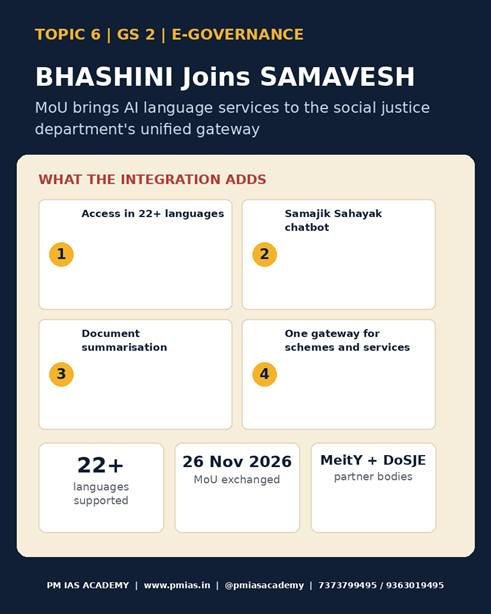
The collaboration integrates BHASHINI’s AI-powered language technology services with SAMAVESH, the Department’s unified digital gateway for schemes and services, supporting access to information and services in more than 22 languages, including document summarisation.
Background: BHASHINI and Digital Public Infrastructure
BHASHINI, the Bhasha Interface for India, is the national language-translation mission under Digital India, building AI-based translation, speech-to-text, text-to-speech and optical character recognition for Indian languages, aimed at the barrier that English-first digital services create for most citizens.
India’s digital public infrastructure approach, identity, payments, documents and now language, treats shared digital rails as the base on which department-specific services run; BHASHINI is the language layer of that stack.
SAMAVESH, the Single Access Mechanism for All Verticals of Empowerment and Social Harmony, is the Department of Social Justice and Empowerment’s unified gateway consolidating schemes, services and organisational portals that were previously scattered across multiple sites.
Key Dimensions
1. The integration: BHASHINI’s language services, translation, speech and related AI capabilities, will be embedded in SAMAVESH, so scheme information and services become available in more than 22 languages through one gateway.
2. Who benefits: The Department’s beneficiaries include Scheduled Castes, Other Backward Classes, senior citizens, persons with disabilities and other vulnerable groups, exactly the populations for whom language and literacy barriers most limit digital access.
3. AI-enabled assistance: The integration supports SAMAVESH’s assistance features, including Samajik Sahayak, a chatbot designed to provide information and assistance in more than 22 languages, moving help beyond static translated pages.
4. Document summarisation: The release names document summarisation among the technology-enabled services, which matters because scheme guidelines are long and formal; plain-language summaries in a citizen’s own language lower the comprehension barrier.
5. Consolidation logic: SAMAVESH’s design consolidates previously scattered portals into a single interface; multilingualism then multiplies the value of consolidation, since one translated gateway beats twenty untranslated ones.
6. Inclusion as governance principle: The MoU is an instance of designing inclusion into digital rails rather than retrofitting it; candidates can use it as the standard example when answering on inclusive e-governance.
7. Institutional pairing: The MoU pairs MeitY’s language-technology mission with a line ministry’s delivery platform, the cross-ministry integration pattern that digital public infrastructure depends on.
8. Exam lens: Carry the names and the chain: BHASHINI (DIBD under DIC, MeitY) plus SAMAVESH (Department of Social Justice and Empowerment), more than 22 languages, Samajik Sahayak chatbot, document summarisation, MoU exchanged 26 November 2026 in the presence of Dr. Virendra Kumar.
9. Technologies named: The release lists AI-powered translation, speech and other language services as the capabilities BHASHINI brings, so candidates should describe the integration as language technology, not merely a translation widget.
10. Institutional chain: Digital India BHASHINI Division sits under the Digital India Corporation, which sits under MeitY; the partner on the welfare side is the Department of Social Justice and Empowerment, so the MoU is an inter-ministerial arrangement.
11. Prelims trap: Keep the two platforms distinct: BHASHINI is the language service provider, SAMAVESH is the departmental gateway that consumes it; questions often swap the two.
Significance
1. Last-mile inclusion: Language-localised access directly raises the effective reach of welfare schemes among the groups they exist to serve.
2. DPI maturation: The MoU shows the language layer being adopted by a delivery ministry, evidence that the shared-infrastructure model is moving from pilots to departmental integration.
3. Governance model: The single-gateway-plus-chatbot pattern is reusable across departments, a template answers can cite for citizen-centric design.
4. Exam hook: The item connects e-governance, AI application, social justice administration and language policy in one verifiable development.
5. Reusability: Because the arrangement is an MoU between a language mission and a delivery department, other departments can adopt the same pattern without building language tools of their own.
Challenges
1. Translation quality: AI translation in low-resource languages can err; in welfare delivery, an error in eligibility or entitlement wording has real costs.
2. Digital divide: Language access helps only citizens who can reach the platform; connectivity, device and digital-literacy gaps persist among the same beneficiaries.
3. Sustained upkeep: Multilingual platforms need continuous updating as schemes change; a stale translated page misleads more than an absent one.
4. Awareness: Beneficiaries must know the gateway exists; without assisted-access channels like Common Service Centres, a multilingual portal can underperform.
Way Forward
1. Test with real beneficiaries: Run usability testing with SC, OBC, senior-citizen and disability-community users in their languages before scaling claims.
2. Pair with assisted access: Integrate SAMAVESH with Common Service Centres and district welfare offices so the digitally unreached are served through intermediaries.
3. Publish language coverage openly: List which services are live in which languages, so the more-than-22-languages claim is verifiable service by service.
4. Extend the pattern: Replicate the BHASHINI integration across other social-sector departments, treating this MoU as the template it is designed to be.
5. Measure outcomes: Report usage by language and by scheme after the integration goes live, so the more-than-22-languages access claim is tested against real beneficiary use.
Prelims Value Addition
- MoU exchanged 26 November 2026 between Digital India BHASHINI Division (under Digital India Corporation, MeitY) and the Department of Social Justice and Empowerment (PRID 2341811).
- SAMAVESH: Single Access Mechanism for All Verticals of Empowerment and Social Harmony, the Department’s unified gateway for schemes and services.
- Integration enables access in more than 22 languages; features include the Samajik Sahayak chatbot and document summarisation.
- Present at exchange: Union Minister Dr. Virendra Kumar, MoS B. L. Verma, Secretary Sudhansh Pant, BHASHINI CEO Amitabh Nag.
Mains Value Addition
- GS 2: ‘Language is the first user interface of welfare.’ Discuss in the light of the BHASHINI-SAMAVESH integration and the goals of inclusive e-governance.
- GS 2/3: Examine how India’s digital public infrastructure approach extends to language access, and evaluate its significance for the delivery of social justice schemes.
Topic 7: Exercise Suryakiran XX: India-Nepal Joint Military Exercise 2026
Subject: Defence and Security – Bilateral Military Cooperation
Paper: GS Paper 2: India and its neighbourhood, bilateral relations; GS Paper 3: security, defence preparedness, border management
UPSC Relevance: Suryakiran is the flagship annual army-to-army exercise of the India-Nepal relationship, the one bilateral where open borders, a Gorkha-soldier legacy and rotational battalion-level training make defence ties structural rather than episodic; edition XX is current-affairs staple for Prelims.
Why in News
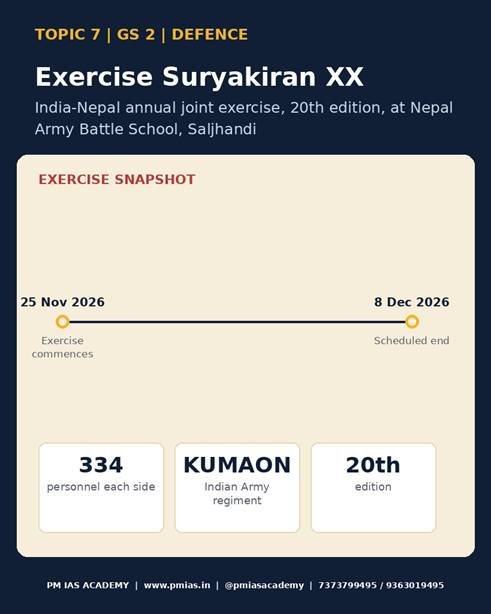
The 20th edition of Exercise Suryakiran, the annual joint military exercise between the Indian Army and the Nepali Army, commenced at the Nepal Army Battle School, Saljhandi, Nepal, and runs from 25 November to 8 December 2026, as per the PIB release (PRID 2341241).
Both sides have fielded 334 personnel each; the Indian contingent is represented by troops of the KUMAON Regiment, and the Nepali side by the Shri Jawla Dal Battalion.
The stated aim is to enhance interoperability, operational coordination and mutual understanding through joint training in counter-insurgency and counter-terrorism operations in challenging terrain; the scope covers joint tactical operations, heliborne operations, disaster response and medical training. The opening ceremony was graced by Major General Purna Bahadur Khatri, GOC Mid Western Division, Nepal Army.
Background: The India-Nepal Defence Relationship
India and Nepal share an open border under the 1950 Treaty of Peace and Friendship, and their armies are linked by the Gorkha regiments: Nepali citizens have served in the Indian Army’s Gorkha regiments for generations, a personnel bond no other bilateral relationship matches.
Both armies confer the honorary rank of General on each other’s Army Chief, a reciprocal tradition that signals the depth of the institutional relationship.
Exercise Suryakiran is held alternately in India and Nepal; as the release states, it is an annual bilateral exercise conducted alternately in India and Nepal.
India shares its land border with Nepal across five Indian states, which is why border management, open movement and security cooperation are tightly linked in the relationship.
Key Dimensions
1. Edition and scale: The XX edition runs 25 November to 8 December 2026 at Saljhandi in Nepal, with 334 personnel from each army, as the release states.
2. Participating units: The Indian side fields KUMAON Regiment troops, continuing the practice of rotating regiments through the exercise; the Nepali side fields the Shri Jawla Dal Battalion, a named unit with its own lineage.
3. Training focus: Counter-insurgency and counter-terrorism in challenging terrain, with joint tactical operations, heliborne operations, disaster response and medical training in scope, as the release lists.
4. Interoperability value: The stated aim is interoperability, operational coordination and mutual understanding; troops exchange operational experiences and best practices while refining tactics, techniques and procedures.
5. Diplomatic signalling: Holding the exercise on schedule each year, including editions in Nepal, is itself the message: the defence pillar of the relationship runs on routine, insulated from political weather in Kathmandu.
6. Regional context: Nepal’s engagement with multiple partners makes steady, substantive military cooperation with India strategically meaningful; exercises are among the few relationship instruments that compound value annually.
7. Prelims discipline: Fix the specifics: 20th edition, Nepal Army Battle School, Saljhandi, 25 November to 8 December 2026, 334 personnel each side, KUMAON Regiment and Shri Jawla Dal Battalion; edition numbers and venues are exactly what Prelims questions test.
8. Mains usage: Use Suryakiran as the standard illustration when answering on India’s neighbourhood defence diplomacy or on soft instruments of strategic partnership.
9. Opening ceremony and venue: The release records that the exercise commenced at the Nepal Army Battle School, Saljhandi, with Major General Purna Bahadur Khatri, GOC Mid Western Division, Nepal Army, gracing the opening ceremony; a battle school venue fits a training-centred exercise.
10. Scope in plain terms: Joint tactical operations test coordinated manoeuvre between units, heliborne operations rehearse movement and insertion by helicopter, disaster response trains for relief tasks, and medical training covers casualty care.
11. Exchange of practice: Troops from both armies exchange operational experiences and best practices while refining tactics, techniques and procedures, so the gain is shared learning rather than one-way instruction.
12. Reciprocal hosting: Because the exercise is annual and alternates between India and Nepal, each army hosts in turn; the release says it will foster mutual trust and camaraderie and reaffirm the shared commitment to regional peace, stability and security.
13. Prelims trap: Do not confuse Suryakiran with other bilateral army exercises named after partners; the Nepal exercise is Suryakiran, and the release gives the 20th edition, 334 personnel per side and KUMAON Regiment as the identifying facts.
Significance
1. Relationship ballast: Annual exercises keep the oldest institutional link between the two countries in working order regardless of political cycles.
2. HADR readiness: Disaster response and medical training are part of the exercise scope, with obvious value in a hazard-prone Himalayan region.
3. Peacekeeping synergy: The release says the exercise will foster mutual trust and camaraderie and reaffirm shared commitment to regional peace, stability and security.
4. Exam hook: Names, numbers and venue make this a direct Prelims item; the relationship context makes it a reliable Mains example.
Challenges
1. Political sensitivity: Bilateral defence cooperation can become a talking point in Nepal’s domestic politics, requiring quiet, professional conduct of engagements.
2. Asymmetric attention: Exercise outcomes get little public attention, so the relationship’s defence pillar is under-recognised even as it does steady work.
3. Modernisation gap: Keeping joint training current with evolving counter-terrorism practice requires regular updating of exercise content, not repetition.
4. Competing engagements: Nepal’s expanding exercise and training ties with other countries require India to keep its offerings substantive and dependable.
Way Forward
1. Keep the calendar sacred: Hold editions on schedule and alternate venues faithfully; reliability is the exercise’s strategic content.
2. Refresh training content: Keep adding current operational themes to the scope so the syllabus tracks real change.
3. Broaden the ladder: Complement battalion-level Suryakiran with staff-level and service-level engagements so cooperation deepens with rank.
4. Link to HADR planning: Convert exercise drills into standing bilateral disaster-response protocols usable on the day a Himalayan emergency strikes.
Prelims Value Addition
- Exercise Suryakiran XX: 25 November to 8 December 2026, Nepal Army Battle School, Saljhandi (PRID 2341241).
- 334 personnel from each side; Indian contingent from the KUMAON Regiment; Nepali contingent from the Shri Jawla Dal Battalion.
- Aim: interoperability through joint counter-insurgency and counter-terrorism training in challenging terrain; scope includes heliborne operations, disaster response and medical training.
- Suryakiran is an annual bilateral exercise held alternately in India and Nepal; XX is the 20th edition.
Mains Value Addition
- GS 2: ‘Defence exercises are the quiet infrastructure of India’s neighbourhood policy.’ Discuss with reference to Exercise Suryakiran and the India-Nepal relationship.
- GS 3: Examine the role of bilateral military exercises in building interoperability for counter-terrorism, disaster response and medical training among South Asian armies.
Topic 8: Udyam Registration Crosses 10 Crore: India’s MSME Formalisation Milestone
Subject: Economy – MSME Sector, Formalisation and Digital Governance
Paper: GS Paper 3: Indian economy, MSMEs, employment, inclusive growth, e-governance in economic administration
UPSC Relevance: Ten crore registrations across the Udyam Registration Portal and the Udyam Assist Platform is the largest snapshot of India’s small-business formalisation drive; the registration-system history and women-led share make this a data-rich GS 3 item.
Why in News
India’s MSME sector crossed 10 crore registrations on the Udyam Registration Portal and Udyam Assist Platform on 30 October 2026, as per the Ministry of MSME release of 25 November 2026 (PRID 2341216).
The release traces growth from 1.02 crore registrations in 2020 to over 10 crore in 2026, which it presents as evidence of rising adoption of digital platforms and of the government’s push to bring enterprises into the formal framework.
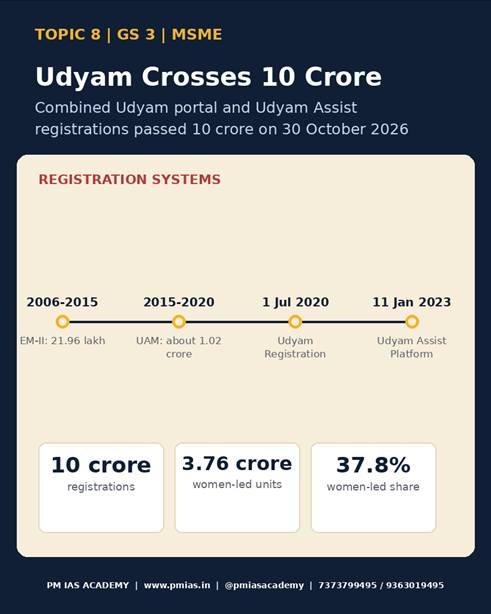
Women-led MSMEs account for 3.76 crore registrations, or 37.8 percent, across Udyam and Udyam Assist data, as reported in the release.
Background: From EM-II to Udyam
The release describes four stages of MSME registration. Entrepreneurs Memorandum (EM-II), 2006 to 17 September 2015, was largely physical, with documents verified by the District Industries Centre, and registered 21.96 lakh MSMEs.
Udyog Aadhaar Memorandum (UAM), 18 September 2015 to 30 June 2020, was an Aadhaar-based online system that registered around 1.02 crore MSMEs. Udyam Registration followed from 1 July 2020.
The Udyam Assist Platform (UAP), from 11 January 2023, extends formalisation to eligible informal micro enterprises through designated financial institutions and other partner agencies.
The release frames the journey as a move from a largely physical, document-intensive process to a technology-driven, entrepreneur-friendly digital ecosystem.
Key Dimensions
1. The headline number: The 10-crore mark was crossed on 30 October 2026 on the combined Udyam Registration Portal and Udyam Assist Platform; candidates should carry the date and the two-platform basis together.
2. Women-led share: 3.76 crore women-led registrations at 37.8 percent is the inclusion headline; registration counts show presence in the formal framework, not share of turnover or employment.
3. Four-stage evolution: EM-II (2006 to 17 Sep 2015, 21.96 lakh), UAM (18 Sep 2015 to 30 Jun 2020, about 1.02 crore), Udyam (from 1 Jul 2020) and UAP (from 11 Jan 2023): the sequence is a standard Prelims chronology.
4. Udyam’s design: Registration is fully online, paperless and self-declaration based, with no physical documents or proof uploads; it integrates Aadhaar and PAN-based details with GST and Income Tax databases, has no renewal requirement and is free of cost.
5. Why recognition matters: The release says Udyam supports identification of enterprises by banks and financial institutions, enabling schemes such as CGTMSE and Priority Sector Lending, and supports PMEGP, National SC-ST Hub and the Public Procurement Policy for Micro and Small Enterprises, subject to eligibility.
6. Informal micro enterprises: UAP recognises that informal micro units struggled to access registration; a simplified route through designated financial institutions and partner agencies brings them in.
7. Inclusion beyond gender: The release says registration brings women, SC and ST entrepreneurs, rural enterprises, traditional artisans and other disadvantaged sections into the formal framework.
8. Exam lens: Carry the verified set: 10 crore crossed on 30 October 2026; 3.76 crore women-led (37.8 percent); EM-II 21.96 lakh; UAM about 1.02 crore; Udyam launched 1 July 2020; UAP from 11 January 2023.
9. The 1.02 crore trap: The figure 1.02 crore appears twice in the release: as the 2020 starting point of the growth story and as the approximate registrations under Udyog Aadhaar Memorandum between 2015 and 2020. Keep the two uses distinct in answers.
10. Scale of growth: Growth from 1.02 crore in 2020 to over 10 crore in 2026 is roughly a tenfold rise in six years, a derived comparison from the release’s two figures rather than a figure the release states itself.
11. Digital versus physical pace: EM-II registered 21.96 lakh MSMEs over nine years of physical, DIC-verified registration, while UAM registered about 1.02 crore in five years once registration moved online; the contrast illustrates how simplification expands formal coverage.
12. Compliance burden: Self-declaration, no physical document or proof uploads, integration with Aadhaar, PAN, GST and Income Tax data, no renewal requirement and zero fee together remove the main frictions that kept small units informal.
13. Scheme linkages: The release names CGTMSE, Priority Sector Lending, PMEGP, the National SC-ST Hub and the Public Procurement Policy for Micro and Small Enterprises as initiatives Udyam recognition supports, subject to eligibility.
Significance
1. Formalisation evidence: The registry quantifies how far formalisation has travelled, giving policy a measurable base.
2. Credit access: Registration lets banks identify enterprises, supporting guarantee and priority-sector lending, the sector’s central constraint.
3. Gender visibility: The women-led share gives gender-responsive enterprise policy a hard number to plan against.
4. Exam hook: The item combines a landmark statistic, a registration-system chronology and inclusion data.
5. Policy planning: A single registry of this scale gives state and central planners a common base for MSME targeting, credit planning and scheme design.
Challenges
1. Stock versus activity: Cumulative registrations are not a count of operating enterprises; closures matter for interpretation.
2. Benefit conversion: Registration to actual credit and scheme uptake can leak, particularly for first-generation and women entrepreneurs.
3. Data quality: Self-declared details can drift from reality, affecting classification accuracy.
4. Informal remainder: Micro units without digital access may remain outside any registry even at this scale.
Way Forward
1. Clean the registry: Periodic re-validation would make the headline number track live enterprises more closely.
2. Measure conversion: Publishing registration-to-credit and registration-to-scheme conversion rates would show what the count delivers.
3. Deepen women-led support: Pair the 37.8 percent share with targeted credit and market-access programmes.
4. Close the informal mile: Use UAP channels through financial institutions and partner agencies to reach units still outside.
5. Link registry to outcomes: Connect registration data with credit, procurement and employment data so the 10-crore milestone can be read against what enterprises actually gain.
Prelims Value Addition
- Udyam Registration Portal and Udyam Assist Platform together crossed 10 crore registrations on 30 October 2026 (PRID 2341216, release dated 25 November 2026).
- Women-led MSMEs: 3.76 crore registrations, 37.8 percent.
- Stages: EM-II 2006 to 17 Sep 2015 (21.96 lakh); UAM 18 Sep 2015 to 30 Jun 2020 (about 1.02 crore); Udyam from 1 Jul 2020; UAP from 11 Jan 2023.
- Udyam is online, paperless, self-declared, free, no renewal; linked to Aadhaar, PAN, GST and Income Tax data.
Mains Value Addition
- GS 3: ‘A registry is not an economy, but it is the beginning of one.’ Discuss the significance and limits of crossing 10 crore Udyam registrations for India’s MSME sector.
- GS 3: Examine the role of digital registration platforms in formalising micro and small enterprises, with attention to the gender composition revealed by registration data.
Quick Bits: Revise for Prelims
International economy and trade
- The Ministry of Commerce and Industry took note of the USTR Notice of Determination in the Section 301 investigation into structural excess capacity in manufacturing across 14 economies, including India; the notice is under examination (PIB, PRID 2341690).
- The Department of Commerce stated during the proceedings that India has no structural excess capacity in any sector, and the government’s position is that trade concerns should be addressed within the India-US Bilateral Trade Agreement negotiations, as announced on 2 February 2026 with a Joint Statement on 7 February 2026.
Art and culture
- India won the Visitors’ Lion for Best National Participation at the 61st International Art Exhibition of La Biennale di Venezia (Biennale Arte 2026), announced on the basis of public preferences (PIB, PRID 2341610).
- The Ministry of Culture presented the India National Pavilion at the Biennale; Union Culture Minister Gajendra Singh Shekhawat and Culture Secretary Vivek Aggarwal described it as a mark of India’s return to the Venice Biennale after a long hiatus.
Practice MCQs
Q1. With reference to NIPU-2026 announced for the urea sector, consider the following: 1. Six new brownfield urea plants of proposed 12.7 LMT installed capacity each are planned. 2. The return on equity band offered is 12 to 16 per cent. 3. All six plants are in the private sector. Which is/are correct?
(a) 1 and 2 only
(b) 1 and 3 only
(c) 2 and 3 only
(d) 1, 2 and 3
Answer: (a). Three of the six units are private (IIPL Jagdishpur, Matix Panagarh, CFCL Gadepan); Madras Fertilizers, NFL Nangal and KFL Shahjahanpur are the others, so statement 3 is wrong.
Q2. Regarding the 16th Finance Commission grants for rural local bodies, consider the following: 1. Grants of Rs 4,35,236 crore cover 28 States for 2026-27 to 2030-31. 2. Operational Guidelines were issued by the Department of Expenditure on 21 May 2026. 3. The first regional workshop on implementation was held in Goa on 26 November 2026. Which is/are correct?
(a) 1 and 2 only
(b) 2 and 3 only
(c) 1 and 3 only
(d) 1, 2 and 3
Answer: (d). All three statements match the Ministry of Panchayati Raj release on the Goa workshop.
Q3. Consider the following about the India-Singapore aviation MRO MoU approved by the Union Cabinet: 1. It covers joint development of an industry-oriented curriculum for Aircraft Maintenance Engineer training. 2. It provides for internships and exchange programmes with Singapore MRO entities. 3. It guarantees the construction of MRO facilities in India. Which is/are correct?
(a) 1 and 2 only
(b) 1 and 3 only
(c) 2 and 3 only
(d) 1, 2 and 3
Answer: (a). The MoU is a cooperation framework that facilitates industry partnerships to support facility expansion; it does not guarantee construction, so statement 3 is wrong.
Q4. The BHASHINI-SAMAVESH MoU relates to: 1. Integration of AI language services into the unified gateway of the Department of Social Justice and Empowerment. 2. Access in more than 22 languages. 3. A chatbot named Samajik Sahayak. Which is/are correct?
(a) 1 and 2 only
(b) 2 and 3 only
(c) 1 and 3 only
(d) 1, 2 and 3
Answer: (d). All three are stated in the PIB release of 26 November 2026; SAMAVESH expands as Single Access Mechanism for All Verticals of Empowerment and Social Harmony.
Q5. Regarding Exercise Suryakiran XX, consider the following: 1. It is the 20th edition of the India-Nepal joint military exercise. 2. It is held alternately in India and Nepal. 3. The 2026 edition is held at Saljhandi, Nepal, from 25 November to 8 December. Which is/are correct?
(a) 1 and 2 only
(b) 1 and 3 only
(c) 2 and 3 only
(d) 1, 2 and 3
Answer: (d). All three match the Ministry of Defence release; each side fields 334 personnel.
Q6. With reference to MSME registration in India, consider the following: 1. Udyam Registration was launched on 1 July 2020. 2. The Udyam Assist Platform has operated since 11 January 2023 for informal micro enterprises. 3. Udyog Aadhaar Memorandum preceded EM-II. Which is/are correct?
(a) 1 and 2 only
(b) 1 and 3 only
(c) 2 and 3 only
(d) 1, 2 and 3
Answer: (a). EM-II (2006 to 17 September 2015) came first, then UAM (18 September 2015 to 30 June 2020), so statement 3 is wrong.
Mains Practice Set
Q1. Urea capacity expansion through brownfield plants is central to India’s fertiliser self-reliance but carries fiscal and energy costs. Examine the rationale and risks of NIPU-2026. (250 words)
Q2. Reliable regional accounts are a precondition for fiscal federalism and local planning. Discuss with reference to the MoSPI Sub-Committee on regional accounts and the 16th Finance Commission grants for rural local bodies. (250 words)
Q3. Digital public infrastructure is moving from payments to language. Assess the significance of the BHASHINI-SAMAVESH integration for inclusive welfare delivery. (250 words)
