
Topic 1: Tamil Nadu Introduces 15-Day Paternity Leave for Government Employees
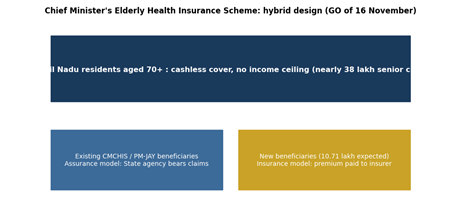
Diagram: the paternity leave window under the Tamil Nadu government order, 15 days availed up to 15 days before childbirth or within six months after, as reported in news coverage.
Subject: State Social Policy – Labour Welfare and Care Economy
Syllabus
TNPSC Group I/II/IV: social welfare measures in Tamil Nadu; labour welfare and service conditions; women and child welfare; comparative social policy
Context
Tamil Nadu has introduced 15 days of paternity leave for married male government employees, the first time the State has granted such leave. As reported in news coverage of the government order, the leave may be availed starting up to 15 days before the expected date of childbirth or within six months from the date of childbirth. The State government said it had received requests from male employees seeking paternity leave and had sympathetically considered them, noting that the period surrounding childbirth is crucial for both the mother and the child.
Main Body: Multi-Dimensional Analysis
1. The order: The government order grants 15 days of paternity leave to married male employees of the Tamil Nadu government, a first for the State, as reported in news coverage; the leave can be taken in a window running from 15 days before childbirth to six months after.
2. Why the timing window matters: A window that spans the weeks before delivery and the months after lets families use the leave for hospital care at birth and for infant care later, which is how paternity leave designs typically try to match the real rhythm of care needs.
3. Care economy framing: Paternity leave recognises that care work around childbirth is shared work; policy analysis treats such leave as one tool for reducing the disproportionate care burden that falls on mothers and that feeds the gender gap in paid work.
4. Central government comparison: Central civil servants have had 15 days of paternity leave under the Central Civil Services (Leave) Rules for many years, so the Tamil Nadu order brings State employees closer to a benefit Union employees already hold.
5. Maternity benefit backdrop: The Maternity Benefit Act, 1961, as amended in 2017, provides 26 weeks of paid maternity leave for women in eligible establishments; paternity provisions remain far shorter everywhere in India, which is a recurring exam point on care policy imbalance.
6. Demand-side origin: The State framed the order as a response to requests from its own employees, showing how service-condition changes often begin as staff-side demands processed through administrative channels rather than as scheme announcements.
7. Coverage limits: The order covers government employees only; private-sector paternity leave in India remains a matter of company policy, with no general statutory mandate, which is why exam answers should not overstate the reach of such orders.
8. Implementation questions: Leave benefits cost departments little on paper but require sanctioning discipline and workload planning; the exam-relevant issue is whether offices actually sanction the leave without penalising the men who take it.
9. Social signalling: Official paternity leave also carries a signalling function: it normalises men’s participation in early childcare inside government workplaces, which policy literature treats as a precondition for wider workplace equality.
10. Fiscal dimension: Because paternity leave is short and restricted to employees on rolls, its direct fiscal cost is modest compared with scheme expenditure; the cost is mainly administrative, in arranging substitute hands for fifteen days.
11. Comparative State practice: Several States and many private employers have moved toward paternity benefits in recent years; Tamil Nadu’s order places it among governments extending formal care leave to fathers, as reported in news coverage.
12. Exam lens: For TNPSC, the point to carry is institutional: service conditions such as leave are set by government orders under the State’s service rules, and a welfare measure can begin as an order rather than a named scheme.
13. Gender policy arc: The order sits inside a longer policy arc that runs from maternity benefit, through child care leave, to paternity leave, reflecting a gradual widening of who the welfare state expects to provide care.
Positives, Negatives, & Government Schemes
| Category | Dimension / initiative | Explanation |
| Positive | Care sharing | Paternity leave formally recognises fathers’ care role around childbirth, easing the mother’s burden in the first weeks. |
| Positive | Employee welfare | The benefit answers a recorded demand from serving male employees, improving service conditions at low fiscal cost. |
| Positive | Parity | State employees move closer to the 15-day paternity leave long available to Central government servants. |
| Negative | Coverage gap | The benefit stops at government rolls; private-sector fathers depend on employer discretion, limiting the social effect. |
| Institution | Service rules | Leave for government employees is governed by service rules and government orders, which is the legal instrument used here. |
| Scheme link | Maternity Benefit Act | The 26-week maternity framework is the comparator that shows how short paternity provisions remain in India. |
Examples
1. Central civil servants have drawn 15 days of paternity leave under the CCS (Leave) Rules for years, which is the benchmark the Tamil Nadu order matches for its own staff.
2. The State government recorded that the order followed requests from male employees, an instance of staff-side demands converting into a service-condition change.
3. The leave window, from 15 days before childbirth to six months after, mirrors the flexible windows used in paternity leave designs reported in news coverage of the order.
4. The Maternity Benefit (Amendment) Act, 2017 raised paid maternity leave to 26 weeks, the contrast routinely cited to show the gap between maternity and paternity provision in India.
5. Private employers in India set paternity leave voluntarily, so the reach of father-specific leave outside government depends on company policy rather than statute.
6. States have been adding care-related leave to service rules piecemeal; Tamil Nadu’s first-time paternity leave order is one more entry in that list, as reported in news coverage.
Way Forward
1. Publish clear sanctioning instructions so heads of offices grant the leave without informal refusal or penalty to the men who apply.
2. Track utilisation in the first year and publish the numbers, so policy review can judge whether the benefit is actually being used.
3. Consider extending a minimum paternity benefit to the State’s large contract and outsourced workforce, who are outside service-rule benefits.
4. Pair the leave with workplace communication that normalises fathers taking it, since uptake is the real test of such orders.
5. Review the benefit against the needs of adoptive fathers and commissioning parents, categories that leave rules often omit.
6. Keep the order’s text accessible on the personnel department’s portal so employees and sanctioning authorities read the same rule.
Conclusion
The paternity leave order is a small but telling addition to Tamil Nadu’s service rules: it costs little, answers a recorded employee demand, and nudges official workplaces toward recognising fathers as carers. Its value will be measured in uptake, not in the order itself.
Practice Mains Question
Discuss the significance of paternity leave as a labour welfare measure, with reference to Tamil Nadu’s introduction of 15 days of paternity leave for its government employees. How does it compare with maternity benefit provision in India?
Topic 2: Rs 3,500 Crore Sanctioned for Vetri Veedu Thittam Rural Housing
Diagram: financing layers per house under Vetri Veedu Thittam, Rs 5 lakh grant plus subsidised top-up loan plus Community Investment Fund, as reported in news coverage.
Subject: State Welfare Schemes – Rural Housing and Poverty Alleviation
Syllabus
TNPSC Group I/II/IV: housing schemes in Tamil Nadu; rural development and panchayat raj; welfare targeting and beneficiary identification; social inclusion
Context
The Tamil Nadu government has sanctioned Rs 3,500 crore to build 70,000 rural houses in the current financial year under the newly launched Vetri Veedu Thittam, part of a commitment to construct five lakh rural homes over five years. As reported in news coverage, each eligible beneficiary will receive Rs 5 lakh to build a house of 360 to 500 square feet, beneficiary verification is under way, and construction of the first batch is scheduled to begin in the first week of December, according to the rural development and panchayat raj secretary.
Main Body: Multi-Dimensional Analysis
1. The sanction: Rs 3,500 crore has been sanctioned for 70,000 rural houses this financial year under Vetri Veedu Thittam, the first annual tranche of a five-year, five-lakh-house commitment, as reported in news coverage.
2. Unit design: Each beneficiary receives Rs 5 lakh for a house of 360 to 500 square feet; where land is scarce, G+1 construction is permitted within the same built-up limit, and beneficiaries may build jointly.
3. Interest subsidy layer: On top of the grant, beneficiaries can take a top-up home loan of up to Rs 1 lakh from cooperative or commercial banks with a 3 per cent interest subsidy, reimbursed by the government for up to 15 years subject to timely repayment.
4. Livelihood mission link: Beneficiaries may also draw Community Investment Fund assistance of up to Rs 50,000 through the Tamil Nadu State Rural Livelihoods Mission, tying the housing grant to the State’s self-help group architecture.
5. Targeting method: First-year beneficiaries are drawn from existing rural development department databases, followed by fresh verification; from 2027 to 2031, lists will be displayed at village panchayats for claims and objections and then placed before the grama sabha for approval.
6. Priority categories: The scheme prioritises scheduled tribe members, nomadic communities, widows, destitute and deserted women, women-headed households, transgender persons, manual scavengers, sanitation workers, released bonded labourers, construction workers, disaster victims, accident-affected households, women survivors of crimes, and persons living with HIV/AIDS or tuberculosis.
7. Disability reservation: Five per cent of each district’s allocation is reserved exclusively for persons with disabilities across all beneficiary categories, including families with members who have intellectual disabilities, a notable cross-cutting inclusion measure.
8. Grama sabha role: Routing final list approval through the grama sabha uses the constitutional village assembly as a transparency device, a recurring exam point on participatory beneficiary selection in rural schemes.
9. Housing as welfare infrastructure: Rural housing schemes convert income support into a durable asset; policy literature treats a pucca house as a platform that improves health, schooling outcomes and the security of women-headed households.
10. Execution calendar: Verification under way with first-batch construction from early December sets a tight schedule; exam answers should note that sanction, verification and construction milestones are separate stages, each with its own delay risks.
11. Financing mix: The design stacks a capital grant, a subsidised top-up loan and livelihood-mission assistance, an example of convergent welfare financing that TNPSC questions often test through scheme-layering items.
12. Exam lens: Remember the structure, not only the headline figure: grant plus interest-subsidised loan plus Community Investment Fund, targeted through databases and grama sabhas, with explicit priority lists and a disability sub-quota.
13. Five-year frame: The five-lakh-house commitment spreads across five years, so annual sanctions like this one are the units to track when assessing whether the larger promise is on course.
Positives, Negatives, & Government Schemes
| Category | Dimension / initiative | Explanation |
| Positive | Asset creation | Rs 5 lakh per house builds a durable rural asset that anchors health, schooling and security gains for poor households. |
| Positive | Inclusion design | Priority lists for vulnerable groups plus a 5 per cent disability reservation hard-wire inclusion into allocations. |
| Positive | Transparency | Panchayat display of lists and grama sabha approval create public checkpoints against wrongful inclusion or exclusion. |
| Negative | Execution risk | Large rural housing programmes can slip on verification disputes, material costs and mason shortages in peak season. |
| Institution | Grama sabha | The village assembly’s approval role in beneficiary lists applies the 73rd Amendment’s participatory framework to housing. |
| Scheme link | TNSRLM | Community Investment Fund assistance through the Rural Livelihoods Mission layers self-help group finance onto the housing grant. |
Examples
1. The first-year sanction of Rs 3,500 crore for 70,000 houses works out to the announced Rs 5 lakh unit cost, showing the sanction is sized to the beneficiary target rather than a lump announcement.
2. Beneficiaries can stack the grant with a Rs 1 lakh top-up loan at a 3 per cent interest subsidy and up to Rs 50,000 from the Community Investment Fund, a three-layer financing pattern.
3. Lists displayed at village panchayats from 2027 to 2031 with grama sabha approval echo the public verification method used in earlier rural welfare selections in the State.
4. The priority list runs from scheduled tribes and nomadic communities to manual scavengers, sanitation workers and released bonded labourers, naming groups that general housing quotas often miss.
5. Five per cent of every district’s allocation is reserved for persons with disabilities, cutting across categories, which is a cross-quota design rarely seen in housing schemes.
6. Where house sites are small, the scheme allows G+1 construction within the same built-up area, an adaptation to land scarcity in denser villages, as reported in news coverage.
Way Forward
1. Complete beneficiary verification on the published calendar so first-batch construction can start in early December as announced.
2. Grievance channels should sit at panchayat level during list display, so claims and objections are settled before grama sabha approval.
3. Tie material supply and mason training to the construction calendar, since cost overruns and skill shortages are the usual slippage points.
4. Publish district-wise progress against the 70,000-house target each quarter so the five-year commitment can be tracked publicly.
5. Ensure the interest subsidy reimbursement reaches beneficiaries automatically on timely EMI payment, without fresh applications each year.
6. Audit convergence with the livelihood mission so Community Investment Fund assistance reaches the same households without duplication of paperwork.
Conclusion
Vetri Veedu Thittam turns a five-year housing promise into a funded first year with a defined unit cost, layered financing and public beneficiary selection. Its success depends on the unglamorous stages: clean verification, timely construction and subsidy delivery that actually reaches the household.
Practice Mains Question
Describe the design of Tamil Nadu’s Vetri Veedu Thittam rural housing scheme, highlighting its financing layers, beneficiary selection process and inclusion measures. What execution risks must be managed for the five-year target to be met?
Topic 3: Interest Waiver for Crop Loans Repaid by November 30
Diagram: the crop loan interest waiver chain, repayment by 30 November, interest waived, fresh loan eligibility, with this year’s disbursement figures, as reported in news coverage.
Subject: State Agriculture – Cooperative Credit and Farm Finance
Syllabus
TNPSC Group I/II/IV: agriculture in Tamil Nadu; cooperative institutions and rural credit; farmer welfare measures; crop seasons and agrarian distress
Context
The Tamil Nadu cooperation department has announced a complete waiver of interest for farmers who repay their outstanding crop loans in full by 30 November, making them eligible for fresh crop loans. As reported in news coverage, cooperative institutions have disbursed crop loans worth Rs 5,190 crore to 5,70,942 farmers in the current financial year, and disbursement has declined significantly this year, largely because cultivated area shrank after the failure of the Kuruvai crop and partial damage to the Samba crop. Cooperative credit societies will remain open on 28 and 29 November, though they fall on Saturday and Sunday, to facilitate repayment.
Main Body: Multi-Dimensional Analysis
1. The waiver: Farmers who clear their entire outstanding crop loan by 30 November will have the interest fully waived and become eligible for fresh crop loans, according to the cooperation department’s announcement as reported in news coverage.
2. Incentive design: Time-bound interest waivers work as collection incentives: they convert overdue loans into recoveries before the financial year closes, while returning repaying farmers to credit eligibility for the next season.
3. Disbursement backdrop: Cooperative institutions have disbursed Rs 5,190 crore in crop loans to 5,70,942 farmers this financial year, the base over which the waiver operates, as reported in news coverage.
4. Crop failure context: Department sources attribute the fall in disbursement to reduced cultivated area after the Kuruvai crop failed and the Samba crop suffered partial damage, linking credit demand directly to the monsoon and crop calendar.
5. Kuruvai and Samba: Kuruvai is the short summer paddy crop and Samba the longer main-season crop in Tamil Nadu’s paddy calendar; exam answers should place credit cycles against these seasons, since borrowing follows sowing and repayment follows harvest.
6. Cooperative credit structure: Short-term crop loans in the State flow through the three-tier cooperative structure of primary agricultural credit societies, district central cooperative banks and the State cooperative bank, making societies the front line of the waiver.
7. Operational arrangement: Societies staying open on the weekend of 28 and 29 November is an administrative accommodation to maximise repayment before the deadline, showing how deadline schemes need field-level logistics, not just orders.
8. Fresh loan eligibility: Tying the waiver to fresh loan eligibility is the real lever: a farmer who repays re-enters the credit system for the coming season, which matters more to cultivation decisions than the interest saving alone.
9. Fiscal and institutional cost: Interest waivers transfer the forgone interest to the cooperative system, which the State typically reimburses; answers should note that waivers ease the farmer’s burden but strain cooperative finances unless compensated.
10. Debt relief debate: The wider policy debate distinguishes targeted, time-bound waivers that restore credit discipline from open-ended waivers that can encourage strategic default; this scheme sits in the first category because it rewards repayment.
11. Climate signal in credit: Falling disbursement after crop failure shows how agricultural credit data double as distress indicators; declining loan offtake in a sowing season is an early warning exam answers can cite.
12. Exam lens: Hold the numbers together: Rs 5,190 crore disbursed, 5,70,942 farmer borrowers, 30 November repayment deadline, full interest waiver plus fresh loan eligibility for those who clear dues.
13. Seasonal credit cycle: Crop loans are short-term production credit repaid after harvest; a November deadline targets the post-Samba-sowing window so societies can recycle funds into the next crop season.
Positives, Negatives, & Government Schemes
| Category | Dimension / initiative | Explanation |
| Positive | Credit recycling | Repayment incentives return funds to societies, restoring their capacity to lend for the next crop season. |
| Positive | Farmer relief | Interest waiver cuts the cost of past borrowing for farmers hit by Kuruvai failure and partial Samba damage. |
| Positive | Credit discipline | The scheme rewards repayment rather than default, avoiding the moral hazard of open-ended waivers. |
| Negative | Deadline pressure | Short repayment windows can push distressed farmers toward moneylenders to clear cooperative dues in time. |
| Institution | Cooperative structure | Primary societies, district central cooperative banks and the State cooperative bank form the three-tier rural credit chain. |
| Scheme link | Crop calendar | Kuruvai and Samba seasons drive the borrowing and repayment rhythm the waiver is timed against. |
Examples
1. Cooperative societies staying open on Saturday 28 and Sunday 29 November is a field-level accommodation to let farmers deposit repayments before the 30 November deadline.
2. The Rs 5,190 crore disbursed to 5,70,942 farmers this year is the lending base affected by the waiver, as reported in news coverage.
3. Department sources linked lower disbursement to the failed Kuruvai crop and partially damaged Samba crop, a direct example of weather shocks transmitting into rural credit.
4. The waiver converts repaying farmers into fresh-loan-eligible borrowers, which is how deadline waivers double as next-season credit policy.
5. Farmers can contact the joint registrars of cooperative societies in their districts for repayment facilitation, per the announcement as reported.
6. Time-bound interest waivers differ from blanket loan waivers: the incentive runs to those who repay, keeping repayment culture intact while easing the interest burden.
Way Forward
1. Publicise the waiver through societies and farmer producer groups so eligible farmers learn of the deadline before it closes.
2. Ensure societies issue same-day no-dues certificates so repaying farmers can draw fresh loans without administrative lag.
3. Monitor whether farmers borrow from informal lenders to meet the deadline, and intervene where distress sales or usurious borrowing appear.
4. Plan the fresh loan window immediately after the deadline so recycled funds reach farmers for the ongoing season without a gap.
5. Track district-wise repayment and fresh disbursement data to read continuing crop distress and target follow-up relief.
6. Compensate cooperative institutions promptly for the waived interest so their liquidity for next-season lending is protected.
Conclusion
The interest waiver is a compact credit-cycle intervention: it pulls repayments in before 30 November, recycles cooperative funds and restores repaying farmers to fresh-loan eligibility after a hard crop year. Its limits are the usual ones of deadline schemes, and they lie in the field, not in the announcement.
Practice Mains Question
Explain the design and rationale of time-bound interest waivers on cooperative crop loans, with reference to Tamil Nadu’s waiver for loans repaid by 30 November. How do crop seasons and cooperative credit structures shape such measures?
Topic 4: Rs 5 Crore for 500 Dairy Farms to Strengthen Aavin Procurement
Diagram: unit economics of the 500 dairy farm scheme, Rs 1 lakh front-end subsidy and Rs 3 lakh institutional credit per Rs 4 lakh unit, as reported in news coverage.
Subject: State Animal Husbandry – Dairying and Cooperative Marketing
Syllabus
TNPSC Group I/II/IV: animal husbandry and dairying in Tamil Nadu; cooperative milk unions and Aavin; subsidy design in welfare schemes; rural livelihoods
Context
The Tamil Nadu government has sanctioned Rs 5 crore to establish 500 medium-scale dairy farms across the State, extending a 25 per cent capital subsidy to eligible milk producers, in a move to expand milk production and strengthen Aavin’s cooperative procurement network. As reported in news coverage, the government order provides for 500 units of five milch cows or buffaloes each at a project cost of Rs 4 lakh per unit, with Rs 1 lakh as front-end subsidy and the remaining Rs 3 lakh through institutional credit at concessional rates, taking total project investment to an estimated Rs 20 crore.
Main Body: Multi-Dimensional Analysis
1. The sanction: Rs 5 crore has been sanctioned for 500 dairy units of five milch animals each, a 25 per cent capital subsidy on a Rs 4 lakh unit cost, with the balance financed by institutional credit, as reported in news coverage of the government order.
2. Scheme origin: The scheme was announced in the 2026-27 Agriculture Budget and is being implemented through 27 District Cooperative Milk Producers’ Unions, excluding Kanniyakumari and the Nilgiris.
3. Unit economics: Each unit carries a Rs 4 lakh project cost: Rs 1 lakh front-end government subsidy and Rs 3 lakh as institutional credit at concessional interest, so the producer’s entry cost is largely financed rather than saved up front.
4. Eligibility rules: Applicants must be 21 to 60 years old, members of a milk cooperative society, owners of at least one milch animal who regularly supply milk to the society, with cattle housing and at least one acre of land owned or leased.
5. Inclusion targets: Women milk producers should preferably make up 30 per cent of beneficiaries, with priority quotas envisaged at 18 per cent for Scheduled Caste and 1 per cent for Scheduled Tribe applicants, per the selection criteria reported.
6. Procurement rationale: The scheme’s stated aim is to augment Aavin’s procurement network: more supplier-members with more animals raise the daily milk pool that the cooperative federation processes and markets.
7. Output arithmetic: On an indicative yield of seven litres per animal per day, the 2,500 additional animals are expected to add about 17,500 litres a day, or roughly 53.37 lakh litres a year, to procurement, as reported.
8. Support bundle: Newly purchased animals get livestock insurance for three years, and beneficiaries receive veterinary services, fodder support and livestock management training, the wrap-around services that decide whether dairy units survive.
9. Selection process: Applications will be received through a dedicated online portal, scrutinised by selection committees and forwarded to banks for loan approval, a portal-plus-committee pipeline now standard in State subsidy schemes.
10. Cooperative dairying model: The scheme works inside the Anand-pattern three-tier structure of village societies, district unions and the State federation that markets milk under the Aavin brand, a standard exam topic in cooperative dairying.
11. Subsidy design lesson: A front-end subsidy combined with institutional credit is the standard capital-subsidy pattern: the grant lowers the loan burden, and bank appraisal adds a commercial check on the unit’s viability.
12. Exam lens: Carry the unit numbers: 500 units, five animals each, Rs 4 lakh cost, Rs 1 lakh subsidy, 27 unions, 30 per cent women preference, 18 and 1 per cent SC/ST priority, 17,500 litres a day expected.
13. White Revolution frame: Small and medium dairy units are the historical engine of India’s milk growth under Operation Flood; State schemes like this one extend that cooperative logic to procurement-constrained regions.
Positives, Negatives, & Government Schemes
| Category | Dimension / initiative | Explanation |
| Positive | Livelihood creation | Five-animal units create steady daily income for 500 rural households, anchored to a guaranteed cooperative buyer. |
| Positive | Procurement depth | An expected 17,500 extra litres a day strengthens Aavin’s pool and its capacity to supply urban demand. |
| Positive | Inclusion | Women’s 30 per cent preference and SC/ST priority quotas target the benefit toward weaker sections. |
| Negative | Viability risk | Dairy units fail on fodder cost, animal disease and yield shortfalls; insurance and veterinary support must actually reach units. |
| Institution | Aavin federation | The Tamil Nadu Co-operative Milk Producers’ Federation markets members’ milk under the Aavin brand through district unions. |
| Scheme link | Agriculture Budget | The scheme originates in the 2026-27 Agriculture Budget, showing how budget announcements convert into sanctioned schemes. |
Examples
1. The government order fixes the unit at five milch cows or buffaloes costing Rs 4 lakh, with Rs 1 lakh front-end subsidy and Rs 3 lakh institutional credit, as reported in news coverage.
2. The scheme runs through 27 District Cooperative Milk Producers’ Unions, excluding only Kanniyakumari and the Nilgiris, giving it near-statewide coverage through the cooperative network.
3. Eligibility requires existing membership of a milk society, at least one milch animal and regular milk supply, so the scheme builds on active suppliers rather than first-time entrants.
4. The 30 per cent women’s preference, with 18 per cent SC and 1 per cent ST priority, writes social targets directly into beneficiary selection, as reported.
5. The output estimate of 7 litres per animal a day yields about 17,500 litres daily from 2,500 animals, the arithmetic behind the procurement strengthening claim.
6. Three-year livestock insurance plus veterinary, fodder and training support accompany the subsidy, reflecting the standard finding that credit-linked dairy units fail without animal-health cover.
Way Forward
1. Run the online application portal with district-level help desks so eligible rural applicants are not screened out by digital access.
2. Ensure banks clear the linked loans on the scheme timeline, since subsidy schemes stall most often at the credit stage.
3. Deliver the promised veterinary, fodder and training support from day one; animal health decides whether the five-animal units stay viable.
4. Publish union-wise beneficiary lists so the women, SC and ST targets can be publicly verified against actual selections.
5. Track milk actually procured from the new units against the 17,500-litre daily projection, and report it in the federation’s reviews.
6. Review unit survival after the first year and correct design gaps before scaling the scheme to further batches.
Conclusion
The dairy farm sanction is a classic credit-linked subsidy scheme riding the State’s cooperative milk network: modest in outlay, precise in unit design, and aimed at the procurement base that keeps Aavin viable. The projection of fresh milk will hold only if credit, insurance and veterinary support arrive together.
Practice Mains Question
Explain the design of Tamil Nadu’s capital subsidy scheme for medium-scale dairy farms and its role in strengthening cooperative milk procurement. What factors determine the viability of such credit-linked livestock units?
Topic 5: VETTRI Conclave: 78 MoUs Worth Rs 58,214 Crore Proposed Investments
Diagram: the largest proposed investments among the 78 MoUs signed at the second VETTRI Conclave; these are proposed investments under MoUs, not realised investment (source data: DT Next report).
Subject: State Economy – Investment Promotion and Industrial Development
Syllabus
TNPSC Group I/II/IV: industrial development and investment promotion in Tamil Nadu; memoranda of understanding and their conversion; employment generation; sectoral composition of investment
Context
The Tamil Nadu government signed 78 memoranda of understanding involving proposed investments worth Rs 58,214 crore and an estimated 65,786 employment opportunities at the second VETTRI Investment and Conversion Conclave held near Kovalam in Chengalpattu district, presided over by the Chief Minister, as reported in news coverage. The government stated that cumulative commitments have crossed Rs 1.73 lakh crore through 190 MoUs during its first 200 days in office, projected to generate 1,98,557 jobs. These are investment commitments recorded in MoUs, not realised investment.
Main Body: Multi-Dimensional Analysis
1. The headline: Seventy-eight MoUs recording Rs 58,214 crore of proposed investments and an estimated 65,786 jobs were signed at the second VETTRI Investment and Conversion Conclave near Kovalam in Chengalpattu district, as reported in news coverage.
2. Commitment versus realisation: MoU figures are intentions recorded at signing; exam answers must state the status exactly, since actual grounded investment depends on clearances, financing and market conditions, and conversion rates vary widely across conclaves.
3. Grounded and completed projects: The same event saw foundation stones laid for 15 projects valued at Rs 7,925 crore with a projected 19,965 jobs, and six completed projects worth Rs 1,430 crore inaugurated with expected employment of 1,710, the realised end of the pipeline.
4. Cumulative tally: The government said commitments now exceed Rs 1.73 lakh crore across 190 MoUs in its first 200 days, projected to create 1,98,557 jobs; this cumulative figure remains a commitment total, as reported.
5. Sectoral spread: The MoUs cover automotive manufacturing and components, electronics, semiconductors, renewable energy, shipbuilding, logistics, aerospace and defence, textiles, engineering, chemicals, hospitality and tourism, matching the State’s established industrial strengths.
6. Largest commitments: CSE Development India proposed Rs 8,140 crore in renewable energy across multiple districts and JM Baxi Ports and Logistics committed Rs 5,200 crore for logistics, the two largest single commitments reported at the conclave.
7. Manufacturing anchors: TVS Motor Company proposed Rs 2,000 crore for automotive components in Krishnagiri and Brazil-based WEG the same amount for an integrated manufacturing facility in Dharmapuri, signalling continued auto and electrical machinery interest.
8. Shipbuilding and electronics: Sanmar Group committed Rs 1,950 crore for shipbuilding in Thoothukudi and Titan Company Rs 1,500 crore for electronics manufacturing in Krishnagiri, spreading investment beyond the Chennai belt.
9. Electric mobility signal: Royal Enfield proposed a Rs 1,000 crore electric motorcycle manufacturing project with an estimated 500 jobs, placing the State in the electric two-wheeler supply chain conversation.
10. Greenfield share: Fifty-eight of the 78 agreements are greenfield projects accounting for 64 per cent of the proposed investment, as reported; greenfield projects build new capacity, while the rest are expansions of existing units.
11. Direct hiring evidence: Appointment orders were handed to 18 candidates selected by five companies, UPS, Autoliv, Stylcove, Mahindra and Mahindra and Omron, a small but concrete employment outcome alongside the projections.
12. Exam lens: TNPSC questions on such events test the distinction between proposed, committed, grounded and realised investment; always tag conclave figures with the status the source gives, here proposed investments under MoUs.
13. Conversion conclave idea: The event’s name pairs investment with conversion, reflecting the administrative practice of tracking signed MoUs through single-window clearance into grounded projects, the metric that ultimately matters.
Positives, Negatives, & Government Schemes
| Category | Dimension / initiative | Explanation |
| Positive | Pipeline breadth | 78 MoUs across a dozen sectors widen the State’s industrial pipeline beyond its automotive core. |
| Positive | District spread | Commitments in Krishnagiri, Dharmapuri, Thoothukudi, Virudhunagar and Ranipet spread proposed investment beyond Chennai. |
| Positive | Some realisation | Fifteen grounded projects and six completed ones show part of the earlier pipeline converting into physical capacity. |
| Negative | Conversion risk | MoU commitments are not realised investment; historical conversion rates at investment summits are far below 100 per cent. |
| Institution | Single-window clearance | The State’s investment facilitation machinery is what turns signed MoUs into grounded projects within defined timelines. |
| Scheme link | VETTRI conclaves | The conclave series is the government’s platform for signing and then tracking investment commitments to conversion. |
Examples
1. CSE Development India’s Rs 8,140 crore renewable energy proposal and JM Baxi’s Rs 5,200 crore logistics commitment were the largest MoUs reported at the conclave.
2. TVS Motor Company and Brazil-based WEG each proposed Rs 2,000 crore, for automotive components in Krishnagiri and an integrated facility in Dharmapuri respectively, as reported.
3. Sanmar Group’s Rs 1,950 crore shipbuilding commitment in Thoothukudi and Titan’s Rs 1,500 crore electronics proposal in Krishnagiri extend the industrial map south and west.
4. Royal Enfield’s proposed Rs 1,000 crore electric motorcycle plant, with an estimated 500 jobs, is the electric mobility entry in the list, as reported in news coverage.
5. PepsiCo committed Rs 868 crore for a new greenfield food manufacturing facility, and Hyundai suppliers Hwashin and Seoyon E-Hwa a combined Rs 1,370 crore for expansions, per the report.
6. The government pegged cumulative commitments at over Rs 1.73 lakh crore from 190 MoUs in 200 days; this is a commitment tally, with realised investment to be measured as projects ground.
Way Forward
1. Publish a public MoU tracker showing each commitment’s stage from signing through clearance to grounding, so conversion can be independently assessed.
2. Prioritise single-window clearances for the largest commitments, since early movement on anchor projects signals credibility to smaller investors.
3. Match skill development to the committed sectors, particularly semiconductors, shipbuilding and electric vehicles, so projected jobs become employable jobs.
4. Disclose land, power and water arrangements for greenfield projects early, the inputs on which conversion most often stalls.
5. Report realised investment and actual employment separately from commitments in every conclave statement, keeping the categories distinct.
6. Support supplier ecosystems around anchor investments so tier-two and tier-three firms, where most jobs sit, can co-locate and grow.
Conclusion
The conclave adds a sizeable tranche of proposed investment to the State’s pipeline, with encouraging spread across sectors and districts. The honest exam framing is status discipline: these are MoU commitments, and their value will be settled by conversion into grounded projects, as the completed and foundation-laid projects at the same event illustrate.
Practice Mains Question
Distinguish between investment commitments under MoUs and realised investment, with reference to the second VETTRI Investment and Conversion Conclave. What institutional mechanisms improve the conversion of MoUs into grounded projects in Tamil Nadu?
Topic 6: 148 Houses for Sri Lankan Tamils at Krishnagiri Camp; Cash Aid Raised
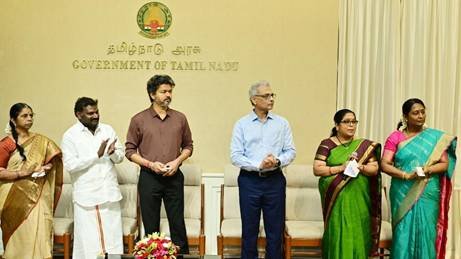
Current-event photo: Chief Minister C. Joseph Vijay with Ministers and officials at the Government of Tamil Nadu function on 26 November 2026 at which 148 houses at the Pambar Dam Sri Lankan Tamil Rehabilitation Camp in Krishnagiri were inaugurated through video conferencing and enhanced cash assistance was launched (photo: The Hindu, Special Arrangement).
Subject: State Social Welfare – Rehabilitation of Sri Lankan Tamils
Syllabus
TNPSC Group I/II/IV: welfare of Sri Lankan Tamil refugees in Tamil Nadu; rehabilitation camps and assistance; State humanitarian administration; vulnerable group welfare
Context
The Tamil Nadu Chief Minister inaugurated, through video conferencing from the Secretariat on 26 November 2026, 148 newly constructed houses at a cost of Rs 8.52 crore at the Sri Lankan Tamil Rehabilitation Camp at Pambar Dam in Krishnagiri district, according to an official release reported in news coverage. Basic amenities in these houses were provided at a cost of Rs 1.37 crore. The Chief Minister also launched the disbursal of enhanced monthly cash assistance to 56,638 Sri Lankan Tamils belonging to 19,710 families living in camps across the State.
Main Body: Multi-Dimensional Analysis
1. The housing: The 148 houses at the Pambar Dam rehabilitation camp in Krishnagiri district were built at a cost of Rs 8.52 crore, with basic amenities provided for Rs 1.37 crore, according to the official release as reported in news coverage.
2. Cash assistance enhancement: Monthly assistance for heads of families rises from Rs 1,500 to Rs 1,800, for members aged 12 and above from Rs 1,000 to Rs 1,200, and for children below 12 from Rs 500 to Rs 600, involving an additional Rs 14.95 crore a year.
3. Coverage: The enhanced assistance reaches 56,638 Sri Lankan Tamils in 19,710 families living in camps, per the official release, making this a population-wide revision rather than a pilot.
4. Who the camp residents are: Sri Lankan Tamils in Tamil Nadu’s camps are refugees who fled ethnic conflict in Sri Lanka across decades, many from the 1980s and later waves; they live under a special rehabilitation administration because they are outside the ordinary citizen framework.
5. Administrative arrangement: The event involved the Minister for the Welfare of Non-Resident Tamils, the Chief Secretary and the Secretary of the Public and Rehabilitation Department, showing the departmental chain that runs refugee welfare in the State.
6. Housing as rehabilitation: Moving camp families from ageing temporary structures to newly constructed houses is the core of rehabilitation policy: it converts protracted displacement into settled, dignified living with basic amenities.
7. Assistance structure: The graded monthly assistance by family role, head, adult member and child, is a subsistence support design; exam answers should read the graded amounts as a household budget supplement, not income replacement.
8. Cost arithmetic: The enhancement adds Rs 14.95 crore annually, a modest fiscal outlay for a population of over 56,000, which is why such revisions are fiscally feasible even in tight budgets.
9. Legal backdrop: Sri Lankan Tamil refugees are not covered by a national refugee law, since India is not a party to the 1951 Refugee Convention; their welfare runs on State and Union administrative arrangements, a standard polity point.
10. Long-standing demand: Rehabilitation camp residents have long sought better housing and higher assistance; the inauguration and enhancement respond to that standing demand, as reflected in the official release.
11. Exam lens: Hold the numbers: 148 houses, Rs 8.52 crore, Pambar Dam camp in Krishnagiri, 56,638 persons, 19,710 families, assistance raised to Rs 1,800, Rs 1,200 and Rs 600, additional annual cost Rs 14.95 crore.
12. Wider welfare frame: The measures sit alongside education, health and livelihood support the State extends to camp residents, part of a humanitarian obligation Tamil Nadu carries given its historic and linguistic ties.
13. Future questions: Durable questions remain around citizenship pathways, livelihoods outside camps and the eventual closure or conversion of camps, which answers may note as open policy issues.
Positives, Negatives, & Government Schemes
| Category | Dimension / initiative | Explanation |
| Positive | Dignified housing | 148 new houses with amenities replace ageing camp structures for Sri Lankan Tamil families at Pambar Dam. |
| Positive | Income support | Enhanced monthly assistance reaches all 56,638 camp residents, indexed by family role, from 26 November disbursal. |
| Positive | Modest cost | The assistance enhancement adds only Rs 14.95 crore a year, a fiscally light humanitarian measure. |
| Negative | Protracted limbo | Camp residents remain refugees without a settled legal status; housing and cash aid ease but do not end that condition. |
| Institution | Rehabilitation department | The Public and Rehabilitation Department administers the camps and assistance, the nodal machinery for this welfare stream. |
| Policy link | Refugee framework | India has no national refugee law and is not a party to the 1951 Convention, so this welfare runs administratively. |
Examples
1. The 148 houses at Pambar Dam cost Rs 8.52 crore with Rs 1.37 crore more for basic amenities, per the official release as reported in news coverage.
2. Monthly assistance for a family head rises from Rs 1,500 to Rs 1,800, showing the revision scale across the three graded categories of head, member and child.
3. The enhancement covers 56,638 persons in 19,710 families, so its effect is spread across the entire camp population rather than a selected subset.
4. The inauguration by video conferencing from the Secretariat illustrates the now-standard remote launch mode for distributed welfare infrastructure.
5. The additional annual outlay of Rs 14.95 crore quantifies what graded cash revisions cost when applied to a defined beneficiary population.
6. The Minister for Welfare of Non-Resident Tamils’ presence reflects the departmental structure that handles both diaspora and refugee welfare in the State.
Way Forward
1. Extend the housing programme to remaining camps on a published schedule so new construction replaces ageing structures statewide.
2. Index cash assistance to price levels with periodic revision, so inflation does not erode the enhancement within a few years.
3. Expand livelihood support for camp youth, including skill training and work access, to reduce dependence on subsistence assistance.
4. Document each camp’s population and needs in a public rehabilitation dashboard to guide phased housing and service upgrades.
5. Coordinate with the Union government on long-pending questions of status and documentation for camp residents.
6. Maintain schooling, health and nutrition services in camps at par with surrounding villages while residents remain there.
Conclusion
The Krishnagiri housing and the assistance enhancement are incremental but real improvements in a protracted rehabilitation story: better shelter now, somewhat larger subsistence support every month. The larger questions of status and durable settlement remain, and they belong to a different policy table.
Practice Mains Question
Discuss the welfare administration for Sri Lankan Tamil refugees in Tamil Nadu with reference to the recent housing inauguration at Pambar Dam and the enhancement of monthly cash assistance. What are the limits of administrative welfare in the absence of a national refugee law?
Topic 7: Supreme Court to Hear Contempt Pleas in Thirupparankundram Lamp Row
Diagram: chronology of the Thirupparankundram Deepathoon matter from the Supreme Court’s 20 November order to the listed 27 November hearing, as reported in legal news coverage.
Subject: Polity and Judiciary – Contempt, Court Orders and Executive Compliance
Syllabus
TNPSC Group I/II/IV: Indian judiciary and contempt jurisdiction; fundamental rights and religious freedom; executive accountability to courts; temple administration
Context
The Supreme Court has allowed a contempt petition and a fresh application seeking urgent directions on the lighting of the Karthigai Deepam at the Deepathoon, a stone pillar atop Thirupparankundram Hill in Madurai, to be listed for hearing on 27 November 2026, as reported in legal news coverage. The contempt petition was filed against the Madurai District Collector and three other officials for the lamp not being lit at the Deepathoon on 24 November despite the Court’s order of 20 November. The Bench of Justice Aravind Kumar and Justice Vipul M. Pancholi took note of the mentioning and said everything would be listed the next day.
Main Body: Multi-Dimensional Analysis
1. The listing: The Supreme Court agreed to list on 27 November a contempt petition and a fresh application on the Karthigai Deepam at the Deepathoon pillar atop Thirupparankundram Hill, after the matter was mentioned, as reported in legal news coverage.
2. Contempt alleged: The contempt petition names the Madurai District Collector and three other officials, alleging the lamp was not lit at the Deepathoon on 24 November despite the Court’s 20 November order permitting it.
3. Contempt jurisdiction: The Supreme Court’s power to punish for contempt of itself flows from Article 129 of the Constitution, with the Contempt of Courts Act, 1971 defining civil contempt as wilful disobedience of a court’s order, the doctrinal frame for this petition.
4. The State’s account: The Collector’s preliminary status report stated that the temple’s Board of Trustees lit the Karthigai Mahadeepam at the Deepa Mandapam near the Uchipillaiyar Temple instead, and that the Devasthanam never authorised a team to light the lamp at the pillar, per the report.
5. Petitioners’ counter: Petitioners alleged the State evaded compliance through, in their words, stratagem and devices, citing prohibitory orders and custom claims attributed to the temple’s Board of Trustees and sthanikars, which the sthanikars later denied making.
6. High Court’s role: On 24 November, the Madras High Court passed a John Doe injunction restraining the public from calling for violation of the Supreme Court’s 20 November order, observing that it could not overreach the apex court but could direct officials to comply with it.
7. John Doe orders: A John Doe, or Ashok Kumar, order binds unnamed persons; it is used where the violators cannot be individually identified in advance, a procedural device exam answers should define when cited.
8. Executive compliance principle: The structural issue is the obligation of the executive to implement court orders in letter and spirit; contempt law exists precisely to police that obligation when compliance is alleged to have failed.
9. Religious freedom frame: Disputes over where and how a festival lamp is lit engage Articles 25 and 26 on religious practice and denominational rights, balanced against public order, the constitutional axis on which such litigation turns.
10. Property and custom questions: The pillar’s history and ownership remain disputed and the Court has not ruled on ownership, as news coverage of the row notes; answers must avoid asserting either party’s factual claims as settled.
11. Case identity: The proceedings run in Hindu Dharma Parishad versus Union of India, W.P.(C) 1280/2025, with connected matters including a contempt diary number, per the legal report; citing the case identity correctly is part of exam precision.
12. Exam lens: The examinable content is doctrinal, not devotional: contempt of court, status reports, John Doe injunctions, the hierarchy that binds High Courts to Supreme Court orders, and executive accountability.
13. Neutrality discipline: Because the dispute concerns a religious site with competing claims, exam answers should describe the proceedings and the law without endorsing any side’s position on custom or ownership.
Positives, Negatives, & Government Schemes
| Category | Dimension / initiative | Explanation |
| Positive | Judicial oversight | Prompt listing of the contempt plea keeps executive compliance with court orders under judicial scrutiny. |
| Positive | Procedural clarity | Status reports and listed hearings create a documented record of what was ordered and what was done. |
| Positive | Order protection | The High Court’s John Doe injunction aimed to prevent public disorder around compliance with the apex court’s order. |
| Negative | Escalation risk | Disputes over religious sites can sharpen communal tension when compliance questions become public contests. |
| Doctrine | Contempt of court | Article 129 and the Contempt of Courts Act, 1971 govern wilful disobedience of orders, the frame of this petition. |
| Right | Articles 25 and 26 | Religious practice and denominational autonomy, subject to public order, frame the underlying festival dispute. |
Examples
1. The Bench of Justice Aravind Kumar and Justice Vipul M. Pancholi, on mentioning, said everything would be listed on 27 November, a standard urgent-listing response, as reported.
2. The contempt petition names the Madurai Collector and three officials over the lamp not being lit at the Deepathoon on 24 November, against the 20 November order.
3. The Collector’s status report said the Mahadeepam was lit at the Deepa Mandapam near the Uchipillaiyar Temple instead of the pillar, the factual heart of the compliance dispute.
4. Petitioners alleged prohibitory orders and attributed custom claims were used to avoid compliance; the sthanikars denied making the custom claims, per the report.
5. The Madras High Court’s 24 November John Doe order restrained calls to violate the Supreme Court’s order, while disclaiming any power to interpret that order.
6. The matter runs in W.P.(C) 1280/2025 with connected contempt proceedings, the case identity for anyone tracking the litigation, as reported in legal coverage.
Way Forward
1. Let the judicial process run: the listed hearing is the forum where compliance and contempt questions belong, not street mobilisation.
2. District administration should file complete, factual status reports so the Court can assess compliance on record rather than allegation.
3. Maintain public order around the site through even-handed prohibitory measures that do not themselves become compliance obstacles.
4. Temple administration and stakeholders should channel custom and ownership claims into the litigation, where evidence can be tested.
5. All sides should avoid public statements that pre-judge ownership or custom questions still before the courts.
6. Once the Court rules, prompt and visible compliance by officials is the only stable exit from a contempt cycle.
Conclusion
The Thirupparankundram listing is, at its core, a contempt story: whether a court order was implemented as directed, and what follows if it was not. The constitutional stakes are executive fidelity to judicial orders and the careful handling of a sensitive site, and both are examinable without taking sides on the underlying dispute.
Practice Mains Question
Explain the law of contempt as it applies to alleged executive non-compliance with court orders, with reference to the Thirupparankundram matter. What procedural devices, such as status reports and John Doe orders, feature in such litigation?
Topic 8: Health Cover for All Above 70 Without Income Ceiling
Diagram: the hybrid assurance-insurance design of the Chief Minister’s Elderly Health Insurance Scheme for residents aged 70 and above, as reported in news coverage.
Subject: State Health Policy – Insurance for Senior Citizens
Syllabus
TNPSC Group I/II/IV: health policy and insurance schemes in Tamil Nadu; senior citizen welfare; Centre-State convergence in health cover; insurance versus assurance models
Context
Tamil Nadu has cleared a health insurance scheme for all residents aged 70 and above, irrespective of income, following an Assembly announcement by the Health Minister to provide cashless treatment to nearly 38 lakh senior citizens. As reported in news coverage, a government order issued by the Health Secretary on 16 November permits the Tamil Nadu Health Systems Project to implement the Chief Minister’s Elderly Health Insurance Scheme, which follows the Centre’s approval to extend Ayushman Bharat PM-JAY benefits to everyone aged 70 and above regardless of socioeconomic status.
Main Body: Multi-Dimensional Analysis
1. The scheme: The Chief Minister’s Elderly Health Insurance Scheme extends cashless health cover to every State resident aged 70 and above without an income ceiling, following an Assembly announcement covering nearly 38 lakh senior citizens, as reported in news coverage.
2. Government order: The order of 16 November, issued by the Health Secretary, authorises the Tamil Nadu Health Systems Project to implement the scheme, the administrative vehicle that also runs the State’s other health programmes.
3. Centre-State convergence: The scheme follows the Union government’s extension of Ayushman Bharat PM-JAY to all persons aged 70 and above regardless of income; the State design folds that expansion into its own framework rather than running a rival scheme.
4. Population coverage: The scheme covers eligible senior citizens in families already enrolled under PM-JAY as well as those outside it, with enrolment through e-Sevai centres and other mechanisms adopted by the project.
5. New enrolment estimate: From public distribution system, electoral roll and population registry data, the State expects about 10.71 lakh people not covered by the Chief Minister’s Comprehensive Health Insurance Scheme to enrol, as reported.
6. Hybrid financing: The model is hybrid: assurance-based coverage for existing CMCHIS and PM-JAY beneficiaries, where the State health agency bears approved claims, and insurance-based coverage for new beneficiaries, where the government pays a premium to an insurer that settles claims.
7. Coverage limit: The order does not specify a coverage limit; officials said it would be in line with CMCHIS, which covers roughly 1.45 crore families for up to Rs 5 lakh per family a year, with high-end procedures funded up to Rs 23 lakh from a corpus fund.
8. Package additions: Procedures commonly sought by senior citizens, such as cataract surgery, will be added to the package, per officials quoted in the coverage, an age-sensitive design adjustment.
9. Exclusions and phasing: Beneficiaries under the government employees’ health insurance cannot join until April, a sequencing choice that staggers the enrolment load across insurance pools.
10. Insurer arrangement: For newly covered families the government will pay United India Insurance Company, the current CMCHIS implementing agency, continuing the public insurer arrangement the State already runs.
11. Why 70-plus matters: Health spending rises sharply with age and a single hospitalisation can push elderly households into debt; universal cover for the 70-plus band targets the highest-risk age group regardless of means-testing errors.
12. Assurance versus insurance: The assurance model pays claims directly from government funds for existing beneficiaries, while the insurance model pays premiums for new entrants; the distinction is a standard exam point on how States structure health cover.
13. Exam lens: Carry the structure: universal 70-plus cover, GO of 16 November, Tamil Nadu Health Systems Project as implementer, PM-JAY convergence, 10.71 lakh expected new enrolments, hybrid assurance-insurance design, Rs 5 lakh indicative family cover.
Positives, Negatives, & Government Schemes
| Category | Dimension / initiative | Explanation |
| Positive | Universal coverage | Every resident above 70 qualifies without income testing, removing exclusion errors that means tests create. |
| Positive | Convergence | Building on the PM-JAY 70-plus expansion avoids duplicate structures and aligns State and Union cover. |
| Positive | Age-fit packages | Adding procedures like cataract surgery matches the package to the conditions the elderly actually claim. |
| Negative | Capacity strain | Cashless entitlement without matching hospital capacity and claim settlement speed can frustrate beneficiaries. |
| Institution | TNHSP | The Tamil Nadu Health Systems Project implements the scheme, the State’s standing vehicle for health systems programmes. |
| Scheme link | PM-JAY and CMCHIS | The scheme sits atop Ayushman Bharat’s 70-plus expansion and the State’s CMCHIS, an instance of layered health cover. |
Examples
1. The government order of 16 November, issued by the Health Secretary, authorises the Tamil Nadu Health Systems Project to run the scheme, as reported in news coverage.
2. The State expects about 10.71 lakh people outside the Chief Minister’s Comprehensive Health Insurance Scheme to enrol, estimated from ration, electoral and population data.
3. The hybrid design keeps existing CMCHIS and PM-JAY beneficiaries on assurance-based funding while new beneficiaries move to a premium-paid insurance model with United India Insurance.
4. Officials indicated coverage in line with CMCHIS’s roughly Rs 5 lakh per family a year, with high-end procedures such as transplants funded up to Rs 23 lakh from a corpus fund.
5. Cataract surgery, among the commonest procedures claimed by senior citizens, is being added to the package, per officials quoted in the coverage.
6. Government employees’ health insurance beneficiaries are excluded until April, a phased entry that manages enrolment load across the State’s insurance pools.
Way Forward
1. Publish the final coverage limits and package list so hospitals and beneficiaries operate on the same entitlement schedule.
2. Enrol through e-Sevai and camps near elderly populations, since digital self-enrolment alone will miss the oldest and poorest.
3. Monitor claim settlement times for both assurance and insurance streams and publish them, the metric beneficiaries actually feel.
4. Expand empanelled hospital capacity for geriatric and high-end care so the entitlement is usable beyond metropolitan centres.
5. Coordinate premium and corpus fund provisioning in the budget so the insurer and State agency are funded before claims peak.
6. Review the April entry of government employee beneficiaries on schedule and communicate it to avoid confusion at hospitals.
Conclusion
The 70-plus health cover converts a Central expansion into a State-wide universal entitlement with a workable hybrid financing design. Its test will be operational: enrolment that reaches the oldest, packages that match their illnesses, and claims settled fast enough to keep the promise cashless in practice.
Practice Mains Question
Describe the design of Tamil Nadu’s health insurance scheme for residents aged 70 and above, including its convergence with PM-JAY and its hybrid assurance-insurance financing. Why is universal age-based coverage preferred over income-based targeting for the elderly?
