
The 2024 Forest Declaration Assessment Report
Syllabus: GS3/Biodiversity and Conservation
Context
- The 2024 Forest Declaration Assessment report, “Forests under fire: Tracking progress on 2030 forest goals,” was released.
About
- Most countries backed the 2030 zero deforestation pledge at the UN Cop26 climate summit in 2021.
- The 2024 forest declaration assessment, produced by a coalition of research and civil society organisations, assessed progress towards the goal using a baseline of the average deforestation between 2018 and 2020.
- It found progress was significantly off track, with the level of deforestation in 2023 almost 50% higher than steady progress towards zero would require.
Major Findings
- Shortcomings in Meeting Target: The target for last year was to bring global deforestation down to a maximum of 4.4 million hectares (10.9 million acres).
- The global deforestation remains 45 percent above the levels needed to meet international goals
- Nearly 96 percent of all deforestation occurred in tropical regions, and almost all these areas failed to meet their annual targets
- Tropical deforestation resulted in the emission of nearly 3.7 billion metric tons of carbon dioxide-equivalent in 2023.
- Loss of Forest: In 2023, the world lost 6.37 million hectares of forest, this loss was 45 percent higher than the goal to eliminate deforestation by 2030.
- Primary tropical forests, essential for storing carbon and protecting biodiversity, lost 3.7 million hectares in 2023.
- It indicated serious problems in global efforts to stop deforestation and forest damage.
- Forest Damage: Forest damage without complete destruction is 10 times worse than deforestation itself, affecting 62.6 million hectares in 2022.
- Main Drivers: Agriculture, road construction, fires and commercial logging were the main drivers of deforestation across Africa, Asia, Latin America and the Caribbean.
- Positive Progress: Brazil has reduced its deforestation by 9 percent below previous levels, showing that significant progress is possible.
- Other countries that made progress towards the 2030 deforestation target included Australia, Colombia, Paraguay, Venezuela and Vietnam.
- The report also emphasizes the loss of Key Biodiversity Areas (KBAs), where more than 1.4 million hectares of forest were lost in 2023.
- Protecting these areas is critical for wildlife and Indigenous communities that depend on them.
- Forest fires are a significant threat, mainly due to intentional land clearing for agriculture.
- Since 2001, 138 million hectares of tree cover have been lost to fires, with about a third of that occurring between 2019 and 2023.
- The report outlined steps for global actors to achieve forest protection goals, which includes:
- Ensuring adequate funding for forest conservation efforts.
- Reducing the demand for products that cause deforestation.
- Recognising the important role of Indigenous and local communities in forest protection.
Way Ahead
- Ultimately, the challenges outlined in the 2024 Forest Declaration Assessment underscore that achieving forest conservation goals and advancing sustainable economic development are not mutually exclusive.
- But success depends on the willingness of governments, industry, and civil society to prioritize forests and integrate sustainable practices at every level.
- With just a few years remaining before 2030, the time to act is now.
Fair Work India Ratings 2024
Syllabus: GS3/Economy
Context
- The report titled ‘Fairwork India Ratings 2024: Labour Standards in the Platform Economy’ was released recently.
About
- It is the sixth consecutive annual study of this nature conducted by the Fairwork India Team in association with Oxford University.
- It analyses the work conditions of platform workers on digital labour platforms in India.
- Platform workers are those whose work is based on online software apps or digital platforms.
Major Highlights
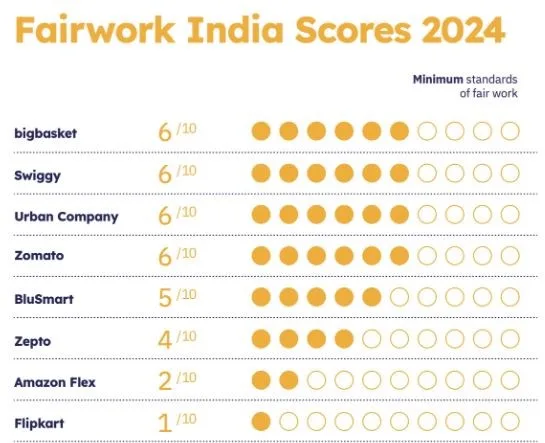
- Fair Work assessed platforms against five principles: Fair Pay, Fair Conditions, Fair Contracts, Fair Management, and Fair Representation.
- The study evaluates 11 platforms offering location-based services in sectors such as domestic and personal care, logistics, food delivery, and transportation, in India.
- These include Amazon Flex, Bigbasket, BluSmart, Flipkart, Ola, Porter, Swiggy, Uber, Urban Company, Zepto and Zomato.
- Only Bigbasket and Urban Company were awarded the first point under Fair Pay for instituting a minimum wage policy.
- No platform earned the second point under Fair Pay, which requires platforms to commit to and ensure a local living wage after work-related costs.
- Representation through a collective body or trade union is a vital dimension of fairness at work.
- Despite the rise in platform worker collectivisation across the country over the past six years, there was insufficient evidence from any platform to show a willingness to recognise a collective body of workers.
Who are Gig Workers?
- Non-standard or gig work consists of income-earning activities outside of standard, long-term employer-employee relationships.
- It relies heavily on temporary and part-time positions filled by independent contractors and freelancers rather than full-time permanent employees.
- The term is borrowed from the music world, where performers book “gigs” that are single or short-term engagements at various venues.
- The gig economy uses digital platforms to connect freelancers with customers to provide short-term services or asset-sharing.
- Examples include ride-hailing apps, food delivery apps, and holiday rental apps.
India and Gig Economy
- In 2020, 7.7 million workers were engaged in the gig economy.
- The gig workforce is expected to expand to 23.5 million workers by 2029-30.
- At present about 47% of the gig work is in medium skilled jobs, about 22% in high skilled, and about 31% in low skilled jobs.
Reasons for a rise in Gig Workers
- Post Pandemic: The trend accelerated during the 2020 COVID-19 pandemic, as gig workers delivered necessities to home-bound consumers, and those whose jobs had been eliminated turned to part-time and contract work for income.
- Freedom to work from anywhere: These types of positions facilitate independent contracting work, with many of them not requiring a freelancer to come into an office.
- Rise of Technology and Internet: Rise of fast internet and smartphones have made it easier to work from anywhere easily.
- Convenient for Small Organisations: Employers who cannot afford to hire full-time employees to do all the work will often hire part-time or temporary employees to take care of busier times or specific projects.
- Benefits Employers: Employers do not need to provide related benefits, such as medical insurance, Provident Fund, and year-end bonuses which make it a better option for them to pay only for work on a unit basis.
Challenges
- Work-life balance: For some workers, the flexibility of working gigs can actually disrupt the work-life balance, sleep patterns, and activities of daily life.
- Can replace Full time employees: The number of full-time employees required by the company can be reduced as freelance workers take over the work.
- No regular job benefits: Many employers save money by avoiding paying benefits such as health coverage and paid vacation time.
- There is no formal employment relationship with the platform company and there are usually no employee benefits in short-term contracts.
Steps Taken by Government of India for Gig Workers
- Code of Social Security, 2020: The Government has formulated the Code on Social Security, 2020 which envisages framing of suitable social security schemes for gig workers and platform workers on matters relating to life and disability cover, accident insurance, health and maternity benefits, old age protection, etc.
- However, these provisions under the Code have not come into force.
- e-Shram Portal: The Government has also launched e-Shram portal in 2021 for registration and creation of a Comprehensive National Database of Unorganized Workers including gig workers and platform workers.
- It allows a person to register himself or herself on the portal on a self-declaration basis, which is spread across around 400 occupations.
2024 Nobel Prize in Physics
Syllabus : GS 3/Science and Tech
In News
John Hopfield and Geoffrey Hinton were awarded the 2024 Nobel Prize in Physics for their foundational contributions to machine learning using artificial neural networks (ANNs).
- Artificial neural networks (ANNs), which process data through interconnected nodes, have become well-known due to the popularity of AI apps like ChatGPT.
| Nobel Prize in Physics – Alfred Nobel mentioned physics first in his 1895 will, reflecting its high status at the time. – In the late 19th century, physics was considered the foremost science, a view Nobel likely shared given his own research ties to physics. – The Nobel Prize in Physics is awarded by the Royal Swedish Academy of Sciences in Stockholm, Sweden. |
John Hopfield’s Contribution:
- John Hopfield, a professor at Princeton University, developed the Hopfield network, a type of recurrent neural network that processes information based on Hebbian learning.
- It enables the storage and reconstruction of images and patterns.
- The Hopfield network is inspired by the physics of magnetic atoms, with neurons mimicking atoms’ energy-minimizing behavior to complete patterns or denoise images.
- His 1982 paper laid the foundation for using statistical physics in modeling neural circuits.
- The Hopfield network finds patterns by lowering its overall energy, comparing distorted or incomplete input to saved patterns.
Geoffrey Hinton’s Contribution:
- Geoffrey Hinton, a professor at the University of Toronto, adapted the Boltzmann machine for cognitive tasks and created the restricted Boltzmann machine (RBM).
- It uses statistical physics to recognize features in data and learns by recognizing patterns and generating new examples of the data on which it was trained, playing a significant role in machine learning’s current growth
- His work led to the development of deep learning ANNs, with layers of neurons capable of complex tasks.
Applications
- The work of Hopfield and Hinton have significantly advanced the field of machine learning, with widespread applications, including material development.
- Their innovations have enabled advancements in various fields including physics, chemistry, biology, medicine, finance, and health.
Concerns Around AI
- Hinton raised concerns about AI, particularly how tools like ChatGPT could flood the internet with false information, making it difficult for people to discern truth. He also highlighted worries about AI taking human jobs.
| Do you know ? – In 2023, the prize went to Pierre Agostini, Ferenc Krausz, and Anne L’Huillier for their contributions to attophysics. – The 2024 Physiology/Medicine prize was awarded to Victor Ambros and Gary Ruvkun for their discovery of microRNA. |
Why is India’s Textile Industry Struggling to Perform Better?
Syllabus: GS3/ Economy
Context
- India’s textile industry faced a challenging period, raising doubts about achieving the target of $350 billion annually by 2030.
Textile Industry of India
- Share in Domestic Trade: The domestic apparel & textile industry in India contributes approx. 2.3 % to the country’s GDP, 13% to industrial production and 12% to exports.
- Share in Global Trade: India has a 4% share of the global trade in textiles and apparel.
- Export: In FY22, India was the third largest textile exporter globally, enjoying a 5.4% share.
- Production of Raw Material: India is one of the largest producers of cotton and jute in the world. India is also the 2nd largest producer of silk in the world and 95% of the world’s hand-woven fabric comes from India.
- Employment Generation: The industry is the 2nd largest employer in the country providing direct employment to 45 million people and 100 million people in the allied sector.
- Regions: Andhra Pradesh, Telangana, Haryana, Jharkhand, and Gujarat are the top textile and clothing manufacturing states in India.
Challenges Faced by the Textile Industry
- Expensive Raw Material: Recent Quality Control Orders issued for fabric imports have complicated the process of bringing in essential raw material.
- This scenario forces exporters to use expensive domestic supplies, making Indian garments overpriced and unappealing to global buyers who prefer specific fabric sources.
- Cotton Price Fluctuations: India is a major producer and consumer of cotton. Fluctuations in cotton prices impact the cost of production for textile manufacturers.
- Imports from Bangladesh: With Bangladesh having duty-free access to the Indian market, those garments are available at 15-20% less cost in India.
- When fabric is imported, jobs are lost in cotton, spinning, knitting, compacting, and processing segments in India.
- Competition in the International Market: The overall cost difference between Indian and Bangladesh garments should be about 2-3%, but the labor costs are lesser in Bangladesh by almost 30%.
- Between 2013 and 2023, garment exports from Vietnam have grown nearly 82% to hit $33.4 billion while that of Bangladesh has grown nearly 70% to hit $43.8 billion.
- Infrastructure Constraints: Infrastructure challenges, including inadequate transportation systems, power shortages, and outdated technology, hinder the efficiency of the textile manufacturing process.
- Technology Upgradation: Many textile units in India still use outdated machinery and technology.
Initiatives by Government of India for the Growth of the Textile
- Amended Technology Upgradation Fund Scheme (ATUFS): To achieve the vision of generating employment and promoting exports through “Make in India’’ with “Zero effect and Zero defect” in manufacturing, ATUFS was launched in 2016 to provide credit linked Capital Investment Subsidy (CIS).
- Scheme for Capacity Building in Textile Sector (SAMARTH): To address the skilled manpower requirement across the textile sector, the scheme was formulated, under the broad policy guidelines of “Skill India” initiative.
- National Technical Textile Mission: The Mission for a period of 4 years (2020-21 to 2023-24) was approved for developing usage of technical textiles in various flagship missions, programmes of the country including strategic sectors.
- Production Linked Incentive (PLI) Scheme – The PLI Scheme for Textiles to promote production of Manmade Fibre (MMF) apparel, MMF Fabrics and Products of Technical Textiles in the country.
- PM-MITRA: To boost employment generation through setting up of 7 PM Mega Integrated Textile Region and Apparel (PM MITRA) Parks in Greenfield /Brownfield sites with world class infrastructure.
- Scheme for Integrated Textile Parks (SITP): SITP is designed to promote textile industry clusters by providing infrastructure support, including common facilities, utilities, and services.
- The goal is to encourage a more organized and efficient approach to textile manufacturing.
- Integrated Skill Development Scheme (ISDS): ISDS focuses on skill development in the textile sector to address the industry’s labor challenges.
- It aims to provide training to workers and enhance their employability, contributing to the overall growth of the sector.
Way Ahead
- The industry continues to hope for a revival in demand but, what the industry needs urgently is policy intervention at the Centre and State-levels and holistic measures to improve competitiveness.
- So, on the lines of the ‘Make in India’ campaign, the government should encourage purchase of Indian garments.
- While the current volume of imports are not much compared with the overall size of the domestic market, diversion of these orders to local manufacturers will bolster production.
