Delhi’s Shallow Earthquake
Syllabus: GS1/Geography; Important Geo-physical Phenomena
Context
- Recently, a 4.0-magnitude earthquake struck Delhi-NCR, causing strong tremors despite its moderate intensity.
- The National Center for Seismology (NCS) attributed the quake to in-situ material heterogeneity—natural geological variations—rather than plate tectonics.
What is ‘In-Situ Material Heterogeneity’?
- Unlike earthquakes caused by tectonic plate movement, this event resulted from variations in the physical properties of the Earth’s crust. Differences in rock type, fluid presence, and stress concentration can create localized seismic activity.
Delhi’s Seismic Risk
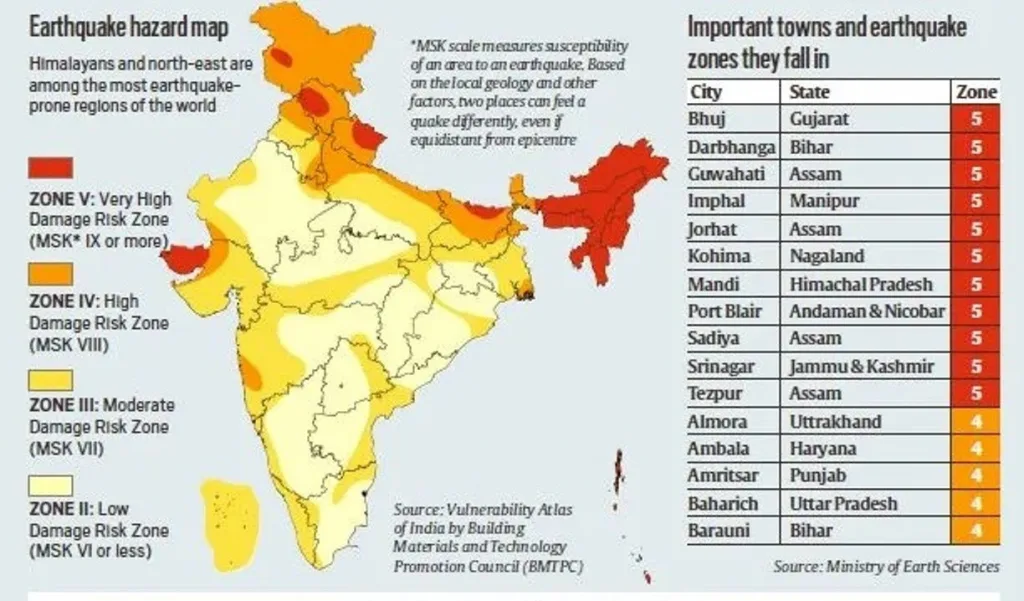
- Located in Seismic Zone IV (second highest in India).
- Near the Indian-Eurasian Plate collision zone, where stress builds along fault lines.
- Major Fault Systems:
- Delhi-Haridwar Ridge (extension of the Indian Plate).
- Aravalli Fault System (deep-seated geological structure).
Reasons for Strong Tremors
- Shallow Depth (5 km): Seismic waves had less distance to travel, intensifying the impact.
- Epicenter Within Delhi: The city’s dense urban landscape and high-rise structures amplified the effects.
- Soft Alluvial Soil: The Indo-Gangetic Plain geology enhances wave propagation, making tremors feel stronger.
About Earthquake
- It is the shaking of the ground caused by movement beneath the earth’s surface when two blocks slip past each other along a fault.
- It releases stored elastic strain energy in the form of seismic waves, which causes ground shaking.
- Epicentre: location directly above it on the surface of the earth;
- Hypocenter: location below the earth’s surface where the earthquake;
- Measuring of Earthquake:
- Magnitude: Richter scale;
- Intensity: Mercalli scale;
Earthquake in India
- India is one of the most seismically active regions in the world due to its geographical positioning along the Indian Plate, which is colliding with the Eurasian Plate.
- Earthquakes have historically caused significant devastation in various parts of the country, particularly in the Himalayan belt and other seismically vulnerable regions.
- The growing number of tremors could be linked to shifts in tectonic stress along fault lines, particularly in northern India, and due to the activation of the Almora fault.
India’s Earthquake Zones and Risk Areas
- India is highly vulnerable to earthquakes, with 58.6% of India’s landmass is prone to moderate to very high intensity earthquakes.
- State-wise ‘Seismic Zonation Map’ of the India country given by Bureau of Indian Standards (BIS).
- Approximately 11% area falls in Zone V, about 18% in Zone IV, about 30% in Zone III and remaining in Zone II.
Seismic Zones in India
- Zone V (Highest Risk): Northeast India, Himachal Pradesh, Uttarakhand, parts of Bihar and Gujarat.
- These are the most vulnerable areas in India, corresponding to MSK-9 levels of intensity or higher.
- Zone IV:Delhi, parts of Maharashtra, Jammu & Kashmir.
- It includes areas that are expected to experience MSK-8-level intensity during an earthquake.
- Zone III: Southern and central states with moderate seismic activity.
- Zone II: Least risk, including parts of southern India.
Key Initiatives
- Seismic Monitoring: The India Meteorological Department (IMD) actively monitors seismic activity and provides real-time updates.
- NDMA Guidelines: The NDMA has issued detailed guidelines for earthquake preparedness, including community awareness programs and structural safety measures.
- Smart Cities and Resilient Infrastructure: Government policies now emphasize earthquake-resistant buildings, particularly in high-risk areas.
Appointment of Chief Election Commissioner
Syllabus: GS2/Polity and Governance
Context
- President Droupadi Murmu appointed Gyanesh Kumar as the chief election commissioner of India under the Chief Election Commissioner and Other Election Commissioner Act, 2023.
About
- This 2023 Act replaces the Election Commission (Conditions of Service of Election Commissioners and Transaction of Business) Act, 1991, introducing significant changes to enhance the autonomy and functioning of the Election Commission of India (ECI).
- The CEC name was recommended by a three-member committee comprising:
- Prime Minister of India (Chairperson),
- Union Home Minister (Cabinet Minister nominated by the PM).
- Leader of Opposition in Lok Sabha.
Background
- In 2023, while examining the appointment of the CEC and ECs, the Supreme Court declared that their appointment should not be done solely by the Executive.
- The Court directed that the appointment should be done by the President on the recommendation of a Selection Committee, until Parliament made a law.
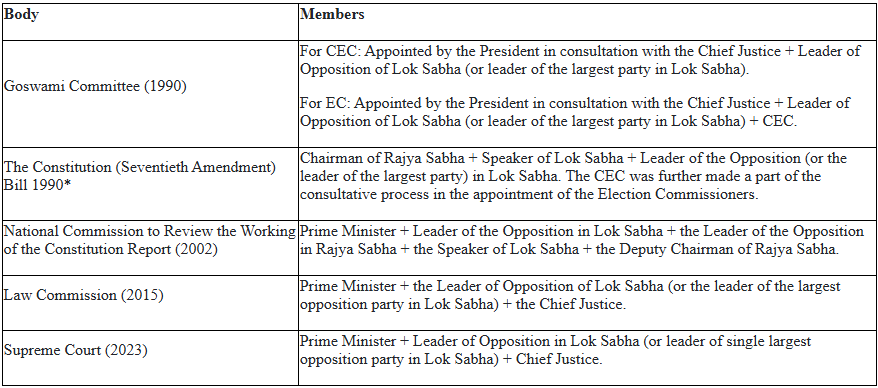
- The Selection Committee will consist of: The Prime Minister, The Leader of Opposition in Lok Sabha, and The Chief Justice of India.
Article 324 of Constitution
- Article 324 of the Constitution states that the Election Commission will comprise the Chief Election Commissioner (CEC) and such number of Election Commissioners (ECs), as the President may decide.
- The Election Commission of India (ECI) is responsible for managing the preparation of electoral rolls and conducting elections to Parliament, State Legislatures, and the offices of the President and Vice-President.
- The Constitution specifies that the President will appoint the CEC and ECs, subject to the provisions of an Act of Parliament.
Key Features of the CEs and ECs Appointment Act, 2023
- Election Commission: The Election Commission will consist of a Chief Election Commissioner (CEC) and other Election Commissioners (ECs). The President will periodically fix the number of ECs.
- Appointment of the Commission: The Commission will be appointed by the President, upon the recommendation of the Selection Committee.
- The Selection Committee will comprise the Prime Minister, Cabinet Minister, and Leader of Opposition in Lok Sabha (or leader of the single largest opposition party).
- A Search Committee headed by the Cabinet Secretary will suggest five names to the Selection Committee.
- The Selection Committee may consider any person other than those suggested by the Search Committee.
- Term and reappointment: Members of the Election Commission will hold office for six years, or until they attain the age of 65 years, whichever is earlier.
- Members of the Commission cannot be re-appointed.
- If an EC is appointed as a CEC, the overall period of the term may not be more than six years.
- Salary and pension: The salary, allowances, and other conditions of service of the CEC and ECs will be equivalent to that of the Cabinet Secretary.
- Removal: The CEC may be removed in the same manner and on the same grounds as a Supreme Court Judge.
- ECs may be removed only upon the recommendation of the CEC.
Concerns
- Executive Control Over Appointments: The selection committee now includes the PM, a Union Minister, and Leader of Opposition, reducing judicial oversight. The Selection Committee selects names from a panel of five people suggested by the Search Committee.
- The Selection Committee may go beyond the names suggested by the Search Committee.
- Election Commission’s Independence: A government-dominated appointment process may lead to bias in election management which eventually erodes trust in free and fair elections.
- Weaker Protection for Election Commissioners: CEC can only be removed via impeachment, but ECs lack such safeguards. This may lead to political pressure on ECs, affecting decision-making.
Suggestions made by various Commissions/Courts for composition of the Selection Committee
Concluding Remarks
- The CEC and EC Appointment Act 2023 shows reform in the selection process for the ECI, but it also raises concerns about the potential hijacking of the process of appointment of CEC & EC in the hands of the executive.
- The independence of the Election Commission is paramount to guarantee impartiality and integrity in the execution of electoral processes.
India, Qatar Elevate Ties To ‘Strategic Partnership’
Syllabus: GS2/IR
Context
- India and Qatar have signed an agreement to elevate their ties to the level of a strategic partnership.
- Both countries commemorated the 50 years of establishment of diplomatic relations in 2023.
Key Outcomes
- Both countries are exploring the option of concluding a Free Trade Agreement (FTA).
- Two sides also signed a double taxation avoidance treaty and also planned on doubling their trade to $28 billion within five years.
- Both sides discussed the Israel-Palestinian conflict in Gaza Strip.
- India currently has strategic partnerships with four other members of the Gulf Cooperation Council – the United Arab Emirates (UAE), Saudi Arabia, Oman, and Kuwait.
- Significance of the Visit:
- Arab States Summit: The visit of the Qatari Emir has drawn attention as it is being held just two days prior to the five Arab states summit in Riyadh.
- The summit will take up the new proposals from the United States.
- US Proposal on Gaza Crisis: President Trump’s proposed that the Palestinians of the region should be shifted out to neighbouring countries like Egypt and Jordan.
- India supports a two-state solution in bringing an end to the Israel-Palestinian crisis and has welcomed the ceasefire that was announced recently.
- Arab States Summit: The visit of the Qatari Emir has drawn attention as it is being held just two days prior to the five Arab states summit in Riyadh.

Brief on India-Qatar Relations
- Economic and Trade Relations: Qatar is the largest provider of liquefied natural gas (LNG) and liquefied petroleum gas (LPG) to India, supplying 10.91 million metric tonnes of LNG and 4.92 million metric tonnes of LPG in FY 2023-24.
- The current annual trade is worth $14.08 billion.
- Defence: India participates in the biennial Doha International Maritime Defence Exhibition and Conference (DIMDEX).
- Exercise Zair-Al-Bahr is a joint naval exercise between the Indian Navy and the Qatar Emiri Naval Force (QENF).
- The India-Qatar Defence Cooperation Agreement was signed in 2008 and extended for five years in 2018.
- The agreement is managed through the Joint Defence Cooperation Committee (JDCC).
- Labor and Diaspora: India has a large expatriate community in Qatar, numbering over 700,000.
- The Indian diaspora in Qatar plays a crucial role in the country’s development, particularly in construction and other sectors.
- Regional Cooperation: Gulf Cooperation Council (GCC) is a political and economic alliance of six Middle Eastern countries—Saudi Arabia, Kuwait, the United Arab Emirates, Qatar, Bahrain, and Oman. It was established in 1981.
- India engages regularly with GCC and aims to deepen its relationship with the GCC.
Challenges/Concerns
- The Hamas–Israel conflict and shipping attacks in the Red Sea affect India’s energy security and economic growth.
- India remains cautious in Middle Eastern politics, balancing relations with the Gulf, Iran, and Israel.
- If the conflict escalates, this balancing act could become more challenging.
- Delay in Connectivity Projects: The conflict has delayed a senior-officials meeting for the I2U2 group since 2023.
- India urges economic initiatives like I2U2 and IMEC to progress despite the conflict.
- FTAs with GCC: Delays in finalizing the India–GCC Free Trade Agreement (FTA) due to changes in the GCC’s trade negotiator.
- Reaching an agreement that satisfies all GCC states remains a key challenge.
Way Forward
- Growing security challenges are increasing the need for India to be a key strategic partner of Gulf states.
- India aims to expand its regional presence and influence.
- Stronger alignment in political, economic, and security interests is shaping a new framework for India-Gulf relations.
- If maintained, this framework will boost trust and enable more ambitious cooperation.
Bharat Tex 2025 For Textile Industry
Syllabus: GS3/ Economy
Context
- Bharat Tex 2025, India’s largest global textile event, took place in New Delhi, highlighting the country’s textile innovations and international trade opportunities.
About
- Bharat Tex 2025 served as a platform to accelerate the government’s “Farm to Fibre, Fabric, Fashion, and Foreign Markets” vision.
- The event featured over 5,000 exhibitors and more than 1,20,000 trade visitors, from 120+ countries including global CEOs, policymakers, and industry leaders, attended the event.
India’s Textile Industry
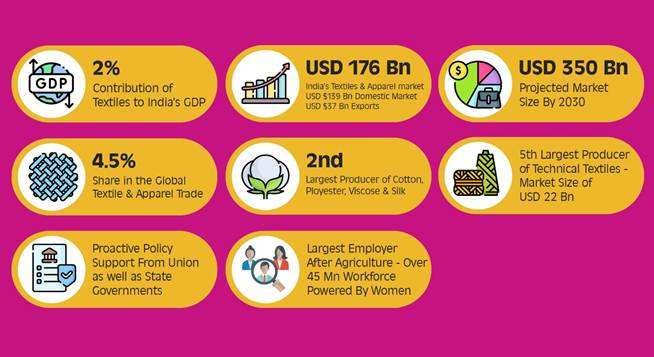
- India is the sixth-largest exporter of textiles globally, contributing 8.21% to the country’s total exports in 2023-24.
- The sector holds a 4.5% share in global trade, with the United States and European Union accounting for 47% of India’s textile and apparel exports.
- The industry provides direct employment to over 45 million people.
Supportive Policy Framework
- Prime Minister Mega Integrated Textile Region and Apparel (PM MITRA) Parks Scheme: 7 mega textile parks with an expected investment of USD 10 Bn are being set up with world class infrastructure, plug and play facilities and an integrated ecosystem.
- Production Linked Incentive (PLI) Scheme with approved incentives of INR 10,683 crore to promote production of Man-made fibers (MMF) Apparel, MMF Fabrics and Products of Technical Textiles.
- Samarth: The scheme is a demand-driven and placement-oriented program to build Capacity, address skill gaps in the textile value chain.
- National Handloom Development Programme (NHDP): Financial and market support for handloom weavers.
- Raw Material Support: Promotion of cotton, jute, silk, and wool to improve quality and yield.
Challenges Facing India’s Textile Industry
- High Raw Material Costs: Fluctuating cotton, jute, and synthetic fiber prices.
- Outdated Technology: Low adoption of automation and modern machinery.
- Global Competition: Strong competition from China, Vietnam and Bangladesh.
- Environmental Regulations: Compliance with sustainability norms and pollution control.
- Skilled Labor Shortage: Workforce needs upskilling to meet industry demands.
- Supply Chain Issues: Logistics inefficiencies and export-import bottlenecks.
- Limited Market Access: Trade barriers, high tariffs, and FTA limitations.
Way Ahead
- Technology Upgradation: Invest in automation and modern machinery.
- Sustainable Practices: Promote eco-friendly production and waste management.
- Skill Development: Strengthen workforce training through Samarth and other initiatives.
- Global Market Expansion: Leverage FTAs and improve export competitiveness.
- Raw Material Security: Enhance cotton, jute, silk, and wool production.
NAKSHA Program
Syllabus :GS 3/Economy
In News
- The Union Minister of Rural Development and Agriculture inaugurated the NAKSHA program in Raisen, Madhya Pradesh.
Digitization of land records
- The digitization of land records is modernizing land ownership management in rural India, addressing challenges like complex paperwork and ownership disputes.
- Status: Nearly 95% of rural land records have been digitized since 2016, improving transparency and accessibility.
Benefits of Digitization
- It enhances transparency and reduces illegal encroachments.
- It simplifies dispute resolution and reduces court burdens.
- It empowers marginalized communities by improving access to land rights.
- Geospatial mapping integration aids in accurate surveys and land management.
Challenges
- Land reforms face significant challenges due to outdated and missing land records across the country, especially in northeastern states with community-owned land and limited land records.
- Many cadastral maps are outdated and some are missing, causing discrepancies in land ownership.
Initiatives
- Digital India Land Records Modernization Programme (DILRMP): DILRMP, launched in April 2016, aims to create a modern, transparent land records system with real-time land information.
- Fully funded by the central government, it aims to reduce land disputes, prevent fraud, and optimize land use.
- NAKSHA program : It is expected to cost ₹194 crore, fully funded by the Government of India.
- The program covers 152 Urban Local Bodies (ULBs) across 26 states and 3 Union Territories.
- Survey of India is Technical partner, responsible for aerial surveys and orthorectified imagery.
- Madhya Pradesh State Electronic Development Corporation (MPSEDC) develops the end-to-end web-GIS platform.
- National Informatics Centre Services Inc. (NICSI) provides storage facilities.
- Objective: Aims to create and update urban land records for accurate and reliable documentation of land ownership.
- SVAMITVA Scheme: The Ministry of Panchayati Raj (MoPR) is implementing the Central Sector Scheme SVAMITVA with the aim to provide the ‘Record of Rights’ to village household owners possessing houses in inhabited areas in villages.
Conclusion and Way Forward
- The government’s initiative is revolutionizing land governance by increasing transparency and accessibility, especially for marginalized communities.
- This shift towards organized, efficient land record management contributes to a more inclusive and equitable society, fostering economic growth and stability.
RBI to Raise Deposit Insurance Cover
Syllabus: GS3/Economy
Context
- The government is considering increasing the insurance cover for bank deposits from the current limit of Rs 5 lakh.
About
- Deposit insurance was introduced in India in 1962, and coverage has thus far been enhanced six times – from Rs 1,500 per depositor to Rs 5 lakh now.
- The deposit insurance scheme was started with 287 banks in 1962; the number of insured banks was 1,997 as of March 31, 2024.
What is Deposit Insurance Cover?
- The Deposit Insurance and Credit Guarantee Corporation (DICGC) is a subsidiary of the Reserve Bank of India (RBI).
- It insures deposits held in Indian banks, providing protection in the event of a bank failure.
- Cover: DICGC currently offers insurance coverage of up to ₹5 lakh per depositor, per bank.
- This includes the total of both principal and interest amounts in all types of accounts, such as savings, fixed, current, and recurring deposits.
- DICGC covers deposits in various types of banks, including: Commercial Banks (public, private, and foreign banks), Cooperative Banks (central, state, and urban co-operatives) and Regional Rural Banks (RRBs).
- How does it work:
- Registration: Banks must register with DICGC to offer deposit insurance.
- Premium Payment: Banks pay a fixed premium to DICGC, which is not passed on to depositors.
- Claim Process: If a bank fails, DICGC reimburses depositors up to ₹5 lakh after verifying claims submitted by the liquidator.
- Limitations:
- Coverage Limit: The ₹5 lakh limit may not be sufficient for individuals or businesses with large deposit amounts.
- Exclusions: Government and interbank deposits are not covered under DICGC.
- Claims Processing Time: Though deposits are insured, the payout may take time as claims are handled through the bank’s liquidator.
Significance of DICGC for Depositors:
- Protection Against Bank Failures: Deposits are protected, up to ₹5 lakh, even if the bank goes bankrupt.
- Encouraging Savings: With insurance protection, depositors are more confident in saving their money in banks.
- Broad Coverage: DICGC covers most types of banks, providing widespread protection.
Way Ahead
- In light of recent bank crises, such as the issues faced by New India Co-operative Bank, there is an ongoing proposal to increase the insurance limit.
- If approved, the increase in the insurance limit would offer greater protection for depositors, especially those with higher deposits in banks.
- This would provide additional security and enhance trust in the banking system.
Extension of PM-AASHA Scheme Until 2025-26
Syllabus: GS3/ Agriculture
Context
- The Union Government has approved the continuation of the Pradhan Mantri Annadata Aay Sanrakshan Abhiyan (PM-AASHA) Scheme during the 15th Finance Commission Cycle up to 2025-26.
PM-AASHA Scheme
- The scheme was launched in 2018 as an umbrella scheme to ensure Minimum Support Price (MSP) to farmers, particularly for pulses, oilseeds, and copra.
- It aims to ensure remunerative prices for farmers and price stability in the agricultural sector.
Components of PM-AASHA
- Price Support Scheme (PSS): The government procures pulses, oilseeds, and copra at MSP.
- The Central Nodal Agencies (CNAs) conduct procurement in collaboration with state agencies.
- Only produce meeting Fair Average Quality (FAQ) standards is procured.
- Price Deficiency Payment Scheme (PDPS): It directs compensation payments to pre-registered farmers for the difference between MSP and the market price.
- There is no physical procurement of produce.
- It applies to oilseeds and requires transactions through a transparent auction process in notified market yards.
- Private Procurement & Stockist Scheme (PPSS) (Pilot Basis): It allows states to involve private stockists for oilseed procurement.
- It is implemented in selected Agricultural Produce Market Committees (APMCs) or districts.
Key Changes in the scheme
- In 2024 the Government converged the Price Support Scheme (PSS) & Price Stabilization Fund (PSF) schemes in PM AASHA to serve the farmers and consumers more efficiently.
- It will help in protecting consumers from extreme volatility in prices of agri-horticultural commodities by maintaining strategic buffer stock of pulses and onion for calibrated release; to discourage hoarding, unscrupulous speculation; and for supplies to consumers at affordable prices.
- The Market Intervention Scheme (MIS) was made a component of the integrated scheme of PM-AASHA.
- The scheme is for perishable agricultural and horticultural commodities like onions, potatoes, and tomatoes.
- It is implemented when prices fall by at least 10% from the previous normal season.
Significance of the Scheme
- Ensures price support to farmers, reducing distress sales.
- Enhances procurement efficiency through market-based interventions.
- Increases farmer participation in transparent marketing systems.
- Prevents extreme price fluctuations, protecting both producers and consumers.
Concerns
- Limited implementation: PDPS and PPSS have seen low adoption by states.
- Procurement constraints: MSP coverage is not uniform across all crops and regions.
- Awareness and accessibility issues: Many farmers lack awareness or face bureaucratic hurdles in registration.
- Budgetary concerns: Ensuring adequate funding for procurement operations remains a challenge.
Concluding remarks
- The extension of PM-AASHA till 2025-26 reaffirms the government’s commitment to farmers’ income security and agriculture market reforms.
- Strengthening its implementation and addressing challenges can enhance its impact in ensuring remunerative prices for farmers.
Swami Ramakrishna Paramhansa
Syllabus :GS 1/History
In News
- The Prime Minister paid tributes to Swami Ramakrishna Paramhansa on his Jayanti.
Swami Ramakrishna Paramhansa
- Swami Ramakrishna was born as Gadadhar Chattopadhyay on February 18, 1836, in Kamarpukur, Bengal, to a poor Brahmin family with strong religious values.
- His deep spirituality led him to explore various religious paths, affirming that all faiths lead to the same divine truth.
- His life was centered around uninterrupted contemplation of God.
- His God-consciousness transcends time and place, appealing universally to seekers of all religions.
Notable Disciple
- Foremost among his innumerable disciples was Swami Vivekananda, who was instrumental in establishing the philosophy of Ramakrishna at a global stage.
- Vivekananda established the Ramakrishna Mission in 1897 to carry out the visions of his Guru Ramakrishna and dedicated the establishment in servitude of the society.
Teaching and Message
- Sri Ramakrishna’s life influenced modern spiritual thought and currents.
- He proved that God-realization is not limited by age, country, or people.
- His teachings demonstrated that God exists beyond materialism and skepticism, restoring faith in religion.
- His teachings and spiritual presence uplifted individuals, transforming sinners into saints and purifying all.
Relevance Today
- Ramakrishna’s greatest contribution is the message of the harmony of religions.
- His message offers hope for the present-day world, threatened by religious intolerance and global crises.
- His teachings promote religious tolerance and mutual respect, fostering fellowship between different faiths.
Source :TH
Anticyclone System
Syllabus: GS1/Climatology
Context
- Weather experts said the anomalous spike in temperatures in Mumbai was spurred by the presence of an anticyclone system along the western coast.
About
- An anticyclone is a high-pressure weather system where the air pressure at the surface is higher than the surrounding areas.
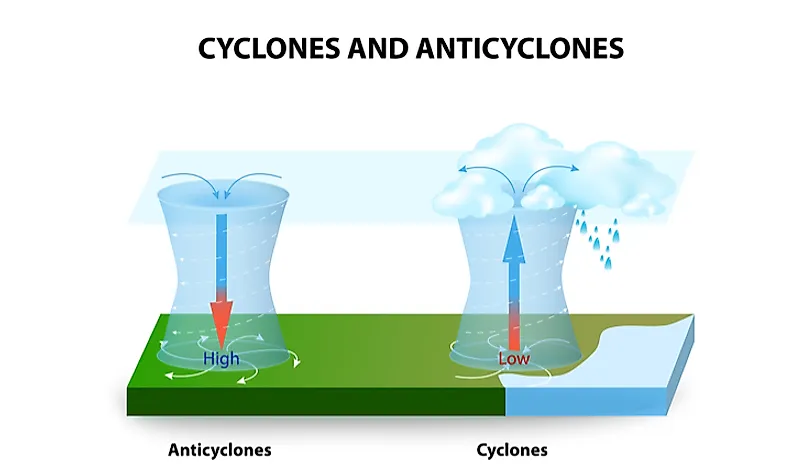
- Key features of an anticyclone system:
- High pressure at the center: The air pressure in the center of the system is higher compared to the areas around it.
- Air movement: Air moves outward from the center of an anticyclone.
- Sinking air: The air within an anticyclone sinks rather than rising, preventing cloud formation and often leading to dry and clear conditions.
- Impact: Anticyclones can influence local weather patterns significantly, sometimes causing prolonged dry spells or heatwaves.
Source: IE
‘Rarest of rare’ Doctrine
Syllabus: GS2/Polity and Governance
Context
- The recent two separate murder convictions reignited the questions about the judiciary’s approach to the ‘rarest of rare’ doctrine.
About
- 1972 – Jagmohan Singh vs. State of U.P.: The Supreme Court upheld the constitutionality of the death penalty.
- 1980 – Bachan Singh vs. State of Punjab: The Court introduced the ‘rarest of rare’ doctrine, stating the death penalty should be imposed only in exceptional cases.
- The definition of ‘rarest of rare’ was not clearly defined, leading to confusion.
- 1983 – Machhi Singh vs. State of Punjab: The Supreme Court clarified the ‘rarest of rare’ doctrine and identified five categories of crimes where the death penalty may be justified:
- Manner of committing the murder: Extremely brutal and dastardly murders.
- Motive of the murder: Committed for a motive showing total depravity.
- Socially abhorrent nature of the crime: When a murder targets a minority community and raises social wrath.
- Magnitude of the crime.
- Personality of the offender: When the victim is particularly vulnerable, such as a child, woman, or elderly person.
Conclusion
- The application of the death penalty in India remains complex and controversial.
- While the Supreme Court has given a certain framework, the unclear, universally agreed-upon definition for what qualifies as ‘rarest of rare’ continues to leave room for judicial discretion.
Source: TH
India’s 1st Vertical Bifacial Solar Plant
Syllabus: GS3/Environment and Conservation
Context
- Union Minister for Housing and Urban Affairs inaugurated India’s first vertical bi-facial solar plant installation at Okhla Vihar Metro station.
About
- The inauguration was done in the 5th International Conference on Green Metro Systems – The Future of Urban Mobility here.
- It was organised by the Delhi Metro Rail Corporation (DMRC), under the banner of i-Metro in association with the Confederation of Indian Industry (CII) and Indian Green Building Council (IGBC).
- The bi-facial panels can capture sunlight from both sides.
- It will take advantage of the metro’s elevated structure for solar energy generation without occupying any additional land.
- Significance: Transitioning from thermal to renewable energy, utilising solar rooftops, and implementing regenerative braking in metros exemplify the shift toward a greener future.
- The innovation can help metro rail operations be more sustainable and contribute to renewable energy goals.
Source: IE
Decade of Soil Health Cards
Syllabus: GS3/ Agriculture
Context
- The Soil Health Card Scheme, introduced on February 19, 2015, in Rajasthan, has completed a decade in operation.
Soil Health Cards Scheme
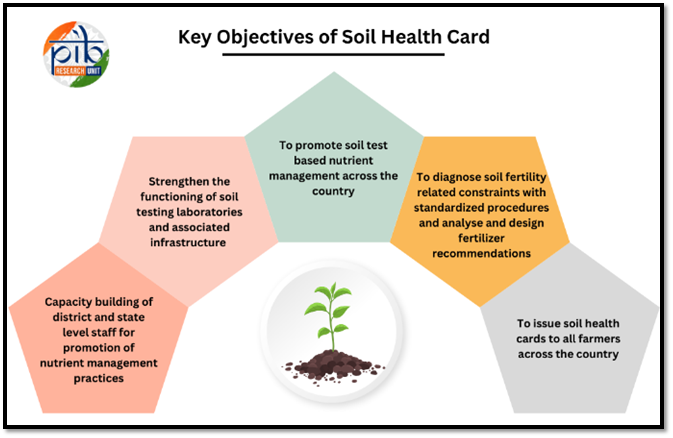
- Objective: Soil health card provides information to farmers on nutrient status of their soil along with recommendations on appropriate dosage of nutrients to be applied for improving soil health and its fertility.
- The scheme assists State Governments to issue soil health cards to all farmers in the country.
- The Soil Health Card contains status of the soil with respect to 12 parameters that determine soil health:
- Macro-nutrients: Nitrogen (N), Phosphorus (P), Potassium (K), Sulfur (S).
- Micro-nutrients: Zinc (Zn), Iron (Fe), Copper (Cu), Manganese (Mn), Boron (Bo).
- Other Indicators: pH level (Acidity or Basicity of soil), Electrical Conductivity (Indicates the presence of salts in soil), Organic Carbon (OC).
- Soil Health Card scheme has been merged in Rashtriya Krishi Vikas Yojana (RKVY) scheme as one of its components under the name ‘Soil Health & Fertility’ from the year 2022-23.