
SC stays Lokpal Order Giving Itself Jurisdiction over HC Judges
Syllabus: GS2/Polity and Governance
Context
- The Supreme Court stayed a Lokpal order bringing High Court judges under its jurisdiction terming the interpretation “very disturbing”.
About
- Suo Motu Cognisance: Supreme Court’s Special Bench took suo motu cognisance of the Lokpal’s recent order, which impacted judicial independence.
- Lokpal’s order declared High Court judges as ‘public servants’ under the Lokpal and Lokayuktas Act of 2013, allowing its jurisdiction over them.
- Lokpal’s Argument: Lokpal’s argument stemmed from High Courts being established by pre-constitutional British Acts, whereas the Supreme Court was formed by the Constitution.
- Exclusion of Supreme Court Judges: Earlier, on January 3, Lokpal had ruled that it had no authority over Supreme Court judges.
- Lokpal’s Jurisdiction: The Lokpal based its decision on Section 14(1) of the 2013 Act, which includes judges of High Courts created by Acts of Parliament.
- Supreme Court’s Stance: The Court emphasized that all judges are appointed under the Constitution, underscoring judicial independence.
Lokpal and Lokayuktas
- The Lokpal and Lokayuktas Act, 2013 came into effect in 2014.
- Purpose: Establish Lokpal at the Centre and Lokayuktas in states for investigating corruption in public servants.
- Concept: The concept was inspired by the Scandinavian Countries Ombudsman system.
- The first Lokayukta was constituted in Maharashtra in 1971.
- Appointment Process: Members of Lokpal (and Lokayuktas) appointed by the President (Governor), based on recommendations from a Selection Committee.
- Selection Committee: Includes the PM (CM), Speaker of the Lower House, Leaders of Opposition, CJI (or a nominated judge), and an eminent jurist nominated by the President.
- Composition of Lokpal: One Chairperson (CJI/former SC judge/qualified non-judicial member), with up to 8 members.
- 50% judicial members, and the non-judicial members need 25 years’ experience in relevant fields.
- Removal of Members: Members can be removed by the President after an inquiry by the Supreme Court, which may be initiated based on the President’s reference, a citizen’s petition, or a petition signed by 100 MPs.
- Jurisdiction of Lokpal: Can inquire into offences under the Prevention of Corruption Act, 1988, committed by the PM (with safeguards), Union Ministers, MPs, officers (Group A-D), and certain private entities.
- PM’s Inquiry: Inquiry against the PM must be in-camera, approved by a 2/3 majority of the Lokpal, and cannot involve certain sensitive areas like national security.
- The PM cannot be investigated related to international relations, external and internal security, public order, atomic energy and space.
- Inquiry and Investigation: Lokpal’s inquiry wing must act within 60 days, and investigations to be completed within 6 months.
- Jurisdiction of Lokayuktas: Covers the CM, Ministers, MLAs, state government employees, and certain private entities (including religious institutions).
- Penalties: Penalizes false complaints with imprisonment up to 1 year and a fine of up to ₹1 lakh.
- Increases penalties for public servants committing corruption (from 5 to 7 years) and criminal misconduct (from 7 to 10 years).
Challenges
- Limited Jurisdiction: The jurisdiction is often limited to certain categories of public servants or specific areas of governance, which restrict their ability to address all forms of corruption comprehensively.
- Lack of Independence: They often face political interference or pressure from the government, which hinder their autonomy.
- Whistleblower Protection: Whistleblowers and complainants who report corruption may face threats, harassment, or retaliation, which discourages them from coming forward with information.
- Political Will: Ultimately, the effectiveness depends on the political will of the government to combat corruption and strengthen accountability mechanisms.
Way Ahead
- Over the years, there have been calls for strengthening Lokpal and Lokayukts and expanding their jurisdiction to cover more public officials and institutions.
- By implementing the required measures, India can significantly enhance the effectiveness and credibility of Lokpal and Lokayuktas in combating corruption and promoting good governance.
I&B Ministry Advisory on ‘Obscene Content’
Syllabus: GS2/Governance
In News
- The Information & Broadcasting Ministry issued an advisory following complaints regarding the spread of “obscene, pornographic, or vulgar content” on OTT platforms and social media.
- Over-the-Top (OTT) refers to media services that provide access to films, television shows, and other video content directly over the internet, bypassing traditional cable, satellite, or broadcast television providers.
Major Highlights of recent advisory
- The Information & Broadcasting Ministry has directed OTT platforms to follow the Code of Ethics under the IT Rules, 2021, including strict adherence to age-based classification.
- The advisory referenced the Indecent Representation of Women Act, 1986, Bharatiya Nyay Sanhita (BNS), 2023, POCSO Act, and the IT Act, 2000, noting that publishing obscene or pornographic content is punishable under these laws.
- Under the IT Rules, 2021, a three-level grievance redressal mechanism governs OTT platforms and digital news publishers:
- Level-I: Self-Regulation by Publishers
- Platforms appoint a Grievance Officer to resolve complaints within 15 days.
- Ensure compliance with the Code of Ethics and content classification.
- Level-II: Self-Regulation by Self-Regulatory Bodies (SRBs)
- SRBs oversee publisher decisions, handle appeals, and ensure ethical compliance.
- Must be registered with the Ministry of Information & Broadcasting (MIB).
- Level-III: Oversight by Ministry of Broadcasting
- The Ministry can issue advisories, warnings, or take action for non-compliance.
- A Grievance Appellate Committee (GAC) may review unresolved complaints.
- Level-I: Self-Regulation by Publishers
Challenges in OTT Regulation
- Balancing Freedom & Regulation: Excessive rules may lead to self-censorship, affecting creativity.
- Article 19 of the Constitution guarantees freedom of speech but allows restrictions for decency and morality.
- Subjectivity in Grievance Redressal: Varying interpretations of offensive content may cause inconsistent rulings.
- Jurisdiction Issues: Global platforms face challenges in adapting to Indian laws.
- Censorship Concerns: There is a growing fear of government overreach, ambiguity in content restrictions and political bias in content moderation on OTT platforms.
- AI Moderation Challenges: Automated moderation may misinterpret cultural nuances, causing unjustified takedowns.
Laws Governing Obscenity in Online Content
- Section 294 of the Bhartiya Nyaya Sanhita (BNS), 2023: It Penalizes the sale, import, export, advertisement, or profit from obscene material, including electronic content.
- The material must be lascivious or excessively sexual.
- Section 67 of the Information Technology (IT) Act, 2000: It penalizes the publication or transmission of obscene material in electronic form, with a more stringent punishment (up to 3 years imprisonment and a fine of up to Rs. 5 lakh for first-time offenders).
- Indecent Representation of Women Act, 1986: Restricts content that portrays women indecently.
- IT Rules, 2021: the Information Technology (Intermediary Guidelines and Digital Media Ethics Code) Rules, 2021, include:
- Code of Ethics for OTT platforms, Provisions for age-based classification and access control mechanisms for “A” rated content to prevent child access,
- Platforms must not transmit illegal content and should exercise caution and discretion.
- POCSO Act: Protects children from sexual content and exploitation.
Supreme Court’s Observations
- Ranjit D. Udeshi v. State of Maharashtra (1964): The Supreme Court applied the Hicklin Test, defining obscenity as material that corrupts and depraves susceptible minds, including children and those with impure thoughts.
- Aveek Sarkar v. State of West Bengal (2014): The SC adopted the “community standards” test, quashing proceedings against magazines for a nude image of Boris Becker.
- In March 2024, the Supreme Court quashed obscenity proceedings against the makers of College Romance, ruling that profanity alone does not amount to obscenity.
- The judgment reinforced that for content to be deemed obscene, it must actively arouse sexual thoughts.
Intensified Non Communicable Disease (NCD) Screening Campaign Launched
Syllabus: GS2/ Health
In News
- The Government of India has intensified its efforts to combat Non-Communicable Diseases (NCDs) through the National Programme for Prevention and Control of Non-Communicable Diseases (NP-NCD).
About
- With the establishment of NCD divisions at the National, State, and District levels, the government aims to ensure 100% screening of individuals aged 30 years and above to identify and manage prevalent NCDs, including Diabetes, Hypertension, and common cancers (Oral, Breast, and Cervical).
About Non-Communicable Diseases (NCDs)
- NCDs are chronic diseases that do not spread from person to person but pose significant health and economic burdens. According to the WHO (2018), NCDs account for 63% of all deaths in India, with key contributors being:
- Cardiovascular Diseases (27%)
- Chronic Respiratory Diseases (11%)
- Cancers (9%)
- Diabetes (3%)
- The increasing prevalence of NCDs is driven by multiple factors, including lifestyle changes, environmental conditions, and genetic predisposition.
- Lifestyle Choices: Tobacco use, alcohol consumption, unhealthy diet, lack of exercise, and air pollution.
- Health Risks: Obesity, high blood pressure, high cholesterol, and high blood sugar.
- Other Factors: Stress and hereditary predisposition.
Implications of NCDs
- Health Burden: Increased demand for long-term care and treatment.
- Economic Impact: Loss of productivity and higher medical expenses.
- Healthcare Inequality: Limited access to early diagnosis in rural areas.
Government Initiatives
- NP-NCD: Screening, early diagnosis, and awareness programs.
- PMBJP Scheme: Affordable generic medicines.
- AMRIT Program: Low-cost treatment for cancer and heart diseases.
- Eat Right India Movement: Promotes healthy eating habits.
- Ayushman Bharat: Free healthcare services for the underprivileged.
Way Forward
- Strengthen Primary Healthcare for prevention and early detection.
- Promote Healthy Lifestyles through awareness campaigns.
- Improve Air Quality and reduce pollution-related risks.
- Enhance Insurance Coverage for affordable treatment.
- Encourage Public Participation in health initiatives.
RBI Restrictions on New India Co-operative Bank
Syllabus: GS3/ Economy
Context
- The RBI’s restrictions on New India Co-operative Bank highlight ongoing vulnerabilities within the urban cooperative banking sector.
What are Cooperative Banks?
- Cooperative Banks refer to those financial institutions under the Banking System in India that operate on the principles of cooperation and mutual benefit for their members.
- They belong to their members who are both the owners and customers of the bank.
- They operate on the principle of “one person, one vote” in decision-making. Along with lending, these banks also accept deposits.
Regulation of Cooperative Banks in India
- These banks in India, broadly, come under the dual control of:
- Reserve Bank of India: Under the Banking Regulation Act, 1949, and the Banking Laws (Application to Co-operative Societies) Act, 1965, the RBI is responsible for regulating banking aspects of these banks, such as capital adequacy, risk control, and lending norms.
- Registrar of Co-operative Societies (RCS) of respective State or Central Government: They are responsible for regulation of management-related aspects of these banks, such as incorporation, registration, management, audit, supersession of board of directors, and liquidation.
Structure of Cooperative Banks in India
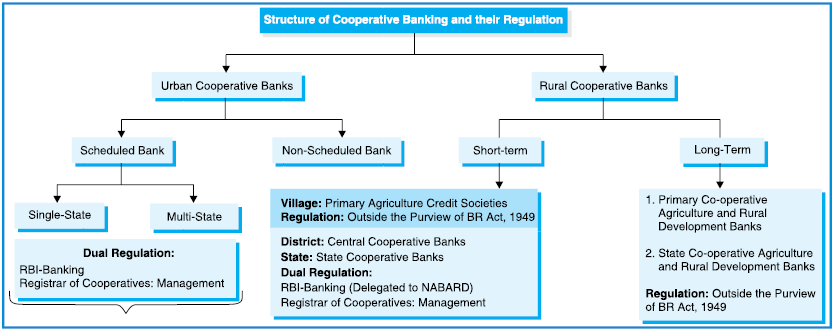
- These banks, under the Banking System in India, are primarily categorized into – Rural Cooperative Banks (RCBS), and Urban Cooperative Banks (UCBS).
- They are further sub-categorised as shown below:
Urban Cooperative Banks (UCBs)
- They operate in urban and semi-urban areas and mainly lend to small borrowers and businesses.
- Based on their regulation regime, they are categorized into two types – Scheduled Banks and Non-Scheduled Banks.
Issues in Urban Cooperative Banks (UCBs)
- Cooperative Banks are facing financial vulnerabilities such as low capitalization, high levels of NPAs, and low Capital Adequacy Ratio (CAR).
- A large number of big Cooperative banks have failed due to financial scams. Ex-Punjab and Maharashtra Cooperative (PMC) bank, Guru Raghavendra Cooperative Bank and Maharashtra State Cooperative (MSC) Bank have failed due to financial frauds.
Reasons for Recurring Issues in the UCBs
- Regulatory Arbitrage: Cooperative banks escape stringent RBI scrutiny compared to commercial banks.
- Political Interference: Many cooperative banks are influenced by local politicians, leading to poor governance.
- Limited Technological Adoption: Many UCBs lack robust digital infrastructure, making them susceptible to operational inefficiencies and fraud.
- Weak Risk Management Practices: Inadequate internal controls result in unchecked lending, increasing bad loans.
Measures to Strengthen the Cooperative Banking Sector
- Capital Adequacy Norms: Cooperative banks should maintain higher capital buffers to withstand financial shocks.
- Technology Upgradation: Adoption of digital banking, fraud detection mechanisms, and improved cyber security measures.
- Consolidation of Weak Banks: Merging smaller, financially weak cooperative banks with larger, stable ones will enhance their resilience.
- Governance Framework: Stricter norms for board composition, qualifications of directors, and independent audits must be enforced.
Government to Lease Out 10 Airports via PPP Model
Syllabus: GS3/ Infrastructure
Context
- The Union government is consulting on leasing out more than 10 airports across the country under the public-private partnership (PPP) model.
- The government is leasing out the airports to improve their management by utilising private sector efficiency and investment.
Public-Private Partnership (PPP) Model
- The Public-Private Partnership (PPP) model is a collaboration between the government and private sector entities to deliver public infrastructure and services efficiently.
- In India, PPPs have been widely used in infrastructure, healthcare, education, and urban development.
- Benefits: It leverages private sector efficiency, investment, and expertise while ensuring public sector oversight and social welfare objectives.
Types of PPP Models
- Build-Operate-Transfer (BOT): The private entity builds the infrastructure, operates it for a specified period, and transfers it back to the government.
- Build-Own-Operate (BOO): The private player builds, owns, and operates the project indefinitely.
- Design-Build-Finance-Operate (DBFO): The private sector designs, builds, finances, and operates the project for a concession period before transferring it.
- Hybrid Annuity Model (HAM): The government provides a portion of the investment, reducing private risk while ensuring efficiency.
- Swiss Challenge Method: A private player proposes a project, and the government invites competing bids before final selection.
Significance of the PPP Model
- Technology Transfer: It facilitates the adoption of modern technology and global best practices.
- Reduces Fiscal Burden: The model lessens the financial pressure on governments by involving private capital.
- Improves Service Efficiency: Private sector expertise brings efficiency, innovation, and quality control.
Concerns with PPP Model
- Regulatory Uncertainty: Frequent policy changes and bureaucratic hurdles deter private investment.
- Financial Viability Issues: Long gestation periods and cost overruns pose financial risks.
- Risk Allocation Disputes: Poorly structured contracts lead to conflicts between private players and the government.
- Delays in Project Execution: Land acquisition issues, environmental clearances, and slow decision-making delay projects.
Government Initiatives for Strengthening PPPs in India
- National Infrastructure Pipeline (NIP): Aims to boost PPP investments across sectors.
- Viability Gap Funding (VGF): Provides financial support for infrastructure projects to enhance their viability.
- India Infrastructure Project Development Fund Scheme (IIPDF): The scheme provides financial support for project development expenses of PPP projects.
- National Monetisation Pipeline (NMP): The initiative was announced in 2021 to create infrastructure by tapping private sector investment.
Concluding remarks
- The PPP model remains a vital tool for infrastructure and service development in India.
- While challenges persist, effective policy measures and innovative financing solutions can maximize the benefits of PPPs, fostering sustainable economic growth.
‘Majorana 1’: A Quantum Chip
Syllabus: GS3/Science & Technology
Context
- Recently, Microsoft has unveiled its groundbreaking quantum computing chip, Majorana 1, marking a significant leap in the field of quantum technology.
Understanding Quantum Computing
- Quantum Computing represents a paradigm shift in the field of computing, promising exponential speed-ups for certain types of problems that classical computers struggle with.
- It is based on quantum mechanics—the branch of physics that deals with subatomic particles.
Working of Quantum Computers
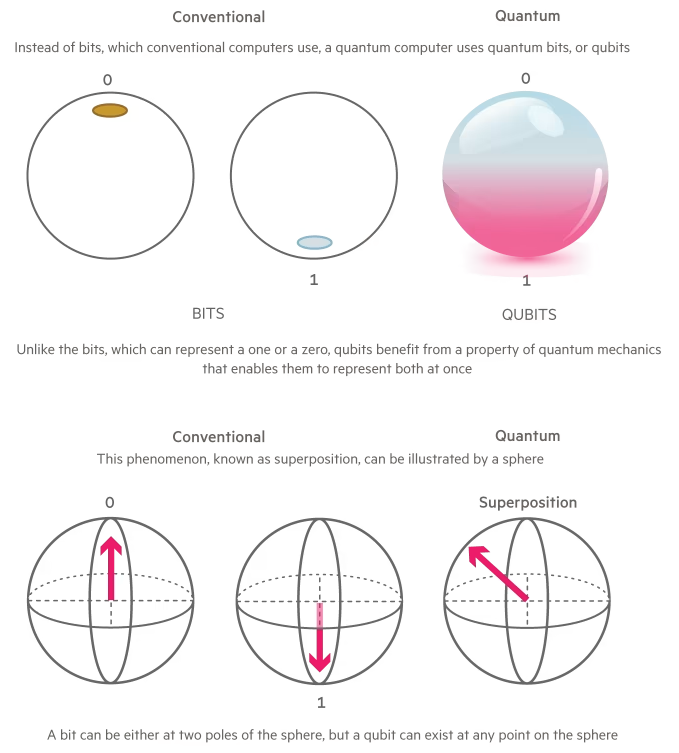
- Quantum computers leverage quantum bits or qubits, which exploit the principles of superposition, entanglement, and quantum interference to perform calculations at unprecedented speeds, process vast amounts of data and make them ideal for solving complex problems.
- Superposition: A qubit can exist in multiple states simultaneously, and can be both 0 and 1 at the same time, exponentially increasing computing power.
- Traditional computers use binary bits (0s and 1s).
- Entanglement: The state of one qubit is instantly correlated with another, regardless of distance, when qubits become entangled. It enables ultra-fast information transfer.
- Quantum Interference: By manipulating quantum states, computations can be optimized to produce highly efficient results.
- Superposition: A qubit can exist in multiple states simultaneously, and can be both 0 and 1 at the same time, exponentially increasing computing power.
Potential Applications of Quantum Computing
- Cryptography: Quantum computers can break traditional encryption algorithms, necessitating the development of quantum-safe cryptographic methods.
- Healthcare and Drug Discovery: Quantum computing can simulate molecular interactions at an atomic level, accelerating the discovery of new drugs and treatments.
- Artificial Intelligence (AI) and Machine Learning: Quantum algorithms can enhance AI models by solving optimization problems much faster than classical computers.
- Financial Modeling: Quantum computers can analyze vast datasets to predict market trends with greater accuracy.
- Climate Modeling: Quantum simulations can improve climate predictions by analyzing complex atmospheric interactions.
Key Milestones
- IBM’s Qiskit: It is an open-source quantum computing framework, allows researchers and developers to experiment with quantum algorithms.
- IBM Eagle Processor (world’s first 127-qubit processor) and Condor (in 2023).
- Microsoft’s Quantum Computing Approach:
- Quantum Development Kit (QDK): A platform that allows developers to build quantum applications using the Q# programming language.
- Topological Qubits (highly stable qubits with lower error rates).
| Majorana 1 – It uses a new class of materials called topoconductors, which enable the creation of topological qubits (Topological Core Architecture). 1. These qubits are more stable and less prone to errors compared to traditional qubits. – Innovative Material Stack: The chip is built using a combination of Indium Arsenide (a semiconductor) and Aluminum (a superconductor), creating a pristine environment for Majorana particles. |
Challenges and Concerns
- Hardware Limitations: Maintaining quantum coherence in qubits is extremely difficult due to environmental interference.
- Error Correction: Quantum computers are highly susceptible to errors, requiring sophisticated error-correction techniques.
- Scalability: Building large-scale quantum systems that outperform classical computers remains a challenge due to the need for advanced cryogenic technology, making their development and maintenance highly expensive.
- Security Risks: Quantum computers could break existing encryption algorithms, necessitating new cryptographic standards.
Quantum Computing Research in India
- National Quantum Mission (NQM): With budget outlay of Rs.6003.65 crore from 2023-24 to 2030-31.
- It aims to work towards strengthening India’s research and development in the quantum arena alongside indigenously building quantum-based (physical qubit) computers.
- National Mission on Quantum Technologies & Applications (NM-QTA): It was announced in the Union Budget (2020) with an allocation of ₹8,000 crores.
- Research institutions such as the Indian Institute of Science (IISc) and IITs are advancing quantum computing research.
- Department of Science and Technology (DST): It has launched various projects focused on quantum communication, quantum cryptography, and quantum materials.
- Quantum-enabled Science & Technology (QuEST) is for fostering quantum research and capacity building.
- Centre for Development of Advanced Computing (C-DAC) and the DRDO are exploring quantum computing applications for national security and defense.
