
Trump Disruption in Five Eyes Intelligence Alliance
Syllabus: GS2/International Relations
Context
- The Five Eyes intelligence alliance is facing challenges due to shifts in U.S. foreign policy during the Presidency of Donald Trump.
About the Five Eyes Intelligence Alliance (FVEY)
- It is one of the most powerful and secretive intelligence-sharing alliances in the world, comprising the United States, the United Kingdom, Canada, Australia, and New Zealand.
- Origins and Evolution:
- The foundation of Five Eyes was laid during the Second World War when the US and UK signed the UKUSA Agreement in 1946, formalizing their intelligence-sharing mechanism.
- Canada (1948), Australia (1956), and New Zealand (1956) later joined, creating a trusted circle of Anglo-Saxon nations dedicated to seamless intelligence collaboration.
- Initially focused on monitoring Soviet communications during the Cold War, the alliance adapted over time to cover terrorism, cyber warfare, and threats from rising global powers.
- It operates primarily through agencies such as:
- United States: National Security Agency (NSA)
- United Kingdom: Government Communications Headquarters (GCHQ)
- Canada: Communications Security Establishment (CSE)
- Australia: Australian Signals Directorate (ASD)
- New Zealand: Government Communications Security Bureau (GCSB)
- It uses advanced surveillance tools such as the ECHELON system, a vast global interception network capable of monitoring communications across various platforms, including emails, phone calls, and online activities.
Functions and Intelligence-Sharing Mechanism
- Signal Intelligence (SIGINT): Monitoring electronic communications, satellite data, and cyber threats.
- Human Intelligence (HUMINT): Gathering intelligence from spies and undercover agents.
- Geospatial Intelligence (GEOINT): Satellite imagery and mapping for security and military operations.
- Cyber Intelligence: Tracking cyber threats, hacking attempts, and state-sponsored cyber espionage.
- Counterterrorism Intelligence: Monitoring global terror networks, preventing radicalization, and foiling attacks.
- Geopolitical Monitoring: Keeping track of developments in regions of strategic interest, such as the Indo-Pacific and the Middle East.
Controversies and Challenges
- Privacy Concerns: Revelations by whistleblowers, such as Edward Snowden, have raised concerns about mass surveillance and the potential misuse of collected data.
- Geopolitical Tensions: The alliance’s focus on monitoring nations like China and Russia has led to diplomatic tensions.
- Internal Frictions: Differences in policy priorities and approaches among member nations occasionally create friction within the alliance.
Five Eyes in the 21st Century
- China and Russia: The alliance is increasingly focused on countering China’s expanding influence in technology, trade, and security.
- Similarly, Russia’s hybrid warfare strategies, including disinformation campaigns and cyberattacks, are closely monitored.
- Counterterrorism and Extremism: Post 9/11, counterterrorism became a primary objective, leading to extensive surveillance programs targeting terror organizations like Al-Qaeda and ISIS.
- Intelligence-sharing among the Five Eyes nations has helped prevent several major terror plots globally.
- Cybersecurity and Artificial Intelligence (AI) Threats: Aiming to counter ransomware attacks, data breaches, and AI-driven disinformation campaigns.
- Surveillance and Privacy Concerns: Whistleblowers like Edward Snowden exposed controversial mass surveillance programs like PRISM, raising ethical questions about the alliance’s activities.
- Governments defend these practices as necessary for national security, but concerns over privacy violations persist.
Geopolitical Implications: A Challenge for India?
- India, though not part of Five Eyes, has engaged in limited intelligence-sharing with the alliance, particularly in counterterrorism and cyber threats.
- Recently, a conference of global intelligence and security chiefs, held in New Delhi, India, brought together intelligence chiefs from over 20 countries, including representatives of Five Eyes alliance nations.
- The possibility of expanding the group to include partners like India, Japan, and Germany has been discussed, but remains a subject of debate due to trust issues and strategic concerns.
Mangrove Forest Cover Increase
Syllabus :GS 3/Environment
In News
Tamil Nadu’s mangrove forest cover has nearly doubled from 4,500 ha in 2021 to 9,039 ha in 2024, due to new plantations and preservation of existing mangroves.
Mangroves
- Mangroves are salt-tolerant plants found in tropical and subtropical intertidal regions, providing refuge for coastal biodiversity and acting as bio-shields against extreme climatic events.
- They are adapted to thrive in coastal regions with brackish water and wet, loose soil.
- They have tangled prop roots that help them survive tides and capture sediments while slowing water flow.
Importance
- Climate Change Mitigation: Mangroves stabilize coastlines, reduce erosion, encourage biodiversity, and protect coastal communities from sea-level rise and natural disasters.
- Carbon Sinks: Mangroves store carbon at up to four times the rate of terrestrial forests, making them vital for achieving net zero emissions .
- Ecosystem and Habitat Support: Mangroves support interconnected terrestrial, freshwater, and marine habitats, including species like Royal Bengal Tigers and river dolphins.
- They capture sediments, create fertile lands, and help marine life thrive by making water clearer.
- Disaster Risk Reduction: Mangroves act as the first line of defense against tropical storms, cyclones, and hurricanes, slowing down winds and minimizing land impact.
- Socio-economic Importance: Mangroves provide critical jobs and protein for millions of small-scale fishers worldwide
- They are also important for sustainable timber and fuelwood collection.
| Do you know ? – The Bay of Bengal coastline is home to India’s largest mangrove forest with 60 per cent of its mangrove cover concentrated there because of the Sundarbans. – The Arabian Sea coast accounts for 27 per cent of mangrove area while the Andaman and Nicobar Islands account for 13 per cent. – The Sundarbans in West Bengal is the largest mangrove region in the world and a UNESCO World Heritage Site. It spans from the Hooghly River in West Bengal to the Baleswar River in Bangladesh. 1. India’s Sunderbans mangroves are a biodiversity hotspot, home to endangered species like the Royal Bengal Tiger, fishing cats, and macaques. |
Threats
- The mangrove ecosystem faces pressures from population growth, land demand, and the need for resources like timber, fodder, fuel-wood, and fisheries.
- Aquaculture and fisheries obstructing tidal flow are significant threats to mangrove ecosystems.
- Agricultural and industrial activities in Coastal Regulation Zone areas have led to mangrove destruction.
Steps
- MISHTI Initiative: The government’s MISHTI initiative, aiming for large-scale mangrove plantation,is implemented through the MGNREGS, CAMPA Fund, and other sources.
- The MISHTI initiative aligns with India’s Nationally Determined Contributions to create an additional 2.5-3 billion tonnes of carbon dioxide equivalent carbon sink by 2030.
- Mangrove Alliance for Climate : India joined the Mangrove Alliance for Climate at the 27th Conference of the Parties in Egypt to address climate change.
Suggestions and Way Forward
- Mangroves play a crucial role in global conservation efforts by storing significant amounts of carbon, helping mitigate climate change and reducing greenhouse gas emissions.
- Mangroves are key guardians of coasts and essential for the environment and communities, making their conservation a necessary priority.
- There is a need to promote sustainable livelihoods such as eco-tourism and carbon credit programs, as well as district-specific planning for the preservation and expansion of mangrove ecosystems.
India and New Zealand resumed trade deal talks after decade
Syllabus :GS 2/IR
In News
India and New Zealand announced the resumption of negotiations for a Free Trade Agreement (FTA) .
| Do you know ? – India is aiming to conclude trade negotiations with the US and the European Union in 2025. – Ongoing negotiations with Australia for a comprehensive trade deal and renegotiations of the ASEAN trade deal. |
Historical Linkages of India and New Zealand relations
- They have shared warm diplomatic ties since 1952, with similarities in Commonwealth membership, common law practices, and democratic governance.
- Tourism and sports, particularly cricket, hockey, and mountaineering, have fostered goodwill.
- In 2011, New Zealand identified India as a priority country through its “Opening Doors to India” policy and launched the NZ Inc. India Strategy to strengthen trade, economic, and political ties.
- The 2020 strategy paper, “India-NZ 2025 – Investing in the Relationship,” aims to build a long-term strategic relationship with India.
Bilateral Trade (2023-24):
- New Zealand exported goods/services worth US$ 0.84 billion to India and imported US$ 0.91 billion, with total trade valued at US$ 1.75 billion.
- India’s imports: Wool, Iron & Steel, Fruit & Nuts, Aluminium.
- India’s exports: Pharmaceuticals, Mechanical Machinery, Made-up Textile Articles, Pearls, Precious Stones & Metals.
Defence Cooperation
- Defence ties reflect overall friendly relations.
- INSV Tarini’s port call in New Zealand (Dec 2024-Jan 2025).
- INS Sahyadri and INS Kolkata visited New Zealand (Aug-Sept 2023).
- India contributes staff to Combined Task Force 150, led by RNZ Navy from January 2025.
Customs Cooperation
- In August 2024, India and NZ signed a Customs Cooperative Arrangement to boost trade and fight organized crime.
International Solar Alliance
- New Zealand ratified the International Solar Alliance during the President’s state visit to Wellington (Aug 2024).
Education:
- India is the 2nd largest source of international students in NZ, with approximately 8,000 Indian students in various fields (IT, hospitality, science, engineering, architecture).
People-to-People and Cultural Ties:
- There is strong cultural cooperation due to a large Indian diaspora in NZ.
- Indian festivals like Diwali, Holi, Baisakhi, Onam are celebrated with enthusiasm.
- Schools in NZ teach Indian traditional arts (Kathak, Bharatnatyam), Bollywood dance, and languages like Hindi.
Sports:
- Close sporting links, especially in cricket, hockey, and mountaineering.
- Sir Edmund Hillary, a NZ hero, is iconic in India for his mountaineering achievements.
Latest Developments
- The two countries started negotiating the Comprehensive Economic Cooperation Agreement (CECA) in April 2010 to promote trade in goods, services, and investment.
- Talks were stalled in 2015 after nine rounds of discussions.
- The aim of the FTA negotiations is to achieve balanced outcomes, enhance supply chain integration, and improve market access.
Challenges
- India seeks better access for skilled professionals and the IT/services sector, while New Zealand resists offering work opportunities like those for Australia and China.
- India withdrew from RCEP in 2019 over market access concerns.
- New Zealand has a low average import tariff (2.3%), while India’s is higher (17.8%), requiring significant reductions.
- New Zealand also seeks greater access to India’s protected dairy market.
Conclusion and Way Forward
- India and New Zealand share a strong and evolving relationship based on mutual respect and shared goals.
- With ongoing efforts to strengthen ties in trade, defense, education, and cultural exchanges, their partnership is set to grow, ensuring a more resilient and prosperous future for both nations.
Alarming Surge in Global Sea Levels in 2024
Syllabus :GS 3/Environment
In News
NASA reported that global sea levels rose faster than expected in 2024, reaching 0.59 cm per year, surpassing the anticipated 0.43 cm.
Global Mean Sea Level
- Global mean sea level provides an integrative measure of the state of the climate system, encompassing both the ocean and cryosphere (ice covered portions of Earth).
- It is the average height of the entire ocean surface.
- It is a key indicator of climate change, reflecting changes in both the ocean and ice-covered regions.
Causes of Global Mean Sea Level changes
- Ice Melt: Warming causes ice sheets and glaciers to melt, adding freshwater to the ocean.
- Thermal Expansion: As oceans absorb heat, water expands, raising sea levels.
- In 2024, thermal expansion contributed to two-thirds of the rise, a shift from previous years when melting ice was the dominant factor.
- It was also the warmest year on record, with Earth’s oceans at their highest levels in three decades. Since 1993, global sea levels have risen by 10 cm, with the rate of rise more than doubling.
- Land Water Storage: Changes in water storage on land, such as groundwater pumping or dam building, can alter the amount of water in the ocean.
- Climate change is the primary driver of global sea level rise.
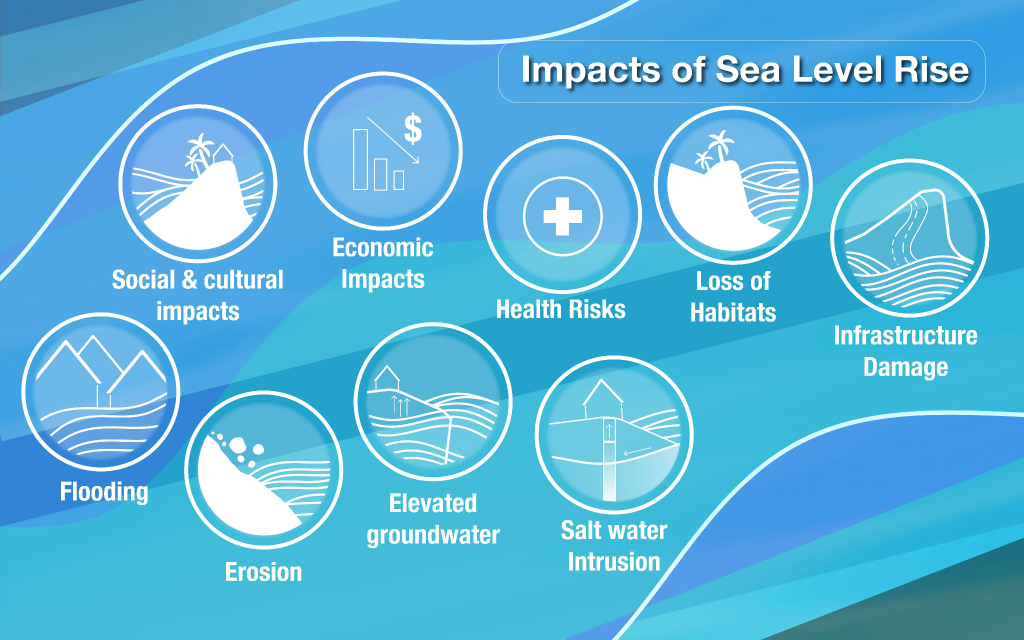
Effects of Global Sea Level Rise
- Threatens infrastructure, including roads, bridges, and buildings, leading to increased repair costs.
- Causes more frequent and severe coastal flooding, exacerbating erosion and saltwater intrusion into freshwater supplies.
- Endangers coastal ecosystems (e.g., mangroves, coral reefs) and displaces people in low-lying areas, causing social and economic challenges.
- Economic and Social Impacts: Rising seas lead to higher costs for coastal protection (e.g., sea walls) and infrastructure repairs.
- Displacement of communities and loss of livelihoods (tourism, fishing, agriculture) due to coastal flooding and erosion.
- Disrupts economic activities and places strain on social services, especially in vulnerable regions.
Countries Most Affected by Rising Sea Levels:
- High-Risk Countries: Bangladesh, China, India, and the Netherlands are highly vulnerable.
- Pacific Island Nations: Kiribati, Tuvalu, and the Marshall Islands face extreme risks due to high exposure to storms and sea-level sensitivity.
What can be done to counter sea level rise?
- Reduce Greenhouse Gas Emissions: The most important action is to slow global warming by cutting emissions, the primary cause of climate change and sea level rise.
- Mitigation and Adaptation: Build infrastructure like sea walls and storm surge barriers to protect against flooding and erosion.
- Improve drainage systems and construct flood-resistant buildings.
- Restore natural barriers like mangroves, wetlands, and coral reefs to absorb wave energy and reduce storm surge impacts.
- Disaster Risk Reduction: Strengthen disaster risk reduction plans and enhance early warning systems, supported by the UN, to address sea level-related incidents.
- In some cases, relocate communities from vulnerable coastal areas as part of adaptation strategies.
India’s Electronics Manufacturing and Export Market
Syllabus: GS3/ Economy
Context
- The IT Ministry has launched a Rs 23,000 crore incentive policy over six years to enhance domestic electronic components manufacturing.
About
- India aims to boost domestic value addition in smartphone manufacturing from 15-20% to 30-40% by promoting local production of key electronic components.
- Key Features of the policy to boost production is as;
- Offers incentives in three forms: based on operational expenses (net incremental sales), capital expenses (eligible investments), or a combination of both.
- Targets the manufacturing of critical components like display modules, camera modules, PCBAs, lithium cell enclosures, resistors, capacitors, and ferrites.
- Annual incentives ranging between Rs 2,300 crore and Rs 4,200 crore.
- Open to both greenfield (new) and brownfield (existing) investments.
Global Scenario of Electronics sector
- The global electronics market is estimated at US$ 4.3 trillion.
- The electronics GVC is intricate, with a select group of nations like China, Taiwan, the USA, South Korea, Vietnam, Japan, Mexico, and Malaysia.
- China is the world’s largest electronics producer, accounting for nearly 60% of worldwide electronics production.
India’s electronics sector
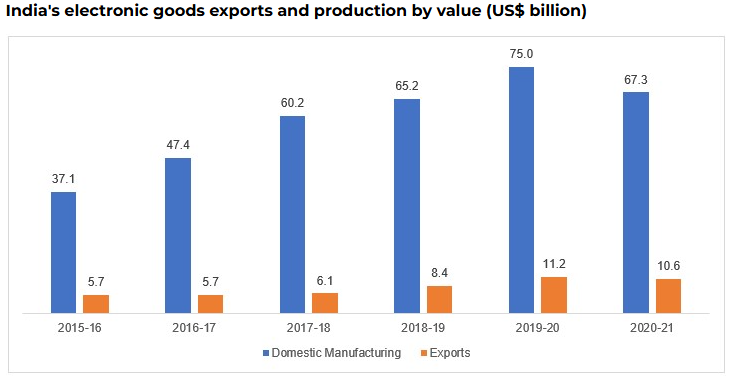
- India’s electronics sector reached USD 155 billion in FY23.
- The electronics production nearly doubled from USD 48 billion in FY17 to USD 101 billion in FY23, driven primarily by mobile phones which constitute 43% of total electronics production.
- This comprises USD 86 billion in finished goods production and USD 15 billion in components manufacturing.
- The country’s electronics export is expected to reach $120 Bn by FY26.
- During May 2024, electronic goods exports were recorded at $2.97 Bn as compared to $2.41 Bn during May 2023, registering a growth of 22.97%.
Government initiatives
- Make in India, Digital India, and Startup India for promoting domestic manufacturing and technological innovation.
- Production Linked Incentive Scheme (PLI): The scheme aims to attract large investments in the mobile phone manufacturing and specified electronic components, including Assembly, Testing, Marking and Packaging (ATMP) units.
- National Policy on Electronics 2019 (NPE 2019) It is a comprehensive framework to develop India as a global hub for electronics manufacturing.
- Modified Electronics Manufacturing Clusters (EMC 2.0) develops infrastructure with common amenities and industrial clusters for electronics production.
- In India 100% FDI is allowed under the automatic route. In the case of defense electronics, FDI up to 49% is allowed through automatic route and beyond 49% requires government approval.
- Scheme for setting up of Semiconductor Fabs in India provides fiscal support to eligible applicants for setting up of Semiconductor Fabs which is aimed at attracting large investments for setting up semiconductor wafer fabrication facilities in the country.
Challenges in electronics sector
- Market Competition: The global electronics market is dominated by countries like China, Taiwan, USA, South Korea, Vietnam and Malaysia.
- India currently exports approximately USD 25 billion annually, representing less than 1% of the global share.
- High Investment-to-Turnover Ratio: Unlike finished products like smartphones (where ₹1 investment generates ₹20 revenue), component manufacturing yields only ₹2-4 per rupee invested.
- Technical Skills: There is a lack of adequately trained technical personnel for advanced manufacturing processes.
- Capital Intensive industry: Electronic manufacturing is a complex and technology-intensive sector with huge capital investments, high risk, long gestation and payback periods, requiring significant and sustained investments.
Way Ahead
- India has set a target to achieve 500 billion USD in electronics manufacturing in value terms by 2030.
- To enhance competitiveness, India needs to localize high-tech components, strengthen design capabilities through R&D investments, and forge strategic partnerships with global technology leaders.
US-China trade war 2.0
Syllabus: GS2/ International Relations, GS3/ Economy
Context
- The ongoing trade war between the United States and China has caused significant global economic turbulence, influencing everything from tariffs on goods to the financial markets and international relations.
What is a Trade War?
- A trade war occurs when nations impose tariffs or trade barriers against each other in retaliation for perceived economic harm or unfair trade practices.
- It disrupts global supply chains, increases production costs, and impacts economic growth worldwide.
Background
- The US-China trade war began in 2018 when the US, under President Donald Trump, accused China of unfair trade practices.
- The US imposed tariffs on Chinese goods, leading to countermeasures from China. This escalation affected trade worth over $450 billion.
- India also got caught in the US-China trade war, facing tariffs on steel and aluminum exports and losing its Generalized System of Preferences (GSP) status in 2019.
- In February 2025, President Trump reintroduced a 10% tariff on all Chinese imports, prompting China to retaliate with its own set of tariffs.
- Trump’s reciprocal tariff policy is set to take effect from April 2.
- Trump’s policy aims to balance trade by imposing tariffs on countries that impose high tariffs on US goods.
- The policy is designed to reduce the US trade deficit and generate tariff revenue.
Global impact of Trade War
- Stock Market Volatility: Trade wars create uncertainty, leading to fluctuating stock prices. Investors react sharply to tariff announcements, impacting market stability worldwide.
- Supply Chain Disruptions: Tariffs increase production costs, forcing companies to rethink supply chains. Businesses look for alternative suppliers, leading to relocation of manufacturing hubs.
- Currency Fluctuations: As investors seek safer assets, emerging market currencies often depreciate, increasing import costs and inflationary pressures in developing economies.
- Commodity Price Swings: Trade wars can disrupt global demand for raw materials like oil, metals, and agricultural products, leading to price instability.
- Shifts in Trade Alliances: Countries seek new trading partners to mitigate tariff impacts. Regional trade agreements and economic blocs often gain prominence during such periods.
Negative Impact on India
- Electronics and Gadgets: Indian manufacturers depend on Chinese components for smartphones, laptops, and appliances. Disruptions in supply chains may lead to higher prices and shortages.
- Pharmaceuticals: Around 70% of India’s raw materials (APIs) for medicines come from China. Any delay or price hike in these imports will raise the cost of essential medicines.
- Automobile Industry: India’s auto sector relies on Chinese spare parts. Trade disruptions could slow production, increase costs, and extend delivery timelines.
- Stock Market and Currency: During the last trade war, foreign investors withdrew ₹33,000 crore from Indian markets, and the rupee depreciated by 9.5%, making imports costlier.
Positive Impact on India
- Rise in Exports: Indian exporters gained from the trade diversion as US buyers looked for alternatives to Chinese goods. Sectors like textiles, chemicals, and electronics saw increased demand.
- Boost to Indian IT Sector: US companies, reducing reliance on Chinese tech, outsourced more work to Indian firms, benefiting the IT industry.
- Agricultural Exports: India took advantage of China reducing US agricultural imports in 2018 by increasing soybean and other crop exports.
Way Ahead
- Geopolitical Strategy: India must navigate the US-China trade tensions carefully while securing its own economic interests through diplomacy and trade partnerships.
- Diversifying Supply Chains: Reducing reliance on China by strengthening domestic manufacturing under initiatives like ‘Make in India’ and boosting alternative supplier networks.
- Strengthening Trade Agreements: India should negotiate favorable trade deals with the US, ASEAN, and EU to capitalize on shifting trade dynamics.
Concluding Remarks
- Trade wars might seem like distant problems involving big governments, but their effects trickle down to everyday life.
- The global economy is more connected than ever. When two giants like the U.S. and China clash, the rest of the world, especially countries like India, feels the impact.
- While some sectors might find opportunities, overall uncertainty tends to slow down growth and affect livelihoods.
- The US is India’s largest trading partner, so India must accommodate US interests to maintain a good relationship.
