
Concerns Raised over the Amendment into the RTI Act, 2005
Syllabus: GS2/Governance
Context
- Over 30 civil society organisations are urging the Union government to preserve the Right to Information Act, 2005.
About
- Concern Raised: Organizations urge the government to avoid fully implementing changes to the RTI Act through the Digital Personal Data Protection Act (DPDP) of 2023.
- Section 8(1)(j) of the RTI Act now includes a blanket prohibition on disclosing personal information, even if it serves the public interest.
- Government’s Position: The government defends the change, citing the Supreme Court’s judgment on the Right to Privacy (Justice K.S. Puttaswamy case, 2017) as a fundamental right.
- Concerns Raised by Activists:
- The change makes it harder to access information vital for social audits and uncovering misuse of public funds or corruption.
- RTI requests have been critical in verifying government programs and ensuring accountability, e.g., checking food ration distribution.
- The original RTI Act balanced privacy and transparency; they reject the argument that the changes align with the Supreme Court’s privacy ruling.
Right to Information Act (RTI), 2005
- Aim: It was designed to promote transparency in the functioning of the government by giving citizens the right to access information from public authorities.
- Scope: The Act applies to public authorities, which include government departments, ministries, and organizations that are substantially funded by the government.
- Information Accessible to the Public: Citizens have the right to request information from public authorities. This includes the right to access records, documents, and other information.
- Exclusions: Information that may compromise national security, breach confidentiality, or harm the integrity of ongoing investigations.
- Timeframe for Response: Public authorities are required to respond to information requests within 30 days. In certain cases, this period can be extended to 45 days.
- Penalties: The Act provides for penalties against officials who withhold information without reasonable cause or provide false information.
Significance of the Act
- Empowers Citizens: By accessing information from public authorities, promoting transparency and accountability in government.
- Holds Government Accountable: Helps in holding public authorities accountable for their actions, preventing corruption.
- RTI helped uncover misuse of funds in the Mahatma Gandhi National Rural Employment Guarantee Scheme (MGNREGS).
- Promotes Good Governance: It strengthens democratic processes by ensuring that the government operates transparently, fostering public trust.
- Enables Social Audits: Activists and NGOs use RTI to perform social audits of government schemes and services.
- RTI was used to check if food rations were correctly distributed under the Public Distribution System (PDS).
- Access to Public Records: RTI requests have been used to obtain details of government contracts, exposing corruption or inefficiencies.
- Strengthens Democracy: Provides a tool for citizens to actively participate in the decision-making process, enhancing democracy.
Criticism of the Act
- Overburdening Public Authorities: It has led to an overload of information requests, putting a strain on public authorities and diverting attention from their primary duties.
- Misuse of the Act: Some individuals or groups use RTI requests as a tool for harassment or to settle personal or political scores, leading to unnecessary administrative burdens.
- Delay in Processing Requests: Despite the stipulated time frames for response, some public authorities struggle to adhere to these deadlines, causing frustration among information seekers.
- Capacity and Training Issues: Some public authorities lack the necessary infrastructure, manpower, and training to effectively implement the RTI Act.
- Exemptions and Ambiguities: The Act’s provisions regarding exemptions are sometimes vaguely defined, this ambiguity can be exploited to withhold information that should ideally be in the public domain.
Way Ahead
- The RTI Act has played a significant role in promoting transparency, reducing corruption, and empowering citizens to actively participate in the democratic process by holding government institutions accountable.
- It is a powerful tool for promoting good governance and ensuring that citizens have access to information that affects their lives.
- Parliament must codify clear definitions of what constitutes “personal information” and “public interest”.
- Disclosure of personal information should be allowed if it serves a larger public good, such as exposing corruption, ensuring delivery of entitlements, or verifying misuse of public funds.
- Draft rules and amendments should be done with multi-stakeholder consultation, including RTI activists, data protection experts, and legal scholars.
Fast Track Special Courts
Syllabus: GS2/ Polity, Judiciary
In Context
- With an disposal rate of 96.28%, Fast Track Special Courts (FTSCs) have significantly expedited justice for survivors of sexual crimes by ensuring swift legal proceedings in cases of rape and offenses under the POCSO Act.
- The Protection of Children from Sexual Offences (POCSO) Act, 2012 is a gender-neutral law aimed at safeguarding children from sexual crimes.
What are Fast Track Special Courts (FTSCs)?
- About: They are dedicated courts set up in India to reduce the pendency of cases involving heinous crimes like rape and child sexual abuse by delivering time-bound justice.
- Establishment: Initiated in 2019 by the Department of Justice, Ministry of Law & Justice, as a Centrally Sponsored Scheme with funding shared between the central and state governments.
- 60:40 (Centre:States) for most States/UTs with Legislature.
- 90:10 for Northeastern and Hilly States/UTs.
- Target: Under the Scheme, a total of 790 FTSCs, including exclusive POCSO (e-POCSO) courts, are to be set up.
- Each FTSC is expected to dispose of 41-42 cases per quarter and at least 165 cases annually to ensure timely justice and case backlog reduction.
Need for Fast Track Special Courts (FTSCs)
- The Supreme Court of India in 2019 issued directives for the speedy disposal of POCSO cases as both the Criminal Procedure Code (CrPC) and the POCSO Act, 2012 mandate strict timelines for investigation and trial.
- Inadequate judicial resources leading to prolonged trials. Delayed justice fails to serve victims and weakens the law’s deterrent effect.
- By speeding up the judicial process, FTSCs help to send a clear message that society will not tolerate these crimes.
Key Recommendations by Indian Institute of Public Administration (IIPA)
- Continuation of the Scheme: FTSCs must continue, as they are essential for ensuring streamlined and expedited trials in cases of sexual violence.
- Strengthening Judicial Infrastructure: States and High Courts should appoint special judges experienced in handling POCSO cases. Ensure sensitization training for judicial officers and staff.
- Technological Upgradation of Courtrooms: Equip courtrooms with audio-video recording systems, e-filling of cases & digitization of court records.
- Strengthening Forensic Support: Increase the number of Forensic Labs & train manpower with necessary skills.
- Ensure timely submission of DNA reports, thereby accelerating trials and ensuring fair justice.
- Establishment of Vulnerable Witness Deposition Centres (VWDCs): Set up VWDCs in every district to enable sensitive and child-friendly recording of testimonies.
- Appoint a child psychologist at every FTSC to assist victims through the pre-trial and trial processes.
Sub-categorisation of SCs in Andhra Pradesh
Syllabus :GS 2/Governance
In News
- The Andhra Pradesh Cabinet approved the one-member commission’s recommendations on the sub-categorisation of Scheduled Castes (SCs) to ensure equitable distribution of benefits.
- The demand for sub-categorisation has been ongoing for over 30 years, with earlier efforts including the Justice Ramachandra Rao Commission in 1996.
Sub-categorisation
- It divides the SC category into smaller sub-castes to ensure fair distribution of benefits, especially in reservations for education, employment, and affirmative action.
Historical Context & SC Rulings
- In 1975, Punjab issued a notification giving first preference in SC reservations to the Balmiki and Mazhabi Sikh communities, two of the most backward communities in the state.
- This was challenged in 2004 after the apex court struck down a similar law in Andhra Pradesh in E V Chinnnaiah.
- SC held that SCs and STs form a single, indivisible class once included in the Presidential list under Article 341/342.
- Said States could not sub-classify or create quotas within SC/ST reservations.
- In 2020, the Supreme Court ruled that the 2004 decision in E.V. Chinnaiah should be reconsidered, recognizing inequality within the SC list.
- It acknowledged that there are “unequals within the list of SCs” and noted the concept of the “creamy layer” now applies to SCs, as established in the 2018 ruling in Jarnail Singh v Lachhmi Narain Gupta.
- In 2024, the Supreme Court allowed sub-classification within Scheduled Castes (SCs) and Scheduled Tribes (STs) to extend affirmative action benefits, with strict guidelines for its implementation.
- The ruling clarified that Article 341 does not prevent sub-classification; it only limits the President’s power to add or exclude SC groups.
Arguments in Favour
- States argued that some SCs/STs are underrepresented despite reservation, leading to proposals for separate quotas within the SC/ST categories.
- SCs are not a “homogeneous class”; some are more disadvantaged than others, justifying sub-classification.
- Article 14 allows sub-classification to achieve substantive equality, addressing differences within SC/ST groups.
- It could lead to a caste census to assess representation and address inequities in reservation distribution.
Arguments against
- Some argue that Sub-classification would open the door for political manipulation of reservations, violating the constitutional intent.
- It violates the Constitution by altering the President’s list of SCs, which can only be changed by Parliament.
Conclusion and Way Forward
- States might have the legal backing to sub-classify SCs, but it must ensure the process is backed by data and is fair, with judicial oversight to prevent misuse.
- Sub-classification must be based on “quantifiable and demonstrable data,” not political motives, to ensure equitable benefits among different SC/ST groups.
- States must devise a policy to exclude the “creamy layer” (wealthier members of backward classes) within SC/STs from reservation benefits to achieve true equality.
Production Linked Incentive Scheme
Syllabus: GS3/ Economy & Development
In News
- The Government has decided not to extend the PLI Scheme beyond the existing 14 sectors.
- Despite initial success in some areas, the scheme underperformed in others and saw delays in incentive payouts.
More About the News
- Out of the $23 billion allocated, only $1.73 billion (8%) has been disbursed as of October 2024.
- $151.93 billion worth of goods have been produced under the scheme—just 37% of the original target. Firms like Foxconn, Reliance, and Adani faced delays, unmet targets, or non-compliance.
- Hence, the government has declined requests to extend production deadlines or add new sectors to the scheme.
About the PLI Scheme
- Lauch: In 2020 under the Ministry of Commerce & Industry with an outlay of ₹1.97 lakh crore.
- Sectors Included: It covers 14 sectors (Mobile, Pharma, Auto, ACC Battery, Telecom, White Goods, Solar, etc.)
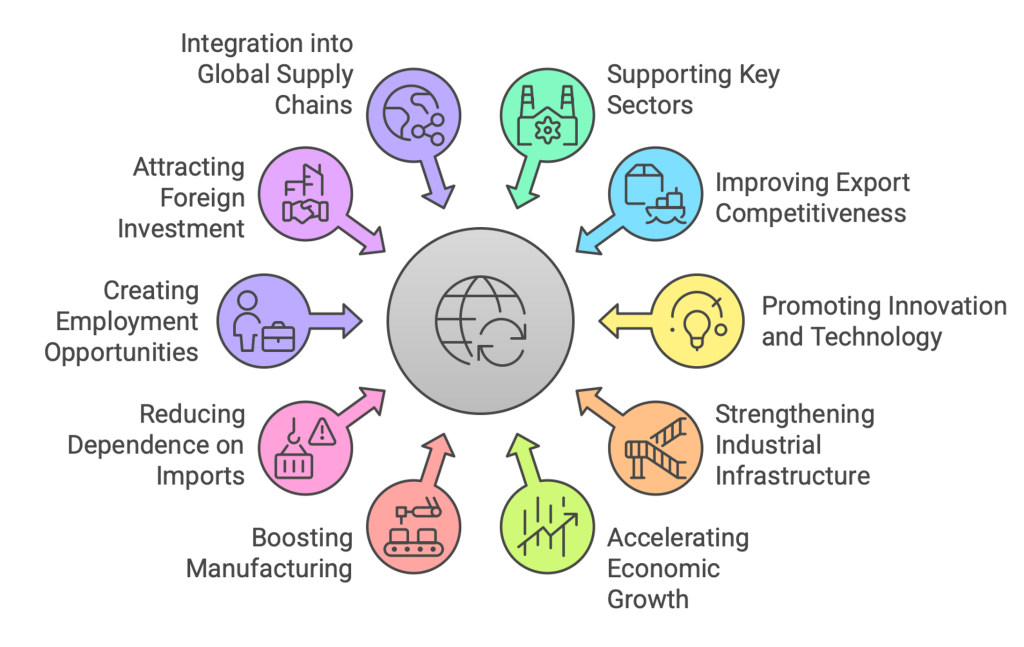
- Objectives: It offers incentives to eligible firms on incremental sales for five years as part of the Make in India initiative.
- It aims to reduce India’s dependence on foreign countries like China and increase employment in labor-intensive sectors.
- Raise manufacturing’s share in GDP to 25% by 2025
- Incentive Mechanism: 4–6% on incremental sales over a base year.
- Applicable to both domestic and foreign companies registered in India.
Benefits of PLI Scheme
- Electronics Success: India produced $49 billion worth of mobiles in FY 2023–24; Apple now manufactures high-end models in India.
- Pharmaceutical Growth: Exports nearly doubled to $27.85 billion from a decade ago.
- Boosted FDI inflow, helped develop core industries, and supported India’s ‘China Plus One’ strategy.
- Encouraged production in strategic sectors (e.g., semiconductors, solar modules).
Issues and Concerns
- Low Disbursement: Only 8% of incentives disbursed despite meeting targets.
- Delays in Subsidies: They are not released on time, eventually affecting cash flow.
- Unmet Targets: Many firms failed to initiate or scale up production.
- Red Tapism: Bureaucratic hurdles and rigid compliance conditions.
- No GDP Boost: Manufacturing share fell from 15.4% to 14.3% (2020–2024).
1st Glacier Declared Dead from Climate Change
Syllabus: GS3/Environment and Conservation
Context
- Satellite images taken more than three decades apart show the disappearance of Iceland’s Okjökull.
- It was the first glacier to be officially declared dead as a result of human-caused climate change in 2014.
About
- Okjökull was a dome-shaped glacier situated around the summit crater on Ok, a 1,200 meters shield volcano located 71 kilometers northwest of Reykjavík, Iceland.

- In 2023, Iceland also created the world’s first iceberg graveyard, where ice-like headstones were constructed for the 15 major glaciers listed on the Global Glacier Casualty List, all of which are either dead or critically endangered.
- This list includes the Anderson Glacier in Washington state, which, in 2015, became the first U.S. glacier to be declared dead.
| Do you Know? – The United Nations declared 2025 as the International Year of Glaciers’ Preservation, accompanied by the proclamation of the 21st March of each year as the World Day for Glaciers starting in 2025. |
Earth’s Cryosphere
- Cryosphere: The term “cryosphere” originates to the Greek word ‘kryos’ for frost or ice cold.
- It includes the components of the Earth System at and below the land and ocean surface that are frozen.
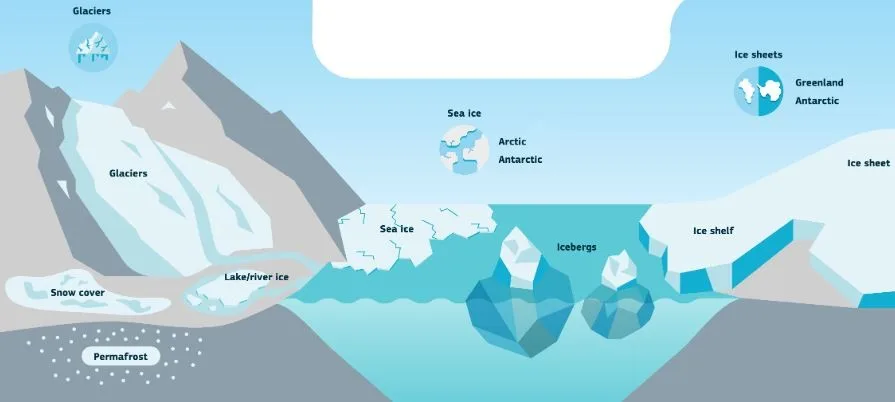
- They include snow cover, glaciers, ice sheets, ice shelves, icebergs, sea ice, lake ice, river ice, permafrost, and seasonally frozen ground, and solid precipitation.
- An ice sheet is defined as a mass of glacial land that extends more than 50,000 square kilometers across a land.
- There are only two ice sheets on Earth today, the Greenland and Antarctic Ice Sheets.
- Ice on both is more than 2 kilometers thick.
- Antarctic and Greenland Ice Sheets contain more than 70% of the freshwater ice on Earth.
- Related Facts:
- 70% of Earth’s fresh water exists as snow or ice.
- Around 10% of Earth’s land area is covered by glaciers or ice sheets.

Roles and Significance of Cryosphere
- Climate Regulation: Reflects sunlight (albedo effect) and helps regulate Earth’s temperature.
- Sea Level Control: Stores freshwater; melting contributes to rising sea levels.
- Global Water Cycle: A source of freshwater when glaciers and snow melt.
- Habitat: Provides ecosystems for specialized species.
- Indicator of Climate Change: Sensitive to temperature changes, it serves as a marker for global warming.
Threats to the Cryosphere and its Global Impact
- Global Warming: Higher global temperatures are causing widespread melting of glaciers, ice caps, and sea ice.
- Rising Sea Levels: Melting ice contributes to higher ocean levels, threatening coastal areas.
- Loss of Habitats: Species dependent on ice-covered regions face habitat loss.
- It also affects important fish stocks, marine mammals and bird populations.
- Permafrost Thawing: Permafrost is a layer of frozen soil, composed of soil, gravel, and sand bound together by ice.
- Permafrost contains a lot of carbon dioxide and methane that has been stored over thousands of years.
- Current rapid thawing releases carbon dioxide and methane into the atmosphere.
- Changing Snow Patterns: Altered snowfall and melting patterns disrupt ecosystems and water availability.
Global Initiatives to Conserve Cryosphere
- Paris Agreement (2015): A global treaty with the goal of limiting global temperature rise to well below 2°C, ideally to 1.5°C, to reduce the impact on the cryosphere and other ecosystems. It encourages countries to reduce greenhouse gas emissions.
- International Cryosphere Climate Initiative (ICCI): Established in 2009 as a result of the COP-15, it is a network of senior policy experts and researchers that works with governments and organizations.
- It creates and implements initiatives designed to preserve the Earth’s cryosphere.
- IPCC Reports and Climate Action: The Intergovernmental Panel on Climate Change (IPCC) regularly releases reports that emphasize the need for action to mitigate the impacts of climate change on the cryosphere.
- The National Mission for Sustaining the Himalayan Ecosystem (NMSHE) is one of the eight missions under the National Action Plan on Climate Change (NAPCC) by India.
- It intends to evolve suitable management and policy measures for sustaining and safeguarding the Himalayan ecosystem.
- CryoNet (WMO): The World Meteorological Organization’s Cryosphere Observing Network (CryoNet) aims to monitor and track changes in the cryosphere.
- Sustainable Development Goals (SDGs): The United Nations’ SDGs, particularly Goal 13 (Climate Action) and Goal 15 (Life on Land), include objectives to reduce the impacts of climate change on ecosystems, including the cryosphere.
- The Arctic Council: It is a forum for Arctic countries to collaborate on environmental protection, sustainable development, and climate change mitigation in the Arctic region.
- Global Ice Monitoring Initiatives: Programs like the Global Cryosphere Watch (GCW) and the European Space Agency’s CryoSat mission provide essential data for monitoring ice mass loss and other cryospheric changes globally.
Conclusion
- All living beings depend directly or indirectly on the cryosphere.
- Conserving the cryosphere is essential for maintaining the balance of Earth’s climate, ecosystems, and freshwater resources.
Progress on GM Food Crops: DBT Official
Syllabus: GS3/S&T, Agriculture
Context
- Recently, the Department of Biotechnology (DBT) Secretary stated that there is ‘progress’ on Genetically Modified (GM) food crops, acknowledging ongoing research and development.
About the Genetically Modified (GM) Food Crops
- These are plants whose genetic material has been artificially modified using biotechnological methods to enhance desirable traits.
- It is done to introduce beneficial traits such as pest resistance, drought tolerance, and higher nutritional content that do not naturally occur in the species.
- Some common modifications include:
- Pest resistance (e.g., Bt cotton, Bt brinjal)
- Herbicide tolerance (e.g., GM soybean)
- Drought and salinity resistance
- Nutritional enhancement (e.g., Golden Rice enriched with Vitamin A)
GM Crops in India
- Bt Cotton is the only commercially cultivated GM crop in India that was introduced in 2002.
- Other key developments include:
- Bt Brinjal: Approved in 2010 but banned due to public protests.
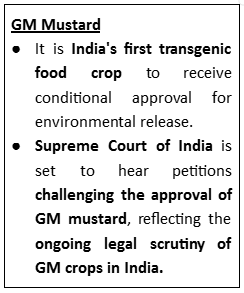
- GM Mustard (DMH-11): Approved by GEAC in 2022 but faces legal and environmental concerns.
- Golden Rice: Under research but not yet approved for commercial cultivation.
| Current State of India’s ‘Bio Economy’: – According to the ‘India Bioeconomy Report 2025’, India’s Bio-economy has grown 16-fold, from $10 billion in 2014 to an impressive $165.7 billion in 2024. – It accounts for 4.25% of India’s GDP. – It has achieved a Compound Annual Growth Rate (CAGR) of 17.9% over the past four years, Key Sectors in Bio-Economy – Bio-industrial Segment (enzymes,biofuels, bioplastics): Made up 47% of the bio-economy; – Biopharma (medicines, diagnostics): 35%; – Bio IT/Research Services (contract research, clinical trials): 9%, – Bio-agriculture: 8.1%. Statewise Contribution – Maharashtra: 21% ($35 billion) – Karnataka: 19% ($32 billion) – Telangana: 12% ($19 billion). Startups – There were 10,075 biotech-startups in 2024. It is expected to grow to 22,500 by 2030 creating 35 million jobs. |
Benefits of GM Crops
- Higher Yields: GM crops can increase productivity, helping in food security.
- Reduced Pesticide Use: Crops like Bt Cotton are resistant to pests, reducing pesticide dependence.
- Climate Resilience: Drought- and salinity-tolerant crops can withstand harsh conditions.
- Nutritional Benefits: Biofortified crops like Golden Rice combat malnutrition.
Concerns and Challenges
- Environmental Impact: GM crops may affect biodiversity, soil health, and pollinators.
- Health Risks: Long-term effects on human health remain debated.
- Farmer Dependency: GM seeds are patented by corporations, increasing dependency.
- Ethical and Religious Concerns: Some communities oppose genetic modification for cultural reasons.
Regulatory Framework & Policy in India
- Genetic Engineering Appraisal Committee (GEAC): The primary body regulating GM crops.
- Food Safety and Standards Authority of India (FSSAI): Approves GM food imports.
- Environment Protection Act, 1986: Rules for Manufacture, Use, Import, Export and Storage of Hazardous Microorganisms (HM) Genetically Engineered Organisms or Cells, 1989.
- BioE3 Policy: Use of biotechnology to improve food crops – as in the case of GM mustard – is a key focus of the government’s BioE3 policy.
- It involves manufacturing new kinds of enzymes, pharmaceuticals and agricultural products while applying techniques, including genetic engineering.
- Programs like BioSaarthi are fostering innovation by connecting biotech startups with international mentors.
Global Perspective
- While countries like the US, Brazil, and China have adopted GM crops extensively, nations like the EU and India remain cautious.
- The debate on GM crops continues, with scientists advocating their potential and activists highlighting risks.
