
UAE’s Crown Prince Visit to India
Syllabus: GS2/IR
Context
- UAE’s Crown Prince is on an official visit to India.
Major Highlights
- Defence Cooperation: Strengthened defence collaboration and increased manufacturing partnership.
- Focus on scaling up defence cooperation to match trade and business progress.
- Training exchanges identified as a key area to enhance bilateral defence ties.
- Formalising Coast Guard-to-Coast Guard cooperation through an MoU.
- Educational Initiatives: Agreement to set up IIM Ahmedabad’s first overseas campus in Dubai (MBA program starting in 2025).
- Launch of Indian Institute of Foreign Trade (IIFT) campus at Expo City Dubai.
- Infrastructure and Economic Projects: Bharat Mart construction to begin and a 3-D rendering of the complex launched.
- Allocation of land for UAE-India Friendship Hospital in Dubai.
- Development of ship-repair clusters at Kochi and Vadinar.
- Establishment of an India Office for the Dubai Chamber of Commerce.
| About UAE – UAE is situated in the southeast of the Arabian Peninsula, bordering Oman and Saudi Arabia. – Prior to independence, the seven Emirates were part of a British protectorate called the Trucial States. – In 1971, the UAE became a federation of six emirates – Abu Dhabi, Dubai, Sharjah, Ajman, Umm Al-Quwain, and Fujairah, while the seventh emirate, Ras Al Khaimah, joined the federation in 1972. – The capital city is Abu Dhabi, located in the largest and wealthiest of the seven emirates. |
Brief overview of the UAE and India Relations:
- Political: India and the United Arab Emirates (UAE) established diplomatic relations in 1972.
- Multilateral Cooperation: India and the UAE are currently part of several plurilateral platforms such as I2U2 (India-Israel-UAE-USA) and UFI (UAE-France-India) Trilateral, etc. UAE was also invited as a Guest Country to the G-20 Summit
- Economic & Commercial: CEPA was signed in 2022, since the agreement, bilateral merchandise trade has nearly doubled from USD 43.3 billion in FY 2020-21 to USD 83.7 billion in FY 2023-24.
- UAE is the second largest export destination of India (after the US) with an amount of nearly US$ 31.61 billion for the year 2022-23.
- Bilateral trade is expected to surpass $97 billion, with targets to hit $100 billion in non-oil trade.
- Defence cooperation: It is steered through a Joint Defence Cooperation Committee (JDCC) at the Ministry level, with the signing of Agreement on Defence Cooperation in 2003, which came into effect in 2004.
- Space Cooperation: Indian Space Research Organisation (ISRO) and the UAE Space Agency signed an MoU regarding cooperation in the exploration and use of outer space for peaceful purposes in 2016.
- Indian Community: Indian expatriate community of approximately 3.5 million is the largest ethnic community in UAE constituting roughly about 35% of the country’s population.
Challenges
- Trade Imbalances: India has a trade deficit with the UAE, primarily due to high oil imports from the UAE, which makes the economic relationship uneven despite growing non-oil trade.
- Geopolitical Tensions in the Region: Political instability in the Middle East and the Gulf region affect bilateral relations, especially with India’s strategic interests in the region.
- Labor and Migration Issues: India is one of the largest sources of migrant labor in the UAE, and issues related to the welfare and rights of Indian workers have been a point of concern.
- Foreign Policy of UAE: India’s relations with countries like Iran and Pakistan sometimes complicate its relations with the UAE, which maintains different strategic priorities in the region.
Way Ahead
- Aggressively pursue the USD 100 billion non-oil trade target: Leverage the Comprehensive Economic Partnership Agreement (CEPA) by actively addressing any implementation challenges.
- Focus on trade diversification: Move beyond traditional sectors like oil and gems & jewelry to boost trade in high-growth areas such as technology, renewable energy.
- Enhance investment flows: Encourage greater UAE investment in India’s infrastructure, manufacturing, and technology sectors, and vice versa.
- Support MSMEs and startups: Actively involve Micro, Small, and Medium Enterprises (MSMEs) and startups in the bilateral trade and investment ecosystem through initiatives like Bharat Mart.
- Strengthening Diaspora: Strengthened ties through the large Indian diaspora in the UAE, facilitating cultural exchange and collaboration in various sectors.
India-Israel Sign Agreements on Agricultural Cooperation
Syllabus: GS2/ IR, GS3/ Agriculture
In News
- India and Israel signed a Comprehensive Agriculture Agreement to boost bilateral cooperation in agriculture, food security, and the modernization of farming practices.
About
- Key Focus Areas:
- The agreement explicitly mentions areas like soil and water management, horticultural and agricultural production, post-harvest and processing technology, agriculture mechanisation, animal husbandry, and research and development.
- Centres of Excellence Recognition: India praises the 43 Centres of Excellence and highlights their pivotal role in the success of the agricultural projects.
- Five-Year Seed Improvement Plan: The discussion between both nations on a five-year seed improvement plan marks a significant new development.
- Global Commitments and Future Prospects:
- India reaffirmed commitment to Vasudhaiva Kutumbakam (“the world is one family”) underlining India’s commitment to:
- Global agricultural partnerships
- Climate-smart solutions
- Israeli delegation invited to World Food India 2025
- India reaffirmed commitment to Vasudhaiva Kutumbakam (“the world is one family”) underlining India’s commitment to:
Background
- India and Israel share a deep-rooted partnership in agriculture, formalized through various Memoranda of Understanding (MoUs) and Joint Working Groups over the past two decades.
- Indo-Israel Agricultural Project (IIAP) was launched in 2006 for providing training to farmers, demonstrations of modern farming techniques & opting best practices in horticulture (e.g., drip irrigation, precision farming).
Why is Israel a Key Partner for India in Agriculture?
- Israel is globally renowned for transforming arid land into green productive zones using:
- Drip and micro-irrigation systems
- Soil-less agriculture and hydroponics
- Greenhouse and polyhouse technologies
- Advanced agro-automation and remote sensing
- These innovations align with India’s goals of:
- Enhancing water-use efficiency (under PM-Krishi Sinchayee Yojana)
- Promoting sustainable agriculture
- Supporting small and marginal farmers (who form over 85% of the farming population)
| India-Israel Bilateral Cooperation Historical Ties: – Began during Sino-India War (1962); Israel provided India arms support again during 1965 Indo-Pak war – Israel was among the few nations not to condemn India’s Pokhran-II nuclear tests (1998) Economic Relations: – Trade Volume (2024): Over $5.65 billion (excluding defence) India is Israel’s 3rd largest trade partner in Asia – Major trade: Major exported items from India to Israel include Gems and Jewelry (US$ 351.56 million); followed by engineering goods (US$ 241.02 million), and electronic goods (US$ 97.50 million). – I4F Fund (Israel-India Industrial R&D and Technological Innovation Fund): Established with a joint contribution of $40 million over five years, I4F supports collaborative R&D projects. Defence Cooperation: – Israel is among India’s top four arms suppliers – India imports: 1. Phalcon AWACS, Heron/Searcher drones 2. Barak missile systems, Spyder SAMs 3. Precision-guided bombs like Spice-2000, Crystal Maze – Defence deals touch $1 billion/year – Recent Developments: In January 2025, the Indian Ministry of Defence signed a contract with Bharat Dynamics Limited for the supply of over 70 Medium-Range Surface-to-Air Missiles (MRSAM) for the Indian Navy, valued at approximately $400 million. |
One State One RRB: Amalgamation of Regional Rural Banks (RRBs)
Syllabus: GS3/Indian Economy; Banking
Context
- Recently, the Department of Financial Services (DFS) has notified amalgamation of 26 Regional Rural Banks (RRBs) on the principles of ‘One State One RRB’.
- It is the fourth phase of amalgamation of RRBs.
About Regional Rural Banks (RRBs)
- Background: These were established in 1975, following the recommendations of the Narasimham Working Group and the enactment of the Regional Rural Banks Act in 1976.
- It was aimed to provide financial services to rural areas, particularly to small and marginal farmers.
- However, over the decades, fragmentation, overlapping operations, and high operational costs limited their effectiveness.
- To address these challenges, the government introduced the amalgamation strategy, with the vision of ‘One State, One RRB’:
- Avoids duplication of services.
- Enhances governance and accountability.
- Increases access to technology and modern banking.
- Ownership Structure: Jointly owned by:
- Central Government: 50%
- State Government: 15%
- Sponsoring Bank: 35%
- Supervision and Regulation: Regulated by the Reserve Bank of India (RBI) under the Banking Regulation Act, 1949.
- Supervised by the National Bank for Agriculture and Rural Development (NABARD).
- Treated as cooperative societies for tax purposes under the Income Tax Act, 1961.
‘One State, One RRB’ Policy
- It is a strategic initiative led by the Department of Financial Services (DFS) under the Ministry of Finance.
- It aims to restructure and consolidate Regional Rural Banks (RRBs) in India, and to boost rural banking efficiency, enhance financial inclusion, and optimize operational costs through the amalgamation of RRBs within the same state.
Objectives of ‘One State, One RRB’
- Operational Efficiency: Larger banks benefit from economies of scale, uniform technology platforms, and shared human resources.
- Cost Rationalization: Reduces administrative overhead and duplication.
- Enhanced Credit Flow: Streamlined operations mean better credit availability to farmers and small businesses.
- Improved Governance: Single RRB per state improves state-wise planning, accountability, and monitoring.
- Technological Advancement: Unified Core Banking Systems (CBS) and digital banking capabilities.
- Enhanced Financial Inclusion: The unified RRBs will focus on providing credit and financial services to small and marginal farmers, artisans, and rural entrepreneurs.
| Phases of Amalgamation of RRBs in India (Initiated in 2004-05 based on the recommendations of the Vyas Committee) | ||
| Phases | Objectives | Outcomes |
| Phase I (2006–2010) | To address the operational inefficiencies and financial weaknesses of RRBs. | 196 RRBs to 82 |
| Phase II (2013–2015) | To further streamline the RRB structure and enhance their operational scale. | 82 RRBs to 56 |
| Phase III (2019–2021) | To align RRBs with modern banking requirements and enhance their financial sustainability. | 56 RRBs to 43 |
| Phase IV (2025) | To implement the ‘One State, One RRB’ policy, ensuring uniformity and efficiency across states. | 43 RRBs to 28 |
After Phase IV amalgamation
- At present, 43 RRBs are functioning in 26 States and 2 union territories. Post amalgamation, there will be 28 RRBs in 26 states and 2 UTs with more than 22,000 branches covering 700 districts.
- Their predominant area of operation is in rural areas with approximately 92% of branches in rural or semi urban areas.
Challenges Ahead
- Despite the advantages, the amalgamation process brings some transitional issues:
- Staff realignment and training in the unified systems.
- Regional disparities in infrastructure and local banking needs.
- Customer awareness and onboarding in rural areas.
- The government, however, is addressing these through capacity building and increased financial literacy campaigns.
Electronic Surveillance System in JK Border
Syllabus: GS3/Internal Security
Context
- The Union Home Minister announced two models of an electronic surveillance system along the Jammu Kashmir border.
About
- Technology is expected to be deployed along the entire India-Pakistan border in the next four years.
- The Union Home Minister acknowledged that while terrorism in Jammu and Kashmir is reduced, it is not fully eliminated.
- Technology Initiatives: Over 26 technology initiatives, including anti-drone and tunnel detection technology, are being tested, with some results expected by 2026.
- Two models of electronic surveillance systems are being developed for the entire India-Pakistan and India-Bangladesh borders to improve response capabilities of security forces.
| Border Management Initiatives – Border Infrastructure and Management (BIM) Scheme: It is a Central Sector Scheme comprising projects aimed at infrastructure development of India’s international borders. 1. It aims to enhance the security along the borders and involve projects such as Border Fence, Border Roads, Border Floodlights, Border Out Posts (BOPs), Helipads and foot tracks along the international borders. 2. It also involves deployment of technological solutions in such patches of the borders, which are not feasible for physical fences. – Comprehensive Integrated Border Management System: To improve situational awareness at different levels of hierarchy to facilitate prompt and quick response to emerging situations along the India-Pakistan Border (IPB) and India-Bangladesh Border (IBB), CIBMS has been conceptualized. 1. It is the integration of manpower, sensors, networks, intelligence and command control solutions. – Vibrant Villages Programme-II (VVP-II): It is a Central Sector Scheme (100% Centre-funded) that aims to boost development in strategic border areas. 1. VVP-II, along with VVP-I, is a transformative step towards making border villages self-reliant, resilient, and vibrant—crucial for national security and inclusive development. |
:Borders in India
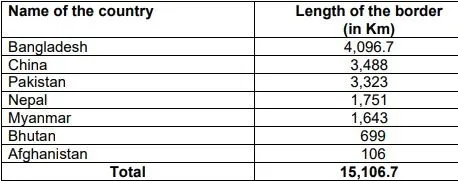
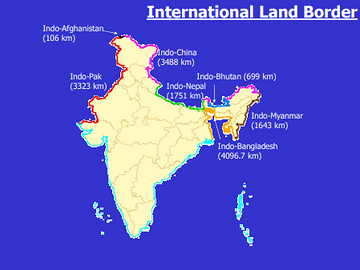
- India currently has more than 15000 km of land borders.
- It shares borders with seven countries, Afghanistan, Pakistan, China, Nepal, Bhutan, Bangladesh and Myanmar.
Border Management in India
- Border guarding responsibility initially was with the state forces post-independence, however, the same was found inadequate to handle the challenges and threats.
- Central armed police forces (CAPFs) were raised under the Ministry of Home Affairs (MHA) and were tasked to guard the borders under the control of the ministry.
- In case of active hostilities, the Army is given the responsibility to man the borders.
Need for Border Management
- India-Pakistan Border: Ongoing issue since 1947 with four wars fought (1947-48, 1965, 1971, and 1999).
- Active Line of Control (LC) with both Army and BSF deployed.
- India-China Border: Disputed borders in Ladakh, Middle Sector, and Arunachal Pradesh.
- Limited progress in resolving disputes despite multiple talks.
- India-Bangladesh Border: Relations fluctuate based on political changes.
- External influences (Pakistan, China) pose threats to stability.
- India-Bhutan Border: India defends Bhutan, particularly in case of Chinese aggression (e.g., Doklam 2017).
- India-Nepal Border: Challenges include porous border management and Chinese infrastructure developments near the border.
- India-Myanmar Border: Long border with Myanmar, connecting to China and Bangladesh.
- Porous, with local communities living on both sides.
- Influx of refugees into India, especially in Manipur.
Challenges In Managing the Borders
- Length and Diversity: India shares extensive borders with multiple countries, each with unique geographical features (mountains, rivers, plains), making monitoring and control difficult.
- Porosity of Borders: Many borders are porous, allowing illegal crossings of people, goods, and contraband (drugs, weapons), exacerbated by difficult terrain like dense forests and rivers.
- Cross-Border Terrorism: Pakistan-based militant groups exploit porous borders to infiltrate and carry out attacks in Jammu and Kashmir, creating significant security concerns.
- Ethnic and Tribal Dynamics: Border regions are home to diverse ethnic and tribal communities with cross-border ties, requiring sensitive management of grievances and aspirations to prevent exploitation by external forces.
- Dispute over Borders: India has unresolved border disputes, especially with China and Pakistan, leading to tensions and requiring constant vigilance and diplomacy.
- Infrastructure Development: Many border areas lack basic infrastructure (roads, communication, outposts), hindering effective border management and surveillance efforts.
- Humanitarian Concerns: Borders with politically unstable countries lead to refugee influxes and humanitarian crises, requiring careful management to balance security with international obligations.
Way Ahead
- Border Roads Organisation (BRO): Constructed over 8,500 km of roads and more than 400 permanent bridges.
- Key Tunnels: Atal Tunnel, Sela Tunnel, and Shikun-La Tunnel (soon to be the world’s highest tunnel) will be major milestones in border area development.
Technology and Innovation Report 2025
Syllabus :GS 3/Science and Technology
In News
- The Technology and Innovation Report 2025 released by the UN Conference on Trade and Development (UNCTAD).
Technology and Innovation Report
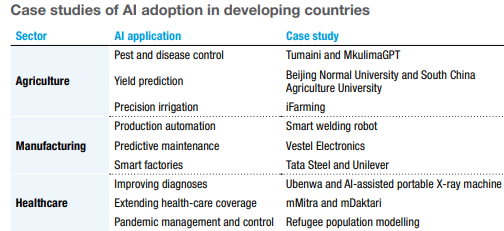
- It surveys the complex artificial intelligence landscape, aiming to help decision makers design science, technology and innovation policies that foster inclusive technological progress
- It analyses the requirements and policies needed at all stages, from development to adoption, to foster inclusive technological progress for sustainable development.
Findings
- The U.S. leads in private AI investments, contributing 70% of global AI investment in 2023.
- India, China, and Brazil contribute significantly to AI advances and the production of AI-related scientific knowledge.
- Brazil has a significant talent pool of 4 million developers.
- China and the U.S. dominate in cloud infrastructure services, with India and Brazil also making notable contributions.
| Do you know? – Countries are specializing in specific technological domains: Germany in wind energy, India in nanotechnology, Japan in electric vehicles, and South Korea in 5G technology. – Industrialization in developing countries (e.g., Brazil, China, India) has been key to reducing poverty and driving economic growth, providing jobs in multiple sectors. |
India’s Position
- India ranks 10th globally for private AI investments in 2023, with $1.4 billion.
- India is one of the only developing countries with significant AI investments, along with China (2nd place with $7.8 billion).
- India ranks 36th in the Readiness for Frontier Technologies index (improved from 48th in 2022).
- India has around 13 million developers, making it a major contributor to AI and GenAI projects.
Concerns
- It highlights growing inequality in the AI landscape, with just 100 companies controlling 40% of global private R&D investment, primarily from the US and China.
- 118 countries, mostly from the Global South, are excluded from global AI governance discussions
- AI could impact up to 40% of global jobs, offering productivity gains but also raising concerns about automation and job displacement.
- AI could widen inequality, but it can also create new industries and empower workers if governments invest in reskilling and workforce adaptation.
| India’s Initiatives – India has invested in AI education through the establishment of centers like IIT Hyderabad and IIT Kharagpur. – The India AI Mission (approved in 2024) aims to reduce entry barriers to AI programs and increase AI courses in smaller cities. |
Conclusion and Way Forward
- Countries with large populations like India and China have an advantage in AI development due to their large developer pools, positioning them favorably in the global AI landscape.
- For developing countries to avoid being left behind, UNCTAD advises focusing on three key areas: infrastructure, data, and skills.
- This involves improving internet and computing power, ensuring access to diverse datasets, and strengthening education systems for digital skills.
- The report calls for global collaboration, including creating a shared AI resource facility and establishing a public disclosure framework for AI.
- The goal is to ensure equitable access to AI and promote inclusive human development.
3D Printing
Syllabus: GS3/ S&T
In Context
- Japan’s West Japan Railway Company unveiled the world’s first 3D-printed train station in Arida City, Wakayama Prefecture. It was named Hatsushima Station and the structure was built in under six hours.
What is 3D Printing?
- About:
- 3D Printing, also known as Additive Manufacturing (AM), is a process of creating three-dimensional objects from a digital file, by adding material layer by layer.
- Unlike traditional subtractive manufacturing (which involves cutting away material), 3D printing builds up the product from scratch.
- Key Components of 3D Printing:
- CAD Model: A 3D digital blueprint of the object.
- Slicing Software: Converts the 3D model into thin horizontal layers.
- 3D Printer: Executes the design by laying down material in successive layers.
- Printing Material: Includes plastics, concrete, resin, metal powders, or even biological tissue.
- Types of 3D Printing Technologies:
- Fused Deposition Modeling (FDM): Most common and cost-effective method.
- Uses thermoplastic filaments like PLA or ABS.
- Stereolithography (SLA): Uses UV light to cure liquid resin into solid plastic.
- High-resolution but more expensive.
- Selective Laser Sintering (SLS): Uses laser to sinter powdered material (e.g., nylon, metal).
- Suitable for industrial applications.
- Direct Metal Laser Sintering (DMLS) / Selective Laser Melting (SLM): Used for producing metal parts in aerospace, defense, and automotive sectors.
- Fused Deposition Modeling (FDM): Most common and cost-effective method.
Applications of 3D Printing
- Construction & Infrastructure: Rapid construction of homes, bridges, train stations, and disaster-relief shelters.
- Example: India’s first 3D-printed post office in Bengaluru by L&T in 2023.
- Healthcare & Biomedical: 3D-printed prosthetics, dental implants, organs-on-chip, and even human tissue.
- Aerospace & Defense: Lightweight, durable parts being made for aircraft and satellites.
- Example: DRDO is exploring additive manufacturing for weapon parts and UAVs.
- Education & Research: Affordable tools and models for STEM education and research labs.
- Food Industry: Layered printing of chocolates, pancakes, or custom-designed food.
| Advantage | Explanation |
| Speed | Rapid prototyping and construction. |
| Customization | Tailor-made objects as per specific requirements. |
| Waste Reduction | Only required material is used—less scrap. |
| Cost-Effective for Low Volumes | No need for molds or dies. |
| Design Flexibility | Can manufacture complex and intricate shapes. |
| Decentralized Production | On-demand local manufacturing reduces logistics and storage. |
| Limitation | Explanation |
| Material Constraints | Limited types and properties of printable materials. |
| High Initial Cost for Industrial Use | Equipment and material costs can be high. |
| Size Restrictions | Printers have limited build volume. |
| Post-Processing Required | Additional steps like curing, polishing, or machining. |
| Slow for Mass Production | Not ideal for large-scale production lines. |
| Intellectual Property Risks | Digital designs are prone to unauthorized copying. |
| Skill & Regulation Gap | Skilled manpower and standardization are lacking in many regions. |
De-Extinction of Dire Wolf
Syllabus: GS3/ Science and Technology
Context
- A United States-based bioscience company claimed that it had revived an extinct species of animal, the dire wolf.
The Dire Wolf (Aenocyon dirus)
- The Dire wolf was one of the most formidable predators of the late Pleistocene epoch.
- Geographic Range: It lived across North America — from southern Canada to the United States, before they went extinct about 13,000 years ago.
- Physical Traits: They resembled the grey/ gray wolves (Canis lupus), but were larger, with white coats.
- A dire wolf could be 3.5 feet tall, more than 6 feet in length, and weigh up to 68 kg.
- Diet: Predators of horses, bison, and possibly mammoths.
What Is De-Extinction?
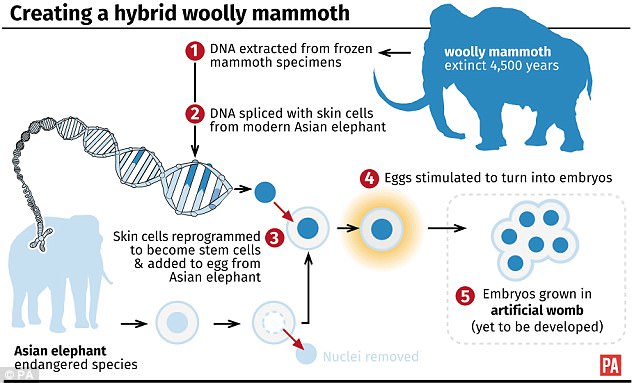
- De-extinction, or resurrection biology, refers to the scientific process of bringing back extinct species or creating organisms closely resembling them through genetic engineering.
- De-extinction is possible because of bioengineering techniques that can manipulate DNA and genomes or the genetic material in an organism.
- The goal is to re-establish dynamic processes that produce healthy ecosystems and restore biodiversity.
Methods of De-Extinction
- Back-breeding: It uses the principles of selective breeding. This method works well when the extinct species are closely related to a still-living species.
- Limitation: It cannot recreate the exact genome of the extinct species. Risks include inbreeding and genetic mutations.
- Cloning: It produces a genetically identical copy of an organism through Somatic Cell Nuclear Transfer (SCNT).
- Example: Birth of Dolly the sheep in 1996.
- Limitation: It requires intact living cells, so it’s not feasible for long-extinct species.
- Genome Editing & Synthetic Genomics: Genome editing tools (like CRISPR) allow for precise deletion, addition, or modification of genes.
- Synthetic genomics involves inserting large sections of synthesized DNA into a host genome.
- Result: Hybrid organisms with traits from both extinct and living species.
Concerns
- Ecological Disruption: The reintroduction of hybrid species may disturb present-day ecosystems.
- Genetic Health: High chances of mutations, low genetic diversity, and inbreeding.
- Habitat Availability: With the changing environment natural habitats may no longer exist.
Concluding remarks
- The revival of the dire wolf signifies a giant leap in genetic science but also opens up a Pandora’s box of ecological, ethical, and legal concerns.
- While de-extinction holds promise for biodiversity and conservation, its application must be cautious, well-regulated, and grounded in sustainability.
