
Maharashtra Sets Up Dedicated Cell for Mercy Petitions
Syllabus: GS2/ Polity
In News
- The Maharashtra government formed a dedicated cell under the Additional Secretary (Home) for dealing with mercy petitions filed by death row convicts.
- It was established on the direction of SC that all states set up such cells to avoid delays in the execution of death penalties, which it observed can have a “dehumanising effect” on convicts.
Mercy Petition
- What is a Mercy Petition?
- A mercy petition is a formal request submitted by a convict (especially on death row or serving a long sentence) to seek clemency—in the form of pardon, commutation, or remission—from the President of India or the Governor of a State, as a last resort after all judicial remedies are exhausted.
- No fixed time limit is prescribed for the President’s decision on the mercy petition.
- Constitutional & Legal Provisions:
- The Constitution granted the President (Article 72) and Governor (Article 161) the power to grant pardons or commute sentences.
- In the Supreme Court’s ruling in Maru Ram vs. Union of India (1981), it was established that the President must act based on the Council of Ministers’ advice in mercy petitions.
- Philosophy Behind Mercy Petitions:
- Right to Life (Article 21): Everyone has the fundamental right to life and personal liberty, guaranteed by Article 21 of the Indian Constitution.
- A mercy petition seeks to uphold this right by allowing for compassionate reconsideration.
- Rectification of Judicial Errors: Offers recourse when the judiciary may have overlooked evidence or erred.
- International Norms and Human Rights: Many global conventions, including the Universal Declaration of Human Rights, emphasize the right to life and human dignity.
- Mercy powers help nations adhere to these humanitarian standards.
- Right to Life (Article 21): Everyone has the fundamental right to life and personal liberty, guaranteed by Article 21 of the Indian Constitution.
Types of Pardoning Powers in India
- Under Article 72 (President) and Article 161 (Governor), the executive is empowered to grant clemency in various forms.
| Type | What Changes? | Example |
|---|---|---|
| Pardon | Cancels both conviction & sentence | Full forgiveness; treated as not guilty |
| Commutation | Changes sentence to a lesser one | Death → Life imprisonment |
| Remission | Reduces sentence duration | 10 years → 6 years |
| Respite | Lesser punishment for valid reasons | A pregnant woman receives lighter punishment |
| Reprieve | Delays execution temporarily | Time granted to file mercy petition |
Comparison of Pardoning Powers of President & Governor
| Aspect | President (Article 72) | Governor (Article 161) |
| Authority | President of India | Governor of a State |
| Jurisdiction | Offenses under Union laws, court-martial cases, and death penalty | Offenses under State laws |
| Military Law (Court-Martial) | Can grant pardon or reduce sentence for military court convictions | No power in court-martial cases |
| Death Sentence | Can grant pardon and commute a death sentence | Can only commute death sentence; cannot pardon it |
| Binding Advice | Acts on the advice of the Council of Ministers at the Centre | Acts on the advice of the State Council of Ministers |
Conclusion
- Mercy petitions and pardoning powers are essential checks and balances within India’s justice system. They ensure that law is tempered with compassion, and justice doesn’t turn blind to human rights.
Elon Musk’s Neuralink to Implant ‘Blindsight’ chip in first human by 2025
Syllabus: GS3/ S&T
In News
- Elon Musk’s brain-chip startup Neuralink has announced ambitious plans to begin human trials of its visual prosthesis device, “Blindsight” by the end of 2025.
- This brain-computer interface (BCI) aims to restore vision in people who are completely blind.
What is Blindsight?
- Blindsight is an experimental artificial vision device that:
- Uses a microelectrode array implanted in the visual cortex of the brain.
- Bypasses the eyes and optic nerves entirely.
- Processes visual data from a camera feed and stimulates neurons in the brain’s visual center, enabling perception of images.
About Brain-Computer Interfaces (BCIs)
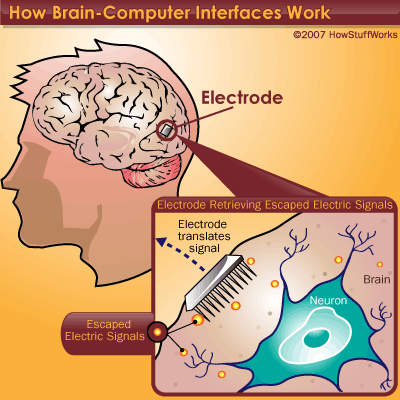
- A Brain-Computer Interface (BCI) is a computer-based system that:
- Acquires brain signals
- Analyzes them
- Translates them into commands
- Sends those commands to external devices to carry out a desired action
- Unlike traditional motor control (e.g., flipping a light switch), BCIs enable users to control devices directly using brain activity, bypassing the body’s muscles and peripheral nerves.
- BCIs can be broadly categorized as:
- Invasive: Electrodes are surgically implanted directly into the brain. These offer high signal quality but carry risks associated with surgery.
- Non-invasive: Sensors are placed on the scalp (e.g., EEG headsets). These are safer but have lower signal quality.
- Partially invasive: Electrodes are placed inside the skull but outside the brain tissue.
Applications & Challenges of BCIs
| Category | Applications | Challenges |
| Medical & Rehab | Assistive technology for paralysis, ALS, etc.; Stroke & spinal injury rehab; Communication aids | Signal noise in non-invasive methods; Biocompatibility issues with implants |
| Mental Health & Cognitive | Neurofeedback for ADHD, PTSD, etc.; Memory & attention enhancement | Requires brain training; Ethical issues in cognitive manipulation |
| Education | Monitor engagement & cognitive load; Adaptive learning systems | Data privacy in learning settings; Standardization of tools |
| Military & Defense | Thought-controlled drones & devices; Cognitive monitoring of soldiers | Ethical use in combat; Risk of misuse or surveillance |
| Smart Home & IoT | Control devices using brain signals | Latency and reliability issues; Cost and integration complexity |
| Neuroscience Research | Brain mapping; Understanding cognition and neural links | Requires high-precision data; Long development cycles |
| General | Enhancement of brain functions and overall efficiency in functionality. | High costs; Lack of trained experts; Regulatory and legal uncertainty; Brain data security |
Vibe Coding
Syllabus: GS3/ S&T
In Context
- In February 2025, OpenAI co-founder Andrej Karpathy coined a new term called “Vibe Coding”.
What is Vibe Coding?
- Definition: Vibe coding is an intuitive, prompt-driven approach to software development, where users interact with LLMs (Large Language Models) like ChatGPT, Cursor, or Sonnet to generate and debug code without deep programming expertise.
- Vibe coding emphasizes ‘feeling the vibes’ over structured programming logic, making it especially suited for low-risk, creative, or personal projects where precision isn’t the primary concern.
- Working: The user types a plain-language prompt describing the feature or tool they want.
- The AI generates code and suggests improvements or fixes.
- The user copies, pastes, and runs the code with minimal engagement in debugging or understanding.
Advantages of Vibe Coding
- Accessibility for Non-Programmers: Allows creatives, entrepreneurs, and students to build apps or websites without formal training.
- Boosts Creativity & Experimentation: Encourages rapid prototyping and iterative testing.
- Exposes new users to different programming languages and concepts.
- Time-Saving for Developers: Helps seasoned developers automate repetitive tasks, debug small issues, or draft boilerplate code quickly.
- Gateway to Learning: Serves as a stepping stone for beginners to transition into serious coding by sparking curiosity.
Disadvantages and Concerns
- Code Quality & Efficiency: AI may generate bloated, inefficient, or redundant code.
- Results often lack optimization, making maintenance harder and more expensive.
- Security Risks: AI-generated code might introduce vulnerabilities, especially if users don’t review it.
- Loss of Understanding: Vibe coders often don’t understand the code they use, making future editing or scaling difficult.
- “Accept All” culture (blindly accepting changes) increases risk.
- Ethical and Legal Issues: Raises concerns of plagiarism, especially in hackathons or job applications.
- Unsuitable for Critical Applications: Not fit for enterprise, medical, financial, or industrial-grade systems that require precision and reliability.
Will Vibe Coding Replace Traditional Programming?
- Though, AI coding tools are advancing rapidly, they:
- Lack deep contextual understanding
- Struggle with long-term maintainability
- Are still experimental and error-prone
India, US To Jointly Design, Manufacture Nuclear Reactors In India
Syllabus: GS3/Energy
Context
- The US Department of Energy (DoE) has granted final approval for a US company to design and build nuclear power plants in India.
About
- The India-US civil nuclear agreement was signed in 2007 but took 20 years of negotiations, legal clearances, and regulatory approvals to reach this stage.
- India had insisted on local design and manufacturing of nuclear plants, which the US has now agreed to.
- Amendments to the Atomic Energy Act 1962 also have to be initiated to enable private companies to enter nuclear generation as operators, which is currently restricted to only state-owned companies.
Highlights of the Deal
- Regulatory Approval: The DoE approved Holtec International’s proposal as an American Company, allowing it to transfer SMR technology to three Indian firms: Larsen & Toubro, Tata Consulting Engineers, and Holtec Asia.
- SMR Technology: US and Indian firms will jointly manufacture Small Modular Reactors (SMRs) and co-produce all parts.
- US Condition: The US has placed a condition that the jointly-designed nuclear plants cannot be transferred to other entities or countries without prior written consent.
Significance
- Diplomatic Achievement: The deal strengthens US-India relations and gives India access to advanced PWR (Pressurized Water Reactor) technology, previously limited to government corporations.
- China Competition: The agreement comes as China expands its Small Modular Reactor (SMR) plans, with India and China competing for leadership in the Global South with affordable nuclear technology.
- Private Sector: The deal is also being seen as a major win for India’s private sector, which will gain specialisation and expertise in designing and manufacturing nuclear power plants.
| Small Modular Reactors (SMR) – These are advanced nuclear reactors that have a power capacity of up to 300 MW(e) per unit, which is about one-third of the generating capacity of traditional nuclear power reactors. – SMRs, which can produce a large amount of low-carbon electricity, are: 1. Small – physically a fraction of the size of a conventional nuclear power reactor. 2. Modular – making it possible for systems and components to be factory-assembled and transported as a unit to a location for installation. 3. Reactors – harnessing nuclear fission to generate heat to produce energy. – Significance: Advanced SMRs offer many advantages, such as relatively small physical footprints, reduced capital investment, ability to be sited in locations not possible for larger nuclear plants, and provisions for incremental power additions. 1. SMRs also offer distinct safeguards, security and nonproliferation advantages. |
Need for Private Players in Nuclear Sector
- Nuclear Capacity: India’s plans to increase its nuclear power capacity from the current 8,180 MW to 22,480 MW by 2031-32 and eventually 100 GW by 2047.
- Energy Demand Growth: India’s electricity demand is expected to increase 4-5 times by 2047, and nuclear power will help meet base-load demand alongside renewables.
- India’s Targets: To reduce the emission intensity of its GDP by 44% by 2030 from the 2005 level.
- To achieve 50% cumulative electric power installed capacity from non-fossil fuel-based energy resources by 2030.
- Roadmap for 100 GW: A roadmap is being developed with stakeholders, and while challenges remain, achieving the 100 GW target is seen as both ambitious and achievable
Governance
- Recently, Nuclear Power Corporation of India Ltd (NPCIL) has invited requests for proposals (RFPs) from private players to set up Bharat Small Reactors (BSRs).
- NPCIL: India’s nuclear sector is governed by the Atomic Energy Act, 1962, under which only government-owned entities such as NPCIL can generate and supply nuclear energy.
- There has been no private sector involvement in India’s nuclear power sector so far.
Arguments in Favour of Private Sector Participation in Nuclear Power
- Improved Efficiency and Innovation: Private companies bring technological advancements, operational efficiency, and innovation, reducing costs and improving safety standards.
- Increased Investment: Private players attract more capital, helping to address the financial challenges of large nuclear projects.
- Faster Project Execution: Driven by competition and profit incentives, they can complete nuclear projects faster and more effectively compared to government processes.
- Expertise and Global Standards: Private companies will bring global best practices, cutting-edge technology, and expertise to the nuclear industry, improving overall standards.
- Job Creation: It will lead to increased employment opportunities in the nuclear sector, from construction to operations.
Arguments Against
- Safety and Security Risks: Private players prioritize cost-cutting over rigorous safety measures, potentially risking catastrophic accidents.
- Lack of Transparency: They may not be as transparent as public institutions, leading to a lack of accountability in the management of sensitive nuclear technologies.
- National Security Concerns: Involving private entities in nuclear power generation raises concerns about the potential for foreign ownership, control, or influence over critical national infrastructure.
- Limited Regulatory Control: Ensuring strict regulatory oversight of private companies might be challenging, potentially leading to lapses in compliance with safety, environmental, and operational standards.
- Profit Motive Over Public Welfare: Private companies prioritize profitability over public welfare, potentially compromising on environmental protections, worker safety, and the long-term sustainability of nuclear energy.
Way Ahead
- Clear Regulatory Framework: Establish a robust regulatory environment to ensure safety, compliance, and transparency, addressing concerns about accountability and national security.
- Public-Private Partnerships (PPPs): Promote partnerships where the government maintains oversight, while private players handle operations, innovation, and investment, ensuring a balance of interests.
- Gradual Implementation: Start with pilot projects and small-scale initiatives to test private sector involvement, ensuring risk management before large-scale implementation.
Energy Statistics India 2025
Syllabus: GS3/Energy
Context
- Recently, the Ministry of Statistics and Programme Implementation (MoSPI) has unveiled its annual publication, ‘Energy Statistics India 2025’, through the National Statistics Office (NSO).
India’s Energy Scenario in 2025
- Total Energy Supply and Demand:
- Supply: Approximately 1,800 Million Tonnes of Oil Equivalent (MToE), reflecting an annual increase of 4.5% compared to 2024.
- Demand: It is driven primarily by industrial growth (40%), transportation (25%), and residential consumption (20%).
- Energy Mix (Sources and Shares):
- Coal: 48%
- Oil: 28%
- Natural Gas: 8%
- Renewables (Solar, Wind, Hydro, Biomass): 12%
- Nuclear: 4%
- Fossil Fuel Reserves and Production (Total coal reserves: 320 billion tonnes):
- Coal Reserves and Production: The distribution of coal reserves in India is concentrated in a few states like Odisha (25.47%), Jharkhand (23.58%), Chhattisgarh (21.23%), West Bengal (8.72%) and Madhya Pradesh (8.43%).
- These states account for approximately 85% of the total coal reserves in India.
- Total estimated reserves of lignite as on 01-04-2024 stood at 47.30 billion tonnes. The highest reserves of lignite are located in the state of Tamil Nadu (79%).
- Annual coal production: 950 million tonnes, meeting 85% of domestic demand.
- India remains the second-largest coal producer globally, after China.
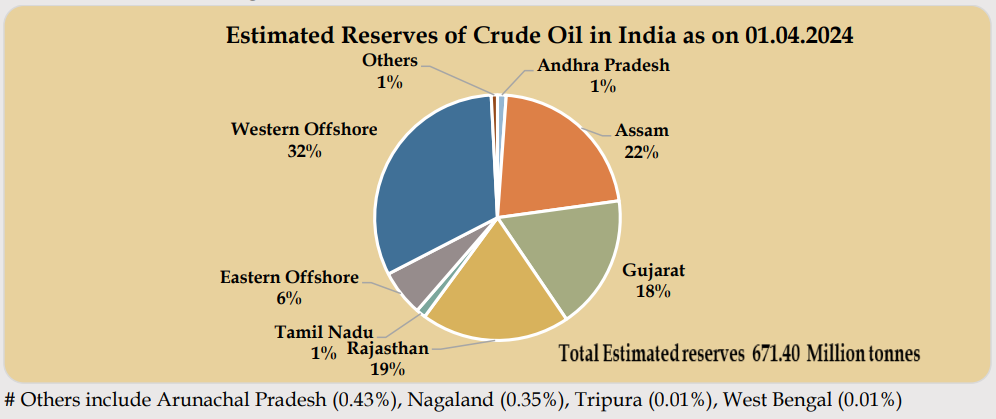
- Crude Oil: Geographically, the maximum crude oil reserves in India are concentrated in the Western Offshore region (32% of the total crude oil reserves). It is followed by the Assam region (22% of the country’s crude oil reserves).
- Coal Reserves and Production: The distribution of coal reserves in India is concentrated in a few states like Odisha (25.47%), Jharkhand (23.58%), Chhattisgarh (21.23%), West Bengal (8.72%) and Madhya Pradesh (8.43%).
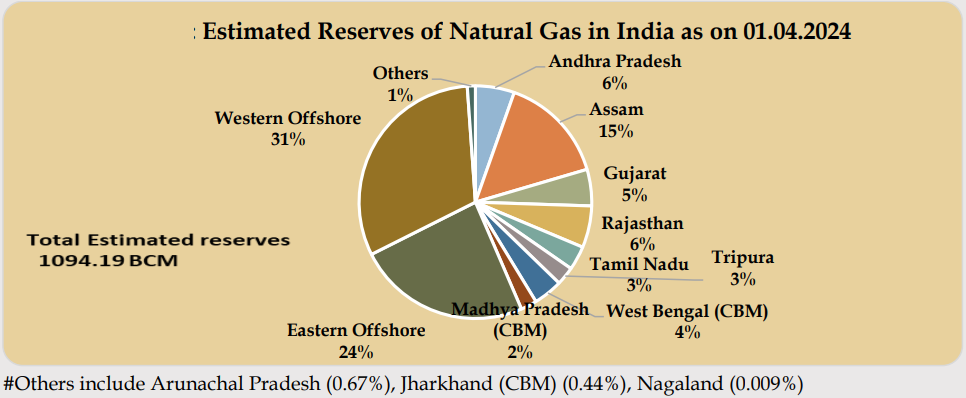
- Natural Gas Reserves: Largest reserves of natural gas in India are located in the Western Offshore region (approximately 31% of the total natural gas reserves). It is followed by the Eastern Offshore (approx 24% of the reserves).
Renewable Energy Growth
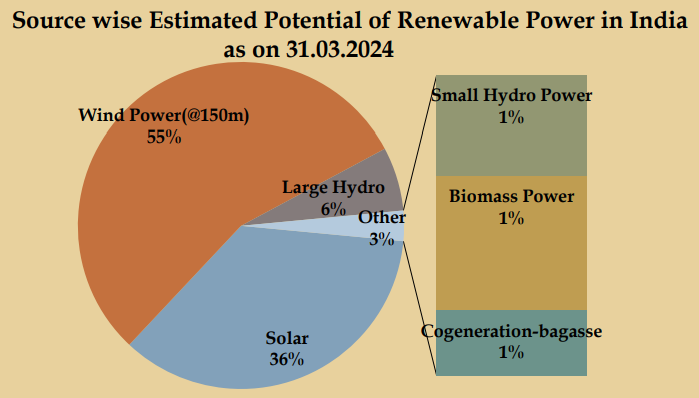
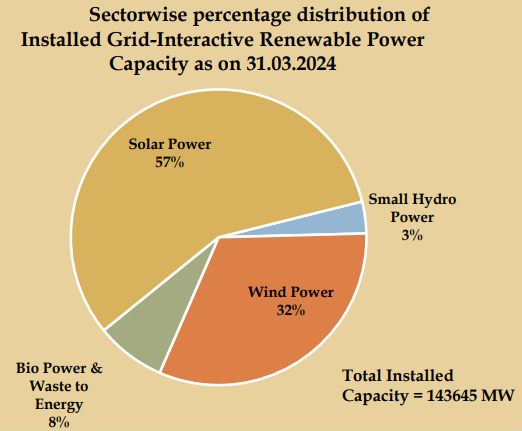
- Potentials: Wind Power dominates share (around 55%), followed by Solar Energy and Large Hydro.
- Geographical Distribution of Renewable Energy Potential: More than half of the potential for generation of renewable energy has been concentrated within the four States of India viz. Rajasthan (20.3%), Maharashtra (11.8%), Gujarat (10.5%) and Karnataka (9.8%).
- Solar and Wind Power Expansion: The National Solar Mission and Wind Energy Development Programme have played a crucial role in achieving these milestones:
- Solar Power Capacity: 175 GW (up from 150 GW in 2024)
- Wind Power Capacity: 50 GW (up from 45 GW in 2024)
- Hydro and Biomass Energy:
- Hydropower: 52 GW, providing 12% of total electricity generation.
- Biomass and Waste-to-Energy: 15 GW, contributing to sustainable energy practices in rural areas.
- Electricity Generation and Consumption Trends:
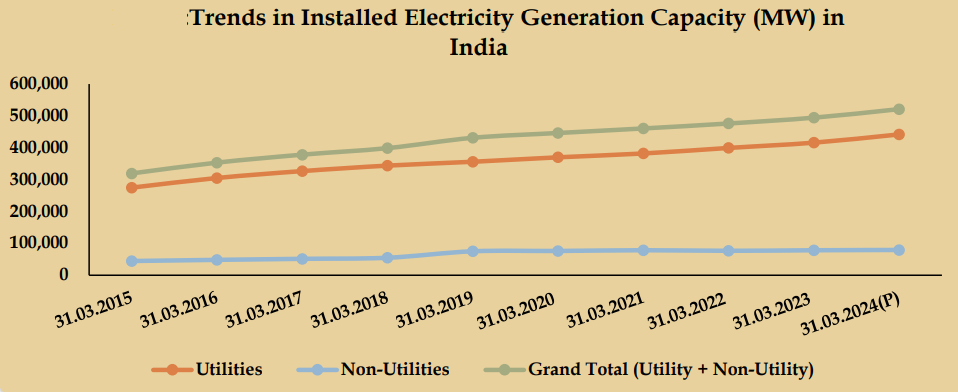
- Installed Capacity and Generation: India’s total installed power generation capacity stands at 450 GW, an increase from 420 GW in 2024.
- Total electricity generation: 1,700 TWh (terawatt-hours).
- Per capita electricity consumption: 1,500 kWh per year, reflecting economic growth and urbanization.
- Distribution and Transmission:
- Transmission losses have reduced to around 17% during FY 2023-24 (23% during FY 2014-15) due to Smart Grid Initiatives.
Energy Efficiency and Sustainability Measures
- Government Policies and Initiatives:
- National Hydrogen Mission: Promoting Green Hydrogen production for industrial use.
- Perform, Achieve, and Trade (PAT) Scheme: Encouraging industries to adopt energy-efficient technologies.
- Faster Adoption of Electric Vehicles (FAME-III): Boosting EV sales and charging infrastructure.
- Carbon Emissions and Climate Targets:
- India’s carbon emissions in 2025 are projected at 2.9 billion tonnes CO₂, a 4% decline due to increased renewable energy usage.
- Commitment to net-zero emissions by 2070 remains a long-term goal.
Future Outlook
- Future Energy Projections (2026-2030):
- Renewable energy share is expected to reach 25% by 2030.
- Energy demand will continue growing at 5% annually, driven by economic expansion.
Challenges Ahead
- Dependence on Fossil Fuels: India still relies heavily on coal and imported crude oil.
- Energy Security Risks: Geopolitical uncertainties affect oil and gas imports.
- Infrastructure Bottlenecks: Need for grid modernization and storage solutions for renewables.
Why Are Tensions High in the Arctic?
Syllabus: GS2/International Relations; GS3/Resource Geography
Context
- The Arctic has become a geopolitical hotspot due to climate change, resource competition, and strategic rivalries among major powers.
About Arctic Region
- It is one of the most fragile and crucial ecosystems on Earth, covering the northernmost parts of the planet.
- It includes the Arctic Ocean, parts of Canada, Russia, Greenland, Norway, Sweden, Finland, Iceland, and the United States (Alaska).
- The Arctic is warming at nearly four times the global average, causing environmental and economic shifts that influence policies and territorial claims.
Key Factors Driving Geopolitical Tensions in Arctic Region
- Natural Resources: According to the U.S. Geological Survey, the region holds about 13% of the world’s undiscovered oil and 30% of its natural gas.
- With ice caps retreating, these resources are becoming increasingly accessible, fueling competition among nations seeking to exploit them.
- New Navigational Routes: These include routes such as the Northern Sea Route (NSR) and the Northwest Passage are becoming viable alternatives to the Suez and Panama Canals.
- The Northeast Passage along Russia’s Arctic coast could shorten trade routes between Asia and Europe by 8,000 km, reducing costs significantly.
- Northwest Passage, a potential shipping route through Canada’s Arctic archipelago, remains a flashpoint.
- Canada asserts it as internal waters, while the US insists it is an international strait with freedom of navigation.
Key Concerns/Challenges
- Russia’s Expansion in the Arctic: Russia, which controls nearly half of the Arctic coastline, has been actively increasing its military presence in the region.
- It has reopened Soviet-era military bases, deployed nuclear-powered icebreakers, and modernized its Arctic military infrastructure.
- Russia conducted regular military drills, signaling its determination to assert control over Arctic waters.
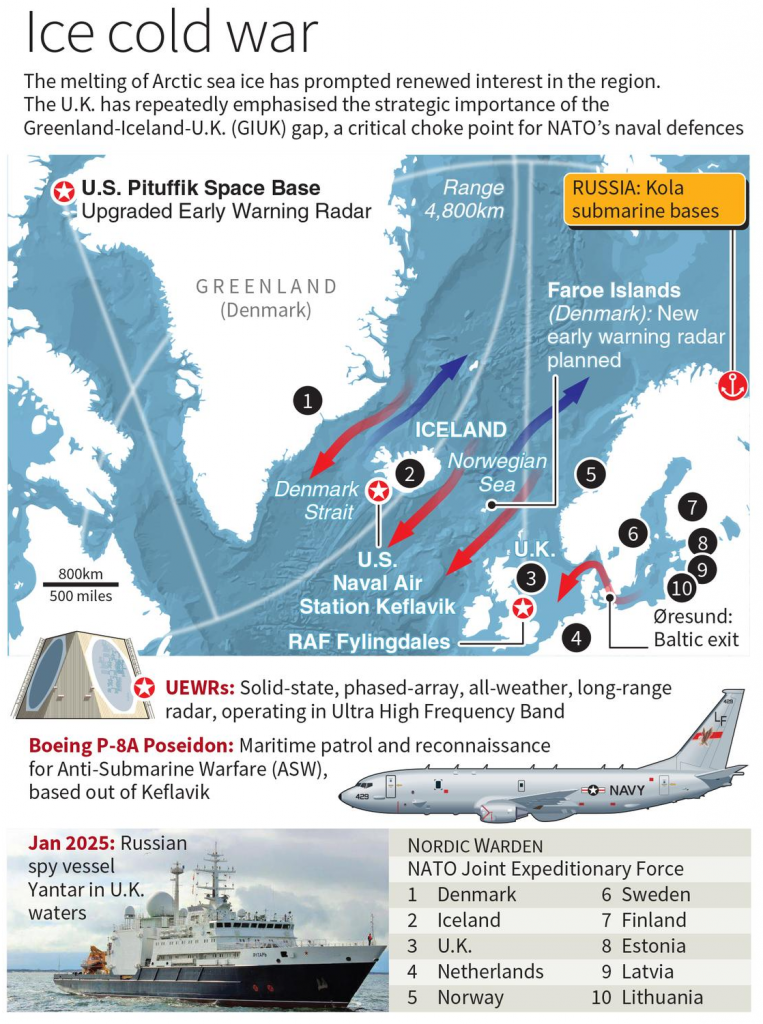
- NATO’s Response and Western Concerns: In response to Russia, the United States and NATO have ramped up their presence in the region.
- Finland and Sweden’s decision to join NATO is partly due to concerns over Russian aggression, particularly after its invasion of Ukraine.
- The US has increased Arctic military exercises, deployed submarines, and strengthened ties with Norway and Canada to counter Russian influence.
- The United Kingdom, for instance, has repeatedly emphasised the strategic importance of the Greenland-Iceland-U.K. (GIUK) gap, a critical choke point for NATO’s naval defences.
- China’s Growing Arctic Ambitions: China, despite being a non-Arctic nation, has declared itself a ‘near-Arctic state’ and is investing heavily in Arctic infrastructure.
- It has proposed a ‘Polar Silk Road’ as part of its Belt and Road Initiative, aiming to establish economic and scientific footholds in the region.
- Legal Disputes and Territorial Claims: Several Arctic nations have competing territorial claims in the region, particularly over the continental shelf.
Geopolitical Implications
- UN Convention on the Law of the Sea (UNCLOS): Nations can extend their claims to the seabed beyond the 200-nautical-mile EEZ if they can prove that the area is a natural prolongation of their continental shelf.
- Russia, Canada, and Denmark (via Greenland) have all submitted claims to extend their seabed sovereignty under the UNCLOS.
- The US, which has not ratified UNCLOS, faces limitations in asserting its claims. Meanwhile, Russia has used legal maneuvers and strategic military positioning to reinforce its claims, challenging Western interests.
- Arctic Council: It is composed of eight nations (U.S., Canada, Russia, Denmark, Norway, Sweden, Finland, and Iceland), and aims to promote environmental protection and scientific cooperation.
- It was formally established in 1996 through the Ottawa Declaration.
- India is an Observer in the Arctic Council.
India’s Role in Arctic Research
- India, despite being a non-Arctic nation, plays an active role in Arctic research.
- National Centre for Polar and Ocean Research (NCPOR): India conducts scientific studies on climate patterns, marine biodiversity, and glacial dynamics.
- India’s Arctic Policy, titled ‘India and the Arctic’ by the Ministry of Earth Science for building a partnership for sustainable development.
- India established Himadri (in 2008), its research station in Svalbard, Norway, to study Arctic climate systems and their global impact.
