
Lok Sabha Passes Waqf (Amendment) Bill, 2025
Syllabus: GS2/Governance
Context
- Waqf (Amendment) Bill 2025, now renamed as the Unified Waqf Management, Empowerment, Efficiency, and Development (UMEED) Bill, has been passed in the Lok Sabha.
- Mussalman Wakf (Repeal) Bill 2024 also approved, repealing the Mussalman Wakf Act, 1923.
Background
- Two Bills Introduced in 2024:
- Waqf (Amendment) Bill, 2024.
- Mussalman Wakf (Repeal) Bill, 2024.
- Objective of Waqf (Amendment) Bill, 2025:
- Amend the Waqf Act, 1995 to address challenges in managing Waqf properties.
- Improve administration and efficiency of Waqf boards.
- Objective of Mussalman Wakf (Repeal) Bill, 2024:
- Repeal the Mussalman Wakf Act, 1923, an outdated colonial-era law.
- Ensure uniformity, transparency, and accountability in Waqf property management under the Waqf Act, 1995.
- Eliminate inconsistencies and ambiguities created by the continued existence of the old law.
Meaning of ‘Waqf’:
- Refers to properties dedicated solely for religious or charitable purposes under Islamic law.
- Sale or other use of the property is prohibited.
- The ownership of the property is transferred from the person making the Waqf (called waqif) to Allah, making it irrevocable.
- The creator is a wakif, and the property is managed by a mutawalli.
Origin of the Concept of ‘Waqf’:
- Traces back to the Delhi Sultanate when Sultan Muizuddin Sam Ghaor dedicated villages to the Jama Masjid of Multan.
- Waqf properties grew with the rise of Islamic dynasties in India.
- The Mussalman Waqf Validating Act of 1913 protected the institution of Waqf in India.
Constitutional Framework and Governance:
- Charitable and religious institutions are under the Concurrent List of the Constitution, allowing both Parliament and State Legislatures to frame laws on it.
- Waqf Governance: Currently governed by the Waqf Act, 1995, replacing earlier laws from 1913, 1923, and 1954.
- Creation of Waqf: Can be created via:
- Declaration (oral or written deed).
- Long-term use of land for religious or charitable purposes.
- Endowment upon the end of a line of succession.
- States with the highest share of Waqf properties: Uttar Pradesh (27%), West Bengal (9%), Punjab (9%).
- Evolution of Waqf Laws:
- 1913 Act: Validated Waqf deeds.
- 1923 Act: Made registration of Waqf properties mandatory.
- 1954: Established Central Waqf Council and State Waqf Boards for better management.
- 1995 Act: Introduced Tribunals for dispute resolution and added elected members and Islamic scholars to Waqf Boards.
Key Amendments
- Composition of the Central Waqf Council: The Union Minister in-charge of waqf is the ex-officio chairperson.
- Council members include:
- Members of Parliament (MPs).
- Persons of national eminence.
- Retired Supreme Court/High Court judges.
- Eminent scholars in Muslim law.
- The Bill removes the Muslim requirement for MPs, former judges, and eminent persons.
- The Bill mandates two non-Muslim members in the Council.
- Composition of Waqf Boards:
- Empowers state governments to nominate one person from each group.
- Non-Muslim members required: two.
- Must include at least one member each from Shias, Sunnis, and Backward Muslim classes.
- Requires two Muslim women members.
- Composition of Tribunals:
- Removes the expert in Muslim law.
- District Court judge (Chairman).
- Joint Secretary rank officer.
- Appeals Against Tribunal Orders:
- Act: Decisions of Tribunals are final, with no appeals allowed in courts.
- Bill: Allows appeals against Tribunal decisions to the High Court within 90 days.
- Survey of Properties: The Bill replaces the Survey Commissioner with the District Collector or other senior officers to oversee the survey of Waqf properties.
- Government property as waqf: The Bill states that any government property identified as waqf will cease to be so.
- The Collector of the area will determine ownership in case of uncertainty, if deemed a government property, he will update the revenue records.
- Audits: Waqf institutions earning over ₹1 lakh will undergo audits by state-sponsored auditors.
- Centralized Portal: A centralized portal will be created for automating Waqf property management, enhancing efficiency and transparency.
- Property Dedication: Practicing Muslims (for at least five years) can dedicate property to the Waqf, restoring pre-2013 rules.
- Women’s Inheritance: Women must receive inheritance before the Waqf declaration, with special provisions for widows, divorced women, and orphans.
Need for the bill
- The new Bill mandates a unified digital listing of Waqf properties to reduce litigation and ensure transparency.
- The bill ensures gender justice by mandating women’s inclusion in Waqf Boards.
Concerns
- Non-Muslim Members in Waqf Boards: The Bill mandates the inclusion of non-Muslim members in State Waqf Boards and the Central Waqf Council.
- This could lead to these bodies being majorly composed of non-Muslims, whereas similar boards for Hindu and Sikh endowments primarily consist of members from those religions.
- Impact on Waqf Tribunals: Removal of experts in Muslim law from Waqf Tribunals may affect the redressal of waqf-related disputes.
- Creation of Waqf: The Bill limits the creation of Waqf to people who have been practicing Islam for at least five years.
- The rationale behind this five-year criterion is unclear and creates a distinction between those who practice Islam for less than five years and those who have done so for more than five years.
Conclusion
- The Bill marks a significant step towards reforming the management of Waqf properties in India.
- The proposed reforms not only ensure better governance and accountability but also foster a more inclusive approach, benefiting all communities involved.
SC On Rural Development
Syllabus: GS2/Issues Relating to Development; Health; GS3/Infrastructure
Context
- Recently, the Supreme Court of India has emphasized the critical need to prioritize education, hygiene, and healthcare in rural areas to foster holistic development.
Key Observations by the Supreme Court
- Focus on Basic Infrastructure: The court underscored that ensuring access to quality education, healthcare, and hygiene is essential for improving the living standards of rural populations.
- Budgetary Allocations: It suggested that states allocate at least 10-15% of their budgets to enhance rural infrastructure, addressing long-standing disparities in resource distribution.
- Libraries vs. Basic Needs: The court acknowledged the importance of public libraries, and stressed that immediate priorities should include addressing hunger, healthcare, and education.
Rural Landscape in India: Positive Transformations in Rural India
- India is home to 6.65 lakh villages, with 2.68 lakh Gram Panchayats and Rural Local Bodies, which form the backbone of the nation’s rural landscape.
- National Multidimensional Poverty Index (MPI) Report: Declined from 24.85% to 14.96% between 2015-16 and 2019-21 (13.5 crore individuals escaped multidimensional poverty during this period).
- Rural Internet Connectivity: India had 954.40 million internet subscribers (March 2024). Out of this, 398.35 million were rural internet subscribers.
- Income Distribution (Gini Coefficient): Declined from 0.266 in FY22-23 to 0.237 in FY23-24, for rural areas.
- Rural Wage Growth: As per data from the Labour Bureau, rural wages in FY25 showed a growth of above 4% each month year-on-year:
- Agriculture wages grew by 5.7% for men and 7% for women.
- Non-agricultural wages grew by 5.5% for men and 7.9% for women.
- Annual Status of Education Report (ASER) of 2024 reveals improvements in rural education, including pre-primary enrollment and learning outcomes, with a focus on foundational literacy and numeracy, and increased digital literacy among older children.
Key Government Initiatives
- Education in Rural India:
- Samagra Shiksha Abhiyan: Integrates Sarva Shiksha Abhiyan (SSA), Rashtriya Madhyamik Shiksha Abhiyan (RMSA), and teacher education programs.
- Mid-Day Meal Scheme: Aims to improve nutrition and attendance rates.
- Digital India Initiative: Promotes e-learning and smart classrooms in rural schools.
- Beti Bachao Beti Padhao: Encourages education for girl children.
- Health & Hygiene in Rural India:
- Swachh Bharat Abhiyan (G): Currently in Phase 2 the focus is on maintaining the ODF status, managing solid and liquid waste by 2024-25 and transitioning all villages from ODF to the ODF Plus model.
- Other schemes include Deendayal Antyodaya Yojana-NRLM, Ayushman Bharat Yojana (PM-JAY), Poshan Abhiyan, Jan Aushadhi Yojana, Total Sanitation Campaign, National Rural Drinking Water Programme, and National Rural Health Mission (2005).
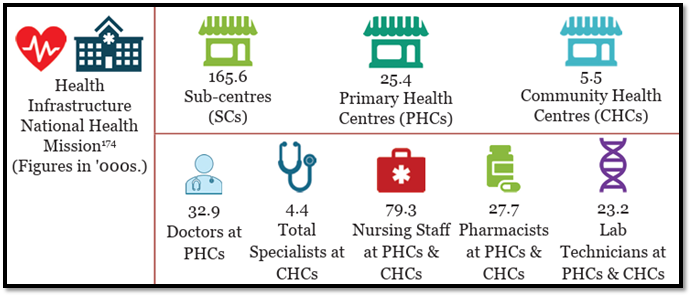
- For Betterment of Socio-Economic Conditions:
- Water Supply – Jal Jeevan Mission (extended until 2028): Operation and maintenance of rural piped water supply schemes through a citizen-centric approach, known as ‘Jan Bhagidhari’.
- India Post as a Catalyst for Rural Economy: 1.5 lakh rural post offices, India Post Payment Bank, and 2.4 lakh Dak Sevaks.
- Pradhan Mantri Gram Sadak Yojana (PMGSY) – Roads: rural connectivity through a single all-weather road.
- Pradhan Mantri Awaas Yojana-Gramin (PMAY-G) – Housing
Challenges in Rural Development
- Financial Constraints: States often cite limited budgets as a barrier to implementing comprehensive rural development programs.
- Inadequate Infrastructure: Many villages still lack basic amenities like clean drinking water, functional schools, and healthcare services.
- Lack of Policy Focus: The absence of targeted policies for rural areas has led to uneven development and persistent inequalities.
Way Forward
- Integrated Development Approach: Governments must adopt a holistic strategy that simultaneously addresses education, healthcare, and hygiene to ensure sustainable rural development.
- Corporate Social Responsibility (CSR): The court suggested leveraging CSR funds to establish e-libraries and other essential facilities in rural areas.
- Community Participation: Empowering local communities to take ownership of development initiatives can lead to more effective and sustainable outcomes.
Cape Town Convention
Syllabus: GS2/ Bills & treaties
In Context
- The Rajya Sabha passed ‘The Protection of Interests in Aircraft Objects Bill, 2025‘, a landmark legislation aimed at giving legal force to international treaties governing aviation finance.
- It seeks to implement the Cape Town Convention and Aircraft Protocol within the Indian legal system.
What Is the Cape Town Convention?
- About:
- Adopted in 2001, the Cape Town Convention on International Interests in Mobile Equipment and its Aircraft Protocol were designed to create a uniform legal framework to facilitate asset-based financing and leasing of high-value mobile equipment like aircraft, helicopters & aircraft engines.
- Objectives of the Convention:
- Safeguard the rights of lessors and creditors
- Provide legal remedies in cases of default
- Reduce cross-border legal complexities
- Enable quick repossession and deregistration of aircraft in case of payment failures
- Ratification:
- India ratified the Convention in 2007, but until now, had no domestic legislation to operationalize its provisions.
Protection of Interests in Aircraft Objects Bill, 2025
- Key Provisions of the Bill:
- Legal Enforceability: Grants statutory recognition to the Cape Town Convention and Protocol in India.
- Creditor Remedies: In case of default, allows creditors or lessors to reclaim possession of aircraft within two months or a mutually agreed period.
- DGCA as Domestic Registry: Designates the Directorate General of Civil Aviation (DGCA) as the domestic registry for aircraft-related international interests and dues.
- Mandatory Reporting: Airlines must report dues to lessors on a per-aircraft basis.
- Lessors must inform DGCA about their operations and interests in India.
- Clarity in Bankruptcy Scenarios: Offers clearer protections to lessors in situations where airlines become insolvent.
Impact and Benefits
- The legislation is expected to:
- Reduce leasing costs by 8–10%
- Encourage global leasing firms to operate from or partner with India
- Lower airfares over time due to more affordable aircraft financing
India-Australia Economic Cooperation and Trade Agreement
Syllabus :GS 2/IR
In News
- India-Australia Economic Cooperation and Trade Agreement (Ind-Aus ECTA) marked its third anniversary.
Ind-Aus ECTA
- The agreement signed in April , 2022, has strengthened economic ties between India and Australia, fostering new trade pathways and business opportunities
- Total bilateral trade reached USD 24 billion in 2023-24, with a 14% increase in India’s exports to Australia compared to 2022-23.
- India’s exports to Australia grew by 4.4% from April 2024 to February 2025 compared to the same period in the previous fiscal year.
- Sectors benefiting from ECTA include textiles, pharmaceuticals, chemicals, agriculture, electronics, and engineering.
- New export lines, such as Calcined Petroleum Coke, High-Capacity Diesel Generating Sets, and Air Liquefaction Machinery, show expanding trade opportunities.
- Imports from Australia include key raw materials like metalliferous ores, cotton, and wood products, supporting the growth of Indian industries.
Diplomatic Relations
- Diplomatic relations between Australia and India date back to 1941, with the Consulate-General of India opening in Sydney.
- Both countries hold annual leader-level summits and frequent multilateral forum interactions (e.g., Quad, G20, East Asia Summit).
- The 2+2 format (Foreign & Defence Ministers) meetings occur every two years to discuss strategic issues.
- Foreign Ministers’ Framework Dialogue meets annually.
People-to-People Links
- Nearly 1 million Australians have Indian heritage, forming the second-largest overseas-born group.
- India is Australia’s largest source of skilled migrants and second-largest source of international students.
- Cultural and Community Initiatives like the Australia India Leadership Dialogue and Youth Dialogue strengthen bilateral ties.
Renewable Energy & Resources
- Renewable Energy Partnership was launched November 2024 and focuses on solar, green hydrogen, and energy storage.
- Both countries are developing new supply chains for green steel and minerals to support India’s clean energy goals.
Defence Engagement
- It was enhanced post-2020 with Mutual Logistics Support Agreement and joint military exercises.
- Australia hosted Exercise Malabar, Indian Navy visited Australia’s Cocos Islands in 2023.
Future Outlook
- Australia and India are committed to deepening cooperation for mutual prosperity and a stable Indo-Pacific region.
- The partnership is expected to continue growing, driving mutual prosperity and contributing to a stronger global economy.
Domestically Manufactured Iron & Steel Products Policy-2025
Syllabus: GS3/ Infrastructure
In News
- The Centre has introduced the DMISP Policy – 2025 with a sharp focus on self-reliance and domestic value addition in the steel sector.
Objective & Significance
- Promote Self-Reliance: The primary goal is to encourage domestic production and consumption of iron and steel, aligning with the “Atmanirbhar Bharat” (Self-Reliant India) vision.
- Curb Imports: The policy seeks to address the rising trend of steel imports, which the government perceives as a threat to the Indian steel sector.
- Protect Domestic Industry: It aims to shield Indian steel manufacturers from foreign competition, particularly in government contracts and infrastructure projects.
- Enhance Domestic Value Addition: The policy also emphasizes increasing the local sourcing of capital goods used in steel manufacturing.
Key Highlights of the DMI&SP Policy–2025
- Preference for Domestic Steel: All government ministries, departments, PSUs, trusts, and statutory bodies must procure locally manufactured iron and steel products.
- Applies to all procurement contracts exceeding ₹5 lakh.
- Covers infrastructure projects under centrally sponsored and central sector schemes.
- “Melt & Pour” Requirement: Products must be melted and poured into solid form within India, ensuring core production happens domestically. Includes flat-rolled products, bars, rods, and railway steel.
- No Global Tenders Under ₹200 Cr: Global Tender Enquiries (GTE) are banned for contracts below ₹200 crore unless explicitly approved by the Department of Expenditure.
- Reciprocal Clause: Suppliers from nations that prohibit Indian firms from participating in their public procurement processes will be barred from bidding in Indian government steel tenders—unless specifically allowed by the Ministry of Steel.
- Aimed at ensuring level playing fields in international trade, with China believed to be a primary target.
- Emphasis on Domestic Value Addition: For capital goods used in steel production (e.g., furnaces, rolling mills), a minimum of 50% domestic value addition is mandatory.
- Bidders must self-certify, with false claims risking blacklisting and forfeiture of earnest money deposits.
- Auditor certification is required for capital goods to verify value thresholds.
