
Supreme Court on Child Trafficking
Syllabus: GS2/Vulnerable Section of Society; Human Rights Concerns
Context
- Recently, the Supreme Court of India has issued a warning to parents across the country, urging them to remain vigilant against the growing menace of child trafficking.
- It highlighted that traffickers exploit juvenile protection laws to force children into crime.
About the Child Trafficking
- It is defined as the recruitment, transportation, transfer, harboring, or receipt of a child for the purpose of exploitation.
- Forms of Child Trafficking:
- Forced Labor: Children are trafficked into industries such as domestic work, agriculture, and construction.
- Sexual Exploitation: Many victims are forced into prostitution or online exploitation.
- Illegal Adoption: Criminal networks abduct children to sell them for adoption.
Current Scenario and Statistics
- Over 10,000 cases of trafficking were reported, yet only 1,031 convictions were secured (Between 2018 and 2022).
- Uttar Pradesh, Bihar, and Andhra Pradesh are among the top states with the highest number of trafficked children.
- According to National Crime Records Bureau (NCRB) data of 2022, 3098 victims (below 18 years) are rescued.
Challenges in Addressing Child Trafficking
- Low Conviction Rates: Despite thousands of arrests, the conviction rate remains below 5%, highlighting gaps in investigation and prosecution.
- Lack of Awareness and Reporting: Many cases go unreported due to fear, lack of legal knowledge, and social stigma.
- Inter-State Trafficking Networks: Traffickers operate across state borders, making it difficult for law enforcement agencies to track and dismantle these networks.
Legal and Institutional Framework in India
- Article 23 of the Constitution: It prohibits trafficking in human beings and forced labor.
- The Immoral Traffic (Prevention) Act, 1956 (ITPA): It criminalizes human trafficking and provides penalties for offenses involving children, especially those trafficked for sexual purposes.
- Protection of Children from Sexual Offences (POCSO) Act, 2012: It is designed to protect children from sexual assault, sexual harassment, and pornography.
- It was passed to address child sexual abuse comprehensively and includes provisions for special courts to try these offenses.
- It defines a child as anyone under 18 years of age.
- The Juvenile Justice (Care and Protection of Children) Act, 2015: It defines a child in need of care and protection, including those at risk of trafficking.
- It mandates rehabilitation through child welfare committees.
- Bharatiya Nyaya Sanhita (BNS), 2023:Sections 143 and 144 are related to provisions for the offences of human trafficking.
- Also, Section 111 in BNS is related to Organized Crimes, covers the crime of trafficking of persons for prostitution.
- Bhartiya Nagarik Suraksha Sanhita (BNSS): It recognizes trafficking as a cognizable and non-bailable offence.
- Anti Human Trafficking Units (AHTUs): Central Government has provided financial assistance to States/ UTs for setting up/ strengthening of AHTUs.
- Currently, 827 AHTUs are functional including 807 in States/ UTs, 15 in Border Security Forces (BSF) and 5 in Sashastra Seema Bal (SSB).
- Crime Multi Agency Centre (Cri-MAC): It was launched by the Ministry of Home Affairs (MHA) for online sharing of information on crime & criminals on 24×7 basis among various Law Enforcement Agencies and ensure seamless flow of information between them.
- Ujjawala Scheme (by Ministry of Women and Child Development): A comprehensive scheme for the prevention of trafficking and rehabilitation of victims through rescue, reintegration, and repatriation.
Global Initiatives Related To Child Trafficking
- United Nations Protocol to Prevent, Suppress and Punish Trafficking in Persons: It is known as the Palermo Protocol (adopted by UNGA in 2000), that provides a framework for countries to combat trafficking through prevention, protection, and prosecution.
- Global Report on Trafficking in Persons: It is published by the United Nations Office on Drugs and Crime (UNODC), highlighting the trends, patterns, and regional analyses of trafficking.
- 2024 Edition: It revealed a 25% increase in detected trafficking victims, with children accounting for 38% of all victims detected worldwide.
- International Labour Organization (ILO): It works to eliminate child labor, a form of trafficking, through initiatives like the International Programme on the Elimination of Child Labour (IPEC).
Conclusion
- The Supreme Court’s judgment serves as a wake-up call for parents, authorities, and society at large to address the growing threat of child trafficking.
- By emphasizing vigilance, accountability, and swift legal action, the court has laid the groundwork for combating this heinous crime.
T.N. Government Issues Advisory Reiterating Use of Tamil as Official Language
Syllabus: GS1/Polity and Governance
Context
- The Tamil Nadu government has issued an advisory to senior officials and heads of departments, reiterating existing provisions and orders mandating the use of Tamil as the official language in all government offices.
About
- Tamil is the official language of the Government of Tamil Nadu, according to the Official Languages Act 1956.
- As per the Advisory:
- Government orders should only be issued in Tamil, and circulars should also be in Tamil.
- The letters received in Tamil from the public should be replied to in Tamil; the notes about them should also be in Tamil.
- Government employees should sign only in Tamil in all correspondence.
Regional Languages in State Legislature
- As per the Article 345: A State Legislature can choose any language(s) used in the State or Hindi for official work.
- However, until the State passes a law to change it, English will continue to be used for official purposes where it was used before the Constitution began.
Official Language of Union
- English, alongside Hindi, is one of the two official languages of the central government.
- Article 343(2) says that “for a period of fifteen years from the commencement of this Constitution, the English language shall continue to be used for all the official purposes of the Union for which it was being used immediately before such commencement”. The Constitution of India came into force on January 26, 1950.
- Under Article 343(3), “Parliament may by law provide for the use, after the said period of fifteen years, of— (a) the English language, or (b) the Devanagari form of numerals, for such purposes as may be specified in the law.”
- On January 26, 1965, Section 3 of the Official Languages Act, 1963 came into effect, which provided for the “continuation of English Language for official purposes of the Union and for use in Parliament”.
Administrative Efficiency vs. Regional Assertion
- Exclusive use of Tamil may lead to communication challenges with central authorities or inter-state coordination.
- Translation requirements for ordinances and letters could cause delays or errors if not implemented carefully.
- The directive for government servants to sign in Tamil might pose difficulties for officers from non-Tamil backgrounds, especially All India Services.
- Tamil-only directives could require significant technological adjustments, especially in databases, software, and e-governance tools.
| Status of Hindi language – The Constitution of India does not list any one language as India’s “national language”. – Clause 1 of Article 343 (Official language of the Union) says “The official language of the Union shall be Hindi in Devanagari script”. – Article 351 (Directive for development of the Hindi language) says “It shall be the duty of the Union to promote the spread of the Hindi language, to develop it so that it may serve as a medium of expression for all the elements of the composite culture of India”. 1. However, the provision says, this must be done “without interfering with its genius, the forms, style and expressions used in Hindustani and in the other languages of India specified in the Eighth Schedule”. Eighth Schedule – Initially there were only 14 languages in this Schedule. – Currently 22 languages are listed under the Eighth Schedule of the Constitution. 1. These include Assamese, Bengali, Gujarati, Hindi, Kannada, Kashmiri, Konkani, Malayalam, Manipuri, Marathi, Nepali, Oriya, Punjabi, Sanskrit, Sindhi, Tamil, Telugu, Urdu ,Bodo, Santhali, Maithili and Dogri. – English is absent from the list of 22 in the Eighth Schedule. It is one of the 99 non-scheduled languages of India. |
Justice BR Gavai To Be the Next CJI
Syllabus: GS2/Polity and Governance/ Judiciary
Context
- Chief Justice of India (CJI) Sanjiv Khanna has recommended Justice B.R. Gavai — next in line by seniority — to the Union Law Ministry for appointment as the 52nd Chief Justice of India.
About Appointment of the CJI
- The Constitution of India does not mention any procedure for appointment of the CJI.
- Article 124 (1) of the Constitution merely says, “there shall be a Supreme Court of India consisting of a Chief Justice of India.”
- Clause (2) of Article 124 of the Constitution says that every Judge of the Supreme Court shall be appointed by the President.
- Thus, in the absence of a constitutional provision, the procedure to appoint CJI relies on convention.
What is the Convention?
- The outgoing CJI recommends his successor a practice, which is based on seniority.
- Seniority at the apex court, however, is not defined by age, but by the date a judge was appointed to the SC.
- If two judges are elevated to the Supreme Court on the same day,
- the one who was sworn in first as a judge would trump another;
- if both were sworn in as judges on the same day, the one with more years of high court service would ‘win’ in the seniority stakes;
- an appointment from the bench would ‘trump’ in seniority an appointee from the bar.
Roles and Powers of CJI
- Master of the Roster: The CJI has the exclusive authority to allocate cases to different benches of the Supreme Court. This power includes determining the schedule and priority of hearings.
- Appointment of Judges: The CJI, along with the collegium (comprising the four senior-most Supreme Court judges), plays a crucial role in recommending judges for appointment to the Supreme Court and High Courts. The President consults with the CJI and the collegium during this process.
- Appointment of Ad-hoc Judges: Under Article 127 of the Constitution, the CJI can appoint ad-hoc judges to the Supreme Court when necessary.
- Changing the Seat of the Supreme Court: With the President’s approval, the CJI can relocate the Supreme Court from Delhi to another location.
Removal Process of CJI
- The President of India has the authority to remove the CJI.
- However, the President can only remove the CJI after Parliament presents an address requesting the removal.
- This address must be supported by a special majority in both Houses of Parliament.
Growing relevance of the Northeast – as a gateway to Southeast Asia
Syllabus: GS2/IR/GS3/Infrastructure
Context
- External Affairs Minister S Jaishankar highlighted the growing relevance of the Northeast – as a gateway to Southeast Asia.
About
- EAM was virtually addressing a meeting of ambassadors for the upcoming North East Investors Summit 2025.
- It was organised by the Ministry of Development of North Eastern Region (DoNER).
- He said the northeast region is at the heart of many key Indian policies — Neighbourhood First, Act East or the Bay of Bengal Initiative for Multi-Sectoral Technical and Economic Cooperation (BIMSTEC).
North Eastern Region (NER)
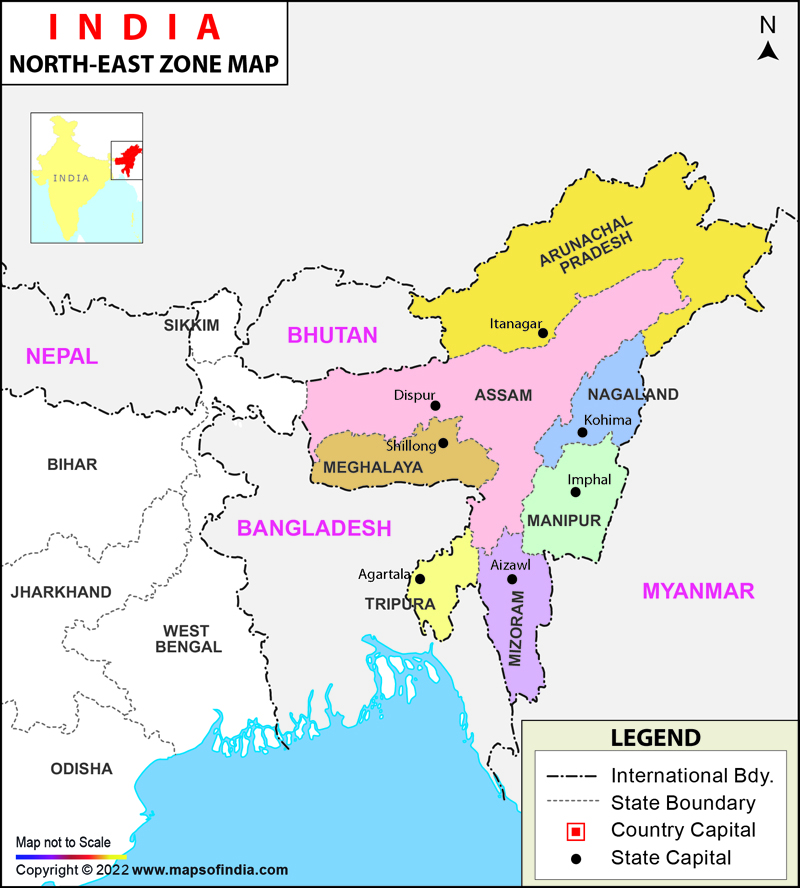
- The NER comprises eight States viz. Arunachal Pradesh, Assam, Manipur, Meghalaya, Mizoram, Nagaland, Sikkim and Tripura.
- This region is culturally and ethnically diverse having more than 200 ethnic groups which have distinct languages, dialects and socio-cultural identities.
- The Region covers 7.97% of the country’s geographical area and 3.78% of its population.
- It has 5,484 km of international border viz. Bangladesh (1,880 km), Myanmar (1,643 km), China (1,346 km), Bhutan (516 km) and Nepal (99 km).
How is it a gateway to South East Asia?
- NER has the potential to become a vibrant link between India and East/Southeast Asia.
- BIMSTEC, especially countries like Bangladesh, Myanmar, Nepal, and Bhutan, can facilitate cross-border connectivity.
- Kaladan Multi-Modal Transit Transport Project: It is aimed at connecting the port of Kolkata with the port of Sittwe in Rakhine which would then be connected to Mizoram by road and the Kaladan river which flows by Paletwa.
- Sea route: Kolkata – Sittwe (Myanmar).
- River route: Sittwe – Paletwa.
- Road route: Paletwa – Zorinpui (Mizoram border).
- India-Myanmar-Thailand highway: The 1,400-km-long highway that connects the three nations is nearly 70% completed, but the rest of the work has been affected at several places due to political changes in Myanmar since the military coup in 2021.
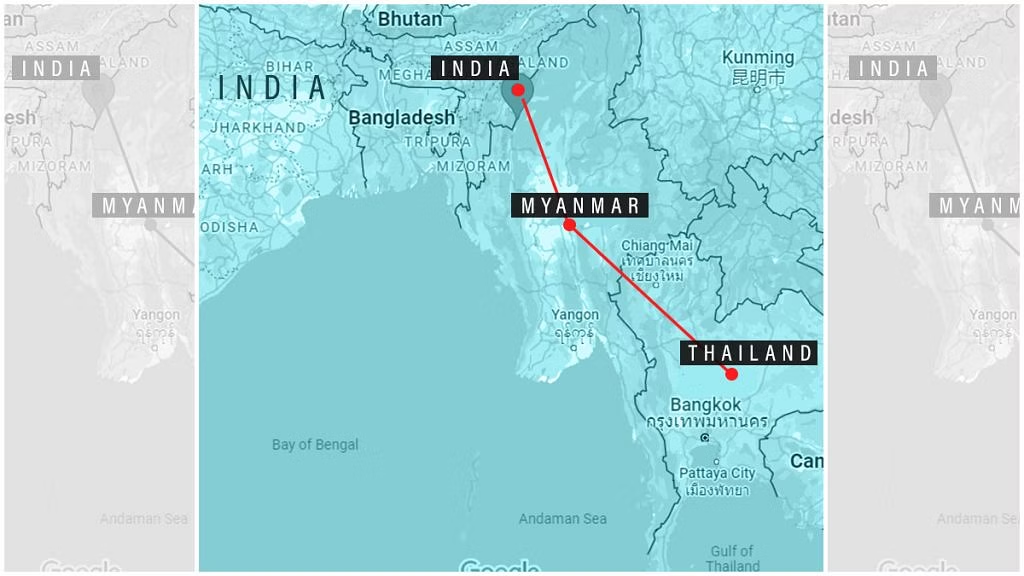
- Motor Vehicles Agreements (MVA): Crucial for seamless cross-border movement of goods and people. Two MVAs in progress:
- BBIN MVA (Bangladesh, Bhutan, India, Nepal)
- India-Myanmar-Thailand MVA.
- Modern investments come via Japan’s Overseas Development Assistance (ODA):
- India-Japan Act East Forum (established 2017).
- Facilitates infrastructure and cultural connectivity projects in the NER.
Concerns
- Connectivity corridors (road and rail) are key to integrating India with Bangladesh, Bhutan, Nepal, and ASEAN countries.
- Mountainous terrain makes railway construction challenging in the NER.
- Insurgent groups disrupt progress, including abductions of Indian workers.
- Myanmar’s ongoing political turmoil hampers project completion and cooperation.
- Motor Vehicles Agreements (MVA): Bhutan withdrew from BBIN MVA over environmental concerns.
- Thailand is hesitant due to potential disadvantages for local businesses.
Way Ahead
- Historically neglected, the northeast has gained prominence in recent decades.
- Its strategic value has increased due to India’s ‘Act East’ Policy and evolving Indo-Pacific geopolitical dynamics.
- The region is now seen as a vital gateway for India’s regional connectivity initiatives.
- Ongoing connectivity efforts require capacity-building for rail and road projects and improved border infrastructure.
- The overarching goal is to maximise the multi-dimensional potential of the northeast and cement its role as a regional connectivity hub.

India-Middle East-Europe Economic Corridor (IMEC)
Syllabus: GS2/ International Relations
In News
- The Union Minister of Commerce and Industry emphasized the potential of India-Middle East-Europe Economic Corridor (IMEC) as a modern-day Silk Route aimed at connecting Asia with Europe through the Middle East.
About India-Middle East-Europe Economic Corridor (IMEC)
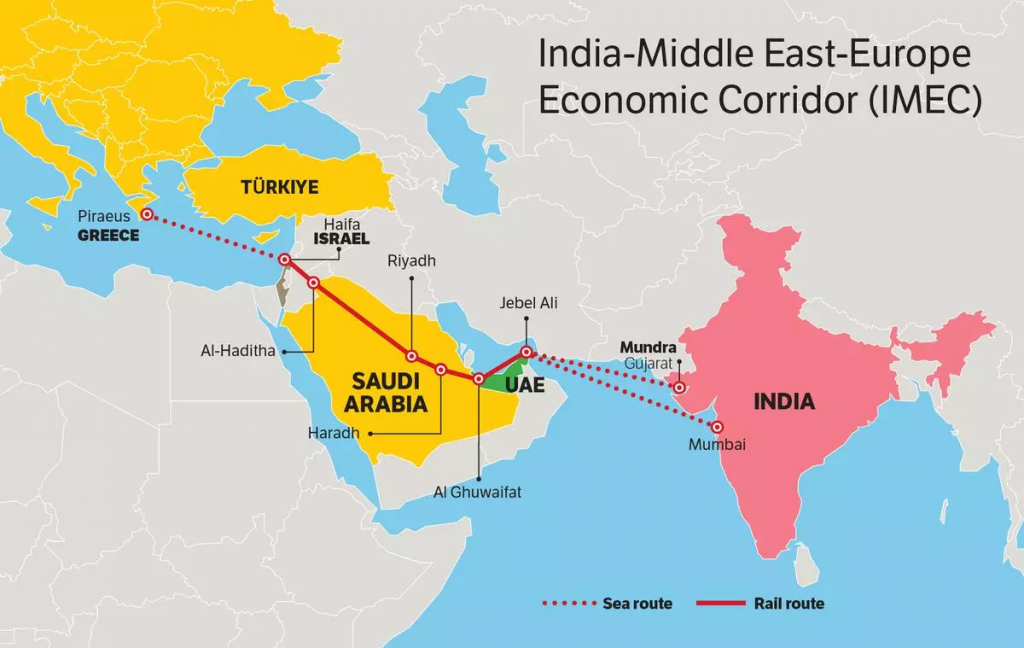
- Establishment: The MoU signed by leaders from India, the European Union, France, Germany, Italy, Saudi Arabia, UAE, and the US at the G20 Summit (2023) in New Delhi directly points to the official announcement and initial steps for the IMEC.
- Aim: The description of a multi-modal connectivity project involving ports, railways, roads, sea lines, and pipelines to enhance trade between India, the Arabian Peninsula, the Mediterranean region, and Europe perfectly aligns with the stated goals of the IMEC.
- Corridors: The division into an Eastern corridor (India to the Gulf) and a Northern corridor (the Gulf to Europe) is a key structural element of the IMEC.
Significance IMEC for India
- Strategic Geopolitical Influence:
- Counter to China’s BRI: IMEC is viewed as a Western-backed alternative to China’s Belt and Road Initiative (BRI), giving India a key role in shaping global connectivity.
- Strengthens ties with West Asia and Europe: It enhances India’s diplomatic and trade engagement with countries like UAE, Saudi Arabia, Israel, and EU nations.
- Trade and Economic Boost:
- Faster, cheaper trade routes: IMEC offers an efficient corridor for Indian exports to reach European markets through the Middle East, reducing transit time and cost.
- Economic integration: Encourages foreign investment in India’s ports, railways, and logistics sectors, boosting employment and GDP.
- Energy Security:
- Facilitates better energy cooperation, especially in green hydrogen, natural gas, and renewable energy, aligning with India’s transition to clean energy.
- Enhances connectivity to Gulf energy hubs like Saudi Arabia and UAE.
- Digital Infrastructure and Technology:
- Includes plans for digital connectivity (like fiber-optic cables) between India, Middle East, and Europe—critical for tech partnerships and cyber cooperation.
- Infrastructure and Maritime Development:
- Boosts India’s port-led development under the Sagarmala Project by integrating Indian ports into global logistics chains. Logistics cost can be reduced up to 30%.
- Multilateral Cooperation:
- Reinforces India’s image as a responsible global player and a vital link between Global South and Global North.
- Encourages triangular cooperation with the US, EU, and Gulf nations.
Challenges
- Geopolitical Instability:
- Ongoing conflicts like the Israel-Palestine crisis, the friction between Iran and Gulf nations, and general regional unrest can impact corridor planning and operations.
- Issues like piracy, naval skirmishes, or blockades in these crucial chokepoints can seriously jeopardize smooth trade flow.
- Infrastructure and Funding Hurdles:
- Setting up multimodal logistics points like ports, railways, energy systems, and digital networks requires a hefty investment from both public and private sectors.
- Challenges such as land acquisition, getting regulatory approvals, and navigating bureaucratic red tape across various countries can slow down infrastructure development.
- Multinational Coordination:
- IMEC brings together several sovereign nations (India, UAE, Saudi Arabia, Jordan, Israel, and EU countries), each with its own set of priorities, policies, and political landscapes.
- Technological and Digital Standardization:
- The corridor features digital and energy elements, including data cables and green energy grids and ensures that everything works seamlessly while checking other technological challenges.
- Competition from Existing Routes:
- Current maritime routes through the Suez Canal or even China’s BRI corridors might still be more affordable. India needs to make sure that IMEC is not only cost-effective but also logistically superior to draw in global businesses.
China Restricts Exports of Rare Earths
Syllabus :GS 3/Economy
In News
- Recently, China announced restrictions on the export of seven Rare Earth Elements which includes samarium, gadolinium, terbium, dysprosium, lutetium, scandium, and yttrium following U.S. President Trump’s tariff impositions.
Rare Earth Elements (REEs)
- They are a set of 17 chemical elements in the periodic table — cerium (Ce), dysprosium (Dy), erbium (Er) etc. All have similar chemical properties and appear silver-coloured.
- Despite their name, they are not as rare as they appear, but concentrated, economically mineable deposits are hard to find.
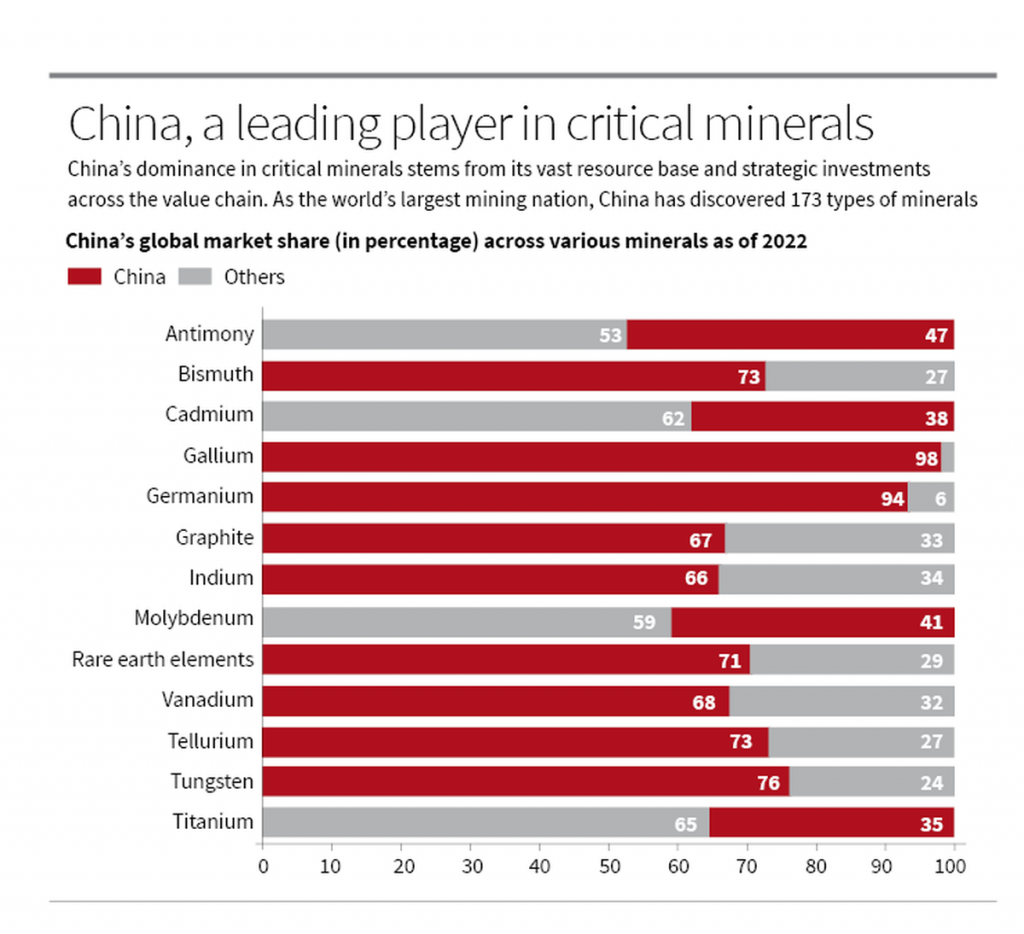
- China has dominated the rare earth market since the 1990s, supplying 85-95% of global demand.
Importance
- Rare Earth Elements (REEs) are crucial in various industries, including clean energy (electric vehicles and wind turbines), electronics (digital displays), and automobile manufacturing (magnets for power steering, windows, and speakers).
- They are also crucial for manufacturing high-tech products including defense.
Consequences of China’s Export Restrictions
- China dominates the global supply of critical minerals, controlling vast reserves and processing capabilities, including 87% of rare earth processing and major shares in lithium, cobalt, and silicon refining.
- The new controls are expected to disrupt industries globally reliant on rare earths, leading to higher prices and potential supply shortages.
- As supply tightens, the prices of REEs are expected to surge which could further raise the production cost & overall prices.
- REEs are crucial for manufacturing advanced military technologies like fighter jets (e.g., F-35), submarines (e.g., Virginia and Columbia class), missiles (e.g., Tomahawk)
- The mining process can also cause significant environmental damage, as it releases harmful substances like arsenic and cadmium.
Status in India
- India has significant reserves of rare earth elements in the states of Andhra Pradesh, Karnataka, Odisha, and Kerala. The monazite sands in Kerala are particularly rich in REEs.
- India faces acute vulnerability with over 40% dependency on China for six key minerals: bismuth (85.6%), lithium (82%), silicon (76%), titanium (50.6%), tellurium (48.8%), and graphite (42.4%).
- Despite having significant mineral resources, India lacks the technology to extract minerals like lithium from its own deposits.
| Do you know ? – In 2023, India identified 30 critical minerals essential for its economic growth and national security, with a significant dependency on imports, especially from China. |
Conclusion and Way Forward
- REEs’ unique magnetic and optical properties make them indispensable in modern technology.
- In this context, India is working to diversify its supply chain by investing in overseas assets, joining global initiatives like the Minerals Security Partnership, and promoting recycling and research.
- However, reducing dependency on China will require long-term investment and sustained efforts.
- There is a need to develop national policies and implementation strategies for ensuring indigenous supply of REEs.
Particulate Matter Trading Scheme in Gujarat
Syllabus: GS3/ Environment
Context
- A study found that the Surat Emission Trading Scheme (ETS) in Gujarat, delivered both environmental and economic benefits.
About
- The Emission Trading Scheme (ETS) in Surat, launched in 2019, is the world’s first market-based trading system for particulate matter (PM) emissions and India’s first pollution trading scheme of any kind.
- It represents a cap-and-trade system, where total emissions are capped and emission permits can be traded among industrial units.
- It was developed by the Gujarat Pollution Control Board (GPCB), in collaboration with the Energy Policy Institute at the University of Chicago.
How does the Scheme Work?
- Continuous Emissions Monitoring Systems (CEMS): 318 coal-using industrial units were mandated to install CEMS to enable real-time tracking of PM emissions.
- This marked a shift from the earlier system of periodic spot checks.
- GPCB set a cap of 170 tonnes/month based on real-time CEMS data.
- Auctioning: The GPCB issued about 80% of the emissions cap in free permits, distributed in proportion to a plant’s emissions potential (e.g., boiler size), while the remaining 20% were auctioned weekly.
- Firms failing to hold enough permits to match their emissions were penalised proportionally.
Key Achievements of Surat ETS
| Parameter | Impact |
| Pollution Reduction | 20–30% reduction in PM emissions |
| Cost Efficiency | Over 10% decrease in pollution abatement costs |
| Compliance | 99% compliance with environmental norms |
Significance of the Programme
- Environmental Innovation: being the first cap-and-trade system globally for PM emissions it showcases India’s leadership in market-based environmental regulation.
- Data-Driven Policy: The use of real-time CEMS data allowed for evidence-based regulation and gradual tightening of caps to match actual emissions levels.
- Scalability: The success in Surat paves the way for similar schemes in other Indian cities and for other pollutants, including NOx and SO₂.

