
Cloudburst-Triggered Landslide in Jammu and Kashmir
Syllabus: GS1/ Geography
Context
- Recently, a cloudburst event in the Ramban tehsil of Jammu and Kashmir led to torrential rains, hailstorms, and winds, causing widespread destruction.
About
- A cloudburst is a localized event with intense rainfall activity. The phenomenon is most common in hilly regions, however it can occur in plains also.
- The rainfall of 10 cm or more in an hour over a roughly 10 km x 10 km area is classified as a cloudburst event.
- Also 5 cm of rainfall in a half-hour period over the same area would also be categorized as a cloudburst.
Mechanism of Cloudbursts
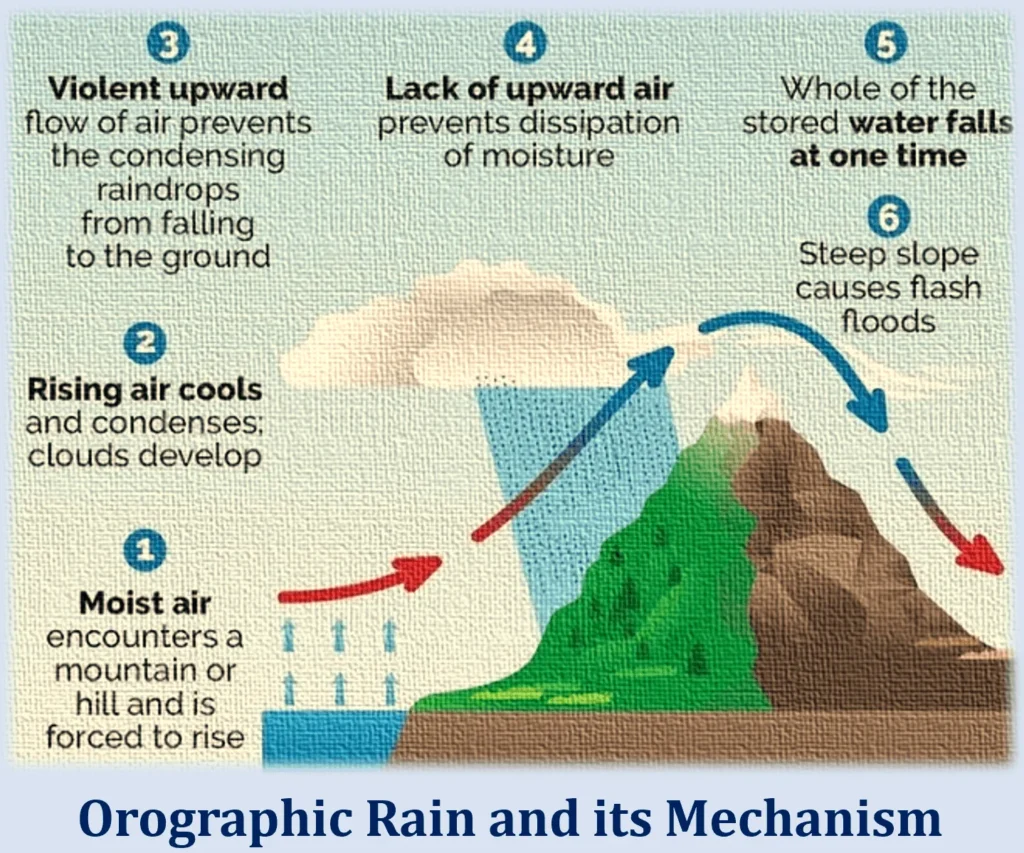
- Cloudbursts are more common in hilly areas because of a phenomenon called ‘orographic lift’. When moist, warm air masses approach a mountain range, they are forced to ascend along the slope.
- As the air rises, it encounters lower atmospheric pressure, causing it to expand and cool.
- The cooling leads to condensation of water vapor, forming dense clouds and typically causing rainfall.
Impact of Cloudbursts
- Flash Flood: A flash flood happens quickly, when a lot of rain suddenly enters into the drainage systems (waterbodies, drains), and water overflows.
- Flash floods are more common in hills, because rocky terrain does not absorb water very well.
- Example: The 2013 Kedarnath Disaster involved a cloudburst followed by massive flash floods.
- Landslide: Landslides are a geological phenomenon that involves the sudden and rapid movement of a mass of rock, soil, or debris down a slope under the influence of gravity.
- Loss of Life and Livelihood: Sudden nature of cloudbursts leaves little time for evacuation. Destruction of homes, agricultural fields, and livestock affects livelihoods, especially in rural and tribal communities.
- Damage to Infrastructure: Roads, bridges, power lines, and communication networks are often washed away.
- Social Impact: Frequent disasters create trauma, displacement, and migration pressures. Affects education, healthcare, and access to essential services in remote regions.
Measures taken in India
- The Disaster Management Act, of 2005 provides a comprehensive legal and institutional framework for the management of various disasters in India.
- The National Institute of Disaster Management (NIDM) has been providing capacity building and other support to various national and state-level disaster management authorities.
- Early Warning system:
- India Meteorological Department (IMD), implements the Ensemble Prediction System (EPS), which uses multiple models to improve the accuracy of rainfall predictions.
- Doppler Weather Radars (DWRs): Installed in hilly and vulnerable regions to detect intense rainfall events in real-time.
- Flash Flood Guidance System (FFGS): Developed with WMO support to provide early warning for flash floods across South Asia, including India.
- Mobile-based Alert Systems: IMD and NDMA use SMS and app-based alerts to inform people in real-time.
Way Ahead
- To effectively mitigate the impact of cloudbursts, India must adopt a comprehensive and proactive approach that combines scientific forecasting, infrastructural resilience, and community-based preparedness.
- Land use planning and zoning regulations must be strictly enforced to prevent construction in high-risk zones.
- Urban and rural infrastructure should be designed to handle sudden surges in water flow, with emphasis on stormwater drainage systems, slope stabilization, and rainwater harvesting.
- Also there is a need to integrate climate change adaptation into disaster management planning as intensity of such extreme weather events has increased.
ISRO Satellites Forecast Wheat Production: Use of Space Technology in Agriculture Sector
Syllabus :GS 3/Economy
In News
- ISRO’s study using satellite data has estimated India’s total wheat production for the 2024-25 Rabi season at 122.724 million tonnes from eight major wheat-growing states.
About the study
- It used the Comprehensive Remote Sensing Observation on Crop Progress (CROP) framework, which employs Optical and Synthetic Aperture Radar (SAR) datasets from EOS-04, EOS-06, and Resourcesat-2A to monitor wheat sowing and crop conditions in near real-time.
- CROP is a semi-automated, scalable framework, developed by NRSC/ISRO that enables the near real-time monitoring of crop sowing and harvesting during the Rabi season across India.
- As of March 31, 2025, the wheat sown area was 330.8 lakh hectares, closely matching the Ministry of Agriculture’s data.
Importance and Need of Space Technology in Agriculture Sector
- India’s agricultural sector is vital for livelihoods but faces pressure from a growing population and shrinking natural resources.
- To ensure sustainability, optimized planning and smart resource management are essential.
- Space-based technologies such as satellite imaging, remote sensing, GNSS, and geolocation offer powerful tools for monitoring large, diverse areas.
- It Improves crop monitoring, resource use, and weather forecasting.
- It supports informed decision-making for farmers, researchers, and policymakers.
Applications
- Precision Agriculture : Global Navigation Satellite Systems (GNSS) enables accurate field mapping and resource allocation.
- It helps in precise irrigation, nutrient management, and crop planning.
- It boosts yields and resource efficiency.
- Improved Connectivity : Satellite-based networks provide real-time access to weather, prices, and expert advice.
- Remote Sensing & Satellite Imaging : It tracks crop health, vegetation, and land use.
- It detects disease early for targeted pest control and reduced pesticide use.
- Hyperspectral Imaging: It offers detailed plant health insights by detecting subtle physiological changes.
- More effective than traditional spectral sensors.
- Water & Soil Management: It supports efficient irrigation, groundwater conservation, and soil moisture tracking.
- It aids in combating erosion, land degradation, and promoting soil conservation.
Related steps
- The Ministry of Agriculture and Farmers Welfare has actively adopted space technology since the 1980s for improving agricultural planning and productivity.
- In 2012, the Mahalanobis National Crop Forecast Centre (MNCFC) was established to operationalize ISRO’s space technology for crop forecasting.
- The Soil and Land Use Survey of India (SLUSI) uses satellite data for soil resource mapping.
- Krishi-DSS is a first-of-its-kind geospatial platform specifically designed for Indian agriculture. The platform provides seamless access to comprehensive data including satellite images, weather information, reservoir storage, groundwater levels and soil health information, which can be easily accessed from anywhere at any time.
Conclusion and Way Forward
- Space technology holds immense promise for the future of agriculture.
- By harnessing the power of satellite imagery and data, the agricultural sector can achieve significant improvements in productivity, sustainability, and economic value.
- Their growing adoption will play a crucial role in ensuring food security, economic development, and environmental sustainability.
Electronics Manufacturing
Syllabus: GS3/Economy
Context
- India has attracted global smartphone makers like Apple and Samsung due to a large talent pool, government subsidies, and geopolitical factors pushing companies to diversify from China.
About
- After successfully being able to localise smartphone assembly in the country for domestic consumption and some exports, the government has shifted its focus to deepening local value addition in the sector.
- The key target: Driving up local value addition in the sector, reducing India’s import dependence on countries like China, and creating good quality jobs.
- Currently, the domestic value addition stands at around 15-20%, with the government hoping to double that in the coming years (China’s current value addition in the sector is around 38%).
- Worryingly, India’s trade deficit with China reached an all-time high in 2024-25, nearing $100 billion.
Electronics Sector
- The electronics sector encompasses the design, manufacturing, and marketing of electronic components and systems.
- Electronics is one of the highest-traded and fastest-growing industries globally and is expected to play a pivotal role in shaping the global economy.
- Since electronics permeates all sectors of economy it has economic and strategic importance.
India’s Electronic Sector
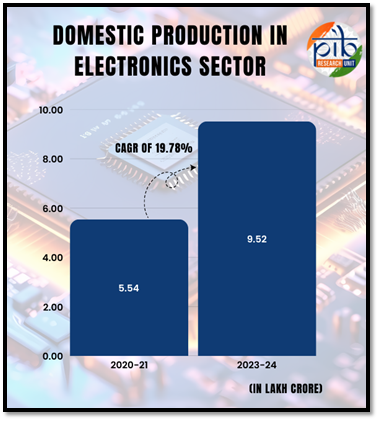
- Domestic Production: It has increased from Rs.1.90 lakh crore in FY 2014-15 to Rs.9.52 lakh crore in FY 2023-24 at a CAGR of more than 17%.
- Exports: The exports of electronic goods have also increased from Rs.0.38 lakh crore in FY 2014-15 to Rs.2.41 lakh crore in FY 2023-24 at a CAGR of more than 20%.
- India is the second largest mobile phone producer in the world.
- India’s semiconductor ecosystem has gained significant momentum, with five landmark projects receiving approval with a total combined investment nearing Rs 1.52 lakh crores.
- Future Projections: It indicates that India’s electronics production will reach USD 300 billion by 2026.
Challenges
- Dependence on Imports: High reliance on imported components, especially semiconductors, increases costs and supply chain vulnerabilities.
- Infrastructure Gaps: Inadequate infrastructure for large-scale manufacturing and logistics hampers efficiency.
- Skilled Labor Shortage: Limited availability of skilled workers for advanced manufacturing processes and R&D.
- High Capital Investment: Significant investment required for setting up world-class manufacturing facilities, making entry challenging for new players.
- Technology Gaps: Lack of cutting-edge technology and innovation in certain segments of the electronic value chain.
- Competition from Global Players: Intense competition from established global electronics manufacturers and countries with lower production costs.
Government schemes for the Electronics boom in India:
- Make in India: launched in 2014, aimed at boosting India’s manufacturing sector and economic growth.
- Transform India into a global hub for design and manufacturing.
- Phased Manufacturing Programme (PMP): Launched in 2017, aimed to promote domestic value addition in mobile phones and their parts.
- Increased investment and set up significant manufacturing capacities in India.
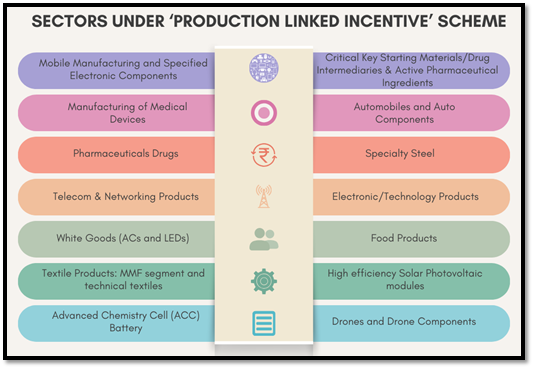
- Production Linked Incentive (PLI) Scheme: Introduced in 2020, aimed to boost domestic manufacturing in mobile phones, electronic components, and semiconductor packaging.
- Incentives: 3% to 6% on incremental sales (over base year) for eligible companies.
- Duration: 5 years.
- Semicon India Program: Launched in 2021 with a financial outlay of ₹76,000 crore, it is structured to promote the domestic semiconductor industry through incentives and strategic partnerships.
- At Global Investors Summit 2025, it was announced that India’s first indigenous semiconductor chip will be ready for production by 2025.
- The Scheme for Promotion of Manufacturing of Electronic Components and Semiconductors (SPECS): The scheme will provide financial incentive of 25% on capital expenditure for the identified list of electronic goods that comprise downstream value chain of electronic products.
- Increased Budget: Allocation for electronics manufacturing rose from ₹5,747 crore (2024-25) to ₹8,885 crore (2025-26), highlighting the government’s commitment to industrial growth.
- Electronics Component Manufacturing Scheme: The Union Cabinet chaired by the PM approved the Electronics Component Manufacturing Scheme with a funding of Rs.22,919 crore to make India Atmanirbhar in the electronics supply chain.
- Tenure of six years with a one-year gestation period.
- Expected Outcomes:
- Attract an investment of Rs.59,350 crore.
- Result in production of Rs.4,56,500 crore.
- Generate 91,600 direct jobs and numerous indirect jobs.
Conclusion
- India’s rapid transformation into a global electronics manufacturing hub is a testament to the success of the Make in India initiative.
- With numerous schemes to support the manufacturing processes in India, the country has significantly boosted local manufacturing, exports, and investment.
- Aiming for USD 300 billion in electronics production by 2026, India is positioning itself as a major hub in the electronics and semiconductor industries.
Kerala’s Intellectual Property Rights policy to be revised after 17 years
Syllabus: GS3/Science and Technology
Context
- The Intellectual Property Rights (IPR) Policy of Kerala is set to undergo a thorough overhaul after a gap of 17 years.
About
- The Kerala State Council for Science, Technology and Environment (KSCSTE) has constituted a six-member drafting committee headed by Chairman, Kerala State Biodiversity Board, for preparing the revised policy.
- Kerala had first formulated an IPR policy in 2008, which will now undergo comprehensive revision.
Key Highlights
- The National IPR Policy 2016, and a 2024 direction by the Centre’s Department of Science and Technology to the States to prepare State-level policies in line with the national policy has necessitated the revision.
- The draft policy recommends, the inclusion of IPR in school and university curricula as a mandatory subject.
- The establishment of an IPR Academy and a Kerala Traditional Knowledge Authority, the creation of a Traditional Knowledge Docketing System and a ‘Mission IPR’ for the IP administration of the State are other highlights of this draft.
Intellectual Property (IP) Rights
- Intellectual Property (IP) is generally defined as the ‘Product of Mind’.
- It is a property that results from the creations of intellect in industrial, scientific, literary or artistic fields.
- Intellectual Property Right (IPR) is the legally enforceable exclusive right granted to the owner of the intellectual property for a limited period.
- IPR rewards creativity & human endeavor which fuel the progress of humankind.
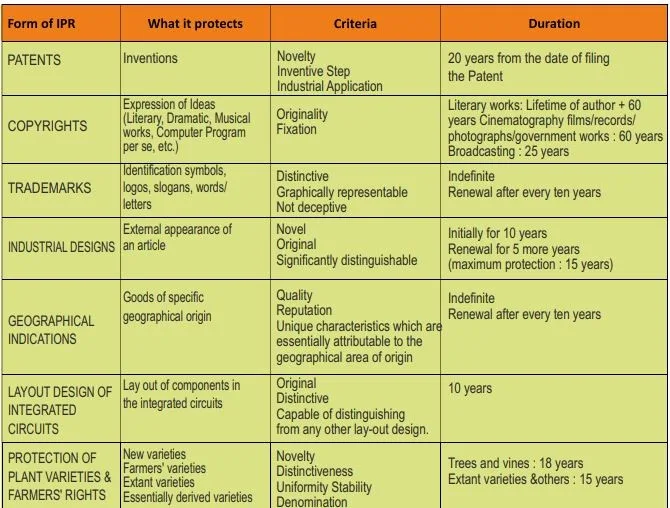
- Forms of IPR : Patents, Copyrights, Trademarks, Industrial Designs, Geographical Indications, Layout Design of Integrated Circuits, Protection of Plant Varieties & Farmers’ Rights, Protection of undisclosed information/ Trade Secrets.
Is an Indian Patent valid in other Countries?
- No. Patent rights are territorial rights, which will be valid within the territory of the Country which has issued Patent.
- Hence, an Indian Patent, which is granted by the Indian Government, will be valid only in India.
| Patent Co-operation Treaty (PCT): – Patent Laws differ from Country to Country and there is nothing like “World Patent” or “International Patent”. However, there is an international filing system known as Patent Cooperation Treaty (PCT) system. – When a PCT application is filed, an inventor of a member country of PCT can simultaneously obtain priority for his/her invention in all the PCT member countries. – India joined PCT in 1998. – All activities related to PCT are coordinated by the World Intellectual Property Organization (WIPO) situated in Geneva. World Intellectual Property Organization (WIPO) – It is a self-funding agency of the United Nations, that serves the world’s innovators and creators, ensuring that their ideas travel safely to the market and improve lives everywhere. – History: WIPO was established in 1967 by the WIPO Convention. – Members: The organization has 193 member states including both developing and developed nations like India, Italy, Israel, Austria, Bhutan, Brazil, China, Cuba, Egypt, Pakistan, the U.S. and the U.K. 1. India joined WIPO in 1975. – Headquarters: Geneva, Switzerland. |
Challenges in India’s IP Regime
- Patent Backlog: Despite increasing filings, patent examination and grant delays remain a significant issue.
- IP Infringement: Weak enforcement mechanisms, leading to rampant counterfeiting and piracy.
- Low Patent Commercialization: Many patents filed in India do not get commercialized due to lack of industry-academia collaboration.
- Global Competitiveness: India’s innovation is dominated by foreign applicants, reflecting low domestic R&D investments.
India’s initiative
- National IPR Policy 2016 encompassing all IPRs into a single vision document setting in place an institutional mechanism for implementation, monitoring and review of IP laws.
- The policy encourages innovation and creativity by providing stronger protection and incentives for inventors, artists, and creators.
- Cell for IPR Promotion and Management (CIPAM): It has been set up to coordinate the implementation of the National IPR Policy.
- National Intellectual Property Awareness Mission (NIPAM), a flagship program to impart IP awareness and basic training in educational institutes.
- Scheme for Facilitating Startups Intellectual Property Protection(SIPP): It is introduced to foster innovation and entrepreneurship by providing a supportive ecosystem for startups to protect and manage their IP assets.
- Atal Innovation Mission (AIM): It was set up by NITI Aayog in 2016 to promote a culture of innovation and entrepreneurship in India. AIM has created four programs to support these functions:
- Atal Tinkering Labs
- Atal Incubation Centers
- Atal New India Challenges and Atal Grand Challenges
- Mentor India.
Concluding remarks
- India’s impressive IP growth, marked by significant advancements in patents, industrial designs, and trademarks, underlines its commitment to fostering innovation and reinforcing its global economic presence.
- This momentum supports India’s broader goals of economic expansion and innovation-driven development.
