
Suspension of the Indus Waters Treaty by India: Implications for Pakistan and India
Syllabus: GS2/International Relations
Context
- Recently, the Cabinet Committee on Security (CCS), chaired by Prime Minister of India, held the Indus Waters Treaty (1960) with Pakistan ‘in abeyance with immediate effect’ in the aftermath of the terror strike in Pahalgam.
| About Cabinet Committee on Security (CCS) – It is the apex decision-making body in India responsible for matters related to national security and defence. – It is chaired by the Prime Minister, it typically includes key ministers such as the Home Minister, Defence Minister, Finance Minister, and External Affairs Minister. – The National Security Advisor (NSA) acts as a secretary-level coordinator for issues within its purview. Key Functions of the CCS – Defence and Security: Addresses internal and external security challenges, including military strategies and intelligence operations. – Foreign Affairs: Deals with diplomatic policies and international security collaborations. – Nuclear and Space Policy: Oversees critical decisions related to nuclear energy and space exploration. – Major Appointments: Approves high-level appointments in defence and intelligence agencies. |
About the Indus Waters Treaty (IWT)
- It was signed in 1960 by India’s Prime Minister Jawaharlal Nehru and Pakistan’s President Ayub Khan to regulate water-sharing between the two countries.
- It was brokered by the World Bank.
- According to IWT:
- India controls the Eastern Rivers (Beas, Ravi, Sutlej).
- Pakistan controls the Western Rivers (Indus, Chenab, Jhelum).
- Under the IWT, India received rights over 20% of the system’s water, while Pakistan received 80%.
- India is allowed limited use of western rivers for non-consumptive purposes like hydropower, but cannot block or significantly alter flows.
Implications for Pakistan of IWT Suspension
- Water Security Threat: Pakistan is highly dependent on the Indus River system for agriculture, drinking water, and hydropower.
- Suspension would leave Pakistan vulnerable to upstream control by India, especially over the eastern rivers (Ravi, Beas, Sutlej), potentially disrupting water availability.
- Agricultural Impact: Punjab and Sindh, the key agricultural regions, rely heavily on Indus waters.
- A reduction or delay in water flows could devastate crop cycles, threatening food security and livelihoods.
- Energy Crisis: A significant portion of Pakistan’s power comes from hydroelectric dams on the Indus.
- Disruption in water flow could reduce energy generation, worsening the power crisis, especially in summer.
- Geopolitical Fallout: Suspension would escalate tensions with India, possibly leading to military posturing, cross-border skirmishes, or further diplomatic isolation.
- International Repercussions: Pakistan could appeal to the UN, World Bank, or ICJ, framing India as violating a binding treaty.
- Suspension may invite international pressure on India to reinstate the treaty, possibly straining India’s global relations.
- Domestic Unrest: Water shortages and crop failures could fuel domestic discontent, protests, and political instability.
- Dependence on China or Other Allies: Pakistan may look for alternative water management partnerships or increase strategic alignment with China.
| Do You Know? – Nearly 25% of Pakistan’s GDP is contributed by the Indus River System. – About 80% of Pakistan’s cultivated land relies on water from the Indus system. – It supports over 237 million people, with Pakistan accounting for 61% of the Indus Basin population. – Major urban centres like Karachi, Lahore, Multan draw their water directly from these rivers. |
Feasibility of Suspension of the IWT by India
- Strategic Leverage: India’s move signals a strong diplomatic stance, reinforcing its position against terrorism.
- It could serve as a negotiation tool to pressure Pakistan into policy changes.
- Treaty Framework and International Law: IWT lacks an exit clause, meaning neither India nor Pakistan can legally abrogate it unilaterally. The Treaty has no end date, and any modification requires the consent of both parties.
| IWT & Dispute Resolution Mechanism – Article IX of IWT, along with Annexures F and G, lays out procedures for raising grievances — first before the Permanent Indus Commission, then a Neutral Expert, and eventually, a Forum of Arbitrators. |
- However, under Article 62 of the Vienna Convention on the Law of Treaties, a fundamental change in circumstances can justify withdrawal.
- The United Nations and World Bank could push for negotiations to prevent regional instability.
- India’s Water Management Challenges: Diverting water from the Western Rivers requires major infrastructure projects, including dams and reservoirs.
- Environmental concerns, such as river ecosystem disruptions, must be addressed.
- Pressure on Pakistan’s Internal Stability: Water scarcity could exacerbate inter-provincial disputes within Pakistan, particularly between Punjab and Sindh.
- Political instability may lead to increased militant activity along the border.
National Panchayati Raj Day
Syllabus: GS2/Polity and Governance
Context
- The Ministry of Panchayati Raj on the occasion of National Panchayati Raj Day 2025, presented the Special Category National Panchayat Awards- 2025.
About
- These awards include the Climate Action Special Panchayat Award (CASPA), Atma Nirbhar Panchayat Special Award (ANPSA), and Panchayat Kshamta Nirman Sarvottam Sansthan Puraskar (PKNSSP).
- The awards aim to recognize Gram Panchayats and institutions that have demonstrated exemplary performance in areas such as climate resilience, fiscal self-reliance, and capacity building.
- Awardees have been selected from States including Bihar, Maharashtra, Odisha, Karnataka, Andhra Pradesh, Telangana, Kerala, and Assam.
National Panchayati Raj Day
- India celebrates National Panchayati Raj Day on April 24 every year to mark the foundation of the Panchayati Raj System, when the Constitution (73rd Amendment) Act, 1992, came into force.
- It celebrates the importance of grassroots democracy, strengthens local governance and helps empower rural communities.
Panchayati Raj System
- The word Panchayat comes from two words – “Panch” meaning five and “Ayat” meaning assembly.
- It refers to a traditional system where a group of elders from a village would come together to solve problems or settle disputes.
- The Balwant Rai Mehta Committee, appointed in 1957, recommended the establishment of the Panchayati Raj system in India.
- The Panchayati Raj system has three levels – Village Panchayat, Panchayat Samiti and Zilla Parishad.
- The Village Panchayat: It has around five members that includes a Sarpanch.
- The Panchayat Samiti: It usually covers 20 to 60 villages. Its head is called the Pradhan and the deputy is the Up-Pradhan.
- The Zilla Parishad: It includes members from Panchayat Samitis and government officials. Its main job is to guide and check the work done in the district.
- The Ministry of Panchayati Raj was created in 2004 which handles all matters related to Panchayati Raj and is led by a cabinet minister.
- Panchayat elections are held every five years to choose new members.
- Reservation: Article 243D of the Constitution provides for reservation of seats in Panchayats for Scheduled Tribes, Scheduled Castes, Backward Class of citizens and women.
Need for the Panchayati Raj Institutions in India
- Decentralization of Power: PRIs bring governance closer to the grassroots level, empowering local communities to take decisions tailored to their specific needs.
- Democratic Participation: Ensures people’s direct involvement in decision-making processes, thereby strengthening democracy at the village level.
- Efficient Implementation of Schemes: Local self-governments can effectively implement and monitor development schemes based on local conditions and requirements.
- Better Utilization of Resources: Local bodies can ensure optimal use of resources like land, water, and manpower due to better understanding of regional dynamics.
- Inclusive Development: Encourages participation from marginalized communities, including women, Scheduled Castes (SCs), and Scheduled Tribes (STs), fostering inclusive growth.
- Employment Generation: Through rural development programs like MGNREGA, PRIs play a critical role in providing employment and reducing rural poverty.
Challenges of Panchayati Raj Institutions
- Lack of Infrastructure and Digital Literacy: Insufficient computer skills hinder efficient working.
- Digital divide limits effective implementation.
- Inadequate Financial Resources: Panchayats often lack adequate funds for development activities, it leads to delays, poor execution, and increased risk of corruption.
- Poor Coordination Among Administrative Bodies: Poor inter-departmental coordination affects developmental work and fund utilization.
- Issues include politicization, inadequate incentives, and bureaucratic inefficiencies.
- Male Dominance in Decision-Making: Women’s political participation is hindered by patriarchal norms.
- Even if elected, women may not have real power due to dominance by male officials.
- Low Literacy and Awareness: Many representatives, especially women, are unaware of their powers and responsibilities due to low education levels.
- The general public, especially at the grassroots, lacks understanding of Panchayati Raj’s role and benefits.
- Irregular Elections and Tenure Issues: Delay in conducting elections affects continuity and planning.
Government Initiatives to Strengthen PRIs
- Rashtriya Gram Swaraj Abhiyan (RGSA): Focuses on strengthening governance capabilities of PRIs.
- Supports training, e-governance, infrastructure, and capacity building.
- e-Panchayat Mission Mode Project: Aims to digitalize Panchayati Raj functioning.
- Provides web-based applications for budgeting, accounting, and planning (like PRIASoft, PlanPlus, etc.).
- Financial Incentives and Performance Grants: States and the Finance Commission provide performance-based grants to reward efficient and transparent PRIs.
- e-Gram Swaraj Portal: Launched in 2020, it provides a unified digital platform for Panchayat planning, accounting, monitoring, and reporting.
- Since 2021, all payments under Central Finance Commission funds are done only online through the eGramSwaraj – PFMS Interface (eGSPI) system.
- Gram Manchitra – Spatial Development Planning: Launched in 2019 as a geospatial platform for evidence-based planning.
Conclusion
- PRIs have played a crucial role in promoting democratic values, inclusive development, and grassroots-level decision-making.
- For PRIs to reach their full potential, sustained efforts are needed to enhance their autonomy, build institutional capacity, ensure adequate funding, and promote active citizen participation.
- Strengthening PRIs is not just about rural governance—it’s a powerful step toward achieving participatory democracy, sustainable development, and an empowered rural India.
India’s DBT System Yields
Syllabus: GS 3/Economy
In News
- India’s Direct Benefit Transfer (DBT) framework is offering valuable insights for governments worldwide revising their social protection systems.
The Direct Benefit Transfer (DBT) system
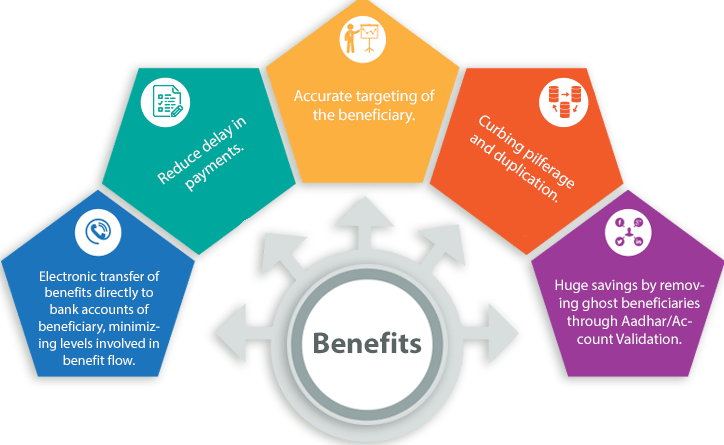
- It was launched on January 1, 2013, to reform government welfare delivery by simplifying processes, ensuring accurate targeting of beneficiaries, reducing fraud, and facilitating faster flow of information and funds.
- The DBT Mission, originally in the Planning Commission, was transferred to the Cabinet Secretariat in 2015 for better coordination.
- Jan Dhan, Aadhaar, and Mobile (JAM) form the backbone of the system, enabling efficient and transparent transfers.
- It aims to ensure maximum governance with minimum government, enhancing transparency and accountability.
- It covers schemes like scholarships, subsidies, wages, pensions, and cash for food grains.
- Its scope continues to grow rapidly with the adoption of new programs and digital technologies under the Digital India Programme.
Progress
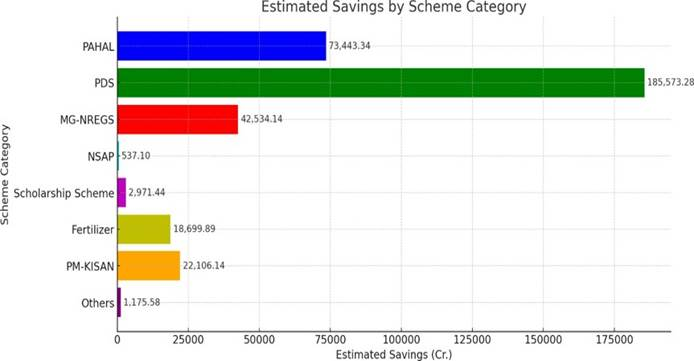
- India’s Direct Benefit Transfer (DBT) system has greatly improved welfare delivery, cutting fiscal leakages by ₹3.48 lakh crore and making subsidies more targeted.
- The rise in the Welfare Efficiency Index (WEI) highlights DBT’s success in optimizing fiscal resources while expanding beneficiary coverage.
- Savings in sectors like food subsidies, MGNREGS, and PM-KISAN demonstrate the effectiveness of Aadhaar and mobile-based transfers in reducing inefficiencies and misuse.
Sectoral Analysis: DBT has particularly benefited high-leakage programme
- Food Subsidies (PDS): ₹1.85 lakh crore saved, accounting for 53% of total DBT savings. This was largely due to Aadhaar-linked ration card authentication.
- MGNREGS: 98% of wages were transferred timely, saving ₹42,534 crore through DBT-driven accountability.
- PM-KISAN: ₹22,106 crore saved by deleting 2.1 crore ineligible beneficiaries from the scheme.
- Fertilizer Subsidies: Sales of 158 lakh MT of fertiliser were reduced, saving ₹18,699.8 crore through targeted disbursement.
- Subsidies dropped from 16% to 9% of government expenditure, while beneficiaries increased from 11 crore to 176 crore.
Challenges
- Issues with identifying real beneficiaries
- Aadhaar mismatches and biometric failures
- Poor banking access and digital infrastructure in rural areas
- Low digital literacy among beneficiaries
- Overlapping and complex subsidy structures
Suggestions and Way Forward
- India’s Direct Benefit Transfer (DBT) system successfully balances fiscal prudence with social inclusion.
- It offers a global model for efficient, transparent, and inclusive welfare delivery, demonstrating how direct transfers can drive both economic and social development.
- However, challenges like beneficiary identification issues, Aadhaar errors, limited banking access in rural areas, and low digital literacy remain.
- To address these, India should focus on improving data accuracy, expanding rural banking, enhancing digital infrastructure, promoting awareness, and customizing DBT models for specific regions.
MeitY Launches ‘I Am Circular’ Coffee Table Book
Syllabus: GS3/Economy
Context
- The Ministry of Electronics and Information Technology (MeitY), hosted the release of the ‘I Am Circular’ Coffee Table Book, curetted by the International Council for Circular Economy (ICCE).
About
- The ‘I Am Circular’ Coffee Table Book features 30 of India’s most promising innovations identified through the nationwide ‘I Am Circular’ Challenge.
- It is an initiative designed to discover and amplify breakthrough solutions rooted in the principles of the circular economy.
| International Council for Circular Economy (ICCE) – It is a non-profit organization launched in 2020 by India. – It is dedicated to promoting and accelerating the transition to a circular economy both nationally and globally. – ICCE acts as a think tank, networking platform, and policy influencer, fostering collaboration across industries, governments, academia, and civil society. |
What is Circular Economy?
- The circular economy (CE) is a model of production that prioritises waste reduction or elimination at all stages of the product life cycle, from raw materials extraction and manufacturing to disposal and reuse.
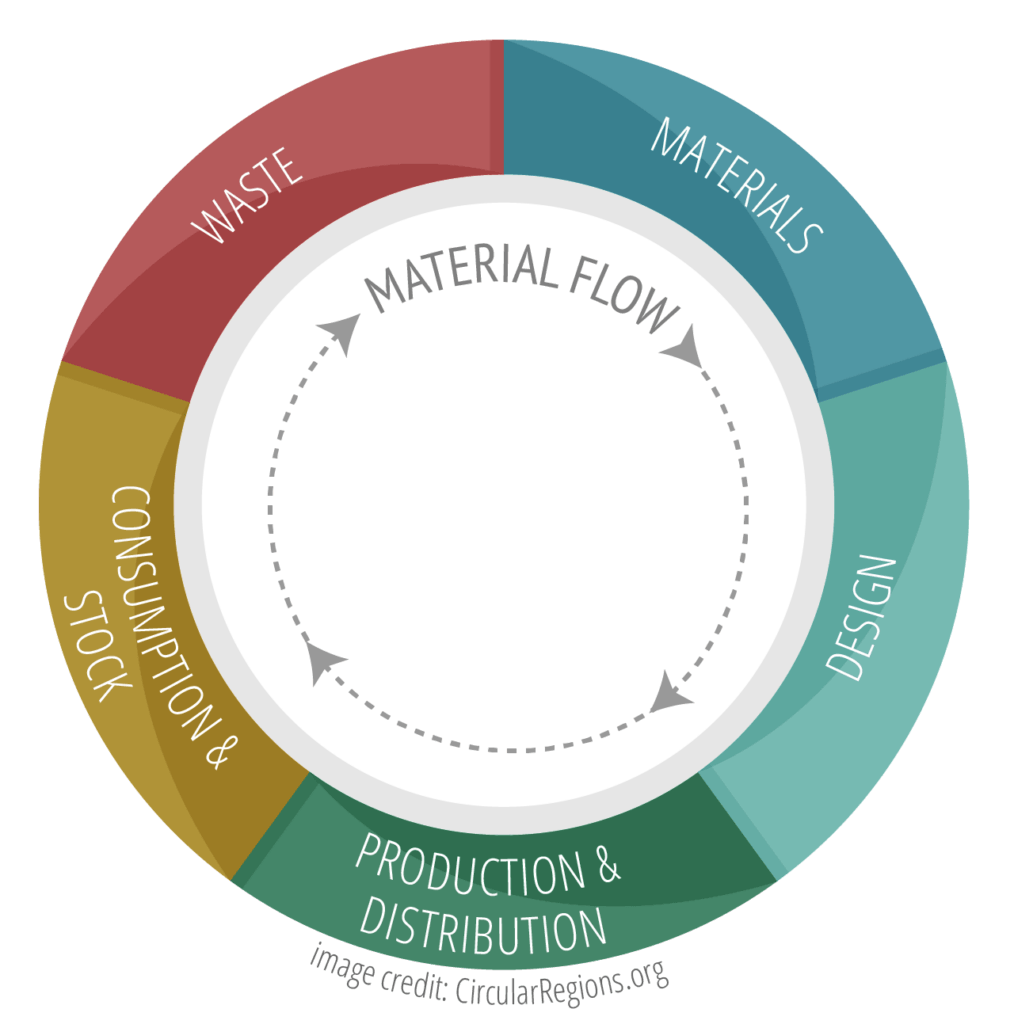
- Core Principles of the Circular Economy:
- Products and systems are designed to reduce or eliminate waste from the beginning.
- Through reuse, repair, remanufacture, and recycling, products are kept in circulation for as long as possible.
- The system supports and restores natural resources rather than depleting them—like composting food waste to enrich soil.
- Benefits:
- Reduces environmental impact and pollution.
- Conserves finite resources.
- Stimulates innovation and new business models.
- Can create new jobs and economic opportunities.
India’s Circular Economy Vision and Potential
- India’s circular economy could generate over $2 trillion in market value and create up to 10 million jobs by 2050.
- Globally, the circular economy could unlock $4.5 trillion in economic output by 2030.
- India has proposed to host the World Circular Economy Forum in 2026. The 2025 forum will be held in São Paulo, Brazil.
Opportunities for India
- High Economic Potential: The growth of India’s circular economy has the potential to drive economic growth, job creation, and innovation focused on sustainability.
- Environmental and Resource Efficiency: It reduces resource extraction and environmental degradation and also aligns with UN Sustainable Development Goals (SDGs), the Paris Agreement, and the UN Decade on Ecosystem Restoration (2021-2030).
- Macro and Industry-Level Gains: Transition to the circular economy will enhance systemic efficiency.
- It will also support government and industry performance in sustainability benchmarks.
Challenges
- Fragmented and Inefficient Waste Infrastructure: India lags behind in capacity across supply chains for waste collection, material recovery, and (re)processing.
- Limited Private Sector Incentives: There is a lack of business incentives for the private sector for moving towards a circular economy.
- Underutilized Informal Sector: Informal waste workers are not integrated into formal systems this leads to inefficiencies, resource leakages, and health risks.
India’s Key Steps and Commitments
- Swachh Bharat Mission (SBM-U): It strengthens urban waste management, under SBM-U, India has achieved 108.62% success in household toilet construction and 80.29% of solid waste in India is being processed successfully.
- GOBAR-Dhan Scheme: Promoting waste-to-wealth initiatives through biogas and organic waste processing.
- This scheme currently covers 67.8% of the total number of districts in India, with 1008 biogas plants being fully operational.
- E-Waste Management Rules (2022): Strengthening circular economy practices in electronic waste disposal.
- For FY 2024-25, the quantity of e-waste collected and recycled stood at 5,82,769 MT and 5,18,240 MT respectively.
- Extended Producer Responsibility (EPR) for Plastic: Encouraging industries to take accountability for plastic waste. India banned single use plastic in 2022.
- Circular Economy Cell (CE Cell) was constituted in NITI Aayog in 2022 as a dedicated unit to work in the area of Circular Economy.
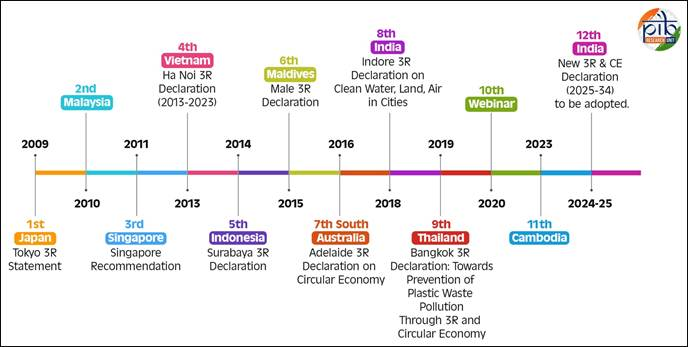
- Regional 3R and Circular Economy Forum in Asia and the Pacific: India is a part of the forum and hosted the 12th Regional 3R and Circular Economy Forum in March 2025.
- It was launched in 2009 to promote sustainable waste management, resource efficiency, and circular economy principles.
Conclusion
- India stands at a critical juncture where the shift from a linear to a circular economy is not just a sustainability imperative but also a powerful economic opportunity.
- With its growing population, rapid urbanization, and rising consumption, embracing circularity can help India reduce environmental degradation, create jobs, and unlock economic value.
- However, this transition demands a comprehensive approach—integrating policy reforms, infrastructure development, technological innovation, and inclusive practices that recognize the role of the informal sector.
IMF Projects India’s Economy to Grow at 6.2% in 2025
Syllabus: GS3/ Economy
Context
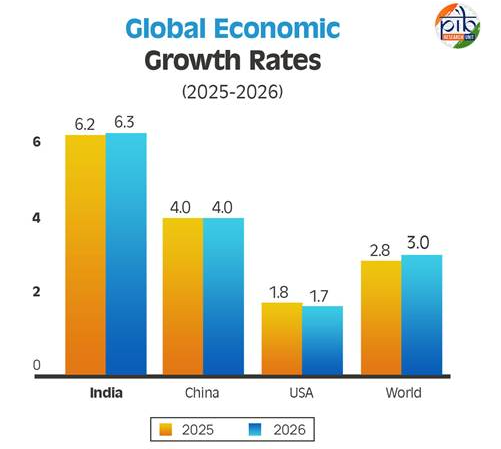
- According to the April 2025 edition of the IMF’s World Economic Outlook, India will remain the fastest growing major economy over the next two years.
World Economic Outlook Report
- The World Economic Outlook (WEO) is the International Monetary Fund’s key report on global economic trends and policy challenges.
- Published twice a year it provides projections for the near and medium term, covering advanced, emerging, and developing economies.
Key highlights
- India’s Growth outlook: India is projected to remain the fastest-growing large economy and is expected to grow by 6.2 percent in 2025 and 6.3 percent in 2026.
- Global Growth outlook: The global economic growth will be much lower, at 2.8 percent in 2025 and 3.0 percent in 2026.
- Emerging Asia: The region is also expected to grow strongly, led by India, but faces downward revisions due to global trade disruptions.
Reasons for slowdown in world economy
- Tariff War 2.0: Since early 2025, new tariffs by the US on imports, coupled with retaliatory measures, have triggered a fresh wave of trade tensions.
- Slowing Consumer Confidence: As new tariffs increase costs and lower disposable incomes, consumer spending has weakened, especially in the US and Europe.
- Inflation: While headline inflation has cooled from its peak, core inflation remains sticky, particularly in services.
- Diminished Policy Space: High public debt and rising interest rates have limited the ability of governments to respond with countercyclical policies.
- Aging populations in countries like Japan, Germany, and China are reducing the available workforce, constraining long-term growth.
Reasons for India’s Resilience
- Domestic Demand: India’s growth remains largely driven by robust domestic consumption and investment, particularly in infrastructure and services.
- This has weakened global investor sentiment, triggered financial market volatility, and elevated policy uncertainty to unprecedented levels
- Structural Strengths:
- A young population and expanding digital economy.
- A growing middle class with increasing consumption power.
- Government-led capex push and PLI schemes that bolster industrial activity.
Way Ahead
- Structural reforms: Durable structural reforms across several areas, including labor markets, education, regulation and competition, and financial sector policies, can jointly lift productivity and potential growth and support job creation.
- Technological Integration: Technological progress, related to digitalization and AI, can enhance productivity and potential growth.
- Fiscal Prudence: Maintaining fiscal sustainability amid high global debt and rising interest rates is critical.
| International Monetary Fund (IMF) – The IMF was established in 1944 in the aftermath of the Great Depression of the 1930s. – The organization is currently composed of 190 member countries. 1. Each member has representation on the IMF’s executive board in proportion to its financial importance. – The primary goal of the IMF back then was to bring about international economic coordination to prevent competing currency devaluation by countries trying to promote their own exports. – Eventually, the IMF evolved to be a lender of last resort to governments of countries that had to deal with severe currency crises. |
